SEBA Class 9 Class 10 Syllabus 2024 Advance Maths
Finished viewing? Save it for later —
Download SEBA Class 9 Class 10 Syllabus 2024 Advance Maths (PDF · 13 pages)About SEBA Class 9 Class 10 Syllabus 2024 Advance Maths
SEBA Class 9 Class 10 Syllabus 2024 Advance Maths is available here for free download. Published by Assam Board for Class 10, this syllabus can be viewed online or downloaded as a PDF (13 pages). Candidates preparing for Class 10 can use SEBA Class 9 Class 10 Syllabus 2024 Advance Maths to understand the exam pattern, the type of questions asked, and the overall difficulty level.
Frequently Asked Questions
How can I download SEBA Class 9 Class 10 Syllabus 2024 Advance Maths?
Open this page and click the Download button to save SEBA Class 9 Class 10 Syllabus 2024 Advance Maths as a PDF. It is completely free on AglaSem Docs.
Is SEBA Class 9 Class 10 Syllabus 2024 Advance Maths free to download?
Yes. SEBA Class 9 Class 10 Syllabus 2024 Advance Maths can be viewed online and downloaded as a PDF free of cost on AglaSem Docs.
How many pages does SEBA Class 9 Class 10 Syllabus 2024 Advance Maths have?
SEBA Class 9 Class 10 Syllabus 2024 Advance Maths contains 13 pages, which you can read online or download together as a single PDF.
Where can I find more Class 10 study material?
You can find more Class 10 question papers, sample papers, syllabus, and answer keys on AglaSem Docs.
SEBA Class 9 Class 10 Syllabus 2024 Advance Maths – Text
Read the full text of this syllabus below — useful to quickly search, copy and reference the content online without downloading the PDF.
📄 View text version (13 pages)
Page 1
SUBJECT CODE - 19
CLASS - IX-X
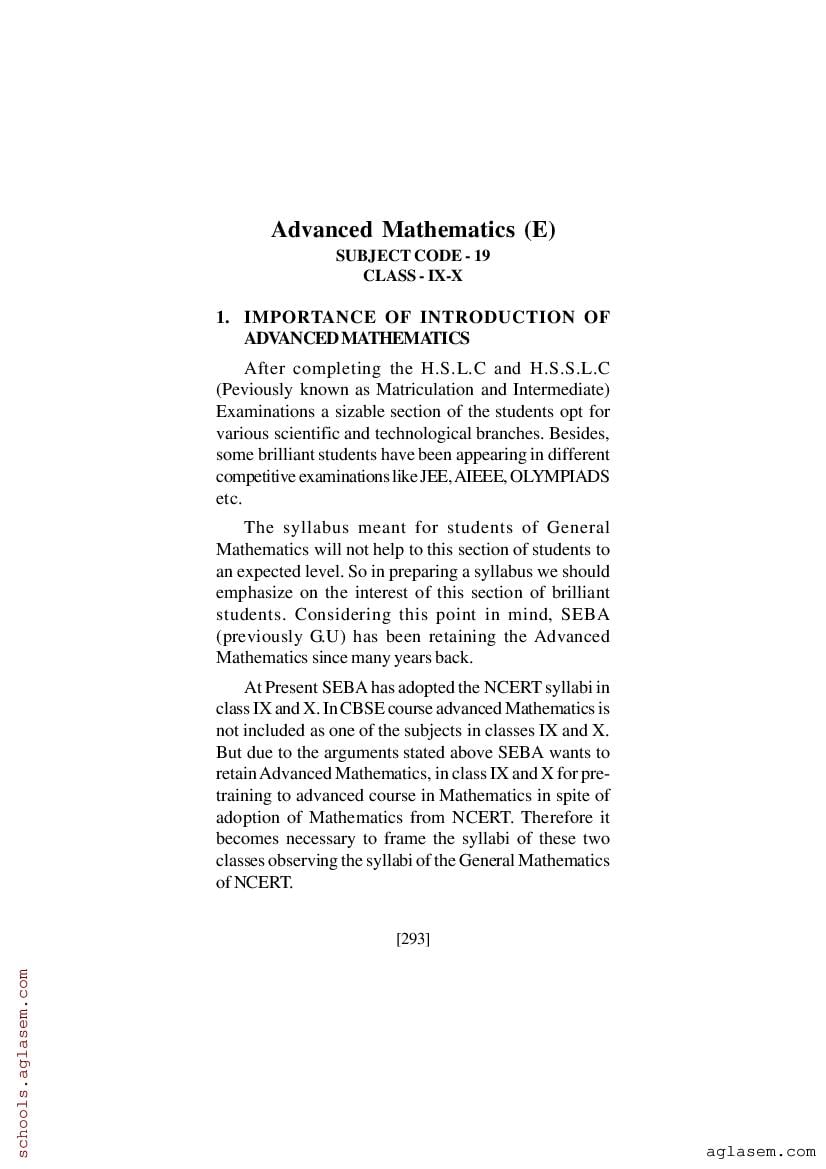
1. IMPORTANCE OF INTRODUCTION OF
ADVANCED MATHEMATICS
After completing the H.S.L.C and H.S.S.L.C
(Peviously known as Matriculation and Intermediate)
Examinations a sizable section of the students opt for
various scientific and technological branches. Besides,
some brilliant students have been appearing in different
competitive examinations like JEE, AIEEE, OLYMPIADS
etc.
The syllabus meant for students of General
Mathematics will not help to this section of students to
an expected level. So in preparing a syllabus we should
emphasize on the interest of this section of brilliant
students. Considering this point in mind, SEBA
(previously G.U) has been retaining the Advanced
Mathematics since many years back.
At Present SEBA has adopted the NCERT syllabi in
class IX and X. In CBSE course advanced Mathematics is
not included as one of the subjects in classes IX and X.
But due to the arguments stated above SEBA wants to
retain Advanced Mathematics, in class IX and X for pre-
training to advanced course in Mathematics in spite of
adoption of Mathematics from NCERT. Therefore it
becomes necessary to frame the syllabi of these two
classes observing the syllabi of the General Mathematics
of NCERT.
[293]
Page 2
Teaching of Advanced Mathematics at the Secondary
School level enables the pupils :
- to develop interest in the study of Mathematics.
- to provide the necessary background for the study of
higher Mathematics.
- to help pupil to think and act logically, to develop
creativity.
- to lay down geater emphasis on the basic concepts,
imagination, reasoning without neglecting the basic
skills.
- to encourage the students to pursue mathematics in
higher studies.
[294]
Page 3
Subject Code : 19
Class : IX Total Marks : 100
Unit- I. System of Numeration :
History of Numeration and numerals, Different systems
of Numerals: Roman and Indo-Arabian. Different
Scales of Numeration with bases 2,8, 10 and 16.
Change of base. Arithmetic of Binary numbers.
Unit- II. Basic Set Theory :
(A) Fundamentals of Statement Algebra
(B) Operations of Sets, Algebra of Sets, Proofs of
Laws of Algebra of Sets.
Unit -III. Logarithm and properties
Unit -IV. Special product and Factorization of :
(i) a3+b3+c3 +3 (b+c) (c+a) (a+b)
(ii) x3+ (a+b+c) x2+ (ab+bc+ab)x + abc
(iii) (a+b+c) (bc+ca+ab) - abc
(iv) a3+b3+c3 - 3abc
(v) a2 (b+c)+b2(c+a)+c2(a+b)+2abc
(vi) bc(b+c)+ca(c+a)+ab (a+b)+2abc
(vii) a(b2+c2) + b(c2+a2) + c(a2+b2)+2abc
(viii) a2(b+c) + b2(c+a) + c2(a+b)+3abc
(ix) bc(b+c) +ca (c+a) +ab (a+b)+3abc
(x) a(b2+c2) + b(c2+a2) +c (a2+b2)+3abc
(xi) a2(b-c) + b2(c-a) + c2(a-b)
(xii) bc (b-c) + ca(c-a) + ab(a-b)
[295]
Page 4
(xiv) a3(b2-c2) + b3 (c2-a2) + c3 (a2-b2)
Unit V : Concept of inequalities, Tricnotomy property
(Order relation in R) Elementary properties of
inequalities, Simple applications) Inequations and
solutions of inequations in two variables, Graphs
of inequations (simple cases).
Unit VI : Sequence and series :
(A) Idea of a sequence of numbers -
(B) Arithmetic Progression (AP)-
AP as a special kind of a sequence, General
term of an AP, to find an AP having given any
two terms of it. If each term of an AP is
increased or decresed or multiplied or divided
by the same number then the resulting
sequence is also an AP, Arithmetic mean
(A.M.), insertion of any number of AM between
two given positive numbers,Arithmetic series and
its sum to n terms and related problems.
(C) Geometric Progression (GP)-
GP as a special kind of sequence and its general
terms; to find a GP having given any two terms
of it. If each term of GP is multiplied or divided
by the same number the resulting sequence is also
a GP. Geometric mean (G.M), insert any number
of GM between any two given positive numbers.
To prove the relation AM>GM in case of any
positive real numbers. Geometric series and its
sum to n terms and related problems.
(D) Sum of the three series
i) 1 +2+3+ ...................................... + n
[296]
Page 5
iii) 13+23+33+ ................................... + n3
Unit VII : Plane Geometry
Proofs of the following theorems and exercises
on the theorems.
1. The Perpendicular bisectors of the sides of a triangle are
concurrent.
2. The internal bisectors of the angles of a triangle are concur-
rent
3. The perpendiculars drawn from the vertices of a triangle to
the opposite sides are concurrent.
4. The medians of a triangle are concurrent.
Unit VIII : Some special Geometrical Constructions :
(1) Construction of a triangle given its two sides and a median
correcponding to these sides.
(2) (i) Construct a triangle with given Perimeter and the two
suitable base angles.
(ii) Construct a triangle with given (unequal) medians.
(iv) Draw a square equal in area to a given rectangle.
(v) Draw a rectangle having given one side and a diagonal.
(vi) Draw a regular polygon in a given circle.
3) Construction of figures (Triangles, quadrilaterals) similar to
the given figure as per the given scale factor.
4) Construction of circumcircle and incircle.
[297]
Page 6
ADVANCED MATHEMATICS (E)
Subject Code : 19
Class: IX
1. Project: Different systems of numerations.
2. If P and Q are any two statements then form any five
tautology (or formula).
3. Using Venn diagram, verify the following properties of sets.
i) Associative laws. ii) Distributive laws.
iii) De-Morgan’s laws. iv) Difference laws.
4. Using log tables find the value.
(4.56)4 (32.4)15
i) 7 ii)10th root of 0.0004296
(11.529) 4 (6.9642)3
Teachers are requested not to provide the same problem
(question) to all the students. They are, requested to create
similar questions, at least 15-20 so that each student gets
different question.
5. Pascal triangle and its application to find the coefficients in
the expansion of (a+b)n, n=4, 5, 6, 7, 8, 9, 10
6. Solve graphically the following system of linear inequations.
2x-3y+6>0 ; 3x+5y < 15 ; y> 1 ; x>0
Note: Teachers are requested not provide the same pair of
linear inequations to the all students.
7. Verification of the following formulae
i) Sum of first n terms of an AP
n(n+1)
ii) 1 +2+3+ ......+ n =
2
[298]
Page 7
iv) 2+4+6+8 ....... +2n= n(n+l)
8. (a) To verify that the perpendicular bisector of the sides of
any triangle are concurrent
(b) To verify that the angle bisectors of a triangle are con-
current.
(c) To verify that the altitudes of a triangle are concurrent.
(d) To verify that the medians of a triangle are concurrent.
9. Find the positions of Circumcentre, Incentre, Orthocentre
and Centroid of a given triangle.
10. Construct a triangle when the medians are given and hence
verify that the centroid divides a median in the ratio 2: 1.
N.B. : Students have to do atleast 8 practicals.
[299]
Page 8
Subject Code : 19
Class - IX Time : 3 hours
Full Marks : 100 Pass Marks : 30
Internal Assessment : 10
Pass marks in written examination : 27
Marks
Sl. No. LESSONS Half
Annual
Yearly
1. System of Numeration 15 10
2. Sets 20 12
3. Logarithm 20 12
4. Special products and 20 12
Factorisation
5. Inequalities 12
6. Sequence and Series 14
7. Plane Geometry 15 10
8. Some Special Geometrical 08
Constructions
Total 90 90
9. Internal Assessment 10 10
Grand Total 100 100
Textbook: Uccha Ganit
The Assam State Textbook Production and
Publication Corporation Limited, Guwahati-1
[300]
Page 9
Subject Code : 19
For Class - X Total Marks - 100
Unit-1. Set
Algebra of sets :
Proofs of laws of Algebra of sets. Derivation of n(A∪ B)=
n (A) + n (B) - n (A ∩ B). Relation as subset of Cartesian
product, function. Concepts of reflexive, symmetric and transi-
tive relation. Equivalence relation.
Unit 2 : Complex Number :
1. Introduction to imaginary numbers.
2. Complex number, as an ordered pair of real numbers.
3. Operations of complex numbers.
4. Properties of complex numbers.
5. Diagramatic representation of a complex number in a plane.
6. Conjugate complex number, properties of conjugate com-
plex numbers.
7. Modulus of complex number and properties.
8. Argument of a complex number and properties.
9. Representation of complex number in (r, θ) form
10. In a quadratic equation, complex roots occur in conjugate
pair (without proof).
11. Square root of complex number.
Unit -3 : Arithmetic of integers :
Method of induction (Statement only) and simple
applications. Divisibility of Integers : Division algorithm,
Greatest Common Divisor (GCD), simple peoperties of
[301]
Page 10
If d is the GCD of two integers a and b then there exist
integers x and y such that d = ax+by.
Least common multiple (LCM) of integers. Theorem on
GCD & LCM, Calculation of GCD of two integers by
Euclid’s Algorithm. Prime numbers, composite numbers
perfect number, reletive prime nos. congruence of integers
modulo, properties of modular congruence.
Unit - 4 : Quadratic equation :
Formation of quadratic equation from roots, equations
reducible to Quadratic equation. Application problems
involving quadratic equation. Simultaneous equations in two
variables - one linear and other quadratic.
Unit - 5 : Application of Common Logarithm :
Characteristic and Mantissa. Use of Log table in numerical
calculations.
Unit -6 : Permutation & Combination :
Combination and Permutation of distinct objects only.
Symbols nCr and n Pr with proofs. Restricted permutations
and combinations, applications in simple problems.
Unit -7 : Plane Trigonometry :
Trigonometric ratios for
angles θ, 900 ± θ, 1800 ± θ,2700 ± θ, 3600 ± θ.
Trigonometric ratios of compound angles : Formula for sin
(A ± B), cos (A ± B), tan (A ± B), (Idea of multiple
angles and with simple application excluding identities)
Unit -8 : Plane Geometry :
Proofs of the following theorems and exercises on them :
(i) The angles made by a tangent to a circle with a chord drawn
from point of contact are respectively equal to the angles in
the alternate segments of the circle.
(ii) If two chords of a circle cut at a point within or outside it,
[302]
Page 11
(iii) If a straight line drawn from an external point P intersects a
circle at A and B and a straight line drawn from P touches
the circle at T then PA. PB = PT2.
(iv) The internal bisector of an angle of a triangle divides the
opposite side internally in the ratio of the sides containing
the angle. (The corresponding theorem about an external
bisector should be given as an exercise).
(v) If the vertical angle of a triangle is bisected by a straight line
which cuts the base, the rectangle contained by the sides of
the triangle is equal to the rectangle contained by the segment
of the base, together with the square on the straight line
which bisects the angle.
(vi) The rectangle contained by the diagonals of a quadrilateral
inscribed in a circle is equal to the sum of the two rectangles
contained by the opposite sides.
Unit -9 : Co-ordinate Geometry : Straight line :
Every first degree equation in x and y represents a straight
line. Equation of straight line in gradient form, intercept form
and normal form, passing through two points. Angle between
two straight lines and condition of perpendicularity and
parallelism.
[303]
Page 12
ADVANCED MATHEMATICS (E)
Subject Code - 19, Class - X
1. Graph of Relations
2. Plotting complex numbers on Argand plane and to verify-
i) Whether the points are concyclic or not.
ii) Whether the points are collinear or not.
3. Geometrical representation of
i) Addition of complex numbers.
ii) Subraction of complex numbers.
4. To find the prime numbers between 1 and 1000.
5. To draw the graph of quadratic polynomial p(x) and find
the roots of the equation p(x)=0 (same polynomial should
not be given to all the students)
6. Find the values using log table.
(4.21)8 (7.294)9
235
315
i ) 11 (ii ) 5 6
(16.529)10 (234.1)7 2 7
Teachers are requested not to provide the same problem
(question) to all the students. They are requested to create
similar question at least 15-20 so that each student gets
different question.
7. Verification of fundamental principle of counting.
8. Draw the graph of y = sin x and y = cos x.
9. To draw a straight line when its slope and a point on it are given.
10. Verify the following theorems
i) Tangents drawn to a circle from an external point are
equal in length.
ii) Alternate segment theorem.
iii) Theorems on area of rectangle related to circles.
N.B. : Students have to do atleast 8 (eight) practicals.
[304]
Page 13
Subject Code : 19
Class-X Time : 3 hours
Full Marks : 100 Pass Marks : 30
Internal Assessment : 10
Pass marks in written examination : 27
Marks
Sl. No. LESSONS Half
Final
Yearly
1. Sets 18 10
2. Complex Numbers 20 12
3. Arithmetic of Integers 20 12
4. Quadratic Equation 20 10
5. Applications of Common 12 5
Logarithm
6. Permutation and Combination 9
7. Trigonometry 10
8. Plane Geometry 12
9. Co-ordinate Geometry 10
Total 90 90
10. Internal Assessment 10 10
Grand Total 100 100
Textbook: New Advanced Mathematics
The Assam State Textbook Production and
Publication Corporation Limited, Guwahati-1
[305]
Document Details
| Board / Org | Assam Board |
| Exam | Class 10 |
| Type | Syllabus |
| Pages | 13 |
| Updated | 22 Jul 2026 |