Goa Board Class 9 Sample Paper 2026 Science (E)
Finished viewing? Save it for later —
Download Goa Board Class 9 Sample Paper 2026 Science (E) (PDF · 49 pages)About Goa Board Class 9 Sample Paper 2026 Science (E)
Goa Board Class 9 Sample Paper 2026 Science (E) is available here for free download. Published by Goa Board for Class 9, this sample paper can be viewed online or downloaded as a PDF (49 pages). Candidates preparing for Class 9 can use Goa Board Class 9 Sample Paper 2026 Science (E) to understand the exam pattern, the type of questions asked, and the overall difficulty level.
Frequently Asked Questions
How can I download Goa Board Class 9 Sample Paper 2026 Science (E)?
Open this page and click the Download button to save Goa Board Class 9 Sample Paper 2026 Science (E) as a PDF. It is completely free on AglaSem Docs.
Is Goa Board Class 9 Sample Paper 2026 Science (E) free to download?
Yes. Goa Board Class 9 Sample Paper 2026 Science (E) can be viewed online and downloaded as a PDF free of cost on AglaSem Docs.
How many pages does Goa Board Class 9 Sample Paper 2026 Science (E) have?
Goa Board Class 9 Sample Paper 2026 Science (E) contains 49 pages, which you can read online or download together as a single PDF.
Where can I find more Class 9 study material?
You can find more Class 9 question papers, sample papers, syllabus, and answer keys on AglaSem Docs.
Goa Board Class 9 Sample Paper 2026 Science (E) – Text
Read the full text of this sample paper below — useful to quickly search, copy and reference the content online without downloading the PDF.
📄 View text version (40 pages)
Page 4
Subject: Science SEMESTER I Grade: 9
Time: 3 hours. YEAR: 2025-26 Max. Marks: 70
--------------------------------------------------------------------------------- The
weightage or the distribution of marks over different dimensions of the
question paper shall be as follows:
1. Weightage to Learning Outcomes:
Sr.No Learning Outcomes Marks Percentage of Marks
1. Knowledge 21 30%
2. Understanding 21 30%
3. Application 17 24%
4. Analysis 04 06%
5. Evaluation 04 06%
6. Creativity 03 04 %
Total 70 100%
2. Weightage to Content/Subject Units:
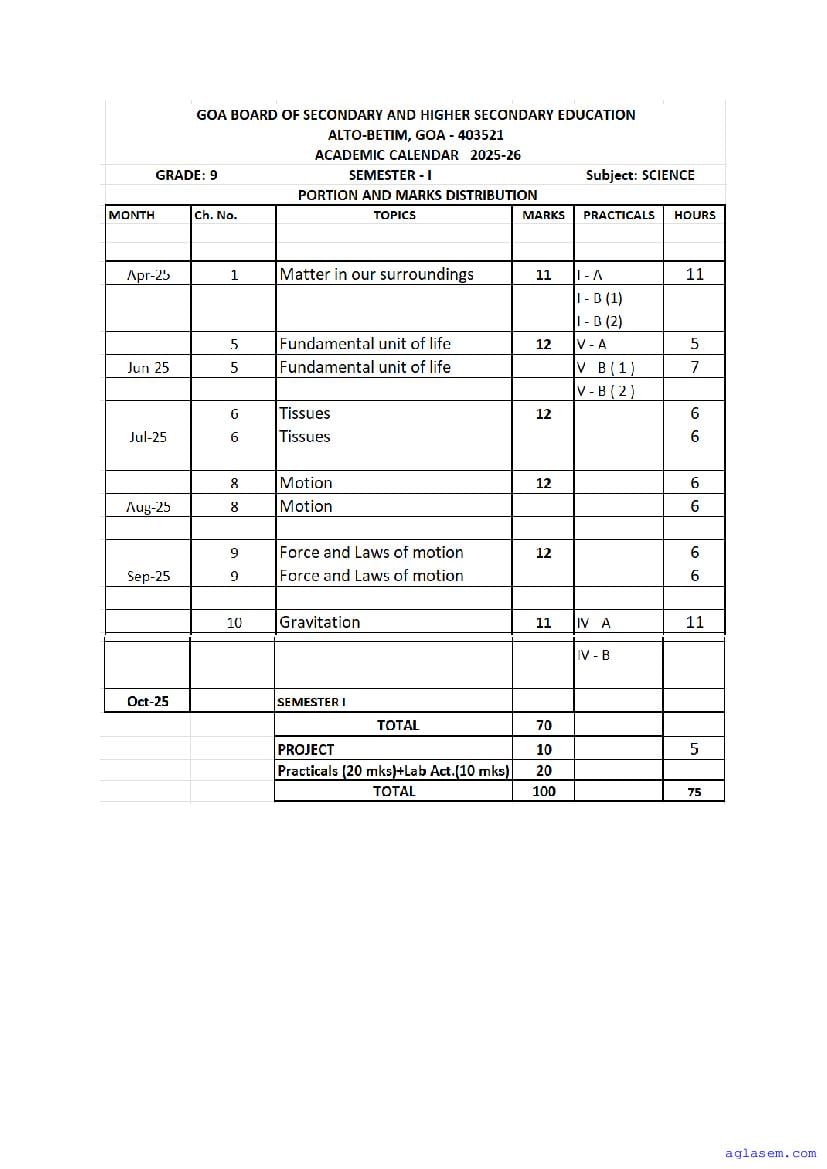
Ch. Units Marks Deletions
No.
(Flexibility of + 1
marks is permitted
for each topic,
while ensuring that
the total marks
overall remain
within 70 )
1 Matter in our 11 No Deletions
Surroundings
5 The fundamental unit of 12 No Deletions
life
6 Tissues 12 No Deletions
8 Motion 12 No Deletions
Page 5
motion
10 Gravitation 11 No Deletions
Total 70
3. Weightage to Forms of Questions:
Sr.No. Form of Questions Marks for Number of Total
each question questions Marks
1. Long Answer Type (LA) 4 03 12
2. Short Answer Type (SA-II) 3 04 12
3. Short Answer Type (SA-I) 2 14 28
4. Very Short Answer Type (VSA) 1 18 18
Total 39 70
4. The expected time for different types of question would be as
follows:
S.No. Form of Questions Approx. time Number of Approx. time
for each questions for each form
Question in (n) of Questions
mints (t) in mints (n x t)
1 Long Answer Type (LA) 12 03 36
2 Short Answer Type (SA-II) 7.5 04 30
3 Short Answer Type (SA-I) 05 14 60
4 Very Short Answer Type (VSA) 03 18 54
Total 39 180
As the total time is calculated on the basis of the number of questions required to be
answered and the length of their anticipated answers, it would, therefore, be advisable
for the candidates to budget their time properly by cutting out the superfluous words
and be within the expected time limits.
5. Scheme of Options
(There will be no overall choice, however, there is an internal choice in some
questions.)
Page 6
S.No. Estimated difficulty level of question Percentage
1 Easy 20%
2 Average 60%
3 Difficult 20%
A question may vary in difficulty level from individual to individual, As such, the
assessment in respect of each question will be made by the paper setter on the basis
of general anticipation from the group as a whole taking the examination. This
provision is only to make the paper balanced in its weightage, rather than to
determine the pattern of marking at any stage.
7. Number of Questions:
It has been decided to introduce serial wise question number and to do away with
sub-question among the questions.
Page 7
SEMESTER II
Subject: Science GRADE: 9 Time: 3 hours.
YEAR: 2025-26 Max. Marks: 70
--------------------------------------------------------------------------------------------------------
The weightage or the distribution of marks over different dimensions of the
question paper shall be as follows:
1. Weightage to Learning Outcomes :
Sr.No Learning Outcomes Marks Percentage of Marks
1. Knowledge 21 30%
2. Understanding 21 30%
3. Application 17 24%
4. Analysis 04 06%
5. Evaluation 04 06%
6. Creativity 03 04%
Total 70 100%
2. Weightage to Content/Subject Units:
Ch. Units Marks Deletions
No.
(Flexibility of + 1
marks is permitted for
each topic, while
ensuring that the total
marks overall remain
within 70)
2 Is matter around us 11 No deletion
pure
3 Atoms and Molecules 12 No Deletions
Page 8
11 Work and Energy 12 No Deletions
12 Sound 12 No Deletions
14 Improvement in food No Deletions
resources 11
Total 70
3. Weightage to Forms of Questions:
Sr.No. Form of Questions Marks for Number of Total
each question questions Marks
1. Long Answer Type (LA) 4 03 12
2. Short Answer Type (SA-II) 3 04 12
3. Short Answer Type (SA-I) 2 14 28
4. Very Short Answer Type (VSA) 1 18 18
Total 39 70
4.The expected time for different types of question would be as follows :
S.No. Form of Questions Approx. time Number of Approx. time
for each questions for each form
Question in of Questions
(n)
mins (t) in mins (n x t)
1 Long Answer Type (LA) 12 03 36
2 Short Answer Type (SA-II) 7.5 04 30
3 Short Answer Type (SA-I) 05 14 60
4 Very Short Answer Type (VSA) 03 18 54
Total 180
As the total time is calculated on the basis of the number of questions required to be
answered and the length of their anticipated answers, it would, therefore, be advisable
for the candidates to budget their time properly by cutting out the superfluous words
and be within the expected time limits.
Page 9
(There will be no overall choice, however, there is an internal choice in some
questions.)
6. Weightage to Difficulty level of questions:
S.No. Estimated difficulty level of question Percentage
1 Easy 20%
2 Average 60%
3 Difficult 20%
A question may vary in difficulty level from individual to individual, As such, the
assessment in respect of each question will be made by the paper setter on the basis
of general anticipation from the group as a whole taking the examination. This
provision is only to make the paper balanced in its weightage, rather than to determine
the pattern of marking at any stage.
7. Number of Questions:
It has been decided to introduce serial wise question number and to do away with
sub-question among the questions.
Page 15
CG-1 Explores the world of matter, C-1.1 Describes classification of
its interactions, and properties at the elements in the Periodic Table, and
atomic level. explains how compounds (including
carbon compounds) are formed based
on atomic structure (Bohr's model)
and properties (valency)
C-1.2 Investigates the nature and
properties of chemical substances
(distillation, crystallisation,
chromatography, centrifugation, types
and properties of mixtures, solutions,
colloids, and suspensions)
C-1.3 Describes and represents
chemical interactions and changes
using symbols and chemical
equations (acid and base, metal, and
non-metal, reversible, and
irreversible)
CG-2 Explores the physical world C-2.1 Applies Newton's laws to
around them, and understands explain the effect of forces (change in
scientific principles and laws based state of motion - displacement and
on observations and analysis. direction, velocity and acceleration,
uniform circular motion, acceleration
due to gravity) and analyses graphical
and mathematical representations of
motion in one dimension
C-2.2 Explains the relationship
between mass and weight using
universal law of gravitation and
connect it to laws of motion
C-2.3 Manipulates the position of
object and properties of lenses (focus,
centre of curvature) to observe image
characteristics and correspondence
with a ray diagram, and extends this
understanding to a combination of
lenses (telescope, microscope)
C-2.4 Manipulates and analyses
different characteristics of the circuit
(current, voltage, resistance) and
Page 16
(Ohm's law), and applies it to
everyday usage (electricity bill, short
circuit, safety measures)
C-2.5 Defines work in scientific
terms, and represents the relationship
between potential and kinetic energy
(conservation of energy) in
mathematical expressions
C-2.6 Demonstrates the principle of
mechanical advantage by constructing
simple machines (system of levers
and pulleys)
C-2.7 Describes the origin and
properties of sound (wavelength,
frequency, amplitude) and differences
in what we hear as it propagates
through different instruments
CG-3 Explores the structure and C-3.1 Explains the role of cellular
function of the living world at the components (nucleus, mitochondria,
cellular level endoplasmic reticulum, vacuoles,
chloroplast, cell wall), including the
semi-permeability of cell membrane
in making cell the structural basis of
living organisms and functional basis
of life processes
C-3.2 Analyses similarities and
differences in the life processes
involved in nutrition (photosynthesis
in plants; absorption of nutrients in
fungi; digestion in animals), transport
(transport of water in plants;
circulation in animals), exchange of
materials (respiration and excretion),
and reproduction
C-3-3 Describes mechanisms of
heredity (in terms of DNA, genes,
chromosomes) and variation (as
changes in the sequence of DNA)
CG-4 Explores interconnectedness C-4.1 Applies the knowledge of
between organisms and their cellular diversity in organisms along
environment with the ecological role organisms
play (autotrophic/heterotrophic
Page 17
kingdoms
C-4.2 Illustrates different levels of
organisations of living organisms
(from molecules to organisms)
C-4.3 Analyses different levels of
biological organisation from
organisms to ecosystems and biomes
along with interactions that take place
at each level
C-4.4 Analyses patterns of
inheritance of traits in terms of
Mendel's laws and its consequences at
a population level (using models
and/or simulations)
C-4.5 Analyses evidences of
biological evolution demonstrating
the consequences of the process of
natural selection in terms of changes -
in allele frequency in population,
structure, and function of organisms
CG-5 Draws linkages between C-5.1 Explores how literature and the
scientific knowledge and knowledge arts have influenced Science
across other curricular areas C-5.2 Examines a case study related
to the use of Science in human life
from the perspective of Social
Sciences and ethics (e.g., Marie
Curie, Jenner, treatment of patients
with mental illness, the story of the
atomic bomb, green revolution and
GMOs, conservation of biodiversity)
C-5.3 Applies scientific principles to
explain phenomena in other subjects
(sound pitch, octave, and amplitude in
music; use of muscles in dance form
and sports)
CG-6 Understands and appreciates C-6.1 Knows and explains the
the contribution of India through significant contributions of India to
history and the present times to the all matters (concepts, explanations,
overall field of Science, including the methods) that are studied within the
disciplines that constitute it curriculum in an integrated manner
CG-7 Develops awareness of the C-7.1 States concepts that represent
most current discoveries, ideas, and the most current understanding of the
Page 18
knowledge in order to appreciate that mere familiarity to conceptual
Science is ever evolving, and that understanding of the matter as
there are still many unanswered appropriate to the developmental
questions stage of the students
C-7.2 States questions related to
matters in the curriculum for which
current scientific understanding is
well-recognised to be inadequate
CG-8 C-8.1 Develops accurate and
Explores the nature of Science by appropriate models (including
doing Science geometric, mathematical, graphical)
to represent real-life events and
phenomena using scientific principles
and use these models to manipulate
variables and predict results
C-8.2 Designs and implements a plan
for scientific inquiry (formulates
hypotheses, makes predictions,
identifies variables, accurately uses
scientific instruments, --in represents
data primary and secondary multiple
modes, draws inferences based on
data and understanding of scientific
concepts, theories, laws, and
principles, communicates findings
using scientific terminology)
Grade 9 science
Learning Outcomes
The learner—
LO1: differentiates materials, objects, organisms, phenomena, and
processes, based on properties or characteristics, such as, prokaryotes and
eukaryotes, plant cell and animal cell, diffusion and osmosis, simple and
complex tissues, distance and displacement, speed and velocity, balanced and
unbalanced forces, elements, compound and mixture, solution, suspension and
colloid, isobars and isotopes, etc.
LO2: Classifies materials, objects, organisms, phenomena, and processes,
based on properties or characteristics, classification of plants and animals
Page 19
classification of matter, based on their states, ( solid / liquid / gas ) and
composition ( Elemen / compound /mixtures ), etc.
LO3: plans and conducts investigations or experiments to arrive at and
verify the facts, principles, phenomena or to seek answers to queries on
their own, such as, how does speed of an object change? How do an objects
float / sink when placed on the surface of a liquid? Is there any change in mass
when chemical reaction takes place? What is the effect of heat on the state of
substances? What is the effect of compression on different states of matter?
Where are stomata present in different types of leaves? Where are growing
tissues present in plants?
LO4: relates processes and phenomena with causes and effects, such as,
symptoms with diseases and causal agents, tissues with their functions,
production with use of fertilisers, process of evaporation with cooling effect,
various processes of separation with the physical and chemical properties of the
substances, production of sound with vibrations of source, etc.
LO5: explains processes and phenomena, such as, functions of different
organelles, spread of diseases and their prevention, effect of force on the state of
motion of objects, action and reaction, rotation and revolution of planets and
satellites, conservation laws, principle of separation of different gases from air,
melting, boiling, freezing, how bats use ultrasonic waves to catch prey, etc.
LO6: calculates using the data given, such as, distance, velocity, speed,
frequency, work done, number of moles in a given mass of substance,
concentration of solution in terms of mass by mass percentage of substances,
conversion of Celsius scale to Kelvin scale and vice versa, number of neutrons
in an atom from atomic number and mass number, speed of sound, kinetic and
potential energies of an object, boiling points of liquids to predict the order of
their separation from the mixture, etc.
LO7: draws labelled diagrams, flow charts, concept maps, graphs, such as,
biogeochemical cycles, cell organelles and tissues, human ear, distance-time and
speed-time graphs, distribution of electrons in different orbits in an atom,
process of distillation and sublimation, etc.
LO8: analyses and interprets graphs, and figures, such as, distance-time and
velocity-time graphs, computing distance, speed, acceleration of objects in
motion, properties of components of a mixture to identify the appropriate
method of separation, crop yield after use of fertilisers, etc.
Page 20
various quantities, elements, and units, such as, SI units, symbols of
elements, formulae of simple compounds, chemical equations, etc.
LO10: measures physical quantities using appropriate apparatus,
instruments, and devices, such as, weight and mass of an object using spring
balance, mass using a physical balance, time period of a simple pendulum,
volume of liquid using measuring cylinder, temperature using thermometer, etc.
LO11: applies learning to hypothetical situations, such as, weight of an
object at moon, weight of an object at equator and poles, possibility of life on
other planets, etc.
LO12: applies scientific concepts in daily life and solving problems, such as,
separation of mixtures, uses safety belts in automobiles, covers walls of large
rooms with sound absorbent material, follows intercropping and crop rotation,
takes preventive measures to control disease causing agents, etc.
LO13: derives formulae, equations, and laws, such as, mathematical
expressions for Newton’s second law of motion, law of conservation of
momentum, expression for force of gravity, equations of motion from velocity-
time graphs, etc.
LO14: draws conclusion, such as, classification of life forms, is related to
evolution, deficiency of nutrients affects, physiological processes in plants,
matter is made up of particles, elements, combine chemically in a fixed ratio to
form compounds, effect of action and reaction on two different bodies, etc.
LO15: describes scientific discoveries, and inventions, such as, discovery
of various atomic models, discovery of cell with invention of microscope,
experiments of Lavoisier and Priestley, beliefs regarding motion, discovery of
real cause for peptic ulcers, Archimedes principle, classification of living things,
etc.
LO16: designs models using eco-friendly resources, such as, 3D model of a
cell, water purification system, stethoscope, etc.
LO17: exhibits values of objectivity, honesty, rational thinking, freedom
from myths, superstitious beliefs while taking decisions, respect for life,
etc., such as, records and reports experimental data exactly, myth that sexually
transmitted diseases are spread by casual physical contact, belief that
vaccination is not important for prevention of diseases, etc.
Page 21
derived from experiments, activities, and projects both in oral and written
form using appropriate figures and tables graphs, and digital forms, etc.
LO19: applies the interdependency and interrelationship in the biotic and
abiotic factors of environment to promote conservation of environment,
such as, organic farming, waste management, etc.
GRADE 9 SCIENCE
Suggested Pedagogical Processes
The learners may be provided with opportunities individually or in groups
and encouraged to—
PP1: observe, group or classify materials, such as mixtures, based on their
properties, viz. solubility, passage of light, etc., by performing various
activities. Based on the observations, a discussion may be facilitated to help
arrive at the appropriate conclusions. Students with visual impairment or low
vision may be motivated to observe solubility of the materials by touching the
materials. (Caution should be taken while using the materials.)
PP2: design and carry out activities. For example, Tug of war to
understand balanced and unbalanced forces. They may be encouraged to
experiment by applying forces (equal and unequal) on an object in same and
opposite directions, followed by peer group discussion to generalise.
PP3: study the daily life experiences, using interdisciplinary approach such
as the cause behind cooling of water in earthen pots. They may be
encouraged to measure and compare the temperatures of water both in earthen
pot and metal containers, thereby helping them to relate process of evaporation
with cooling effect. Students with visual impairment or low vision may be
encouraged to feel the difference in temperature by touching the surface of the
containers.
PP4: conduct survey to understand the process of spreading of diseases.
They may be encouraged to collect data from doctors and nurses about various
diseases. They can prepare a report on spread, causes, prevention, and cure of
diseases. They may share their findings with the community through role plays,
skits and also campaign for prevention.
PP5: present their observations/ ideas/ learning through flow charts/
concept maps/ graphs and ICT tools.
Page 22
distance, displacement, velocity, which can be shared and discussed in groups
or with peers. Rubrics can be used to assess the conversion of units and
reporting results.
PP7: collect and analyse wide variety of graphs from newspapers,
magazines or the internet. They may be encouraged to draw, analyse and
interpret the graphs
(for example, distance – time graph, speed - draw, analyse and interpret the
graphs time, or acceleration-time graphs of motion of a vehicle on a straight
road)
PP8: write chemical formulae of simple compounds, chemical equations,
etc., using play way methods such as a game of cards.
PP9: select and use appropriate devices for measuring physical quantities.
They may be encouraged to find the minimum and maximum value that can be
measured by an instrument and note down the readings correctly.
PP10: collect information from books, e-books, magazines, internet, etc., to
appreciate the efforts of scientists made over time, for example, various models
of atoms, discovery of microscope, etc., and showcase it in the form of a
project or role play.
PP11: observe various technological devices and innovative exhibits such as
waste management kits, water filtration system, using low-cost or no-cost eco-
friendly materials, develop them and showcase it in science exhibitions, clubs
and parent-teacher meets.
PP12: share and discuss their beliefs and views regarding myths, taboos,
superstitions, etc. by initiating an open-ended debate, leading to the alignment
of their beliefs to the scientifically proven facts. They may also be involved in
awareness campaigns in the community.
Page 23
CRITERIA WOW (2.5) WELL DONE (1.5) ACCEPTABLE (1.0 ) NOT THERE YET (.5)
HANDLING EQUIPMENTS -Proper use of equipments with Not very well versed with use of Needs assistance in the use of Needs extra help in safety and
safety and manages without any equipments and needs assistance equipments and to take readings the use of equipments
help
RECORDING DATA Records data accurately in Records data somewhat Records data in an unorganised Very poor in recording data and
tabular column accurately manner with no accuracy in accuracy
INTERPRETATION OF DATA Very well interpreted data and Somewhat well interpreted data Somewhat well interpreted data No interpretation of data and no
inference and inference but cannot infer inference
APPLICATION OF CONCEPT Able to explain the concept and Able to explain the concept and To some extent can explain the Unable to explain anything
AND COMMUNICATION its applications in daily life very its applications concept but not its application related to the concept.
well
Page 24
CRITERIA EXCELLENT ( 2.5 ) GOOD (1. 5 ) FAIR (1.0) NEEDS IMPROVEMENT(0.5)
NEATNESS & - Neatly presented - Neatly presented - somewhat neatly - quite sloppy presentation
ORGANIZATION - Very well organised - Mostly organised presented - is very unorganised
- Makes 100% sense - Makes 90% sense - some parts are organised
- makes 50% sense
-
CONTENT ACCURACY information provided is 100% Information provided is mostly Information provided are Information provided are mostly
correct, clear and detailed correct and to some extent clear somewhat correct with many incorrect with lots of mistakes
mistakes
REQUIRED ELEMENTS All necessary information and All necessary information is Some information is provided Necessary information and facts
facts provided provided are missing
ILLUSTRATION & Diagrams and illustrations are Diagram and illustrations are Diagrams and illustrations are Diagrams and illustrations
DIAGRAMS neatly presented with many neatly presented with few details not presented neatly and few missing with no details
details details shown
Page 25
CRITERIA EXCELLENT ( 2.5) GOOD (1.5) FAIR ( 1.0 ) NEEDS IMPROVEMENT(0.5)
CONTENT KNOWLEDGE All information is accurate and in Almost all information is Most of the information is Very little information is
(SCIENTIFIC KNOWLEDGE) correct sequence accurate and in correct sequence correct and to some extent in accurate and is in incorrect
correct sequence sequence
USE OF SCIENTIFIC Very well use of scientific Well use of scientific methods Somewhat well use of scientific Very little use of scientific
METHODOLOGY methods methods methods
CREATIVITY, ORIGINALITY, Shows exceptional degree of Shows some degree of creativity Shows little degree of creativity Shows very little degree of
ATTRACTIVENESS creativity and originality and originality and originality creativity and originality
RELEVANCE, CLARITY, Graph, data, pictures are all clear Graph, data, pictures are Graph, data and pictures are not Graph, data, pictures are not at
TIMELINESS and relevant and very well somewhat clear and relevant and clear and relevant. Very little all clear and relevant. It does not
supported by content and supports the content. Submitted supports the content. Submitted support content.
Submitted late.
submitted on time on time little late
GRADE: 9 SCHEME OF ASSESSMENT FIRST SEMESTER
Page 26
ASSIGNMENTS LAB ACTIVITIES PRACTICAL TOTAL
70 MARKS 10 MARKS 10 MARKS 20/2=10 MARKS 100 MARKS
Page 27
MODEL QUESTION PAPER YEAR 2025 - 2026
GRADE: 9 TIME: 3 HRS. MARKS: 70 SUBJECT: SCIENCE
GENERAL INSTRUCTIONS:
1. There are 39 questions in the question paper. All questions are compulsory.
2. Question No. 1 to 18 are multiple choice questions carrying 1 mark each.
3. Question No. 19 to 32 are short answer type (i) question, carrying 2 marks each.
4. Question No. 33 to 36 are short answer type (ii) questions, carrying 3 marks each.
5. Question No. 37. to 39 are long answer type questions, carrying 4 marks each.
6. There is no overall choice in the question paper.
However, an internal choice has been provided for 3 questions of 2 marks each,
2 questions of 3 marks each and one question of 4 marks.
***************************************************************
SECTION A
Select the most correct alternative from those given below each statement.
1. One of the substances which can readily sublime on heating is _______
A. sodium chloride
B. calcium chloride
C. ammonium chloride
D. magnesium chloride
2. Rate of evaporation of water increases with decrease in ______
A. humidity
B. temperature
C. wind speed
D. surface area
3. A solid melts at 52 oC. This temperature on Kelvin scale is _______
A. 52 K
B. 325 K
C. 352 K
D. 425 K
04. The cell organelle responsible for digesting damaged cells is ________
A. plastids
B. lysosomes
C. mitochondria
D. Golgi apparatus
Page 28
.
A. squamous
B. cuboidal
C. columnar
D. stratified
06. The features that best describe the cells of parenchyma are _________
A. dead cells, thick walled, tightly packed
B. living cells, thin walled, loosely packed
C. dead cells, thin walled, tightly packed
D. living cells, thick walled, loosely packed
07. The Units of ----------------------- quantities are same.
speed and velocity
displacement and speed
velocity and acceleration
acceleration and speed
08. In the graph shown below, the body is ________
A. moving with increasing velocity per unit time x
B. moving at a constant velocity
C. moving with decreasing velocity per unit time
D. not moving
09. Amoeba acquires its food through a process termed --------------
A. exocytosis
Page 29
C. Plasmolysis
D. Biogenesis
10 From the distance- time graph shown below, which of the following option is
correct?
A. Speed of A = speed of B
B. Speed of A > speed of B
C. Speed of A < Speed of B
D. Speed cannot be predicted from the above graph
11. When the net force acting on a body is zero, the forces acting on it are called ______
A. balanced forces
B. unbalanced forces
C. centripetal forces
D. centrifugal forces
12. An object of mass 2 kg moves with constant velocity of 20 ms-1, then, the unbalanced
force acting on the body is _________
A. 0 N
B. 10 N
C. 20 N
D. 40 N
13. The value of ‘G’ in the universal law of gravitation depends on _____
A. mass and density of the earth
B. density and radius of the earth
C. mass and radius of the earth
D. mass, density and radius of the earth
14. A scientist observes that a cell is unable to digest worn-out cell parts and invading
microbes. The organelle most likely malfunctioning in this case is -----------------
A. Mitochondria
B. Lysosomes
C. Golgi apparatus
D. Endoplasmic reticulum
15 Voluntary muscles are found in ---------------------
Page 30
B. limbs
C. bronchi of lungs
D. iris of the eye
16. You’re designing shoes for people who walk on snow. Based on based on your
knowledge of pressure the best design would be ----------------------
A. Shoes with small, narrow soles
B. Shoes with large, flat soles
C. Shoes with metal heels
D. Shoes with pointed studs
Directions: Question numbers 17 and 18 are Assertion – Reasoning based questions:
These consists of of two statements – Assertion (A) and Reason (R) Answer these
questions selecting the appropriate options given below:
Both A and R are true and R is the correct explanation of A.
Both A and R are true and R is not the correct explanation of A .
A is true but R is false.
A is false but R is true.
17. Assertion (A): A sheet of paper falls slower than one that is crumbled into a ball.
Reason (R) :. The crumbled paper has less surface area
18. Assertion (A) : A person travelling along a straight road will always have a
displacement equal to the distance travelled .
Reason ( R) : Displacement considers both magnitude and direction
SECTION B
19. Draw a diagram to show the separation of ammonium chloride and salt by sublimation
and label the cotton plug and solidified ammonium chloride.
20. A ball is thrown vertically upward and returns to the thrower after 6 seconds .Analyse
the motion of the ball to determine:
a) The initial velocity with which it was thrown,
b) The maximum height it reaches. ( gravity g = 10 m/s²)
21.. Draw a scientifically correct diagram of a plant cell and label the vacuole and cell
membrane.
22. Give reasons for the following (i) Gas completely fills the vessels in which it is kept.
(ii) Solids are incompressible
23. What are the consequences of the following conditions? (i) A cell having higher water
concentration than the surrounding medium (ii) A cell having equal water concentration to
its surrounding medium
OR
Page 31
subsequently transferred into a hypertonic solution? How do substances like CO2 and
water move in and out of the cell?
24.. How does the water change to water vapour at temperature below its boiling point?
Write two examples of daily life situations where evaporation causes cooling.
25. Study the graph and answer the questions given below.
(1) Find the distance travelled during the duration when the body travels with
constant velocity of 40 km/hr
(2) Find the acceleration acting on the body between A and B.
26. Some students claim that all types of epithelial tissues perform the same function. Do
you agree or disagree with this statement? Use at least two examples to justify your
opinion.
27. State why newton’s first law of motion is called law of Inertia. A rubber ball and a
stone of the same size which one will have more inertia?
28. People in the villages use earthen pots to get cool water in summers. Explain the reason
why water remains cool in earthen pots
OR
28. Why do clothes dry faster on a windy day? How does applying pressure and reducing
temperature help in liquefying a gas?
29.Write two differences between nuclear region of bacterial cell and nuclear region of an
animal cell.
30. Using Newton’s third law of motion, explain the below mentioned situations,
a. rocket propulsion
b. it is difficult for a fireman to hold a hose, which ejects large amounts of
water at high velocity
31. Create a poster or advertisement that encourages people to wear seatbelts, explaining
the science behind it using Newton’s laws.Make sure your message is both scientific and
creative.
OR
31. Create a fun classroom game or activity that helps students experience Newton’s First
Law (inertia) in real life. Describe the rules and how the law is demonstrated through the
game.
Page 32
statement with reasoning and examples."
SECTION C
33. A car falls off a ledge and drops to the ground in 0.5 s. Let g=10 m/s2. (i) What is its
speed on striking the ground? (ii) What is its average speed during 0.5 s/ (iii) How high is
the ledge from the ground?
OR
33. An object falls freely from a height of 45 m. Find the time taken to reach the ground
(g= 9.8 m/s2) .Now evaluate how the result would differ on the Moon, where g=1.63 m/s2
34. Write two characteristic features of collenchyma tissues. Where are sclerenchyma
tissues present and what are there functions
OR
34. State the differences between tendon and ligament. Give the functions of adipose tissue
35. Draw a diagram of a plant cell and label the cytoplasm and nucleus. Make a comparison
and write two ways in which plant cells are different from animal cells
36. What is the relation between the mass m and the weight W of a body .How much would
a 70 kg astronaut weigh on moon? What would be his mass on earth and moon?
SECTION D
37. Given below is the diagram of the meristemtic tissues. Identify the labelled parts
(A, B, C) and write one function for each part. How are simple tissues different from
complex tissues?
38 A constant force acts on an object of mass 5 kg for a duration of 2 s. It increases
the velocity of the object from 3 ms-1 to 7 ms-1. Find the magnitude of the force
applied. Now if the force was applied for a duration 5 s, what would be the final
velocity.
39. (i) A motor cyclist moving initially with a speed of 6 ms-1 accelerates by
2 ms-2 for 5 s. Calculate the final speed and distance travelled by the motor cyclist.
(ii) Write a point of difference between speed and velocity.
OR
39. (i) From a station ‘X’ a train starts from rest and attains a speed of 15 ms-1 in
10 s. Then by applying brakes, a negative acceleration of 3 m s -2 is produced
and it stops at station ‘Y’ in 6 s. Find the distance between ‘X’ and ‘Y’.
(ii) Write a point of difference between distance and displacement.
Page 34
MODEL QUESTION PAPER YEAR 2025-26
GRADE : IX TIME: 3 HRS. MARKS: 70 SUB: SCIENCE
GENERAL INSTRUCTIONS: Read the following instructions carefully and strictly follow them:
1. There are 39 questions in the question paper. All questions are compulsory.
2. Questionn No. 1 to 18 are multiple choice questions carrying one mark each.
3. Question No. 19 to 32 are short answer type (i) question, carrying two mark each.
4. Question No.33 to 36 are short answer type (ii) questions, carrying 3 marks each.
5. Question No. 37 to 39 are long answer type questions, carrying 4 Marks each.
6. There is no overall choice in the question paper. However, an internal choice has been provided for
3 questions of 2 marks, 2 questions of 3 marks and one question of 4 marks. .
PART – I (MULTIPLE CHOICE QUESTIONS)
Select the most correct alternative from those given below each statement.
1 .Tincture of iodine has antiseptic property. This solution is made by dissolving ___
A. iodine in water
B. iodine in acetone
C. iodine in glycerine
D. iodine in alcohol
2. According to the atomicity of the element chlorine is diatomic. What would be the
atomicity of phosphorous :
A. monoatomic
B. diatomic
C. tetra-atomic
D. Poly –atomic
3. Time taken by the wave to complete one oscillation is called ------------------
A. frequency
B. time period
C. wavelength
D. velocity
4. A technique that is used to separate cream from milk is _______
A. distillation
B. decantation
C. centrifugation
D. chromatography
Page 35
percentage of the solution is ________
A. 5%
B. 10 %
C. 15 %
D. 20 %
. . 6 The particles that determine the mass of an atom is:
A. Electrons and protons
B. Protons and neutrons
C. Neutrons and electrons
D. Protons, neutrons and electrons
7 .Which of the following has a fixed volume but not a fixed shape?
E. gas
F. solid
G. liquid
H. Plasma
. 8. The growing of different crops in pre- planned succession is called ______
A. mixed cropping
B. inter cropping
C. inter breeding
D. crop rotation
9. The unit of work is joule. The other physical quantity that has same unit as joule is :
A. power
B. velocity
C. energy
D. force
10. Identify two correct statements from those given below.
(i) hybridization means crossing between genetically dissimilar plants.
(ii) cross between two varieties is called as inter-specific hybridization.
(iii) introducing genes of desired characters into a plant gives genetically modified crop.
(iv) cross between plants of two species is called as inter varietal hybridization.
A. (i) and (iii)
B. (ii) and (iv)
C. (ii) and (iii)
D. (iii) and (iv)
Page 36
(i) ice (ii) wood
(iii) soil (iv) air
A. I and iii
B. ii and iv
C. I and iv
D. Iii and iv
12. If you had to develop a new variety of wheat for a drought-prone region, which trait
would you prioritize first?
A. high water requirement for better yield
B. resistance to pests but low drought tolerance
C. ability to grow with minimal water while maintaining good yield
D. longer maturation time to increase grain size
13. Rusting of an article made up of iron is called ----------
A. corrosion and it is a physical change as well as chemical change
B. dissolution and it’s a physical change
C. corrosion and it’s a chemical change
D. dissolution and its chemical change
14. If you lift a block of mass 1 kg through a distance of 1 m in 2 seconds, what is the work
done? (g=9.8 m/s2)
A. 19.6 J
B. 9.8 J
C. 4. 9 J
D. 2.6 J
15. A farmer wants to increase milk production in his cows. Which of the following
approaches would work best?
A. increasing water supply only
B. providing balanced feed and proper healthcare
C. letting cows graze freely without any supplements
D. reducing milking frequency
16. If the atomic mass of Hydrogen is 1u, nitrogen is 14 u, and that of oxygen is 16 u then
the Molecular mass of HNO3 will be:
A.69 u
B.68 u
C.65u
D.63 u
Page 37
questions selecting the appropriate options given below:
Both A and R are true and R is the correct explanation of A.
Both A and R are true and R is not the correct explanation of A .
A is true but R is false.
A is false but R is true.
17. Assertion (A): In an atom, first orbit can occupy maximum of 2 electrons.
Reason (R) : The maximum number of electrons present in an orbit is given by the
formula 4n2 where n is the orbit number
18. Assertion (A) : A person travelling along a straight road will always have a
displacement equal to the distance travelled .Ammonia obtained from different sources
contains nitrogen and hydrogen combined in the ratio of 14 : 3 by mass
Reason ( R) : A chemical compound always contains same elements combined in same
fixed proportion by mass
PART B (SUBJECTIVE)
19. Give two real life examples of tyndal effect
OR
19. Why does colloidal solution appear homogenous? Give examples of colloidal solutions
20. What are binary compounds? Write the molecular formulae of calcium chloride and
ammonium sulphate
21. How is atomic mass related to the number of protons and neutrons? What are valence
electrons?
22. Write an expression for the work done when a force is acting on an object in the
direction of its displacement. When do we say one joule of work is done?
OR
22. Write an expression for the kinetic energy of an object. What are the energy
transformations that occur when you are riding a bicycle?
23 "Two classrooms—one with bare walls and another with curtains and carpets—are used
for teaching. Which classroom will have better sound quality? Give reasons for your choice."
24. Draw the schematic atomic structure of magnesium and neon
OR
24. Draw the schematic atomic structure of Beryllium and Nitrogen
25. Under what conditions can work done be zero?. State any two conditions.
26. Write two advantageous of mixed cropping
27. With help a suitable example explain the law of conservation of energy
28 Two isotopes of chlorine have mass numbers 35 and 37. Calculate the average atomic
mass of chlorine if their natural abundances are 75% and 25%, respectively."
29 A chemist has 36 g of water. Evaluate whether the number of molecules present will be
more, less, or equal compared to 36 g of oxygen gas. Justify your answer."
30. A farmer alternates between growing legumes and cereals on the same land. Analyze
how does this practice of growing two different crops affects soil fertility."
31. "If you were asked to design a new musical instrument using everyday household
materials, what would it be and how would you produce different pitches of sound with it?"
Page 38
be in 36 g of water."
33. Draw a diagram to show the process of obtaining colored component (dye) from
Blue/black ink. Name the process of separation of dyes in blue / black ink and write
two applications of this process.
OR
33. Draw a diagram to show the separation of two immiscible liquids (oil and
Water). Label the water and oil layers. Explain the principle behind this method
of separation
34. Write the molecular formulae of all the compounds that can be formed by the
combination of following ions. Cu 2+, Na +, Fe 3+, cl-, SO42-, PO43-
35.The figure below shows snapshots of two waves (A, B). Both the figures are drawn in
the same scale. Distinguish between both waves with respect its frequency, wavelength and
pitch
. 36. A poultry farmer desires to expand his poultry business. Devise a method by which he
can increase productivity. Discuss any two modern management practices that he can
employ.
OR
36 A dairy farmer wants to increase the yield of milk. What should the animal feed include
to achieve this? Enlist any two practices that the farmer can employ to maintain the
health and hygiene of these animals.
37. . Complete the following table by writing the correct values in places marked as A,
. B, C, D, E, and F and also write the electronic configuration of any one pair of isotopes
and isobars
Atomic Mass Number of Number of Number of Name of the
number number Neutrons Electrons Protons Element
A 1 B 1 1 Hydrogen
C 24 12 12 D Magnesium
11 23 E 11 11 F
38.75 kg missile is dropped downwards from an air, and has a speed of 60m/s at an
altitude of 850 m above the ground. Determine
(i) The kinetic energy possessed by the missile at 850 m.
Page 39
(iii) The total mechanical energy possessed by the missile.
(iv) The kinetic energy and velocity with which it strikes the ground.
OR
38. Calculate the electricity bill amount for a month of 30 days, if the following devices are
used as specified:
(i) 2 bulbs of 40 W for 6 hours
(ii) 2 tube lights of 50 W for 8 hours
(iii) A TV of 120 W for 6 hours
Given the cost of electricity is three rupees per unit.
39 . Establish the relationship between speed of sound, its wavelength and frequency. If
the speed of sound in air is 340 m/s. Calculate;
(i) Wavelength when frequency is 170 Hz
(ii) Frequency when wavelength is 2 m
(iii) Sound is a mechanical wave and needs a material medium like air, water, steel,etc
for its propagation. With the help a labelled diagram demonstrate that sound cannot travel
through vacuum
.
Page 40
SUGGESTED LIST OF ASSIGNMENTS
AND PROJECTS
GRADE : 9 SUB : SCIENCE
Terminology:
ASSIGNMENT: It is focused on specific, pre-defined tasks.
PROJECT: Involves a variety of inter related tasks to be performed in
order to achieve a particular aim.
OBJECTIVES:
1 . Assignment and projects are extended classroom activities.
2. It is a window to bring in outside world of facts, inventions, discoveries,
innovation, concepts into the classroom.
3.To make student aware of the latest developments in science and technology.
4.To make students aware of latest outbreak of new diseases, virus or microbes
etc.
Note: Such assignments could be made mandatory for a particular class of
students in that particular year.
5.Students receive hands on experience in constructing and assembling a
working model.
6.Students must be given a fair choice to choose the topic for their assignments
and projects as per their interest.
7. Topics given to the students may be related to the syllabus or from outside.
8.If topics are related to the syllabus, then the students must be guided to go in
depth beyond the text book.
9. Choice of topics given by the teacher should cover all areas of science
and technology.
Example: Sound, light, robotics, biotechnology, optic, electricity, electronics,
plant kingdom, animal kingdom, water, agriculture, music, etc.
10. Students must understand concepts, principle, and working of the above
assembled projects.
11. Teachers must encourage students to innovate, modify existing known
technology. Focus on moving from conventional to non- conventional use
of energy.
Example: Solar powered projects like solar car, solar boat, solar wind mill,
solar mobile charger, etc.
Page 41
assignment.
13. PROJECTS are group activity. (Group comprising of 3 to 5 students)
14. Project could be a role play or dramatizing which may require more
students. Students may be allowed to expand their group in such cases. 15.
Some Assignment / Projects that may require a lot of pictures or short
animations. This could be carried out by a PowerPoint presentation, where
students must explain the project.
16. In case of projects, the group of students will present the same in the class,
assembly, school exhibition, or any school gathering which will promote
awareness.
17. Fancy materials and decorations must be avoided.
FIRST SEMESTER
GRADE : 9 ASSIGNMENT (Any one) MARKS:10
1.Students can collect water from tap/well/kitchen of their own house, drains of
their locality and find out the difference in terms of colour, odour and
components etc.
2. List 10 different situations where you observe an application of force
mentioning the effect it produces.
3. To find the density of a wooden rectangular block in water.
4. To find the density of a rectangular piece of stone like marble, granite,
Kadappa in water.
5. To measure the speed of any 5 moving objects using a measuring tape and
stop watch in cm/s and later converting into m/sec.
6. Frictional force, its pros and cons in our day to day lives.
7. To prepare a coloured chart showing electronic distribution of first 10
elements along with their valencies.
8. Prepare charts to show different methods of classification of organism.
--------OR ANY OTHER SIMILAR ASSIGNMENTS ---------
SECOND SEMESTER
GRADE : 9 PROJECT (Any one) MARKS:10
1.Prepare a chart/poster of disease caused by microbes and their mode of
spread.
(a) Bacterial disease
(b) Viral disease
Page 42
2. Make a model of various water harvesting techniques.
3. Make some devices on solar energy. (Students may use "Do it yourself" kits
available in the market or online)
4. Visit a weed infected field in the month of July or August and make a list
of the weeds, insects, pests and diseases noticed in crops observed in fields.
5. Find out the facts about the electron microscope from resources in a
school library or through internet.
6. Information on importance of diffusion in plants and animals.
7. To list the names of local variety and hybrid variety of plants/crops grown
in Goa in the past and present. Also collect the names of local variety of
crops/vegetables which are not available now and find out the positive
aspects of them and the reason of their unavailability.
8. To prepare a poster showing ill effects of fertilizers and pesticides in plants,
animals and human beings by collecting information from different sources.
9. To prepare a list of 20 local fishes found in Goa and write its local name,
English name and scientific name if any. Also note down habitat to which
they belongs. (pictures, or posters/PowerPoint presentation)
10. Prepare a model of Human ear and label the parts. Also find out causes of
deafness.
11. To investigate the outbreak of new diseases like Ebola, Zika etc. Note down
its causes, symptoms and treatment.
12. To demonstrate production of high frequency and low frequency sound
using different objects.
13. Making musical tunes by producing sounds using different utensils, glasses,
metal containers.
14. To prepare a working model of longitudinal waves and transverse waves
and note down its differences.
15. To make a study of olive Ridley turtles nesting on Morjim beach, Galgibag
beach and its life cycle.
16. Write a skit and dramatize at least 5-6 diseases its symptoms, causes and
cares.
Hint: Doctor, nurse, patients (a scene at a clinic) Students will act out the skit
and submit the script.
17. To demonstrate or dramatize Newton 3rd law of motion by performing at
least 10 activities. List of activities with drawing.
18. To visit a public Health centre and prepare a table showing different
vaccines administered to a child from birth (Age wise). Also write the
importance of Polio and Tetanus Vaccine.
Page 43
Importance of taking an anti- rabies injection and its dosage after a dog
bite. To list names of other animals other than dogs that causes rabies.
20. To make a study of the causes of Malaria, Filaria, Dengue fever and monkey
fever (reported in Goa) its symptoms, prevention and cure.
21. A visit to a poultry farm / dairy farm and to study the following.
a. Breeds (their names).
b. Feed (their brands).
c. Care/shelter / cleanliness / water.
d. Vaccination administered at various stages.
e. Production of eggs / milk versus our local breeds.
--------OR ANY OTHER PROJECTS ON SIMILAR LINES------------
NOTE:
1. Direct print out of the information about assignments should not be
allowed however small printed matter highlighting certain points
on chart paper/poster is allowed.
2. Readymade projects should not be accepted.
3. Only Environment friendly materials should be used for projects as
far as possible.
4. PowerPoint presentation may be accepted in certain cases as per
the needs of the project/Assignment.
5. Fancy Material/decoration/colourful paper must be avoided.
Page 44
In the blueprint, diagrams are categorised under the
‘REMEMBERING’ section.
_______________________________________________
SEMESTER FIRST -----LAB ACTIVITIES –---
List of Lab activities: ( TOTAL 10 mks)
1. To prepare Tincture Iodine in the lab. 5mks
2. To prepare a saturated solution of two different salts in a fixed 10mks
volume of water and find solubility of the solute in the solvent.
Evaluate which is more soluble.
3. Measure your walking speed along the corridor of your School. 5mks
Materials: measuring tape and Stopwatch.
4. To check whether seeds are monocots or dicots. To soak seeds of 5mks
green gram, wheat, peas tamarind. Try to split the seeds.
5. To germinate the above seeds and observe the venation of leaf 5mks
and type of root system.
6. To collect the flowers of Hibiscus/Rose/Petunia, and 10mks
grass/maize/Bamboo/lily/ Pea and count the number of petals,
sepals stamens of each type and note the differences.
Select a monocot and a dicot
7. To determine the speed of a pulse propagated through a 10mks
stretched string or slinky
Materials: slinky, meter scale, a fixed hook and stopwatch.
Create a pulse by moving the end of the string up and down and
calculate the speed of the pulse. d=_____m, t=____secs.
Therefore v=d/t = _____m/s
8. To purify common salt from bazaar salt using the process of 5mks
Crystallisation.
9. To observe Human cheek cell (Squamous epithelium) under a 10mks
compound microscope.
Materials: slide, toothpick, methylene blue solution for stain,
filter paper, cover slip, glycerine, Water.
Procedure: Scrap gently the inner cheek to get some epithelial
cells. Place the scrapped part in a watch glass containing water
to clean it. Add a drop of methylene blue stain. Add one or two
drops of glycerine and observe under low and high power of the
microscope. Draw diagram and label nucleus and cytoplasm
10. To conduct Osmosis with an egg. (Activity 5.3 on text book) 10mks
Page 45
into a concentrated salt solution. (Text book activity 5.4)
Observe and note the change. Note down which is hypotonic
solution or Hypertonic solution.
12. Carry out the following osmosis experiment. 10mks
Take two peeled potato halves. A is raw potato. B is boiled
potato. Take halves of each potato and scoop the inner part to
make like a cup.
Place the raw half cup potato in a petridish containing tap water.
Place the boiled half cup potato in another petridish containing
tap water. Water quantity must be equal.
Add half teaspoon salt each in both the halves.
After two hours observe inside the two cups in which case
osmosis has taken place and write your reason.
13. To demonstrate Newtons 1st Law 2nd Law and 3rd Law and 5mks
write the differences.
****Any other similar activities by the teacher will be accepted.
**** Pls note: Two students in a team will conduct the above
activities during the course of the semester.
For Evaluation: Each team must select any two activities 5mks
each OR one activity of 10mks each and present to other
students in the lab.
SEMESTER SECOND --- LAB ACTIVITIES----
List of Lab activities: ( TOTAL 10 mks)
1. To measure the work done in lifting a load by using a spring 5mks
balance and a pulley system. {set up a pully system with the
spring balance attached to the string. Attach the load to the end
of the string. Measure the initial length. Slowly pull the load
using a pully system keeping the string intact. Measure and
record the force exerted on the spring balance at regular
intervals. Measure the final length of string. Calculate the
displacement of the load by subtracting initial length from final
length, calculate the work done by using formula work =force x
displacement}
2. To measure the power consumption of appliances using multi 10mks
meter {Set the multimeter to measure voltage (AC) and current
(A). Connect the multimeter in series with the appliance, using
extension cord. Ensure the multimeter is set to a correct range for
the expected voltage and current. Record voltage and current at
Page 46
Calculate the energy consumption for one hour using the
formulae=P x t (in watts hours) . Ensure appliance is turned off
and unplugged before doing the experiment
3. To measure and calculate approximately the energy 10mks
consumption of a room or a building . (Collect information
regarding the number of type of appliances, determine the energy
consumption of each appliance by checking the appliances name
plate or manual for its voltage and energy consumption ratings.
Estimate energy consumption based on the appliances type and
usage patterns. Using simple formulas find energy consumption.
{ This is a simple guide to find energy consumption. Actual energy consumption
may require many more details and complex formulas}
4. To create models and explain different molecules, 5mks
demonstrating chemical bonding with play dough or / clay
5. To prove the law of conservation of mass by conducting
experiment. 10mks
6. To measure the speed of sound using stop watch and a meter 10mks
stick to measure the time taken for sound to travel certain
distance (Echo method ; Find an open place with minimum
obstacles for example a football field or an empty parking lot.
Measure the distance from the starting point to a reflective
surface (a wall). Stand at the starting point and clap your hands
or make a loud noise. Stop the stop watch when you hear the
echo return. Record the time elapsed. Calculate speed of sound
using Speed = 2 x distance / time
7. To determine the speed of a pulse propagated through a 10mks
stretched string or slinky
Materials: slinky, meter scale, a fixed hook and stopwatch.
Create a pulse by moving the end of the string up and down and
calculate the speed of the pulse. d=_____m, t=____secs.
Therefore v=d/t = _____m/s
8. To investigate the effects of medium on sound (Fill three 5mks
identical containers with air, water and oil and measure the time
taken for sound to travel through each medium.)
Page 47
and valencies of the elements separately . Each student should
hold two placards, one with symbol in the right hand and other
with the valency in the left hand. Keeping the symbols in place,
students should criss-cross their valencies to form the formula of
a compound.
10. To compare amount of kinetic energy.(Text book Activity 11. 6) 5mks
11. To study the amount of work done (Text book activity 11.7) 5mks
12. Computing the potential energy and kinetic energy in different 10mks
cases ( Text book activity 11.15 )
13 To estimate the electricity consumed / to be consumed by 10 mks
specific appliances by tabulating their known wattages and
hours of operation (Text book activity 11.7)
14. To measure the angle of incidence and the angle of reflection of 10
sound ( Text book activity 12. 5) mks
****Any other similar activities by the teacher will be accepted.
**** Pls note: Two students in a team will conduct the above
activities during the course of the semester.
For Evaluation: Each team must select any two activities 5mks
each OR one activity of 10mks each and present to other
students in the lab.
Page 48
(ANNEXURE—1)
GRADE: 9 SUB: SCIENCE YEAR : 2025-26
Ch. No Name of Title of Diagrams Fig :No
Chapter
1 Matter in our Sublimation of ammonium 1.7
surroundings chloride
2 Is matter around us Separation of immiscible 2.6
pure liquids
Separation of ammonium
chloride 2.7
3 Atoms and -------------------- ----------------
molecules
4 Structure of atoms Schematic atomic structure of 4.4
first 18 elements
5 The fundamental Prokaryotic cell 5.4
unit of life Animal cell 5.5
Plant cell 5.6
6 Tissues Location of meristamatic 6.2
tissues
Various types of simple 6.4
permanent tissues
Guard cells and epidermal cells 6.5
Types of complex tissues 6.7(d)
Neuron unit of nervous tissue 6.12
Motion Distance- time graph 8.3
8 Distance-time graph 8.4
Velocity –time graph 8.5
Velocity-time graph 8.6
Velocity –time graph 8.8
9 Force and laws of ---------------------- ----------------------
motion
10 Gravitation -------------------------- ----------------------
11 Work and energy ------------------------------- -----------------------
12. Sound Bell jar experiment 12.6
Auditory parts of human ear 12.19
15. Improvement in ---------------- ----------------------
food resources
Page 49
(not for drawing)
(ANNEXURE—11)
GRADE: 9 SUB: SCIENCE YEAR: 2025-26
Ch. No Name of Chapter Title of Diagrams Fig :No
1 Matter in our --------------------- ------------------
surroundings
2 Is matter around us 2.5
pure 2.8
2.9
2.10
3 Atoms and molecules -------------------- ----------------
4 Structure of atoms 4.3
5 The fundamental unit 5.3
of life
6 Tissues 6.9
6.10
6.11
Motion 8.7
8
9 Force and laws of ---------------------- ----------------------
motion
10 Gravitation -------------------------- ----------------------
11 Work and energy ------------------------------ -----------------------
-
12. Sound 12.8
12.9
12.10
12.17
15. Improvement in food ---------------- ----------------------
resources