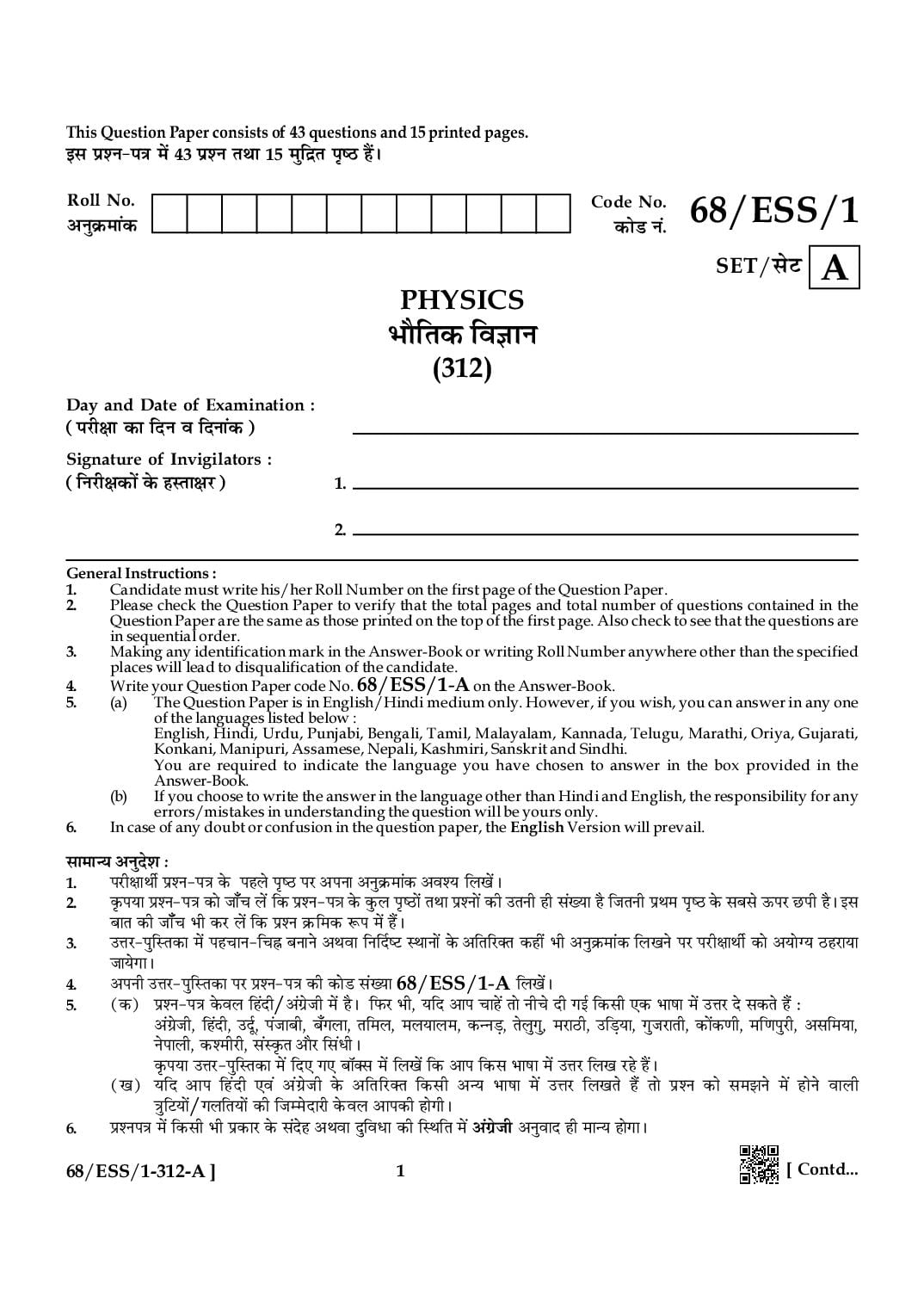
NIOS Class 12 October 2024 Question Paper Physics
Finished viewing? Save it for later —
Download NIOS Class 12 October 2024 Question Paper Physics (PDF · 15 pages)About NIOS Class 12 October 2024 Question Paper Physics
NIOS Class 12 October 2024 Question Paper Physics is available here for free download. Published by NIOS for National Institute of Open Schooling Class 12, this question paper can be viewed online or downloaded as a PDF (15 pages). Candidates preparing for National Institute of Open Schooling Class 12 can use NIOS Class 12 October 2024 Question Paper Physics to understand the exam pattern, the type of questions asked, and the overall difficulty level.
Frequently Asked Questions
How can I download NIOS Class 12 October 2024 Question Paper Physics?
Open this page and click the Download button to save NIOS Class 12 October 2024 Question Paper Physics as a PDF. It is completely free on AglaSem Docs.
Is NIOS Class 12 October 2024 Question Paper Physics free to download?
Yes. NIOS Class 12 October 2024 Question Paper Physics can be viewed online and downloaded as a PDF free of cost on AglaSem Docs.
How many pages does NIOS Class 12 October 2024 Question Paper Physics have?
NIOS Class 12 October 2024 Question Paper Physics contains 15 pages, which you can read online or download together as a single PDF.
Where can I find more National Institute of Open Schooling Class 12 study material?
You can find more National Institute of Open Schooling Class 12 question papers, sample papers, syllabus, and answer keys on AglaSem Docs.
NIOS Class 12 October 2024 Question Paper Physics – Text
Read the full text of this question paper below — useful to quickly search, copy and reference the content online without downloading the PDF.
📄 View text version (15 pages)
Page 1
ß‚ ¬˝‡Ÿ-¬òÊ ◊¥ 43 ¬˝‡Ÿ ÃÕÊ 15 ◊ÈÁŒ˝Ã ¬Îc∆U „Ò¥–
Roll No. Code No.
•ŸÈ∑˝§◊Ê¥∑§ ∑§Ê«U Ÿ¥.
68/ESS/1
SET/‚ ≈ A
PHYSICS
÷ÊÒÁÃ∑§ ÁflôÊÊŸ
(312)
Day and Date of Examination :
(¬⁄UˡÊÊ ∑§Ê ÁŒŸ fl ÁŒŸÊ¥∑§)
Signature of Invigilators :
(ÁŸ⁄UˡÊ∑§Ê¥ ∑§ „SÃÊˇÊ⁄U) 1.
2.
General Instructions :
1. Candidate must write his/her Roll Number on the first page of the Question Paper.
2. Please check the Question Paper to verify that the total pages and total number of questions contained in the
Question Paper are the same as those printed on the top of the first page. Also check to see that the questions are
in sequential order.
3. Making any identification mark in the Answer-Book or writing Roll Number anywhere other than the specified
places will lead to disqualification of the candidate.
4. Write your Question Paper code No. 68/ESS/1-A on the Answer-Book.
5. (a) The Question Paper is in English/Hindi medium only. However, if you wish, you can answer in any one
of the languages listed below :
English, Hindi, Urdu, Punjabi, Bengali, Tamil, Malayalam, Kannada, Telugu, Marathi, Oriya, Gujarati,
Konkani, Manipuri, Assamese, Nepali, Kashmiri, Sanskrit and Sindhi.
You are required to indicate the language you have chosen to answer in the box provided in the
Answer-Book.
(b) If you choose to write the answer in the language other than Hindi and English, the responsibility for any
errors/mistakes in understanding the question will be yours only.
6. In case of any doubt or confusion in the question paper, the English Version will prevail.
‚Ê◊Êãÿ •ŸÈŒ‡Ê —
1. ¬⁄UˡÊÊÕ˸ ¬˝‡Ÿ-¬òÊ ∑§ ¬„‹ ¬Îc∆U ¬⁄U •¬ŸÊ •ŸÈ∑˝§◊Ê¥∑§ •fl‡ÿU Á‹π¥–
2. ∑Χ¬ÿÊ ¬˝‡Ÿ-¬òÊ ∑§Ê ¡ÊÚ°ø ‹¥ Á∑§ ¬˝‡Ÿ-¬òÊ ∑§ ∑ȧ‹ ¬Îc∆UÊ¥ ÃÕÊ ¬˝‡ŸÊ¥ ∑§Ë ©ÃŸË „Ë ‚¥ÅUÿÊ „Ò Á¡ÃŸË ¬˝Õ◊ ¬Îc∆ ∑ §‚’‚ ™§¬⁄U ¿U¬Ë „Ò– ß‚
’Êà ∑§Ë ¡ÊÚ°ø ÷Ë ∑§⁄U ‹¥ Á∑§ ¬˝‡Ÿ ∑˝ Á◊∑§ UM§¬ ◊¥ „Ò¥–
3. § ©ûÊ⁄U-¬ÈÁSUÃ∑§Ê ◊¥ ¬„øÊŸ-Áøq ’ŸÊŸ •ÕflÊ ÁŸÁŒ¸c≈U SÕÊŸÊ¥ ∑§§•ÁÃÁ⁄UÄà ∑§„Ë¥ ÷Ë •ŸÈ∑˝§◊Ê¥∑§ Á‹πŸ ¬⁄U ¬⁄UˡÊÊÕ˸ ∑§Ê •ÿÊÇÿ ∆U„⁄UÊÿÊ
¡ÊÿªÊ–
4. •¬ŸË ©ûÊ⁄U-¬ÈÁSUÃ∑§Ê ¬⁄U ¬˝‡Ÿ-¬òÊ ∑§Ë ∑§Ê«U ‚¥ÅÿÊ 68/ESS/1-A Á‹π¥–
5. (∑§) ¬˝‡Ÿ-¬òÊ ∑§fl‹ Á„¥ŒË/•¥ª˝¡Ë ◊¥ „Ò– Á»§⁄U ÷Ë, ÿÁŒ •Ê¬ øÊ„¥ ÃÊ ŸËø ŒË ªß¸ Á∑§‚Ë ∞∑§ ÷Ê·Ê ◊¥ ©ûÊ⁄ Œ ‚∑§Ã „Ò¥ —
•¥ª˝¡Ë, Á„¥ŒË, ©ŒÍ¸, ¬¥¡Ê’Ë, ’°ª‹Ê, ÃÁ◊‹, ◊‹ÿÊ‹◊, ∑§ãŸ«∏, ËȪÈ, ◊⁄UÊ∆UË, ©Á«∏ÿÊ, ªÈ¡⁄UÊÃË, ∑§Ê¥∑§áÊË, ◊ÁáʬÈ⁄UË, •‚Á◊ÿÊ,
Ÿ¬Ê‹Ë, ∑§‡◊Ë⁄UË, ‚¥S∑Χç•ÊÒ⁄U Á‚¥œË–
∑Χ¬ÿÊ ©ûÊ⁄U-¬ÈÁSÃ∑§Ê ◊¥ ÁŒ∞ ª∞ ’ÊÚÄ‚ ◊¥ Á‹π¥ Á∑§ •Ê¬ Á∑§‚ ÷Ê·Ê ◊¥ ©ûÊ⁄U Á‹π ⁄U„ „Ò¥–
(π) ÿÁŒ •Ê¬ Á„¥ŒË ∞fl¥ •¥ª˝¡Ë ∑§ •ÁÃÁ⁄UÄà Á∑§‚Ë •ãÿ ÷Ê·Ê ◊¥ ©ûÊ⁄U Á‹πà „Ò¥ ÃÊ ¬˝‡Ÿ ∑§Ê ‚◊¤ÊŸ ◊¥ „ÊŸ flÊ‹Ë
òÊÈÁ≈UÿÊ¥/ª‹ÁÃÿÊ¥ ∑§Ë Á¡ê◊UŒÊ⁄Ë ∑ fl‹ •Ê¬∑§Ë „ʪ˖
6. ¬˝‡Ÿ¬òÊ ◊¥ Á∑§‚Ë ÷Ë ¬˝∑§Ê⁄U ∑§ ‚¥Œ„ •ÕflÊ ŒÈÁflœÊ ∑§Ë ÁSÕÁà ◊¥ •¥ª˝¡Ë •ŸÈflÊŒ „Ë ◊Êãÿ „ʪʖ
68/ESS/1-312-A ] 1 [ Contd...
Page 2
÷ÊÒÁÃ∑§ ÁflôÊÊŸ
(312)
Time : 3 Hours ] [ Maximum Marks : 80
‚◊ÿ — 3 ÉÊá≈U ] [ ¬ÍáÊÊZ∑§ — 80
Note : (i) This question paper consists of 43 questions in all.
(ii) All questions are compulsory.
(iii) Marks are given against each question.
(iv) Use log tables if necessary.
(v) Section A consists of
(a) Q. No. 1 to 16 - Multiple choice type questions (MCQs) carrying 1 mark each.
Select and write the most appropriate option out of the four options given in each
of these questions.
(b) Q. No. 17 to 28 - Objective type questions carrying 2 marks each (with 2
sub-parts of 1 mark each). Attempt these questions as per the instructions given
for each of the questions 17 to 28.
(vi) Section B consists of
(a) Q. No. 29 to 37 - Very short answer type questions carrying 2 marks each to be
answered in the range of 30 to 50 words.
(b) Q. No. 38 to 41 - Short answer type questions carrying 3 marks each to be
answered in the range of 50 to 80 words.
(c) Q. No. 42 and 43 - Long answer type questions carrying 5 marks each to be
answered in the range of 80 to 120 words.
ÁŸŒ¸‡Ê — (i) ß‚ ¬˝‡Ÿ ¬òÊ ◊¥ ∑ȧ‹ 43 ¬˝‡Ÿ „Ò¥–
(ii) ‚÷Ë ¬˝‡Ÿ •ÁŸflÊÿ¸ „Ò¥–
(iii) ¬˝àÿ∑§ ¬˝‡Ÿ ∑§ ‚Ê◊Ÿ •¥∑§ ÁŒÿ ªÿ „Ò¥–
(iv) •Êfl‡ÿ∑§ „ÊŸ ¬⁄U ‹ÉÊȪáÊ∑§ ÃÊÁ‹∑§Ê ∑§Ê ¬˝ÿʪ ∑§⁄¥U–
(v) πá«U A ◊¥
(a) ¬˝‡Ÿ ‚¥ÅÿÊ 1 ‚ 16 - ’„ÈÁfl∑§À¬Ëÿ ¬˝∑§Ê⁄U ∑§ ¬˝‡Ÿ „Ò¥, ¡Ê ¬˝àÿ∑§ 1 •¥∑§ ∑§Ê „Ò– ߟ ¬˝‡ŸÊ¥ ◊¥ ¬˝àÿ∑§
◊¥ ÁŒÿ ªÿ øÊ⁄U Áfl∑§À¬Ê¥ ◊¥ ‚ ‚’‚ ©¬ÿÈÄà Áfl∑§À¬ øÈÁŸÿ •ÊÒ⁄U Á‹Áπ∞–
(b) ¬˝‡Ÿ ‚¥ÅÿÊ 17 ‚ 28 - flSÃÈÁŸc∆U ¬˝‡Ÿ „Ò¥, ¬˝‡Ÿ ‚¥ÅÿÊ 17 ‚ 28 Ã∑§ ¬˝àÿ∑§ ¬˝‡Ÿ 2 •¥∑§Ê¥ ∑§Ê „Ò (ŒÊ
©¬÷ʪ ∑§ ‚ÊÕ ¬˝àÿ∑§ ∑§Ê 1 •¥∑§)– ¬˝‡Ÿ ‚¥ÅÿÊ 17 ‚ 28 ◊¥ ¬˝àÿ∑§ ¬˝‡Ÿ ◊¥ ŒË ªß¸ ‚ÍøŸÊ •ŸÈ‚Ê⁄U
¬˝‡ŸÊ¥ ∑§ ©ûÊ⁄U ŒËÁ¡∞–
(vi) πá«U B ◊¥
(a) ¬˝‡Ÿ ‚¥ÅÿÊ 29 ‚ 37 - •ÁËÉÊÈ ©ûÊ⁄UËÿ ¬˝∑§Ê⁄U ∑§ ¬˝‡Ÿ „Ò¥, ¬˝àÿ∑§ ∑§ 2 •¥∑§ „Ò¥ •ÊÒ⁄U ©ûÊ⁄U ∑§Ë ‚Ë◊Ê
30 ‚ 50 ‡ÊéŒ „Ò–
(b) ¬˝‡Ÿ ‚¥ÅÿÊ 38 ‚ 41 - ‹ÉÊÈ ©ûÊ⁄UËÿ ¬˝∑§Ê⁄U ∑§ ¬˝‡Ÿ „Ò¥, ¬˝àÿ∑§ ∑§ 3 •¥∑§ „Ò¥ •ÊÒ⁄U ©ûÊ⁄U ∑§Ë ‚Ë◊Ê 50 ‚
80 ‡ÊéŒ „Ò–
(c) ¬˝‡Ÿ ‚¥ÅÿÊ 42 ‚ 43 - ŒËÉʸ ©ûÊ⁄UËÿ ¬˝∑§Ê⁄U ∑§ ¬˝‡Ÿ „Ò¥, ¬˝àÿ∑§ ∑§ 5 •¥∑§ „Ò¥ •ÊÒ⁄U ©ûÊ⁄U ∑§Ë ‚Ë◊Ê 80 ‚
120 ‡ÊéŒ „Ò–
68/ESS/1-312-A ] 2 [ Contd...
Page 3
(1) Answers of all questions are to be given in the Answer-Book given to you.
‚÷Ë ¬˝‡ŸÊ¥ ∑§ ©ûÊ⁄U •Ê¬∑§Ê ŒË ªß¸ ©ûÊ⁄U-¬ÈÁSÃ∑§Ê ◊¥ „Ë Á‹π¥–
(2) 15 minutes time has been allotted to read this Question Paper. The Question Paper will be
distributed at 2 : 15 p.m. From 2 : 15 p.m. to 2 : 30 p.m., the students will read the Question
Paper only and will not write any answer on the Answer-Book during this period.
ß‚ ¬˝‡Ÿ-¬òÊ ∑§Ê ¬…∏Ÿ ∑§ Á‹∞ 15 Á◊Ÿ≈U ∑§Ê ‚◊ÿ ÁŒÿÊ ªÿÊ „Ò– ¬˝‡Ÿ-¬òÊ ∑§Ê ÁflÃ⁄UáÊ ŒÊ¬„⁄U ◊¥ 2 : 15 ’¡ Á∑§ÿÊ
¡Ê∞ªÊ– 2 : 15 ’¡ ‚ 2 : 30 ’¡ Ã∑§ ¿UÊòÊ ∑§fl‹ ¬˝‡Ÿ-¬òÊ ∑§Ê ¬…∏¥ª •ÊÒ⁄U ß‚ •flÁœ ∑§ ŒÊÒ⁄UÊŸ fl ©ûÊ⁄U-¬ÈÁSÃ∑§Ê ¬⁄U
∑§Ê߸ ©ûÊ⁄U Ÿ„Ë¥ Á‹π¥ª–
SECTION - A
Uπá«U - A
1. In which of the following situations work is done against gravity of earth ? 1
(A) A monkey climbs up a tree.
(B) A car moves on a horizontal level road.
(C) A person tries to lift a heavy load but fails to do so.
(D) A person lifts a load to a certain height in an earth’s natural satellite.
ÁŸêŸÁ‹Áπà ◊¥ ‚ Á∑§‚ ÁSÕÁà ◊¥ ¬ÎâflË ∑§ ªÈM§àfl ∑§ ÁflM§h ∑§Êÿ¸ Á∑§ÿÊ ¡ÊÃÊ „Ò?
(A) ∑§Ê߸ ’ãŒ⁄U Á∑§‚Ë flÎˇÊ ¬⁄U ™§¬⁄U ø…∏ÃÊ „Ò
(B) ∑§Ê߸ ∑§Ê⁄U ∞∑§ ˇÊÒÁá ‚◊Ë ‚«∏U∑§ ¬⁄U ªÁà ∑§⁄UÃË „Ò–
(C) ∑§Ê߸ √ÿÁÄà Á∑§‚Ë ÷Ê⁄UË flSÃÈ ∑§Ê ™§¬⁄U ©∆UÊŸ ∑§Ê ¬˝ÿàŸ ∑§⁄UÃÊ „Ò ‹Á∑§Ÿ ∞‚Ê ∑§⁄UŸ ◊¥ •‚◊Õ¸ ⁄U„ÃÊ „Ò–
(D) ¬ÎâflË ∑§ Á∑§‚Ë ¬˝Ê∑ΧÁÃ∑§ ©¬ª˝„ ◊¥ ∑§Ê߸ √ÿÁÄà Á∑§‚Ë ™°§øÊ߸ Ã∑§ ∑§Ê߸ ÷Ê⁄U ™§¬⁄U ©∆UÊÃÊ „Ò–
2. Through wave motion : 1
(A) only energy is transmitted
(B) only particles are transmitted
(C) energy and particles both are transmitted
(D) neither energy nor particles are transmitted
Ã⁄¥Uª ªÁà ∑§ ◊Êäÿ◊ ‚ —
(A) ∑§fl‹ ™§¡Ê¸ ‚¥øÁ⁄Uà „ÊÃË „Ò–
(B) ∑§fl‹ ∑§áÊ ‚¥øÁ⁄Uà „Êà „Ò¥–
(C) ™§¡Ê¸ •ÊÒ⁄U ∑§áÊ ŒÊŸÊ¥ ‚¥øÁ⁄Uà „Êà „Ò–
(D) Ÿ ™§¡Ê¸ ‚¥øÁ⁄Uà „ÊÃË „Ò •ÊÒ⁄U Ÿ ∑§áÊ ‚¥øÁ⁄Uà „Êà „Ò¥–
3. The maximum number of electrons present in the outermost orbit of any atom is : 1
(A) 2 (B) 8 (C) 32 (D) infinite
Á∑§‚Ë ÷Ë ¬⁄U◊ÊáÊÈ ∑§Ë ’ÊsÃ◊ ∑§ˇÊÊ ◊¥ Áfll◊ÊŸ ß‹Ä≈˛UÊÚŸÊ¥ ∑§Ë •Áœ∑§Ã◊ ‚¥ÅÿÊ „ÊÃË „Ò —
(A) 2 (B) 8 (C) 32 (D) •ŸãÃ
68/ESS/1-312-A ] 3 [ Contd...
Page 4
be :
Á∑§‚Ë Á¬¥«U ¬⁄U ‹ª∑§⁄U ß‚ ‚¥ÃÈ‹Ÿ ◊¥ ’ŸÊ∞ ⁄UπŸ flÊ‹ •‚◊Ã‹Ë ’‹Ê¥ ∑§Ë ãÿÍŸÃ◊ ‚¥ÅÿÊ „ÊªË —
(A) 2 (B) 3
(C) 4 (D) 5
5. A particle is projected at an angle of 608 to the horizontal with a certain kinetic energy E. Its 1
kinetic energy at the highest point of its path will be :
Á∑§‚Ë ∑§áÊ ∑§Ê ªÁá ™§¡Ê¸ E ‚ ˇÊÒÁá ‚ 608 ∑§Ê ∑§ÊáÊ ’ŸÊà „È∞ ¬˝ˇÊÁ¬Ã Á∑§ÿÊ ¡ÊÃÊ „Ò– •¬Ÿ ¬Õ ∑§ ©ìÊÃ◊ Á’ãŒÈ
¬⁄U ß‚∑§Ë ªÁá-™§¡Ê¸ „ÊªË —
E
(A) O (B)
2
E
(C) (D) E
4
6. The electrostatic force between two point charges kept in air at a distance ‘d’ is F1 and F2 at 1
the same distance in a medium of dielectric constant K. The ratio F1 : F2 is equal to :
ŒÊ Á’¥ŒÈ •Êfl‡ÊÊ¥ ∑§Ê ¡’ “d” ŒÍ⁄UË ¬⁄U flÊÿÈ ◊¥ ⁄UπÊ ¡ÊÃÊ „Ò ÃÊ ©Ÿ∑§ ’Ëø ’‹ F1 ‹ªÃÊ „Ò •ÊÒ⁄U ¡’ K ¬⁄UÊflÒlÈÃÊ°∑§ ∑§
Á∑§‚Ë ◊Êäÿ◊ ◊¥ ⁄UπÊ ¡ÊÃÊ „Ò ÃÊ F2 „ÊÃÊ „Ò– F1 : F2 ’⁄UÊ’⁄U „ÊÃÊ „Ò —
(A) 1:1 (B) 1:K
(C) K:1 (D) K2 : 1
7. Work done in displacing a charge q on an equipotential surface through a distance r will 1
be :
q
(A) 4 πε0 r (B) 4πε 0rq
q
(C) 4 πε0 r 2 (D) Zero
Á∑§‚Ë ‚◊Áfl÷flË ¬Îc∆ ¬⁄U Á∑§‚Ë •Êfl‡Ê q ∑§Ê r ŒÍ⁄UË ÁflSÕÊÁ¬Ã ∑§⁄UŸ ◊¥ Á∑§ÿÊ ªÿÊ ∑§Êÿ¸ „ÊªÊ —U
q
(A) 4 πε0 r (B) 4πε 0rq
q
(C) 4 πε0 r 2 (D) ‡ÊÍãÿ
8. A resistance of 5 Ω is connected in the left gap and that of 15 Ω is connected in the right gap 1
of a metre-bridge. The position of the null point on the bridge wire from its left end will
be :
Á∑§‚Ë ◊Ë≈U⁄U-‚ÃÈ ∑§ ’Ê°ß ªÒ¬ ◊¥ 5 Ω ÃÕÊ ŒÊÁ„Ÿ ªÒ¬ ◊¥ 15 Ω ∑§Ê ¬˝ÁÃ⁄UÊœ ¡Ê«∏Ê ªÿÊ „Ò– Á’˝¡ ∑§ ÃÊ⁄U ¬⁄U ’ʰ߸ •Ê⁄U ∑§
Á‚⁄U ‚ ‡ÊÍãÿ ÁflˇÊ¬ ÁSÕÁà ∑§Ë ŒÍ⁄UË „ÊªË —
(A) 75 cm (B) 60 cm
(C) 25 cm (D) 15 cm
68/ESS/1-312-A ] 4 [ Contd...
Page 5
will converge nearest to its optical centre ?
(A) Blue (B) Green
(C) Yellow (D) Red
Á∑§‚Ë ©ûÊ‹ ‹ã‚ ¬⁄U ‡flà ¬˝∑§Ê‡Ê ∑§Ê ∑§Ê߸ ‚◊Ê¥Ã⁄U Á∑§⁄UáÊ ¬ÈT •Ê¬ÁÃà „Ò– ÁŸêŸÁ‹Áπà ◊¥ ‚ Á∑§‚ ⁄¥Uª ∑§ ‚¥ªÃ
»§Ê∑§‚ ß‚∑§ ¬˝∑§ÊÁ‡Êà ∑§ãŒ˝ ∑§ ‚’‚ ¬Ê‚ „ʪÊ?
(A) ŸË‹Ê (B) „⁄UÊ
(C) ¬Ë‹Ê (D) ‹Ê‹
10. A body of mass ‘m’ just starts sliding down an inclined plane when the plane make an angle 1
of 308 with the vertical. The coefficient of friction between the surface of the plane and the
block will be :
‘m’ Œ˝√ÿ◊ÊŸ ∑§Ê ∑§Ê߸ Á¬¥«U Á∑§‚Ë ‚◊Ë ¬Îc∆ ¬⁄U ©‚ ‚◊ÿ ŸËø ∑§Ë •Ê⁄U Á»§‚‹ŸÊ ‡ÊÈM§ ∑§⁄U ŒÃÊ „Ò ¡’ ÿ„ ‚◊Ë
™§äflʸœ⁄UU ‚ 308 ∑§Ê ∑§ÊáÊ ’ŸÊÃÊ „Ò– ‚◊Ë ∞fl¥ Á¬¥«U ∑§ ¬Îc∆UÊ¥ ∑§ ’Ëø ÉÊ·¸áÊ ªÈáÊÊ¥∑§ ∑§Ê ◊ÊŸ „ÊªÊ —
1
(A) (B) 3
3
mg
(C) (D) 3 mg
3
11. The number of electrons that constitute −1 C of charge is : 1
−1 C •Êfl‡Ê ÁŸÁ◊¸Ã ∑§⁄UŸ ∑§ Á‹∞ •Êfl‡ÿ∑§ ß‹ÄÚ≈˛UÊŸÊ¥ ∑§Ë ‚¥ÅÿÊ „ÊÃË „Ò —
(A) 6.25×10 18 (B) 6.4×10 27
(C) 9.0×10 18 (D) 1.6×10 19
12. A particle having charge −1 µC is placed at a point where the electric potential is 100 V. 1
The electric potential energy of the particle is :
−1 µC •Êfl‡Ê ∑§Ê ∑§Ê߸ ∑§áÊ ©‚ Á’ãŒÈ ¬⁄U ⁄UπÊ „Ò ¡„Ê° flÒlÈà Áfl÷fl 100 V „Ò– ∑§áÊ ∑§Ë flÒlÈà SÕÒÁÃ∑§ ™§¡Ê¸ „Ò —
(A) 10−8 J (B) 10−4 J
(C) 104 J (D) −10−4 J
68/ESS/1-312-A ] 5 [ Contd...
Page 6
3 N. The power loss due to frictional force is :
(A) Zero (B) 15 W
(C) −15 W (D) 30 W
2 kg Œ˝√ÿ◊ÊŸ ∑§Ê ∑§Ê߸ Á¬¥«U Á∑§‚Ë 3 N ∑§ ÁŸÿà ’‹ ∑§ •ãê¸Ã ∞∑§ ÁŸÿà flª v=5 ms−1 ‚ ªÁà ∑§⁄UÃÊ „Ò–
ÉÊ·¸áÊ ’‹ ∑§ ∑§Ê⁄UáÊ ß‚∑§Ë ‡ÊÁÄà ◊¥ „ÊÁŸ „ÊÃË „Ò —
(A) ‡ÊÍãÿ (B) 15 W
(C) −15 W (D) 30 W
14. A 100 W bulb is connected to a 220 V supply. The current flowing through the bulb is : 1
100 W ∑§Ê ∞∑§ ’À’ 220 V ∑§ flÒlÈà ‡ÊÁÄà ¬˝ŒÊÿ ‚ ¡È«∏UÊ „Ò– ß‚ ’À’ ◊¥ ¬˝flÊÁ„à „ÊŸ flÊ‹Ë œÊ⁄UÊ „Ò —
5 10
(A) A (B) A
11 11
11 11
(C) A (D) A
5 10
15. A straight power line laid along east-west direction carries a current of 10 A. The earths 1
magnetic field at the place is 10−4 T. Force per metre experienced by the line wire will be :
¬Ífl¸-¬Á‡ø◊ ÁŒ‡ÊÊ ◊¥ Á’¿UÊ∞ ª∞ ÁfllÈà ∑§ Á∑§‚Ë ÃÊ⁄U ◊¥ 10 A œÊ⁄UÊ ¬˝flÊÁ„à „Ê ⁄U„Ë „Ò– ©‚ SÕÊŸ ¬⁄U ¬ÎâflË ∑§
øÈê’∑§Ëÿ ˇÊòÊ ∑§Ê ◊ÊŸ 10−4 T „Ò– ÃÊ⁄U ¬⁄U ¬˝Áà ◊Ë≈U⁄U ‹ê’Ê߸ ◊¥ ‹ªŸ flÊ‹ ’‹ ∑§Ê ¬Á⁄U◊ÊáÊ „Ò —
(A) 10−2 Nm−1 (B) 10−3 Nm−1
(C) 10−4 Nm−1 (D) 10−5 Nm−1
16. You are given equal number of nuclei of two radioactive elements A and B. The half life of 1
A is 20 minutes and that of B is 40 minutes. After 80 minutes the ratio of number of nuclei
in A and B will be :
•Ê¬∑§Ê ŒÊ ⁄UÁ«UÿÊ∞ÁÄ≈Ufl ÃûflÊ¥ A ∞fl¥ B ∑§ ŸÊÁ÷∑§Ê¥ ∑§Ë ’⁄UÊ’⁄U ‚¥ÅÿÊ ŒË ªß¸ „Ò– A ∑§Ë •œ¸-•ÊÿÈ 20 Á◊Ÿ≈U •ÊÒ⁄U
B ∑§Ë •œ¸-•ÊÿÈ 40 Á◊Ÿ≈U „Ò– 80 Á◊Ÿ≈U ∑§ ’ÊŒ A ∞fl¥ B ◊¥ ŸÊÁ÷∑§Ê¥ ∑§Ë ‚¥ÅÿÊ ∑§Ê •ŸÈ¬Êà „ÊªÊ —
(A) 1:1 (B) 2:1
(C) 4:1 (D) 1:4
68/ESS/1-312-A ] 6 [ Contd...
Page 7
“ The law of conservation of energy is a universal law. In any case if you find that the system
is not following this law, you have certainly missed something in your observations. Adherence
to the law has lead to many new discoveries. For example, in beta-decay of radioactive
elements apparent breach of the law of conservation of energy triggered the research work
which culminated in the discovery of nutrino.”
ŸËø ÁŒ∞ ª∞ ©h⁄UáÊ ∑§Ê äÿÊŸ ‚ ¬Á…∏∞ •ÊÒ⁄U ©‚∑§ ’ÊŒ ÁŒ∞ ª∞ ¬˝‡ŸÊ¥ ∑§ ©ûÊ⁄U Á‹Áπ∞–
““™§¡Ê¸ ‚¥⁄UˇÊáÊ ∑§Ê ÁŸÿ◊ ∞∑§ ‚Êfl¸ÁòÊ∑§ ÁŸÿ◊ „Ò– ÿÁŒ Á∑§‚Ë ¬˝∑§⁄UáÊ ◊¥ •Ê¬ ¬Êà „¥Ò Á∑§ ÁŸ∑§Êÿ ß‚ ÁŸÿ◊ ∑§Ê
•ŸÈ‚⁄UáÊ Ÿ„Ë¥ ∑§⁄U ⁄U„Ê „Ò ÃÊ ÁŸÁ‡øà M§¬ ‚ •Ê¬ ‚ •¬Ÿ ¬˝ˇÊáÊÊ¥ ◊¥ ∑ȧ¿U ¿ÍU≈U ªÿÊ „Ò– ß‚ ÁŸÿ◊ ◊¥ ŒÎ…∏ Áfl‡flÊ‚ ∑§
¬Á⁄UáÊÊ◊ SflM§¬ ∑§ß¸ Ÿß¸ πÊ¡¥ „È߸ „Ò¥– ©ŒÊ„⁄UáÊ ∑§ Á‹∞, ∑ȧ¿U ⁄UÁ«UÿÊ∞ÁÄ≈Ufl ÃûflÊ¥ ∑§ ’Ë≈UÊ-ˇÊÿ ◊¥ ÿ„ ÁŸÿ◊ ÷¥ª „ÊÃÊ
„È•Ê ◊Ê‹Í◊ ¬«∏Ê ÃÊ ‡ÊÈM§ „È∞ ‡ÊÊœ∑§Êÿ¸ ∑§Ê ‚◊ʬŸ “ãÿÍÁ≈˛UŸÊ” ∑§Ë πÊ¡ ◊¥ „È•Ê–””
(i) Apparent breach of the law of conservation of energy in beta-decay reactions lead to
the discovery of :
(A) Electron (B) Proton (C) Neutron (D) Nutrino
’Ë≈UÊ-ˇÊÿ •Á÷Á∑˝§ÿÊ•Ê¥ ◊¥ ™§¡Ê¸ ‚¥⁄UˇÊáÊ ÁŸÿ◊ ∑§ ÷¥ª „ÊŸ ∑§ •Ê÷Ê‚ ∑§ ¬Á⁄UáÊÊ◊ SflM§¬ πÊ¡ „È߸ —
(A) ß‹Ä≈˛UÊÚŸ ∑§Ë (B) ¬˝Ê≈UÊÚŸ ∑§Ë (C) ãÿÍ≈˛UÊÚŸ ∑§Ë (D) ãÿÍÁ≈˛UŸÊ ∑§Ë
(ii) The law of conservation of energy is applicable to :
(A) mechanical systems only (B) chemical systems only
(C) nuclear systems only (D) every system of the universe
™§¡Ê¸ ‚¥⁄UˇÊáÊ ÁŸÿ◊ ‹ÊªÍ „ÊÃÊ „Ò —
(A) ∑§fl‹ ÿÊ¥ÁòÊ∑§ ÁŸ∑§ÊÿÊ¥ ∑§ Á‹∞ (B) ∑§fl‹ ⁄UÊ‚ÊÿÁŸ∑§ ÁŸ∑§ÊÿÊ¥ ∑§ Á‹∞
(C) ∑§fl‹ ŸÊÁ÷∑§Ëÿ ÁŸ∑§ÊÿÊ¥ ∑§ Á‹∞ (D) ’˝rÊÊ¥«U ∑§ ‚÷Ë ÁŸ∑§ÊÿÊ¥ ∑§ Á‹∞
18. Complete the following two sentences using the words given in bracket. 2
(degree celcius, Joule, temperature, pressure) :
(i) __________ of a body determines the direction of flow of heat.
(ii) Heat is measured in ___________.
•Êª ÁŒ∞ ŒÊ flÊÄÿÊ¥ ∑§Ê ∑§Êc∆U∑§ ◊¥ ÁŒ∞ ª∞ ‡ÊéŒÊ¥ ◊¥ ‚ ©¬ÿÈÄà ‡ÊéŒ øÈŸ∑§⁄U ¬Í⁄UÊ ∑§⁄UÊ–
(Á«Uª˝Ë ‚ÁÀ‚ÿ‚, ¡Í‹, Ãʬ, ŒÊ’)
(i) Á¬¥«U ∑§Ê __________ ™§c◊Ê ∑§ ¬˝flÊ„ ∑§Ë ÁŒ‡ÊÊ ÁŸœÊ¸Á⁄Uà ∑§⁄UÃÊ „Ò–
(ii) ™§c◊Ê ∑§Ê ◊ʬŸ __________ ◊¥ Á∑§ÿÊ ¡ÊÃÊ „Ò–
68/ESS/1-312-A ] 7 [ Contd...
Page 8
“Phenomena like interference, diffraction and polarization show that light has a wave nature.
Dispersion of light indicates that the visible, so called white light is composed of seven different
wavelength ranges corresponding to the seven colours of the rainbow”.
ŸËø ÁŒ∞ ª∞ ©Œ˜œ⁄UáÊ ∑§Ê ¬Á…∏∞ •ÊÒ⁄U ©‚‚ •Êª ÁŒ∞ ª∞ ŒÊ ¬˝‡ŸÊ¥ ∑§ ©ûÊ⁄U Á‹Áπ∞ —
““√ÿÁÃ∑§⁄UáÊ, ÁflfløŸ ∞fl¥ œ˝ÈfláÊ ¡Ò‚Ë ¬Á⁄UÉÊ≈UŸÊ∞° Œ‡ÊʸÃË „Ò¥ Á∑§ ¬˝∑§Ê‡Ê ∑§Ë ¬˝∑ΧÁà Ã⁄¥UªflØ „Ò– ¬˝∑§Ê‡Ê ∑§Ê ÁflˇÊ¬áÊ
ߥÁªÃ ∑§⁄UÃÊ „Ò Á∑§ ÃÕÊ∑§ÁÕà ‡flÃ, ŒÎ‡ÿ ¬˝∑§Ê‡Ê ‚Êà •‹ª-•‹ª Ã⁄¥UªŒÒÉÿ¸ ¬Á⁄U‚⁄UÊ¥ ‚ ÁŸÁ◊¸Ã „ÊÃÊ „Ò ¡Ê ßãŒ˝œŸÈ· ∑§
‚Êà ⁄¥UªÊ¥ ∑§ ‚¥ªÃ „Êà „Ò¥–””
(i) The phenomenon responsible for the formation of rainbow is :
(A) interference (B) diffraction
(C) dispersion (D) polarization
ßãŒ˝œŸÈ· ÁŸ◊ʸáÊ ∑§ Á‹∞ ©ûÊ⁄UŒÊÿË ¬Á⁄UÉÊ≈UŸÊ „Ò —
(A) √ÿÁÃ∑§⁄UáÊ (B) ÁflfløŸ
(C) fláʸÁflˇÊ¬áÊ (D) œ˝ÈfláÊ
(ii) Interference is a phenomenon exhibited by :
(A) waves only (B) particles only
(C) waves as well as by particles (D) neither the waves nor the particles
√ÿÁÃ∑§⁄UáÊ ∑§Ë ¬Á⁄UÉÊ≈UŸÊ ¬˝ŒÁ‡Ê¸Ã ∑§Ë ¡ÊÃË „Ò —
(A) ∑§fl‹ Ã⁄¥UªÊ¥ mÊ⁄UÊ (B) ∑§fl‹ ∑§áÊÊ¥ mÊ⁄UÊ
(C) Ã⁄¥UªÊ¥ ∑§ mÊ⁄UÊ ÷Ë •ÊÒ⁄U ∑§áÊÊ¥ ∑§ mÊ⁄UÊ ÷Ë (D) Ÿ ÃÊ Ã⁄¥UªÊ¥ ∑§ mÊ⁄UÊ •ÊÒ⁄U Ÿ „Ë ∑§áÊÊ¥ ∑§ mÊ⁄UÊ
20. Fill in the blanks : 2
(i) ___________ is a device in which a sustained, nuclear chain reaction is carried out in a
controlled manner.
(ii) The enormous energy produced by sun is generated as a result of __________ reaction.
Á⁄UÄà SÕÊŸ ÷⁄¥U–
(i) ___________ ∞∑§ ∞‚Ë ÿÈÁÄà „Ò Á¡‚◊¥ ‚¥¬ÊÁ·Ã ÁŸÿ¥ÁòÊà ŸÊÁ÷Á∑§ÿ oÎ¥π‹Ê •Á÷Á∑˝§ÿÊ ‚¥øÊÁ‹Ã ∑§Ë ¡ÊÃË
„Ò–
(ii) ‚Íÿ¸ mÊ⁄UÊ ©à¬ÛÊ Áfl‡ÊÊ‹ ™§¡Ê¸ ___________ •Á÷Á∑˝§ÿÊ ∑§ ¬Á⁄UáÊÊ◊SflM§¬ ¡ÁŸÃ „ÊÃË „Ò–
21. Match Column - I statement with the right option of Column - II. 2
Column - I Column - II
(i) Law of conservation of linear (a) F=µR
momentum
(ii) Expression for friction force (b) F=ma
(c) Ptotal=Constant
∑§ÊÚ‹◊ - I ◊¥ ÁŒ∞ ª∞ ∑§ÕŸ ∑§Ê Á◊‹ÊŸ ∑§ÊÚ‹◊ - II ∑§ ‚„Ë Áfl∑§À¬ ‚ ∑§ËÁ¡∞ —
∑§ÊÚ‹◊ - I ∑§ÊÚ‹◊ - II
(i) ⁄UπËÿ ‚¥flª ‚¥⁄UˇÊáÊ ÁŸÿ◊ (a) F=µR
(ii) ÉÊ·¸áÊ-’‹ ∑§ Á‹∞ √ÿT∑§ (b) F=ma
(c) Ptotal=ÁŸÿÃÊ°∑§
68/ESS/1-312-A ] 8 [ Contd...
Page 9
(i) Efficiency of a heat engine does not depend on the nature of the __________.
(ii) 1 kilo calorie = __________ J.
Á⁄UÄà SÕÊŸÊ¥ ∑§Ë ¬ÍÁø ∑§ËÁ¡∞ —
(i) Á∑§‚Ë ™§c◊Ê ßã¡Ÿ ∑§Ë ŒˇÊÃÊ __________ ∑§Ë ¬˝∑ΧÁà ¬⁄U ÁŸ÷¸⁄U Ÿ„Ë¥ ∑§⁄UÃË „Ò–
(ii) 1 Á∑§‹Ê ∑§‹Ê⁄UË = __________ J
23. Write true for correct statement and false for incorrect statement : 2
(i) All types of waves exhibit the phenomenon of polarization.
(ii) All the points on a wavefront are in the same phase.
‚„Ë ∑§ÕŸ ∑§ Á‹∞ ‚àÿ •ÊÒ⁄U ª‹Ã ∑§ÕŸ ∑§ Á‹∞ •‚àÿ Á‹Áπ∞ —
(i) ‚÷Ë ¬˝∑§Ê⁄U ∑§Ë Ã⁄¥Uª¥ œ˝ÈfláÊ ∑§Ê ¬˝∑˝§◊ ¬˝ŒÁ‡Ê¸Ã ∑§⁄UÃË „Ò¥–
(ii) Á∑§‚Ë Ã⁄¥UªÊª˝ ∑§ ‚÷Ë Á’ãŒÈ ∞∑§ „Ë ∑§‹Ê ◊¥ „Êà „Ò¥–
24. Match Column - I statement with the right option of Column - II : 2
Column - I Column - II
(i) Visible spectrum (a) Lyman series
(ii) Far infrared spectrum (b) Balmer series
(c) Paschen series
(d) Pfund series
∑§ÊÚ‹◊ - I ◊¥ ÁŒ∞ ª∞ ∑§ÕŸ ∑§Ê Á◊‹ÊŸ ∑§ÊÚ‹◊ - II ∑§ ‚„Ë Áfl∑§À¬ ‚ ∑§ËÁ¡∞ —
∑§ÊÚ‹◊ - I ∑§ÊÚ‹◊ - II
(i) ŒÎcÿ fláʸ∑˝§◊ (a) ‹Êß◊ÒŸ o˝áÊË
(ii) ‚ÈŒÍ⁄U •fl⁄UÄà S¬Ä≈˛U◊ (b) ’Ê◊⁄U o˝áÊË
(c) ¬Ê‡øŸ o˝áÊË
(d) »¥§«U o˝áÊË
25. Fill in the blanks : 2
(i) A photodiode is always connected in __________ biasing.
(ii) A forward biased p-n junction offers __________ resistance to the flow of electrons.
Á⁄UÄà SÕÊŸÊ¥ ∑§Ê ÷Á⁄U∞ —
(i) »§Ê≈UÊ«UÊÿÊ«U ∑§Ê ‚ŒÒfl __________ •Á÷ŸÁà ◊¥ ¡Ê«∏Ê ¡ÊÃÊ „Ò–
(ii) •ª˝•Á÷ŸÃ p-n ‚¥Áœ ß‹ã≈˛UÊÚŸÊ¥ ∑§ ¬˝flÊ„ ∑§ ¬˝Áà __________ ¬˝ÁÃ⁄UÊœ ¬˝ŒÊŸ ∑§⁄UÃË „Ò–
68/ESS/1-312-A ] 9 [ Contd...
Page 10
Column - I Column - II
(i) Transistor in common base configuration (a)
(ii) Transistor in common emitter configuration (b)
(c)
(d)
∑§ÊÚ‹◊ - I ◊¥ ÁŒ∞ ª∞ ∑§ÕŸ ∑§Ê Á◊‹ÊŸ ∑§ÊÚ‹◊ - II ◊¥ ÁŒ∞ ª∞ ‚„Ë Áfl∑§À¬ ‚ ∑§ËÁ¡∞ —
∑§ÊÚ‹◊ - I ∑§ÊÚ‹◊ - II
(i) ≈˛UÊ¥Á¡S≈U⁄U ©÷ÿÁŸc∆ •ÊœÊ⁄U ÁflãÿÊ‚ ◊¥ U (a)
(ii) ≈˛UÊ¥Á¡S≈U⁄U ©÷ÿÁŸD ©à‚¡¸∑§ ÁflãÿÊ‚ ◊¥ (b)
(c)
(d)
27. Write true for correct statement and false for incorrect statement : 2
(1) A NOT gate uses two p-n junctions.
(2) When a zener diode is not working on its optimum voltage condition the load draws
less power than the power dissipated in the diode.
‚„Ë ∑§ÕŸ ∑§ Á‹∞ ‚àÿ •ÊÒ⁄U ª‹Ã ∑§ÕŸ ∑§ Á‹∞ •‚àÿ Á‹Áπ∞ —
(1) NOT Ã∑¸§ mÊ⁄U ◊¥ ŒÊ p-n ‚¥ÁœÿÊ¥ ∑§Ê ©¬ÿʪ Á∑§ÿÊ ¡ÊÃÊ „Ò–
(2) ∑§Ê߸ ¡Ÿ⁄U «UÊÿÊ«U ¡’ •¬Ÿ ߸c≈UÃ◊ flÊÀ≈UÃÊ SÃ⁄U ¬⁄U ∑§Êÿ¸ Ÿ„Ë¥ ∑§⁄U ⁄U„Ê „ÊÃÊ „Ò ÃÊ ‹Ê«U ∑§ mÊ⁄UÊ Áfl÷ÈÄà ‡ÊÁÄÃ
«UÊÿÊ«U ◊¥ ©¬÷ÈÄà ‡ÊÁÄà ‚ ∑§◊ „ÊÃË „Ò–
68/ESS/1-312-A ] 10 [ Contd...
Page 11
Column - I Column - II
(i) Use of a p-n junction diode (a) Rectifier
(ii) Use of a transistor (b) Oscillator
(c) Receiver for remote
(d) Stabilizer
∑§ÊÚ‹◊ - I ◊¥ ÁŒ∞ ª∞ ∑§ÕŸ ∑§Ê Á◊‹ÊŸ ∑§ÊÚ‹◊ - II ◊¥ ÁŒ∞ ª∞ ‚„Ë Áfl∑§À¬ ‚ ∑§ËÁ¡∞ —
∑§ÊÚ‹◊ - I ∑§ÊÚ‹◊ - II
(i) p-n ‚¥Áœ «UÊÿÊ«U ∑§Ê ∑§Ê߸ ∞∑§ ©¬ÿʪ (a) ÁŒc≈U∑§Ê⁄UË
(ii) ≈˛UÊ°Á¡S≈U⁄U ∑§Ê ∑§Ê߸ ∞∑§ ©¬ÿʪ (b) ŒÊÁ‹òÊ
(c) Á⁄U◊Ê≈U ∑§Ê ª˝Ê„Ë
(d) flÊÀ≈UÃÊ SÕÊÿË∑§Ê⁄UË
SECTION - B
Uπá«U - B
29. What is Raynold’s number ? What is its significance ? 2
⁄UŸÊÚÀ«U ‚¥ÅÿÊ ÄÿÊ „ÊÃË „Ò? ß‚∑§Ê ÄÿÊ ◊„ûfl „Ò?
30. What is meant by indicator diagram ? Draw an indicator diagram for an isobaric process. 2
‚Íø∑§ •Ê⁄Uπ ‚ ÄÿÊ ÃÊà¬ÿ¸ „ÊÃÊ „Ò? ‚◊ŒÊ’Ë ¬˝∑˝§◊ ∑§ Á‹∞ ‚Íø∑§ •Ê⁄Uπ ’ŸÊ߸∞ –
31. Write any two applications of photocells. 2
»§Ê≈UÊ‚‹ ∑§ ∑§Ê߸ ŒÊ •ŸÈ¬˝ÿʪ Á‹Áπ∞–
32. Give in brief the principle of working of Parachute. 2
¬Ò⁄UʇÊÍ≈U ∑§Ê ∑§Êÿ¸ Á‚hʥà ‚¥ˇÊ¬ ◊¥ ’ÃÊ߸∞–
33. Distinguish between (i) Pitch and frequency (ii) Loudness and intensity. 2
(i) ÃÊ⁄Uûfl ∞fl¥¥ •ÊflÎÁûÊ ÃÕÊ (ii) ¬˝’‹ÃÊ ∞fl¥ ÃËfl˝ÃÊ ◊¥ Áfl÷Œ ∑§ËÁ¡∞–
34. Give the names of the four factors on which the resistance of a conductor depends. 2
©Ÿ øÊ⁄U ∑§Ê⁄U∑§Ê¥ ∑§ ŸÊ◊ ’ÃÊ߸∞ Á¡Ÿ ¬⁄U Á∑§‚Ë øÊ‹∑§ ∑§Ê ¬˝ÁÃ⁄UÊœ ÁŸ÷¸⁄U ∑§⁄UÃÊ „Ò–
OR / •ÕflÊ
Are the various devices in a household circuit connected in series or in parallel ? Why ?
Á∑§‚Ë ÉÊ⁄U‹È ÁfllÈØ ¬Á⁄U¬Õ ◊¥ ÁflÁ÷㟠ÿÈÁÄÃÿÊ° o˝áÊË∑˝§◊ ◊¥ ¡È«UË „ÊÃË „Ò¥ ÿÊ ¬Ê‡fl¸∑˝§◊ ◊¥ ? ÄÿÊ¥?
68/ESS/1-312-A ] 11 [ Contd...
Page 12
moving charged particle.
flÒlÈà ∞fl¥ øÈê’∑§Ëÿ ˇÊòÊ Á∑§‚Ë ªÁÃ◊ÊŸ •Êfl‡Ê ∑§Ê Á¡‚-Á¡‚ Ã⁄UË∑§ ‚ ÁfløÁ‹Ã ∑§⁄Uà „Ò¥ ©Ÿ◊¥ ∑§Ê߸ ŒÊ •ãÃ⁄U
’ÃÊ߸∞–
OR / •ÕflÊ
Consider a body suspended from a vertical spring. How will the position of the body change
when a current is passed through the spring ? Explain.
Á∑§‚Ë ™§äflʸœ⁄U ÁS¬˝¥ª ‚ ‹≈U∑§ ∞∑§ Á¬¥«U ∑§Ê äÿÊŸ ◊¥ ‹Ê߸∞– ÁS¬˝¥ª ◊¥ œÊ⁄UÊ ¬˝flÊÁ„à ∑§⁄UŸ ¬⁄U Á¬¥«U ∑§Ë ÁSÕÁà ¬⁄U ÄÿÊ
¬˝÷Êfl ¬«UªÊ? √ÿÊÅÿÊ ∑§ËÁ¡∞–
36. Draw the symbol of a : 2
(i) n-p-n transistor
(ii) p-n-p transistor
¬˝ÃË∑§ ’ŸÊ߸∞ —
(i) n-p-n ≈˛UÊ°Á¡S≈U⁄
(ii) p-n-p ≈˛UÊ°Á¡S≈U⁄U
OR / •ÕflÊ
Draw diagrams to show the relative position of energy bonds in :
(i) Semiconductors
(ii) Insulator
Show the magnitude of energy gap in each case.
ÁŸêŸÁ‹Áπà ◊¥ ™§¡Ê¸-•œ¸ ∑§ •Ê¬ÁˇÊ∑§ ÁSÕÁà ∑§Ê Œ‡ÊʸŸflÊ‹ ÁøòÊ ∑§Ê ÁŸ◊ʸáÊ ∑§⁄¥U —
(i) ’¥œøÊ‹∑§
(ii) ÁfllÈÃ⁄UÊœË
¬˝àÿ∑§ ÁSÕÁà ◊¥, ™§¡Ê¸-•¥Ã⁄UÊ‹ ∑§ ¬Á⁄U◊ÊáÊ ∑§Ê Œ‡Êʸ∞°–
37. A body of mass of 50 kg is placed on the smaller piston of a hydraulic lift. If the area of the 2
smaller piston is 0.1 m2 and that of the bigger piston is 10 m2, calculate the weight of the car
which can be lifted by this body.
50 kg Œ˝√ÿ◊ÊŸ ∑§Ê ∑§Ê߸ Á¬¥«U ∞∑§ „Êß«˛UÊÁ‹∑§ Á‹ç≈U ∑§ ¿UÊ≈U Á¬S≈UŸ ¬⁄U ⁄UπÊ „Ò–
ÿÁŒ ¿UÊ≈U Á¬S≈UŸ ∑§Ê ˇÊòÊ»§‹
0.1 m2 ÃÕÊ ’«∏ Á¬S≈UŸ ∑§Ê ˇÊòÊ»§‹ 10 m2 „Ê ÃÊ ©‚ ∑§Ê⁄U ∑§ ÷Ê⁄U ∑§Ê ¬Á⁄U∑§‹Ÿ ∑§ËÁ¡∞ Á¡‚ ß‚ Á¬¥«U mÊ⁄UÊ ™§¬⁄U
©∆UÊÿÊ ¡Ê ‚∑§ÃÊ „Ò–
OR / •ÕflÊ
Calculate the excess of pressure inside a soap bubble of radius 4 cm. The surface tension of
soap solution is 25×10−3 Nm−1.
4 cm ÁòÊíÿÊ ∑§ ‚Ê’ÈŸ ∑§ ’È‹’È‹ ∑§ ÷ËÃ⁄U ŒÊ’ÊÁœÄÿ ∑§Ê ¬Á⁄U∑§‹Ÿ ∑§ËÁ¡∞– ‚Ê’ÈŸ ∑§ Áfl‹ÿŸ ∑§Ê ¬Îc∆ ßÊfl
25×10−3 Nm−1 „Ò–U
68/ESS/1-312-A ] 12 [ Contd...
Page 13
⁄U◊Ÿ ¬˝÷Êfl ÄÿÊ „ÊÃÊ „Ò? ⁄◊Ÿ S¬Ä≈˛U◊ ◊¥ S≈UÊÚ∑§ ∞fl¥ ∞Áá≈US≈UÊÚ∑§ ⁄UπÊ∞° ÄÿÊ „ÊÃË „Ò?
39. Write any three distinguishing features of the fringe patterns formed in Young’s double slit 3
experiment and single slit diffraction.
ÿ¥ª ∑§ ÁmÁ¤Ê⁄UË ¬˝ÿʪ ∞fl¥ ∞∑§-Á¤Ê⁄UË ÁflfløŸ ◊¥ ÁŸÁ◊¸Ã Á»˝¥§¡ ¬Ò≈UŸÊZ ◊¥ •¥Ã⁄U ∑§⁄UŸ flÊ‹Ë ÃËŸ Áfl‡Ê·ÃÊ∞° Á‹Áπ∞–
OR / •ÕflÊ
In a single slit diffraction experiment how will the angular width of central maximum change
when :
(i) Slit width is decreased,
(ii) The distance between the slit and the screen is increased,
(iii) Light of smaller wavelength is used ? Explain.
∞∑§‹ Á¤Ê⁄UË ÁflfløŸ ¬˝ÿʪ ◊¥ ∑§ãŒ˝Ëÿ ©ÁìÊD ∑§Ë ∑§ÊáÊËÿ øÊÒ«∏Ê߸ ¬⁄U ÄÿÊ ¬˝÷Êfl „ʪÊ, ¡’ —
(i) Á¤Ê⁄UË ∑§Ë øÊÒ«∏Ê߸ ∑§◊ ∑§Ë ¡ÊÃË „Ò,
(ii) Á¤Ê⁄UË •ÊÒ⁄U ¬Œ¸ ∑§ ’Ëø ∑§Ë ŒÍ⁄UË ’…∏Ê ŒË ¡ÊÃË „Ò,
(iii) ∑§◊ Ã⁄¥UªŒÒÉÿ¸ ∑§Ê ¬˝∑§Ê‡Ê ©¬ÿʪ ◊¥ ‹ÊÿÊ ¡ÊÃÊ „Ò? √ÿÊÅÿÊ ∑§ËÁ¡∞–
πx
40. A stationary wave is represented by : y = 2 sin cos ( 100 πt ) , where x and y are in 3
10
centimetre. Calculate the distance between a node and adjoining antinode.
πx
Á∑§‚Ë •¬˝ªÊ◊Ë Ã⁄¥Uª ∑§Ê y = 2 sin 10 cos ( 100 πt ) mÊ⁄UÊ ÁŸM§Á¬Ã Á∑§ÿÊ ªÿÊ „Ò, ¡„Ê° x •ÊÒ⁄U y ‚ã≈UË◊Ë≈U⁄U ◊¥
„Ò¥– ß‚ Ã⁄¥Uª ◊¥ Á∑§‚Ë ÁŸS¬¥Œ ∑§Ë ©‚∑§ ¬Ê‚ ∑§ ¬˝S¬¥Œ ‚ ŒÍ⁄UË ∑§Ê ¬Á⁄U∑§‹Ÿ ∑§ËÁ¡∞–
OR / •ÕflÊ
A transverse harmonic wave can be represented by :
y=3 sin 36t + 0.018 x + where, y and x are in metre and time in seconds.
π
4
(i) Is it a progressive wave or a stationary wave ?
(ii) Calculate the :
(a) Period of vibration and
(b) Wavelength of the wave
∞∑§ •ŸÈ¬˝SÕ •ÊflÃ˸ Ã⁄¥Uª ∑§Ê y=3 sin 36t + 0.018 x + π mÊ⁄UÊ ÁŸM§Á¬Ã Á∑§ÿÊ ¡Ê ‚∑§ÃÊ „Ò, ¡„Ê° x ∞fl¥ y
4
◊Ë≈U⁄U ◊¥ •ÊÒ⁄U t ‚∑¥§«U ◊¥ „Ò–
(i) ÿ„ Ã⁄¥Uª ¬˝ªÊ◊Ë „Ò ÿÊ •¬˝ªÊ◊Ë?
(ii) ¬Á⁄U∑§‹Ÿ ∑§ËÁ¡∞ —
(a) ∑¥§¬Ÿ-∑§Ê‹ ÃÕÊ
(b) Ã⁄¥Uª ∑§Ê Ã⁄¥UªŒÒÉÿ¸–
68/ESS/1-312-A ] 13 [ Contd...
Page 14
water. Calculate the angle of minimum deviation of the prism in this situation.
Given : Refractive index of water=1.33, sin−1(0.56)=34.38
608 •¬flø∑§ ∑§ÊáÊ ÃÕÊ 1.5 •¬fløŸÊ°∑§ ∑§Ê ∑§Ê°ø ∑§Ê ∞∑§ Á¬˝í◊ ¬Í⁄UË Ã⁄U„ ¬ÊŸË ◊¥ «ÍU’Ê „È•Ê „Ò– ß‚ ÁSÕÁà ◊¥ ß‚
Á¬˝í◊ ∑§ ãÿÍŸÃ◊ Áflø‹Ÿ ∑§ÊáÊ ∑§Ê ¬Á⁄U∑§‹Ÿ ∑§ËÁ¡∞–
ÁŒÿÊ „Ò — ¡‹ ∑§Ê •¬fløŸÊ°∑§ =1.33, sin−1(0.56)=34.38
5
42. In each of the following cases, mention the various forces acting on the moving object and
explain with reason why the net force is zero ?
(i) A rain drop falling down with a constant speed.
(ii) a cork of mass 10 g floating on water.
(iii) A kite skillfully held stationary in the sky.
(iv) A car moving with a constant velocity of 30 km h−1 on a rough road.
(v) A high speed electron in force free space.
ÁŸêŸÁ‹Áπà ◊¥ ‚ ¬˝àÿ∑§ ¬˝∑§⁄UáÊ ◊¥ ªÁÃ◊ÊŸ Á¬¥«U ¬⁄U ‹ªŸflÊ‹ ÁflÁ÷㟠’‹Ê¥ ∑§Ê ©À‹π ∑§ËÁ¡∞ •ÊÒ⁄U ∑§Ê⁄UáÊ ‚Á„Ã
’ÃÊ߸∞ Á∑§ ©‚ ¬⁄U ‹ªŸ flÊ‹Ê ¬Á⁄UáÊÊ◊Ë ’‹ ‡ÊÍãÿ ÄÿÊ¥ „ÊÃÊ „Ò?
(i) •ø⁄U øÊ‹ ‚ Áª⁄UÃË „È߸ fl·Ê¸ ∑§Ë ’Í°Œ–
(ii) 10 g Œ˝√ÿ◊ÊŸ ∑§Ë ¬ÊŸË ◊¥ ÃÒ⁄UÃË „È߸ ∑§Ê߸ ∑§ÊÚ∑¸§–
(iii) ∑ȧ‡Ê‹ÃʬÍfl¸∑§ •Ê∑§Ê‡Ê ◊¥ ÁSÕ⁄U ∑§Ë „È߸ ∑§Ê߸ ¬Ã¥ª–
(iv) 30 km h−1 ∑§ flª ‚ πÈ⁄UŒ⁄UË ‚«∏∑§ ¬⁄U ø‹ÃË „È߸ ∑§Ê߸ ∑§Ê⁄U–
(v) ∞∑§ ∞‚ ˇÊòÊ ◊¥ ¡„Ê° ∑§Ê߸ ’‹ ¬˝÷ÊflË Ÿ „Ê Ã¡ ªÁà ‚ ø‹ÃÊ „È•Ê ∑§Ê߸ ß‹Ä≈˛UÊÚŸ–
OR / •ÕflÊ
The force-time graph of a body of mass 2 kg is shown in the figure.
2 kg Œ˝√ÿ◊ÊŸ ∑§ Á∑§‚Ë Á¬¥«U ∑§ Á‹∞ ’‹-‚◊ÿ ª˝Ê»§ ‚ÊÕ ÁŒ∞ ª∞ ÁøòÊ ◊¥ Œ‡ÊʸÿÊ ªÿÊ „Ò–
(i) Does the body start its motion essentially from rest ?
(ii) What can you say about the motion of the body between
(a) 0−2 s, (b) 2−4 s and (c) 4−6 s
(iii) Can you tell anything about the velocity of the body a t=6 s ?
(i) ÄÿÊ ÿ„ Á¬¥«U •¬ŸË ªÁà •ÁŸflÊÿ¸Ã— ‡ÊÍãÿ ‚ ¬˝Ê⁄¥U÷ ∑§⁄UÃÊ „Ò?
(ii) (a) 0−2 s, (b) 2−4 s ÃÕÊ (c) 4−6 s ∑§ ’Ëø Á¬¥«U ∑§Ë ªÁà ∑§ Áfl·ÿ ◊¥
•Ê¬ ÄÿÊ ’ÃÊ ‚∑§Ã¥ „Ò¥?
(iii) ÄÿÊ •Ê¬ t=6 s ¬⁄U Á¬¥«U ∑§Ë ªÁà ∑§ Áfl·ÿ ◊¥ ∑ȧ¿U ∑§„ ‚∑§Ã „Ò¥?
68/ESS/1-312-A ] 14 [ Contd...
Page 15
of the primary and secondary coils are 0.4 ohm and 2 ohm respectively. If the power output
of the secondary is 13.5 kW at 1200 V and the efficiency of the transformer is 90%,
calculate :
(i) Input voltage,
(ii) Input power,
(iii) Current in the primary and secondary coils,
(iv) Power lost in the primary
(v) Is power loss 10% of input power ? Explain.
Á∑§‚Ë ≈˛UÊ°S»§Ê◊¸⁄U ∑§Ë ¬˝ÊÕÁ◊∑§ ∑È¥§«U‹Ë ◊¥ 200 »§⁄U „Ò¥ •ÊÒ⁄U ÁmÃËÿ∑§ ∑È¥§«U‹Ë ◊¥ 1000 »§⁄U „Ò¥– ¬˝ÊÕÁ◊∑§ ∑È¥§«U‹Ë ∑§Ê
¬˝ÁÃ⁄UÊœ 0.4 •Ê◊˜ ÃÕÊ ÁmÃËÿ∑§ ∑È¥§«U‹Ë ∑§Ê ¬˝ÁÃ⁄UÊœ 2 •Ê◊˜ „Ò– ÿÁŒ ÁmÃËÿ∑§ ∑È¥§«U‹Ë ◊¥ ÁŸª¸Á◊à ‡ÊÁÄà 1200 V ¬⁄
13.5 kW „Ò •ÊÒ⁄U ≈˛UÊ°S»§Ê◊¸⁄U ∑§Ë ŒˇÊÃÊ 90% „Ê ÃÊ ¬Á⁄U∑§Á‹Ã ∑§ËÁ¡∞ —
(i) ÁŸfl‡ÊË flÊÀ≈UÃÊ,
(ii) ÁŸfl‡ÊË ‡ÊÁÄÃ,
(iii) ¬˝ÊÕÁ◊∑§ ∞fl¥ ÁmÃËÿ∑§ ∑È¥§«UÁ‹ÿÊ¥ ◊¥ ¬˝flÊÁ„à „ÊŸ flÊ‹Ë œÊ⁄UÊ,
(iv) ¬˝ÊÕÁ◊∑§ ∞fl¥ ÁmÃËÿ∑§ ∑È¥§«UÁ‹ÿÊ¥ ◊¥ ˇÊÁÿà œÊ⁄UÊ,
(v) ÄÿÊ ‡ÊÁÄà ˇÊÿ ÁŸfl‡ÊË ‡ÊÁÄà ∑§Ê 10% „Ò? √ÿÊÅÿÊ ∑§ËÁ¡∞–
OR / •ÕflÊ
An inductor of 60 mH, a capacitor of 50 µF and a resistor of 20 ohm are connected in series
across an ac source of peak value of voltage 210 V and angular frequency 400 rad s−1.
Calculate :
(i) Impedance of the circuit,
(ii) rms current supplied by the source,
(iii) rms voltage across L, C and R.
(iv) Is the current-relative to voltage forward moving or backward moving.
60 mH ∑§Ê ∞∑§ ¬˝⁄U∑§, 50 µF ∑§Ê ∞∑§ ‚¥œÊÁ⁄UòÊ ÃÕÊ 20 •Ê◊˜ ∑§Ê ∞∑§ ¬˝ÁÃ⁄UÊœ o˝áÊË∑˝§◊ ◊¥ 210 V ÃÕÊ
400 rad s−1 ∑§ÊáÊËÿ •ÊflÎÁûÊ Á‡Êπ⁄U flÊÀ≈UÃÊ ∑§ ¬˝àÿÊflÃ˸ dÊà ∑§ ‚ÊÕ ¡Ê«∏ ª∞ „Ò¥– ¬Á⁄U∑§‹Ÿ ∑§ËÁ¡∞ —
(i) ¬Á⁄U¬Õ ∑§Ë ¬˝ÁÃ’ÊœÊ,
(ii) dÊà mÊ⁄UÊ ¬˝ŒÊŸ ∑§Ë ªß¸ flª¸◊Êäÿ (rms) ◊Í‹ œÊ⁄UÊ,
(iii) L, C, R ∑§ Á‚⁄UÊ¥ ∑§ ’Ëø flª¸ ◊Êäÿ (rms) ◊Í‹ flÊÀ≈UÃÊ•Ê¥ ∑§ ◊ÊŸ,
(iv) œÊ⁄UÊ, flÊÀ≈UÃÊ ∑§ ‚ʬˇÊ •ª˝ªÊ◊Ë „Ò ÿÊ ¬‡øªÊ◊Ë ?
-oOo-
68/ESS/1-312-A ] 15 [ Contd...
Document Details
| Board / Org | NIOS |
| Exam | National Institute of Open Schooling Class 12 |
| Type | Question Paper |
| Pages | 15 |
| Language | english |
| Updated | 24 Sep 2026 |