Manipur Board Class 11 Syllabus 2027 Philosophy
Finished viewing? Save it for later —
Download Manipur Board Class 11 Syllabus 2027 Philosophy (PDF · 5 pages)About Manipur Board Class 11 Syllabus 2027 Philosophy
Manipur Board Class 11 Syllabus 2027 Philosophy is available here for free download. Published by Manipur Board for Class 11, this syllabus can be viewed online or downloaded as a PDF (5 pages). Candidates preparing for Class 11 can use Manipur Board Class 11 Syllabus 2027 Philosophy to understand the exam pattern, the type of questions asked, and the overall difficulty level.
Frequently Asked Questions
How can I download Manipur Board Class 11 Syllabus 2027 Philosophy?
Open this page and click the Download button to save Manipur Board Class 11 Syllabus 2027 Philosophy as a PDF. It is completely free on AglaSem Docs.
Is Manipur Board Class 11 Syllabus 2027 Philosophy free to download?
Yes. Manipur Board Class 11 Syllabus 2027 Philosophy can be viewed online and downloaded as a PDF free of cost on AglaSem Docs.
How many pages does Manipur Board Class 11 Syllabus 2027 Philosophy have?
Manipur Board Class 11 Syllabus 2027 Philosophy contains 5 pages, which you can read online or download together as a single PDF.
Where can I find more Class 11 study material?
You can find more Class 11 question papers, sample papers, syllabus, and answer keys on AglaSem Docs.
Manipur Board Class 11 Syllabus 2027 Philosophy – Text
Read the full text of this syllabus below — useful to quickly search, copy and reference the content online without downloading the PDF.
📄 View text version (6 pages)
Page 1
Manipur Board Class
11 Syllabus 2027
Philosophy
EXAM YEAR TYPE SUBJECT
Manipur Class 11 2027 Syllabus Philosophy
Notes · Sample Papers · Previous Year Papers · Mock Tests
Page 2
m .co
m .co s e m
se g l a
a
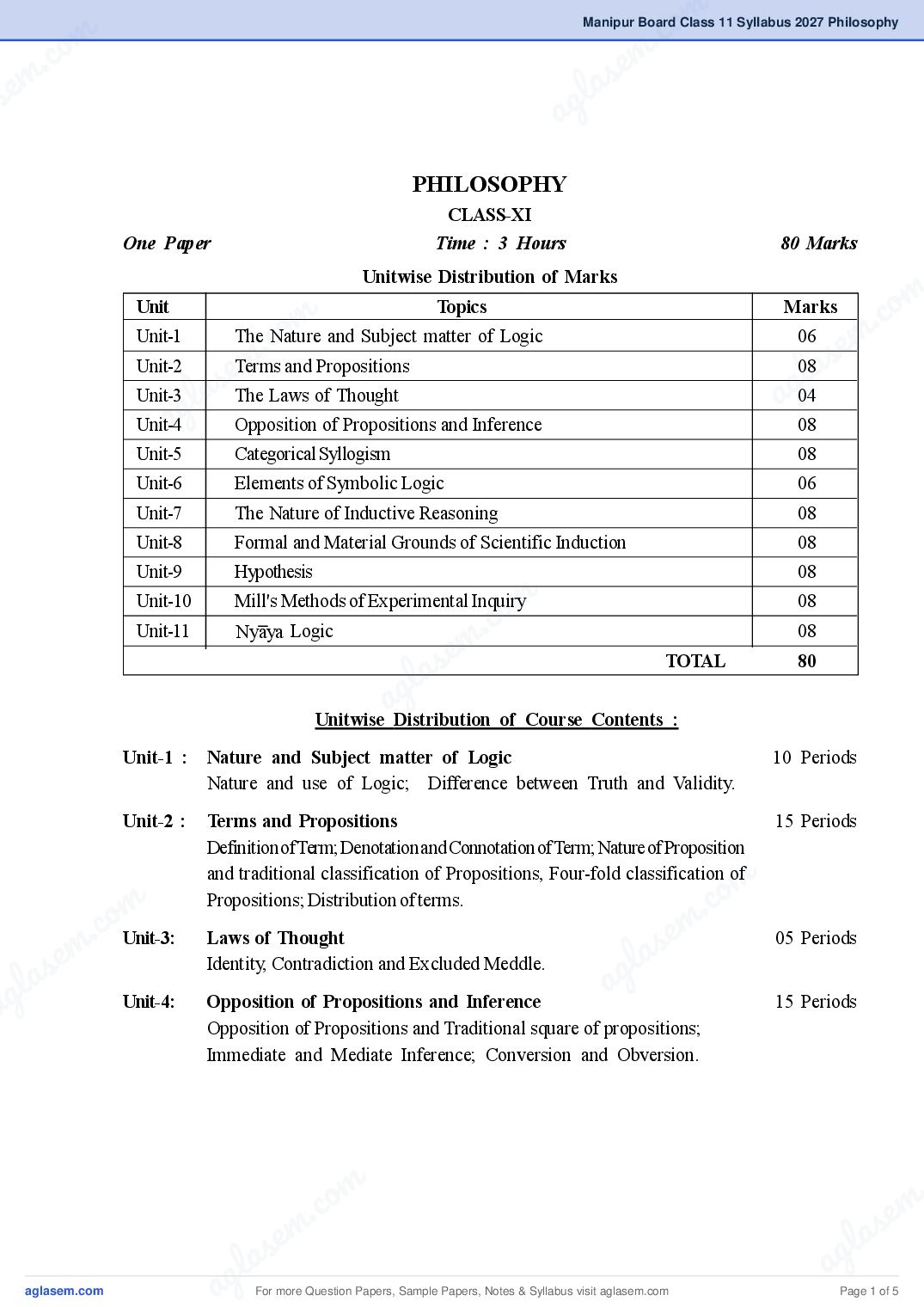
PHILOSOPHY
CLASS-XI
One Paper Time : 3 Hours 80 Marks
Unitwise Distribution of Marks
m
Unit
m Topics Marks
.co
Unit-1
.co
The Nature and Subject matter of Logic
m and Propositions
06
08as
e m
Unit-2
s eTerms g l
Unit-3 la The Laws of Thought a 04
ag Opposition of Propositions and Inference
Unit-4 08
Unit-5 Categorical Syllogism 08
Unit-6 Elements of Symbolic Logic 06
Unit-7 The Nature of Inductive Reasoning 08
Unit-8 Formal and Material Grounds of Scientific Induction 08
Unit-9 Hypothesis 08
m
c. o
Unit-10 Mill's Methods of Experimental Inquiry 08
Unit-11 Nyaya Logic 08
s em TOTAL 80
gl a
a
Unitwise Distribution of Course Contents :
Unit-1 : Nature and Subject matter of Logic 10 Periods
Nature and use of Logic; Difference between Truth and Validity.
Unit-2 : Terms and Propositions 15 Periods
Definition of Term; Denotation and Connotation of Term; Nature of Proposition
and traditional classification of Propositions, Four-fold classification of
m
m
c. oUnit-3:
Propositions; Distribution of terms.
m.co
Laws of Thought
s e
em
05 Periods
s Identity, Contradiction and Excluded Meddle.
g l a
g la a
a Unit-4: Opposition of Propositions and Inference
Opposition of Propositions and Traditional square of propositions;
15 Periods
Immediate and Mediate Inference; Conversion and Obversion.
.co s e m
s em l a
g la ag
a For more Question Papers, Sample Papers, Notes & Syllabus visit Page 1 of 5
Page 3
Its Definition; Rules of Valid Syllogism; Figures and Moods; Fallacies.
Unit-6: Elements of Symbolic Logic 10 Periods
Nature of Symbolic Logic; Value of using symbols in Logic;
Basic Truth - Functions and Truth-Tables.
Unit-7: Nature of Inductive Reasoning 15 Periods
Scientific Induction and its characteristics; Scientific Induction
and Induction by simple enumeration.
Unit-8: Formal and Material Grounds of Scientific Induction 15 Periods
Uniformity of nature and Law of Causation; Observation and
Experiment - Fallacies of Observation.
Unit-9: Hypothesis 15 Periods
Hypothesis and its Importance in Scientific Inquiry; Conditions of Valid
Hypothesis; proofs of Hypothesis :
Unit-10: Mill's Methods of Experimental Inquiry 15 Periods
Method of Agreement, Method of Difference, The Joint Method of Agreement
and Difference, The method of Concomitant Variation and the Method of
Residues.
Unit-11: Nya ya Logic 10 Periods
The Nya ya View on Valid knowledge (Prama), The Four sources of valid
knowledge (Pramanas) with special reference to Perception and Inference
PRESCRIBED TEXTBOOKS :
1. Text Book of Deductive Logic
Bhola Nath Roy
(Published by : S.C. Sarkar & Sons Private Ltd., Calcutta)
2. Text Book of Inductive Logic
Bhola Nath Roy
(Published by : S.C. Sarkar & Sons Private Ltd., Calcutta)
3. An Introduction to Indian Philosophy
S.C. Chatterjee & D.M. Datta
(Published by: Sibendranath Kanjinlal, Superintendent, Calcutta University Press, Calcutta)
For more Question Papers, Sample Papers, Notes & Syllabus visit Page 2 of 5
Page 4
m .co
m .co s e m
se g l a
a
4. Modern Logic (Vol-I): Symbolic Logic
S. Shyamkishore Singh
REFERENCE BOOKS:
m
.co
1. Introduction to Logic
m
.co m
I.M. Copi
m
(Published by Prentice Hall of India Pvt. Ltd., New Delhi) s e
s e l a
2.
l a
The Nyaya Theory of Knowledge
ag
ag S.C. Chatterjee
(Published by: Sibendranath Kanjinlal, Superintendent, Calcutta University Press, Calcutta).
——§§§——
m
m .co
s e
g la
a
m
m .co
m .co s e m
s e g l a
g la a
a
.co s e m
s em l a
g la ag
a For more Question Papers, Sample Papers, Notes & Syllabus visit Page 3 of 5
Page 5
Subject : PHILOSOPHY
Class : XI
Full Marks : 80
Time : 3 Hours
WEITAGE OF OBJECTIVES
Objectives Marks Percentage
Knowledge (K) 20 25
I Understanding (U) 40 50
Application (A) 20 25
Total 80 100
WEITAGE TO FORMS OF QUESTIONS
No. of Time
Forms of questions Marks Percentage
Questions (in minutes)
Essay/Long Answer (E/LA) 4 80 28 35
II Short Answer (SA-I) 4 40 16 20
Short Answer (SA-II) 6 24 12 15
Very Short Answer (VSA) 12 18 12 15
MCQ 12 18 12 15
Total 38 180 80 100
WEITAGE TO CONTENTS :
Marks Percentage
1 The Nature and Subject matter of Logic 6 7.5
2 Terms and Propositions 8 10
3 The Laws of Thought 4 5
4 Opposition of Propositions and Inference 8 10
5 Categorical Syllogism 8 10
III
6 Elements of Symbolic Logic 6 7.5
7 The Nature of Inductive Reasoning 8 10
8 Formal and Material Grounds of Scientific Induction 8 10
9 Hypothesis 8 10
10 Mill's Methods of Experimental Inquiry 8 10
11 Nyaya Logic 8 10
Total 80 100
IV SCHEME OF SECTIONS : NIL
V SCHEME OF OPTIONS : 100% of E/LA and 50% of SA-I
VI DIFFICULTY LEVEL:
Difficult : 30% of the total marks
Average : 50% of the total marks
Easy : 20% of the total marks
Special instructions: 1) Two questions of MCQ will be assertion-reason type questions.
2) One question of SA-I will be source-based question.
Abbreviation: K (Knowledge), U (Understanding), A (Application), S (Skill),
E (Essay), SA (Short Answer), VSA (Very Short Answer), O(Objective),
MCQ (Multiple Choice Question).
For more Question Papers, Sample Papers, Notes & Syllabus visit Page 4 of 5
Page 6
m .co
m .co s e m
se g l a
a
INTERNAL ASSESSMENT
COMPONENT MARKS HOW IT CONDUCTED
m
.co
Minimum 1-3 Unit test during
1. Periodic test
m 10 marks School hour with 3 unit tests
m .co Class work, Home assignment,
s e m
s e 5 marks Notebook, Oral test viva with l a
a ag
2. Subject Enrichment
g l specific subject content
a Class attendance, Interaction,
Group discussion, Listening,
3. Multiple Assessment 5 marks
Speaking test, Discipline,
Neatness
m
m .co
s e
g la
a
m
m .co
m .co s e m
s e g l a
g la a
a
.co s e m
s em l a
g la ag
a For more Question Papers, Sample Papers, Notes & Syllabus visit Page 5 of 5
Document Details
| Board / Org | Manipur Board |
| Exam | Class 11 |
| Type | Syllabus |
| Pages | 5 |
| Updated | 04 Nov 2026 |