NIOS Class 12 October 2024 Question Paper Psychology
Finished viewing? Save it for later —
Download NIOS Class 12 October 2024 Question Paper Psychology (PDF · 32 pages)About NIOS Class 12 October 2024 Question Paper Psychology
NIOS Class 12 October 2024 Question Paper Psychology is available here for free download. Published by NIOS for National Institute of Open Schooling Class 12, this question paper can be viewed online or downloaded as a PDF (32 pages). Candidates preparing for National Institute of Open Schooling Class 12 can use NIOS Class 12 October 2024 Question Paper Psychology to understand the exam pattern, the type of questions asked, and the overall difficulty level.
Frequently Asked Questions
How can I download NIOS Class 12 October 2024 Question Paper Psychology?
Open this page and click the Download button to save NIOS Class 12 October 2024 Question Paper Psychology as a PDF. It is completely free on AglaSem Docs.
Is NIOS Class 12 October 2024 Question Paper Psychology free to download?
Yes. NIOS Class 12 October 2024 Question Paper Psychology can be viewed online and downloaded as a PDF free of cost on AglaSem Docs.
How many pages does NIOS Class 12 October 2024 Question Paper Psychology have?
NIOS Class 12 October 2024 Question Paper Psychology contains 32 pages, which you can read online or download together as a single PDF.
Where can I find more National Institute of Open Schooling Class 12 study material?
You can find more National Institute of Open Schooling Class 12 question papers, sample papers, syllabus, and answer keys on AglaSem Docs.
NIOS Class 12 October 2024 Question Paper Psychology – Text
Read the full text of this question paper below — useful to quickly search, copy and reference the content online without downloading the PDF.
📄 View text version (32 pages)
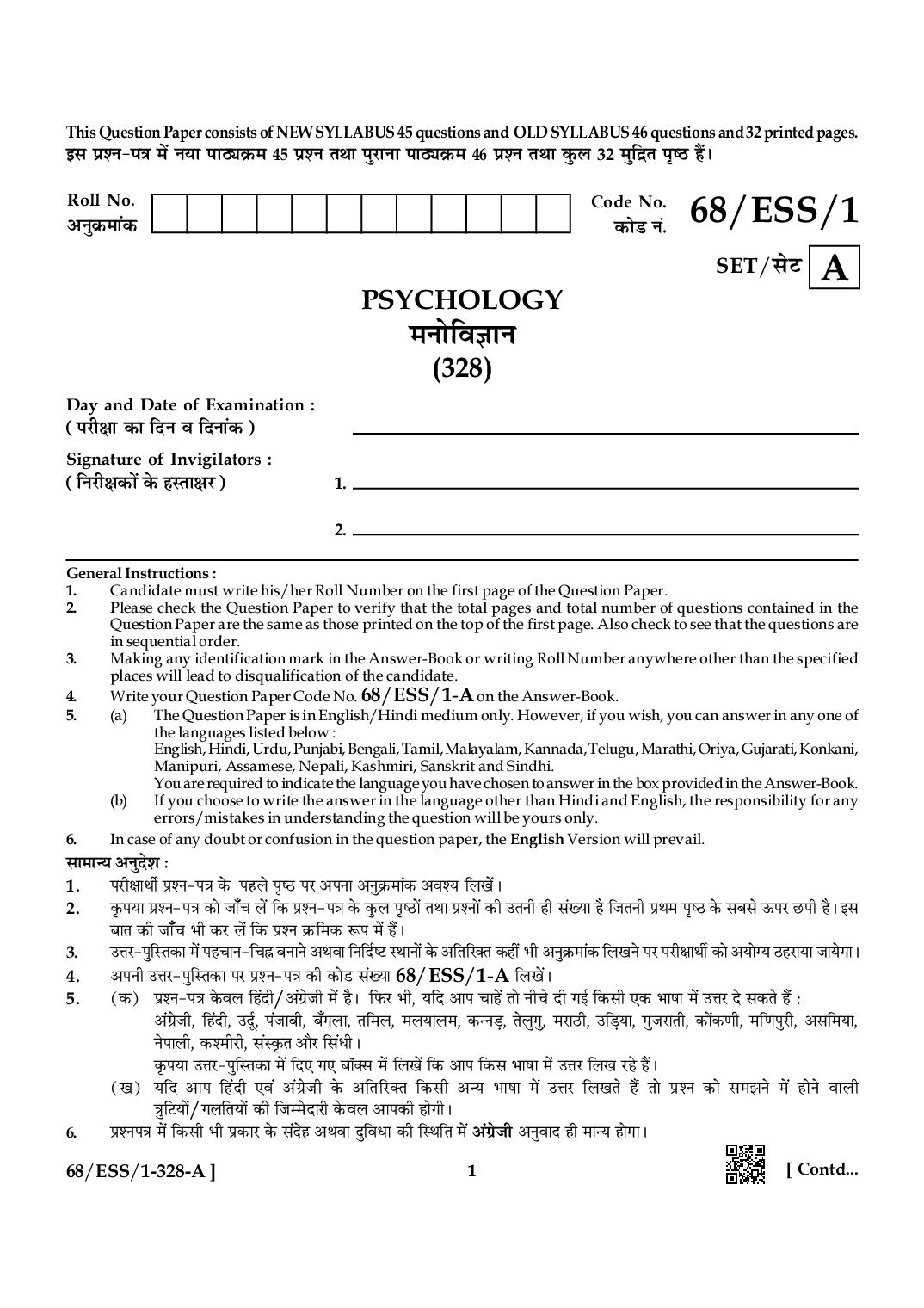
Page 1
ß‚ ¬˝‡Ÿ-¬òÊ ◊¥ ŸÿÊ ¬Ê∆K∑˝§◊ 45 ¬˝‡Ÿ ÃÕÊ ¬È⁄UÊŸÊ ¬Ê∆K∑˝§◊ 46 ¬˝‡Ÿ ÃÕÊ ∑ȧ‹ 32 ◊ÈÁŒ˝Ã ¬Îc∆U „Ò¥–
Roll No. Code No.
•ŸÈ∑˝§◊Ê¥∑§ ∑§Ê«U Ÿ¥.
68/ESS/1
SET/‚ ≈ A
PSYCHOLOGY
◊ŸÊÁflôÊÊŸ
(328)
Day and Date of Examination :
(¬⁄UˡÊÊ ∑§Ê ÁŒŸ fl ÁŒŸÊ¥∑§)
Signature of Invigilators :
(ÁŸ⁄UˡÊ∑§Ê¥ ∑§ „SÃÊˇÊ⁄U) 1.
2.
General Instructions :
1. Candidate must write his/her Roll Number on the first page of the Question Paper.
2. Please check the Question Paper to verify that the total pages and total number of questions contained in the
Question Paper are the same as those printed on the top of the first page. Also check to see that the questions are
in sequential order.
3. Making any identification mark in the Answer-Book or writing Roll Number anywhere other than the specified
places will lead to disqualification of the candidate.
4. Write your Question Paper Code No. 68/ESS/1-A on the Answer-Book.
5. (a) The Question Paper is in English/Hindi medium only. However, if you wish, you can answer in any one of
the languages listed below :
English, Hindi, Urdu, Punjabi, Bengali, Tamil, Malayalam, Kannada, Telugu, Marathi, Oriya, Gujarati, Konkani,
Manipuri, Assamese, Nepali, Kashmiri, Sanskrit and Sindhi.
You are required to indicate the language you have chosen to answer in the box provided in the Answer-Book.
(b) If you choose to write the answer in the language other than Hindi and English, the responsibility for any
errors/mistakes in understanding the question will be yours only.
6. In case of any doubt or confusion in the question paper, the English Version will prevail.
‚Ê◊Êãÿ •ŸÈŒ‡Ê —
1. ¬⁄UˡÊÊÕ˸ ¬˝‡Ÿ-¬òÊ ∑§ §¬„‹ ¬Îc∆U ¬⁄U •¬ŸÊ •ŸÈ∑˝§◊Ê¥∑§ •fl‡ÿU Á‹π¥–
2. ∑Χ¬ÿÊ ¬˝‡Ÿ-¬òÊ ∑§Ê ¡ÊÚ°ø ‹¥ Á∑§ ¬˝‡Ÿ-¬òÊ ∑§ ∑ȧ‹ ¬Îc∆UÊ¥ ÃÕÊ ¬˝‡ŸÊ¥ ∑§Ë ©ÃŸË „Ë ‚¥ÅUÿÊ „Ò Á¡ÃŸË ¬˝Õ◊ ¬Îc∆ ∑ §‚’‚ ™§¬⁄U ¿U¬Ë „Ò– ß‚
’Êà ∑§Ë ¡ÊÚ°ø ÷Ë ∑§⁄U ‹¥ Á∑§ ¬˝‡Ÿ ∑˝ Á◊∑§ UM§¬ ◊¥ „Ò¥–
3. § ©ûÊ⁄U-¬ÈÁSUÃ∑§Ê ◊¥ ¬„øÊŸ-Áøq ’ŸÊŸ •ÕflÊ ÁŸÁŒ¸c≈U SÕÊŸÊ¥ ∑§§•ÁÃÁ⁄UÄà ∑§„Ë¥ ÷Ë •ŸÈ∑§˝ ◊Ê¥∑§ Á‹πŸ ¬⁄U ¬⁄UˡÊÊÕ˸ ∑§Ê •ÿÊÇÿ ∆U„⁄UÊÿÊ ¡ÊÿªÊ–
4. •¬ŸË ©ûÊ⁄U-¬ÈÁSÃ∑§Ê ¬⁄U ¬˝‡Ÿ-¬òÊ ∑§Ë ∑§Ê«U ‚¥ÅÿÊ 68/ESS/1-A Á‹π¥–
5. (∑§) ¬˝‡Ÿ-¬òÊ ∑§fl‹ Á„¥ŒË/•¥ª˝¡Ë ◊¥ „Ò– Á»§⁄U ÷Ë, ÿÁŒ •Ê¬ øÊ„¥ ÃÊ ŸËø ŒË ªß¸ Á∑§‚Ë ∞∑§ ÷Ê·Ê ◊¥ ©ûÊ⁄ Œ ‚∑§Ã „Ò¥ —
•¥ª˝¡Ë, Á„¥ŒË, ©ŒÍ¸, ¬¥¡Ê’Ë, ’°ª‹Ê, ÃÁ◊‹, ◊‹ÿÊ‹◊, ∑§ãŸ«∏, ËȪÈ, ◊⁄UÊ∆UË, ©Á«∏ÿÊ, ªÈ¡⁄UÊÃË, ∑§Ê¥∑§áÊË, ◊ÁáʬÈ⁄UË, •‚Á◊ÿÊ,
Ÿ¬Ê‹Ë, ∑§‡◊Ë⁄UË, ‚¥S∑Χç•ÊÒ⁄U Á‚¥œË–
∑Χ¬ÿÊ ©ûÊ⁄U-¬ÈÁSÃ∑§Ê ◊¥ ÁŒ∞ ª∞ ’ÊÚÄ‚ ◊¥ Á‹π¥ Á∑§ •Ê¬ Á∑§‚ ÷Ê·Ê ◊¥ ©ûÊ⁄U Á‹π ⁄U„ „Ò¥–
(π) ÿÁŒ •Ê¬ Á„¥ŒË ∞fl¥ •¥ª˝¡Ë ∑§ •ÁÃÁ⁄UÄà Á∑§‚Ë •ãÿ ÷Ê·Ê ◊¥ ©ûÊ⁄U Á‹πà „Ò¥ ÃÊ ¬˝‡Ÿ ∑§Ê ‚◊¤ÊŸ ◊¥ „ÊŸ flÊ‹Ë
òÊÈÁ≈UÿÊ¥/ª‹ÁÃÿÊ¥ ∑§Ë Á¡ê◊UŒÊ⁄Ë ∑ fl‹ •Ê¬∑§Ë „ʪ˖
6. ¬˝‡Ÿ¬òÊ ◊¥ Á∑§‚Ë ÷Ë ¬˝∑§Ê⁄U ∑§ ‚¥Œ„ •ÕflÊ ŒÈÁflœÊ ∑§Ë ÁSÕÁà ◊¥ •¥ª˝¡Ë •ŸÈflÊŒ „Ë ◊Êãÿ „ʪʖ
68/ESS/1-328-A ] 1 [ Contd...
Page 2
1. This Question Paper Booklet contains two Question Papers - one based on revised study material
marked as NEW SYLLABUS and the other based on pre-revised study material marked as
OLD SYLLABUS.
2. NEW SYLLABUS is for those candidates who have registered for 2023-2024 (Stream-I, Block-I)
admission and are appearing in October-2024 Examinations.
3. OLD SYLLABUS is for those candidates who has registered before 2023-24 (Stream-I, Block-I)
admission.
4. Candidates are to answer only one Question Paper from the given two Question Papers.
5. Candidates are not allowed to mix questions from the given two Question Papers.
◊„àfl¬Íáʸ ÁŸŒ¸‡Ê
1. ß‚ ¬˝‡Ÿ-¬òÊ ¬ÈÁSÃ∑§Ê ◊¥ ŒÊ ¬˝‡Ÿ-¬òÊ „Ò¥ - ∞∑§ ‚¥‡ÊÊÁœÃ •äÿÿŸ ‚Ê◊ª˝Ë ¬⁄U •ÊœÊÁ⁄Uà „Ò Á¡‚ ¬⁄U “ŸÿÊ ¬Ê∆K∑˝§◊” •¥Á∑§Ã
„Ò ÃÕÊ ŒÍ‚⁄UÊ ‚¥‡ÊÊœŸ ‚ ¬Ífl¸ •äÿÿŸ ‚Ê◊ª˝Ë ¬⁄U •ÊœÊÁ⁄Uà „Ò Á¡‚ ¬⁄U “¬È⁄UÊŸÊ ¬Ê∆K∑˝§◊” •¥Á∑§Ã „Ò–
2. ŸÿÊ ¬Ê∆K∑˝§◊ ©Ÿ ¬⁄UˡÊÊÁÕ¸ÿÊ¥ ∑§ Á‹∞ „Ò Á¡Ÿ∑§Ê ŸÊ◊Ê¥∑§Ÿ 2023-2024 (S≈˛UË◊-I, é‹ÊÚ∑§-I) ◊¥ „È•Ê „Ò ÃÕÊ ¡Ê •Ä≈UÊ’⁄U
2024 ¬⁄UˡÊÊ ◊¥ ’Ò∆UŸ ¡Ê ⁄U„ „Ò¥–
3. ¬È⁄UÊŸÊ ¬Ê∆K∑˝§◊ ©Ÿ ¬⁄UˡÊÊÁÕ¸ÿÊ¥ ∑§ Á‹∞ „Ò Á¡Ÿ∑§Ê ŸÊ◊Ê¥∑§Ÿ 2023-24 (S≈˛UË◊-I, é‹ÊÚ∑§-I)∑§ ¬„‹ „È•Ê „Ò–
4. ¬⁄UˡÊÊÕ˸ ÁŒ∞ ª∞ ŒÊ ¬˝‡Ÿ-¬òÊÊ¥ ◊¥ ‚ ∑§fl‹ ∞∑§ ¬˝‡Ÿ-¬òÊ ‚ „Ë ©ûÊ⁄U Á‹π¥–
5. ¬⁄UˡÊÊÕ˸ ∑§Ê ŒÊ ¬˝‡Ÿ-¬òÊÊ¥ ∑§ ¬˝‡ŸÊ¥ ∑§Ê Á◊‹Ê∑§⁄U ©ûÊ⁄U ŒŸ ∑§Ë •ŸÈ◊Áà Ÿ„Ë¥ „Ò–
68/ESS/1-328-A ] 2 [ Contd...
Page 3
PSYCHOLOGY
◊ŸÊÁflôÊÊŸ
(328)
Time : 3 Hours ] [ Maximum Marks : 100
‚◊ÿ — 3 ÉÊá≈U ] [ ¬ÍáÊÊZ∑§ — 100
Note :
(i) This question paper consists of 45 questions in all.
(ii) All questions are compulsory.
(iii) Marks are given against each question.
(iv) Section - A consists of
(a) Q.No. 1 to 20 - Multiple Choice type questions (MCQs) carrying 1 mark each. Select and
write the most appropriate option out of the four options given in each of these questions.
(b) Q.No. 21 to 29 - Objective type questions. Q.No. 21 to 23 carrying 2 marks each (with 2 sub-
parts of 1 mark each) and Q.No. 24-29 carries 4 marks (with 4 sub-parts of 1 mark each).
(v) Section - B consists of
(a) Q.No. 30 to 35 - Very Short Answer type questions carrying 2 marks each to be answered in
the range of 30 to 50 words.
(b) Q.No. 36 to 41 - Short Answer type questions carrying 3 marks each to be answered in the
range of 50 to 80 words.
(c) Q.No. 42 to 45 - Long Answer type questions carrying 5 marks each to be answered in the
range of 80 to 120 words.
ÁŸŒ¸‡Ê —
(i) ß‚ ¬˝‡Ÿ-¬òÊ ◊¥ ∑ȧ‹ 45 ¬˝‡Ÿ „Ò¥–
(ii) ‚÷Ë ¬˝‡Ÿ •ÁŸflÊÿ¸ „Ò¥–
(iii) ¬˝àÿ∑§ ¬˝‡Ÿ ∑§ •¥∑§ ©‚ ¬˝‡Ÿ ∑§ ‚Ê◊Ÿ ÁŒ∞ ª∞ „Ò¥–
(iv) πá«U - ∑§ ◊¥ ‚Áê◊Á‹Ã „Ò¥ —
(a) ¬˝‡Ÿ ‚¥ÅÿÊ 1 ‚ 20 Ã∑§ ’„ÈÁfl∑§À¬Ëÿ ¬˝‡Ÿ „Ò¥– ¬˝àÿ∑§ ¬˝‡Ÿ 1 •¥∑§ ∑§ „Ê¥ª– ߟ◊¥ ‚ ¬˝àÿ∑§ ¬˝‡Ÿ ◊¥ ÁŒ∞ ª∞ øÊ⁄U
Áfl∑§À¬Ê¥ ◊¥ ‚’‚ ©¬ÿÈÄà Áfl∑§À¬ ∑§Ê øÿŸ ∑§⁄¥U •ÊÒ⁄U Á‹π¥–
(b) ¬˝‡Ÿ ‚¥ÅÿÊ 21 ‚ 29 Ã∑§ flSÃÈÁŸc∆U ¬˝‡Ÿ „Ò¥– ¬˝‡Ÿ ‚¥ÅÿÊ 21 ‚ 23 Ã∑§ ¬˝àÿ∑§ ∑§ Á‹∞ 2 •¥∑§ „Ò¥– (¬˝àÿ∑§ 1 •¥∑§
∑§ 2 ©¬÷ʪʥ ‚Á„Ã) •ÊÒ⁄U ¬˝‡Ÿ ‚¥ÅÿÊ 24-29 Ã∑§ 4 •¥∑§ ∑§ „Ò¥– (¬˝àÿ∑§ 1 •¥∑§ ∑§ 4 ©¬÷ʪʥ ‚Á„Ö)
(v) πá«U - π§ ◊¥ ‚Áê◊Á‹Ã „Ò¥ —
(a) ¬˝‡Ÿ ‚¥ÅÿÊ 30 ‚ 35 Ã∑§, 2 •¥∑§ flÊ‹ •ÁËÉÊÈ ©ûÊ⁄UËÿ ¬˝‡Ÿ, ¬˝àÿ∑§ ¬˝‡Ÿ ∑§Ê ©ûÊ⁄U 30 ‚ 50 ‡ÊéŒÊ¥ ◊¥ ÁŒÿÊ ¡ÊŸÊ
„Ò–
(b) ¬˝‡Ÿ ‚¥ÅÿÊ 36 ‚ 41 Ã∑§ 3 •¥∑§Ê¥ flÊ‹ ‹ÉÊÈ ©ûÊ⁄UËÿ ¬˝‡ŸÊ¥ ∑§ ©ûÊ⁄U 50 ‚ 80 ‡ÊéŒÊ¥ ∑§Ë ‚Ë◊Ê ◊¥ ŒŸ „Ò¥–
(c) ¬˝‡Ÿ ‚¥ÅÿÊ 42 ‚ 45 Ã∑§ 5 •¥∑§Ê¥ flÊ‹ ŒËÉʸ ©ûÊ⁄UËÿ ¬˝‡ŸÊ¥ ∑§ ©ûÊ⁄U 80 ‚ 120 ‡ÊéŒÊ¥ ∑§Ë ‚Ë◊Ê ◊¥ ŒŸ „Ò¥–
68/ESS/1-328-A ] 3 [ Contd...
Page 4
(1) Answers of all questions are to be given in the Answer-Book given to you.
‚÷Ë ¬˝‡ŸÊ¥ ∑§ ©ûÊ⁄U •Ê¬∑§Ê ŒË ªÿË ©ûÊ⁄U-¬ÈÁSÃ∑§Ê ◊¥ „Ë Á‹π¥–
(2) 15 minutes time has been alloted to read this question paper. The question paper will be
distributed at 02:15 p.m. From 02:15 p.m. to 02:30 p.m., the students will read the question
paper only and will not write any answer on the Answer-Book during this period.
ß‚ ¬˝‡Ÿ-¬òÊ ∑§Ê ¬…∏Ÿ ∑§ Á‹∞ 15 Á◊Ÿ≈U ∑§Ê ‚◊ÿ ÁŒÿÊ ªÿÊ „Ò– ¬˝‡Ÿ-¬òÊ ∑§Ê ÁflÃ⁄UáÊ ŒÊ¬„⁄U ◊¥ 02:15 ’¡ Á∑§ÿÊ
¡Ê∞ªÊ– ŒÊ¬„⁄U 02:15 ’¡ ‚ 02:30 ’¡ Ã∑§ ¿UÊòÊ ∑§fl‹ ¬˝‡Ÿ-¬òÊ ∑§Ê ¬…∏¥ª •ÊÒ⁄U ß‚ •flÁœ ∑§ ŒÊÒ⁄UÊŸ fl
©ûÊ⁄U-¬ÈÁSÃ∑§Ê ¬⁄U ∑§Ê߸ ©ûÊ⁄U Ÿ„Ë¥ Á‹π¥ª–
SECTION - A/πá«U - ∑§
1. Which of the following is NOT a subfield of Psychology ? 1
(A) Clinical Psychology (B) Astrophysics
(C) Developmental Psychology (D) Cognitive Psychology
ÁŸêŸÁ‹Áπà ◊¥ ‚ ∑§ÊÒŸ ‚Ê ◊ŸÊÁflôÊÊŸ ∑§Ê ©¬ˇÊòÊ Ÿ„Ë¥ „Ò?
(A) ŸÒŒÊÁŸ∑§ ◊ŸÊÁflôÊÊŸ (B) πªÊ‹ ÷ÊÒÁÃ∑§Ë
(C) Áfl∑§Ê‚Êà◊∑§ ◊ŸÊÁflôÊÊŸ (D) ‚¥ôÊÊŸÊà◊∑§ ◊ŸÊÁflôÊÊŸ
2. Tanima tries to explain the factors leading to stress and predicts the effects of the stress. 1
What is the key difference between the prediction and explanation in research ?
(A) Prediction focuses on the future, while explanation focuses on the past.
(B) Prediction establishes causation, while explanation describes relationships.
(C) Prediction anticipates outcomes, while explanation clarifies why outcomes occur.
(D) Prediction is qualitative, while explanation is quantitative.
ßË◊Ê ÃŸÊfl ∑§Ë •Ê⁄U ‹ ¡ÊŸ flÊ‹ ∑§Ê⁄U∑§Ê¥ ∑§Ê Áflfl⁄UáÊ ŒÃ „È∞ ©Ÿ∑§Ê ßÊfl ¬⁄U ¬Ífl¸∑§ÕŸ ∑§⁄UÃË „Ò– •ŸÈ‚¥œÊŸ ◊¥
√ÿÊÅÿÊ fl ¬ÍflʸŸÈ◊ÊŸ ◊¥ ÄÿÊ ◊ÈÅÿ •¥Ã⁄U „Ò?
(A) ¬Ífl¸∑§ÕŸ ÷Áflcÿ ¬⁄U ∑§ÁãŒ˝Ã „Ò ¡’Á∑§ √ÿÊÅÿÊ ÷ÍÃ∑§Ê‹ ¬⁄U ∑§ÁãŒ˝Ã „Ò–
(B) ¬Ífl¸∑§ÕŸ ∑§⁄UáÊËÿ ‚¥’¥œ SÕÊÁ¬Ã ∑§⁄UÃÊ „Ò ¡’Á∑§ √ÿÊÅÿÊ •Ê¬‚Ë ‚¥’¥œÊ¥ ∑§Ê ÁflSÃÊ⁄U ‚ ‚◊¤ÊÊÃÊ „Ò–
(C) ¬Ífl¸∑§ÕŸ ¬Á⁄UáÊÊ◊ ∑§Ë •Ê‡ÊÊ ∑§⁄UÃÊ „Ò ¡’Á∑§ √ÿÊÅÿÊ ¬Á⁄UáÊÊ◊ ÄÿÊ¥ •ÊÿÊ „Ò, ∑§Ê S¬c≈UË∑§⁄UáÊ ŒÃÊ „Ò–
(D) ¬Ífl¸∑§ÕŸ ªÈáÊÊà◊∑§ „Ò ¡’Á∑§ √ÿÊÅÿÊ ◊ÊòÊÊà◊∑§ „Ò–
3. A psychologist conducted a survey to examine the frequency of different types of phobias in 1
a community. What type of graph would be most useful to represent the percentage
distribution of various phobia types ?
(A) Bar chart (B) Scatter plot (C) Line graph (D) Pie chart
∞∑§ ◊ŸÊflÒôÊÊÁŸ∑§ Ÿ ‚◊Ê¡ ◊¥ ÁflÁ÷㟠¬˝∑§Ê⁄U ∑§ ŒÈ÷˸Áà ∑§Ë •ÊflÎÁûÊ ∑§ ¬⁄UˡÊáÊ ∑§ Á‹∞ ‚fl¸ ‚¥øÊÁ‹Ã Á∑§ÿÊ– ÁflÁ÷ãŸ
¬˝∑§Ê⁄U ∑§ ŒÈ÷˸Áà ∑§Ê ¬˝ÁÇÊà ÁflÃ⁄UáÊ ¬˝ŒÁ‡Ê¸Ã ∑§⁄UŸ ∑§ Á‹∞ Á∑§‚ ¬˝∑§Ê⁄U ∑§Ê ª˝Ê»§ ‚’‚ ©¬ÿÊªË ⁄U„ªÊ?
(A) ’Ê⁄U •Ê⁄Uπ (B) S∑Ò§≈U⁄U å‹ÊÚ≈U (C) ⁄UπËÿ •Ê⁄Uπ (D) ¬Ê߸ øÊ≈¸U
68/ESS/1-328-A ] 4 [ Contd...
Page 5
space in the form of visual images to remember a list of items ?
(A) Method of Loci (B) Acronym
(C) Keyword technique (D) Pegword method
fl„ ∑§ÊÒŸ ‚Ë ÁŸ◊ÊÁŸ∑§ Ã∑§ŸË∑§ „Ò Á¡‚◊¥ Á∑§‚Ë ¬Á⁄UŒÎ‡ÿ ∑§Ê ‚ΡŸ ∑§⁄U •ÕflÊ flSÃÈ•Ê¥ ∑§Ê ÷ÊÒÁÃ∑§ SÕÊŸ ¬⁄U ß‚ ¬˝∑§Ê⁄U
√ÿflÁSÕà Á∑§ÿÊ ¡ÊÃÊ „Ò Á∑§ ©Ÿ∑§Ë ŒÎ‡ÿ ¿UÁfl ‚ „Ë flSÃÈ•Ê¥ ∑§Ë ‚ÍøË ∑§Ê ÿÊŒ Á∑§ÿÊ ¡Ê ‚∑§ÃÊ „Ò–
(A) SÕÊŸ ÁflÁœ (B) ¬Á⁄UfláÊ˸
(C) ◊ÈÅÿ ‡ÊéŒ ÁflÁœ (D) ¬ªfl«¸U ÁflÁœ
5. This theory of emotion maintains that emotions are comprised of two factors : 1
Physiological and cognitive.
(A) The James - Lange Theory (B) The Cannon - Bard Theory
(C) The Physiological Theory (D) The Schachter - Singer Theory
‚¥flª ∑§Ê ÿ„ Á‚hʥà ◊ÊŸÃÊ „Ò Á∑§ ‚¥flª ŒÊ ∑§Ê⁄U∑§Ê¥ ‚ ’ŸÊ „ÊÃÊ „Ò — ‡ÊÊ⁄UËÁ⁄U∑§ •ÊÒ⁄U ‚¥ôÊÊŸÊà◊∑§–
(A) ¡ê‚ - ‹Ê¥¡ Á‚hÊãà (B) ∑Ò§ŸŸ - ’Ê«¸U Á‚hÊãÃ
(C) ‡ÊÊ⁄UËÁ⁄U∑§ Á‚hÊãà (D) ‡ÊÊÚÄ≈U⁄U - Á‚¥ª⁄U Á‚hÊãÃ
6. In the context of problem-solving, what does the term “functional fixedness” refer to ? 1
(A) The tendency to rely on past experiences
(B) The inability to see an object’s potential uses beyond its typical function
(C) The tendency to use trial and error
(D) The preference for creative solutions
‚◊SÿÊ ‚◊ʜʟ ∑§ ‚¥Œ÷¸ ◊¥ “∑§Êÿʸà◊∑§ ÁSÕ⁄UÃÊ” ‚ ÃÊà¬ÿ¸ „Ò?
(A) ¬Ífl¸ •ŸÈ÷flÊ¥ ¬⁄U Áfl‡flÊ‚ ∑§Ë ¬˝flÎÁûÊ
(B) Á∑§‚Ë flSÃÈ ∑§ ‚¥÷ÊÁflà ©¬ÿʪ ∑§Ê ©‚∑§ ÁflÁ‡Êc≈U ∑§Êÿ¸ ‚ •Êª Œπ ¬ÊŸ ∑§Ë •‚◊Õ¸ÃÊ
(C) ¬⁄UˡÊáÊ ∞fl¥ òÊÈÁ≈U ∑§Ê ©¬ÿʪ ∑§⁄UŸ ∑§Ë ¬˝flÎÁûÊ
(D) ‚ΡŸÊà◊∑§ ‚ȤÊÊflÊ¥ ∑§Ê ¬˝ÊÕÁ◊∑§ÃÊ
7. This refers to declarative memory which requires conscious efforts in recalling the previous 1
experiences and information.
(A) Implicit memory (B) Explicit memory
(C) Procedural memory (D) Long term memory
ß‚ ÉÊÊ·áÊÊà◊∑§ S◊ÎÁà ∑§ M§¬ ◊¥ ‚¥ŒÁ÷¸Ã Á∑§ÿÊ ¡ÊÃÊ „Ò Á¡‚∑§ Á‹∞ Á¬¿U‹ •ŸÈ÷flÊ¥ •ÊÒ⁄U ‚ÍøŸÊ•Ê¥ ∑§Ê ÿÊŒ ∑§⁄UŸ ∑§
Á‹∞ ‚øà ¬˝ÿÊ‚Ê¥ ∑§Ë •Êfl‡ÿ∑§ÃÊ „ÊÃË „Ò–
(A) ÁŸÁ„à S◊ÎÁà (B) S¬c≈U S◊ÎÁÃ
(C) ¬˝Á∑˝§ÿÊ ◊Í‹∑§ S◊ÎÁà (D) ŒËÉʸ∑§Ê‹ËŸ S◊ÎÁÃ
68/ESS/1-328-A ] 5 [ Contd...
Page 6
of information.
(A) Assimilation (B) Accommodation
(C) Organization (D) Equilibration
¡’ ’ëø •¬ŸË ◊ÊÒ¡ÍŒÊ ÿÊ¡ŸÊ•Ê¥ ◊¥ Ÿß¸ ¡ÊŸ∑§Ê⁄UË ‡ÊÊÁ◊‹ ∑§⁄Uà „Ò¥ ÃÊ ©‚ ¡ÊŸ∑§Ê⁄UË ∑§Ê __________ ∑§„Ê ¡ÊÃÊ „Ò–
(A) •Êà◊‚ÊÃË∑§⁄UáÊ (B) ‚◊ÊÿÊ¡Ÿ
(C) ‚¥ª∆UŸ (D) ‚¥ÃÈ‹Ÿ
9. Around four months of age infants copy or reproduce someone’s act or language. This is 1
called __________.
(A) Organization (B) Imitation (C) Equilibration (D) Accommodation
‹ª÷ª 4 ◊„ËŸ ∑§Ë ©◊˝ ∑§ Á‡Ê‡ÊÈ Á∑§‚Ë ∑§ ∑§Êÿ¸ ÿÊ ÷Ê·Ê ∑§Ê ¬ÈŸL§à¬ÊŒŸ ∑§⁄Uà „Ò¥ ÃÊ ß‚ __________ ∑§„Ê ¡ÊÃÊ „Ò–
(A) ‚¥ª∆UŸ (B) •ŸÈ∑§⁄UáÊ (C) ‚¥ÃÈ‹Ÿ (D) ‚◊ÊÿÊ¡Ÿ
10. Neeraj can categorize fruits and vegetables of different types in multiple ways such as those 1
based on their colour, taste, size and so forth. This cognitive attainment of the concrete
operational thought is known as __________.
(A) Conservation (B) Classification (C) Seriation (D) Centration
ŸË⁄U¡ ÁflÁ÷㟠¬˝∑§Ê⁄U ∑§ »§‹Ê¥ •ÊÒ⁄U ‚Áé¡ÿÊ¥ ∑§Ê ©Ÿ∑§ ⁄¥Uª, SflÊŒ, •Ê∑§Ê⁄U •ÊÁŒ ∑§ •ÊœÊ⁄U ¬⁄U ∑§ß¸ Ã⁄UË∑§Ê¥ ‚ flªË¸∑ΧÃ
∑§⁄U ‚∑§ÃÊ „Ò– ◊Íø ‚¥Á∑˝§ÿÊà◊∑§ ÁfløÊ⁄UÊ¥ ∑§Ë ∞‚Ë ‚¥ôÊÊŸÊà◊∑§ ©¬‹Áéœ __________ ∑§„‹ÊÃË „Ò–
(A) ‚¥⁄UˇÊáÊ (B) flªË¸∑§⁄UáÊ (C) ∑˝§◊Ê¥∑§Ÿ (D) ∑§ãŒ˝Ë∑§⁄UáÊ
11. Angad thinks more like a scientist. He thinks of all possible solutions of a problem and 1
systematically tests those solutions. This refers to as __________.
(A) Idealistic thinking (B) Adolescent egocentrism
(C) Propositional thought (D) Hypothetical deductive reasoning
•¥ªŒ íÿÊŒÊÃ⁄U ∞∑§ flÒôÊÊÁŸ∑§ ∑§Ë Ã⁄U„ ‚ÊøÃÊ „Ò– fl„ Á∑§‚Ë ‚◊SÿÊ ∑§ ‚÷Ë ‚¥÷ÊÁflà ‚◊ʜʟʥ ∑§ Áfl·ÿ ◊¥ ‚ÊøÃÊ
„Ò •ÊÒ⁄U Á»§⁄U √ÿflÁSÕà M§¬ ‚ ©Ÿ ‚◊ʜʟʥ ∑§Ê ¬⁄UˡÊáÊ ∑§⁄UÃÊ „Ò– ÿ„ __________ ∑§ M§¬ ◊¥ ‚¥ŒÁ÷¸Ã „ÊÃÊ „Ò–
(A) •ÊŒ‡Ê¸flÊŒË ‚Êø (B) Á∑§‡ÊÊ⁄U •„¥∑¥§ÁŒ˝ÃÃÊ
(C) ¬˝SÃÊfl ÁfløÊ⁄U (D) ¬Á⁄U∑§ÊÀ¬ÁŸ∑§ ÁŸª◊ŸÊà◊∑§ Ã∑¸§
12. What does the term “groupthink” refer to in the context of social psychology ? 1
(A) The tendency for group members to conform to a decision without critical evaluation
(B) The process of brainstorming within a group to generate innovative ideas
(C) The tendency for group members to challenge each other’s opinions
(D) The process of reaching consensus through healthy debate
‚◊Ê¡ ◊ŸÊÁflôÊÊŸ ∑§ ‚¥Œ÷¸ ◊¥ “‚◊Í„ Áø¥ÃŸ” ‡ÊéŒ ‚ ÄÿÊ ÃÊà¬ÿ¸ „Ò?
(A) ‚◊Í„ ∑§ ‚ŒSÿÊ¥ ◊¥ •Ê‹ÊøŸÊà◊∑§ ◊ÍÀÿÊ¥∑§Ÿ ∑§ Á’ŸÊ „Ë ‚ŒSÿÊ¥ ∑§Ë ÁŸáʸÿÊ¥ ¬⁄U ‚„◊ÁÃ
(B) ‚◊Í„ ◊¥ ’ÈÁh‡ÊË‹ÃÊ ∑§Ë ¬˝Á∑˝§ÿÊ mÊ⁄UÊ ŸflËŸ ÁfløÊ⁄U ¬ÒŒÊ ∑§⁄UŸÊ
(C) ‚◊Í„ ∑§ ‚ŒSÿÊ¥ mÊ⁄UÊ ∞∑§ ŒÍ‚⁄U ∑§ ÁfløÊ⁄UÊ¥ ∑§Ê øÈŸÊÒÃË ŒŸ ∑§Ë ¬˝flÎÁûÊ
(D) SflSÕ flÊŒ-ÁflflÊŒ mÊ⁄UÊ ‚„◊Áà Ã∑§ ¬„È°øŸ ∑§Ë ¬˝Á∑˝§ÿÊ
68/ESS/1-328-A ] 6 [ Contd...
Page 7
topic. After the discussion, it was observed that the group’s opinions became more extreme.
Which phenomenon does this demonstrate ?
(A) Social loafing (B) Group polarization
(C) Group think (D) Social facilitation
∞∑§ “©ŒÊ⁄UflÊŒË ⁄UÊ¡ŸÒÁÃ∑§ ÁfløÊ⁄UœÊ⁄UÊ flÊ‹Ê ∞∑§ ‚◊Í„ ∞∑§ ÁflflÊŒÊS¬Œ Áfl·ÿ ¬⁄U ’„‚ ∑§⁄UÃÊ „Ò– ’„‚ ∑§ ’ÊŒ ÿ„
¬ÊÿÊ ªÿÊ Á∑§ ‚◊Í„ ∑§Ë ÁfløÊ⁄UœÊ⁄UÊ •Áœ∑§ ø⁄U◊¬¥ÕË „Ê ªß¸– ÿ„ Á∑§‚ ÉÊ≈UŸÊ ∑§Ê ¬˝ŒÁ‡Ê¸Ã ∑§⁄UÃÊ „Ò?
(A) ‚Ê◊ÊÁ¡∑§ SflÒ⁄UÊøÊ⁄U (B) ‚◊Í„ œ˝ÈflË∑§⁄UáÊ
(C) ‚◊Í„ Áø¥ÃŸ (D) ‚Ê◊ÊÁ¡∑§ ‚ÊÒ∑§ÿ¸
14. What is the initial stage in group development according to Tuckman’s model ? 1
(A) Storming (B) Forming (C) Norming (D) Performing
“≈U∑§◊ÒŸ ◊ÊÚ«U‹” ∑§ •ŸÈ‚Ê⁄U ‚◊Í„ Áfl∑§Ê‚ ∑§Ê ¬˝Ê⁄¥UÁ÷∑§ ø⁄UáÊ ∑§ÊÒŸ ‚Ê „Ò?
(A) Áflå‹flŸ (B) ÁŸ◊ʸáÊ (C) ◊ÊŸ∑§ ÁŸ◊ʸáÊ (D) ÁŸc¬ÊŒŸ
15. Rakhi has organised a weekly cleanliness drive in her locality. Identify this component of the 1
attitude system.
(A) Cognitive (B) Affective (C) Behavioural (D) Extremeness
⁄UÊπË •¬Ÿ ◊Ê„À‹ ◊¥ ‚ÊåÃÊÁ„∑§ Sflë¿UÃÊ •Á÷ÿÊŸ •ÊÿÊÁ¡Ã ∑§⁄U øÈ∑§Ë „Ò– •Á÷flÎÁûÊ Ã¥òÊ ∑§ ß‚ ÉÊ≈U∑§ ∑§Ê
¬„øÊÁŸÿ–
(A) ‚¥ôÊÊŸÊà◊∑§ (B) ÷ÊflŸÊà◊∑§ (C) √ÿÊfl„ÊÁ⁄U∑§ (D) ÁŸÃÊ¥ÃÃÊ/•Ê‹¥ÁÃ∑§ÃÊ
16. Bani observes that her mother feels happy when she finishes food. She is forming an attitude 1
through __________.
(A) Classical Conditioning (B) Operant Conditioning
(C) Modelling (D) Social Comparison
’ÊŸË ÿ„ ŒπÃË „Ò Á∑§ ©‚∑§Ë ◊Ê° Ã’ ¬˝‚㟠„ÊÃË „Ò ¡’ fl„ •¬ŸÊ ÷Ê¡Ÿ ‚◊Êåà ∑§⁄U ŒÃË „Ò– fl„ __________ ∑§
◊Êäÿ◊ ‚ •Á÷flÎÁûÊ ÁŸ◊ʸáÊ ∑§⁄U ⁄U„Ë „Ò–
(A) ¬˝ÊøËŸ •ŸÈ’¥œŸ (B) Á∑˝§ÿÊ ¬˝‚Íà •ŸÈ’¥œŸ
(C) ◊ÊÚ«UÁ‹¥ª (D) ‚Ê◊ÊÁ¡∑§ ÃÈ‹ŸÊ
17. A period of loss of interest or pleasure in most activities, together with other symptoms 1
which may include a change in body weight, constant sleep problems, tiredness, inability to
think clearly etc. may indicate presence of __________.
(A) Bipolar disorder (B) Major depressive disorder
(C) Mood disorder (D) Anxiety disorder
∞‚Ë •flÁœ Á¡‚◊¥ •Áœ∑§Ê¥‡Ê ªÁÃÁflÁœÿÊ¥ ◊¥ M§Áø ÿÊ •ÊŸ¥Œ ∑§Ë „ÊÁŸ ∑§ ‚ÊÕ-‚ÊÕ •ãÿ ‹ˇÊáÊÊ¥ ¡Ò‚ ‡Ê⁄UË⁄U ∑§ fl$¡Ÿ
◊¥ ’Œ‹Êfl, ‹ªÊÃÊ⁄U ŸË¥Œ ∑§Ë ‚◊SÿÊ, Õ∑§ÊŸ, S¬c≈U M§¬ ‚ ‚ÊøŸ ◊¥ •‚◊Õ¸ÃÊ •ÊÁŒ __________ ∑§ „ÊŸ ∑§Ê
‚¥∑§Ã ∑§⁄Uà „Ò¥–
(A) Ámœ˝ÈflË Áfl∑§Ê⁄U (B) ¬˝◊Èπ •fl‚ÊŒ Áfl∑§Ê⁄U
(C) ◊ŸÊŒ‡ÊÊ Áfl∑§Ê⁄U (D) Áø¥ÃÊ Áfl∑§Ê⁄U
68/ESS/1-328-A ] 7 [ Contd...
Page 8
development of certain mental disorders. This refers to __________ as the cause of some
psychological disorders.
(A) Heredity (B) Biochemical factors
(C) Brain Damage (D) Psychological factors
◊ÁSÃc∑§ ◊¥ ãÿÍ⁄UÊ≈˛UÊ¥‚◊Ë≈U⁄U ◊¥ ª«∏’«∏Ë ∑ȧ¿U ◊ÊŸÁ‚∑§ Áfl∑§Ê⁄UÊ¥ ∑§ Áfl∑§Ê‚ ◊¥ ◊„ûfl¬Íáʸ ÷ÍÁ◊∑§Ê ÁŸ÷ÊÃË „Ò– ß‚∑§Ê ‚¥Œ÷¸
__________ ‚ „ÊÃÊ „Ò Á¡‚ ∑ȧ¿U ◊ÊŸÁ‚∑§ Áfl∑§Ê⁄UÊ¥ ∑§Ê ∑§Ê⁄UáÊ ◊ÊŸÊ ¡ÊÃÊ „Ò–
(A) •ŸÈflÊ¥Á‡Ê∑§ÃÊ (B) ¡Òfl ⁄UÊ‚ÊÿÁŸ∑§ ∑§Ê⁄U∑§
(C) ◊ÁSÃc∑§ ˇÊÁà (D) ◊ŸÊflÒôÊÊÁŸ∑§ ∑§Ê⁄U∑§
19. Radhika was facing stress due to strained interpersonal relationships at home. This can be 1
attributed to __________.
(A) Biological factors (B) Physiological changes
(C) Psychological factors (D) Political factors
⁄UÊÁœ∑§Ê ÉÊ⁄U ¬⁄U ßÊfl¬Íáʸ ¬Ê⁄US¬Á⁄U∑§ ‚¥’¥œÊ¥ ∑§ ∑§Ê⁄UáÊ ÃŸÊfl ◊„‚Í‚ ∑§⁄U ⁄U„Ë ÕË– ß‚∑§Ê ∑§Ê⁄UáÊ __________ „Ê
‚∑§ÃÊ „Ò–
(A) ¡ÒÁfl∑§ ∑§Ê⁄U∑§ (B) ‡ÊÊ⁄UËÁ⁄U∑§ ¬Á⁄UfløŸ
(C) ◊ŸÊÒflÒôÊÊÁŸ∑§ ∑§Ê⁄U∑§ (D) ⁄UÊ¡ŸÒÁÃ∑§ ∑§Ê⁄U∑§
20. Neerja experiences recurrent attacks of anxiety in which she experiences intense terror. She 1
is likely to be suffering from __________.
(A) Mania (B) Panic attack (C) Phobia (D) Depression
ŸË⁄U¡Ê ∑§Ê ’Ê⁄U-’Ê⁄U ÁøãÃÊ ∑§ „◊‹Ê¥ ∑§Ê •ŸÈ÷fl „ÊÃÊ „Ò Á¡‚◊¥ ©‚ •àÿÊÁœ∑§ ÷ÿ ‹ªÃÊ „Ò– ÿ„ ∑§Ê»§Ë ‚¥÷ÊflŸÊ „Ò
Á∑§ fl„ __________ ‚ ¬⁄U‡ÊÊŸ „Ò–
(A) ©ã◊ÊŒ (B) Áøãà Áfl∑§Ê⁄U (C) ŒÈ÷˸Áà (D) •fl‚ÊŒ
21. State whether the following statements are true or false. 2
(a) Applied psychology is primarily focused on conducting research and advancing
theoretical knowledge.
(b) Environmental psychology studies the relationship between people and their physical
environment, exploring how factors like design, nature, and space impact behaviour
and well-being.
’ÃÊ∞° Á∑§ ŸËø ÁŒ∞ ª∞ ∑§ÕŸ ‚àÿ „Ò ÿÊ •‚àÿ–
(a) ∞å‹Êß«U ◊ŸÊÁflôÊÊŸ •ŸÈ‚¥œÊŸ ∑§⁄UŸ fl ‚ÒhÊÁãÃ∑§ ôÊÊŸ ∑§Ê •Êª ’…UÊŸ ¬⁄U ¬˝ÊÕÁ◊∑§ ’‹ „ÊÃÊ „Ò–
(b) ¬ÿʸfl⁄UáÊ ◊ŸÊÁflôÊÊŸ ‹ÊªÊ¥ •ÊÒ⁄U ©Ÿ∑§ ÷ÊÒÁÃ∑§ ¬ÿʸfl⁄UáÊ ∑§ ’Ëø ‚¥’¥œ ∑§Ê •äÿÿŸ „Ò– fl„ Á«U¡Ê߸Ÿ, ¬˝∑ΧÁÃ
•ÊÒ⁄U SÕÊŸ ¡Ò‚ ∑§Ê⁄U∑§Ê¥ ∑§Ê √ÿfl„Ê⁄U fl ∑§ÀÿÊáÊ ¬⁄U ¬˝÷Êfl ∑§Ê •ãfl·áÊ ∑§⁄Uà „Ò¥–
68/ESS/1-328-A ] 8 [ Contd...
Page 9
(a) Adolescents might think what ideal standards are and they might compare themselves
and others against those standards.
(b) Formal operational thinkers can solve problems merely through verbal presentation of
the problems.
ÁŸêŸÁ‹Áπà flÊÄÿÊ¥ ◊¥ ¬Á⁄U‹ÁˇÊà “‚¥¬˝àÿÿÊ¥” ∑§Ë ¬„øÊŸ ∑§ËÁ¡∞–
(a) Á∑§‡ÊÊ⁄U ‚Êø ‚∑§Ã „Ò Á∑§ •ÊŒ‡Ê¸ ◊ÊŸ∑§ ÄÿÊ „Ò •ÊÒ⁄U fl ©Ÿ ◊ÊŸ∑§Ê ‚ πÈŒ ∑§Ë •ÊÒ⁄U ŒÍ‚⁄UÊ¥ ∑§Ë ÃÈ‹ŸÊ ∑§⁄U ‚∑§Ã
„Ò–¥
(b) •ÊÒ¬øÊÁ⁄U∑§ ‚¥Á∑˝§ÿÊà◊∑§ ÁfløÊ⁄U∑§ ‚◊SÿÊ•Ê¥ ∑§Ë ◊ÊÒÁπ∑§ ¬˝SÃÈÁà ∑§ ◊Êäÿ◊ ‚ ‚◊SÿÊ•Ê¥ ∑§Ê „‹ ∑§⁄U ‚∑§Ã
„Ò–¥
23. Preeti experiences repeated and unreasonable thoughts about dirt on her hands. Thus, she 2
washes her hands every time she touches something. Which of the following (any two) is
True of the condition that she is facing ?
(a) She is affected by obsessive-compulsive disorder
(b) She can control her preoccupation with specific ideas or can also prevent herself from
repeatedly carrying out a particular act.
(c) This affects her ability to carry out normal activities.
(d) She often finds these thoughts to be unpleasant an shameful.
(e) Her symptoms include recurrent dreams, flashbacks, impaired concentration, and
emotional numbing.
(f) Compulsive behaviour is the need to perform certain behaviour over and over again.
¬˝ËÁà ’Ê⁄U-’Ê⁄U •¬Ÿ „ÊÕÊ¥ ¬⁄U œÍ‹ Á◊^Ë „ÊŸ ¡Ò‚ ÁfløÊ⁄UÊ¥ ∑§Ê •ŸÈ÷fl ∑§⁄UÃË „Ò– ß‚Á‹∞ fl„ Á∑§‚Ë ÷Ë flSÃÈ ∑§Ê ¿ÍUŸ
∑§ ’ÊŒ „ÊÕ œÊÃË „Ò– ÁŸêŸ ◊¥ fl„ ∑§ÊÒŸ ‚Ë (∑§Ê߸ ŒÊ) ¬Á⁄UÁSÕÁÃÿÊ¥ ∑§Ê ‚Ê◊ŸÊ ∑§⁄U ⁄U„Ë „Ò?
(a) fl„ ◊ŸÊªÎSÃÃÊ-’ÊäÿÃÊ Áfl∑§Ê⁄U ‚ ¬˝÷ÊÁflà „Ò–
(b) fl„ ∞∑§ ÁflÁ‡Êc≈U ÁfløÊ⁄U ‚ •¬ŸË √ÿSÃÃÊ•Ê¥ ∑§Ê ÁŸÿ¥ÁòÊà ∑§⁄U ‚∑§ÃË „Ò •ÕflÊ Á∑§‚Ë ∞∑§ ∑§Ê◊ ∑§Ê ’Ê⁄U-’Ê⁄U
∑§⁄UŸ ‚ •¬Ÿ •Ê¬ ∑§Ê ⁄UÊ∑§ ‚∑§ÃË „Ò–
(c) ß‚∑§Ê ¬˝÷Êfl ©‚∑§ ‚Ê◊Êãÿ Á∑˝§ÿÊ ∑§‹Ê¬Ê¥ ∑§ ÁŸfl¸„Ÿ ¬⁄U ÷Ë ¬«∏ÃÊ „Ò–
(d) •Áœ∑§Ã⁄U ‚◊ÿ ©‚ •¬Ÿ ÿ„ ÁfløÊ⁄U ŒÈ—πË ∑§⁄UŸ flÊ‹ fl ‡Ê◊¸ŸÊ∑§ ‹ªÃ „Ò¥–
(e) ©‚∑§ ‹ˇÊáÊÊ¥ ◊¥ ’Ê⁄U-’Ê⁄U •ÊŸflÊ‹ ‚¬Ÿ, ¬È⁄UÊŸË ’ÊÃ¥, ∞∑§Êª˝ÃÊ ∑§Ê •÷Êfl •ÊÒ⁄U ÷ÊflŸÊà◊∑§ ‚È㟬ŸÊ
‚Áê◊Á‹Ã „Ò– .
(f) Á∑§‚Ë √ÿfl„Ê⁄U ∑§Ê ’Ê⁄U-’Ê⁄U ∑§⁄UŸ ∑§Ë •Êfl‡ÿ∑§ÃÊ ’Êäÿ∑§Ê⁄UË √ÿfl„Ê⁄U ∑§„‹ÊÃË „Ò–
68/ESS/1-328-A ] 9 [ Contd...
Page 10
(a) Procedural memory is a type of non-declarative memory that involves the recall of
skills and habits, rather than facts and information.
(b) Memory is a single, unified process.
(c) Chunking is a strategy where information is grouped into meaningful units, making it
easier to remember and recall.
(d) Elaborative rehearsal, which involves making meaningful connections to information,
is generally more effective for long-term memory than simple repetition (maintenance
rehearsal).
S◊ÎÁà ¬˝Á∑˝§ÿÊ ∑§ ’Ê⁄U ◊¥ ÁŸêŸ ∑§ÕŸÊ¥ ∑§Ë ‚àÿ/•‚àÿ „ÊŸ ∑§Ë ¬„øÊŸ ∑§ËÁ¡∞–
(a) ¬˝Á∑˝§ÿÊ ◊Í‹∑§ S◊ÎÁÃ, ªÒ⁄U ÉÊÊ·áÊÊà◊∑§ S◊ÎÁà ∑§Ê ∞‚Ê ¬˝∑§Ê⁄U „Ò Á¡‚◊¥ ‚ÍøŸÊ ∞fl¥ ÃâÿÊ¥ ∑§Ë •¬ˇÊÊ ŒˇÊÃÊ •ÊÒ⁄U
•ÊŒÃÊ¥ ∑§Ê ÿÊŒ ∑§⁄UŸÊ ‚Áê◊Á‹Ã „Ò–
(b) S◊ÎÁà ∞∑§‹ ∞∑§Ë∑Χà ¬˝Á∑˝§ÿÊ „Ò–
(c) π¥«UËÿŸ ÁflÁœ ∞∑§ ∞‚Ë ⁄UáÊŸËÁà „Ò Á¡‚∑§ •ãøªÃ ¡ÊŸ∑§ÊÁ⁄UÿÊ¥ ∑§Ê •Õ¸¬Íáʸ ß∑§Ê߸ÿÊ¥ ◊¥ ∞‚ ’Ê¥≈UÊ ¡ÊÃÊ „Ò Á∑§
©ã„¥ ÿÊŒ ∑§⁄U ¬ÈŸ— ÿÊŒ ∑§⁄UŸÊ •Ê‚ÊŸ „Ê ¡Ê∞–
(d) ‚ÈÁflSÃÎà ¬ÍflʸèÿÊ‚ Á¡‚◊¥ ‚ÍøŸÊ•Ê¥ ◊¥ •Õ¸¬Íáʸ ‚¥’¥œ SÕÊÁ¬Ã Á∑§ÿÊ ¡ÊÃÊ „Ò– ŒÊ„⁄UÊfl (⁄Uπ⁄UπÊfl ¬ÍflʸèÿÊ‚)
∑§Ë ÃÈ‹ŸÊ ◊¥ ‚ÊœÊ⁄UáÊ× ŒËÉʸ∑§Ê‹ËŸ S◊ÎÁà ∑§ Á‹∞ •Áœ∑§ ¬˝÷Êfl‡ÊÊ‹Ë „ÊÃÊ „Ò–
25. Rakesh and Manoj’s ego devises strategies to divert energy to safe activities to protect itself
from the demands of the id. Thus using the defense mechanism to reduce anxiety. State the
defence mechanism used by them in each statement. 1x4=4
(a) Manoj is diverting attention from the anxiety-causing urges to acceptable activities.
(b) Rakesh is forcefully suppressing the anxiety causing memories or events.
(c) Rakesh is refusing to accept the existence of anxiety-producing events.
(d) Manoj has unacceptable impulses, which are denied entry into consciousness and are
projected (displaced) onto others.
⁄UÊ∑§‡Ê •ÊÒ⁄U ◊ŸÊ¡ ∑§Ê •„◊˜ ߌ¥ ∑§Ë ◊Ê¥ªÊ¥ ‚ ’øÊŸ ∑§ Á‹∞ ™§¡Ê¸ ∑§Ê ‚È⁄UÁˇÊà ªÁÃÁflÁœÿÊ¥ ◊¥ ’Œ‹Ÿ ∑§Ë ⁄UáÊŸËÁà ÃÒÿÊ⁄U
∑§⁄Uà „Ò¥– ß‚ Ã⁄U„ fl„ •¬ŸË ÁøãÃÊ ∑§◊ ∑§⁄UŸ ∑§ Á‹∞ ⁄UˇÊÊÃ¥òÊ ∑§Ê ¬˝ÿʪ ∑§⁄U ⁄U„ „Ò¥– ¬˝àÿ∑§ ∑§ÕŸ ◊¥ ©Ÿ∑§ mÊ⁄UÊ
¬˝ÿÈÄà ⁄UˇÊÊÃ¥òÊ ∑§Ê ŸÊ◊ ’ÃÊßÿ–
(a) ◊ŸÊ¡ Áø¥ÃÊ ¬ÒŒÊ ∑§⁄UŸ flÊ‹Ë ßë¿UÊ•Ê¥ ‚ äÿÊŸ „≈UÊ∑§⁄U ©‚ SflË∑§Êÿ¸ ªÁÃÁflÁœÿÊ¥ ∑§Ë •Ê⁄U ◊Ê«∏ ‹ÃÊ „Ò–
(b) ⁄UÊ∑§‡Ê Áø¥ÃÊ ©à¬ãŸ ∑§⁄UŸ flÊ‹Ë S◊ÎÁÃÿÊ¥ ÿÊ ÉÊ≈UŸÊ•Ê¥ ∑§Ê ’‹¬Ífl¸∑§ Œ’Ê ŒÃÊ „Ò–
(c) ⁄UÊ∑§‡Ê Áø¥ÃÊ ©à¬ãŸ ∑§⁄UŸ flÊ‹Ë ÉÊ≈UŸÊ•Ê¥ ∑§ „ÊŸ ∑§Ê „Ë •SflË∑§Ê⁄U ⁄U„Ê „Ò–
(d) ◊ŸÊ¡ ◊¥ •SflË∑§Êÿ¸ •Êflª „Ò ©‚Ÿ ©ã„¥ øÃŸÊ ◊¥ ¬˝fl‡Ê ‚ fl¥Áøà ∑§⁄U ÁŒÿÊ „Ò •ÊÒ⁄U ©ã„¥ ŒÍ‚⁄UË •Ê⁄U ¬˝ˇÊÁ¬Ã ∑§⁄U
ÁŒÿÊ „Ò–
68/ESS/1-328-A ] 10 [ Contd...
Page 11
(a) Schemas (i)
The application of techniques that worked in similar situations
in the past
(b) Heuristics (ii) Cognitive frameworks that represent our knowledge and
assumptions about the world
(c) Trial and Error (iii) The simplest problem solving approach.
(d) Analogy (iv) General rule of thumb, which are based on prior experiences
and are mental shortcuts, which may or may not lead to the
desired solution
ÁŸêŸ ∑§Ê Á◊‹ÊŸ ∑§ËÁ¡∞ —
(a) `moOZmE§ (i) Eogr VH$ZrH$m| H$m à`moJ Omo AVrV _| g_mZ {ñW{V _| H$m_ AmB© hmo&
(b) øy[apñQ>Šg `m (ii) g§kmZmË_H$ ê$naoImE± Omo g§gma Ho$ ~mao _| h_mao kmZ Am¡a YmaUmAm| H$m à{V{Z{YËd
AZw_mZ H$aVr h¡&
(c) à`ËZ Ed§ ^yb (iii) g_ñ`m g_mYmZ H$s g~go gab {d{Y
(d) EZmbm°Or `m (iv) gm_mÝ` {Z`_ Omo nyd© AZw^dm| na AmYm[aV hmoVo h¡¢ Am¡a _mZ{gH$ em°Q>©H$Q²> h¡ Omo
g_mZVm dm§{N>V g_mYmZ VH$ bo Om ^r gH$Vo h¡¢ `m Zhr§ ^r&
27. Identify whether the following statements are true or false in relation to emotional intelligence.
1x4=4
(a) Salovey and Mayer defined emotional intelligence as “the global capacity to think
rationally, understand the world, and use available resources effectively when faced
with challenges”.
(b) When people lack emotional intelligence, they experience problems in the family,
workplace, and interpersonal relationships.
(c) This concept was first introduced by Salovey and Mayer and popularised by Daniel
Goleman.
(d) Salovey and Mayer’s definition covers four aspects of emotional intelligence; they are
emotional perception, emotional integration, emotional understanding and emotional
management.
‚Ê¥flÁª∑§ ’ÈÁh ∑§ ‚¥Œ÷¸ ◊¥ ÁŸêŸÁ‹Áπà ∑§ÕŸ ‚àÿ ÿÊ •‚àÿ „Ò, ∑§Ë ¬„øÊŸ ∑§ËÁ¡∞–
(a) ‚‹ÊflË •ÊÒ⁄U ◊ÿ⁄U Ÿ ‚¥flªÊà◊∑§ ’ÈÁh ∑§Ê ß‚ ¬˝∑§Ê⁄U ¬Á⁄U÷ÊÁ·Ã Á∑§ÿÊ ““Ã∑¸§‚¥ªÃ M§¬ ‚ ‚ÊøŸ •ÊÒ⁄U Áfl‡fl ∑§Ê
‚◊¤ÊŸ fl øÈŸÊÒÁÃÿÊ¥ ∑§Ê ‚Ê◊ŸÊ „ÊŸ ¬⁄U ©¬‹éœ SòÊÊÃÊ¥ ∑§ ∑ȧ‡Ê‹Ã◊˜ ©¬ÿʪ ¬⁄U ’‹ ŒŸ ∑§Ë flÒÁ‡fl∑§ ˇÊ◊ÃÊ””–
(b) ¡’ ‹ÊªÊ¥ ◊¥ ‚¥flªÊà◊∑§ ’ÈÁh ∑§Ë ∑§◊Ë „ÊÃË „Ò ÃÊ fl„ •¬Ÿ ¬Á⁄UflÊ⁄U, ∑§Êÿ¸SÕ‹ •ÊÒ⁄U ¬Ê⁄US¬Á⁄U∑§ √ÿÁÄêÃ
‚¥’¥œÊ¥ ◊¥ ÷Ë ◊ÈÁ‡∑§‹Ê¥ ∑§Ê •ŸÈ÷fl ∑§⁄Uà „Ò¥–
(c) ÿ„ •flœÊ⁄UáÊÊ ‚fl¸¬˝Õ◊ ‚‹ÊflË •ÊÒ⁄U ◊ÿ⁄U Ÿ ¬˝ÁìÊÁŒÃ ∑§Ë ÕË Á¡‚ «UÁŸÿ‹ ªÊ‹◊Ÿ Ÿ ‹Ê∑§Á¬˝ÿ Á∑§ÿÊ–
(d) ‚‹ÊflË fl ◊ÿ⁄U mÊ⁄UÊ ŒË ªß¸ ¬Á⁄U÷Ê·Ê ◊¥ ‚¥flªÊà◊∑§ ’ÈÁh ∑§ øÊ⁄U ¬ˇÊ „Ò¥, ¡Ê „Ò — ÷ÊflŸÊà◊∑§ œÊ⁄UáÊÊ, ÷ÊflŸÊà◊∑§
∞∑§Ë∑§⁄UáÊ, ÷ÊflŸÊà◊∑§ ‚◊¤Ê •ÊÒ⁄U ÷ÊflŸÊà◊∑§ ¬˝’㜟–
68/ESS/1-328-A ] 11 [ Contd...
Page 12
(a) Effective leaders work hard towards the achievement of goals but are not driven by the
desire to excel.
(b) Have good communication skills and are self-confident and assertive.
(c) Effective leaders are open to new ideas, experiences and can be flexible.
(d) Such leaders have high personal integrity and maturity.
(e) They have good interpersonal skills.
(f) They are not considerate and do not have the ability to listen.
ÁŸêŸÁ‹Áπà ◊¥ ‚ øÊ⁄U ∑§ÕŸÊ¥ ∑§Ë ¬„øÊŸ ∑§ËÁ¡∞ ¡Ê ¬˝÷ÊflË ŸÃÊ ∑§ ‹ˇÊáÊ ¬˝ŒÁ‡Ê¸Ã ∑§⁄Uà „Ê¥ —
(a) ¬˝÷ÊflË ŸÃÊ ‹ˇÿÊ¥ ∑§Ë ¬˝ÊÁåà ∑§ Á‹∞ ∑§«∏Ë ◊„ŸÃ ∑§⁄Uà „Ò ¬⁄¥UÃÈ ©à∑Χc≈UÃÊ ¬˝Êåà ∑§⁄UŸ ∑§Ë ßë¿UÊ ‚ ¬˝÷ÊÁflà Ÿ„Ë¥
„ÊÖ
(b) fl„ •ë¿UÊ ‚¥øÊ⁄U ∑§Ê҇ʋ ⁄Uπà „Ò¥ ÃÕÊ •Êà◊ Áfl‡flÊ‚Ë fl ŒÎ…∏ ÁŸ‡øÿË „Êà „Ò¥–
(c) ¬˝÷ÊflË ŸÃÊ Ÿ∞ ÁfløÊ⁄UÊ¥, •ŸÈ÷flÊ¥ ∑§ ¬˝Áà πÈ‹ „Êà „Ò¥ •ÊÒ⁄U ‹øË‹ ÷Ë „Ê ‚∑§Ã „Ò¥–
(d) ∞‚ ŸÃÊ•Ê¥ ◊¥ ©ëø √ÿÁÄêà ‚àÿÁŸc∆UÊ •ÊÒ⁄U ¬Á⁄U¬ÄflÃÊ „ÊÃË „Ò–
(e) ©Ÿ∑§ ¬Ê‚ •ë¿U ¬Ê⁄US¬Á⁄U∑§ ∑§Ê҇ʋ „Êà „Ò¥–
(f) fl Ÿ ÃÊ ÁfløÊ⁄U‡ÊË‹ „Êà „Ò¥ •ÊÒ⁄U Ÿ „Ë ©Ÿ◊¥ ‚ÈŸŸ ∑§Ë ˇÊ◊ÃÊ „ÊÃË „Ò–
29. Fill in the blanks by choosing the correct option. 1x4=4
(a) People suffering from ________ become euphoric or experience ‘high’, can be extremely
active, excessively talkative, and are easily distractible. (Mania/Phobia)
(b) ________ are characterized by disturbances in prolonged emotional state. (Phobias/
Mood disorders)
(c) The most common mood disorder is ________. (anxiety/depression)
(d) Gender plays a great role in this differential risk addition with respect to depression.
________ are more likely to report a depressive disorder. (Men/Women)
‚„Ë Áfl∑§À¬ ∑§Ê øÈŸÊfl ∑§⁄U Á⁄UÄà SÕÊŸÊ¥ ∑§Ë ¬ÍÁø ∑§ËÁ¡∞ —
(a) ________ ‚ ¬ËÁ«∏à ‹Êª •àÿÊÁœ∑§ ©à‚Ê„Ë „Ê ¡Êà „Ò¥ ÿÊ “üÊc∆U” •ŸÈ÷fl ∑§⁄Uà „Ò¥ •ÊÒ⁄U •àÿÊÁœ∑§ ‚Á∑˝§ÿ,
•àÿÊÁœ∑§ ’ÊÃÈÁŸ •ÊÒ⁄U •Ê‚ÊŸË ‚ ÁfløÁ‹Ã „Ê ¡Êà „Ò– (©ã◊ÊŒ/ŒÈ÷˸ÁÃ)
(b) ________ ‹ê’ ‚◊ÿ Ã∑§ ‚¥flªÊà◊∑§ ÁSÕÁà ◊¥ ª«∏’«∏Ë ∑§ M§¬ ◊¥ ¬Á⁄U‹ÁˇÊà „ÊÃË „Ò–
(ŒÈ÷˸ÁÃ/◊ŸÊŒ‡ÊÊ Áfl∑§Ê⁄U)
(c) ÿ„ ‚’ ‚ ‚Ê◊Êãÿ ◊ŸÊŒ‡ÊÊ Áfl∑§Ê⁄U „Ò ________– (Áø¥ÃÊ/•fl‚ÊŒ)
(d) Á‹¥ª Áfl÷Œ∑§ ¡ÊÁπ◊ •fl·ÊŒ flÎÁh ◊¥ ’«∏Ë ÷ÍÁ◊∑§Ê ÁŸ÷ÊÃÊ „Ò ________ ◊¥ •fl‚ÊŒ ª˝Sà „ÊŸ ∑§Ë ‚¥÷ÊflŸÊ
•Áœ∑§ „ÊÃË „Ò– (¬ÈL§·Ê¥/◊Á„‹Ê•Ê¥)
68/ESS/1-328-A ] 12 [ Contd...
Page 13
30. What is applied research ? 2
OR
Describe any two goals of research in Psychology.
“¬˝ÿÈÄà •ŸÈ‚¥œÊŸ” ÄÿÊ „Ò?
•ÕflÊ
◊ŸÊÁflôÊÊŸ ◊¥ ‡ÊÊœ ∑§ Á∑§ã„Ë¥ ŒÊ ‹ˇÿÊ¥ ∑§Ê fláʸŸ ∑§ËÁ¡∞–
31. What is an illusion ? 2
“÷˝◊” ÄÿÊ „Ò?
32. (a) What is Adolescent egocentrism ? 2
OR
(b) What is idealistic thinking ?
(a) “Á∑§‡ÊÊ⁄U •„¥∑§ÁŒ˝ÃÃÊ” ÄÿÊ „Ò?
•ÕflÊ
(b) “•ÊŒ‡Ê¸flÊŒË ‚Êø” ÄÿÊ „Ò?
33. Ramit had mastered the ability to pick up the tiniest objects between his thumb and forefingers 2
by early childhood. Explain the fine motor abilities that he is likely to achieve by age 4 and 5.
⁄UÁ◊à Ÿ •¬Ÿ ’ÊÀÿ∑§Ê‹ ◊¥ „Ë ¿UÊ≈UË ‚ ¿UÊ≈UË flSÃÈ ∑§Ê •¬ŸË •¥ªÈÁ‹ÿÊ¥ fl •¥ªÍ∆U ∑§Ë ‚„ÊÿÃÊ ‚ ©∆ÊŸ ◊¥ ÁŸ¬ÈáÊÃÊ ¬˝ÊåÃ
∑§⁄U ‹Ë ÕË– ‚◊¤ÊÊ߸ÿ Á∑§ 4 ÿÊ 5 fl·¸ ∑§Ë •ÊÿÈ Ã∑§ fl„ •ÊÒ⁄U ∑§ÊÒŸ-∑§ÊÒŸ ‚Ë ‚͡◊ ◊Ê≈U⁄U ˇÊ◊ÃÊ∞° Áfl∑§Á‚à ∑§⁄U ‹ªÊ?
34. Raman has a high IQ. Is he likely to be high in creative tasks ? Give reason for your answer. 2
⁄U◊áÊ ∑§Ë ’ÈÁh‹Áéœ ©ëø „Ò– ÄÿÊ ÿ„ ‚¥÷fl „Ò Á∑§ fl„ ⁄UøŸÊà◊∑§ ∑§Êÿ¸ ◊¥ ÷Ë ©ëø „Ê? •¬Ÿ ©ûÊ⁄U ∑§ ¬ˇÊ ◊¥ ∑§Ê⁄UáÊ
ŒËÁ¡∞–
35. (a) Giridharan was feeling better after attending the therapeutic session. Explain the next 2
step initiated by his therapist.
OR
(b) Suggest any two strategic to maintain health and well-being.
(a) Áª⁄UËœ⁄UŸ ∞∑§ ÁøÁ∑§à‚Ëÿ ‚òÊ ◊¥ ÷ʪ ‹Ÿ ∑§ ’ÊŒ •ë¿UÊ ◊„‚Í‚ ∑§⁄U ⁄U„Ê ÕÊ– ©‚∑§ ÁøÁ∑§à‚∑§ mÊ⁄UÊ ©∆UÊÿ
¡ÊŸ flÊ‹ •ª‹ ∑§Œ◊ ∑§Ê ‚◊¤ÊÊßÿ–
•ÕflÊ
(b) SflÊSâÿ ∞fl¥ ∑§ÀÿÊáÊ ∑§Ê ’ŸÊŸ „ÃÈ Á∑§ã„Ë¥ ŒÊ ⁄UáÊŸËÁÃÿÊ¥ ∑§Ê fláʸŸ ∑§ËÁ¡∞–
68/ESS/1-328-A ] 13 [ Contd...
Page 14
scores and wants to provide a summary of the scores. Discuss the advantages and limitations
of using the mean and mode as measures of central tendency in summarizing the test scores.
∞∑§ ◊ŸÊÁflôÊÊŸ ∑§Ê ¬˝Ê»§‚⁄U •¬ŸË ∑§ˇÊÊ ∑§ ¿UÊòÊÊ¥ ∑§ ¬⁄UˡÊÊ ◊¥ ¬˝Êåà •¥∑§Ê¥ ∑§Ê Áfl‡‹·áÊ ∑§⁄U ⁄U„Ê „Ò– ©ã„ÊŸ¥ ‚÷Ë •¥∑§Ê¥
∑§Ê ∞∑§ÁòÊà ∑§⁄U Á‹ÿÊ „Ò– •’ fl„ ©Ÿ •¥∑§Ê¥ ∑§Ê ‚Ê⁄U ¬˝ŒÊŸ ∑§⁄UŸÊ øÊ„Ã „Ò¥– ¬⁄UˡÊÊ ◊¥ ¬˝Êåà •¥∑§Ê¥ ∑§Ê ‚Ê⁄U M§¬ ◊¥
¬˝SÃÈà ∑§⁄UŸ ∑§ Á‹∞ ∑§ãŒ˝Ëÿ ¬˝flÎÁûÊ ∑§ ◊ʬʥ, ◊Êäÿ ∞fl¥ ’„È‹∑§ ∑§ ‹Ê÷ fl „ÊÁŸÿÊ¥ ∑§Ë øøʸ ∑§ËÁ¡∞–
37. (a) When Nazim held a finger in front of his nose and slowly brought it closer, his eyes 3
turned inward as his finger was nearer. Explain this phenomenon.
OR
(b) Meghanshi is an Air traffic controller. She has to constantly watch and monitor signals
on screens. Explain this type of attention.
(a) ¡’ ŸÊÁ¡◊ Ÿ •¬ŸË •¥ªÈ‹Ë ŸÊ∑§ ∑§ ‚Ê◊Ÿ ∑§⁄Uà „È∞ ŸÊ∑§ ∑§ ‚◊ˬ ∑§Ë ÃÊ ©‚∑§Ë •Ê¥π ©‚∑§Ë •¥ªÈ‹Ë ∑§Ë
‚◊ˬÃÊ ∑§ ‚¥ª ©‚∑§Ë •Ê°π •¥Œ⁄U ∑§Ë •Ê⁄U ÉÊÈ◊ÃË ªß¸– ß‚ ÉÊ≈UŸÊ ∑§Ë √ÿÊÅÿÊ ∑§⁄¥U–
•ÕflÊ
(b) ◊ÉÊÊ¥‡ÊË ∞∑§ flÊÿÈ ÿÊÃÊÿÊà ÁŸÿ¥òÊ∑§ „Ò– ©‚ ‹ªÊÃÊ⁄U S∑˝§ËŸ ¬⁄U ‚¥∑§ÃÊ¥ ∑§Ê ŒπŸÊ fl ◊ÊÚŸË≈U⁄U ∑§⁄UŸÊ ¬«∏ÃÊ „Ò–
•flœÊŸ ∑§ ß‚ ¬˝∑§Ê⁄U ∑§Ë √ÿÊÅÿÊ ∑§ËÁ¡∞–
38. (a) State the features of any one type of Reasoning. 3
OR
(b) J.P. Guilford was a pioneer in the field of creative thinking. Explain any one type of
creative thinking that he proposed.
(a) “Ã∑¸§” ∑§ Á∑§‚Ë ∞∑§ ¬˝∑§Ê⁄U ∑§Ë Áfl‡Ê·ÃÊ•Ê¥ ∑§Ê ©À‹π ∑§ËÁ¡∞–
•ÕflÊ
(b) ¡.¬Ë. Áª‹»§Ê«¸U ⁄UøŸÊà◊∑§ Áø¥ÃŸ ∑§ ˇÊòÊ ∑§ •ª˝-ŒÍà Ֆ ©Ÿ∑§ mÊ⁄UÊ ¬˝ÁìÊÁŒÃ Á∑§‚Ë ∞∑§ ¬˝∑§Ê⁄U ∑§
⁄UøŸÊà◊∑§ Áø¥ÃŸ ∑§Ë √ÿÊÅÿÊ ∑§ËÁ¡∞–
39. (a) Why does social loafing occur ? 3
OR
(b) Explain the phenomenon of Groupthink.
(a) “‚Ê◊ÊÁ¡∑§ SflÒ⁄UÊøÊ⁄U” ÄÿÊ¥ „ÊÃÊ „Ò¥?
•ÕflÊ
(b) “‚◊Í„ Áø¥ÃŸ” ∑§Ë ÉÊ≈UŸÊ ∑§Ê ‚◊¤ÊÊßÿ–
68/ESS/1-328-A ] 14 [ Contd...
Page 15
as well as knowledge and intellect related to the area of concern will influence the
likelihood and extent of change in his attitude. Do you agree with this statement ? Give
reasons for your answer.
OR
(b) By taking any example of stereotype or prejudice, suggest any three strategies to reduce
it.
(a) ‚ÁøŸ ∞∑§ ©l◊Ë „Ò– ©‚∑§ ªÈáÊ ¡Ò‚ •ë¿UÊ ◊Í«U, •ŸÈ÷flÊ¥ ∑§ ¬˝Áà πȋʬŸ, •¬Ÿ ˇÊòÊ ∑§Ê ôÊÊŸ ∞fl¥ ’ÈÁh
•Á÷flÎÁûÊ ¬Á⁄UfløŸ ∑§Ë ‚¥÷ÊflŸÊ•Ê¥ ◊¥ flÎÁh ∑§⁄UÃË „Ò¥–”” ÄÿÊ •Ê¬ ß‚ ∑§ÕŸ ‚ ‚„◊à „Ò¥? •¬Ÿ ©ûÊ⁄U ∑§ ¬ˇÊ
◊¥ ∑§Ê⁄UáÊ ŒËÁ¡∞–
•ÕflÊ
(b) L§Á…∏ÿÊ¥ ÿÊ ¬Íflʸª˝„Ê¥ ∑§Ê ∑§Ê߸ ÷Ë ©ŒÊ„⁄UáÊ ‹∑§⁄U ßã„¥ ŒÍ⁄U ∑§⁄UŸ ∑§Ë Á∑§ã„Ë¥ ÃËŸ ⁄UáÊŸËÁÃÿÊ¥ ∑§Ê ‚ȤÊÊfl ŒËÁ¡∞–
41. What is PTSD ? Explain its symptoms. 3
¬Ë.≈UË.∞‚.«UË. ÄÿÊ „Ò? ß‚∑§ ‹ˇÊáÊÊ¥ ∑§Ë √ÿÊÅÿÊ ∑§ËÁ¡∞–
42. (a) What are Self-Report measures ? Give examples and limitations of the same.
5
OR
(b) Explain Abraham Maslow’s theory of personality.
(a) •Êà◊ ¬˝ÁÃflŒŸ ∑§Ë ◊ʬ ∑§ÊÒŸ ‚ „Ò¥? ©ŒÊ„⁄UáÊ ŒËÁ¡∞ •ÊÒ⁄U ©Ÿ∑§Ë ‚Ë◊Ê∞° ’ÃÊßÿ–
•ÕflÊ
(b) •’˝Ê„◊ ◊ÊS‹Ê¥ mÊ⁄UÊ ÁŒ∞ ª∞ √ÿÁÄÃàfl ∑§ Á‚hÊãà ∑§Ë √ÿÊÅÿÊ ∑§ËÁ¡∞–
43. Describe the evolution of psychology, highlighting the key milestones in the development of 5
the field.
◊ŸÊÁflôÊÊŸ ˇÊòÊ ∑§ ¬˝◊Èπ ◊Ë‹ ∑§ ¬àÕ⁄UÊ¥ ∑§ Áfl∑§Ê‚ ¬⁄U ¬˝∑§Ê‡Ê «UÊ‹Ã „È∞ ß‚∑§ ©Œ˜Áfl∑§Ê‚ ∑§Ê fláʸŸ ∑§ËÁ¡∞–
44. (a) Ruby listens to a song and wants to memorise it for the school competition. Explain the 5
three stages of memory processes that will take place.
OR
(b) Mukul is helping his student remember the answers for the examination. Explain the
techniques he can suggest to his student to enhance his memory ?
(a) L§’Ë ∞∑§ ªÊŸÊ ‚ÈŸÃË „Ò •ÊÒ⁄U ÁfllÊ‹ÿ ∑§Ë ¬˝ÁÃÿÊÁªÃÊ ∑§ Á‹∞ ©‚ ÿÊŒ ∑§⁄UŸÊ øÊ„ÃË „Ò– S◊ÎÁà ¬˝Á∑˝§ÿÊ ∑§
ÉÊÁ≈Uà „ÊŸ flÊ‹ ÃËŸÊ¥ ø⁄UáÊÊ¥ ∑§Ê Áflfl⁄UáÊ ŒËÁ¡∞–
•ÕflÊ
(b) ◊È∑ȧ‹ •¬Ÿ ¿UÊòÊ ∑§Ê ¬⁄UˡÊÊ ∑§ Á‹∞ ∑ȧ¿U ©ûÊ⁄U ÿÊŒ ∑§⁄UŸ ◊¥ ‚„ÊÿÃÊ ∑§⁄U ⁄U„Ê „Ò– ©Ÿ Ã∑§ŸË∑§Ê¥ ∑§Ê fláʸŸ
∑§ËÁ¡∞ Á¡Ÿ∑§Ê ‚ȤÊÊfl fl„ S◊ÎÁà ’…∏ÊŸ ∑§ Á‹∞ •¬Ÿ ¿UÊòÊÊ¥ ∑§Ê Œ ‚∑§ÃÊ „Ò–
45. What are the Issues and Concerns during Early childhood ? 5
¬˝Ê⁄¥UÁ÷∑§ ’ÊÀÿÊflSÕÊ ∑§ ŒÊÒ⁄UÊŸ ∑§ÊÒŸ ‚ ◊Èg fl ÁøãÃÊ∞¥ „ÊÃË „Ò¥?
-oOo-
68/ESS/1-328-A ] 15 [ Contd...
Page 16
PSYCHOLOGY
◊ŸÊÁflôÊÊŸ
(328)
Time : 3 Hours ] [ Maximum Marks : 100
‚◊ÿ — 3 ÉÊá≈U ] [ ¬ÍáÊÊZ∑§ — 100
Note :
(i) This question paper consists of 46 questions in all.
(ii) All questions are compulsory.
(iii) Marks are given against each question.
(iv) Section-A consists of :
(a) Q.No. 1 to 17 - Multiple Choice type questions (MCQs) carrying 1 mark each. Select and
write the most appropriate option out of the four options given in each of these questions.
(b) Q.No. 18 to 25 - Objective type questions. Q.No. 18 to 20 carry 02 marks each (with 2 sub-
parts of 1 mark each) and Q.No. 21-25 carries 4 marks (with 4 sub-parts of 1 mark each).
(v) Section-B consists of :
(a) Q.No. 26 to 31 - Very Short questions carrying 02 marks each to be answered in the range of
30 to 50 words.
(b) Q.No. 32 to 36 - Short Answer type questions carrying 03 marks each to be answered in the
range of 50 to 80 words.
(c) Q.No. 37 to 39 - Long Answer type questions carrying 05 marks each to be answered in the
range of 80 to 120 words.
(vi) Attempt any one of the two optional modules given :
(a) Q.No. 40 - 46 - Here Q.No. 40-42 are Multiple Choice type questions (MCQs) carrying
1 mark each. Select and write the most appropriate option out of the four options given in
each of these questions.
(b) Q.No. 43 - 44 are Objective type questions carrying 02 marks each (with 2 sub-parts of
1 mark each).
(c) Q.No. 45 consists of Very Short questions carrying 03 marks each to be answered in the
range of 30 to 50 words.
(d) Q.No. 46 consists of Long Answer type question carrying 05 marks to be answered in the
range of 80 to 120 words.
68/ESS/1-328-A ] 16 [ Contd...
Page 17
(i) ß‚ ¬˝‡Ÿ ¬òÊ ◊¥ ∑ȧ‹ 46 ¬˝‡Ÿ „Ò¥–
(ii) ‚÷Ë ¬˝‡Ÿ •ÁŸflÊÿ¸ „Ò¥–
(iii) „⁄U ¬˝‡Ÿ ∑§ ‚Ê◊Ÿ •¥∑§ ÁŒ∞ ª∞ „Ò¥–
(iv) π¥«U-∑§ ◊¥ ‡ÊÊÁ◊‹ „Ò¥ :
(a) ¬˝.‚¥. 1 ‚ 17 Ã∑§ 1 •¥∑§ ∑§ ’„ÈÁfl∑§ÁÀ¬ÿ ¬˝‡Ÿ „Ò¥– ߟ◊¥ øÊ⁄U Áfl∑§À¬ ÁŒ∞ ª∞ „Ò, ©‚◊¥ ‚ ‚flʸÁœ∑§ ©¬ÿÈÄÃ
Áfl∑§À¬ ∑§Ê øÿŸ ∑§⁄U Á‹Áπ∞–
(b) ¬˝.‚¥. 18 ‚ 25 - Ã∑§ ∑§ flSÃÈÁŸD ¬˝‡Ÿ „Ò¥– ¬˝.‚¥. 18-20, 2 •¥∑§Ê¥ ∑§ „Ò¥ (1 •¥∑§ ∑§ ŒÊ ©¬÷ʪʥ ‚Á„Ã) •ÊÒ⁄U (1 •¥∑§
∑§ øÊ⁄U ©¬÷ʪʥ ‚Á„Ã) ¬˝‡Ÿ. 21-25 Ã∑§ ∑§ ¬˝‡Ÿ 4 •¥∑§ „Ò¥–
(v) π¥«U-π ◊¥ ‡ÊÊÁ◊‹ „Ò¥ :
(a) ¬˝.‚. 26 ‚ 31 Ã∑§ 02 •¥∑§ flÊ‹ •Áà ‹ÉÊÈ ¬˝‡Ÿ „Ò¥– Á¡Ÿ∑§ ©ûÊ⁄U 30-50 Ã∑§ ‡ÊéŒÊ ◊¥ ŒŸ „Ò¥–
(b) ¬˝.‚. 32 ‚ 36 Ã∑§ 03 •¥∑§ flÊ‹ ‹ÉÊÈ ©ûÊ⁄UËÿ ¬˝‡Ÿ „Ò¥– Á¡Ÿ∑§ ©ûÊ⁄U 50-80 Ã∑§ ‡ÊéŒÊ ◊¥ ŒŸ „Ò–
(c) ¬˝.‚. 37 ‚ 39 Ã∑§ 05 •¥∑§ flÊ‹ ŒËÉʸ ©ûÊ⁄UËÿ ¬˝‡Ÿ „Ò¥– Á¡Ÿ∑§ ©ûÊ⁄U 80-120 ‡ÊéŒÊ¥ ◊¥ ŒŸ „Ò¥–
(vi) ŒÊ flÒ∑§ÁÀ¬∑§ ◊ÊÚ«KÍ‹Ê¥ ◊¥ ‚ Á∑§‚Ë ∞∑§ ∑§Ê ¬˝ÿÊ‚ ∑§⁄¥U– ¬˝.‚¥. 40 - 46 Ã∑§–
(a) ¬˝.‚¥. 40 - 42 Ã∑§– 1 •¥∑§ ∑§ ’„ÈÁfl∑§À¬Ë ¬˝‡Ÿ „Ò¥– ¬˝‡Ÿ ∑§ Á‹∞ øÊ⁄U Áfl∑§À¬ ÁŒ∞ ª∞ „Ò¥, ߟ◊¥ ‚ ©Áøà ©ûÊ⁄U
øÈŸ∑§⁄U Á‹π¥–
(b) ¬˝.‚¥. 43 - 44 Ã∑§ 02 •¥∑§ ∑§ (1-1 •¥∑§ ∑§ ŒÊ ©¬÷ʪ ‚Á„Ã, flSÃÈÁŸc≈U ¬˝‡Ÿ „Ò¥)–
(c) ¬˝.‚¥. 45, 03 •¥∑§ ∑§Ê ‹ÉÊÈ ©ûÊÁ⁄Uÿ ¬˝‡Ÿ „Ò– Á¡Ÿ∑§ ©ûÊ⁄U 30 - 50 ‡ÊéŒÊ¥ ◊¥ ŒŸÊ „Ò¥–
(d) ¬˝.‚¥. 46, 05 •¥∑§ ∑§Ê ŒËÉʸ ©ûÊ⁄UËÿ ¬˝‡Ÿ „Ò– Á¡Ÿ∑§Ê ©ûÊ⁄U 80 - 120 ‡ÊéŒÊ¥ ◊¥ ŒŸÊ „Ò–
Note / ÁŸŒ¸‡Ê —
(1) Answers of all questions are to be given in the Answer-Book given to you.
‚÷Ë ¬˝‡ŸÊ¥ ∑§ ©ûÊ⁄U •Ê¬∑§Ê ŒË ªÿË ©ûÊ⁄U-¬ÈÁSÃ∑§Ê ◊¥ „Ë Á‹π¥–
(2) 15 minutes time has been alloted to read this question paper. The question paper will be
distributed at 02:15 p.m. From 02:15 p.m. to 02:30 p.m., the students will read the question
paper only and will not write any answer on the Answer-Book during this period.
ß‚ ¬˝‡Ÿ-¬òÊ ∑§Ê ¬…∏Ÿ ∑§ Á‹∞ 15 Á◊Ÿ≈U ∑§Ê ‚◊ÿ ÁŒÿÊ ªÿÊ „Ò– ¬˝‡Ÿ-¬òÊ ∑§Ê ÁflÃ⁄UáÊ ŒÊ¬„⁄U ◊¥ 02:15 ’¡ Á∑§ÿÊ
¡Ê∞ªÊ– ŒÊ¬„⁄U 02:15 ’¡ ‚ 02:30 ’¡ Ã∑§ ¿UÊòÊ ∑§fl‹ ¬˝‡Ÿ-¬òÊ ∑§Ê ¬…∏¥ª •ÊÒ⁄U ß‚ •flÁœ ∑§ ŒÊÒ⁄UÊŸ fl
©ûÊ⁄U-¬ÈÁSÃ∑§Ê ¬⁄U ∑§Ê߸ ©ûÊ⁄U Ÿ„Ë¥ Á‹π¥ª–
68/ESS/1-328-A ] 17 [ Contd...
Page 18
1. Non-visual cues that help in the perception of space, are called so because : 1
(A) They emanate from the retinal image
(B) They produce double images
(C) They do not emanate from the retinal image
(D) They fall on the disparate areas of the retina
ªÒ⁄U-ŒÎ‡ÿ ‚¥∑§Ã ¡Ê SÕÊŸ (S¬‚) ∑§Ë œÊ⁄UáÊÊ ◊¥ ◊ŒŒ ∑§⁄Uà „Ò¥, ©ã„¥ ∞‚Ê ∑§„Ê ¡ÊÃÊ „Ò ÄÿÊ¥Á∑§ —
(A) fl ⁄UÁ≈UŸÊ ¿UÁfl ‚ ÁŸ∑§‹Ã „Ò¥
(B) fl ŒÊ„⁄UË ¿UÁfl ÁŸÁ◊¸Ã ∑§⁄Uà „Ò¥
(C) fl ⁄UÁ≈UŸÊ ¿UÁfl ‚ ©à¬ãŸ Ÿ„Ë¥ „Êà „Ò¥
(D) fl ⁄UÁ≈UŸÊ ∑§ •‚◊ÊŸ ˇÊòÊ ¬⁄U Áª⁄Uà „Ò¥
2. Identify the illusion given in the figure below : 1
(A) Ponzo illusion (B) Vertical Horizontal illusion
(C) Muller Lyer illusion (D) Moon illusion
ŸËø ÁŒ∞ ª∞ ÁøòÊ ◊¥ ÁŒ∞ ª∞ ÷˝◊ ∑§Ê ¬„øÊŸ¥ —
(A) ¬Ê¥¡Ê ÷˝◊ (B) ™§äflʸœ⁄U ˇÊÒÁá ÷˝◊
(C) ◊Í‹⁄U ‹Êÿ⁄U ÷˝◊ (D) ø¥Œ˝ ÷˝◊
68/ESS/1-328-A ] 18 [ Contd...
Page 19
mental preparedness to catch its prey. This shows :
(A) Alerting function (B) Functional fixedness
(C) Perceptual alertness (D) Vigilance alertness
ÿÁŒ •Ê¬ Á∑§‚Ë ’Ê¡ ∑§Ê ©‚ ‚◊ÿ Œπà „Ò¥ ¡’ fl„ •¬Ÿ Á‡Ê∑§Ê⁄U ∑§Ê ÁŸ‡ÊÊŸÊ ’ŸÊ ⁄U„Ê „ÊÃÊ „Ò, ÃÊ fl„ •¬Ÿ Á‡Ê∑§Ê⁄U
∑§Ê ¬∑§«∏Ÿ ∑§ Á‹∞ ¬Í⁄UË ‡ÊÊ⁄UËÁ⁄U∑§ •ÊÒ⁄U ◊ÊŸÁ‚∑§ ÃÒÿÊ⁄UË ◊¥ „ÊÃÊ „Ò– ÿ„ Œ‡ÊʸÃÊ „Ò —
(A) øÃÊflŸË ŒŸ flÊ‹Ê ∑§Êÿ¸ (B) ¬˝∑§Êÿʸà◊∑§ ÁSÕ⁄UÃÊ
(C) •flœÊ⁄UáÊÊà◊∑§ ‚Ã∑¸§ÃÊ (D) ‚Ã∑¸§ ŒÎÁc≈U ‚Ã∑¸§ÃÊ
4. While walking alone in the right, I suddenly hear footsteps approaching. My heart beat 1
increases, breathing becomes short and rapid, pupils dilate etc. This is due to the activation
of :
(A) Hypothalamus (B) Sympathetic nervous system
(C) Parasympathetic nervous system (D) Somatic nervous system
⁄UÊà ◊¥ •∑§‹ ø‹Ã ‚◊ÿ •øÊŸ∑§ ◊È¤Ê Á∑§‚Ë ∑§ á ∑§Œ◊Ê¥ ∑§Ë •Ê„≈U ‚ÈŸÊ߸ ŒÃË „Ò– ◊⁄U ÁŒ‹ ∑§Ë œ«∏∑§Ÿ ’…∏ ¡ÊÃË
„Ò, ‚Ê°‚ ¿UÊ≈UË •ÊÒ⁄U á „Ê ¡ÊÃË „Ò, ¬ÈÃÁ‹ÿÊ° »Ò§‹ ¡ÊÃË „Ò, •ÊÁŒ– ÿ„ ß‚∑§Ë ‚Á∑˝§ÿÃÊ ∑§ ∑§Ê⁄UáÊ „ÊÃÊ „Ò —
(A) „Ê߬ÊÕ‹◊‚ (B) •ŸÈ‚¥flŒË SŸÊÿÈ Ã¥òÊ
(C) •h¸-•ŸÈ‚¥flŒË SŸÊÿÈ Ã¥òÊ (D) ∑§ÊÁÿ∑§ Ã¥ÁòÊ∑§Ê Ã¥òÊ
5. A student who is fluent in the Hindi language finds learning of Sanskrit easy. This is due to : 1
(A) Negative transfer (B) Zero transfer
(C) Positive transfer (D) Neutral transfer
∞∑§ ¿UÊòÊ ¡Ê Á„¥ŒË ÷Ê·Ê ◊¥ ¬Ê⁄¥UªÃ „Ò– ©‚ ‚¥S∑Χà ‚ËπŸÊ •Ê‚ÊŸ ‹ªÃÊ „Ò– ß‚∑§Ë fl¡„ „Ò —
(A) Ÿ∑§Ê⁄UÊà◊∑§ SÕÊŸÊ¥Ã⁄UáÊ (B) ‡ÊÍãÿ SÕÊŸÊ¥Ã⁄UáÊ
(C) ‚∑§Ê⁄UÊà◊∑§ SÕÊŸÊ¥Ã⁄UáÊ (D) Ã≈USÕ SÕÊŸÊ¥Ã⁄UáÊ
6. Which one of the following is not a part of emotional competence ? 1
(A) Emotional maturity (B) Emotional intelligence
(C) Emotion management (D) Emotional theories
ÁŸêŸÁ‹Áπà ◊¥ ‚ ∑§ÊÒŸ ÷ÊflŸÊà◊∑§ ˇÊ◊ÃÊ ∑§Ê Á„S‚Ê Ÿ„Ë¥ „Ò?
(A) ÷ÊflŸÊà◊∑§ ¬Á⁄U¬ÄflÃÊ (B) ÷ÊflÊà◊∑§ ’ÈÁh◊ûÊÊ
(C) ÷ÊflŸÊ ¬˝’¥œŸ (D) ÷ÊflŸÊà◊∑§ Á‚hÊ¥Ã
68/ESS/1-328-A ] 19 [ Contd...
Page 20
(A) Fails to distinguish between mathematical numbers
(B) Fails to distinguish between some alphabets
(C) Fails to ride a bicycle
(D) Inability to speak any words
Á∑§‚Ë ’ëø ∑§Ê Á«US‹ÁÄ‚ÿÊ „Ò, ÿ„ „◊ ∑Ò§‚ ¬„øÊŸ ‚∑§Ã „Ò¥?
(A) ªÁáÊÃËÿ ‚¥ÅÿÊ•Ê¥ ∑§ ’Ëø •¥Ã⁄U ∑§⁄UŸ ◊¥ Áfl»§‹ ⁄U„ÃÊ „Ò–
(B) ∑ȧ¿U fláʸ◊Ê‹Ê•Ê¥ ∑§ ’Ëø •¥Ã⁄U ∑§⁄UŸ ◊¥ Áfl»§‹ ⁄U„ÃÊ „Ò–
(C) ‚ÊßÁ∑§‹ ø‹ÊŸ ◊¥ Áfl»§‹ „Ê ¡ÊÃÊ „Ò–
(D) ∑§Ê߸ ÷Ë ‡ÊéŒ ’Ê‹Ÿ ◊¥ •‚◊Õ¸ÃÊ–
8. When does anxiety decrease the performance and health of an individual ? 1
(A) When anxiety does not exist.
(B) When anxiety is at a high level
(C) When anxiety is at an optimum level
(D) When anxiety is low
Áø¥ÃÊ ∑§’ √ÿÁÄà ∑§ ÁŸc¬ÊŒŸ ∞fl¥ SflÊSâÿ ∑§Ê ∑§◊ ∑§⁄U ŒÃË „Ò?
(A) ¡’ Áø¥ÃÊ Áfll◊ÊŸ Ÿ„Ë¥ „ÊÃË–
(B) ¡’ Áø¥ÃÊ •¬Ÿ ©ëøÃ◊ SÃ⁄U ¬⁄U „ÊÃË „Ò–
(C) ¡’ Áø¥ÃÊ •¬Ÿ ßc≈UÃ◊ SÃ⁄U ¬⁄U „ÊÃË „Ò–
(D) ¡’ Áø¥ÃÊ ∑§◊ „ÊÃË „Ò–
9. In facial expressions there are three dimensions of emotional expression. Which one of the 1
following is not a dimension of this ?
(A) Gestures and Postures (B) Pleasantness-Unpleasantness
(C) Attention-Rejection (D) Sleep-Tension
ø„⁄U (◊ÈπËÿ) ∑§Ë •Á÷√ÿÁÄà ◊¥ ÷ÊflŸÊà◊∑§ •Á÷√ÿÁÄà ∑§ ÃËŸ •ÊÿÊ◊ „Êà „Ò¥– ∑§ÊÒŸ-‚Ê ÁŸêŸÁ‹Áπà ◊¥ ‚ ß‚∑§Ê
•ÊÿÊ◊ Ÿ„Ë¥ „Ò?
(A) ◊ÈŒ˝Ê∞° ÃÕÊ •Ê‚Ÿ (B) ‚ÈπŒ-ŒÈ—πŒ
(C) •flœÊŸ-•SflË∑ΧÁà (D) ŸË¥Œ-ßÊfl
68/ESS/1-328-A ] 20 [ Contd...
Page 21
of broader reality ?
(A) Self actualisation (B) Self esteem
(C) Love and belongingness (D) Self transcendence
◊ÊS‹Ê ∑§ •ŸÈ‚Ê⁄U, ¡’ ∑§Ê߸ √ÿÁÄà √ÿʬ∑§ flÊSÃÁfl∑§ÃÊ ∑§ ¬˝Áà ‚øà „Ê ¡ÊÃÊ „Ò, ÃÊ •Êfl‡ÿ∑§ÃÊ ∑§Ê ©ëøÃ◊ SÃ⁄U
∑§ÊÒŸ-‚Ê „Ò?
(A) •Êà◊Á‚Áh (B) •Êà◊-‚ê◊ÊŸ
(C) ¬˝◊ fl ‹Êª (D) •Êà◊-ÁflSÃÊ⁄U
11. The changes during puberty are dramatic because : 1
(A) The child has achieved all the developmental tasks
(B) The individual can now be allowed to make all decisions
(C) The child will soon become a full grown adult
(D) The child can take up a career
ÃL§áÊÊflSÕÊ (åÿÍ’≈U˸) ∑§ ŒÊÒ⁄UÊŸ ¬Á⁄UfløŸ ŸÊ≈U∑§Ëÿ „Êà „Ò¥, ÄÿÊ¥Á∑§ —
(A) ’ëø Ÿ ‚÷Ë Áfl∑§Ê‚Êà◊∑§ ∑§Êÿ¸ „ÊÁ‚‹ ∑§⁄U Á‹∞ „Ò¥–
(B) ’ëø ∑§Ê ‚÷Ë ÁŸáʸÿ ‹Ÿ ∑§Ë •ŸÈ◊Áà ŒË ¡Ê ‚∑§ÃË „Ò¥–
(C) ’ëøÊ ¡ÀŒ „Ë ¬Íáʸ √ÿS∑§ ’Ÿ ¡Ê∞ªÊ–
(D) ’ëøÊ ∑Ò§Á⁄Uÿ⁄U •¬ŸÊ ‚∑§ÃÊ „Ò–
12. A person whose personality is characterised by truth, detachment, cleanliness and sense of 1
control is said to have :
(A) Sattva guna (B) Rajas guna (C) Tamas guna (D) Dhyan guna
∞∑§ √ÿÁÄà Á¡‚∑§ √ÿÁÄÃàfl ◊¥ ‚àÿ, flÒ⁄UÊÇÿ, Sflë¿UÃÊ •ÊÒ⁄U ÁŸÿ¥òÊáÊ ∑§Ë ÷ÊflŸÊ „ÊÃË „Ò, ©‚ ∑§„Ê ¡ÊÃÊ „Ò —
(A) ‚àfl ªÈáÊ (B) ⁄U¡ ªÈáÊ (C) Ã◊ ªÈáÊ (D) äÿÊŸ ªÈáÊ
13. The cause of an individual’s abnormal behaviour is due to chromosomal dysfunction. Here 1
the factor is :
(A) Psychological (B) Social
(C) Biological (D) Emotional
Á∑§‚Ë √ÿÁÄà ∑§ •‚Ê◊Êãÿ √ÿfl„Ê⁄U ∑§Ê ∑§Ê⁄UáÊ ªÈáÊ‚ÍòÊÊ¥ ∑§Ë •Á∑˝§ÿÊ (∑˝§Ê◊Ê‚Ê◊‹ Á«U‚»¥§Ä‡ÊŸ) „ÊÃË „Ò– ÿ„Ê° ∑§Ê⁄U∑§
„Ò —
(A) ◊ŸÊflÒôÊÊÁŸ∑§ (B) ‚Ê◊ÊÁ¡∑§
(C) ¡ÒÁfl∑§ (D) ÷ÊflŸÊà◊∑§ (‚¥flªÊà◊∑§)
68/ESS/1-328-A ] 21 [ Contd...
Page 22
(A) Whole psychological reality that determine the behaviour of an individual.
(B) The psychological reality that determine the belief of an individual.
(C) The psychological reality that determine the environment of an individual.
(D) Whole physiological reality that determine the behaviour of an individual.
∑§≈¸U ‹ÁflŸ ∑§ •ŸÈ‚Ê⁄U ¡ËflŸ SÕÊŸ ÄÿÊ „Ò?
(A) ‚¥¬Íáʸ ◊ŸÊflÒôÊÊÁŸ∑§ flÊSÃÁfl∑§ÃÊ ¡Ê Á∑§‚Ë √ÿÁÄà ∑§ √ÿfl„Ê⁄U ∑§Ê ÁŸœÊ¸Á⁄Uà ∑§⁄UÃË „Ò–
(B) ◊ŸÊflÒôÊÊÁŸ∑§ flÊSÃÁfl∑§ÃÊ ¡Ê Á∑§‚Ë √ÿÁÄà ∑§ Áfl‡flÊ‚ ∑§Ê ÁŸœÊ¸Á⁄Uà ∑§⁄UÃË „Ò–
(C) ◊ŸÊflÒôÊÊÁŸ∑§ flÊSÃÁfl∑§ÃÊ ¡Ê Á∑§‚Ë √ÿÁÄà ∑§ flÊÃÊfl⁄UáÊ ∑§Ê ÁŸœÊ¸Á⁄Uà ∑§⁄UÃË „Ò–
(D) ‚¥¬Íáʸ ‡ÊÊ⁄UËÁ⁄U∑§ flÊSÃÁfl∑§ÃÊ ¡Ê Á∑§‚Ë √ÿÁÄà ∑§ √ÿfl„Ê⁄U ∑§Ê ÁŸœÊ¸Á⁄Uà ∑§⁄UÃË „Ò–
15. Behaviour modification techniques are based on : 1
(A) Social learning approach (B) Operant conditioning
(C) Classical conditioning (D) Psychotherapy
√ÿfl„Ê⁄U ‚¥‡ÊÊœŸ Ã∑§ŸË∑¥§ ÁŸêŸ ¬⁄U •ÊœÊÁ⁄Uà „Ò¥ —
(A) ‚Ê◊ÊÁ¡∑§ ‚ËπŸÊ ŒÎÁc≈U∑§ÊáÊ (B) ‚Á∑˝§ÿ •ŸÈ∑ͧ‹Ÿ
(C) ‡ÊÊSòÊËÿ •ŸÈ∑ͧ‹Ÿ (D) ◊ŸÊÁøÁ∑§à‚Ê
16. Which one of the following is not a part of the medical model in the treatment of disorders ? 1
(A) Electroconvulsive Therapy (B) Antidepressants
(C) Antipsychotics (D) Free association
Áfl∑§Ê⁄UÊ¥ ∑§ ©¬øÊ⁄U „ÃÈ, ÁŸêŸÁ‹Áπà ◊¥ ‚ ∑§ÊÒŸ ‚Ê ÁøÁ∑§à‚Ê ◊ÊÚ«U‹ ∑§Ê Á„S‚Ê Ÿ„Ë¥ „Ò?
(A) ÁfllÈà ÁøÁ∑§à‚Ê (B) •fl‚ÊŒ⁄UÊœË
(C) ◊ŸÊÁfl∑§Ê⁄U ŸÊ‡Ê∑§ (D) ◊ÈÄà ‚Ê„øÿ¸ (»˝§Ë ∞‚ÊÁ‚∞‡ÊŸ)
17. When a new teacher joins a school, students form impressions about the teacher by giving 1
more weightage to the :
(A) First impression (B) Subsequent impression
(C) Similarity (D) Affiliation need
¡’ ∑§Ê߸ ŸÿÊ Á‡ÊˇÊ∑§ Á∑§‚Ë S∑ͧ‹ ◊¥ ‡ÊÊÁ◊‹ „ÊÃÊ „Ò, ÃÊ ¿UÊòÊ ÁŸêŸ ’ÊÃÊ¥ ∑§Ê •Áœ∑§ ◊„ûfl Œ∑§⁄U Á‡ÊˇÊ∑§ ∑§ ’Ê⁄U ◊¥
œÊ⁄UáÊÊ ’ŸÊà „Ò¥ —
(A) ¬˝Õ◊ œÊ⁄UáÊÊ (B) ¬⁄UflÃ˸ œÊ⁄UáÊÊ
(C) ‚◊ÊŸÃÊ (D) ‚¥’Œ˜œÃÊ ∑§Ë •Êfl‡ÿ∑§ÃÊ
68/ESS/1-328-A ] 22 [ Contd...
Page 23
options :
(stage 1, stage 2, stage 3)
(a) Child judges action by intentions and not consequences. This happens in __________.
(b) Child obeys rules because they are sacred and not changeable. This happens in
________.
ŸÒÁÃ∑§ Áfl∑§Ê‚ ∑§ ŒÊ ø⁄UáÊ ŸËø ÁŒÿ ª∞ „Ò¥– ‚„Ë Áfl∑§À¬Ê¥ ‚ Á⁄UÄà SÕÊŸ ÷⁄U¥ —
(ø⁄UáÊ-1, ø⁄UáÊ-2, ø⁄UáÊ-3)
(a) ’ëøÊ ∑§Êÿ¸flÊ„Ë ∑§Ê ◊ÈÀÿÊ¥∑§Ÿ ß⁄Uʌʥ ‚ ∑§⁄UÃÊ „Ò– ¬Á⁄UáÊÊ◊ ‚ Ÿ„Ë– ∞‚Ê __________ ◊¥ „ÊÃÊ „Ò–
(b) ’ëøÊ ÁŸÿ◊Ê¥ ∑§Ê ¬Ê‹Ÿ ∑§⁄UÃÊ „Ò, ÄÿÊ¥Á∑§ fl ¬ÁflòÊ „Ò¥ •ÊÒ⁄U •¬Á⁄UfløŸËÿ „Ò¥– ∞‚Ê ________ ◊¥ „ÊÃÊ „Ò–
19. Choose the correct options from the words given below : 2
(Catatonic, residual, paranoid)
(a) In ________ schizophrenia, the patient is preoccupied with one or more set of ideas.
(b) In ________, the patient display unusual pattern of motor activity and speech
disturbances.
ŸËø ÁŒ∞ ª∞ ‡ÊéŒÊ¥ ◊¥ ‚ ‚„Ë Áfl∑§À¬ øÈŸ¥ —
(∑Ò§≈UÊ≈UÊÚÁŸ∑§, •flÁ‡Êc≈U, √ÿÊ◊Ê„Ë)
(a) ________ ◊ŸÊÁflŒ‹Ÿ ◊¥ ⁄UÊªË ∞∑§ ÿÊ •Áœ∑§ ÁfløÊ⁄UÊ¥ ◊¥ √ÿSà ⁄U„ÃÊ „Ò–
(b) ________ ◊¥ ⁄UÊªË ªÁÃ∑§ Á∑˝§ÿÊ∑§‹Ê¬ •ÊÒ⁄U (÷Ê·áÊ) ’Ê‹Ÿ ‚¥’¥œË ª«∏’«∏Ë ∑§Ê •‚Ê◊Êãÿ √ÿfl„Ê⁄U ¬˝ŒÁ‡Ê¸Ã
∑§⁄UÃÊ „Ò–
20. Fill in the blanks with the correct option given below : 2
(social-cultural, physical)
(a) Natural environment like climate, terrain, temperature, rainfall etc. are examples of
________ environment.
(b) Those aspects like norms, custom, process of socialisation are examples of ________
environment
ŸËø ÁŒ∞ ª∞ ‚„Ë Áfl∑§À¬ ‚ Á⁄UÄà SÕÊŸ ÷⁄U¥ —
(‚Ê◊ÊÁ¡∑§-‚Ê¥S∑ΧÁÃ∑§, ÷ÊÒÁÃ∑§)
(a) ¬˝Ê∑ΧÁÃ∑§ ¬ÿʸfl⁄UáÊ ¡Ò‚ ¡‹flÊÿÈ, ÷Í÷ʪ, Ãʬ◊ÊŸ, fl·Ê¸ •ÊÁŒ ________ ∑§ ©ŒÊ„⁄UáÊ „Ò¥–
(b) ◊ÊŸŒ¥«U, ⁄UËÁÃ-Á⁄UflÊ¡, ‚Ê◊Ê¡Ë∑§⁄UáÊ ∑§Ë ¬˝Á∑˝§ÿÊ ¡Ò‚ ¬„‹Í ________ ¬ÿʸfl⁄UáÊ ∑§ ©ŒÊ„⁄UáÊ „Ò¥–
68/ESS/1-328-A ] 23 [ Contd...
Page 24
Match the correct Indian value with explanation given below :
Explanation Indian Value
(a) Keeping tolerance (i) Indriya Nigraha
(b) Control over one's (ii) Dam
sense organs
(c) Control over anger (iii) Driti
(d) Control over self (iv) Akrodh
œ◊¸ ∑§Ê …UÊ°øÊ ◊ÍÀÿÊ¥ ∑§Ê ∞∑§ ‚◊Í„ ¬˝ŒÊŸ ∑§⁄UÃÊ „Ò ¡Ê ¡ËflŸ ÿʬŸ ∑§ Á‹∞ ◊„ûfl¬Íáʸ „Ò– ŸËø ÁŒ∞ ª∞ S¬c≈UË∑§⁄UáÊ ∑§
‚ÊÕ ‚„Ë ÷Ê⁄UÃËÿ ◊ÍÀÿÊ¥ ∑§Ê Á◊‹ÊŸ ∑§⁄¥U —
ñnîQ>rH$aU ^maVr` _yë `
(a) ghZerbVm ~ZmE aIZm (i) B§{Ð` {ZJ«h
(b) AnZr B§{Ð`m| na {Z`§ÌU aIZm (ii) X_
(c) H«$moY na {Z`§ÌU aIZm (iii) Ñ{V
(d) AmË_ na {Z`§ÌU aIZm (iv) AH«$moY
22. Choose the correct answer out of the various options given below : 4
(Occipital, Parietal, Temporal, Frontal)
(a) The function of the ________ lobe include coordination of movement, planning,
attention etc.
(b) The auditory functions are dealt by the ________ lobe.
(c) This ________ lobe is specialised for vision.
(d) The sensation of touch and sensations, is regulated by ________ lobe.
ŸËø ÁŒ∞ ÁflÁ÷㟠Áfl∑§À¬Ê¥ ◊¥ ‚ ‚„Ë ©ûÊ⁄U øÈŸ¥ —
(¬‡ø∑§¬Ê‹, ¬ÊÁ‡fl¸∑§Ê, ‹ÊÒÁ∑§∑§, ‹‹Ê≈U)
(a) ªÁà ∑§Ê ‚◊ãflÿ, ÿÊ¡ŸÊ, äÿÊŸ •ÊÁŒ ________ π¥«U ∑§Ê ∑§Êÿ¸ „Ò–
(b) üÊfláÊ ‚¥’¥œË ∑§Êÿ¸ ________ π¥«U mÊ⁄UÊ ÁŸ¬≈UÊÿ ¡Êà „Ò–
(c) ÿ„ ________ π¥«U ŒÎÁc≈U ∑§ Á‹∞ Áfl‡Ê·Ë∑Χà „Ò–
(d) S¬‡Ê¸ •ÊÒ⁄U •ŸÈ÷ÍÁà ∑§Ë ‚¥flŒŸÊ ________ π¥«U ∑§ mÊ⁄UÊ ‚¥øÊÁ‹Ã „ÊÃË „Ò–
68/ESS/1-328-A ] 24 [ Contd...
Page 25
(Feedback, primary reinforcer, meaningfulness, secondary reinforcer)
(a) Reeta can relate to the topic that the teacher is teaching, and hence her rate of learning
is faster. This is due to ________.
(b) The teacher always gives tips to enhance the students learning. This is an example of
________.
(c) A teacher gives a star to the child who writes neatly and underlines key words. This is
an example of ________.
(d) Students in many areas are given mid-day meals when they come to school. This serves
as a ________.
ŸËø ÁŒ∞ ª∞ Áfl∑§À¬Ê¥ ◊¥ ‚, Á⁄UÄà SÕÊŸ ◊¥ ‚„Ë ©ûÊ⁄U Á‹π¥ —
(¬˝ÁìÈÁc≈U, ¬˝ÊÕÁ◊∑§ ¬ÈŸ’¸‹∑§, ‚ÊÕ¸∑§ÃÊ, ÁmÃËÿ∑§ ¬ÈŸ’¸‹∑§)
(a) ⁄UËÃÊ ©‚ Áfl·ÿ ‚ ¡È«∏ ‚∑§ÃË „Ò, Á¡‚ Á‡ÊˇÊ∑§ ¬…∏Ê ⁄U„Ê „Ò, •ÊÒ⁄U ß‚Á‹∞ ©‚∑§Ë ‚ËπŸ ∑§Ë Œ⁄U á „Ò– ß‚∑§Ë
fl¡„ „Ò ________–
(b) Á‡ÊˇÊ∑§ „◊‡ÊÊ ¿UÊòÊÊ¥ ∑§Ë ‚ËπŸ ∑§Ë ªÁà ∑§Ê ’…∏ÊŸ ∑§ Á‹∞ Á≈Uå‚ ŒÃ „Ò¥– ÿ„ ©ŒÊ„⁄UáÊ „Ò ________–
(c) ∞∑§ •äÿʬ∑§ ©‚ ’ëø ∑§Ê S≈UÊ⁄U ŒÃÊ „Ò ¡Ê ‚Ê»§-‚ÈÕ⁄UÊ Á‹πÃÊ „Ò •ÊÒ⁄U ◊ÈÅÿ-Á’¥ŒÈ•Ê¥ ∑§Ê ⁄UπÊ¥Á∑§Ã ∑§⁄UÃÊ „Ò–
ÿ„ ©ŒÊ„⁄UáÊ „Ò ________–
(d) ’„Èà ‚ ˇÊòÊÊ¥ ◊¥ ÁfllÊÁÕ¸ÿÊ¥ ∑§Ê S∑ͧ‹ •ÊŸ ¬⁄U ŒÊ¬„⁄U ∑§Ê ÷Ê¡Ÿ ÁŒÿÊ ¡ÊÃÊ „Ò– ÿ„ ∞∑§ ________ M§¬ ◊¥
∑§Êÿ¸ ∑§⁄UÃÊ „Ò–
24. Fill in the blanks with the correct personality assessment method, out of the options given 4
below :
(Thematic apperception test, Rating scale, Projective technique, Personality inventories)
(a) Questionnaire where a person has to answer many questions about the way he/she
reacts are called ________.
(b) When a person is asked to describe the self confidence level of another person in a
range starting from high to low, he/she uses a ________.
(c) When indirect symbolic information is used to uncover the unconscious, then
psychologist uses ________.
(d) When the ambiguous material is in the form of pictures, ________ is being used.
ŸËø ÁŒ∞ ª∞ Áfl∑§À¬Ê¥ ◊¥ ‚ ‚„Ë √ÿÁÄÃàfl ◊ÍÀÿÊ¥∑§Ÿ ¬hÁà ‚ Á⁄UÄà SÕÊŸ ÷⁄¥U —
(ÁÕ◊Á≈U∑§ ∞¬‡Ê¸å‡ÊŸ ≈US≈U, ⁄UÁ≈¥Uª S∑§‹, ¬˝Ê¡ÁÄ≈Ufl Ã∑§ŸË∑§, √ÿÁÄÃàfl ‚ÍøË)
(a) ¬˝‡ŸÊfl‹Ë, ¡„Ê° ∞∑§ √ÿÁÄà ∑§Ê •¬ŸË ¬˝ÁÃÁ∑˝§ÿÊ ∑§ Ã⁄UË∑§ ∑§ ’Ê⁄U ◊¥ ∑§ß¸ ‚flÊ‹-¡flÊ’ ŒŸ „Êà „Ò¥ ________
∑§„‹ÊÃË „Ò–
(b) ¡’ Á∑§‚Ë √ÿÁÄà ‚ ŒÍ‚⁄U √ÿÁÄà ∑§ •Êà◊Áfl‡flÊ‚ ∑§ SÃ⁄U ∑§Ê fláʸŸ ©ëø ‚ ÁŸêŸ üÊáÊË ◊¥ ∑§⁄UŸ ∑§Ê ∑§„Ê ¡ÊÃÊ
„Ò– fl„ ________ ∑§Ê ¬˝ÿʪ ∑§⁄UÃÊ „Ò–
(c) ¡’ •¬˝àÿˇÊ ¬˝ÃË∑§Êà◊∑§ ¡ÊŸ∑§Ê⁄UË ∑§Ê ©¬ÿʪ •øß ∑§Ê ©¡Êª⁄U ∑§⁄UŸ ∑§ Á‹∞ Á∑§ÿÊ ¡ÊÃÊ „Ò Ã’ ◊ŸÊflÒôÊÊÁŸ∑§
________ ∑§Ê ©¬ÿʪ ∑§⁄UÃÊ „Ò–
(d) ¡’ •S¬c≈U ‚Ê◊ª˝Ë ÁøòÊÊ¥ ∑§ M§¬ ◊¥ „Ê ÃÊ ________ ∑§Ê ©¬ÿʪ Á∑§ÿÊ ¡ÊÃÊ „Ò¥–
68/ESS/1-328-A ] 25 [ Contd...
Page 26
given below :
(Charity, justice, prudence, fortitude)
(a) Hardship that one has to go through for one’s own benefits is ________.
(b) Using reasons for one’s benefits is ________.
(c) Helping and forgiving others is ________.
(d) Fulfilling obligations to parent and respecting their rights is ________.
ŸËø ÁŒ∞ ª∞ Áfl∑§À¬Ê¥ ◊¥ ‚ ©Ÿ ªÈáÊÊ¥ ‚ Á⁄UÄà SÕÊŸ ÷⁄¥U Á¡ã„¥ ÷Ê⁄UÃËÿ ‚◊Ê¡ ◊¥ ¬˝Êà‚ÊÁ„à Á∑§ÿÊ ¡ÊÃÊ „Ò —
(ŒÊŸ, ãÿÊÿ, Áflfl∑§, œÒÿ¸)
(a) •¬Ÿ ‹Ê÷ ∑§ Á‹∞ Á∑§‚Ë ∑§Ê ∑§Á∆UŸÊßÿÊ¥ ‚ ªÈ¡⁄UŸÊ ________ „Ò–
(b) Ã∑§Ê¸ ∑§Ê ¬˝ÿʪ •¬Ÿ ∑§ Á‹∞ ∑§⁄UŸÊ ________ „Ò–
(c) ŒÍ‚⁄UÊ¥ ∑§Ë ◊ŒŒ ∑§⁄UŸÊ ∞fl¥ ©ã„¥ ◊Ê»§ ∑§⁄UŸÊ ________ „Ò–
(d) ◊ÊÃÊ-Á¬ÃÊ ∑§ ¬˝Áà ŒÊÁÿàflÊ¥ ∑§Ê ¬Í⁄UÊ ∑§⁄UŸÊ •ÊÒ⁄U ©Ÿ∑§ •Áœ∑§Ê⁄UÊ¥ ∑§Ê ‚ê◊ÊŸ ∑§⁄UŸÊ ________ „Ò–
SECTION - B/πá«U - π
26. What cognitive changes takes place in the adolescents when they enter Piaget’s formal 2
operation stage ?
¡’ Á∑§‡ÊÊ⁄U Á¬ÿÊ¡ ∑§ •ÊÒ¬øÊÁ⁄U∑§ ‚¥øÊ‹Ÿ ø⁄UáÊ ◊¥ ¬˝fl‡Ê ∑§⁄Uà „Ò¥ ÃÊ ©Ÿ◊¥ ÄÿÊ ‚¥ôÊÊŸÊà◊∑§ ¬Á⁄UfløŸ „Êà „Ò¥?
27. How do the elderly persons perform on the intelligence test ? 2
OR
What are the problems of adjustment faced by the individual during old age ?
’ȡȪ¸ √ÿÁÄà ’ÈÁh◊ûÊÊ ¬⁄UˡÊáÊ ◊¥ ∑Ò§‚Ê ¬˝Œ‡Ê¸Ÿ ∑§⁄Uà „Ò¥?
•ÕflÊ
flÎŒ˜œÊflSÕÊ ∑§ ŒÊÒ⁄UÊŸ √ÿÁÄà ∑§Ê ‚◊ÊÿÊ¡Ÿ ∑§Ë Á∑§Ÿ ‚◊SÿÊ•Ê¥ ∑§Ê ‚Ê◊ŸÊ ∑§⁄UŸÊ ¬«∏ÃÊ „Ò?
28. List some developmental tasks during adolescence. 2
Á∑§‡ÊÊ⁄UÊflSÕÊ ∑§ ŒÊÒ⁄UÊŸ ∑ȧ¿U Áfl∑§Ê‚Êà◊∑§ ∑§ÊÿÊZ ∑§Ë ‚ÍøË ’ŸÊ∞¥–
29. What is the difference between obsession and compulsion ? 2
◊ŸÊªÎSÃÃÊ •ÊÒ⁄U ’ÊäÿÃÊ ◊¥ ÄÿÊ •¥Ã⁄U „Ò?
68/ESS/1-328-A ] 26 [ Contd...
Page 27
OR
Give suggestions to your friend on any two ways to develop self-control.
©ŒÊ„⁄UáÊÊ¥ ∑§Ë ‚„ÊÿÃÊ ‚ ¬˝ÁÃ-‚Ê◊ÊÁ¡∑§ •ÊÒ⁄U •‚Ê◊ÊÁ¡∑§ √ÿfl„Ê⁄U ∑§ ’Ëø ∑§ •¥Ã⁄U ∑§Ê S¬c≈U ∑§⁄¥U–
•ÕflÊ
•¬Ÿ Á◊òÊ ∑§Ê •Êà◊-ÁŸÿ¥òÊáÊ Áfl∑§Á‚à ∑§⁄UŸ ∑§ Á∑§ã„Ë¥ ŒÊ Ã⁄UË∑§Ê¥ ¬⁄U ‚ȤÊÊfl ŒËÁ¡∞–
31. What is environmental psychology ? 2
OR
What are threats to environment these days ?
¬ÿʸfl⁄UáÊ ◊ŸÊÁflôÊÊŸ ÄÿÊ „Ò?
•ÕflÊ
flø◊ÊŸ ◊¥ ¬ÿʸfl⁄UáÊ ∑§Ê ÄÿÊ πÃ⁄U „Ò¥?
32. What are parenting styles ? Explain the various styles. 3
OR
Our perceptual sets influence perception. What are these sets ?
¬Ê‹Ÿ-¬Ê·áÊ ∑§Ë ‡ÊÒÁ‹ÿÊ° ÄÿÊ „Ò¥? ÁflÁ÷㟠‡ÊÒÁ‹ÿÊ¥ ∑§Ê ‚◊¤ÊÊßÿ–
•ÕflÊ
„◊Ê⁄U ¬˝àÿˇÊ¬⁄U∑§ ‚◊Í„ ¬˝àÿˇÊáÊ ∑§Ê ¬˝÷ÊÁflà ∑§⁄Uà „Ò¥– ÿ ‚◊Í„ ∑§ÊÒŸ ‚ „Ò¥?
33. While attending we can process one task at a time called serial processing. Why does this 3
happen ?
OR
Artists create depth in their paintings even though their canvas is two dimensional. What
are the cues they use ?
„◊ ∞∑§ ‚◊ÿ ◊¥ ∞∑§ „Ë ∑§Êÿ¸ ∑§Ê ‚¥‚ÊÁœÃ ∑§⁄U ‚∑§Ã „Ò¥ Á¡‚ ∑˝§Á◊∑§ ¬˝‚¥S∑§⁄UáÊ ∑§„Ê ¡ÊÃÊ „Ò? ∞‚Ê ÄÿÊ¥ „ÊÃÊ „Ò?
•ÕflÊ
∑§‹Ê∑§Ê⁄U •¬Ÿ ÁøòÊÊ¥ ◊¥ ª„⁄UÊ߸ ¬ÒŒÊ ∑§⁄Uà „Ò¥ ÷‹ „Ë ©Ÿ∑§Ê ∑Ò§ŸflÊ‚ Ám•ÊÿÊ◊Ë „Ê– fl Á∑§Ÿ ‚¥∑§ÃÊ¥ ∑§Ê ©¬ÿʪ
∑§⁄Uà „Ò¥–
68/ESS/1-328-A ] 27 [ Contd...
Page 28
OR
How do emotions influence the individual ? Discuss the three basic aspects of emotions.
ÁŸ⁄UʇÊÊ ∑§Ë •Ê⁄U ‹ ¡ÊŸ flÊ‹ ÃËŸ ¬˝∑§Ê⁄U ∑§ ‚¥ÉÊ·ÊZ ∑§ ’Ëø ∑§ •¥Ã⁄U ∑§Ê S¬c≈U ∑§⁄¥U–
•ÕflÊ
‚¥flª √ÿÁÄà ∑§Ê ∑Ò§‚ ¬˝÷ÊÁflà ∑§⁄UÃË „Ò? ‚¥flªÊ¥ ∑§ ÃËŸ ’ÈÁŸÿÊŒË ¬„‹È•Ê¥ ¬⁄U øøʸ ∑§⁄¥U–
35. All therapies based on operant conditioning follow some basic steps. What are these three 3
steps ?
Á∑˝§ÿʬ˝‚Íà •ŸÈ∑ͧ‹Ÿ ¬⁄U •ÊœÊÁ⁄Uà ‚÷Ë ©¬øÊ⁄U ∑ȧ¿U ’ÈÁŸÿÊŒË ø⁄UáÊÊ¥ ∑§Ê ¬Ê‹Ÿ ∑§⁄Uà „Ò¥, fl ÃËŸ ø⁄UáÊ ∑§ÊÒŸ ‚ „Ò¥?
36. Give examples to show the contemporary problems faced by adolescents. 3
Á∑§‡ÊÊ⁄UÊ¥ mÊ⁄UÊ ‚Ê◊ŸÊ Á∑§∞ ¡ÊŸ flÊ‹Ë ‚◊‚Ê◊Áÿ∑§ ‚◊SÿÊ•Ê¥ ∑§Ê Œ‡ÊʸŸ ∑§ Á‹∞ ©ŒÊ„⁄UáÊ ŒËÁ¡∞–
37. How can the elderly cope with the problems of old age ? Suggest any four effective coping 5
strategies.
OR
Discuss the internal changes that take place as one grows old.
flÎh ‹Êª ’È…∏ʬ ∑§Ë ‚◊SÿÊ•Ê¥ ∑§Ê ‚Ê◊ŸÊ ∑Ò§‚ ∑§⁄Uà „Ò¥? ߟ ‚◊SÿÊ•Ê¥ ∑§Ê ‚Ê◊ŸÊ ∑§⁄UŸ ∑§Ë ∑§Ê߸ øÊ⁄U ¬˝÷ÊflË
⁄UáÊŸËÁÃÿÊ° ‚ȤÊÊ∞°–
•ÕflÊ
©◊˝ ∑§ ’…∏Ÿ ∑§ ‚ÊÕ-‚ÊÕ „ÊŸ flÊ‹ •Ê¥ÃÁ⁄U∑§ ¬Á⁄UfløŸÊ¥ ¬⁄U øøʸ ∑§⁄¥U–
38. How can one distinguish any behaviour as away from normal ? Explain the factors. 5
OR
Discuss various types of anxiety disorders.
∑§Êß Á∑§‚Ë √ÿfl„Ê⁄U ∑§Ê ‚Ê◊Êãÿ ‚ •‹ª ∑Ò§‚ ∑§⁄U ‚∑§ÃÊ „Ò? ∑§Ê⁄U∑§Ê¥ ∑§Ê S¬c≈U ∑§ËÁ¡∞–
•ÕflÊ
ÁflÁ÷㟠¬˝∑§Ê⁄U ∑§ Áø¥ÃÊ Áfl∑§Ê⁄UÊ¥ ¬⁄U øøʸ ∑§⁄¥U–
39. With the help of examples discuss the five factors that influence interpersonal attraction. 5
©ŒÊ„⁄UáÊ ‚Á„à ©Ÿ ¬Ê°ø ∑§Ê⁄U∑§Ê¥ ∑§Ë øøʸ ∑§⁄U¥ ¡Ê ¬Ê⁄US¬Á⁄U∑§ ‚¥’¥œÊ¥ ∑§Ê ¬˝÷ÊÁflà ∑§⁄Uà „Ò¥–
68/ESS/1-328-A ] 28 [ Contd...
Page 29
ŒÊ ◊¥ ‚ Á∑§‚Ë ∞∑§ flÒ∑§ÁÀ¬∑§ ◊ÊÚ«˜UÿÍ‹ ∑§Ê „‹ ∑§⁄¥U–
OPTIONAL MODULE - ‘A’
flÒ∑§ÁÀ¬∑§ ◊ÊÚ«˜ÿÍ‹ - “∞”
40. Identify step in yoga which helps to focus the mind on a particular object : 1
(A) Dhyana (B) Samadhi
(C) Pratyahara (D) Dharna
©‚ ø⁄UáÊ ∑§Ë ¬„øÊŸ ∑§⁄¥ ¡Ê ÿʪ ◊¥ ◊Ÿ ∑§Ê Á∑§‚Ë flSÃÈ Áfl‡Ê· ¬⁄U ∑¥§ÁŒ˝Ã ∑§⁄UŸ ◊¥ ◊ŒŒ ∑§⁄UÃÊ „Ò —
(A) äÿÊŸ (B) ‚◊ÊÁœ
(C) ¬˝àÿÊ„Ê⁄U (D) œÊ⁄UáÊÊ
41. Which one of the following is not an organisation ? 1
(A) School (B) Hospital
(C) Bank (D) Village
ÁŸêŸÁ‹Áπà ◊¥ ‚ ∑§ÊÒŸ ∞∑§ ‚¥ª∆UŸ Ÿ„Ë¥ „Ò?
(A) S∑ͧ‹ (B) •S¬ÃÊ‹
(C) ’Ò¥∑§ (D) ªÊ°fl
42. A person with an enterprising personality will be suitable for a job like : 1
(A) Business executive (B) Banking
(C) Engineer (D) Artist
©Œ˜ÿ◊‡ÊË‹ √ÿÁÄÃàfl flÊ‹Ê √ÿÁÄà ∞‚Ë ŸÊÒ∑§⁄UË ∑§ Á‹∞ ©¬ÿÈÄà „ÊªÊ —
(A) √ÿfl‚Êÿ ∑§Êÿ¸∑§Ê⁄UË (B) ’Ò¥Á∑¥§ª
(C) •Á÷ÿ¥ÃÊ (D) ∑§‹Ê∑§Ê⁄U
43. Fill in the blanks with the types of phobia given below : 2
(claustrophobia; social phobia; agoraphobia)
(a) ________ is the fear of addressing public audience.
(b) ________ is the fear of entering closed places
ŸËø ÁŒ∞ ª∞ »§ÊÁ’ÿÊ ∑§ ¬˝∑§Ê⁄U ‚ Á⁄UÄà SÕÊŸ ÷⁄¥U —
(Ä‹ÊÚS≈˛UÊ»§ÊÁ’ÿÊ, ‚Ê◊ÊÁ¡∑§ »§ÊÁ’ÿÊ, ∞ªÊ⁄UÊ»§ÊÁ’ÿÊ)
(a) ________ ‚Êfl¸¡ÁŸ∑§ üÊÊÃÊ•Ê¥ ∑§Ê ‚¥’ÊÁœÃ ∑§⁄UŸ ∑§Ê «U⁄U „Ò–
(b) ________ ’¥Œ SÕÊŸÊ¥ ◊¥ ¬˝fl‡Ê ∑§⁄UŸ ∑§Ê «U⁄U „Ò–
68/ESS/1-328-A ] 29 [ Contd...
Page 30
(a) An employee receives education and training after entering the occupation. This
is called ________ training.
(b) During the course of one’s career an individual shifts his vocational role, this is
called ________ adjustment.
©Áøà ‡ÊéŒ ‚ Á⁄UÄà SÕÊŸ ∑§Ë ¬ÍÁø ∑§⁄¥U —
(a) ∞∑§ ∑§◊¸øÊ⁄UË ∑§Ê √ÿfl‚Êÿ ◊¥ ¬˝fl‡Ê ∑§⁄UŸ ∑§ ’ÊŒ Á‡ÊˇÊÊ •ÊÒ⁄U ¬˝Á‡ÊˇÊáÊ ¬˝Êåà „ÊÃÊ „Ò– ß‚ ________ ¬˝Á‡ÊˇÊáÊ
∑§„Ê ¡Ê∞ªÊ–
(b) •¬Ÿ ∑Ò§Á⁄Uÿ⁄U ∑§ ŒÊÒ⁄UÊŸ ∑§Ê߸ √ÿÁÄà •¬ŸË √ÿÊfl‚ÊÁÿ∑§ ÷ÍÁ◊∑§Ê ’Œ‹ ‹ÃÊ „Ò– ß‚ ________ ‚◊ÊÿÊ¡Ÿ
∑§„Ê ¡Ê∞ªÊ–
45. Discuss the organisational factors that lead to job satisfaction in an organisation. 3
©Ÿ ‚¥ª∆UŸÊà◊∑§ ∑§Ê⁄U∑§Ê¥ ∑§Ë øøʸ ∑§⁄¥U ¡Ê Á∑§‚Ë ÷Ë ‚¥ª∆UŸ ◊¥ ∑§Êÿ¸ ‚¥ÃÈÁc≈U ∑§Ë •Ê⁄U ‹ ¡Êà „Ò¥–
46. With the help of examples explain some steps to manage time effectively in order to maximise 5
productivity.
©à¬ÊŒ∑§ÃÊ ∑§Ë •Áœ∑§Ã◊ ‚Ë◊Ê ∑§Ê ¬˝Êåà ∑§⁄UŸ ∑§ Á‹∞ ‚◊ÿ ∑§Ê ¬˝÷ÊflË …¥Uª ‚ ¬˝’¥ÁœÃ ∑§⁄UŸ ∑§ ∑ȧ¿U ø⁄UáÊÊ¥ ∑§Ê
©ŒÊ„⁄UáÊ ‚Á„à Á‹Áπ∞–
OPTIONAL MODULE - B
flÒ∑§ÁÀ¬∑§ ◊ÊÚ«˜UÿÍ‹ - “’Ë”
40. Which one of the following is not a characteristic of good play equipment in the play centre ? 1
(A) Design characteristics (B) Constructional characteristics
(C) Educational characteristics (D) Disposable characteristics
π‹ ∑¥§Œ˝ ◊¥ ÁŸêŸÁ‹Áπà ◊¥ ∑§ÊÒŸ ‚Ê •ë¿U π‹ ©¬∑§⁄UáÊ ∑§Ë Áfl‡Ê·ÃÊ Ÿ„Ë¥ „Ò¥?
(A) Á«U¡Êߟ (¬˝ÊM§¬) Áfl‡Ê·ÃÊ∞° (B) ⁄UøŸÊà◊∑§ Áfl‡Ê·ÃÊ∞°
(C) ‡ÊÒÁˇÊ∑§ Áfl‡Ê·ÃÊ∞° (D) ¿UÊ«∏Ÿ ÿÊÇÿ Áfl‡Ê·ÃÊ∞°
68/ESS/1-328-A ] 30 [ Contd...
Page 31
(A) Rules are explained before being enforced.
(B) Children are not allowed freedom to do things on their own.
(C) He is directed what to do and what not to do.
(D) Demands complete obedience.
ÁŸêŸÁ‹Áπà ◊¥ ‚ ∑§ÊÒŸ ‚Ë ‹Ê∑§ÃÊ¥ÁòÊ∑§ •ŸÈ‡ÊÊ‚Ÿ ∑§Ë Áfl‡Ê·ÃÊ „Ò?
(A) ÁŸÿ◊Ê¥ ∑§Ê ‹ÊªÍ ∑§⁄UŸ ‚ ¬„‹ ‚◊¤ÊÊÿÊ ¡ÊÃÊ „Ò–
(B) ’ëøÊ¥ ∑§Ê •¬ŸË ◊¡Ë¸ ‚ ∑§Ê◊ ∑§⁄UŸ ∑§Ë •Ê¡ÊŒË Ÿ„Ë¥ „ÊÃË „Ò–
(C) ©‚ ÁŸŒ¸Á‡Êà Á∑§ÿÊ ¡ÊÃÊ „Ò Á∑§ ÄÿÊ ∑§⁄UŸÊ „Ò, •ÊÒ⁄U ÄÿÊ Ÿ„Ë¥ ∑§⁄UŸÊ–
(D) ¬Íáʸ •ÊôÊÊ∑§ÊÁ⁄UÃÊ ∑§Ë ◊Ê°ª ∑§⁄UÃÊ „Ò–
42. Nutrition education has been introduced for teachers in a Play centre. This education is 1
essential for :
(A) Lowering the cost (B) Attract more students
(C) For the health of the staff (D) For combating malnutrition in children
∞∑§ π‹ ∑¥§Œ˝ ◊¥ Á‡ÊˇÊ∑§Ê¥ ∑§ Á‹∞ ¬Ê·áÊ Á‡ÊˇÊÊ ‡ÊÈL§ ∑§Ë ªß¸ „Ò– ÿ„ Á‡ÊˇÊÊ •ÁŸflÊÿ¸ „Ò —
(A) ‹ÊªÃ ∑§◊ ∑§⁄UŸ ∑§ Á‹∞– (B) •Áœ∑§ ¿UÊòÊÊ¥ ∑§Ê •Ê∑§Á·¸Ã ∑§⁄UŸ ∑§ Á‹∞–
(C) S≈UÊ»§ ∑§ SflÊSâÿ ∑§ Á‹∞– (D) ’ëøÊ¥ ◊¥ ∑ȧ¬Ê·áÊ ‚ ÁŸ¬≈UŸ ∑§ Á‹∞–
43. Fill in the blanks with the correct answer : 2
(a) The first socialising agent of the child are the ________.
(b) ________ is the extension of home and supplements the home.
‚„Ë ©ûÊ⁄U ‚ Á⁄UÄà SÕÊŸ ∑§Ë ¬ÍÁø ∑§⁄¥U —
(a) ’ëø ∑§ ¬˝Õ◊ ‚Ê◊ÊÁ¡∑§ •Á÷∑§ûÊʸ ________ „Êà „Ò¥–
(b) ________ ÉÊ⁄U ∑§Ê ÁflSÃÊ⁄U „Ò •ÊÒ⁄U ÉÊ⁄U ∑§Ê ¬Í⁄U∑§ „Ò–
68/ESS/1-328-A ] 31 [ Contd...
Page 32
(Daily meals, avoiding noise, organising finances)
(a) ________ is part of long term planning in a Play Centre.
(b) ________ is part of short term planning.
©Áøà ©ûÊ⁄U ‚ Á⁄UÄà SÕÊŸ ∑§Ë ¬ÍÁø ∑§ËÁ¡∞ —
(ŒÒÁŸ∑§ ÷Ê¡Ÿ, ‡ÊÊ⁄U ‚ ’øŸÊ, ÁflûÊ-•ÊÿÊ¡Ÿ)
(a) ________ π‹ ∑¥§Œ˝ ◊¥ ŒËÉʸ∑§ÊÁ‹∑§ ÿÊ¡ŸÊ ∑§Ê Á„S‚Ê „Ò–
(b) ________ •À¬∑§ÊÁ‹∑§ ÿÊ¡ŸÊ ∑§Ê Á„S‚Ê „Ò–
45. How can Mahila Mandals help in the running of a Play Centre ? 3
◊Á„‹Ê ◊¥«U‹ π‹ ∑¥§Œ˝ ø‹ÊŸ ◊¥ ∑Ò§‚ ◊ŒŒ ∑§⁄U ‚∑§ÃË „Ò¥?
46. While planning the structural details of a play centre, discuss how can one organise the 5
space for other activities ?
∞∑§ π‹ ∑¥§Œ˝ ∑§ ‚¥⁄UøŸÊà◊∑§ Áflfl⁄UáÊ ∑§Ë ÿÊ¡ŸÊ ’ŸÊà ‚◊ÿ, •ãÿ ªÁÃÁflÁœÿÊ¥ ∑§ Á‹∞ SÕÊŸ ∑Ò§‚ √ÿflÁSÕà ∑§⁄U
‚∑§Ã „Ò¥? øøʸ ∑§⁄¥U–
-o0o-
68/ESS/1-328-A ] 32 [ Contd...
Document Details
| Board / Org | NIOS |
| Exam | National Institute of Open Schooling Class 12 |
| Type | Question Paper |
| Pages | 32 |
| Language | english |
| Updated | 24 Sep 2026 |