MAHA SET 2018 Question Paper 3 Public Administration
Finished viewing? Save it for later —
Download MAHA SET 2018 Question Paper 3 Public Administration (PDF · 40 pages)About MAHA SET 2018 Question Paper 3 Public Administration
MAHA SET 2018 Question Paper 3 Public Administration is available here for free download. Published by Maharashtra Exams for Maharashtra State Eligibility Test, this question paper can be viewed online or downloaded as a PDF (40 pages). Candidates preparing for Maharashtra State Eligibility Test can use MAHA SET 2018 Question Paper 3 Public Administration to understand the exam pattern, the type of questions asked, and the overall difficulty level.
Frequently Asked Questions
How can I download MAHA SET 2018 Question Paper 3 Public Administration?
Open this page and click the Download button to save MAHA SET 2018 Question Paper 3 Public Administration as a PDF. It is completely free on AglaSem Docs.
Is MAHA SET 2018 Question Paper 3 Public Administration free to download?
Yes. MAHA SET 2018 Question Paper 3 Public Administration can be viewed online and downloaded as a PDF free of cost on AglaSem Docs.
How many pages does MAHA SET 2018 Question Paper 3 Public Administration have?
MAHA SET 2018 Question Paper 3 Public Administration contains 40 pages, which you can read online or download together as a single PDF.
Where can I find more Maharashtra State Eligibility Test study material?
You can find more Maharashtra State Eligibility Test question papers, sample papers, syllabus, and answer keys on AglaSem Docs.
MAHA SET 2018 Question Paper 3 Public Administration – Text
Read the full text of this question paper below — useful to quickly search, copy and reference the content online without downloading the PDF.
📄 View text version (40 pages)
Page 1
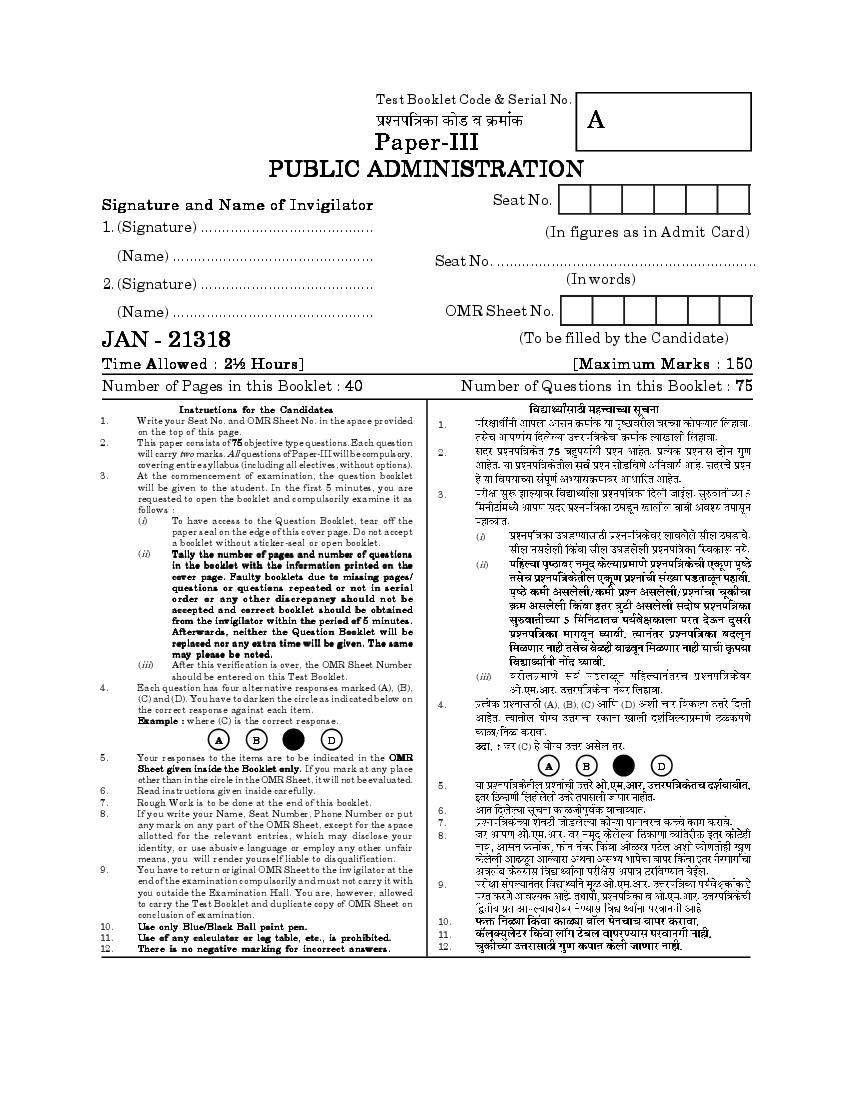
A
PUBLIC ADMINISTRATION
Signature and Name of Invigilator Seat No.
1. (Signature) ......................................... (In figures as in Admit Card)
(Name) ................................................ Seat No. ..............................................................
2. (Signature) ......................................... (In words)
(Name) ................................................ OMR Sheet No.
JAN - 21318 (To be filled by the Candidate)
Time Allowed : 2½ Hours] [Maximum Marks : 150
Number of Pages in this Booklet : 40 Number of Questions in this Booklet : 75
Instructions for the Candidates
1. Write your Seat No. and OMR Sheet No. in the space provided 1.
on the top of this page.
2. This paper consists of 75 objective type questions. Each question
will carry two marks. All questions of Paper-III will be compulsory, 2.
covering entire syllabus (including all electives, without options).
3. At the commencement of examination, the question booklet
will be given to the student. In the first 5 minutes, you are
requested to open the booklet and compulsorily examine it as 3.
follows :
(i) To have access to the Question Booklet, tear off the
paper seal on the edge of this cover page. Do not accept
(i)
a booklet without sticker-seal or open booklet.
(ii) Tally the number of pages and number of questions
in the booklet with the information printed on the (ii)
cover page. Faulty booklets due to missing pages/
questions or questions repeated or not in serial
order or any other discre pancy should not be
accepted and correct booklet should be obtained
from the invigilator within the period of 5 minutes.
Afterwards, neither the Question Booklet will be
replaced nor any extra time will be given. The same
may please be noted.
(iii) After this verification is over, the OMR Sheet Number
should be entered on this Test Booklet. (iii)
4. Each question has four alternative responses marked (A), (B),
(C) and (D). You have to darken the circle as indicated below on
the correct response against each item. 4. (A), (B), (C) (D)
Example : where (C) is the correct response.
A B D
(C)
5. Your responses to the items are to be indicated in the OMR
Sheet given inside the Booklet only. If you mark at any place A B D
other than in the circle in the OMR Sheet, it will not be evaluated.
5.
6. Read instructions given inside carefully.
7. Rough Work is to be done at the end of this booklet.
8. If you write your Name, Seat Number, Phone Number or put 6.
any mark on any part of the OMR Sheet, except for the space 7.
allotted for the relevant entries, which may disclose your 8.
identity, or use abusive language or employ any other unfair
means, you will render yourself liable to disqualification.
9. You have to return original OMR Sheet to the invigilator at the
end of the examination compulsorily and must not carry it with 9.
you outside the Examination Hall. You are, however, allowed
to carry the Test Booklet and duplicate copy of OMR Sheet on
conclusion of examination.
10. Use only Blue/Black Ball point pen. 10.
11. Use of any calculator or log table, etc., is prohibited. 11.
12. There is no negative marking for incorrect answers. 12.
Page 2
Page 3
Paper III
III
Time Allowed : 2½ Hours] [Maximum Marks : 150
Note : This paper contains Seventy Five (75) multiple choice questions. Each
carrying Two (2) marks. Attempt All questions.
(75) (2)
1. ‘‘Administration is politics since it 1.
must be responsive to the public
interests,’’ is said by :
(A) Wilson (A)
(B) Appleby (B)
(C) Waldo (C)
(D) Wiedner (D)
2. The POSDCORB view is criticized 2.
because it ignores :
(A) Managerial Techniques (A)
(B) Managerial Processes (B)
(C) Substance of the subject (C)
(D) Efficiency (D)
3 [P.T.O.
Page 4
emphasizes on :
(A)
(A) Organizational structure
(B)
(B) Bureaucratic authority
(C) Participatory processes (C)
(D) Value-free administration (D)
4. Match List I with List II and select 4. I II
the correct answer from the codes
given below :
I
List I
(a)
(a) New Public Administration
(b)
(b) Development Administration
(c)
(c) Comparative Administration
(d)
(d) Administrative Development
II
List II
(1)
(1) Edward Weidner
(2)
(2) Robert Dahl
(3)
(3) Dwight Waldo
(4) F.W. Riggs (4)
Codes :
(a) (b) (c) (d) (a) (b) (c) (d)
(A) (3) (1) (4) (2) (A) (3) (1) (4) (2)
(B) (4) (3) (2) (1) (B) (4) (3) (2) (1)
(C) (1) (2) (3) (4) (C) (1) (2) (3) (4)
(D) (2) (4) (1) (3) (D) (2) (4) (1) (3)
4
Page 5
common in public and private
administrations ?
(A)
(A) Filing
(B)
(B) Managerial techniques
(C) Scope and complexity (C)
(D) Accounting (D)
6. Which one of the following elements
6.
is ignored by the classical theory ?
(A) Formal structure
(A)
(B) Managerial techniques (B)
(C) Informal patterns
(C)
(D) Principles of organisation
(D)
5 [P.T.O.
Page 6
organisation without hierarchy.
Reason (R) : Organisation involves
(R) :
a group of people amongst whom
work is divided.
Answer the question using the codes
given below : (A) (A) (R)
(A) Both (A) and (R) are true and (R) (A)
(R) is the correct explanation
(B) (A) (R)
of (A)
(R) (A)
(B) Both (A) and (R) are true but
(R) is not the correct (C) (A) (R)
explanation of (A)
(C) (A) is true but (R) is false (D) (A) (R)
(D) (A) is false but (R) is true
8. The principle of unity of command 8.
was rejected by :
(1) F.W. Taylor (1)
(2) Seclor Hudson (2)
(3) J.D. Millet (3)
(4) Herbert Simon (4)
Codes :
(A) (1), (3) and (4) (A) (1), (3) (4)
(B) (1) and (4) (B) (1) (4)
(C) (1), (2) and (3) (C) (1), (2) (3)
(D) (1), (2), (3) and (4) (D) (1), (2), (3) (4)
6
Page 7
co-ordination is :
(A) Hierarchy
(A)
(B) Consultation
(B)
(C) Planning
(C)
(D) Centralised Housekeeping
(D)
Agency
10. The essence of scalar principle 10.
is :
(A)
(A) Unity of Command
(B)
(B) Span of Control
(C)
(C) Communication
(D)
(D) Co-ordination
7 [P.T.O.
Page 8
select the correct answer by using
the codes given below :
I
List I
(a)
(a) Chester Barnard
(b)
(b) Henry Fayol
(c)
(c) Herbert Simon
(d)
(d) Chris Argyris
II
List II
(1)
(1) Organisation and Innovation
(2)
(2) Zone of indifference
(3)
(3) Gangplank
(4)
(4) Bounded rationality
Codes :
(a) (b) (c) (d)
(a) (b) (c) (d)
(A) (1) (2) (3) (4)
(A) (1) (2) (3) (4)
(B) (2) (3) (4) (1) (B) (2) (3) (4) (1)
(C) (3) (4) (1) (2) (C) (3) (4) (1) (2)
(D) (4) (1) (2) (3) (D) (4) (1) (2) (3)
8
Page 9
(A) Human relations theory (A)
(B) Structural theory (B)
(C) Socio-economic theory (C)
(D) Humanistic theory (D)
13. Highly coordinated centralised 13.
administrative system is attributed
to :
(A)
(A) USA
(B)
(B) UK
(C)
(C) India
(D)
(D) UK and India
14.
14. The ‘Gangplank’ refers to :
(A)
(A) Discipline
(B) Initiative (B)
(C) Equity (C)
(D) Level jumping (D)
9 [P.T.O.
Page 10
the correct answer from the codes
given below :
I
List I
(a)
(a) Frederick Taylor
(b)
(b) Abraham Maslow
(c)
(c) Chris Argyris
(d)
(d) Frederick Herzberg
II
List II
(1)
(1) Management by Integration
and self-control
(2)
(2) Two-factor theory
(3)
(3) Reward theory
(4)
(4) Need theory
Codes :
(a) (b) (c) (d)
(a) (b) (c) (d)
(A) (1) (4) (2) (3)
(A) (1) (4) (2) (3)
(B) (3) (4) (1) (2) (B) (3) (4) (1) (2)
(C) (2) (1) (3) (4) (C) (2) (1) (3) (4)
(D) (4) (3) (1) (2) (D) (4) (3) (1) (2)
10
Page 11
society ?
(A) Neo-Prismatic (A)
(B) Ortho-Prismatic (B)
(C) Eo-Prismatic (C)
(D) Bio-Prismatic (D)
17. Who said, ‘British Constitution is a 17.
child of Wisdom and Chance’ ?
(A) Litton Strechy (A)
(B) Margaret Thatcher (B)
(C) Winston Churchill (C)
(D) Edward Dicey (D)
18. ‘‘Differentiation and integration are 18.
two key elements in the process of
development’’ is the assumption
of :
(A)
(A) Classical theory
(B)
(B) Neo-classical theory
(C) Ecological theory (C)
(D) Incremental theory (D)
11 [P.T.O.
Page 12
basis of :
(A) Index Number System (A)
(B) Increased Productivity Index (B)
(C) Performance rating (C)
(D) Priestley formula (D)
20. Which one of the following is the US
20.
President’s principal staff agency in
fiscal, legislative and administrative
management ?
(A) The Executive Office (A)
(B) Office of Management and
(B)
Budgeting
(C)
(C) White House Office
(D) Office of Administration (D)
12
Page 13
Administration is different from
traditional administration. (Choose
the odd man out) :
(A) Structural and function (A)
similarity
(B) Goal-oriented and innovative
(B)
(C) New techniques and new
(C)
attitudes
(D) Citizen participation (D)
22. The concept of Development 22.
Administration used after ...........
(A) First World War (A)
(B) Second World War (B)
(C) Mayo’s Resolution
(C)
(D) Riggs concept
(D)
13 [P.T.O.
Page 14
23.
developed countries can be divided
into :
(A)
(A) Traditional autocracy system
(B) Dominant party mobilization (B)
system
(C)
(C) Non-communist system
(D)
(D) Autocratic elite system
24. Who considered differentiation and 24.
integration as two key elements in
the process of development ?
(A) Panandikar (A)
(B) Neal F.W. (B)
(C) F.W. Riggs (C)
(D) Milton (D)
14
Page 15
pattern :
(A) :
Assertion (A) : The concept of
Development Administration is used
(R) :
in two interrelated senses.
Reason (R) : The administration
of development and development of
administration are intertwined. (A) (A) (R)
Codes : (R) (A)
(A) Both (A) and (R) are true and
(R) is the correct explanation (B) (A) (R)
of (A) (R) (A)
(B) Both (A) and (R) are true and
(R) is not the correct
(C) (A) (R)
explanation of (A)
(C) (A) is true but (R) is false
(D) (A) (R)
(D) (A) is false but (R) is true
15 [P.T.O.
Page 16
pattern :
(A) :
Assertion (A) : Importance of the
Cabinet Secretariat is due to
(R) :
expansion in the scope of
government.
Reason (R) : Advancement of
technology has resulted in creation
of government agencies.
Select the correct answer from the (A) (A) (R)
codes given below : (R) (A)
(A) Both (A) and (R) are true and
(R) is the correct explanation (B) (A) (R)
of (A) (R) (A)
(B) Both (A) and (R) are true but
(R) is not the correct (C) (A) (R)
explanation of (A)
(C) (A) is true but (R) is false
(D) (A) (R)
(D) (A) is false but (R) is true
16
Page 17
Cabinet Secretary should be an
administrative officer of the highest
rank’’ ?
(A)
(A) Chester Barnard
(B)
(B) N. Gopalswami
(C)
(C) Gulick
(D) Woodrow Wilson (D)
28. Who of the following is the first 28.
line supervisor in secretariat
hierarchy ?
(A)
(A) Secretary
(B)
(B) Deputy Secretary
(C)
(C) Additional Secretary
(D) Secretariat Officer (D)
17 [P.T.O.
Page 18
of Government of India are made
by ..........
(A)
(A) President
(B)
(B) Prime Minister
(C)
(C) Parliament
(D)
(D) Secretariat
30. ‘Academy Board’ of Sardar 30.
Vallabhbhai Patel National Police
Academy is headed by :
(A) Home Minister
(B) Home Secretary (A)
(C) Minister of Human Resource
(B)
Development
(C)
(D) Secretary of Human Resource
Development (D)
18
Page 19
31.
act as :
(A) Principal Advisor to the Chief
Minister (A)
(B) Principal Advisor to the
(B)
Governor
(C)
(C) Secretary to the Cabinet
(D)
(D) Secretary to the Chief Minister
32. Citizen charter, in India, ensures in 32.
administration :
(A) Quality approach (A)
(B) Flexibility (B)
(C) Impartiality (C)
(D) Uniformity (D)
19 [P.T.O.
Page 20
the correct answer from the codes
given below :
List I I
(a) Governor (a)
(b) Council of Ministers (b)
(c) Duties of Chief Minister (c)
(d) Legislative Council (d)
List II II
(1) Article 167 (1) 167
(2) Article 169 (2) 169
(3) Article 155 (3) 155
(4) Article 163 (4) 163
Codes :
(a) (b) (c) (d) (a) (b) (c) (d)
(A) (1) (2) (3) (4) (A) (1) (2) (3) (4)
(B) (4) (3) (2) (1) (B) (4) (3) (2) (1)
(C) (3) (2) (4) (1) (C) (3) (2) (4) (1)
(D) (3) (4) (1) (2) (D) (3) (4) (1) (2)
34. It lays down the full blueprint of 34.
personnel processes :
(A) Executive Decisions (A)
(B) Administrative Rules (B)
(C) Constitutional Provisions (C)
(D) Manpower Planning (D)
20
Page 21
repair a faulty :
(A) Recruitment (A)
(B) Placement (B)
(C) Procedure (C)
(D) Organization (D)
36. Morale is improved by the concept 36.
of :
(A) Authority (A)
(B) Hierarchy (B)
(C) Teamwork (C)
(D) Accountability (D)
37. The focus of performance appraisal 37.
is on :
(A) Professional Accomplishments (A)
(B) Personal Accomplishments (B)
(C) Performance Skill (C)
(D) Value attitudes (D)
21 [P.T.O.
Page 22
38.
challenge before local rural
government in India ?
(A) Financial support (A)
(B) Law and order
(B)
(C) Access to marketing outlets
(C)
(D) Promotion of agricultural
research (D)
39. The number of demands in General 39.
Budget for civil expenditure is .......
(A) 109 (A) 109
(B) 106 (B) 106
(C) 103 (C) 103
(D) 102 (D) 102
22
Page 23
about Comptroller and Auditor
General of India ?
(A)
(A) CAG is appointed by the
President (B)
(B) He enjoys the security of tenure
(C)
(C) He can be removed by the
President of his pleasure
(D)
(D) His salary is charged upon the
Consolidated Fund of India
41. A new office of the Comptroller
41.
General of Accounts (CGA) has been
created as a part of :
(A) The Department of Economic (A)
Affairs
(B)
(B) The Department of Expenditure
(C) The Department of revenue (C)
(D) The Department of Financial
(D)
Services
23 [P.T.O.
Page 24
testing in Social Science ?
(A) Charles Booth (A)
(B) P.V. Young (B)
(C) M.L. Bowell (C)
(D) Frank Yatan (D)
43. Which type of research faced the 43.
problem of finding appropriate
primary sources ?
(A) Descriptive research (A)
(B) Explorative research (B)
(C) Experimental research (C)
(D) Historical research (D)
44. What do you call for the subsect 44.
of a larger population in social
research ?
(A)
(A) Society
(B)
(B) Sample
(C)
(C) Community
(D)
(D) Group of peoples
24
Page 25
include :
(A) Interviews (A)
(B) Radio Appeals (B)
(C) Rare Manuscripts (C)
(D) Questionnaires (D)
46. This is a list of questions called 46.
schedule used by the investigator for
measuring attitudes, opinions and
behaviours :
(A)
(A) Observation schedule
(B) Document schedule (B)
(C) Rating schedule (C)
(D) Evaluation schedule (D)
47. Consider the following statements : 47.
(1) Schedule XI contains 18 subject (1)
of Panchayat jurisdiction.
(2) Schedule XII contains 29
(2)
subject of Municipal jurisdiction
Which of the above statements is/
are correct ?
(A) Only (1) is correct (A) (1)
(B) Only (2) is correct (B) (2)
(C) Both statements are correct (C)
(D) Both statements are incorrect (D)
25 [P.T.O.
Page 26
48. 73
Constitutional Amendments, the
development role of the Collector has
become ...........
(A)
(A) Very powerful
(B) Ceremonial (B)
(C) Motivational
(C)
(D) More accountable without
power (D)
49. Which of the following pair is not 49.
correctly matched ?
(A) District Collector is Chief (A)
Executive Officer of ZP : Odisha
(B) District Collector is the (B)
Executive Director of DRDA :
Andhra Pradesh
(C) DRDA is under District (C)
Collector : Maharashtra
(D) The Collector plays very crucial
(D)
role in the execution of welfare
programmes : Rajasthan
26
Page 27
50. (A) (R)
pattern :
(A) :
Assertion (A) : In Indian
Administration the tent is mighter
than the pen.
(R) :
Reason (R) : To impress on the
collector the necessity of field visit
to meet the people in their normal
surroundings and to see things for
himself.
Select the correct answer from the
codes given below :
(A) (A) (R)
Codes :
(A) Both (A) and (R) are true and (R) (A)
(R) is the correct explanation
(B) (A) (R)
of (A)
(R) (A)
(B) Both (A) and (R) are true
but (R) is not the correct (C) (A) (R)
explanation of (A)
(D) (A) (R)
(C) (A) is true but (R) is false
(D) (A) is false but (R) is true
27 [P.T.O.
Page 28
commissions and committees
studying for various urban issues in
India ?
(1)
(1) Royal Commission on
Decentralization
(2)
(2) Statutory Commission on local
self government
(3)
(3) Taxation Enquiry Commission
on local taxation and local
government (4)
(4) Lord Ripon’s resolution on local
self government
(A) (1), (2), (3), (4)
(A) (1), (2), (3), (4)
(B) (4), (3), (2), (1)
(B) (4), (3), (2), (1)
(C) (3), (2), (1), (4)
(C) (3), (2), (1), (4)
(D) (4), (1), (3), (2) (D) (4), (1), (3), (2)
28
Page 29
transforming social policy into social
services ?
(A)
(A) Social Welfare Administration
(B)
(B) Social Service
(C)
(C) Social Security Schemes
(D) Development Administration (D)
53. Under the Constitution welfare 53.
is a :
(A)
(A) Union subject
(B)
(B) State subject
(C)
(C) Concurrent subject
(D) Residuary subject (D)
54. The concept of Social Justice finds 54.
a mention in the Constitution under
articles :
(a) 38
(a) 38
(b) 39
(b) 39
(c) 40
(c) 40
(d) 43
(d) 43
Codes :
(A) (a) (b)
(A) (a) and (b)
(B) (a), (b) and (c) (B) (a), (b) (c)
(C) (a), (b) and (d) (C) (a), (b) (d)
(D) (a), (b), (c) and (d) (D) (a), (b), (c) (d)
29 [P.T.O.
Page 30
group of the Ministry of Social
Justice and Empowerment ?
(A)
(A) Senior Citizens
(B)
(B) Transgender
(C)
(C) Beggars
(D) Labour (D)
56. In some countries the term NGO is 56.
applied to an organization that in
another country would be called
............. (A)
(A) Development organisation (B)
(B) Non-profit organization
(C)
(C) Welfare organization
(D)
(D) Social organization
57.
57. Public Policy is a :
(A)
(A) Discrete Decision
(B) Pattern of Activity (B)
(C) Interest Aggregation (C)
(D) Interest Articulation (D)
30
Page 31
Public Policy :
(1) Policy Education (1)
(2) Policy Interpretation (2)
(3) Policy implementation (3)
(4) Policy formulation (4)
Codes :
(A) (4), (2), (1), (3) (A) (4), (2), (1), (3)
(B) (1), (4), (2), (3) (B) (1), (4), (2), (3)
(C) (1), (2), (4), (3) (C) (1), (2), (4), (3)
(D) (2), (4), (3), (1) (D) (2), (4), (3), (1)
59. Match List I with List II and select 59. I II
the correct answer from the codes
given below : I
List I
(a)
(a) Elite Model
(b)
(b) Systems Model
(c)
(c) Neo-institutionalist model
(d) Incremental model (d)
List II II
(1) Concept of information theory (1)
(2) Preserve the status quo (2)
(3) Conservative tendency in policy (3)
making-decision
(4)
(4) Four Arenas of Power
Codes :
(a) (b) (c) (d) (a) (b) (c) (d)
(A) (2) (1) (4) (3) (A) (2) (1) (4) (3)
(B) (1) (3) (2) (4) (B) (1) (3) (2) (4)
(C) (3) (4) (1) (2) (C) (3) (4) (1) (2)
(D) (4) (2) (3) (1) (D) (4) (2) (3) (1)
31 [P.T.O.
Page 32
policy science concept in Political
Science ?
(A) Max Weber (A)
(B) John Wright (B)
(C) L.D. White (C)
(D) Harold Laswell (D)
61. Strategic planning concentrates 61.
on ...............
(A) Extensive documentation (A)
(B) Decision-making (B)
(C) Fate of subunits (C)
(D) Planners (D)
32
Page 33
62.
........... according to the Article 338
338
of the Constitution of India.
(A) Union Public Service Commi- (A)
ssion
(B)
(B) National Commission for
Backward Classes (C)
(C) Minorities Commission
(D)
(D) Scheduled Caste and Scheduled
Tribes Commission
63. Who has said that ‘‘Directive 63.
Principles of State Policy stand for
the greatest guarantee for a genuine
democracy of India’’ ?
(A)
(A) M.C. Setalwad
(B)
(B) M.V. Pylee
(C) Dr. B.R. Ambedkar (C)
(D) B.N. Rao (D)
33 [P.T.O.
Page 34
Constitution of India, facilities to the
Scheduled castes and Scheduled
tribes are given for the term of ten
years. (A) 338
(A) 338
(B) 334
(B) 334
(C) 244
(C) 244
(D) 164
(D) 164
65. 1935
65. Since the enactment of Government
of India Act 1935, this term has been
generally referred to as ...........
(A) OBC (A)
(B) Scheduled Caste (B)
(C) Women Empowerment (C)
(D) Scheduled Caste and Tribe
(D)
34
Page 35
the correct answer from the codes
given below :
I
List I
(a)
(a) Protection of Civil Right Act
(b)
(b) The Scheduled Castes and
Scheduled Tribes (Prevention of
Atrocities Act)
(c)
(c) Maintenance and Welfare of
Parents and Senior Citizens
Act (d)
(d) National Commission for II
Backward Classes Act
(1) 1955
List II
(2) 1989
(1) 1955
(2) 1989 (3) 1993
(3) 1993 (4) 2007
(4) 2007
Codes :
(a) (b) (c) (d)
(a) (b) (c) (d)
(A) (1) (2) (4) (3)
(A) (1) (2) (4) (3)
(B) (1) (2) (3) (4)
(B) (1) (2) (3) (4)
(C) (2) (3) (1) (4) (C) (2) (3) (1) (4)
(D) (1) (2) (4) (3) (D) (1) (2) (4) (3)
35 [P.T.O.
Page 36
Public Sector undertakings is :
(A) Restructuring of PSEs (A)
(B) Disinvestment (B)
(C) Financial scarcity (C)
(D) Greater autonomy (D)
68. The main reason for the limited 68.
success of the public enterprises in
India are :
(1) Over-capitalisation (1)
(2) Lack of autonomy due to faulty
(2)
control
(3)
(3) Unsound and non-rational price
policy
(4)
(4) Lower utilization of the
production capacities
Codes : (A) (1), (2), (3) (4)
(A) (1), (2), (3) and (4)
(B) (2), (3) (4)
(B) (2), (3) and (4)
(C) (3) (4)
(C) (3) and (4)
(D) only (1) (D) (1)
36
Page 37
69.
related with :
(A) Single state centered market
(A)
system
(B) The growth of single unified (B)
world market
(C)
(C) Geographical location of a firm
(D)
(D) Foreign capitalist transactions
70. The term Local Self Government has 70.
been used in those countries which
were :
(A)
(A) Developing countries
(B)
(B) Developed countries
(C)
(C) Under the colonial rule
(D) Poor countries (D)
37 [P.T.O.
Page 38
added a new schedule to the Indian
Constitution, that is ..........
(A) 12
(A) 12th Schedule
(B) 11
(B) 11th Schedule
(C) 10th Schedule (C) 10
(D) 14th Schedule (D) 14
72. The democratic decentralisation at 72.
the grass-roots level has been
adversely affected because of :
(A) Devolution of power (A)
(B) Local taxation (B)
(C) Procedural checks (C)
(D) Discretionary grants (D)
73. Before 1947 the British Raj in India 73. 1947
was .............
(A) a regulatory administration (A)
(B) services administration (B)
(C) finance administration (C)
(D) welfare administration (D)
38
Page 39
in India ?
(1) Transportation facilities (1)
(2) Industrialisation (2)
(3) People’s growing demands of (3)
luxurious living
(4)
(4) Population explosion
(5)
(5) Education facilities
Codes :
(A) (1), (2), (3) (4)
(A) (1), (2), (3) and (4)
(B) (2), (3) (5)
(B) (2), (3) and (5)
(C) (1), (2), (4) and (5) (C) (1), (2), (4) (5)
(D) (3), (4) and (5) (D) (3), (4) (5)
75. Which one of the following pair is 75.
not correctly matched ?
(A) Community Development
(A) 1952
Programme : 1952
(B) 2014
(B) Ganga Kalyan Yojana : 2014
(C) 1986
(C) Indira Aawas Yojana : 1986
(D)
(D) Integrated Rural Development
Programme : 1978 1978
39 [P.T.O.
Page 40
40
Document Details
| Board / Org | Maharashtra Exams |
| Exam | Maharashtra State Eligibility Test |
| Type | Question Paper |
| Pages | 40 |
| Updated | 22 Jul 2026 |