MAHA SET 2018 Question Paper 3 Mathematical Science
Finished viewing? Save it for later —
Download MAHA SET 2018 Question Paper 3 Mathematical Science (PDF · 48 pages)About MAHA SET 2018 Question Paper 3 Mathematical Science
MAHA SET 2018 Question Paper 3 Mathematical Science is available here for free download. Published by Maharashtra Exams for MAHA SET, this question paper can be viewed online or downloaded as a PDF (48 pages). Candidates preparing for MAHA SET can use MAHA SET 2018 Question Paper 3 Mathematical Science to understand the exam pattern, the type of questions asked, and the overall difficulty level.
Frequently Asked Questions
How can I download MAHA SET 2018 Question Paper 3 Mathematical Science?
Open this page and click the Download button to save MAHA SET 2018 Question Paper 3 Mathematical Science as a PDF. It is completely free on AglaSem Docs.
Is MAHA SET 2018 Question Paper 3 Mathematical Science free to download?
Yes. MAHA SET 2018 Question Paper 3 Mathematical Science can be viewed online and downloaded as a PDF free of cost on AglaSem Docs.
How many pages does MAHA SET 2018 Question Paper 3 Mathematical Science have?
MAHA SET 2018 Question Paper 3 Mathematical Science contains 48 pages, which you can read online or download together as a single PDF.
Where can I find more MAHA SET study material?
You can find more MAHA SET question papers, sample papers, syllabus, and answer keys on AglaSem Docs.
MAHA SET 2018 Question Paper 3 Mathematical Science – Text
Read the full text of this question paper below — useful to quickly search, copy and reference the content online without downloading the PDF.
📄 View text version (48 pages)
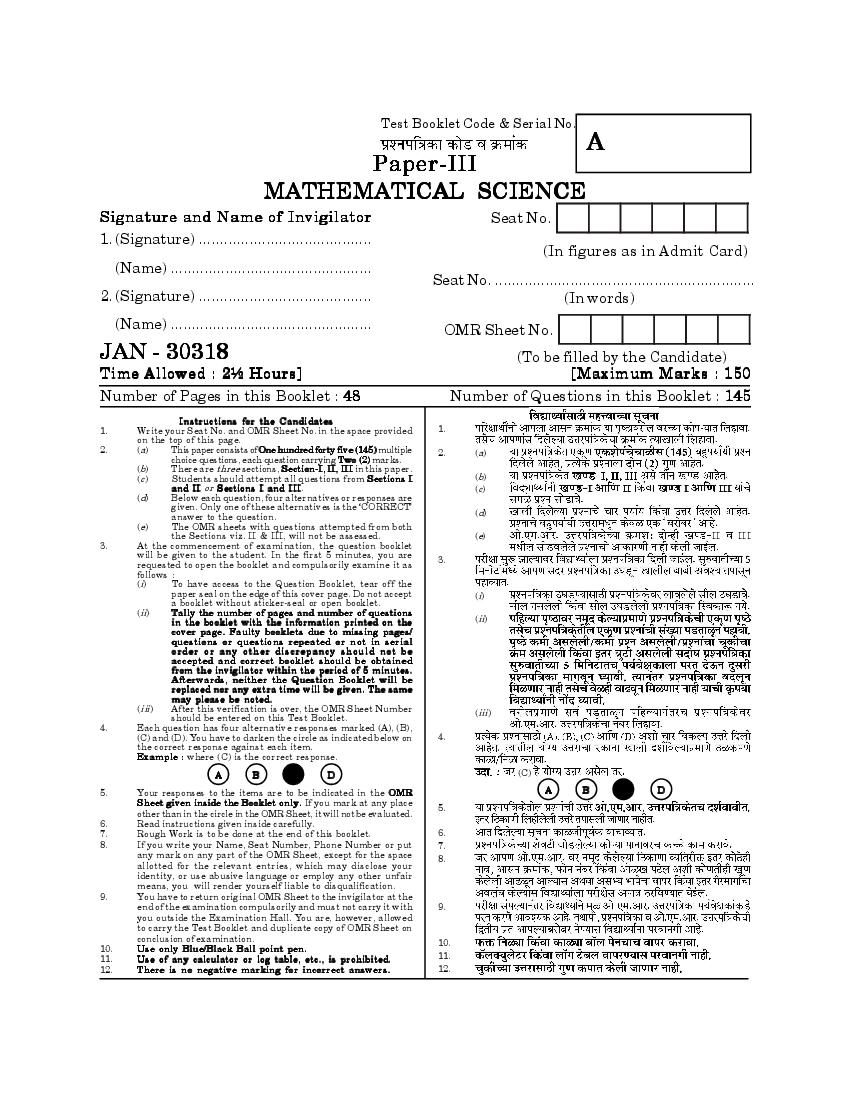
Page 1
A
MATHEMATICAL SCIENCE
Signature and Name of Invigilator Seat No.
1. (Signature) .........................................
(In figures as in Admit Card)
(Name) ................................................
Seat No. ..............................................................
2. (Signature) ......................................... (In words)
(Name) ................................................ OMR Sheet No.
JAN - 30318 (To be filled by the Candidate)
Time Allowed : 2½ Hours] [Maximum Marks : 150
Number of Pages in this Booklet : 48 Number of Questions in this Booklet : 145
Instructions for the Candidates
1. Write your Seat No. and OMR Sheet No. in the space provided 1.
on the top of this page.
2. (a) This paper consists of One hundred forty five (145) multiple 2. (a)
choice questions, each question carrying Two (2) marks.
(b) There are three sections, Section-I, II, III in this paper.
(c) Students should attempt all questions from Sections I (b)
and II or Sections I and III.III (c) I II I III
(d) Below each question, four alternatives or responses are
given. Only one of these alternatives is the ‘CORRECT’
answer to the question. (d)
(e) The OMR sheets with questions attempted from both
the Sections viz. II & III, will not be assessed. (e) II III
3. At the commencement of examination, the question booklet
will be given to the student. In the first 5 minutes, you are
requested to open the booklet and compulsorily examine it as 3.
follows :
(i) To have access to the Question Booklet, tear off the
paper seal on the edge of this cover page. Do not accept (i)
a booklet without sticker-seal or open booklet.
(ii) Tally the number of pages and number of questions
in the booklet with the information printed on the (ii)
cover page. Faulty booklets due to missing pages/
questions or questions repeated or not in serial
o rder or any other discre pancy should not be
accepted and correct booklet should be obtained
from the invigilator within the period of 5 minutes.
Afterwards, neither the Question Booklet will be
replaced nor any extra time will be given. The same
may please be noted.
(iii) After this verification is over, the OMR Sheet Number (iii)
should be entered on this Test Booklet.
4. Each question has four alternative responses marked (A), (B),
(C) and (D). You have to darken the circle as indicated below on 4.
the correct response against each item.
Example : where (C) is the correct response.
A B D (C)
5. Your responses to the items are to be indicated in the OMR A B D
Sheet given inside the Booklet only. If you mark at any place
5.
other than in the circle in the OMR Sheet, it will not be evaluated.
6. Read instructions given inside carefully.
7. Rough Work is to be done at the end of this booklet. 6.
8. If you write your Name, Seat Number, Phone Number or put 7.
any mark on any part of the OMR Sheet, except for the space 8.
allotted for the relevant entries, which may disclose your
identity, or use abusive language or employ any other unfair
means, you will render yourself liable to disqualification.
9. You have to return original OMR Sheet to the invigilator at the
end of the examination compulsorily and must not carry it with 9.
you outside the Examination Hall. You are, however, allowed
to carry the Test Booklet and duplicate copy of OMR Sheet on
conclusion of examination. 10.
10. Use only Blue/Black Ball point pen.
11. Use of any calculator or log table, etc., is prohibited. 11.
12. There is no negative marking for incorrect answers. 12.
Page 2
Page 3
Paper III
Time Allowed : 2½ Hours] [Maximum Marks : 150
Note : Attempt all questions either from Sections I & II or from Sections
I & III only. The OMR sheets with questions attempted from both
the Sections viz. II & III, will not be assessed.
Section I : Q. Nos. 1 to 5, Section II : Q. Nos. 6 to 75,
Section III : Q. Nos. 76 to 145.
Section I
2. Let f(x, y) = x2 + 5xy2, then the
1. Let
directional derivative of f at the
x2 y
f(x, y) = , (x, y) (0, 0)
2 2
x y
point (–2, 1) in the direction of vector
= 0, (x, y) = (0, 0).
v = (12, 5) is :
Then :
f f
(A) and exist at (0, 0) (A) 88/13
x y
(B) f(x, y) is continuous at (0, 0)
(B) –88/13
(C) f(x, y) is differentiable at (0, 0)
(C) 78/7
(D) f(x, y) is continuously differ-
(D) –88
entiable at (0, 0)
3 [P.T.O.
Page 4
3. Let
polynomials with degree 4. Find
the matrix of the linear operator
f(x) = x, if x is rational L(f(t)) = (f(t) – f(0))/t with respect to
the standard basis {1, t, t2, t3, t4}.
= 0, if x is irrational 0 0 0 0 0
1 0 0 0 0
(A) 0 1 0 0 0
then : 0 0 1 0 0
0 0 0 1 0
(A) f is continuous on R
0 1 0 0 0
0 0 1 0 0
(B) 0 0 0 1 0
(B) f is continuous on R except at
0 0 0 0 1
0 0 0 0 0
origin
1 0 0 0 0
0 0 1 0 0
(C) f is discontinuous at all points (C) 0 1 0 0 0
0 0 0 1 0
0 0 0 0 1
except at origin
0 0 0 1 0
(D) f is discontinuous at all points 0 0 1 0 0
(D) 0 0 0 0 1
0 1 0 0 0
of R 1 0 0 0 0
4
Page 5
5. Suppose that the columns of an
6. Suppose f ( x , y ) is of class c 2 ,
then under the coordinate trans-
n × n -matrix M over R are formation x = r cos , y = r sin , the
2 2
f f
expression 2 transforms to :
2
x y
orthonormal. Then which of the
2 2
f f
(A) 2 2
r
following is not true ?
2 2
f 1 f
(B)
r2 r2 2
2 2
(A) For every x Rn, Mx = x f f 1 f
(C) 2 2 2
r r r
2 2
f 1 f 1 f
(D) 2 2 2
(B) For every x, y Rn, r r r r
7. For the function f(x, y) = (x – 1)
2
<Mx, My> = <x, y> (x2 – y2), the point ,0 :
3
(A) is not a critical point
(C) The rows of M are orthonormal
(B) is a local maximum
(C) is a local minimum
(D) M is symmetric
(D) is a saddle point
5 [P.T.O.
Page 6
dx 10. Let R be a Boolean ring with
8. The improper integral n
a
x a
identity having n elements, then
converges :
which of the following values of n
(A) n
is possible ?
(B) if n > 1
(A) n = 32
(C) if n is an integer
(D) only if 0 < n < 1 (B) n = 23
9. The functions : (C) n = 27
f1(x, y, z) = x + y + z
(D) n = 15
f2(x, y, z) = xy + yz + zx
11. Let R be a ring with identity 1 ( 0)
f3(x, y, z) = x2 + y2 + z2
and m be the characteristic of R,
(A) are functionally independent
on R3/{x-axis} then which of the following is
(B) are functionally independent on true ?
the set {(x, y, z) R3/x > 0}
(A) wherever R is infinite, m = 0
(C) are functionally independent on
the set {(x, y, z) R3/x > 0, (B) wherever m 0, R is finite
y > 0, z > 0}
(C) wherever R is finite, m 0
(D) are functionally dependent
on R3 (D) wherever m 0, R is infinite
6
Page 7
elements. Then which of the is false for Q 2 and Z 2 ?
following statements need not be
(A) There are infinitely many units
true ?
in Z 2
(A) Either Z or Zp for some integer
p 2 is embedded in F (B) Q 2 is not a subfield of
complex numbers
(B) If n is not prime, then Zn is not
embedded in F (C) Q 2 is isomorphic to
(C) If Z is embedded in F, then the Q x x2 2
field Q is also embedded in F
(D) There are infinitely many
(D) If F is infinite, then Zp cannot
primes in Z 2
be embedded in F for any
prime p 15. The radius of convergence of the
13. Which of the following rings is a zn
power series is :
n 0 n2 1 2n
Unique Factorization domain but
not a PID ? 1
(A)
2
(A) Z
(B) 1
(B) F[x] (F a field)
(C) Z[x] (C)
(D) Z[i] (D) 2
7 [P.T.O.
Page 8
does the function take complex
3z 4 6
values arbitrarily close to any f(z) = 5 z 6 from C – to C
5
complex number, inside any
assumes all complex values, except :
arbitrary neighbourhood of 0 ?
5
(A) f(z) = ez (A)
3
1 4
(B) f(z) = sin (B)
z 3
6
1 (C)
(C) f(z) = z3 + z2 + 5
z
3
(D) f(z) = cosh z + sinh z 2 (D)
5
17. Which of the following continuous 19. Which of the following complex
functions is not an open mapping functions has an infinite number of
from C to C ? poles ?
2 (A) ez
(A) f(z) = ez
(B) sec z
(B) f(z) = |z|
1
(C) f(z) = sin z + cos z 2 (C) cos
z
1
z2 z4 z6 (D)
(D) f(z) = 1 ....... z5 z 1
2! 4! 6!
8
Page 9
are not compact ?
A= x, y R2 x 0, 1 y 1
(i) a circle
1 1 (ii) a parabola
B= x, y R2 0 ! x ,y sin
" x
1
(iii) S = x, y R2 y sin ,
x
and X = A # B. Then :
0! x 1
(iv) T = x, y R 2 | x| | y| 4
(A) X is connected and path
(A) (i) and (ii)
connected
(B) (ii) and (iii)
(B) X is connected but not path (C) (iii) and (iv)
connected (D) (ii), (iii) and (iv)
22. A metric space is compact if and only
(C) X is not connected but path if it is complete and :
connected (A) bounded
(B) totally bounded
(D) X is neither connected nor path
(C) closed
connected
(D) countable
9 [P.T.O.
Page 10
23. Consider the following statements :
f, g : [0, 1] $ R defined by :
I. A function f on [a, b ] is of
1 if x is rational
f x
0 if x is irrational
bounded variation if, and only
and
if, f is the difference of finite-
1 / x if 0 ! x 1
g x
0 if x 0
valued monotone increasing
then :
functions on [a, b].
(A) both f and g are not Lebesgue
II. If the function f is of bounded
integrable
variation on [a, b], then f is
(B) f is Riemann integrable and
measurable.
g is Lebesgue integrable
(A) Only I is true
(C) f is not Riemann integrable and
(B) Only II is true
g is Lebesgue integrable
(C) Both I and II are not true
(D) f is Lebesgue integrable and
(D) Both I and II are true g is not Lebesgue integrable
10
Page 11
27. Which of the following groups is
f u n ct i on f : [0, 1] $ R defined
by :
not solvable ?
%1 3 x if 0 ! x 1
f x
%0 if x 0 (A) Z 150
is :
(B) S4
3
(A)
4
(C) S5
2
(B)
3
(D) a non-abelian group of order 27
3
(C)
2
28. Which of the following rings is not
4
(D)
3
Noetherian ?
26. For which of the following values
of n is every group of order n (A) R[x1, x2, ........]
abelian ?
(A) n = 100 (B) Z[i]
(B) n = 121
(C) Z
(C) n = 24
(D) Z205[x]
(D) n = 120
11 [P.T.O.
Page 12
the polynomial x3 – 2 Q[x] is : X and [S] be the span of S in X. Then
which of the following need not be
(A) 3
true ?
(B) 6
(A) [S] is a subspace of X
(C) 5
(B) [S] is a closed subspace of X
(D) 4 (C) [S] is a subspace of X
30. Which of the following constructions (D) [S] is a closed subset of X
is not possible by ruler and 32. Let X be a normed space such that
compass ? every closed and bounded set in X
is compact. Then which of the
(A) Trisection of an angle of 90°
following is true ?
(B) Construction of a regular
(A) X has a countably infinite basis
polygon of 7 sides
(B) Every bounded subset of X is
(C) Construction of length equal to
complete
1 + 2 + 42
(C) X is finite dimensional
(D) Construction of the complex (D) Every proper subspace of X is
number e"i/40 bounded
12
Page 13
linear space X by X . Then which
space and Y be any orthonormal set
of the following is true ?
in X. Then :
(A) X is separable & X is separable
(A) Y is linearly dependent (B) X is separable & X is separable
(B) Y is countably infinite (C) X ' X
(D) X is always separable
(C) Y is a basis (Hamel) of X
36. Let f : [0, 1] $ [0, 1] be a continuous
(D) Y is countable
function. Then which of the
34. An infinite dimensional, separable following is true ?
(A) For all x, y [0, 1],
complex Hilbert space is congruent
x y & f(x) f(y)
to :
(B) ( x [0, 1] such that f(x) = x
(A) l
(C) If for some x, y [0, 1] with
(B) l2 x y, f(x) f(y) then for all
x y, f(x) f(y)
(C) l1
(D) If there is x0 [0, 1], f(x0) = x0
(D) l3 then f(x) = x for all x X
13 [P.T.O.
Page 14
39. Let X be a locally connected
not be Hausdorff ?
(A) X is a topological space such topological space. Then which of
that ) = {x × x/x X} is closed
the following is true ?
in X × X
(B) X is a metric space (A) X is connected
(C) X is an Indiscrete Topological
(B) X is locally path connected
space
(D) X is the product of two Hausdorff (C) Every component of an open set
spaces
of X is open in X
38. Let X be a non-empty subset of R
such that for every positive integer
(D) Every component of X is also a
M there is x X such that
|x| M. Then which of the following path component of X
statements is true ?
40. What is the coefficient of x2y2z3 in
(A) X is bounded with respect to
some metric which induces the (x + y + z)7 ?
same topology as induced by the
standard metric on R (A) 630
(B) X is unbounded with respect to
(B) 210
every metric on R
(C) The set X contains rationals as (C) 420
well as irrationals
(D) X is countably infinite (D) 179
14
Page 15
an > 0 for n 0 and a0 = 2 :
is :
(A) 31250
(A) (p * q) + (p * r)
(B) 31000
(B) (~p) + (q + r)
(C) 30350
(C) p + (~q) + (~r)
(D) 30250
(D) ((~p) * q) + ((~p) * r)
44. Eigenvalues corresponding to the
42. Find the number of integers between
following Sturm-Liouville problem :
1 and 10,000 both inclusive which d2X
+ ,X = 0, X(0) = 0, X-(1) = 0
dt2
are divisible by none of 5, 6 or 8 :
are ,n, n N, where ,n =
(A) 3666 2
(2n 1)"
(A)
2
(B) 5000
(B) (2n")2
2
(C) 6250 n"
(C)
2
(D) 6000 (D) (n + 1)"
15 [P.T.O.
Page 16
45. Consider the boundary value
eliminating arbitrary constant a
problem : from :
y = a(x – a)2
ut(x, t) = uxx(x, t), 0 < x < c, t > 0,
is :
with conditions : 3
dy dy
(A) 4 xy 8y 0
dx dx
ux(0, t) = 0 = ux(c, t), t > 0,
3
dy dy
(B) 4 xy 8 y2 0
dx dx
u(x, 0) = f(x), 0 < x < c.
2
dy dy
(C) 4 xy 8 y2 0
Substituting u(x, t) = X(x) T(t) in the dx dx
2
dy dy
above equation we generate the (D) 4 xy 8y 0
dx dx
following Strüm-Liouville problem 47. The general solution of the partial
differential equation :
for X(x) :
z z
xzp – yzq = y2 – x2, p, q
x y
(A) X--(x) + ,X(x) = 0, X(0) = X(c) = 0
is :
(B) X--(x) + ,X(x) = 0, X-(0) = X-(c) = 0
(A) .(xy, x2 + y2 + z2) = 0
(B) .(x2 – y2, x2 + y2 + z2) = 0
(C) X--(x) + ,X(x) = 0, X(0) = 1, X(c) = 0
(C) .(xyz, x2 – y2) = 0
(D) X--(x) + ,X(x) = 0, X-(0) = 0, X(c) = 0
(D) .(xyz, x2 + y2) = 0
16
Page 17
50. For which of the following primes
equation :
p , is the quadratic congruence
z z
x2 z2 xy z3 x y2
x y x2 / 2(mod p) solvable ?
is :
(A) p = 5
(A) linear
(B) p = 13
(B) non-linear
(C) p = 19
(C) semi-linear
(D) p = 23
(D) Quasi-linear
51. Let 0(n) denote Euler’s function.
49. Which of the following natural
Then :
numbers cannot be written as a
0 d
d|24
sum of 3 squares of non-negative
is equal to :
integers ?
(A) 24
(A) 2013
(B) 2015 (B) 25
(C) 2017 (C) 23
(D) 2019 (D) 20
17 [P.T.O.
Page 18
54. If the Lagrangian L x, x
body are :
(A) 1 corresponding to Atwood’s machine
(B) 2
is given as :
(C) 3
1
L x, x m m2 x2 m1 gx
2 1
(D) 6
53. If a particle of mass m moves in a m2 g l x,
plane under the influence of
gravitational force of magnitude
where m1, m2, l and g are constants.
m
directed towards origin. Then
r2
Then the equation of motion is :
Lagrangian of the system is :
m m m1 m2
(A) r2 r2 2 (A) x g
2 r m1 m2
m m m1 m2
(B) r 2
r 2 2 (B) x g
2 r m1 m2
m m m1 m2
(C) r2 r2 2 (C) x g
2 r2 m1 m2
m m m1 m2
(D) r2 r 2 (D) x m1 m2
g
2 r
18
Page 19
57. Let 1 : ,2 $ R3 be defined by
2
1
L , m l2 2 gl 2 , 1(t) = (t, –t, t3). Then the torsion of
2
1 at t = 1 is :
where g, l are constants. Then the
Hamiltonian of the system is : (A) 1
(B) –1
P2 1
(A) mgl 2
2ml 2 2 (C) 0
P2 1 (D) 2
(B) 2
mgl 2
2ml 2
58. The right cylinder over the circle
2
P
(C) mgl 2 x2 + y2 = 1 has the parametrization
2
ml
x : U $ R 3 , where :
P2
(D) 2
mgl 2 U= u, v R 2 |0 ! u ! 2", !v! ,
2ml
56. Let 1 : (0, 1) $ R 3 given by x u, v cos u, sin u, v
1(s) = (s, s + 1, s2) be a curve
Then the coefficients E, F, G in the
parametrised by arc length s. Then
first fundamental form of the
the curvature of 1 at s is :
cylinder are given by :
(A) 2
(A) E = 1, F = 1, G = 1
(B) 2s (B) E = 1, F = 0, G = 1
(C) 2 4 s2 (C) E = sin2 u, F = 0, G = 1
(D) s (D) E = cos u, F = 0, G = 1
19 [P.T.O.
Page 20
2
I u x, y = F x, y, u, ux , uy dx dy x3
I y x 2
dx
G 1
y-
subject to the conditions y(1) = 0,
over the region of integration G,
y(2) = 3 is :
where u is continuous and has (A) y = (x2 – 1)x
continuous derivatives upto second (B) y = (x2 – 1)
(C) y = (x – 1)x
order. Further u takes prescribed
(D) y = (x – 1)
values on the boundary of G. Then 61. The extremal of the isoperimetric
problem :
the differential equation for the
4
2
extremization of the functional is : I y x y- dx
1
F F F subject to the conditions :
(A) 0
u x ux x uy
4
y dx 36
F F F 1
(B) 0
u x uy y uy
and y(1) = 3, y(4) = 24 is :
F F F (A) a parabola
(C) 0
u x ux y ux
(B) an ellipse
F F F (C) a hyperbola
(D) 0
u x ux y uy
(D) a circle
20
Page 21
1 equation :
t
e 2 et s
x s 0
0 t
1
"t x s ds
is a : t s
0
(A) linear Fredholm integral
equation of second kind is :
(B) linear Volterra integral
(A) 2"
equation of second kind
(C) linear Fredholm integral (B) 2" x
equation of first kind
(C) 2 x
(D) linear Volterra integral
equation of first kind (D) " x
63. The initial value problem
corresponding to the integral )2
65. The value of E x 2 (taking
equation :
x h = 1) is :
x t x cos x x t x t dt
0
(A) –1
is : (B) 0
(A) x--(t) + x(t) = sin t, x(0) = 1,
(C) 1
x-(0) = 0
(B) x --( t ) + x -( t ) + x ( t ) = sin t , (D) 2
x(0) = 1, x-(0) = 0
where :
(C) x--(t) – x(t) = cos t, x(0) = –1,
x-(0) = 1 ) — forward difference operator
(D) x --( t ) – x -( t ) – x ( t ) = cos t ,
x(0) = –1, x-(0) = 1 E — shift operator.
21 [P.T.O.
Page 22
the following values : 68. If u0 = 1, u1 = 5, u2 = 8, u3 = 3,
x f (x )
u4 = 7, u5 = 0, then the value of
0 1
1 2 )5u0 is :
3 1
3 10 (A) 24
by Newton’s forward interpolation
formula is : (B) –60
3 2
(A) 4x – 2x + 5x + 1
(B) 2x3 – 7x + 6x + 1 (C) 60
3 2
(C) 2x – x + 8x + 1
(D) 4x3 – 3x2 + 6x + 1 (D) –61
67. A curve passing through the points
as given in the table : where ) forward difference operator.
x y (x )
1 0.2 69. If L–1{F(s)} = f(t), then
2 0.7
3 1 L–1{F(n)(s)} = is :
4 1.3
5 1.5 (A) tn f(t)
6 1.7
7 1.9 (B) (–1)n tn f(t)
8 2.1
9 2.3 (C) (–1)n f(t)
the area bounded by the curve, the
x-axis, x = 1 and x = 9 is : (D) (–1)n f (n)(t)
(A) 11.5 sq. unit
(B) 12.0 sq. unit where L–1 be the inverse Laplace
(C) 10.5 sq. unit
(D) 10.2 sq. unit transform
22
Page 23
72. Let 3* be an outer measure on H(R
R).
equation :
t Then E R) is 3*-measurable
H(R
x t e t sin t 2 x 2 d2
0
if :
by using Laplace transform method
is :
(A) for each A H(R
R)
(A) x(t) = e–2t + 2t – 1
(B) x(t) = 2e–2t + t – 1 3*(A) = 3*(A 4 E) + 3*(A 4 EC)
(C) x(t) = e–t + 2t – 1
(B) for some A H(R
R)
–t
(D) x(t) = 2e + t – 1
71. If F s is the Fourier transform 3*(A) = 3*(A 4 E) + 3*(A 4 EC)
of f(t), then the Fourier transform
of : (C) for each A H(R
R)
f(t) cos at
is : 3*(A) 3*(A 4 E) + 3*(A 4 EC)
(A) F s a
(D) for some A H(R
R)
(B) F s a
1 3*(A) 3*(A 4 E) + 3*(A 4 EC)
(C) F s a F s a
2
1
(D) F s a F s a R)-hereditary 5-ring.
where H(R
2
23 [P.T.O.
Page 24
73. Consider the following statements : f L(E, 3) and 3(E ) F) = 0,
then :
(A) f L(F, 3) and
I. A measure 3 on a ring R is
f d3 = f d3
complete if E R, F 6 E and E F
(B) f L(F, 3) and
3(E) = 0 then F R.
f d3 < f d3
E F
II. A measure 3 on a ring R is
(C) f L(F, 3) and
5-finite if, for every set E R,
f d3 > f d3
E F
E= En for some sequence
(D) f 7 L(F, 3)
n 1
75. Consider the following statements :
{En} such that En R.
I. If v1, v2 and 3 are measures
and v 1 8 3, v 2 8 3, then
(A) Only I is true v1 + v2 8 3.
II. If v and 3 are measures such
that v << 3 and v 8 3, then v
(B) Only II is true is identically zero.
(A) Only I is true
(C) Both I and II are true (B) Only II is true
(C) Both I and II are not true
(D) Both I and II are not true (D) Both I and II are true
24
Page 25
77. Consider the following LPP :
76. Consider the following statements :
1. Sensitivity analysis provides a Max. : Z = 2 x 1 + x2
single value within which a
parameter may change without
Subject to :
affecting optimality.
2. While performing sensitivity
3x1 + 4x2 6
analysis, the upper bound
infinity on the right hand side
6x1 + x2 3
of a constraint means that the
constraint is redundant.
x1 0, x2 0
3. When an additional constraint
is added in the LP models,
What is the solution of this LPP ?
the existing optimal solution
can further be improved if
(A) (1/3, 2/3)
zi – cj 0.
Which of the above are correct ?
(B) (3/11, 14/11)
(A) Only 1 is correct
(B) Only 2 is correct (C) (5/7, 5/7)
(C) Only 3 is correct
(D) All are wrong (D) (2/7, 9/7)
25 [P.T.O.
Page 26
is given as follows :
1. The use of cutting-plane
method reduces the number Max. : Zx = 2x1 + 3x2 – 2 x12
of constraints in the given Subject to :
problem. x1 + 4x2 4
2. In a Branch and Bound x1 + x2 2
minimization tree, the lower x1, x2 0.
bounds on objective function
If we apply Wolfe’s method to solve,
value do not decrease in value.
then the correct Kuhn-Tucker
3. The 0-1 integer programming condition will be :
problem requires the decision (A) 4x1 = ,1 + ,2 + 31 and
variables to have values
x2 = 3 – 4,1 – ,2 + 32
between zero and one.
(B) 4x1 = 2 – ,1 – ,2 – 31 and
Which of the above are correct ?
4x2 = 3 + ,1 + ,2 – 32
(A) Only 1 and 2 are correct
(C) 4x1 = –2 – ,1 + ,2 – 31 and
(B) Only 1 and 3 are correct x2 = 3 – 4,1 – ,2 + 32
(C) Only 2 and 3 are correct (D) 4x1 = 2 – ,1 – ,2 + 31 and
(D) All are correct 3 + 32 = 4,1 + ,2
26
Page 27
defined on the same probability variable with :
space such that for each y > 0, the
P(Y = 0) = P(Y = 1) = 1/2.
conditional density function of X
Let Xn = (1 – Y/n1)n, 1 0,
given Y = y is :
then, which of the following
y yx2 2
f x/ y e , y 9 0, x R.
2"
statements are correct ?
Let
d
(i) Xn ::$ Y when 0 1 < 1
1 y2
g y e , y 9 0.
2"y
d
(ii) Xn ::$ e–Y when 1 = 1
Which of the following statements
d
(iii) Xn ::$ Y when 1 > 1
is more appropriate ?
(A) (i) and (ii)
(A) E(X|Y) = 0
(B) E(E(X|Y)) = 0 (B) (ii) and (iii)
(C) E(X) = 0 (C) (i) and (iii)
(D) E(X) E(E(X|Y)) (D) Only (i)
27 [P.T.O.
Page 28
84. Let < be a countably infinite set and
variables such that :
let F consists of all subsets of <.
P(Xn = –n1/2) = P(Xn = n1/2) = 1/2n
and P(Xn = 0) = (n – 1)/n. Define :
n
0 if A is finite
Let Sn Xi. 3 A
if A is infinite
i 1
Then, which of the following Which of the following statements
statements is not true ?
are true ?
(A) E(Xn) = 0
(i) 3 is finitely additive
(B) V(Xn) = 1
d
(C) Sn n ::$ Z, Z ~ N(0, 1) (ii) 3 is countably additive
d
(D) Sn n ::$ Z, Z is not (iii) {An} is an = sequence of sets
Gaussian
with 3(A n ) = 0 n , but
83. Let X n , Fn be a martingale.
n 1
3(<) = .
Let ;n = 5(X1, X2, ......, Xn). Then,
X n , ;n is a ................ . (A) (i) and (ii)
n 1
(A) Martingale (B) (i) and (iii)
(B) Sub Martingale
(C) (ii) and (iii)
(C) Super Martingale
(D) White noise (D) (i), (ii) and (iii)
28
Page 29
87. Let X be a single observation with
zero-mean unit variance Gaussian
random variables defined on a unknown mean E(X) = 3 (– , )
common probability space. Define
U = X + Y and V = X – Y. Let and variance Var(X) = 3 2 + 1.
F = 5(X). Then, which of the
Consider the problem of estimating
following statements is not true ?
(A) E(U|F) = X a.s. 3 based on X under the squared
(B) E(V|F) = X a.s. error loss L(3, a) = (a – 3)2. Let T1
(C) E(U + V|F) = 2X a.s.
and T2 be defined as follows :
(D) E(U|F) and E(V|F) are
independent T1 = X, T2 = X/2 + 1/2.
86. Let X1 and X2 be two iid random
variables with : Which of the following statements
P(X1 = 1) = P(X1 = –1) = 1/2.
is true ?
Let Z = X1 + X2, Ai = Xi–1({1}),
(A) Risk of T1 = 32
i = 1, 2.
Which of the following is not true
(B) Risk of T2 = (1 – 3 + 32)/2
–1
on Z ({0}) ?
(A) P(A1|Z) = 1/2 (C) Risk of T2 is larger than that
(B) P(A2|Z) = 1/2
of T1
(C) P(A1 4 A2|Z) = 0
(D) P(A1|Z) P(A2|Z) = P(A1 4 A2|Z) (D) T1 is an admissible estimator
29 [P.T.O.
Page 30
same in-control average run length
observations from a Poisson
(ARL). Then which of the following
distribution with probability mass is true ?
function : (A) Both the charts will perform in
e ,,x similar way
f(x/,) = , x = 0, 1, 2, .......,
x!
(B) The charts can be compared
, > 0 unkonwn.
using out-of-control ARL
Suppose the prior distribution of ,
(C) Two charts cannot have the
is desired as : same in-control ARL
(D) The charts must be only to
g(,) > ,, e–2,, , > 0.
monitor population mean
Let n = 3 and the data (X1, X2, X3)
90. Let Lq be the average number of
= (1, 1, 2). Then, suppose we estimate customers in the queue, , be the
, under squared error loss L(,, a) customer arrival rate and 3 be the
average service rate. Then average
= (, – a)2. Then, the Bayes estimator
waiting time for a customer in the
based on the given data is :
queue for all infinite source
(A) 1.5 queueing models is :
(A) Lq/3
(B) 1.65
(B) 3/,
(C) 2.25
(C) ,/3
(D) 1.2 (D) Lq/,
30
Page 31
Poisson variables with E(X) = ,
distribution function :
and E(Y) = , + 1, when , > 0 is an
1
F1(t) = 1 – exp(–(,t) ), ,, 1 > 0 unknown parameter. Based on
single observations X and Y;
t 0
(XY) = (2, 3), the MLE of , will
Then : be :
(A) F1 is IFR (A) 2
(B) F1 is DFR (B) 2.5
(C) 3
(C) F1 is IFR if 0 < 1 1
(D) 3.5
(D) F1 is IFR if 1 1
94. Let X 1 and X 2 be independent
92. Suppose that in a K-unit parallel observations with X1 ~ N(3, 252) and
system each unit has life time X2 ~ N(23, 52). Suppose we define
T1 = X1 – 4X2 and T2 = 2X1 – X2.
distribution with distribution
Which of the following statements
function F. Then reliability function
is not true ?
of the system at time t is given
(A) (T1, T2) is sufficient
by :
(B) When 5 2 is known, T 2 is
(A) (F(t))K ancillary
(B) (1 – F(t))K (C) When 52 is known, T1 and T2
are independent
(C) 1 – (F(t))K
(D) When 52 is known, T1 is not
(D) 1 – (1 – F(t))K sufficient
31 [P.T.O.
Page 32
sample from N(3, 52), where 3 and
2
U( , ); > 1. The maximum
52 are unknown. Then which of the
likelihood estimator (mle) of is :
following statements is not correct ?
2
(A) X (1) n n
(A) Xi, X12 is jointly
1 1
1/ 2
(B) X (3)
sufficient for (3, 52)
2
(C) X (1) X (3) (B) X, s2 is jointly sufficient for
1/2
(3, 52)
(D) 0.2X (1) + 0.8 X (3)
(C) X is sufficient for 3 and s2 is
where :
sufficient for 52
X(1) = Min (X1, X2, X3)
(D) If 5 2 is known then X is
X(3) = Max (X1, X2, X3). sufficient for 3
32
Page 33
|x|
1 |x| satisfying the following regression
P[X = x] = 1 ;
2
equation :
x = –1, 0, 1, 0 < < 1
The complete statistics for : Xi = 1zi + ei; i = 1, 2, ....... n
(A) is X where z1, z2, ....... zn are fixed and
(B) is |X| ei’s (i = 1, 2, ..... n) are iid r.v.s with
(C) is X2 N(0, 52), 52 is unknown MLE of 1
(D) Does not exist is given as :
98. Let X1, X2, .......... Xn be iid r.v.s n
with U( , + 1), then E[X(n) – X(1)], xi zi
1
(A) n
where X (n) = Max X i, and
xi2
X(1) = Min Xi, is given by : 1
n 1 n
(A) xi zi
n 1
1
(B)
1 n
(B) n 1
zi2
(C)
n 1 n
(C) n 1
xi zi
n (D)
(D) n 1
zi2
33 [P.T.O.
Page 34
randomized Neyman-Pearson and sample of size n from exponential
likelihood ratio tests of a simple distribution with mean . The MP
hypothesis against a simple
test of size 1 for testing H0 : = 0
alternative exists, then :
against H1 : = 1
< 0
, is :
(A) They are equivalent
(B) They are one and the same 2@ 22 n, 1 1
%1 ; T <
(C) They are exactly opposite (A) . x = 0
%
(D) One can’t say anything about 0 ; otherwise
it
101. A sample of size n is obtained @2 1
%1 ; T < 0 2n, 1
from a Poisson distribution with (B) . x = 2
parameter m. The most powerful %0 ; otherwise
(MP) test of less than size 1 to test
2
H0 : m m0 against H1 : m > m0 0 @ 2 n, 1
%
is given as : (C) . x = 1 ; T < 2
%0 ; otherwise
1 ; T > t0
(A) . x =
0 ; otherwise
2@ 22 n, 1
%1 ; T <
1 ; T > t0 (D) . x =
% %
0
(B) . x = ? ; T = t0 0 ; otherwise
%0 ; otherwise
n
1 ; T < t0 where T = Xi
(C) . x =
0 ; otherwise 1
103. A test .(x) is called an unbiased
1 ; T < t0
% test if :
(D) . x = ? ; T = t0
%0 ; otherwise (A) EH0 . X 1
(B) EH1 . X 1
n
(C) EH0 . X 1 and EH1 . X 1
where T = Xi
1 (D) EH0 . X 1 = EH1 . X
34
Page 35
sample of size n observed from n from Poisson distribution with
Cauchy distribution with location m ea n ,, asymptotic variance of
parameter . Define T1 = sample X e X is :
mean and T2 = sample median.
,e ,
Then : (A) , , > 0
n
(A) T 1 and T 2 are consistent ,
e 2, ,
2
(B) 1 , , 1
estimator of n
(B) T1 is asymptotically normal ,
(C) 1 , e ,, , 1
n
(C) T2 is asymptotically normal
,
(D) (T1 + T2)/2 is asymptotically (D) , , > 0
n
normal
107. Consider the problem of testing
105. Let Fn(·) be empirical cumulative H0 : = against H1 : , where
0 0
distribution function, based on a is specified value of and is
0
random of size n from a continuous the parameter of one parameter
distribution with cumulative Cramer family. If ,( x ) is the
distribution function F(·). Then : likelihood ratio statistic based on
(A) Fn is not a consistent estimator sample of size n,
for F (A) –2 log ,(x) $ @12 as n $
(B) Variance of Fn converges to a (B) –2 log ,(x) $ @ 2n as n $
positive constant (C) –2 log ,(x) $ @12 , for = , as
0
(C) Asymptotic distribution of F n n $
is normal (D) –2 log ,(x) $ N(0, 1), for = 0
(D) Asymptotic mean of Fn is 1/2 as n $
35 [P.T.O.
Page 36
sample observed from Poisson T2 n p
the distribution of
distribution with mean ,. Then n 1 p
consistent estimator of 1 – e–, is : would be :
(A) unique (A) Non-central F-distribution
(B) not unique
(B) Central F-distribution
(C) fu n ct i on of X only
(C) Chi-square distribution
(D) not asymptotically normally
distributed (D) Student t-distribution
109. If X be a p-component random 111. If x1 , x2 , ........, xn (n p + 1) are
vector with E(X) = 0 and variance distributed independently each
covariance matrix A, positive according to Np( 3 , A), then the
definite. If X is partitioned into X (1) distribution of
of p1 components and X (2) of p2
n
1
components such that p1 + p2 = p S = x1 x x1 x-
n 1
1 1
and p1 p2. Then the square of
canonical correlation are the
is :
characteristic roots of the matrix :
(A) Wp(n – 1, A/(n – 1))
(A) A
(B) Wp(n, A/n)
(B) A111 A12
(C) A 221 A 21 (C) Np( 3 , A)
(D) A111 A12 A221 A21 (D) Np( 3 , S)
36
Page 37
tion of N( X – 3 )- A–1( X – 3 ) would P[4 < Y < 16|X = 5] = 0.954, then
be : B is equal to :
(A) Multivariate normal distribu- (A) +0.80
tion
(B) –0.80
(B) @2 with N – p degree of freedom
(C) ±0.8
(C) @2 with p degree of freedom
(D) 0.96
(D) @2 with N degree of freedom
(It is given that
113. Let X a p-component random vector
2 1 2
(1) (2) 1 z
is partitioned into X and X e 2 dz 0.477 )
2"
where X (1) has q-components and 0
X (2) has (p – q) components and 115. In a multiple regression with 3
X ~ Np ( 3 , A). If 3 and A are regressors and 10 observations, the
also partitioned as of X , then the total variation is found to be 25.549,
variance covariance matrix of the whereas the explained variation by
conditional distribution of X (1) the regression is 24.875. What is the
given X (2) is : value of adjusted-R2 ?
(A) A11 A12 A 221 A 21 (A) 0.964
(B) A11 A12 A 221 A 21 (B) 0.962
(C) A 22 A21 A111 A12 (C) 0.974
(D) A 22 A21 A111 A12 (D) 0.982
37 [P.T.O.
Page 38
model {Y, XC, 52I}, which of the
set-up {Y, XC, 52I} with p-regressors.
following statements is not true ?
The ordinary least squares estimator
(A) E ( Ŷ ) = E(HY) = XC, where
H = X(X-X)–1X- (OLSE) Ĉ is the vector which
(B) Cov( Ŷ ) = 52H minimizes E(Y – XC) (Y – XC)-.
(C) Cov( Ŷ , Y – Ŷ ) = 0 Which of the following statements
(D) Ŷ ~ N n (C, 5 2 H), under is not true under this set-up ?
normality
(A) X Ĉ is always unique
117. Under the standard multiple
regression model {Y, XC, 5 2 <}, (B) Ĉ is unique if and only if rank
which of the following statements is (X) = p
not true ?
(C) Ĉ is unique if and only if rank
(A) E( Ŷ ) = XC, E( Ĉ ) = C
(X) < p
2
(B) Cov( Ŷ ) = 5 <
(D) OLSE K- Ĉ of K-C is unique if
(C) Cov( Ĉ ) = 52(X-<–1X)–1
(D) Cov(HY, MY) = 52H<M and only if K-C is estimable
38
Page 39
119. Which of the following statements
i s not true in the context of a
is not true in the context of the simple linear regression with one
transformation of a response predictor ?
(A) The ratio SSReg/SSTot will be
variable under a regression set-up ?
same whether Y is regressed on
(A) When E(Y) = V(Y) = C X or X is regressed on Y
(B) A value R2 = 0.02 indicates
(a constant), square root
that X and Y are not related
transformation is more
(C) When the fitted regression line
appropriate is horizontal, then SSE = SSTot
and R2 = 0
(B) When E(Y) = C and V(Y) = C2,
(D) When the fitted regression line
log transformation is more is horizontal, then Yi = X .
appropriate 121. If the regression estimator of Y is
Sxy
y b X x where b = , then
(C) Scale transformation preserve S2x
the directions of the association an exact expression for bias of
regression estimator is :
between Y and X
(A) –Cov( y , b)
(D) The Box-Cox transformation
(B) Cov( y , b)
Y $ g(Y, ,) is a discontinuous (C) Cov(b, x )
function of , (D) –Cov(b, x )
39 [P.T.O.
Page 40
with : order and second order inclusion
probabilities of a sampling design in
(A) increasing the sample size n
PPSWOR, then which of the
(B) decreasing the sample size n
following relation is true ?
(C) both (A) and (B)
(A) "ij "i
(D) increase in the population size j
123. A simple random sample of (B) "ij n 1 "i
j
n clusters is selected from a
(C) "ij "i
population of N clusters each of j
size M, then cluster sampling will
(D) "ij n n 1
j
be less efficient than SRSWOR if
(B d = intra class correlation 125. PPSWR sampling reduced to SRS
coefficient between elements if the probability of proportion to
belonging to same cluster) : size i.e. pi is :
(A) M > 1 and Bd > 0 (A) 1/n
(B) M > 1 and Bd < 0 (B) 1
(C) M = 1 and Bd = 0 (C) 1/N
(D) M > 1 and Bd = 0 (D) n/N
40
Page 41
effect model with main effects A and about BIBD(a, b, k, r, ,) :
B used at a and b levels respectively. (1) If a = b, the design is said to
Then the estimate of operating be symmetric
characteristic curve parameter for A (2) ,(k – 1) = r(a – 1)
is :
(3) The adjusted treatment sum
a
na 2 2i of squares is free from block
i 1
(A) 2
b5 effects.
a
nb 22i
Which of the above are correct ?
i 1
(B) 2
a5
(A) Only 1 is correct
b
na C2j
i 1 (B) Only 1 and 2 are correct
(C) 2
b5
b (C) Only 3 is correct
nb C2j
i 1
(D) 2
a5 (D) Only 2 and 3 are correct
41 [P.T.O.
Page 42
(1) If the presence of interaction (1) In Resolution-III designs main
inflates the error mean square, effects are aliased with two-
one should use factorial designs. factor interactions.
(2) Two contrasts with coefficient (2) In Resolution-IV designs, two-
{ci} and {di} are orthogonal if factor interactions are aliased
a
ci di 0. with each other.
i 1
(3) In Resolution-V designs two-
(3) Confounding is a design
technique for arranging a factor interactions cannot
complete factorial experiment in be aliased with three-factor
blocks. interactions.
Which of the above statements are Which of the above statements are
correct ? correct ?
(A) Only 1 and 2 are correct (A) 1 and 2 are correct
(B) Only 1 and 3 are correct (B) 1 and 3 are correct
(C) Only 2 and 3 are correct (C) 2 and 3 are correct
(D) All are correct (D) All are correct
42
Page 43
under consideration. Two of the certain time series data was found
replicates are shown below :
to be significant at lags one and
five, whereas the sample partial
autocorrelations were not signifi-
cants for first 30 lags. What model
would you suggest for such a time
Identify which of the treatment series ?
combinations are partially
confounded in each replicate ? (A) ARMA(1, 5)
(A) AB and AC (B) ARMA(5, 1)
(B) AB and BC
(C) MA(5)
(C) AC and BC
(D) AR(5)
(D) A and BC
131. Consider the time series model : 133. In an AR(1) model Xt = 0.5Xt – 1 + Zt,
Xt = 0.2Xt – 2 – 0.6Xt – 1 + Zt + 1.2Zt – 1, Zt ~ iid normal (0, 1), the best linear
where Zt ~ iid Normal (0, 52). Which p r edi ct or aX1 + b X3 of X2 using
of the following statements is
(X1, X3) will have :
true ?
(A) {Xt} is stationary and invertible (A) a = b
(B) {Xt} is invertible, but not causal (B) a < b
(C) {Xt} is causal but not invertible
(C) a > b
(D) {X t } is neither causal nor
invertible (D) Cannot be determined
43 [P.T.O.
Page 44
ARIMA(2, 1, 2). Then {Yt} is :
TPM :
(A) a stationary model
1 1 1
(B) having one unit root for the AR P= ,
polynomial C 1 C
(C) having one unit root for the MA 0 < 1 < 1, 0 < C < 1.
polynomial
( n)
Then lim P11 is :
(D) having unit roots for both AR n$
and MA polynomials 1
(A)
135. Consider the MC consisting of the 1 C
three states 0, 1, 2 and having C
TPM : (B) 1 C
1 1 1C
0 (C) 1 C
2 2
1 1 1
P= 1
2 4 4 (D) 1
1 2 C
0
3 3
137. There are n units in the system at
Which of the following is correct ? time t and number of arrivals take
places during the time interval )t,
(A) All states do not communicate
the probability of the event is :
(B) The stationary distribution does
(A) Pn(t) (1 – 3)t)
not exist
(B) Pn(t) (1 – ,)t)
(2) 1
(C) P00 =
4 (C) Pn – 1(t) (1 – ,)t)
(D) MC is irreducible (D) Pn(t) (1 – ,)t) + Pn – 1(t) )t
44
Page 45
of a particular random variable is (1) Changing basic objective
function coefficient cj will affect
given as : the entire 0-raw to change.
1 (2) Changing right-hand side of a
P(s) = (s + s2)
2 constraint will retain the
What is the variance of the random current basis to be optimal even
if the constraint is negative.
variable ?
(3) Changing the column of a non-
1
(A) basic variable xj will affect, the
3
coefficient of xj in row-0 is still
1 non-negative and the current
(B)
4 basis is optimal.
1 Which of the above are correct ?
(C)
2
(A) 1 and 2 are correct
2
(D) (B) 1 and 3 are correct
3
(C) 2 and 3 are correct
139. Given the following table :
Age group o f Number of Total (D) All are correct
c hild bearing female Women (’000) Births
141. Let X1, X2, ........, Xn be a random
15 — 19 16.0 260
sample of size n from Bernoulli
20 — 24 16.4 2244
25 — 29 15.8 1894 distribution with parameter . Then
30 — 34 15.2 1320 variance of conditional expectation
35 — 39 14.8 916
n
40 — 44 15.0 280 X1 X2
of given X i is :
45 — 49 14.5 145 2
i 1
What is the value of TFR ?
(A) 0
(A) 2251.75 per thousand
(B) 2135.48 per thousand (B)
(C) 2106.96 per thousand (C) (1 – )
(D) 2018.88 per thousand (D) (1 – )/n
45 [P.T.O.
Page 46
mean ,. Then distribution function where :
of X, evaluated at 1.5 is :
2 0! x! y!1
f x, y
(A) 0 0 otherwise
(B) less than e–, Then E(X/y) is given by :
(C) equal to (, + 1)e–, (A) 2y
(D) greater than ,(, + 1)e–, (B) y/2
143. Let X be a r.v. with cdf, F(x), where :
(C) 1
0 ifx!0 (D) y
% x/2 if0 x!1
%
F( x)
%3/4 if 1 x ! 2 145. Let X be a degenerate random variable,
%1 if 2 x
at X = c . Then characteristic
Then E(X) is given by : function of X at ‘t’ is :
(A) 3/8 (A) c
(B) 1/2 (B) 0
(C) 3/2 (C) exp(itc)
(D) 1 (D) exp(–itc)
46
Page 47
47 [P.T.O.
Page 48
48
Document Details
| Board / Org | Maharashtra Exams |
| Exam | MAHA SET |
| Type | Question Paper |
| Pages | 48 |
| Updated | 22 Jul 2026 |