MAHA SET 2018 Question Paper 3 Philosophy
Finished viewing? Save it for later —
Download MAHA SET 2018 Question Paper 3 Philosophy (PDF · 40 pages)About MAHA SET 2018 Question Paper 3 Philosophy
MAHA SET 2018 Question Paper 3 Philosophy is available here for free download. Published by Maharashtra Exams for MAHA SET, this question paper can be viewed online or downloaded as a PDF (40 pages). Candidates preparing for MAHA SET can use MAHA SET 2018 Question Paper 3 Philosophy to understand the exam pattern, the type of questions asked, and the overall difficulty level.
Frequently Asked Questions
How can I download MAHA SET 2018 Question Paper 3 Philosophy?
Open this page and click the Download button to save MAHA SET 2018 Question Paper 3 Philosophy as a PDF. It is completely free on AglaSem Docs.
Is MAHA SET 2018 Question Paper 3 Philosophy free to download?
Yes. MAHA SET 2018 Question Paper 3 Philosophy can be viewed online and downloaded as a PDF free of cost on AglaSem Docs.
How many pages does MAHA SET 2018 Question Paper 3 Philosophy have?
MAHA SET 2018 Question Paper 3 Philosophy contains 40 pages, which you can read online or download together as a single PDF.
Where can I find more MAHA SET study material?
You can find more MAHA SET question papers, sample papers, syllabus, and answer keys on AglaSem Docs.
MAHA SET 2018 Question Paper 3 Philosophy – Text
Read the full text of this question paper below — useful to quickly search, copy and reference the content online without downloading the PDF.
📄 View text version (40 pages)
Page 1
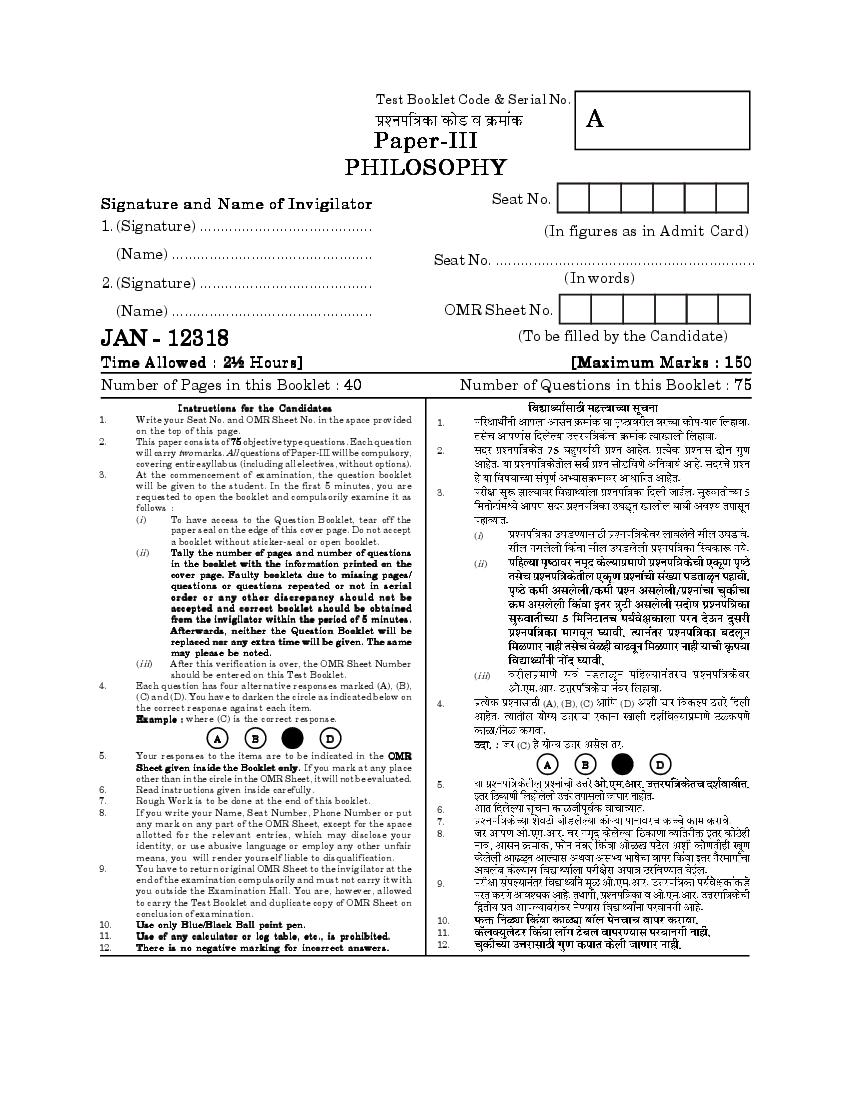
A
PHILOSOPHY
Signature and Name of Invigilator Seat No.
1. (Signature) ......................................... (In figures as in Admit Card)
(Name) ................................................ Seat No. ..............................................................
2. (Signature) ......................................... (In words)
(Name) ................................................ OMR Sheet No.
JAN - 12318 (To be filled by the Candidate)
Time Allowed : 2½ Hours] [Maximum Marks : 150
Number of Pages in this Booklet : 40 Number of Questions in this Booklet : 75
Instructions for the Candidates
1. Write your Seat No. and OMR Sheet No. in the space provided 1.
on the top of this page.
2. This paper consists of 75 objective type questions. Each question
will carry two marks. All questions of Paper-III will be compulsory, 2.
covering entire syllabus (including all electives, without options).
3. At the commencement of examination, the question booklet
will be given to the student. In the first 5 minutes, you are
requested to open the booklet and compulsorily examine it as 3.
follows :
(i) To have access to the Question Booklet, tear off the
paper seal on the edge of this cover page. Do not accept
(i)
a booklet without sticker-seal or open booklet.
(ii) Tally the number of pages and number of questions
in the booklet with the information printed on the (ii)
cover page. Faulty booklets due to missing pages/
questions or questions repeated or not in serial
o rder or any other discre pancy should not be
accepted and correct booklet should be obtained
from the invigilator within the period of 5 minutes.
Afterwards, neither the Question Booklet will be
replaced nor any extra time will be given. The same
may please be noted.
(iii) After this verification is over, the OMR Sheet Number
should be entered on this Test Booklet. (iii)
4. Each question has four alternative responses marked (A), (B),
(C) and (D). You have to darken the circle as indicated below on
the correct response against each item. 4. (A), (B), (C) (D)
Example : where (C) is the correct response.
A B D
(C)
5. Your responses to the items are to be indicated in the OMR
Sheet given inside the Booklet only. If you mark at any place A B D
other than in the circle in the OMR Sheet, it will not be evaluated.
5.
6. Read instructions given inside carefully.
7. Rough Work is to be done at the end of this booklet.
8. If you write your Name, Seat Number, Phone Number or put 6.
any mark on any part of the OMR Sheet, except for the space 7.
allotted for the relevant entries, which may disclose your 8.
identity, or use abusive language or employ any other unfair
means, you will render yourself liable to disqualification.
9. You have to return original OMR Sheet to the invigilator at the
end of the examination compulsorily and must not carry it with 9.
you outside the Examination Hall. You are, however, allowed
to carry the Test Booklet and duplicate copy of OMR Sheet on
conclusion of examination.
10. Use only Blue/Black Ball point pen. 10.
11. Use of any calculator or log table, etc., is prohibited. 11.
12. There is no negative marking for incorrect answers. 12.
Page 2
Page 3
Paper III
III
Time Allowed : 2½ Hours] [Maximum Marks : 150
Note : This Question Paper contains Seventy Five (75) multiple choice questions.
Each question carries Two (2) marks. Attempt All questions.
(75) (2)
1. Which of the following principles is 1.
not mentioned by Ramanuja in
Tattvatraya ?
(A)
(A) Spirit (Cit)
(B)
(B) Matter (Acit)
(C)
(C) Time (Kala)
(D) God (Is vara) (D)
2. According to S ankaracarya the 2.
world is real only as ...........
(A) Paramarthika Satta (A)
(B) Vyavaharika Satta (B)
(C) Both (A) and (B) (C) (A) (B)
(D) Neither (A) nor (B) (D) (A) (B)
3 [P.T.O.
Page 4
Dravya (Substance) has ................
and .............
(A)
(A) Samanya, Vis esa
(B)
(B) Guna, Paryaya
(C)
(C) Guna, Samanya
(D) Paryaya, Vis esa (D)
4. ............. Dravyas (substances) are 4.
advocated by Vais esika.
(A) 6 (A) 6
(B) 3 (B) 3
(C) 9 (C) 9
(D) 10 (D) 10
4
Page 5
5.
with the effect, then the Karana is
called ..............
(A) Samavayi Karana (inherent
cause)
(B) Asamavayi Karana (non- (A)
inherent cause)
(B)
(C) Pratiyogi Karana (opposite
cause)
(C)
(D) Nimitta Karana (efficient
(D)
cause)
6. Hobbes is a/an ............ 6.
(A) Nominalist (A)
(B) Conceptualist (B)
(C) Idealist (C)
(D) Rationalist
(D)
5 [P.T.O.
Page 6
and indivisible.
(A) Heraclitus (A)
(B) Plato (B)
(C) Aristotle (C)
(D) Parmenides (D)
8. ‘Degrees of truth’ are maintained 8.
by :
(A) Plato (A)
(B) Aristotle (B)
(C) Bradley (C)
(D) Kant (D)
9. Brain-mind identity theory is put 9.
forth by :
(A)
(A) Descartes
(B)
(B) Spinoza
(C)
(C) Ryle
(D)
(D) J.J.C. Smart
6
Page 7
identity ?
(A)
(A) Locke
(B)
(B) Berkeley
(C)
(C) Hume
(D) Kant (D)
11. Which of the following is maintained 11.
by Abhihitanvayavada ?
(i) Words have separate meaning. (i)
(ii) The meanings of indepednent
(ii)
words get connected to express
sentence-meaning
(iii) Words function to help convey (iii)
the meaning of a sentence.
(iv) Meaning of a sentence is a (iv)
function of the meanings of the
component words.
Options :
(A) (i) (ii)
(A) (i) and (ii)
(B) (i), (ii) (iii)
(B) (i), (ii) and (iii)
(C) (i), (ii) and (iv) (C) (i), (ii) (iv)
(D) (i), (iii) and (iv) (D) (i), (iii) (iv)
7 [P.T.O.
Page 8
(A) Object of error is unreal (A)
(B) Object of error is imaginary (B)
(C) Object of error is real (C)
(D) Object of error is elsewhere and (D)
is real
13. Identify the true sentences : 13.
(i) According to Buddhists,
(i)
knowledge is intrinsically
invalid.
(ii) According to Naiyayikas (ii)
invalidity of knowledge is
extrinsic.
(iii)
(iii) According to Prabhakara,
invalidity of knowledge is
intrinsic.
Options : (A) (i), (ii) (iii)
(A) (i), (ii) and (iii)
(B) (i)
(B) only (i)
(C) (i) (ii)
(C) (i) and (ii)
(D) (ii)
(D) only (ii)
8
Page 9
the correct answer from the codes
given below :
I
List I
(a)
(a) Pratyaksa and Anumana
(b)
(b) Anumana and S abda
(c)
(c) S abda and Upamana
(d)
(d) Upamana and Anuplabdh i
II
List II
(1)
(1) Sankhya
(2)
(2) Bauddha
(3)
(3) Purvam imamsa
(4)
(4) Nyaya
Codes :
(a) (b) (c) (d)
(a) (b) (c) (d)
(A) (2) (1) (4) (3) (A) (2) (1) (4) (3)
(B) (3) (1) (4) (2) (B) (3) (1) (4) (2)
(C) (1) (2) (3) (4) (C) (1) (2) (3) (4)
(D) (4) (3) (2) (1) (D) (4) (3) (2) (1)
9 [P.T.O.
Page 10
pramanya (Validity) accepted by
Nyaya darsan ?
(A) Svatah-Pramanya (Intrinsic
validity) (A)
(B) Svatah-Apramanya (Intrinsic
invalidity) (B)
(C) Paratah-Pramanya (Extrinsic
validity) (C)
(D) Svatah-Pramanya and
Paratah-Apramanya (Intrinsic
(D)
Validity and Extrinsic Validity)
16. Knowledge that has no source in 16.
experience can be termed as :
(A) A priori (A)
(B) A posteriori (B)
(C) Tentative
(C)
(D) Synthetic
(D)
10
Page 11
connotes objectivity is :
(A) Justification (A)
(B) Truth (B)
(C) Correspondence (C)
(D) Verification (D)
18. Edmund Gettier’s famous paper 18. 1963
published in 1963 was entitled :
(A) Justified true belief is not
(A)
knowledge
(B)
(B) Knowledge cannot be defined
(C)
(C) Is justified true belief
knowledge ?
(D)
(D) Why is justified true belief
knowledge ?
11 [P.T.O.
Page 12
offered by :
(A) Ryle (A)
(B) Moore (B)
(C) Tarski (C)
(D) Russell (D)
20. The truth of the premises of an 20.
inductive argument do not :
(A) in a priori way lead to the truth
(A)
of its conclusion
(B) prima facie lead to the truth of
(B)
its conclusion
(C)
(C) in a posteriori way lead to the
truth of its conclusion
(D) prospectively lead to the truth (D)
of its conclusion
12
Page 13
about the Buddhist theory of
Anumana ?
(1)
(1) Hetu is Trilaksanatmaka
(2)
(2) Vyapti is derived from
tadatmya and tadutpatti
(3)
(3) Anupalabdhi anumana is a
variety of anumana
(4)
(4) Asatpratipaksatva is one of the
conditions of good hetu
Options :
(A) (1), (2) and (4) (A) (1), (2) (4)
(B) (2), (3) and (4)
(B) (2), (3) (4)
(C) (1), (2) and (3)
(C) (1), (2) (3)
(D) (1), (3) and (4)
(D) (1), (3) (4)
13 [P.T.O.
Page 14
the correct answer from the codes
given below :
I
List I
(a)
(a) Pramana Samuccaya
(b)
(b) Pramana Mimamsa
(c)
(c) Nyayavatara
(d)
(d) Nyayabindu
II
List II
(1)
(1) Dharmak irti
(2)
(2) Siddhasena
(3)
(3) Hemacandra
(4)
(4) Dinnaga
Codes :
(a) (b) (c) (d) (a) (b) (c) (d)
(A) (1) (2) (3) (4) (A) (1) (2) (3) (4)
(B) (2) (3) (1) (4) (B) (2) (3) (1) (4)
(C) (4) (3) (2) (1) (C) (4) (3) (2) (1)
(D) (4) (2) (3) (1) (D) (4) (2) (3) (1)
14
Page 15
not included in the Buddhist
classification of anumana ?
(1)
(1) Samanyatodrsta Anumana
(2)
(2) Svabhavanumana
(3)
(3) Anyathanupapanna anumana
(4)
(4) Anupalabdhi anumana
Options :
(A) (1) (3)
(A) (1) and (3)
(B) (1), (2) (3)
(B) (1), (2) and (3)
(C) (2) (4)
(C) (2) and (4)
(D) (2), (3) and (4) (D) (2), (3) (4)
24. Nirvikalpaka and Savikalpaka are 24.
two stages of pratyaksa Jnana. This
view is held by the :
(A) Naiyayikas (A)
(B) Carvakas (B)
(C) Buddhists (C)
(D) Naiyayikas and Carvakas
(D)
15 [P.T.O.
Page 16
right conduct are known as ..............
(A) Triratna (A)
(B) Triguna (B)
(C) Tripitak (C)
(D) None of the above (D)
26. Which among the following are not
26.
the kinds of Pratyaksa according to
Nyaya ?
(A)
(A) Samanyalaksna and
Jnanalaksana (B)
(B) Laukika and Alaukika
(C)
(C) Nirvikalpa and Savikalpa
(D)
(D) Vahaya and Antara
16
Page 17
practised by .................
(A) All human beings (A)
(B) Hindus (B)
(C) Indians (C)
(D) All beings (D)
28. The theory of varna is derived 28.
from :
(A)
(A) Nasad iya-sukta
(B)
(B) Purusa-sukta
(C)
(C) Bhagavad-g ita
(D) Brahma-sutras (D)
17 [P.T.O.
Page 18
(A) Satya (A)
(B) Dharma (B)
(C) Both satya and dharma (C)
(D) Neither satya nor dharma (D)
30. Which of the following alternatives
30.
indicates the correct order ?
(A) Grhasthas rama, Vanapras -
thas rama, Brahmacaryas - (A)
rama and Sanyasas rama
(B) Brahmacaryas rama, has-
(B)
thas rama, Sanyasas rama
and Vanaprasthas rama
(C) Brahmacaryas rama, has-
(C)
thas rama, Vanaprasthas rama
and Sanyasas rama
(D) Grahasthas rama, Brahmaca- (D)
ryas rama, Vanaprasthas rama
and Sanyasas rama
18
Page 19
based on sentiments is advocated
by :
(A)
(A) Kant
(B)
(B) Aristotle
(C) Plato (C)
(D) Hume (D)
32. Retributive theories of punishment
32.
is based on .............
(A) Use
(A)
(B) Fairness
(B)
(C) Equality
(C)
(D) Mercy
(D)
33. Moral responsibility is based on : 33.
(A) Causal agency (A)
(B) Free agency (B)
(C) Meritorious agency (C)
(D) Social agency (D)
19 [P.T.O.
Page 20
the :
(A) Libertarian approach (A)
(B) Contractarian approach (B)
(C) Teleological approach (C)
(D) Deontological approach (D)
35. According to Aristotle, virtues are 35.
..................
(A)
(A) Ideas of reason
(B)
(B) Skills of habit
(C)
(C) Traits of personality
(D) Dispositions of character (D)
20
Page 21
(i) Nyaya-Paratahpramanyavada
(i)
(ii) Buddhists- Svatahpramanya-
(ii)
vada
(iii) M imamsa-Paratahpraman- (iii)
yavada
(iv)
(iv) Samkhya - Svatahpramanya-
vada
Options : (A) (i) (ii)
(A) (i) and (ii)
(B) (i) (iii)
(B) (i) and (iii)
(C) (i) (iv)
(C) (i) and (iv)
(D) (ii) (iii)
(D) (ii) and (iii)
21 [P.T.O.
Page 22
the correct answer from the codes
given below :
I
List I
(a)
(a) Social Disparity
(b)
(b) Human Rights
(c)
(c) Utilitarianism
(d)
(d) Deontological moral theory
II
List II
(1)
(1) Disproportion
(2)
(2) Universality
(3)
(3) Maximum hapiness
(4)
(4) Duty for duty’s sake
Codes :
(a) (b) (c) (d)
(a) (b) (c) (d)
(A) (1) (2) (3) (4)
(A) (1) (2) (3) (4)
(B) (1) (4) (3) (2)
(B) (1) (4) (3) (2)
(C) (4) (2) (3) (1) (C) (4) (2) (3) (1)
(D) (4) (3) (2) (1) (D) (4) (3) (2) (1)
22
Page 23
by :
(A) Carol Gilligan (A)
(B) J.S. Mill (B)
(C) Simone De Beauvoir (C)
(D) Mary Wollstonecraft (D)
39. Who was an ethical non- 39.
naturalist ?
(A)
(A) Moore
(B)
(B) J.S. Mill
(C)
(C) Kant
(D) Gandhi (D)
40. What do you mean by moral 40.
subjectivism ?
(A)
(A) Individual views on morality
(B)
(B) Society’s views on morality
(C)
(C) People’s attitudes and opinions
(D)
(D) None of the above
23 [P.T.O.
Page 24
theory.
(A) Teleological (A)
(B) Deontological (B)
(C) Emotivist (C)
(D) Naturalist (D)
42. ‘‘All that glitters is not gold’’ is a 42.
.............. type of proposition.
(A) E (A) E
(B) A (B) A
(C) I (C) I
(D) O (D) O
24
Page 25
the correct name of the fallacy out
of codes given below :
Argument :
No men are perfect.
All men are animals.
No animals are perfect.
(A)
(A) Fallacy of Illicit Major
(B) Fallacy of Illicit Minor (B)
(C) Fallacy of Illicit Middle (C)
(D) None of the above (D)
44. The subject term of the conclusion 44.
of a syllogism is called .........
(A) Copula (A)
(B) Middle term (B)
(C) Minor term (C)
(D) Major term (D)
25 [P.T.O.
Page 26
subject and predicate terms are
distributed is a ............ proposition.
(A) O
(A) O
(B) I
(B) I
(C) E
(C) E
(D) A (D) A
46. The relation between ‘A’ and ‘E’ 46. ‘A’ ‘E’
propositions is called ...............
(A) Contrary (A)
(B) Sub-contrary (B)
(C) Contradictory (C)
(D) Subalternation (D)
26
Page 27
(A) True (A)
(B) Tautologous (B)
(C) Neither true nor false (C)
(D) Either true or false (D)
48. If the statement ‘p’ is false and the 48. ‘p’ ‘q’
statement ‘q’ is true, the truth- ‘p q’ ‘~ p . q’
value of the statements ‘p q’ and
‘~ p . q’ are :
(A) ‘p q’ ‘~ p . q’
(A) Both the statements ‘p q’ and
‘~ p . q’ are true
(B) ‘p q’ ‘~ p . q’
(B) Both the statements ‘p q’ and
‘~ p . q’ are false
(C) ‘p q’ ‘~ p . q’
(C) The statement ‘p q’ is true and
‘~ p . q’ is false
(D) The statement ‘p q’ is false (D) ‘p q’
and ‘~ p . q’ is true ‘~ p . q’
27 [P.T.O.
Page 28
(A) Tautology ~ (p . ~ p) (A) ~ (p . ~ p)
(B) Contingent p ~ p (B) p ~p
(C) Law of Double ~ (~ p) (C) ~ (~ p)
Negation (D)
( x) x ( x) x
(D) Rule of E.G. a a
50. The correct symbolization of the 50.
following proposition is :
Statement : Authors and poets are
intelligent and successful.
(A) (x)[(Ax . Px) (Ix . Sx)]
(A) (x)[(Ax . Px) (Ix . Sx)]
(B) (x)[(Ax . Px) (Ix Sx)]
(B) (x)[(Ax . Px) (Ix Sx)]
(C) (x)[(Ax . Px) . (Ix . Sx)] (C) (x)[(Ax . Px) . (Ix . Sx)]
(D) (x)[(Ax Px) (Ix . Sx)] (D) (x)[(Ax Px) (Ix . Sx)]
28
Page 29
according to :
(A) Hinduism (A)
(B) Christianity (B)
(C) Zoroastrianism (C)
(D) Islam (D)
52. Guru Nanak is the founder of ......... 52.
(A) Islam (A)
(B) Sikhism (B)
avism (C)
(D) None of the above (D)
53. Everything in the universe is 53.
contingent and there must be
something which is non-contingent,
and that something is God, which
is a necessary being. This is the
........... argument for the proof of
existence of God.
(A)
(A) Moral
(B)
(B) Design
(C) Ontological (C)
(D) Cosmological (D)
29 [P.T.O.
Page 30
terms associated with :
(A) Jainism and Hinduism (A)
(B) Jainism and Buddhism (B)
(C) Sikhism and Hinduism (C)
(D) Judaism and Jainism (D)
55. Is vara is only nimitta karana of 55.
the world is held of :
(A) Nyaya system (A)
(B) Vedanta system (B)
(C) Jainism (C)
(D) Mimamsa system (D)
30
Page 31
Denoting’ :
(A) Quine (A)
(B) Davidson (B)
(C) Russell (C)
(D) Frege (D)
57. Frege makes a distinction between 57.
the following :
(A)
(A) Sense and truth conditions
(B)
(B) Truth and truth conditions
(C)
(C) Sense and nonsense
(D)
(D) Sense and reference
31 [P.T.O.
Page 32
functions not on sentence-to-
sentence basis, but as a whole ?
(A) Frege (A)
(B) Russell (B)
(C) Quine (C)
(D) Early Wittgenstein (D)
59. What is the nature of Strawson’s 59.
metaphysics ?
(A) Revisionary (A)
(B) Idealistic (B)
(C) Descriptive (C)
(D) Nihilistic (D)
32
Page 33
Investigations’ :
(A) Early Wittgentein (A)
(B) Russell (B)
(C) Frege (C)
(D) Later Wittgenstein (D)
61. Wilhem Dilthey introduces the 61.
concept of :
(A) Categories of life (A)
(B) Categories of understanding (B)
(C) Categories of consciousness (C)
(D) Categories of objects (D)
33 [P.T.O.
Page 34
method of hermeneutics is :
(A) Conflict of interpretations
(A)
(B) Transparency of meaning
(B)
(C) Interdependence of interpre-
(C)
tation and understanding
(D) Role of grammar in interpre-
tation (D)
63. Which of the following is not a part 63.
of the method of Phenomenology ?
(A) Dialectics (A)
(B) Epoche
(B)
(C) Intentional analysis
(C)
(D) Reduction
(D)
34
Page 35
Group I I
(a) Carvaka (a)
(b) Bauddha (b)
(c) Kumarila (c)
(d) Prabhakara (d)
Group II II
(i) five pramanas (i)
(ii) six pramanas (ii)
(iii) two pramanas (iii)
(iv) one pramana (iv)
Codes : :
(a) (b) (c) (d) (a) (b) (c) (d)
(A) (ii) (iii) (iv) (i) (A) (ii) (iii) (iv) (i)
(B) (iii) (ii) (iv) (i) (B) (iii) (ii) (iv) (i)
(C) (iv) (iii) (ii) (i) (C) (iv) (iii) (ii) (i)
(D) (ii) (iv) (iii) (i) (D) (ii) (iv) (iii) (i)
35 [P.T.O.
Page 36
become :
(A) an empirical science (A)
(B) a rigorous science (B)
(C) a speculative science (C)
(D) a normative science (D)
66. Which theory of error is upheld by 66.
S amkara ?
(A) Akhyati (A)
(B) Satkhyati (B)
(C) Anirvachan iyakhyati (C)
(D) Vipar ita-khyati (D)
67. According to Ramanuja individual 67.
soul is .............
(A)
(A) non-dual with a God
(B)
(B) Reflection due to ignorance
(C)
(C) Real enjoyer and agent
(D)
(D) The Brahman
36
Page 37
experience and testimony S amkara
prescribes to go by :
(A) Testimony (A)
(B) Sense experience (B)
(C) Reason (C)
(D) Inference (D)
69. Acceptance of Brahman as Supreme 69.
Reality points to :
(A) Subjective Realism (A)
(B) Subjective Idealism (B)
(C) Objective Idealism (C)
(D) Objective Realism (D)
70. According to Ramanuja
70.
Dharmabhutjnana and Nityabhuti
are ............
(A)
(A) Jad Dravyas
(B)
(B) Chetana Dravyas
(C) Ajada Dravyas (C)
(D) Unreal drvyas (D)
37 [P.T.O.
Page 38
those who hold it are trustees not
possessor’ was stated by ............
(A)
(A) Tolstoy
(B)
(B) Vinobha Bhave
(C)
(C) Gandhi
(D)
(D) Tagore
72. Which of the following would Gandhi 72.
not accept ?
(A)
(A) A good end justifies the means
to it
(B)
(B) End and means are convertible
terms
(C) Satya is the end, ahimsa is the (C)
means
(D) End and means are
interdependent (D)
38
Page 39
by ............
(A)
(A) Ambedkar
(B)
(B) Sri Aurobindo
(C)
(C) Gandhi
(D) Swami Vivekananda (D)
74. Gandhi criticised industrialisation in 74.
one of the following :
(A) Education (A)
(B) Hind Swaraj (B)
(C) Key to Health (C)
(D) My Experiments With Truth (D)
75. Gandhian Economics is based on 75.
...........
(A) Spiritual principle (A)
(B) Social principle (B)
(C) Economic principle (C)
(D) All of the above (D)
39 [P.T.O.
Page 40
40
Document Details
| Board / Org | Maharashtra Exams |
| Exam | MAHA SET |
| Type | Answer Key |
| Pages | 40 |
| Updated | 09 Jun 2026 |