NCERT Class 11 Syllabus for Chemistry
Finished viewing? Save it for later —
Download NCERT Class 11 Syllabus for Chemistry (PDF · 5 pages)About NCERT Class 11 Syllabus for Chemistry
NCERT Class 11 Syllabus for Chemistry is available here for free download. Published by NCERT for Class 11, this syllabus can be viewed online or downloaded as a PDF (5 pages). Candidates preparing for Class 11 can use NCERT Class 11 Syllabus for Chemistry to understand the exam pattern, the type of questions asked, and the overall difficulty level.
Frequently Asked Questions
How can I download NCERT Class 11 Syllabus for Chemistry?
Open this page and click the Download button to save NCERT Class 11 Syllabus for Chemistry as a PDF. It is completely free on AglaSem Docs.
Is NCERT Class 11 Syllabus for Chemistry free to download?
Yes. NCERT Class 11 Syllabus for Chemistry can be viewed online and downloaded as a PDF free of cost on AglaSem Docs.
How many pages does NCERT Class 11 Syllabus for Chemistry have?
NCERT Class 11 Syllabus for Chemistry contains 5 pages, which you can read online or download together as a single PDF.
Where can I find more Class 11 study material?
You can find more Class 11 question papers, sample papers, syllabus, and answer keys on AglaSem Docs.
NCERT Class 11 Syllabus for Chemistry – Text
Read the full text of this syllabus below — useful to quickly search, copy and reference the content online without downloading the PDF.
📄 View text version (1 page)
Page 1
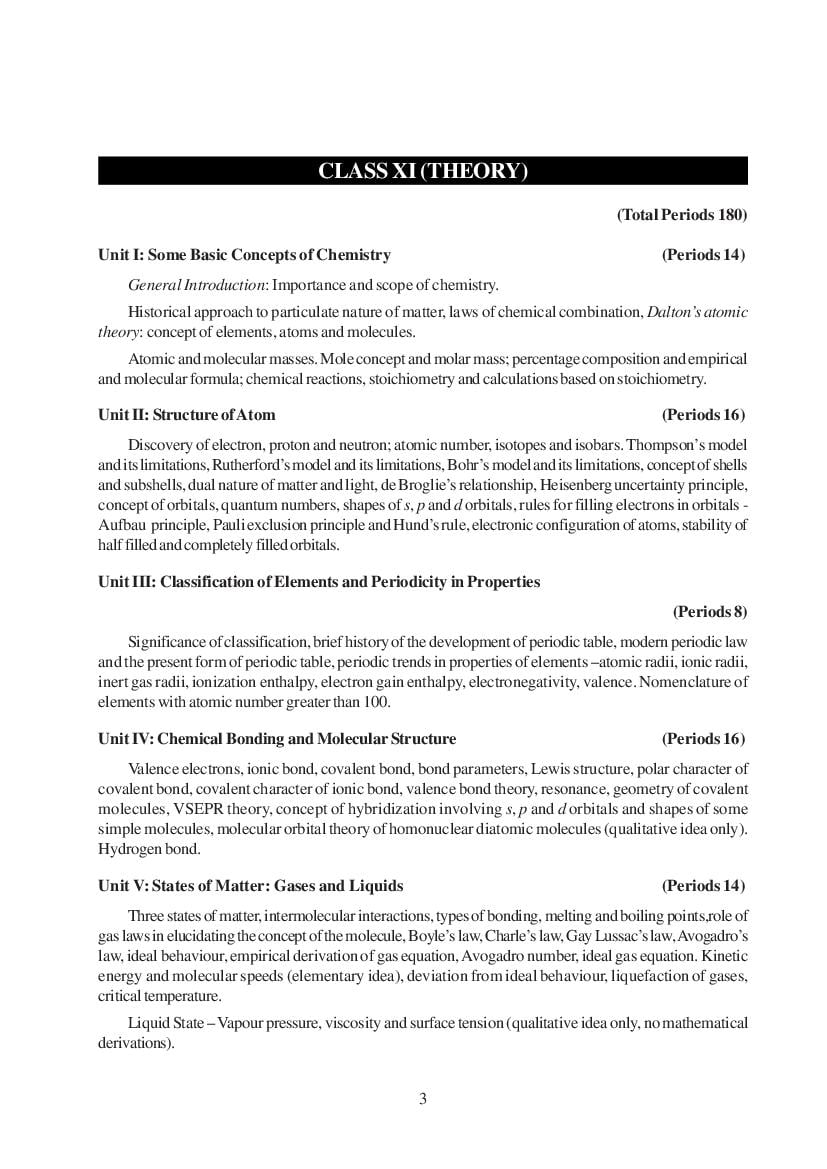
(Total Periods 180)
Unit I: Some Basic Concepts of Chemistry (Periods 14)
General Introduction: Importance and scope of chemistry.
Historical approach to particulate nature of matter, laws of chemical combination, Dalton’s atomic
theory: concept of elements, atoms and molecules.
Atomic and molecular masses. Mole concept and molar mass; percentage composition and empirical
and molecular formula; chemical reactions, stoichiometry and calculations based on stoichiometry.
Unit II: Structure of Atom (Periods 16)
Discovery of electron, proton and neutron; atomic number, isotopes and isobars. Thompson’s model
and its limitations, Rutherford’s model and its limitations, Bohr’s model and its limitations, concept of shells
and subshells, dual nature of matter and light, de Broglie’s relationship, Heisenberg uncertainty principle,
concept of orbitals, quantum numbers, shapes of s, p and d orbitals, rules for filling electrons in orbitals -
Aufbau principle, Pauli exclusion principle and Hund’s rule, electronic configuration of atoms, stability of
half filled and completely filled orbitals.
Unit III: Classification of Elements and Periodicity in Properties
(Periods 8)
Significance of classification, brief history of the development of periodic table, modern periodic law
and the present form of periodic table, periodic trends in properties of elements –atomic radii, ionic radii,
inert gas radii, ionization enthalpy, electron gain enthalpy, electronegativity, valence. Nomenclature of
elements with atomic number greater than 100.
Unit IV: Chemical Bonding and Molecular Structure (Periods 16)
Valence electrons, ionic bond, covalent bond, bond parameters, Lewis structure, polar character of
covalent bond, covalent character of ionic bond, valence bond theory, resonance, geometry of covalent
molecules, VSEPR theory, concept of hybridization involving s, p and d orbitals and shapes of some
simple molecules, molecular orbital theory of homonuclear diatomic molecules (qualitative idea only).
Hydrogen bond.
Unit V: States of Matter: Gases and Liquids (Periods 14)
Three states of matter, intermolecular interactions, types of bonding, melting and boiling points,role of
gas laws in elucidating the concept of the molecule, Boyle’s law, Charle’s law, Gay Lussac’s law, Avogadro’s
law, ideal behaviour, empirical derivation of gas equation, Avogadro number, ideal gas equation. Kinetic
energy and molecular speeds (elementary idea), deviation from ideal behaviour, liquefaction of gases,
critical temperature.
Liquid State – Vapour pressure, viscosity and surface tension (qualitative idea only, no mathematical
derivations).
3
Showing the first page only. Download the PDF above for the complete document.
Document Details
| Board / Org | NCERT |
| Exam | Class 11 |
| Type | Syllabus |
| Pages | 5 |
| Updated | 09 Jun 2026 |