Manipur Board Class 11 Syllabus 2027 Anthropology
Finished viewing? Save it for later —
Download Manipur Board Class 11 Syllabus 2027 Anthropology (PDF · 6 pages)About Manipur Board Class 11 Syllabus 2027 Anthropology
Manipur Board Class 11 Syllabus 2027 Anthropology is available here for free download. Published by Manipur Board for Class 11, this syllabus can be viewed online or downloaded as a PDF (6 pages). Candidates preparing for Class 11 can use Manipur Board Class 11 Syllabus 2027 Anthropology to understand the exam pattern, the type of questions asked, and the overall difficulty level.
Frequently Asked Questions
How can I download Manipur Board Class 11 Syllabus 2027 Anthropology?
Open this page and click the Download button to save Manipur Board Class 11 Syllabus 2027 Anthropology as a PDF. It is completely free on AglaSem Docs.
Is Manipur Board Class 11 Syllabus 2027 Anthropology free to download?
Yes. Manipur Board Class 11 Syllabus 2027 Anthropology can be viewed online and downloaded as a PDF free of cost on AglaSem Docs.
How many pages does Manipur Board Class 11 Syllabus 2027 Anthropology have?
Manipur Board Class 11 Syllabus 2027 Anthropology contains 6 pages, which you can read online or download together as a single PDF.
Where can I find more Class 11 study material?
You can find more Class 11 question papers, sample papers, syllabus, and answer keys on AglaSem Docs.
Manipur Board Class 11 Syllabus 2027 Anthropology – Text
Read the full text of this syllabus below — useful to quickly search, copy and reference the content online without downloading the PDF.
📄 View text version (7 pages)
Page 1
Manipur Board Class 11
Syllabus 2027
Anthropology
EXAM YEAR TYPE SUBJECT
Manipur Class 11 2027 Syllabus Anthropology
Notes · Sample Papers · Previous Year Papers · Mock Tests
Page 2
.co s e m
s em l a
a ag
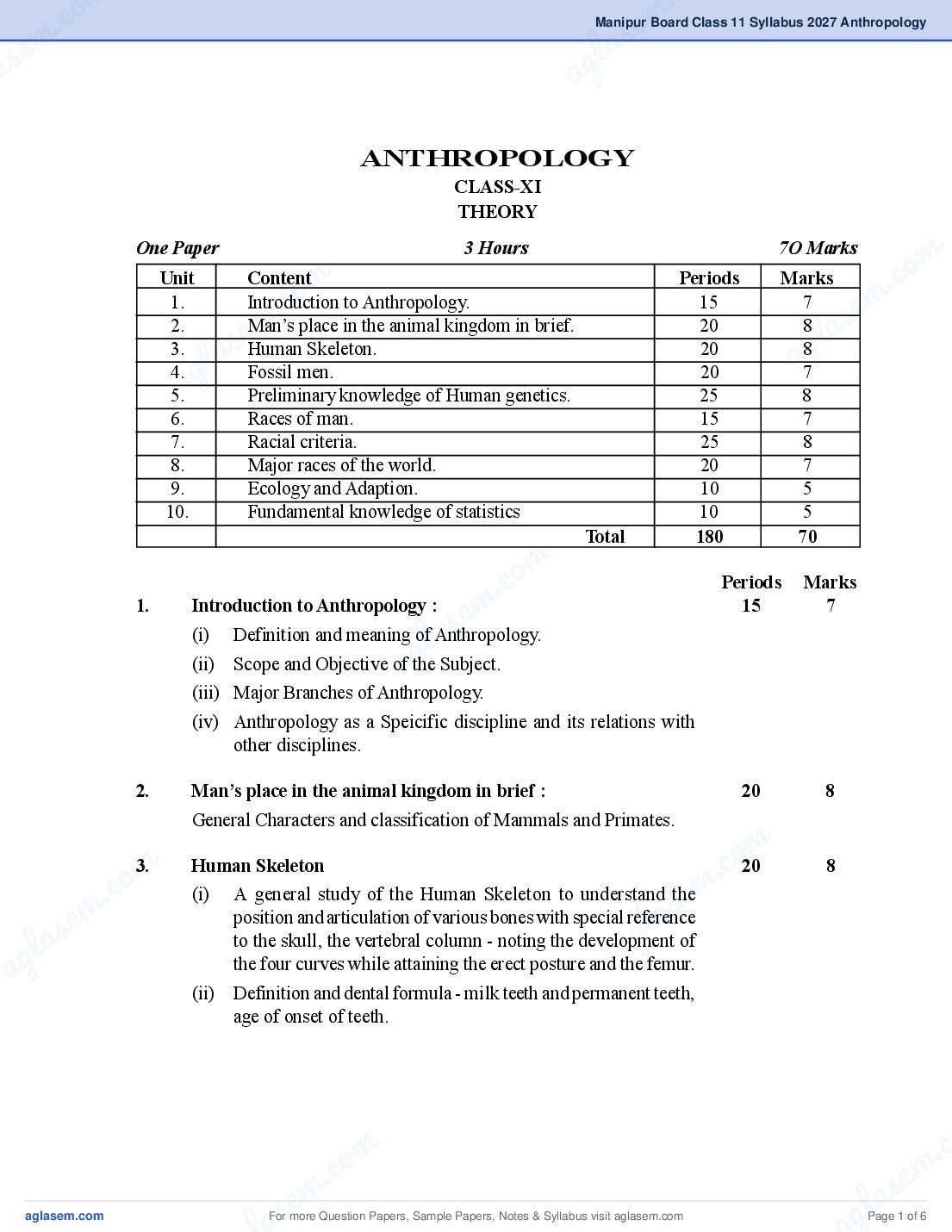
ANTHROPOLOGY
CLASS-XI
THEORY
One Paper 3 Hours 7O Marks
m
Unit Content
om Periods Marks . co
1. . c
Introduction to Anthropology. 15 7
em
2.
e m
Man’s place in the animal kingdom in brief. 20 8
l as
3.
l as Human Skeleton. 20 8
ag
a
4.g Fossil men. 20 7
5. Preliminary knowledge of Human genetics. 25 8
6. Races of man. 15 7
7. Racial criteria. 25 8
8. Major races of the world. 20 7
9. Ecology and Adaption. 10 5
10. Fundamental knowledge of statistics 10 5
Total 180 70
m
m .co Periods Marks
1. Introduction to Anthropology :
s e 15 7
l a
(i) Definition and meaning of Anthropology.
g Subject.
(ii) Scope and Objective ofathe
(iii) Major Branches of Anthropology.
(iv) Anthropology as a Speicific discipline and its relations with
other disciplines.
2. Man’s place in the animal kingdom in brief : 20 8
General Characters and classification of Mammals and Primates.
m
3.m Human Skeleton c. o20 8
c. o (i) A general study of the Human Skeleton to understand the
s e m
e m position and articulation of various bones with special reference
la
las to the skull, the vertebral column - noting the development of
ag
ag the four curves while attaining the erect posture and the femur.
(ii) Definition and dental formula - milk teeth and permanent teeth,
age of onset of teeth.
m . c
c. o s e m
s em
For more Question Papers, Sample Papers, Notes & Syllabus visit
gl a
Page 1 of 6
Page 3
A brief discussion on evolution of Man on the basis of fossil records of -
(a) Australopithecus africanus
(b) Pithecanthropus erectus
(c) Homo neanderthalenis and
(d) Old man and cro-magnon.
5. Preliminary Knowledge of Human genetics : 25 8
(i) Structure of cell and its division - Mitosis and Meiosis cell
division.
(ii) Mendel’s Laws of heredity - Monohybrid and Dihybrid ratio.
6. Races of man. 15 7
Definition of race, Mechanisms for the formation of race.
7. Racial Criteria. 25 8
Head form, Skin colour, Eye, Hair, Nose, Stature, ABO blood group
and Finger ball Patterns.
8. Major races of the world. 20 7
Racial classification, distinctive physical features and geographical
distribution of the major racial groups and man; Caucasoid (Archaic
Caucasoid), Mongoloid, Negroid and Australoid.
9. Ecology and Adaption. 10 5
(i) Meaning and definition of ecology and adaption
(ii) Physical or abiotic environment; biological or biotic
environment and Elements of adaption.
10. Fundamental Knowledge of Statistics. 10 5
Mean, Median and Mode
For more Question Papers, Sample Papers, Notes & Syllabus visit Page 2 of 6
Page 4
.co s e m
s em l a
a ag
ANTHROPOLOGY
CLASS-XI
PRACTICAL
One Paper 3 Hours 3O Marks
m
co
Unit Content Periods Marks
1.
2. . c om
Introduction in Anthropometry
Somatometry
10
12
4
10 e m .
3. em
Identification of human bones. 8 4
l as
4.
l as Identification of blood group 5
ag
4
a
5.g Laboratory Note Book - 4
6. Viva Voce - 4
Periods Marks
1. Introduction in Anthropometry : 10 4
A brief introduction to Anthropometry, Identification (1½ Hour
and uses of instruments : duration each)
(i) Sliding Caliper, (ii) Spreading Caliper,
(iii) Anthropometer and (iv) Weighing machine
m
(portable)
m .co
2. Somatometry
s e 12 10
l a
(a) Somatometric measurements (on 5 subject) (of 1½ hour
(iii) Total facial height,
ag
(i) Maximum head lenght, (ii) Maximum head breadth
(iv) Bizygomatic breadth,
duration each)
(v) Nasal height, (vi) Nasal breadth,
(vii) Height vertex and (viii) Body Weight
(b) Indice :
(i) Cephalic index, (ii) Total facial index and
(iii) Nasal index.
(c) Somatoscopic observation :
m
.co
(i) Skin colour, (ii) Eye,
m
c. o3. (iii) Nose and (iv) Hair.
s em 8
s em Identification of human bones.
g la (of 1½ hour
4
la
(i) Skull : Frontal, Parietal Occipital, Temporal
g (ii) Limb bones : Humerus and Femur, a duration each)
a (iii) Girdles : pelvis, clabvicle and Scapula.
4. Identification of blood group 5 4
Collect blood samples from 5 individuals and classify (of 1½ hour
their ABO blood group (by open slide method) duration each)
5. Laboratory Note Book - 4
6. Viva Voce - 4
m . c
c. o s e m
s em
For more Question Papers, Sample Papers, Notes & Syllabus visit
gl aPage 3 of 6
Page 5
1. Outlines of Physical Anthropology
By B.M. Das,
Published by Kitab Mahal Agencies,
22-A, Sorojini Naidu Marg, Allahabad-211001.
2. Anthropology for Beginners Part I & II
By R.C. Das,
Published by Songam Prakash,
Rajgarh Road, Guwahati - 3.
3. Anthropology The Study of Man
By Indrani Basu Roy,
Published by S. Chand & Company Ltd.
Ram Nagar, New Delhi - 110055.
4. Physical Anthropology Practical
By B.M. Das and Ranjan Deka,
Published by Kitab Mahal Agencies,
Allahabad - 2110003.
5. Methods of Social Survey and Research
By S.R. Bajpai,
Published by Kitab Ghar,
Acharyanagar, Rampur - 3.
6. Physical Anthropology (with Principles and Methods of Anthropology),
By R.M. Sarkar,
Century Publishers,
Calcutta - 9, India.
For more Question Papers, Sample Papers, Notes & Syllabus visit Page 4 of 6
Page 6
.co s e m
s em l a
a ag
DESIGN OF
QUESTION PAPER
Subject : ANTHROPOLOGY
Paper : Theory
Class : XI
m
om
Full Mark
Time
:
:
70
3 Hours . co
. c e m
em TO OBJECTIVES
WEIGHTAGE
l as
las
Objectives g
a 15
Marks Percentage
g
Knowledge(K)
I aComprehension/Understanding(C/U)
10
35 50
Expression (Exp) 21 30
Skill (S) 4 5
Total : 70 100
WEIGHTAGE TO FORMS OF QUESTIONS:
Time
Form of Questions No. of Question Marks Percentage
(in minute)
Essay/Long Answer(E/LA) 3 52 15 21
II Short Answer(SA-I) 6
m 54 18 26
Short Answer(SA-II)
Very Short Answer(VSA)
10
7
m .co 50
14
20
07
29
10
MCQ 10
s e 10 10 14
Total: l
36a 180 70 100
WEIGHTAGE TO CONTENT:
UNIT
ag
CONTENTS Marks Percentage
1. Introduction to Anthropology. 7 10
2. Mans’ place in the animal kingdom in brief. 8 11
3. Human Skeleton. 8 11
4. Fossil Men. 7 10
III 5. Preliminary Knowledge of Human Genetics. 8 11
6. Races of man. 7 10
7. Racial Criteria. 8
m 11
m 8. Major races of the world.
.co
7 10
.co m
9. Ecology and Adaptation. 5 8
m 10.
s e
Fundamental Knowledge of Statistics. 5 8
s e g l
Total a: 70 100
g la IV SCHEME OF SECTIONS : Nil a
a V SCHEME OF OPTIONS
VI DIFFICULTY LEVEL :
: 50% in SA-I, 100% in Essay
Difficult : 30% of the total marks
Average : 50% of the total marks
Easy : 20% of the total marks
Abbreviation : K(Knowledge), U(Understanding ), C(Comprehension), Exp.(Expression), Skill(S),
E(Essay Type), SA (Short Answer Type), VSA (Very Short Answer Type),
MCQ(Multiple Choice Question)
m . c
N.B.:
c. o
Assertion and reasoning: 2(two) Questions in MCQ.
s e m
em
Source Based Question: 1(one) Question in SA-I
s
For more Question Papers, Sample Papers, Notes & Syllabus visit
gl aPage 5 of 6
Page 7
QUESTION PAPER/UNIT TEST
Subject : ANTHROPOLOGY (Practical)
Class : XI
Full Marks : 30
Time : 3 Hours
Sl. Form of Nature of Exercise Skill to be tested
No. Exercise
Manipu- Observa- Drawing Repor- Related Total Estimated
lative tional skill ting Under- Marks Time
Skill Skill Skill standing (Mins.)
1. Short Identification of 2 0 0 0 2 4 20
instrument
2(a) Major Somatometic 2 1 0 3 0 6 30
measurements
2(b) Short Indice 0 0 0 1 1 2 10
2(c) Short Somatoscopic 1 - - - 1 2 5
Observation
3. Short Identification of bones 1 - - 2 1 4 50
4. Short Identification of Blood 1 1 - 2 - 4 35
group
5. Class Laboratory Note book 0 0 2 2 0 4 -
Record
6. Viva voce – - - - - 4 4 30*
Total 7 2 2 10 9 30 180
*Thirty minutes are alloted for Viva Voce during which the examiner should make an assessment of the
knowledge of outdoor experiment by putting related questions along with the general viva voce.
For more Question Papers, Sample Papers, Notes & Syllabus visit Page 6 of 6
Document Details
| Board / Org | Manipur Board |
| Exam | Class 11 |
| Type | Syllabus |
| Pages | 6 |
| Updated | 04 Nov 2026 |