NCERT Class 11 Syllabus for Biology
Finished viewing? Save it for later —
Download NCERT Class 11 Syllabus for Biology (PDF · 4 pages)About NCERT Class 11 Syllabus for Biology
NCERT Class 11 Syllabus for Biology is available here for free download. Published by NCERT for Class 11, this syllabus can be viewed online or downloaded as a PDF (4 pages). Candidates preparing for Class 11 can use NCERT Class 11 Syllabus for Biology to understand the exam pattern, the type of questions asked, and the overall difficulty level.
Frequently Asked Questions
How can I download NCERT Class 11 Syllabus for Biology?
Open this page and click the Download button to save NCERT Class 11 Syllabus for Biology as a PDF. It is completely free on AglaSem Docs.
Is NCERT Class 11 Syllabus for Biology free to download?
Yes. NCERT Class 11 Syllabus for Biology can be viewed online and downloaded as a PDF free of cost on AglaSem Docs.
How many pages does NCERT Class 11 Syllabus for Biology have?
NCERT Class 11 Syllabus for Biology contains 4 pages, which you can read online or download together as a single PDF.
Where can I find more Class 11 study material?
You can find more Class 11 question papers, sample papers, syllabus, and answer keys on AglaSem Docs.
NCERT Class 11 Syllabus for Biology – Text
Read the full text of this syllabus below — useful to quickly search, copy and reference the content online without downloading the PDF.
📄 View text version (1 page)
Page 1
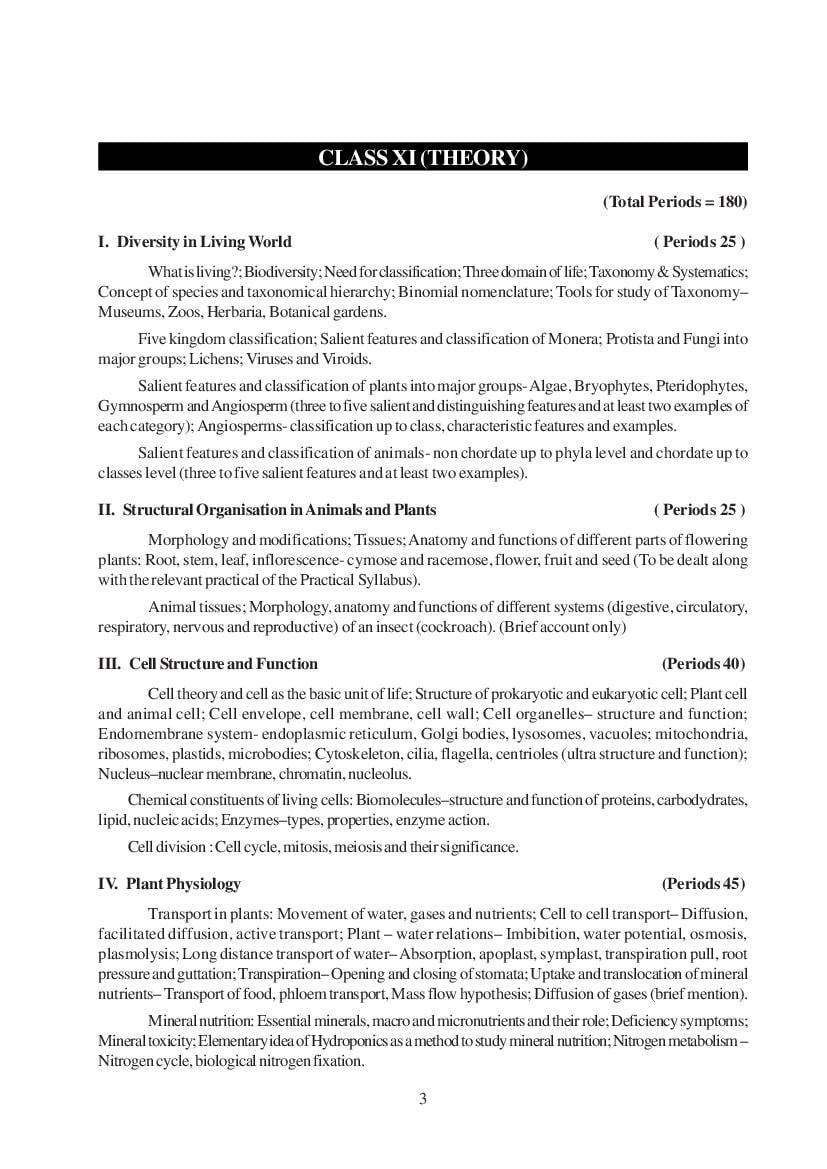
(Total Periods = 180)
I. Diversity in Living World ( Periods 25 )
What is living?; Biodiversity; Need for classification; Three domain of life; Taxonomy & Systematics;
Concept of species and taxonomical hierarchy; Binomial nomenclature; Tools for study of Taxonomy–
Museums, Zoos, Herbaria, Botanical gardens.
Five kingdom classification; Salient features and classification of Monera; Protista and Fungi into
major groups; Lichens; Viruses and Viroids.
Salient features and classification of plants into major groups- Algae, Bryophytes, Pteridophytes,
Gymnosperm and Angiosperm (three to five salient and distinguishing features and at least two examples of
each category); Angiosperms- classification up to class, characteristic features and examples.
Salient features and classification of animals- non chordate up to phyla level and chordate up to
classes level (three to five salient features and at least two examples).
II. Structural Organisation in Animals and Plants ( Periods 25 )
Morphology and modifications; Tissues; Anatomy and functions of different parts of flowering
plants: Root, stem, leaf, inflorescence- cymose and racemose, flower, fruit and seed (To be dealt along
with the relevant practical of the Practical Syllabus).
Animal tissues; Morphology, anatomy and functions of different systems (digestive, circulatory,
respiratory, nervous and reproductive) of an insect (cockroach). (Brief account only)
III. Cell Structure and Function (Periods 40)
Cell theory and cell as the basic unit of life; Structure of prokaryotic and eukaryotic cell; Plant cell
and animal cell; Cell envelope, cell membrane, cell wall; Cell organelles– structure and function;
Endomembrane system- endoplasmic reticulum, Golgi bodies, lysosomes, vacuoles; mitochondria,
ribosomes, plastids, microbodies; Cytoskeleton, cilia, flagella, centrioles (ultra structure and function);
Nucleus–nuclear membrane, chromatin, nucleolus.
Chemical constituents of living cells: Biomolecules–structure and function of proteins, carbodydrates,
lipid, nucleic acids; Enzymes–types, properties, enzyme action.
Cell division : Cell cycle, mitosis, meiosis and their significance.
IV. Plant Physiology (Periods 45)
Transport in plants: Movement of water, gases and nutrients; Cell to cell transport– Diffusion,
facilitated diffusion, active transport; Plant – water relations– Imbibition, water potential, osmosis,
plasmolysis; Long distance transport of water– Absorption, apoplast, symplast, transpiration pull, root
pressure and guttation; Transpiration– Opening and closing of stomata; Uptake and translocation of mineral
nutrients– Transport of food, phloem transport, Mass flow hypothesis; Diffusion of gases (brief mention).
Mineral nutrition: Essential minerals, macro and micronutrients and their role; Deficiency symptoms;
Mineral toxicity; Elementary idea of Hydroponics as a method to study mineral nutrition; Nitrogen metabolism –
Nitrogen cycle, biological nitrogen fixation.
3
Showing the first page only. Download the PDF above for the complete document.
Document Details
| Board / Org | NCERT |
| Exam | Class 11 |
| Type | Syllabus |
| Pages | 4 |
| Updated | 09 Jun 2026 |