APTET Question Paper with Answers 11 Jun 2018 Paper 1 (Shift 2)
Finished viewing? Save it for later —
Download APTET Question Paper with Answers 11 Jun 2018 Paper 1 (Shift 2) (PDF · 64 pages)About APTET Question Paper with Answers 11 Jun 2018 Paper 1 (Shift 2)
APTET Question Paper with Answers 11 Jun 2018 Paper 1 (Shift 2) is available here for free download. Published by Andhra Pradesh Exams for Andhra Pradesh Teacher Eligibility Test, this question paper can be viewed online or downloaded as a PDF (64 pages). Candidates preparing for Andhra Pradesh Teacher Eligibility Test can use APTET Question Paper with Answers 11 Jun 2018 Paper 1 (Shift 2) to understand the exam pattern, the type of questions asked, and the overall difficulty level.
Frequently Asked Questions
How can I download APTET Question Paper with Answers 11 Jun 2018 Paper 1 (Shift 2)?
Open this page and click the Download button to save APTET Question Paper with Answers 11 Jun 2018 Paper 1 (Shift 2) as a PDF. It is completely free on AglaSem Docs.
Is APTET Question Paper with Answers 11 Jun 2018 Paper 1 (Shift 2) free to download?
Yes. APTET Question Paper with Answers 11 Jun 2018 Paper 1 (Shift 2) can be viewed online and downloaded as a PDF free of cost on AglaSem Docs.
How many pages does APTET Question Paper with Answers 11 Jun 2018 Paper 1 (Shift 2) have?
APTET Question Paper with Answers 11 Jun 2018 Paper 1 (Shift 2) contains 64 pages, which you can read online or download together as a single PDF.
Where can I find more Andhra Pradesh Teacher Eligibility Test study material?
You can find more Andhra Pradesh Teacher Eligibility Test question papers, sample papers, syllabus, and answer keys on AglaSem Docs.
APTET Question Paper with Answers 11 Jun 2018 Paper 1 (Shift 2) – Text
Read the full text of this question paper below — useful to quickly search, copy and reference the content online without downloading the PDF.
📄 View text version (64 pages)
Page 1
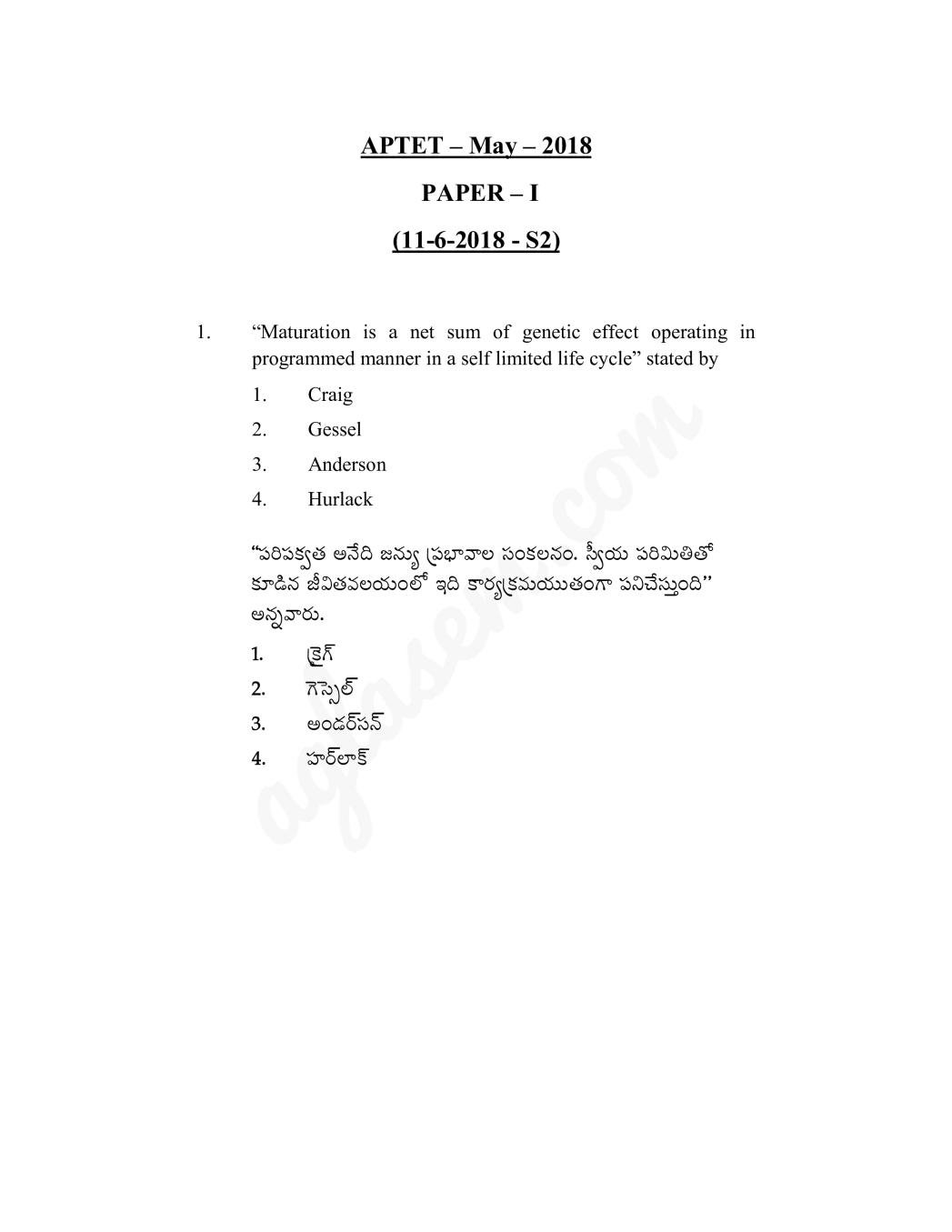
PAPER – I
(11-6-2018 - S2)
1. “Maturation is a net sum of genetic effect operating in
programmed manner in a self limited life cycle” stated by
1. Craig
2. Gessel
3. Anderson
4. Hurlack
Page 2
1. Development is continuous
2. Development cannot be predicted
3. Development is cumulative
4. Development follows the principle of interaction
3. In parallel play children will,
1. imitate the play of others
2. play with others
3. play with friends only
4. share their play materials with others
Page 3
period is
1. Object permanence
2. Animism
3. Ego centrism
4. Lack of concept of irreversibility
5. According to Kohlberg ‘good boy morality’ is found in this
stage.
1. Pre-conventional level – stage 1
2. Pre-conventional level – stage 2
3. Conventional level – stage 3
4. Conventional level – stage 4
Page 4
opined by
1. Chomsky
2. Bandura
3. Skinner
4. Kohlberg
7. An example for individual test of intelligence is
1. Army alpha test
2. Army beta test
3. Ravans standard progressive matrices
4. Weschler Intelligence scale for children
Page 5
1. 2
2. 4
3. 6
4. 8
9. The following is known as master gland
1. Thyroid gland
2. Pituitary gland
3. Adrenal gland
4. Para thyroid gland
Page 6
to play at home. The conflict of Ganesh is
1. Approach – Approach
2. Avoidance - Avoidance
3. Approach - Avoidance
4. Double approach - Avoidance
11. Incorrect statement regarding experimental method is
1. Experimental results can be proved again and again
2. In this method there is less objectivity
3. Relation between cause and effect can be established
4. Experimental method required more money and time.
Page 7
started weeping like a child. This is an example for the
defense mechanism.
1. Identification
2. Displacement
3. Regression
4. Repression
13. This type of transfer of learning takes place, if a student who
learnt to pronounce the word ‘would’, now wish to learn to
pronounce the word ‘could’
1. Positive
2. Negative
3. Zero
4. Bilateral
‘would’ ‘could’
Page 8
learning, then it is called as
1. Proactive inhibition
2. Retroactive inhibition
3. Deja vu
4. Repression
15. Anand learnt a Sanskrit sloka in one and half hour. After one
month he was asked to relearn the same sloka. This time he
took 72 minutes to learn it. His savings score is
1. 20 %
2. 30 %
3. 50 %
4. 75 %
Page 9
1. house
2. education
3. sleep
4. clothes
17. One of the following is not related to cognitive domain
1. Application
2. Alanysis
3. Precision
4. Evaluation
Page 10
the age of
1. 1 year
2. 2 years
3. 3 years
4. 4 years
19. In Pavlov’s experiment the dog salivated on hearing of bell
sound. Here the salivation of dog is.
1. Conditioned stimulus
2. Unconditioned stimulus
3. Conditioned response
4. Unconditioned response
Page 11
1. Role of learner is active
2. Relation is formed between stimulus and response
3. Stimulus is to be shown at the beginning
4. No reinforcement is given
21. Author of the book ‘The Mentality of Apes’
1. Thorndike
2. Kohler
3. Pavlov
4. Skinner
Page 12
includes
1. Continuous reinforcement
2. Primary reinforcement
3. Direct reinforcement
4. Secondary reinforcement
23. As per RTE Act - 2009, the number of teachers required for a
primary school of strength 98 is
2009
1. 2
2. 3
3. 4
4. 5
Page 13
1. Williamson
2. Rogers
3. Thorne
4. Freud
25. In participatory leadership
1. There is no freedom to members to question decisions
made by leader
2. Leader will give importance to the opinions of
members in taking decisions
3. Leader is a dictator
4. All the members act as leaders
Page 14
1. Oral – language disability
2. Reading disability
3. Writing disability
4. Arithmetic disability
27. The enactive method, iconic method and symbolic methods in
instructional order was proposed by
1. Skinner
2. Bruner
3. Piaget
4. Bloom
Page 15
1. Providing a situation
2. Planning
3. Execution
4. Evaluation
29. Chapter 2 of NCF 2005 deals with
1. Learning - knowledge
2. School, class environment
3. Institutional reforms
4. Educational plan
NCF 2005
Page 16
1. Films
2. Bulletin board
3. Chart
4. Black board
Page 17
32.
33.
Page 18
35.
36.
37.
Page 19
39.
40.
41.
Page 20
43.
44.
45.
Page 21
47.
48.
49.
Page 22
51.
52.
Page 23
54.
Page 24
56.
57.
58.
Page 25
60.
Page 26
Choose the meaning of the word “heed”.
1. pay attention
2. travel through
3. work with energy
4. do something
62. What is this dreadful noise that never stops? asked the
country mouse.
Choose the synonym of the word “dreadful”
1. cheerful
2. well known
3. loving
4. unpleasant
63. She fell silent and the children recognized her pensive mood
and kept silent.
Choose the antonym of the word “pensive”.
1. cheerful
2. caring
3. attentive
4. thoughtful
Page 27
1. transperent
2. sofhisticated
3. briliant
4. surgeon
65. I thought I should drop in to see you, Amma.
Choose the meaning of the phrase, “drop in”.
1. attack
2. visit
3. settle
4. teach
66. Choose the suffix that suits the word “comprehend” to form a
noun.
1. tion
2. sion
3. ness
4. ly
67. Choose the simple sentence from the following.
1. The cat is chasing the rat.
2. He is poor but he is honest.
3. The dog is not only wet but also hungry.
4. My father found that the wallet and credit cards were
missing.
Page 28
following.
1. Laxman is only not rich but not also popular.
2. Laxman is not only rich but also not popular.
3. Laxman is not only rich but also popular.
4. Laxman is not only rich and popular.
69. By the end of the month, I _____ the work.
Choose the correct form of the verb that fits the blank.
1. will have finished
2. will finished
3. will be finished
4. will finishing
70. They are perfectly lovely.
Choose the part of speech of the word ‘lovely’.
1. a noun
2. an adverb
3. an adjective
4. a conjunction
Page 29
success.
This sentence has
1. a noun clause
2. an adverbial clause
3. a defining relative clause
4. a conditional clause
72. Ashok is doing his homework now. He usually _______ it at
night.
Choose the correct form of the verb that fits the blank.
1. does
2. do
3. did
4. is doing
73. I like to play _____ cricket.
Choose the correct article that fits the blank.
1. a
2. an
3. the
4. no article is needed
Page 30
Choose the correct preposition that fits the context.
1. about
2. of
3. at
4. for
75. It is the greatest battle of my life.
Choose the positive degree of this sentence.
1. It is greater than any other battle of my life.
2. No other battle of my life is so great as it.
3. All the battles of my life are so great as this.
4. It is one of the greatest battles of my life.
76. Can I leave this place?
The above sentence indicates :
1. Expressing possibility
2. Taking permission
3. Giving permission
4. Seeking information
77. Choose the sentence that has a correct question tag :
1. He completed his home work, did he?
2. They are players, isn’t it?
3. We never miss the class, don’t we?
4. She has arranged a party, hasn’t she?
Page 31
Choose the correct reported speech of the sentence.
1. Shivaji said that he was helped him today.
2. Shivaji said that he had helped him that day.
3. Shivaji said that he had helped me that day.
4. Shivaji said that you had helped me today.
79. The animals and the birds approached him.
Choose the correct Passive Voice of the sentence.
1. He was approached by the animals and the birds.
2. The animals and the birds were approached by him.
3. He has been approached by the animals and the birds.
4. He is approached by the animals and the birds.
80. Andrew’s parents were moving into a smaller house because
they could not afford to stay in the present house after paying
doctors bill. They gave up their efforts.
Choose the word in the sentence that should contain an
apostrophe :
1. parents
2. efforts
3. doctors
4. present
Page 32
your friend:
1. Ask the recipient if he is good at English.
2. Inform the recipient why you are writing the letter.
3. Talk about the crops in the village.
4. Ask the person about his well being.
82. Choose the list of words in correct alphabetical order.
1. lingual, lingerie, linger, linguist
2. linger, linguist, lingual, lingerie
3. linger, lingerie, lingual, linguist
4. linguist, linger, lingerie, lingual
83. Read the passage and choose the correct answer to the
question given after.
Nicholas learnt to make strong kites modeled on the
Japanese kites, Rokkaku that could endure harsh winds. A
novice in his chosen field, set out to train himself.
The purpose of Nicholas to make strong kites on the model of
“Rokkaku” was :
1. to train himself how to fly kites
2. to withstand harsh winds
3. to create history in the field of kite flying
4. to take them to Japan.
Page 33
question given after.
Once there was a cat in a mill. It used to hunt rats
every night. One day all the rats assembled when the cat was
away. ‘The cat is very smart. It walks very soft. We could not
find him until he jumps on us,’ said an old rat.
The rats could not find the cat until it jumps on them because:
1. it lived in a mill
2. it hunts every night
3. the rats don’t assemble and listen to
4. it walks very soft
85. Language exhibits prevarication. Prevarication means:
1. language repeats itself
2. the ability to sing songs.
3. language is extendible
4. the ability to tell lies
86. The following can help the reader anticipate the content of the
article.
1. Reading the second paragraph
2. Reading the title
3. Reading the middle of the article.
4. Reading the second line
Page 34
language.
1. Poem
2. Rhyme
3. Prose lesson
4. Supplementary Reader
88. News paper headings contain mainly
1. structural words
2. content words
3. silent letters
4. double letters
89. A cook seeking a job at a five star hotel could be asked to
prepare a dish of his choice.
This is a:
1. Proficiency test
2. Reliability test
3. Test-Retest
4. Inter – rater test
90. Active listening is :
1. to like and love
2. to make and do
3. to understand and interpret
4. to take and give
Page 35
largest two digit number is
1. 90
2. 900
3. 9900
4. 9990
92. Padma paid on amount of ` 1250 per month as rent. The total
amount of rent paid by her for 2 years (in rupees) is
`
1. 12500/-
2. 15000/-
3. 25000/-
4. 30000/-
93. Average of first five prime numbers is
1. 3
2. 4.4
3. 5
4. 5.6
Page 36
when it is divided by 7, then the number is
1. 51
2. 55
3. 57
4. 59
95. A person bought an article for ` 300 and sold it for ` 320
then his gain percentage is
` `
2
1. 6
3
1
2. 6
4
3. 15
4. 20
Page 37
96. If Akshara bought kg of Chilli powder for ` 28, then the
8
cost of 1 kg Chilli powder is (in Rs.)
1
`
8
1. ` 56
2. ` 112
3. ` 224
4. ` 280
97. Satwika went to her friend’s house at 4.45 P.M. and she came
back to home at 6.20 P.M. then, the time she spent at her
friend’s house is
1. 2 hour 25 min.
2. 2 hour 15 min.
3. 1 hour 25 min.
4. 1 hour 35 min.
1.
2.
3.
4.
Page 38
years each, is 48 years then the age of the elder child is
(in years)
1. 16
2. 15
3. 13
4. 12
1
99. The simple interest on a certain sum for 8 years at 3 is
3
` 200 then the total amount is (in rupees)
1
3
3
`
1. 550
2. 750
3. 950
4. 1050
Page 39
5a–2 5a+4 = 625 ‘a’
1. 1
2. 2
3. 3
4. 4
101. The standard form of the number 241000000 is
241000000
1. 2.41 109
2. 2.41 108
3. 2.41 107
4. 2.41 106
102. The value of 5 1 2 1 6 1 is
51 21 61
1
1.
60
3
2.
5
5
3.
3
4. 60
Page 40
13 and 14 are
1. 24
2. 25
3. 26
4. 27
104. If the median of the data 24, 29, 34, 38, x is 29 then the value
of ‘x’ is
1. more than 29
2. more than 38
3. less than 29
4. between 29 and 34
24, 29, 34, 38, x 29 ‘x’
1.
2.
3.
4.
Page 41
1. 12
2. 10
3. 12 (or) 10
4. 12 and 10
10, 12, 14, 10, 12, 16, 12, 10
1.
2.
3.
4.
106. The bars in a bar graph have
1. Same length
2. Same breadth
3. Same Area
4. Same perimeter
1.
2.
3.
4.
Page 42
the market price of the shirt is (in Rs.)
`
1. 1800
2. 1920
3. 2000
4. 2200
108. The number of factors of 36 is
1. 6
2. 7
3. 8
4. 9
109. The number of lines of symmetry in a 30o-60o-90o set square
is
30o-60o-90o
1. 0
2. 1
3. 2
4. 3
Page 43
1. 90o, 70o, 20o
2. 83o, 70o, 27o
3. 67o, 51o, 62o
4. 40o, 132o, 18o
111. The perimeter of a rectangle whose length 60 cm and length
of the diagonal 61 cm is (in cms)
1. 142
2. 122
3. 120
4. 71
112. Circumference of a circle is 22 cm then its diameter is (in cm)
1. 3.5
2. 14
3. 11
4. 7
Page 44
1. Triangle
2. Rectangle
3. Circle
4. Semi circle
1.
2.
3.
4.
114. The area of rectangular garden which has 40m. length is
1120 sq.m. then the width of the garden is (in mts.)
1. 32
2. 30
3. 28
4. 26
Page 45
1. Approximation theory
2. Theory of numbers
3. Bifurcation theory
4. Automata theory
1.
2.
3.
4.
116. The very lowest level objective in psycho-motor domain is
1. Receiving
2. Characterisation
3. Imitation
4. Naturalisation
1.
2.
3.
4.
Page 46
1. Example to principle
2. Known to unknown
3. Conclusion to hypothesis
4. Concrete to Abstract
1.
2.
3.
4.
118. This indicates the “lowest amount of learning” in
Edgar Dale’s cone of experience
1. Direct purposeful experience
2. Exhibits
3. Visual symbols
4. Verbal symbols
1.
2.
3.
4.
Page 47
addition are included in 1st, 2nd and 3rd classes respectively in
preparation of Maths Text book.” The adopted curriculum
organization approach is
1. Topical approach
2. Concentric approach
3. Spiral approach
4. Inductive approach
1.
2.
3.
4.
Page 48
item
“Write the numbers 17, 32, 23, 19, 62, 37 in ascending order”
1. Reasoning - Proof
2. Communication
3. Connection
4. Representation - Visualisation
1.
2.
3.
4.
Page 49
1. East to West
2. West to East
3. North to South
4. South to North
122. In a bulb, the part that gives light is
1. Metal base
2. Glass chamber
3. Filament
4. Terminals
Page 50
1. Oxalic acid
2. Formic acid
3. Acetic acid
4. Tartaric acid
124. In a plane mirror, the angle of incidence is 30º, then the angle
made by reflected ray with the normal is (in degrees)
º
1. 0
2. 30
3. 60
4. 90
Page 51
1. Petrol
2. Diesel
3. Kerosene
4. Gasoline
126. In a candle flame, the zone at which “Combustion” does not
take place is
1. Blue zone
2. Dark zone
3. Yellow zone
4. Outermost zone
Page 52
1. Natural fertilizer
2. Chemical fertilizer
3. Insecticide
4. Food material
128. The award that is presented by ‘Council for Green
Revolution’ to the students, who participate in forest
motivating movement is
1. Love for the plants
2. Love for the forests
3. Love for the nature
4. Green friend
Page 53
1. Ball and socket joint, Hinge joint
2. Hinge joint, Neck joint
3. Neck joint, Fixed joint
4. Fixed joint, Ball and socket joint
130. This statement is not correct with reference to insectivorous
plants
1. Insectivorous plants are autotrophs
2. Insectivorous plants are called as carnivorous plants
3. Insectivorous plants maintain symbiosis
4. Insectivorous plants receive nitrogen from insects
Page 54
1. Formal education
2. Adolescence education
3. Population education
4. Environmental education
132. As per the list released by IUCN and ZSL this animal of
Andhra Pradesh is in threatened condition
1. Single horned Rhino
2. Spotted chital deer
3. Great Indian Bustard
4. Black spider monkey
IUCN ZSL
Page 55
1. Visakha to Nellore
2. Nellore to Chittoor
3. East Godavari to Prakasam
4. Srikakulam to Pulikat Lake
134. The name of the Gond panchayath is
1. Gana
2. Panchayath
3. Panch
4. Gramasabha
Page 56
1. Chandragupta
2. Ashoka
3. Bindusara
4. Bimbisara
136. Sir John Marshal belongs to
1. Britain
2. Germany
3. France
4. India
Page 57
1. Nellore
2. Chittoor
3. Anathapuram
4. Kurnool
138. The smallest Ocean is
1. Antarctic Ocean
2. Arctic Ocean
3. Atlantic Ocean
4. Indian Ocean
Page 58
1. Shivaji
2. Pruthvi Raj Chowhan
3. Sher Khan
4. Ibrahim Lodi
140. Son of Akbar was
1. Humayun
2. Shah Jahan
3. Jahangir
4. Auranzeb
Page 59
1. Jyotirao Govindarao Phule
2. Narayana Guru
3. Periyar Ramaswamy
4. Bhagyareddy Varma
142. The solar radiation received on the surface of the earth is
called
1. Radiation
2. Solar energy
3. Insolation
4. Reflection
Page 60
1. September 23
2. June 21
3. December 22
4. July 22
144. Silver coin of Mourya period was
1. Nishka
2. Ghatika
3. Pana
4. Besant
Page 61
1. Predicting
2. Experimenting
3. Inferring
4. Communicating
146. The objective that belongs to psychomotor domain is
1. Evaluation
2. Characterization
3. Organization
4. Articulation
Page 62
objectives is curriculum’ – This definition is given by
1. Spears
2. Manroe
3. Cunningham
4. Samuel
148. The memory power is 30% for ordinary individuals in the
following context
1. In hearing
2. In reading
3. In seeing
4. In telling
Page 63
to be used is
1. Evolutionary
2. Social
3. Biographical
4. Anecdotal
150. Evaluation that is suitable to bring changes in the individual
instruction to be provided to the pupils
1. Formative
2. Placement
3. Summative
4. Diagnostic
Page 64
Paper-I - Telugu Medium - Set-D 11.06.2018 Afternoon Session
Q. Nos. CDP Q. Nos. Telugu Q. Nos. English Q. Nos. Maths Q. Nos. EVS
1 2 31 2 61 1 91 3 121 2
2 2 32 3 62 4 92 4 122 3
3 1 33 3 63 1 93 4 123 1
4 4 34 2 64 4 94 3 124 2
5 3 35 1 65 2 95 1 125 3
6 1 36 1 66 2 96 3 126 2
7 4 37 3 67 1 97 4 127 3
8 4 38 4 68 3 98 2 128 2
9 2 39 1 69 1 99 3 129 1
10 1 40 3 70 3 100 1 130 3
11 2 41 2 71 3 101 2 131 2
12 3 42 3 72 1 102 2 132 3
13 1 43 4 73 4 103 3 133 4
14 1 44 3 74 2 104 3 134 3
15 1 45 4 75 2 105 4 135 1
16 3 46 3 76 2 106 2 136 1
17 3 47 3 77 4 107 3 137 2
18 2 48 4 78 2 108 4 138 2
19 3 49 3 79 1 109 1 139 3
20 1 50 2 80 3 110 4 140 3
21 2 51 3 81 4 111 1 141 1
22 3 52 2 82 3 112 4 142 3
23 3 53 2 83 2 113 2 143 1
24 1 54 1 84 4 114 3 144 3
25 2 55 1 85 4 115 2 145 2
26 3 56 3 86 2 116 3 146 4
27 2 57 2 87 3 117 2 147 2
28 1 58 4 88 2 118 4 148 3
29 1 59 2 89 1 119 2 149 1
30 1 60 1 90 3 120 1 150 4
Document Details
| Board / Org | Andhra Pradesh Exams |
| Exam | Andhra Pradesh Teacher Eligibility Test |
| Type | Question Paper |
| Pages | 64 |
| Updated | 09 Jun 2026 |