AP TET 2022 Question Paper I SGT
Finished viewing? Save it for later —
Download AP TET 2022 Question Paper I SGT (PDF · 58 pages)About AP TET 2022 Question Paper I SGT
AP TET 2022 Question Paper I SGT is available here for free download. Published by Andhra Pradesh Exams for Andhra Pradesh Teacher Eligibility Test, this question paper can be viewed online or downloaded as a PDF (58 pages). Candidates preparing for Andhra Pradesh Teacher Eligibility Test can use AP TET 2022 Question Paper I SGT to understand the exam pattern, the type of questions asked, and the overall difficulty level.
Frequently Asked Questions
How can I download AP TET 2022 Question Paper I SGT?
Open this page and click the Download button to save AP TET 2022 Question Paper I SGT as a PDF. It is completely free on AglaSem Docs.
Is AP TET 2022 Question Paper I SGT free to download?
Yes. AP TET 2022 Question Paper I SGT can be viewed online and downloaded as a PDF free of cost on AglaSem Docs.
How many pages does AP TET 2022 Question Paper I SGT have?
AP TET 2022 Question Paper I SGT contains 58 pages, which you can read online or download together as a single PDF.
Where can I find more Andhra Pradesh Teacher Eligibility Test study material?
You can find more Andhra Pradesh Teacher Eligibility Test question papers, sample papers, syllabus, and answer keys on AglaSem Docs.
AP TET 2022 Question Paper I SGT – Text
Read the full text of this question paper below — useful to quickly search, copy and reference the content online without downloading the PDF.
📄 View text version (58 pages)
Page 1
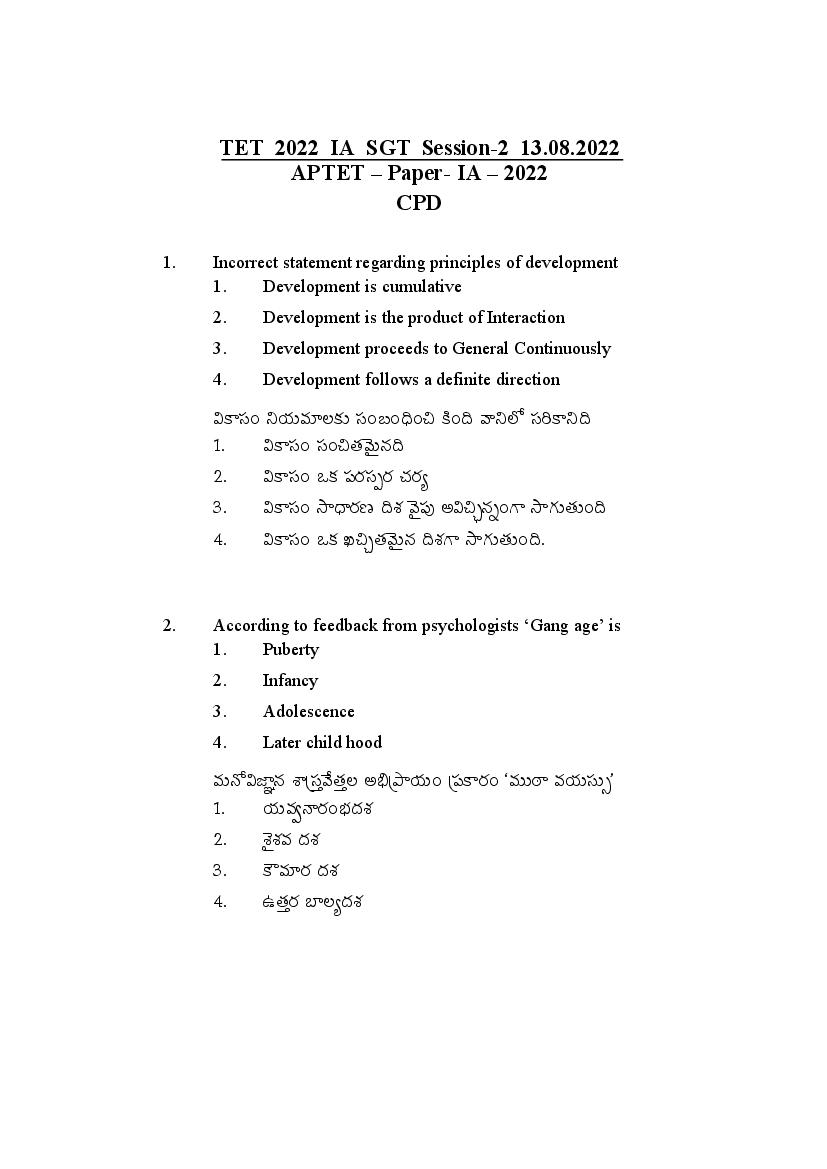
APTET – Paper- IA – 2022
CPD
1. Incorrect statement regarding principles of development
1. Development is cumulative
2. Development is the product of Interaction
3. Development proceeds to General Continuously
4. Development follows a definite direction
$¿±d+ jáTeÖ\Å£ d++~ó+º ¿ì+~ yýË d]¿±~
1. $¿±d+ d+ºÔáyîT®q~
2. $¿±d+ ÿ¿£ |sÁdÎsÁ #ásÁ«
3. $¿±d+ kÍ<ósÁD ~Xø yîÕ|Ú n$ºÌÛq+>± kÍ>·TÔáT+~
4. $¿±d+ ÿ¿£ KºÌÔáyîT®q ~Xø>± kÍ>·TÔáT+~.
2. According to feedback from psychologists ‘Gang age’ is
1. Puberty
2. Infancy
3. Adolescence
4. Later child hood
eTHÃ$C²ãq XæçdïyûÔáï\ n_óçbÍjáT+ ç|¿±sÁ+ »eTTsÄ ejáTdTàµ
1. jáTeÇHsÁ+uó<Xø
2. XèÕXøe <Xø
3. ¿eÖsÁ <Xø
4. ÔáïsÁ u²\«<Xø
Page 2
1. Independent
2. Dependent
3. Intervening
4. Single
ç|jÖî >±¿ì ³+¿£+ ¿£*Ð+#û #ás+Á
1. dÇÔá+çÔá
2. |sÁÔá+çÔá
3. CË¿£«
4. @¿£
4. Socio – culture – theory was proposed by
1. Erik Erikson
2. Chomsky
3. Hurlock
4. Vygotsky
kÍ+|¾T¿£ ` kÍ+dØÜ¿£ ` d¾<Æ+Ô ç|ÜbÍ~+ºq ysÁT
1. m]¿ù m]¿£àH
2. #yT dÓØ
3. V²s¢¿ù
4. yîÕ>Ã{ÙdÓØ
Page 3
1. Sensory motor stage
2. Pre – operational stage
3. Concrete – operational stage
4. Formal – operational stage
|¾jÖá Cñ ç|¿±sÁ+ »nV²+ ¿¹ +çB¿£Ôá uó²eqµ nHû~ <Xýø Ë +³T+~
1. +ç~jáT #\¿£ <Xø
2. |PsÁÇ ç|#\¿£ <Xø
3. eTÖsÁï ç|#\¿£ <Xø
4. neTÖsÁï ç|#\¿£ <Xø
6. According to Psycho – Social Development theory
‘Hero – worship’ belongs to following stage
eTHà kÍ+|T¾ ¿£ $¿±d d¾<Æ+Ôá+ ýË »e«¿ìï |Pȵ nHû~ ¿ì+~
<XøýË +³T+~.
1. 6
2. 4
3. 5
4. 7
7. Author of the book “The Sociology of Teaching”
1. Francis Galton
2. Watson
3. William James
4. Willard Waller
“The Sociology of Teaching” ç>·+<¸ sÁ#s
á TTÔá
1. çbÍàdt >±\¼H
2. y³àH
3. $*jáT+ CñyT à
4. $ý²¢s¦Y y\sY
Page 4
based on the following theory
1. Spearman Specific Factor
2. Guilford Structure of Intellect
3. Thurston Primary Mental Abilities
4. Thorndike C.A.V.D
uóñ<Ôá¿£ kÍeTsÁÆ« ¿£w (DATB) ¿ì+~ d¾<Æ+Ôá+ <ósÁ+>±
sÁÖbõ+~+#á&+~
1. d¾ÎjáTsY eTH ]Æw¼ ¿±sÁ¿+£
2. ÐýÙ|s ¦Y ç|C²ã dÇsÁÖ|+
3. <¸sÁd¼H çbÍ<¸$T¿£ eÖqd¾¿£ kÍeTsÆ«\T
4. <¸sY&îÕ¿ù C.A.V.D
9. A 4th class student named Saritha told that 5 ´ 5 = 52 , then her
thinking process is
1. Convergent thinking
2. Divergent thinking
3. Concrete thinking
4. Abstract thinking
d]Ôá nHû 4e ÔásÁ>·Ü $<«] 5 ´ 5 = 5 n #î|ξ q yîTýË
2
ýË#áq ç|ç¿ìjTá
1. dyTî ¿® «£ ýË#áq
2. $_óq ýË#áq
3. eTÖsÁï ýË#áq
4. neTÖsÁï ýË#áq
Page 5
1. Perception
2. Creativity
3. Knowledge
4. Knowing one’s own mind
yîT{² ¿±ÐwH n+fñ
1. ç|Ô«á ¿£+
2. dÈHÔá¿£Ôá
3. C²ãq+
4. dÇT~Ý
11. The reason for Children under 18 years of age are not given the
right to vote
1. Low Growth
2. Low Maturity
3. High Emotions
4. Low motivation
18 d+ööýË|Ú u²\\Å£ z³TV²Å£Ø ¿£*Î+#á¿b£ þe&¿ì ¿±sÁD+
1. |sÁT>·T<\ ÔáÅ£ Øe
2. ÔáÅ£ Øe |]|¿Ç£ Ôá
3. <ûÇ>±\T mÅ£Øe
4. ÔáÅ£ Øe ç|sÁD
Page 6
curve.
1. Fluctuating stage
2. Plateau stage
3. Initial spirit stage
4. Body limit stage
nuó« dq eç¿£s¹ KýË nuó« dq yû>+· ýË V²#áTÌ Ôá>T· \Z T ¿£q&û <Xø
1. #+#á\« <Xø
2. |ÓsuÁÄ Öó $T <Xø
3. çbÍsÁ+uó dÖÎ]ï <Xø
4. Xæ¯sÁ¿£ V²<TÝ <Xø
13. The concept of ‘Learning Disability’ used for the first time by
1. Vygotsky
2. Samuel Kirk
3. Thurstone
4. Thorndike
»nuó« dq yî¿Õ \£ «+µ nq uó²eqqT yîTT³¼ yîTT<{ì kÍ]>±
|jÖî Ð+ºq ysÁT
1. yî>Õ ±{ÙdØÓ
2. XæeTÖ«ýÙ ¿ìsYØ
3. <¸sYd¼H
4. <¸sY&îÕ¿ù
Page 7
1. Production level
2. Research level
3. Expressive level
4. Innovative level
dÈHÔá¿£Ôá kÍÆsTTýË ¿=Ôáï $wjáÖ\qT ¿£qT>=q&+ ÈsÁT>·TÔáT+~
1. ÔáÎÜï kÍÆsTT
2. |]XË<óq kÍÆsTT
3. e«¿¡ï¿£sÁD kÍÆsTT
4. qÖÔáq dÈq kÍÆsTT
15. Which is not in the ‘Tri polar process’
1. Content
2. Library - Labs
3. Teacher
4. Student
çÜ<ó e $<óq+ýË ýñ~
1. $wjáT+
2. ç>·+<ó\jáT+ ` ç|jÖî >·Xæ\\T
3. bÍ<ó«jáTT&T
4. $<«]
Page 8
1. Food
2. Sleep
3. Home
4. Water
¿ì+~ yýË »>D nedsÁ+µ
1. VäsÁ+
2. ç<
3. \T¢
4. úsÁT
17. Example for Displacement
1. A clerk shows his angry on his wife instead of officer
2. Fantasy
3. Unreached grapes are sour
4. Slow and study wins the race
$kÍï|q eTTqÅ£ ÿ¿£ <V²sÁD
1. |ÓdsY MT< ¿ÃbÍ >·TeÖkÍï Ôáq uó²sÁ« MT< #áÖ|&+
2. |>{ · ì ¿£\\T ¿£q&+
3. n+< ç<¿£ |Ú\¢q
4. <qyûT ç|<ó qeTT
Page 9
1. B.F. Skinner
2. Vygotsky
3. Kohler
4. Pavlov
|]¿£sÔá¿£ +<óH ç|ÜbÍ~+ºq~
1. B.F. d¾ØqsY
2. yî>Õ ±{ÙdØÓ
3. ¿=V²\sY
4. bÍyýËy
19. “Unfinished tasks are remembered for longer time” is called as
1. Zygornic Effect
2. Deja Vu
3. Rote memory
4. Short term memory
»»d>+· ýË |¾q |qT\T mÅ£Øe ¿±\+ >·TsÁT+ï {²sTTµµ, B
ý² n+{²sÁT
1. CÉ>Õ ±]¿ù ç|u²ó e+
2. &îC²eÚ
3. {¡¼dÜ
4. dÇ\ο±\ dÜ
Page 10
with the left hand. This type of Transfer is
1. Positive – Transfer of learning
2. Negative – Transfer of learning
3. Zero Transfer of learning
4. Bilateral Transfer of learning
Å£& #ûÜÔà HûsTÁ ÌÅ£q ¿Xøý²\T m&eT #ûÜÔà ţL& #ûjTá
>·\>·&+ ¿ì+~ nuó« dq <ý²sTT+|Ú
1. nqTÅ£L\ nuó« dq <ý²sTT+|Ú
2. ç|ÜÅ£L\ nuó« dq <ý²sTT+|Ú
3. XøSq« nuó« dq <ý²sTT+|Ú
4. ~Ç bÍsÁôÇ nuó«dq <ý²sTT+|Ú
21. World Wide Web (WWW) launched in the year
esÁý¦Ù yî&Õ yîuÙ (WWW) $sÁÒ$Û +ºq d+eÔáàsÁ+
1. 1989
2. 1992
3. 1987
4. 1990
Page 11
modes of representation
1. Enactive
2. Iconic
3. Symbolic
4. Cognitive
çÖqsY d¾<Æ+Ôá+ ç|¿±sÁ+ çÜ$<ó C²ãq+ýË ýñ n+Xø+
1. ¿£Ô«Ôá¿£
2. uó²eHÔá¿£
3. ç|r¿±Ôá¿£
4. d+C²ãHÔá¿£
23. As per NEP-2020, School Education is
1. Pre Primary to 12th class
2. Primary to 12th class
3. Primary to 10th class
4. Pre Primary to 10th class
NEP-2020 ç|¿±sÁ+ bÍsÄXÁ æ\ $<« nHû~
1. |PsÁÇ çbÍ<¸$T¿£ kÍÆsTT qT+& 12e ÔásÁ>·Ü
2. çbÍ<¸$T¿£ kÍÆsTT qT+& 12e ÔásÁ>·Ü
3. çbÍ<¸$T¿£ kÍÆsTT qT+& 10e ÔásÁ>·Ü
4. |PsÁÇ çbÍ<¸$T¿£ kÍÆsTT qT+& 10e ÔásÁ>·Ü
Page 12
1. Dysgraphia
2. Dyscalculia
3. Dyslexia
4. Dysphasia
>·DÔ
ì á nuó« dq yî¿Õ £ý²«\qT ý² |¾\TkÍïsTÁ
1. &dt ç>±|j¾ Öá
2. &d¿t ±\TØ*jáÖ
3. &dt ýÉ¿àì jáÖ
4. &dt |dj ¾ Öá
25. According to RTE 2009 ‘children’ are
1. 3 - 15 years
2. 5 - 11 years
3. 5 - 15 years
4. 6 - 14 years
RTE 2009 ç|¿±sÁ+ »u²\\Tµ nq>±
1. 3 ` 15 d+eÔáàs\T
2. 5 ` 11 d+eÔáàs\T
3. 5 ` 15 d+eÔáàs\T
4. 6 ` 14 d+eÔáàs\T
Page 13
1. Pavlov
2. Skinner
3. Bandura
4. Noam Chomsky
“uó²cÍ ç>·V² D d¾<Æ+Ôá+” ç|ÜbÍ~+ºq ysÁT
1. bÍyýËy
2. d¾ØqsY
3. +&ÖsÁ
4. HÃ+ #yTdÓØ
27. One of the following is not a type of projector
¿ì+~ yýË çbõCÉ¿£¼sY\ sÁ¿£+ ¿±~
1. LCD
2. DLC
3. LED
4. DLP
28. Trojan Horse is a
1. Computer application
2. Virus
3. App
4. Resource
ç{ËÈH VäsYà nq>±
1. ¿£+|P«³sY n|¾¿¹¢ wH
2. yîsÕ Ádt
3. jáÖ|t
4. eqsÁT
Page 14
1. Crying
2. Babbling Sound
3. Gestures
4. Reciting poems
¿ì+~ y{ìýË ¥XøeÚýË çbÍ¿ù d+uó²wD sÁÖ|+ ¿±~
1. @&Ç&+
2. ¿¹ ]+Ôá\T ¿=³¼&+
3. +ÐÔ\T
4. |<«\T |]+Ä #á&+
30. Over 85% of cumulative brain development
occurs prior to the age of
1. 4 years
2. 5 years
3. 6 years
4. 7 years
yîT<&T d+ºÔá n_óe~ÆýË 85% ¿£+fñ mÅ£Øe ejáTdT¿£+fñ
eTT+<û ÈsÁT>·TÔáT+~
1. 4 d+eÔáàs\T
2. 5 d+eÔáàs\T
3. 6 d+eÔáàs\T
4. 7 d+eÔáàs\T
Page 15
Telugu
31. ¿ì+~ |<« #á~$ ç|XøÅ£ ÈyTqT >·T]ï+#á+&.
sÁ+>· <sÜ uó+>·, K>· sÈÔáTsÁ+>·, $|ÔáÎsÁ+ |sÃ
ÔáTï+>·, ÔáeT: |Ôá+>·, |] »»ÔÃw¾ÔásÁ+>·, <jáÖÔásÁ+>·, d
Ôáà+>·, <ósÔáC²V²<jáT kÍsÁduó+>·, Xæ#ás¨eÖ
Ôá+>·, Xøuó²+>·, uóç<Ð] <XøsÁB¸, Å£sÁTD² |jîÖB!
»<XøsÁB¸ ¿£sÁTD² |jîÖBóµ eTÅ£³+ÔÃ |<«+ sd¾q ysÁT
1. nqeTjáT«
2. ¿£+#îsÁ¢ *+>·q
3. ¿£+#îsÁ¢ seTq
4. ¿£+#îsÁ¢ >Ã|q
32. ¿ì+~ |<« #á~$ ç|XøÅ£ ÈyTqT >·T]ï+#á+&.
sÁ+>· <sÜ uó+>·, K>· sÈÔáTsÁ+>·, $|ÔáÎsÁ+ |sÃ
ÔáTï+>·, ÔáeT: |Ôá+>·, |] »»ÔÃw¾ÔásÁ+>·, <jáÖÔásÁ+>·, d
Ôáà+>·, <ósÔáC²V²<jáT kÍsÁduó+>·, Xæ#ás¨eÖ
Ôá+>·, Xøuó²+>·, uóç<Ð] <XøsÁB¸, Å£sÁTD² |jîÖB!
»<ósÔáC²µ n+fñ
1. uóÖeÖÔá
2. <ósÔá
3. dÓÔ<û$
4. eÖÔá+Ð
Page 16
Ôî\T>·T Je<ÒÛw, Je<ÒÛw $TÐ*q dJe e«edÆ\ ý²>±Hû ¿±\ç¿£eÖq
eÖsÁTÔáT+~. uó²w ýñ<û deÖÈ+ ýñ<T. uó²we\¢ nHëq« e«eVäsÁ+
kÍ<ó«+ ¿±e{+ e\¢Hû kÍeÖ¿£ e«ed @sÁÎ&¦~. ÿ¹¿ deÖÈ+ýË
çbÍ+Ô¿ì, ¿£³T¼, ¿ì, |[ßÞøß, |sÁ+{²\T yîTT<ýqÕÉ y{ìýË¢
Ôû&\Tqfñ¢ uó²cÍ e«eVäsÁ+ýËqÖ Ôû&\T ¿£|¾kÍïsTT. n\y³T¢
yûs HÕ Ôî\T>·T d+dØÜýË @¿£sÖÁ |¿Ô
£ á ¿£|¾dT +ï ~.
>·<« + <ósÁ+>± ds qÕ < >·T]ï+#á+&
1. Je<ÒÛw n+fñ sÁ+ÔásÁ+ eÖsÁ~
2. uó²cÍ e«eVäsÁ+ýË Ôû&\T +&eÚ.
3. Ôî\T>·T d+dØÜýË @¿£sÖÁ |¿Ô
£ á ¿£|¾+#á<T
4. ¿±ý²qT>·TD+>± uó²w eÖsÁTÔáT+~
34. ¿ì+~ >·<« + #á~$ ç|Xø Å£ ÈyT >·T]ï+#á+&.
Ôî\T>·T Je<ÒÛw, Je<ÒÛw $TÐ*q dJe e«edÆ\ ý²>±Hû ¿±\ç¿£eÖq
eÖsÁTÔáT+~. uó²w ýñ<û deÖÈ+ ýñ<T. uó²we\¢ nHëq« e«eVäsÁ+
kÍ<ó«+ ¿±e{+ e\¢Hû kÍeÖ¿£ e«ed @sÁÎ&¦~. ÿ¹¿ deÖÈ+ýË
çbÍ+Ô¿ì, ¿£³T¼, ¿ì, |[ßÞøß, |sÁ+{²\T yîTT<ýqÕÉ y{ìýË¢
Ôû&\Tqfñ¢ uó²cÍ e«eVäsÁ+ýËqÖ Ôû&\T ¿£|¾kÍïsTT. n\y³T¢
yûs HÕ Ôî\T>·T d+dØÜýË @¿£sÖÁ |¿Ô
£ á ¿£|¾dT +ï ~.
çbÍ+Ôá çbÍ+Ô¿ì n\y³T¢ yûs HÕ @¿£sÖÁ |¿Ô
£ á +<TýË ¿£|¾dT +ï ~.
1. Ü+&ýË
2. |[ßýË¢
3. Ôî\T>·T d+dØÜýË
4. Ôî\T>·T ¿£³T¼u²³¢ýË
Page 17
n m\TÂ>Üï #{ìq ¿£$
1. <Xøs~Á ¸ sÁ+>±#sÁ«
2. ll
3. sÁTç<
4. çÜ|ÚsÁHû seTkÍÇ$T
36. »uó +>·eTTµ |s«jáT|<\T
1. $T[+<+, çuóe TsÁ+
2. ¿¡³¿£+, ÔáÖú>·
3. ¿=+&, |sÁÇÔá+
4. Ôá\, eTd¿ï +£
37. »nq|ÖÔáT\Tµ n+fñ
1. bÍbÍÔáT\T
2. |ÚD²«ÔáT\T
3. neÖjáTÅ£\T
4. $<«e+ÔáT\T
38. »sÃV¾²Dì ¿±Âsï m+&Å£ sÃÞøß |>T· \TÔsTT.µ ~ ÿ¿£
1. C²rjáT+
2. |\TÅ£&
3. qT&¿±sÁ+
4. kÍyîTÔá
Page 18
1. uó²cÍ_ósÁTº
2. HîÜÕ ¿£ $\Te\T
3. |¾\\¢ ç|esÁqï ` eÖqe d++<ó\T
4. e<T\Æ |³¢ yîKÕ ]
40. 6e ÔásÁ>·Ü »deTjáTdÖÎ]ïµ nHû bÍsÄÁ+ýË »sÃeTXø&Tµ B |sÁT
1. |Ú*
2. |¾*¢
3. m\T¿£
4. bÍeÚsÁ+
41. *+>·, e#áq, $uóÅ £ \ï T ýñ$
1. HeTy#῱\T
2. ne«jáÖ\T
3. ç¿ìjáT\T
4. $XâwD²\T
42. »¿£s+Á̈ µ Å£ ç|¿£ Ü |<+
1. ¿±\+
2. ¿±jáT+
3. ¿±sÁ«+
4. ¿±sÁ+
Page 19
1. ÔÇsÁ+
2. ¿±ïÇsÁ+
3. XøçÔás¿Á +£
4. #û<sÁ¿£+
44. ç|Ô«á ¿£ ¿£<q¸ +ýË $seT ºVä¿ì çbÍ<óq«+ +~.
1. ¿±eÖ (y¿±«+Xø _+<TeÚ)
2. <sÆ D
Á ºVä\T
3. |Ú ýÙkͼ|t (y¿±«+Ôá _+<TeÚ)
4. ¿Ã\H (qÖ«q _+<TeÚ)
45. nqTHd¾¿±¿£s \T n+fñ
1. >· È & <
2. v x D q eT
3. Xø w d V²
4. ¿£ #á ³ Ôá |
46. uój
Öá ¿£s\ d+K«
1. 4
2. 1
3. 2
4. 3
Page 20
1. u TT
2. n TT
3. TT ÿ
4. @×
48. jáTD²<ûXø d+~óýË |PsÁÇdÇsÁ+>± +&û »µ d+~ó¿±sÁ«+ýË
ý² eÖsÁTÔáT+~
1. ýÙ
2. sY
3. y
4. jYT
49. q~ jîTT¿£Ø ç|yV²+ ` B deÖd|< + >± eÖ]dï
1. qB rsÁ+
2. q~ >·³T¼
3. qB ç|yV²+
4. qB q<eTT\T
50. >·TsÁT çXâw§ &÷ T nHû deÖkÍ¿ì $ç>·V² y¿£«+
1. >·TsÁTeÚ\ýË çXâw§ &÷ T
2. >·TsÁTeÚ\Å£ >·TsÁTeÚ
3. >·TsÁTeÚ\Å£ çXâw§ &÷ T
4. >·TsÁÖÔáeï TT&T
Page 21
1. d+jáTT¿±ï¿s£ \T
2. \|T TeÚ\T
3. >·TsÁTeÚ\T
4. Bsé¿£s\T
52. Xøu²Ý\+¿±sÁ+ýË ÿ¹¿ V²\T¢ |ÚqseÔáeTeÚÔáT+~.
1. n+Ô«qTçbÍd
2. >·eT¿£eTT
3. jáTeT¿£eTT
4. eÔá«ï qTçbÍd
53. ¿ì+~ y{ìýË d+<ûVä sÁ¿ £ y¿£«+
1. HûqT sdTïHqT.
2. yîT u¤eT\T yûjTá >·\<T
3. sÁ$ | #ûkÍï&Ã! #îjTá «&Ã!
4. qTeÚÇ yîÞø ¢
54. esü\T ýñ¿£ |+³\T |+&ý<ñ T . ~
1. d+<ûVä sÁ¿ £ y¿£«+
2. V²ÔáÇsÁ¿ £ y¿£«+
3. #û<sÁ¿£ y¿£«+
4. n|«sÁ¿ £ y¿£«+
Page 22
55. ºq |¾\¢\ yîT<&TÅ£ n<TÒÛÔáyîT®q d+ç>·V²DXø¿ìï
+³T+< sÁÖ|¾+ºq~
1. &\¼H
2. m]¿ù eÖ&îàH
3. qÖ«³H
4. C²qàH
56. jáT³Å£ $|¾+#û³³T¢ #á<e&+
1. u²V²« |sqÁÄ +
2. eTòq |sÄÁq+
3. kÍeTT<sTT¿£ |sÄÁq+
4. yîÕjáT¿ìï¿£ |sÄÁq+
57. n<ó«|Å£& |sÁ«yû¿£DýË n<ó«jáTq+ #ûd $<óq+
1. |sÿ£ n<ó«jáTq $<óq+
2. ç|Ôá«¿£ n<ó«jáTq $<óq+
3. |sÁ«yû¿£D²<ó«jáTq $<óq+
4. <ÖsÁ n<ó«jáTq $<óq+
Page 23
|\ ç|<+ #ûdT ¿Ãy\+fñ, @@ uË<óH +Xæ\qT m+Ô῱\+ýË, m+Ôá
yîÖÔ<TqT, @ $<ó+ >± uË~ó+#* nq n+Xæ\qT >·TsÁT+ï #áT¿=
ÿ¿£ uË<óH ¿±sÁ«ç¿£eÖ sÁÖbõ+~+#áT¿Ãy*.µµ n{ì¼ sÁÖ|¿£\Îq
1. bÍsÄÁ«sÁ#áq
2. $<«sÁ#áq
3. ç|D²[¿£ sÁ#qá
4. uË<óqsÁ#áq
59. jîÖÈq+ n+fñ
1. ç|<ó HÃbÍ<ó«jáTT&T $<«sÁT\ Å£ #ûÌ b͹s«Ä ÔásÁ
d++<óy Tî q® ¿£Ôá«+.
2. ©&sÁT $<«sÁT\Å£ #ûÌ b͹sÄ«ÔásÁ d++<óyîT®q ¿£Ôá«+.
3. eT+&ý²~ó¿±] $<«sÁT\ Å£ #ûÌ b͹s«Ä ÔásÁ
d++<óy Tî q® ¿£Ôá«+.
4. bÍ<ó«jáTT&T $<«sÁT\ Å£ #ûÌ bÍsÄ«Á d++<óy Tî ®q ¿£Ôá«+.
60. #ó+á <Xæôçd+ï ç|d¿ ïì ýñÅ£ +& ç¿£eÖqT>·Ô+á >± uó²wqT
HûsÁÎ&¿ì dÇ#áÌÛ>± ¿=qk͹> sÁ#áq
1. |<« sÁ#qá
2. >·<« sÁ#qá
3. |<« ` >·<« sÁ#áq
4. ¿±e« sÁ#qá
Page 24
61. Statistics _______ not my favourite subject.
Choose the correct form of verb to fill in the blank
1. has
2. is
3. are
4. were
62. Nobody phoned, __________
Choose the correct question tag.
1. did he?
2. do they?
3. did they?
4. didn’t he?
63. He said, ‘Please give us some water.’
Choose the correct reported speech of the sentence above.
1. He requested to give them some water.
2. He asked to give him water.
3. He requested to give him water.
4. He told them to give us some water.
64. Choose the adverb that is not used with present perfect tense.
1. yet
2. already
3. just
4. tomorrow
Page 25
Choose the correct form of verb to fill in the blank.
1. had gone
2. will go
3. goes
4. went
66. In India (A) / a very large section of young female force is (B) /
deployed at (C) / domestic servants (D)
Choose the part that has a grammatical error.
1. A
2. C
3. B
4. D
67. Choose the sentence that can’t express obligation or necessity.
1. You have to go there right away.
2. You must meet him without fail.
3. You should clean the wound before
applying the ointment.
4. You might talk to him.
68. My brother has returned _______ his work place.
Choose the word that fits the blank.
1. from
2. along
3. onto
4. below
Page 26
This is
1. a simple sentence
2. a compound sentence
3. a complex sentence
4. a compound complex sentence
70. Gopi had lived in the village for 20 years. ______ the locals
still considered him an outsider.
Choose the word that links the two sentences.
1. Through
2. Nevertheless
3. Because
4. As if
71. He would have passed his exam _______.
Choose the correct ‘if clause’ to complete the sentence.
1. if he worked hard
2. if he had worked hard
3. if he works hard
4. if he has worked hard
72. Read the following newspaper headline.
DISCOVERY THAT ASPIRIN CAN HELP FIGHT CANCER
Now, choose the passive voice for the above headline.
1. It has been discovered that aspirin can fight cancer.
2. Aspirin is going to fight cancer.
3. The discovery of aspirin was made by aspirin.
4. Aspirin was the discovery of cancer.
Page 27
1. making a series of short high sounds
2. speaking quietly
3. wanting great quantities of food
4. speaking unclearly
74. Choose the word that fits the blank with the opposite
of the word underlined.
Cruelty towards animals is a sin. We should
show ______ to animals.
1. atrocity
2. kindness
3. brutality
4. malice
75. I took a great axe and knocked down the wall.
The meaning of the phrasal verb ‘knocked down’ is
1. demolished
2. escaped
3. became very sad
4. dispersed
76. ______ train runs faster than ______ bus.
Choose the correct articles to complete the sentence above.
1. A, an
2. The, a
3. An, the
4. The, the
Page 28
Choose the correct question to get the above sentence
as the answer.
1. Do you like blue colour?
2. Does you like blue colour?
3. Which colour do you like?
4. Why do you like blue colour?
78. Choose the word that can begin with a capital letter.
1. british
2. birds
3. board
4. boys
79. The following is not a part of the diary entry.
1. Date & time
2. Subscription
3. Salutation
4. Name & Signature
80. Choose the tri-syllabic word from the following.
1. revolt
2. sublime
3. ability
4. envelope
81. Choose the correct spelling of the word.
1. concious
2. conscies
3. conscious
4. consious
Page 29
1. exhale
2. react
3. decode
4. savage
83. Read the following passage.
Homework has historically been given to students to reinforce
what they learn at school, and ultimately to help them learn the
material better. However, too much homework is not helpful
and can be counterproductive.
Homework helps students
1. forget what they have learnt
2. strengthen their learning
3. produce new material
4. lose their interest in studies
84. Read the following passage.
Homework has historically been given to students to reinforce
what they learn at school, and ultimately to help them learn the
material better. However, too much homework is not helpful
and can be counterproductive.
Too much home work, according to this passage……..
1. reinforces what students learn at school
2. helps for ultimate learning
3. helps to produce ultimate products
4. impacts negatively
Page 30
1. Any language contains words from other languages.
2. Language is created by new born babies.
3. Poor people cannot learn English.
4. It is easy to speak English.
86. In language learning,
ESL stands for
1. Engineering Students Limited
2. English as a Second Language
3. European School Learners
4. English Schools Limited
87. Choose the signal word that indicates ‘support’.
1. for example
2. but
3. If so
4. as a result
88. The following is a form of introspection.
1. a story with animal characters
2. describing a picture
3. biography
4. autobiography
Page 31
approach is
1. spelling
2. punctuation
3. nouns and adjectives
4. structures
90. The words that make a sentence grammatically acceptable are
1. synonyms
2. antonyms
3. structural words
4. content words
Page 32
Mathematics
91. Ascending order of -7, 5, -3
-7, 5, -3 \ sÃV²Dç¿£eT+
1. 5, -3, -7
2. 5, -7, -3
3. -5, -7, 3
4. -7, -3, 5
92. Which pair is not co-primes
kÍ|¿£ ç|<óH+¿±\T ¿± ÈÔá
1. 7, 15
2. 12, 49
3. 12, 21
4. 18, 23
93. The value of 23.5 - 27 + 35.4 - 17
23.5 - 27 + 35.4 - 17 $\Te
1. 15.9
2. 12.9
3. 13.8
4. 14.9
Page 33
the minute hand moves in 1 hour (in cm)
ÿ¿£ >·&j
Öá sÁ+ýË $TcÍ\ eTT\T¢ bõ&eÚ 15 d+.MT. nsTTÔû
eTT\T¢¿=q 1 >·+³ýË m+Ôá <ÖsÁ+ bþÔáT+~. ( d+.MT.ýýË)
1. 90.40
2. 82.40
3. 94.20
4. 90.20
95. A bottle contains 2.2 liters of juice. How many cups are
required with volume of 200 ml. to transfer the juice in them
ÿ¿£ dÓkÍýË 2.2 ©. |ÞøßsÁd+ eÚ+~. < 200 $T.©.
|T q|]eÖD+ >·\ ¿£|Ú Î\ýË +|¾Ôû m ¿£|Ú Î\T ¿±y*.
1. 44
2. 100
3. 22
4. 11
96. One of the following letter is not a symmetric figure
ç¿ì+~ yýË kåwe÷ + |³+ ¿± n¿£s >·T]ï+#á+&.
1. A
2. B
3. F
4. E
Page 34
97. If x : 2 :: 21:50 then x =
3
1
x: 2 :: 21:50 nsTTÔû x R
3
1
1. 1
49
1
2. 1
50
49
3.
50
27
4.
50
98. Simplify (xm)n-p . (xn)p-m . (xp)m-n
(xm)n-p . (xn)p-m . (xp)m-n dÖ¿¡ ¿£]+#á>±
1. 1
2. 0
3. 3
4. 2
99. Length of the arc of a circle is ‘l’ and radius of the circle is ‘r’
then its area in square meters
#|¹sK bõ&eÚ ‘l’ eT]jáTT eÔáïy«kÍsÁ+ ‘r’ nsTTq d¿£s¼ TÁ yîXÕ æ\«+
#á<s |Á Ú jáTÖ³¢ýË
1. l + 2r
lr
2.
2
2l
3.
r
2r
4.
l
Page 35
1296 $\Te R
1. 26
2. 36
3. 16
4. 46
101. The cost of 20 meters cloth is Rs. 1600 then the cost of 24.5
meters cloth is (in rupees)
20 MT³sÁ¢ ³¼ K¯<T sÁÖ. 1600 nsTTq 24.5 MT³sÁ¢ ³¼ K¯<T
(sÁÖbÍjáT\ýË)
1. 1950
2. 1960
3. 1970
4. 1980
102. “15x-9” represents
1. equation
2. expression
3. definite statement
4. ‘x’ is a constant
ç¿ì+~ y{ìýË “15x-9” nHû~
1. dMT¿£sD
Á eTT
2. deÖdeTT
3. KºÌÔáyîT®q y¿£«+
4. ‘x’ ÿ¿£ d¾s sÁ ¥
Page 36
103. 9 = y - 1 Solve the equation
4 3
1 1
9 = y - 1 dMT¿£sD
Á eTTqT kÍ~ó+#áTeTT
4 3
128
1. y=
12
127
2. y=
12
129
3. y=
12
130
4. y=
2
104. G.C.D. of 45 and 63 _____
45 eT]jáTT 63 >·.kÍ.¿±. _____
1. 3
2. 6
3. 9
4. 12
2 3 - 6 - 13
105. Simplify + + +
5 7 5 7
2 3 - 6 - 13
+ + + dÖ¿¡ ¿£]+#á>±
5 7 5 7
- 78
1.
35
78
2.
35
- 68
3.
35
+ 68
4.
35
Page 37
5 : 8 eT]jáTT 3 : 7 \ VQÞø wÎÜï 45 : x nsTTq x =
1. 165
2. 166
3. 167
4. 168
107. In a triangle two angles are 116°, 30° then 3rd angle is
ÿ¿£ çÜuóT È+ýË s +&T ¿ÃD²\T 116°, 30° nsTTq 3e ¿ÃD+
1. 36°
2. 56°
3. 64°
4. 34°
108. A closed box with measurements of 60cm long, 40cm broad
and 30cm height. Find the cost for painting the outer surface at
the rate of 50 paise per 20 cm2 (in rupees)
60 d+.MT. bõ&eÚ, 40 d+.MT. yî&\ TÎ eT]jáTT 30 d+.MT. mÔáTï
¿£*Ð eTÖÔá ¿£*Ðq |fɼ jîTT¿£Ø u²V²«Ôá\+ sÁ+>·T yûjTá T³Å£
20 #á.d+.MT.Å£ 50 |Õd\ T #=|ÚÎq yîTTÔá+ï KsÁTÌ (sÁÖbÍjáT\ýË)
1. 500
2. 200
3. 270
4. 370
Page 38
cycle at 20% profit and the other at 20% loss. Did he get profit
or loss at what percentage
1. Profit 4%
2. Loss 4%
3. Profit 5%
4. Loss 5%
ÿ¿£ e«¿ìï Âs+&T dÕ¿ìÞøßqT ÿ¿=Ø¿£Ø{ì sÁÖ. 3000/` #=|ÚÎq neÖ&T
yîTT<{ì < 20% ý²uó²¿ì Âs+&e < 20% qcͼ¿ì n$Tq
yîTTÔáï+ MT< nÔá¿ì ý²uóeÖ ýñ< qw¼eÖ m+Ôá XæÔá+
1. ý²uó+ 4%
2. qw+¼ 4%
3. ý²uó+ 5%
4. qw¼+ 5%
110. Median of 3.3, 3.5, 3.1, 3.7, 3.2 and 3.8 is
3.3, 3.5, 3.1, 3.7, 3.2 eT]jáTT 3.8 \ eT<ó« >·Ô+
á
1. 3.3
2. 3.4
3. 3.5
4. 3.6
Page 39
45m. In the centre of the grass land two paths of 3m. wide, one
is parallel to the length and the another is parallel to breadth are
situated in a way that they are intersecting each other. Then the
area of the path is (in cm2)
BsÁé #áÔTá sÁçkÍ¿±sÁ >·&¦ uóÖ $T bõ&eÚ 55MT., yî&\ TÎ 45MT. <
eT<ó«ýË 3MT. yî&\ TÎ ¿£*Ðq s +&T u²³\T ÿ¿£{ì bõ&eÚÅ£
deÖ+Ôás+Á >± eTs=¿£{ì yî&\ TÎÅ£ deÖ+Ôás+Á >± ÿ¿£<¿ìÿ¿£{ì
K+&+#û$<ó+ >± HsTT. nsTTq u²³ yîXÕ æ\«+ (#á.d+.MT.ýýË)
1. 191
2. 291
3. 391
4. 491
112. The sum of 3 expressions is 8+13a+7a2 two of them are
2a2+3a +2 and 3a2-4a +1 then the third expression is
3 deÖkÍ\ yîTTÔá+ï 8+13a+7a2 y{ìýË s +&T deÖkÍ\T
2a2+3a +2, 3a2-4a +1 nsTTq 3e deÖd+
1. 2a2+14a +5
2. 3a2+14a +5
3. 3a2+14a +6
4. 2a2+13a +5
Page 40
of same side of transversal is
1. equal
2. complementary angle
3. supplementary angle
4. right angle
Âs+&T deÖ+ÔásÁ ¹sK\ýË ÜsÁ«¿ù ¹sKÅ£ ÿ¹¿yîÕ|Úq >·\ n+ÔásÁ ¿ÃD²\
yîTTÔáï+
1. deÖq+
2. |PsÁ¿£¿ÃD²\T
3. d+|PsÁ¿±\T
4. \+¿ÃD+
114. When two straight lines intersect each other, the pair of
opposite angles formed at point of intersection are called as
1. Corresponding angles
2. Alternative angles
3. One side of the transversal
4. Vertically opposite angles
Âs+&T dsÁÞø¹sK\T ÿ¿£<¿ì ÿ¿£{ì K+&+#áTÅ£q|ÚÎ&T K+&q
_+<TeÚ e<Ý @sÁÎ&q n_óeTTK ¿ÃD²\ ÈÔáqT
1. d< Xø«¿ÃD²\T
2. @¿±+ÔásÁ ¿ÃD²\T
3. ÜsÁ«¿ù s¹ KÅ£ ÿ¹¿ yî|Õ Ú >·\ ¿ÃD²\T
4. osü_eó TTK ¿ÃD²\T
Page 41
115. Deductive method was propagated by
1. Aristotle
2. Plato
3. Comenius
4. John Dewey
>·eTq |<ÆÜ ç|#sÁ+ #ûd¾q~
1. n]kͼ{ýì Ù
2. |¢{Ë
3. ¿=yîTjáTdt
4. C²H&Ö«sTÖ
116. Puzzles, riddles, stories etc., are promoting this value
1. aesthetic value
2. utilitarian value
3. recreational value
4. cultural value
|ýÙà, ]&ýàÙ , ¿£<¸\T yîTT<ýqÕÉ eú $\TeqT |+bõ+~kÍïsTT
1. ¿£Þ²Ôá¿£ $\Te
2. W|jÖî п£ $\Te
3. $HÃ<|Ú $\Te
4. kÍ+dØÜ¿£ $\Te
Page 42
1. principle
2. process
3. generalisation
4. visualisation
»»bõ&eÚ yî&\ TÎ\ \u²Ý yîXÕ æ\«+ n+{²sÁTµµ ~ ÿ¿£
1. dÖçÔá+
2. ç|ç¿ìjTá
3. kÍ<ósÁD¡¿£sÁD
4. <o«¿£sD Á
118. Student who knows addition and subtraction can’t understand
this concept
1. Total, difference
2. Addition and subtraction are reciprocals
3. Every addition has two subtraction forms
4. Multiplication is repeated addition
Å£L&¿,£ rd¾yÔ û á Âs+&Ö #ûjTá >·*Ðq $<«] uó²eqqT
nsÁ+ #ûdT ¿Ãýñ&T
1. yîTTÔá+ï , uñ<+ó
2. d+¿£\q e«e¿£\H\T $ýËeT ç|ç¿ìjTá \T
3. ç|Ü d+¿£\H¿ì s +&T e«e¿£\q dÔ«\T+{²sTT
4. >·TD¿±sÁ+ esÁqï d+¿£\q+
Page 43
1. Bhaskaracharya
2. Varahamihira
3. Panini
4. Mahavira
dTq jáTeÖ\qT sÁº+ºq uó²sÁrjáT >·DÔ
ì á XæçdïyÔ
û ïá
1. uó²dØs#sÁ«
2. esV²$TV¾²sÁ
3. bÍDì
4. eTVäMsÁ
120. This is useful to teach additions in fractions
1. Card board
2. White paper
3. Grid paper
4. Graph paper
_óH\ýË Å£L&¿\£ T HûsÎÁ &¿ì ~ |jÖî >·|& T ÔáT+~.
1. ¿±sY¦ uËsÁT¦
2. Ôî\¢ ¿±ÐÔá+
3. çÐ& ||sY
4. ç>±|t ¿±ÐÔá+
Page 44
EVS
121. The word Vaccine comes from “Vaca” which means
1. Cat
2. Cow
3. Horse
4. Donkey
y¿ìàH nqT |<+ »y¿±µ qT+º eºÌq~ B nsÁ+
1. |¾*¢
2. eÚ
3. >·TçsÁ+
4. >±&<
122. The following one is not a natural cause for air pollution
1. Volcanic eruption
2. Forest fire
3. Automobile emissions
4. Decay of organic matter
>±* ¿±\TcÍ«¿ì dV²È ¿±sÁD+ ¿±~
1. nÐ |sÁÇÔ\T ç<Ý\>·T³
2. n&eÚ\ <V² q+
3. yV²H\ <Zs\T
4. d+çBjáT |<s\T Å£[ßbþe&+
Page 45
1. Industrialists
2. Farmers
3. Scavengers
4. Doctors
M] ç||+#á esÁD e«ed sÇV²Å£\T n n+{²sÁT
1. bÍ]çXæ$T¿£yÔ
û ïá\T
2. sÂ Ô Õ Tá \T
3. bÍ]Xø<ó« ¿±]Å£\T
4. yîÕ<T«\T
124. The property helped in separating the husk from grain
1. Husk and grain are light weight
2. Husk is very light as compared to grain
3. Husk is very heavy as compared to grain
4. Husk and grain are heavy weight
<óq«+ qT+& bõ³T¼qT yûsTÁ #ûjTá ³+ýË ÔÃ&Î&û <ósÁ +
1. bõ³T¼, <óq«+ s +&Ö Ôû*¿£>± +{²sTT
2. bõ³T¼, <óq«+ÔÃ bþ*dï #ý² Ôû*¿£>± +³T+~
3. bõ³T¼, <óq«+ÔÃ bþ*dï #ý² sÁTeÚ>± +³T+~
4. bõ³T¼, <óq«+ s +&Ö n~ó¿£ sÁTeÚ ¿£*Ð +{²sTT
Page 46
1. Golgi complex
2. Endoplasmic Reticulum
3. Lysosome
4. Nucleus
¿£D+ýË ÈqT« |<sÁ+ +&û ¿£D²+>·+
1. >±©¨ d+¿ìw¢ +¼
2. n+Ôá¯e¨ ç<e«C²\+
3. ýÉÕkþCËeTT\T
4. ¿¹ +ç<¿+£
126. Reproduction through budding is seen in
1. Amoeba
2. Hydra
3. Paramecium
4. Plasmodium
¿ÃsÁ¿¡uóeq+ <Çs ç|ÔáT«ÔáÎÜï ÈsÁT|Úq~
1. nMTu²
2. VÕ²ç&
3. bÍsMTw¾jTá +
4. bÍ¢kþ&jáT+
Page 47
1. Koyna
2. Malaprabha
3. Panchaganga
4. Gouthami
¿ì+~ yýË ¿£cÍq~¿ì |q~ ¿±~ @~
1. ¿ÃsTTq
2. eT\ç|uó
3. |+#á>·+>·
4. >Ôá$T
128. The first trophic level of an ecosystem is
1. Consumers
2. Producers
3. Decomposers
4. Abiotic Components
esÁD e«edýË ç|<¸eT bþw¿£kÍsTT
1. $jîÖ>·<sÁT\T
2. ÔáÎÜï<sÁT\T
3. $ºÌÛq¿±sÁT\T
4. ¯¨e¿±sÁT\T
Page 48
1. Like poles repel each other
2. Unlike poles repel each other
3. Like poles attract each other
4. Nothing will happen
Âs+&T <+&njáTkÍØ+Ô\qT <>·ZsÁ>± rdT¿=eºÌq|ÚÎ&T
1. dC²Ü <ó y\T $¿£]+ü #áT¿=+{²sTT
2. $C²Ü <ó y\T $¿£]+ü #áT¿=+{²sTT
3. dC²Ôá <ó y\T ¿£]+ü #áT¿=+{²sTT
4. @$T ÈsÁ><· T
130. Matter is defined as
1. Substance having mass but which does not occupy space
is called matter
2. Substance occupies space but without mass is called
matter
3. Substance having certain mass and occupies some space
is called matter
4. Solid materials are called matter
|<s ç¿ì+~ $<ó+ >± sÁǺ+#áe#áTÌ.
1. ç<e«s¥ ¿£*Ð +& dý² ç¿£$T+#á < |<sÁ+
n+{²sÁT
2. dý² ç¿£$T+º, ç<e«s¥ ýñ < |<sÁ+ n+{²sÁT.
3. ¿=+Ôá ç<e«s¥ ¿£*Ð +& dý ² ç¿£$T+#û <
|<sÁ+ n+{²sÁT
4. |T q |<s\qT |<sÁ+ n+{²sÁT.
Page 49
1. Sulphur
2. Cadmium
3. Arsenic
4. Mercury
»»$TyûT{²µµ nqT y«~ó¿ì ¿±sÁD+
1. d\ÎÛsY
2. ¿±&jáT+
3. Âsà¿ù
4. yîTsYÅ£L«]
132. Hormone secreted by ovaries
1. Testosterone
2. Adrenaline
3. Thyroxin
4. Estrogen
çdÓï ;È¿ÃXæ\T ÔáÎÜï #ûd VäsÃqT
1. fÉkþ¼d¾¼sH
2. mç&q*H
3. <î̧sÕ ¿ìàH
4. çkþ¼ÈH
Page 50
Social Studies
133. The place where the earth appears to meet the sky is
1. Horizon
2. Isobars
3. Isolines
4. Isobaths
uóÖ$T, ¿±Xø+ ¿£*d¾q³T¼ ¿£|¾+#û ç|<ûXø+
1. ~>·+&\+
2. ×kþu²sYà
3. ×kþýÉÕHà
4. ×kþu²ÔYà
134. In Eskimo language ‘Igloo’ means
1. Winter
2. Dress
3. Shelter
4. Tents
md¾ØyîÖ uó²wýË »>·Ö¢µ n+fñ
1. oÔ¿±\+
2. <TdT\ï T
3. çXøjáT+
4. >·T&s\T
Page 51
1. Jagath seths - Bengal
2. Shahs - Patna
3. Chettiars - Madras
4. Arunji Nathiji - Hyderabad
uó²sÁÔá<ûXø sÁ+uó u²«+¿£sÁ¢ýË d]>± ÈÔásÁ|sÁ#á < >·T]ï+#á+&.
1. È>·ÔY dsÄ\
Y T ` uÉ+>±ýÙ
2. cÍ\T ` bÍ{²
3. #î{ì¼jáÖsY ` eTç<dT
4. nsÁTDYJ H<¸J ` VÕ²<su²<
136. “Assembly Line Method” of production of cars was introduced
in USA by
1. Henry Ford
2. James Watt
3. Charles
4. Samurai
nyîT]¿±ýË ¿±sÁ¢ ÔáÎÜï yû>e· +Ôá+ #ûjTá {²¿ì
»»nd+;¢ ýÉHÕ $<óHµµ ç|yXû ø |{ìq¼ ysÁT
1. V²çúbþsY¦
2. CñyT ày{Ù
3. #Âsd¢ t
4. deTTsjYT
Page 52
1. Peasant tenure
2. Tax
3. Cultivated land
4. Tenant Farmers
s Ô
Õ Ç] $<óq+ nq>±
1. s Ô
Õ Tá \Å£ kÍ>·T V²Å£Ø edz+
2. |qT
3. kÍ>·TuóÖ$T
4. ¿\T sÂ Ô Õ Tá \T
138. A New National Mineral Policy was announced in the year
¿=Ôáï C²rjáT KÈ $<óH ç|¿{
£ +ì ºq d+eÔáàsÁ+
1. 1991
2. 1992
3. 1993
4. 1997
Page 53
1. Parvathaneni Veeraiah Chowdary
2. Venkatappaiah
3. Duggirala Gopala Krishnaiah
4. Gadicharla Harisarvottama Rao
»»Ns\ ` |s\µµ <«eT HjáTÅ£&T
1. |sÁÇÔáHû MsÁjáT« #ê<]
2. yî+¿£³|ÎjáT«
3. <TÐZs\ >ÃbÍ\¿£wj Tá «
4. >±&#ásÁ¢ V²]dsÃÇÔáïeTseÚ
140. “Begar” Means
1. Agriculture
2. Tenant
3. Interest
4. Bonded labour
»»uñ>±sY µµ nq>±
1. e«ekÍjáT+
2. ¿\T
3. e&¦
4. yî{#¼ì ¿ì]
Page 54
1. Swami Vivekananda
2. Swami Dayananda Saraswathi
3. Rakakrishna Paramhamsa
4. Raja Ram Mohan Roy
»»dÔ«sÁ ç|¿±XÙµµ |Údï¿£ sÁ#ásTTÔá
1. kÍÇ$T $yû¿±q+<
2. kÍÇ$T <jáÖq+< dsÁdÇÜ
3. seT¿£w |seÁ TV²+d
4. sC² s+ yîÖV²HsjYT
142. “Gomateshwara Temple” located in the state of
1. Maharashtra
2. Karnataka
3. Kerala
4. Bihar
»»>ÃeT¹sXÄ Çø sÁ <ûy\jáT+µµ sçw+¼ ýË +~.
1. eTVäsçw¼
2. ¿£s³¿£
3. ¿¹ sÁÞø
4. ;VäsY
Page 55
1. Indian
2. Hinduism
3. Sindhu
4. Indoi
»»V¾²+<Öµµ nHû |<+ |<+ qT+& <Ò$Û +º+~.
1. +&jáTH
2. V¾²+<TeTÔá+
3. d¾+<óT
4. +&ÃsTT
144. “Devadasi System” was strongly opposed by
1. Rukmini Devi
2. Bhagya Reddy Varma
3. Balasaraswathi
4. Koteswaramma
<ûe<dÓ e«edÅ £ e«Ü¹s¿£+>± bþs&q ysÁT
1. sÁT¿ìD¡<$û
2. uó²>·«Âs&¦esÁ
3. u²\dsÁdÇÜ
4. ¿ÃfñXÇø sÁeT
Page 56
physical science is
1. Project method
2. Heuristic method
3. Inductive method
4. Deductive method
uó Ü¿£ XæçkÍï uË~ó+#áT³Å£ nqTyîqÕ $<«] ¿¹ +ç~Ôá |<Ü
Æ
1. çbÍCÉÅ£ ¼ |<Ü
Æ
2. VQ«]d¾¿¼ ù |<Ü Æ
3. >·eTq |<Ü Æ
4. >·eTq |<Ü Æ
146. »Giving reasonsµ is one of the specifications of the following
educational objective
1. Application
2. Knowledge
3. Understanding
4. Skill
»¿±sÁD²\T Ôî\Tγµ $<«\¿£« eTT jîTT¿£Ø dÎwÓ¼¿s£ D
Á
1. $jîÖ>·+
2. C²ãq+
3. ne>±V²q
4. Hî|Õ Ú D«eTT
Page 57
garden”
1. Experimental method
2. Heuristic method
3. Resource method
4. Project method
»&ýË ÔóqT |+#á&+ µ nHû n+Xæ uË~ó+#á&¿ì nqTyîqÕ |<Ü
Æ
1. ç|jÖî >· |<Ü Æ
2. VQ«]d¾¿¼ ù |<Ü Æ
3. eqsÁT\ |<Ü Æ
4. çbÍCÉÅ£ ¼ |<Ü Æ
148. “Educational Objectives are defined as the values of education”
1. Cunningham
2. Cane
3. J.S. Brubacher
4. Albert Einstein
»»$<«\¿±«ýñ $<«$\Te\Tµµ n sÁǺ+ºqysÁT
1. ¿£+>´Vä yT
2. ¿±Hû
3. CÉ.bdt. çTuñ#sá Y
4. \ÒsY¼ ×HdÓ¼H
Page 58
1. Correlation approach
2. Concentric approach
3. Unit approach
4. Integrated approach
ÿ¿£ n+Xæ¿ì #î+~q n çbÍ<¸$ T¿£ $wjÖá * dÖ¿£ +>± #î|Î &+
1. dV² d++<ó |>·eT+
2. @¿£¿¹ +ç< |>e· T+
3. jáTÖ{Ù |>e· T+
4. dyTî ¿® «£ Ô |>e· T+
150. According to the instructions of this committee environmental
studies divided into EVS – I, EVS-II.
1. Eshwari Bai Patel Committee
2. Lakshman Swamy Mudaliar Committee
3. Kothari Commission
4. Radhakrishnan Committee
|]ds\ $C²ãH ¿£$T{ì dÖ#áq\ yûTsÁÅ£ |]ds\ $C²ãq+ I,
|]ds\ $C²ãq+ II \T>± $uó +º uË~ó+#á&+ È]Ð+~.
1. XøÇ]uó²jYT |fýñ Ù ¿£$T{ì
2. \¿£ DkÍÇ$T yîTT<*jáÖsY ¿£$T{ì
3. ¿=sÄ] ¿£MTwH
4. s<¸¿£wH ¿£$T{ì
Document Details
| Board / Org | Andhra Pradesh Exams |
| Exam | Andhra Pradesh Teacher Eligibility Test |
| Type | Question Paper |
| Pages | 58 |
| Updated | 24 Sep 2026 |