CBSE Class 12 Sample Paper 2021 for Biotechnology
Finished viewing? Save it for later —
Download CBSE Class 12 Sample Paper 2021 for Biotechnology (PDF · 6 pages)About CBSE Class 12 Sample Paper 2021 for Biotechnology
CBSE Class 12 Sample Paper 2021 for Biotechnology is available here for free download. Published by CBSE for Class 12, this sample paper can be viewed online or downloaded as a PDF (6 pages). Candidates preparing for Class 12 can use CBSE Class 12 Sample Paper 2021 for Biotechnology to understand the exam pattern, the type of questions asked, and the overall difficulty level.
Frequently Asked Questions
How can I download CBSE Class 12 Sample Paper 2021 for Biotechnology?
Open this page and click the Download button to save CBSE Class 12 Sample Paper 2021 for Biotechnology as a PDF. It is completely free on AglaSem Docs.
Is CBSE Class 12 Sample Paper 2021 for Biotechnology free to download?
Yes. CBSE Class 12 Sample Paper 2021 for Biotechnology can be viewed online and downloaded as a PDF free of cost on AglaSem Docs.
How many pages does CBSE Class 12 Sample Paper 2021 for Biotechnology have?
CBSE Class 12 Sample Paper 2021 for Biotechnology contains 6 pages, which you can read online or download together as a single PDF.
Where can I find more Class 12 study material?
You can find more Class 12 question papers, sample papers, syllabus, and answer keys on AglaSem Docs.
CBSE Class 12 Sample Paper 2021 for Biotechnology – Text
Read the full text of this sample paper below — useful to quickly search, copy and reference the content online without downloading the PDF.
📄 View text version (6 pages)
Page 1
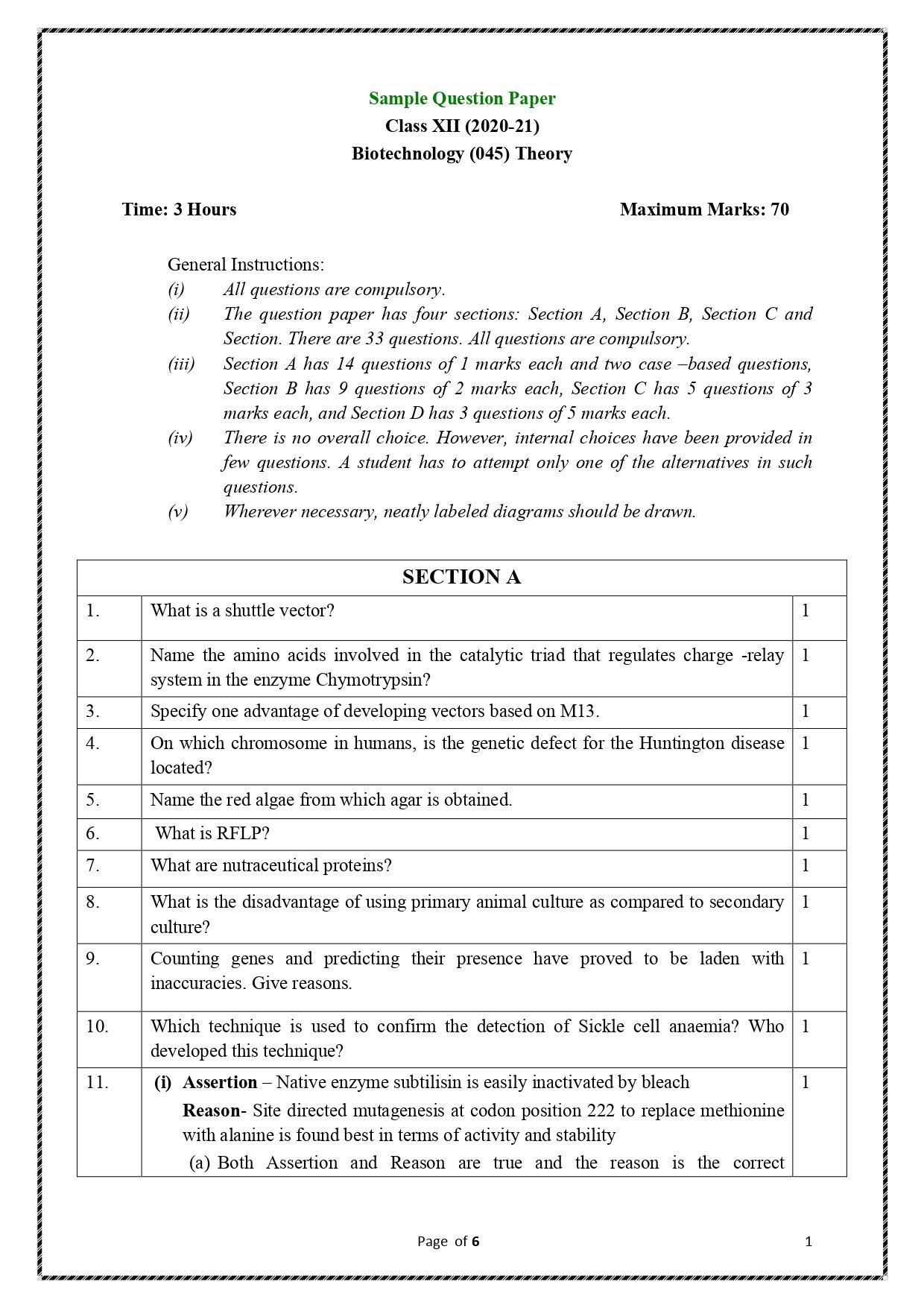
Class XII (2020-21)
Biotechnology (045) Theory
Time: 3 Hours Maximum Marks: 70
General Instructions:
(i) All questions are compulsory.
(ii) The question paper has four sections: Section A, Section B, Section C and
Section. There are 33 questions. All questions are compulsory.
(iii) Section A has 14 questions of 1 marks each and two case –based questions,
Section B has 9 questions of 2 marks each, Section C has 5 questions of 3
marks each, and Section D has 3 questions of 5 marks each.
(iv) There is no overall choice. However, internal choices have been provided in
few questions. A student has to attempt only one of the alternatives in such
questions.
(v) Wherever necessary, neatly labeled diagrams should be drawn.
SECTION A
1. What is a shuttle vector? 1
2. Name the amino acids involved in the catalytic triad that regulates charge -relay 1
system in the enzyme Chymotrypsin?
3. Specify one advantage of developing vectors based on M13. 1
4. On which chromosome in humans, is the genetic defect for the Huntington disease 1
located?
5. Name the red algae from which agar is obtained. 1
6. What is RFLP? 1
7. What are nutraceutical proteins? 1
8. What is the disadvantage of using primary animal culture as compared to secondary 1
culture?
9. Counting genes and predicting their presence have proved to be laden with 1
inaccuracies. Give reasons.
10. Which technique is used to confirm the detection of Sickle cell anaemia? Who 1
developed this technique?
11. (i) Assertion – Native enzyme subtilisin is easily inactivated by bleach 1
Reason- Site directed mutagenesis at codon position 222 to replace methionine
with alanine is found best in terms of activity and stability
(a) Both Assertion and Reason are true and the reason is the correct
Page of 6 1
Page 2
(b) Both Assertion and Reason are true but the reason is not the correct
explanation of the assertion
(c) Assertion is true but Reason is false
(d) Both Assertion and Reason are false
OR
(ii) Assertion- OKT-3 is used to prevent graft rejection following kidney
transplantation
Reason- OKT-3 blocks immune cells which attack foreign grafts.
(a) Both Assertion and Reason are true, and the reason is the correct
explanation of the assertion
(b) Both Assertion and Reason are true, but the reason is not the correct
explanation of the assertion
(c) Assertion is true but Reason is false
(d) Both Assertion and Reason are false
12. Composition of minerals like calcium and phosphorus in mg/ml is highest in- 1`
(a) Cow milk
(b) Buffalo milk
(c) Human milk
(d) Goat milk
13. RefSeq is a curated database of: 1
(a) mRNA and proteins
(b) DNA and proteins
(c) DNA and m RNA
(d) DNA and t RNA
14. During isolation of streptomycin, clear broth is- 1
(a) discarded
(b) subjected to liquid-liquid extraction chromatography
(c) subjected to ultra filtration
(d) subjected to solubilization of proteins
15. Read the following and answer any four questions from 15 (i) to 15 (v) 4
Testing for COVID-19 using PCR
The objective of COVID-19 testing is to identify part of the corona viral genome in
the patient sample. As, there is insufficient viral RNA to detect directly in the patient
sample, a process called reverse transcription polymerase chain reaction (RT-PCR)
is used for amplification. Short single stranded pieces of DNA called primers
recognize unique RNA sequences within the viral genome. When double-stranded
DNA copy of the target region of the viral RNA is produced, it undergoes successive
rounds of amplification during which the DNA undergoes denaturation. Two
Page of 6 2
Page 3
strand. The number of copies of the target region of the viral genome doubles with
each cycle. In practice, the virus is typically detected in 35 cycles of PCR, after
which the number of DNA copies produced will be 235.
PCR based diagnosis is faster, safer and more specific because it does not use live
pathogens.
(i) The sequence of steps in PCR is-
(a) Denaturation, annealing, extension
(b) Annealing, denaturation, extension
(c) Extension, annealing, denaturation
(d) Denaturation, extension, annealing
(ii) A primer is-
(a) short ss piece of DNA
(b) short ds piece of DNA
(c) short ds piece of RNA
(d) Either (b) or (c)
(iii) After n cycles, the number of DNA copies produced are-
(a) n2
(b) 2n
(c) nx2
(d) n÷2
(iv) Taq DNA polymerase synthesizes DNA at a temperature of around 700C as it is-
(a) thermophilic
(b) thermostable
(c) thermoregulator
(d) thermolabile
(v) Culture based approaches for detecting pathogens, as compared to PCR based assays
are-
a) Faster, safer but less specific
b) Slower but safer and more specific
c) Slower, less safer and less specific
d) Slower, less safer but more specific.
16. Read the following and answer any four questions from 16 (i) to 16 (v) 4
Tissue Culture in Rose Propagation
In January 2014, an experiment was conducted to explore the intricacies of in vitro
propagation of Rosa hybrida from explants. The purpose was to determine the
proper basal medium and growth regulators for these tissue culture techniques. Plant
hormones play a pivotal role in growth and differentiation of cultured cells and
tissues. An acidic pH is also very important. There are several types of media like
Page of 6 3
Page 4
species, variety or plant part. However, the most extensively used nutrient medium
is MS medium, which was developed by Murashige and Skoog in 1962.
Rosa hybrida L. species are propagated around the world, using seed propagation,
micropropagation, stem cuttings, budding, grafting, and even tissue culture. To
increase the productivity of roses, somatic hybridization is also thought of.
(i) To enhance the productivity through micropropagation, which medium is generally
used.
(a) MS medium
(b) LS
(c) B5
(d) Nitsch's medium
(ii) An optimum pH is very important in plant cell tissue culture. It is usually:
(a) 8.7
(b) 7.7
(c) 9.7
(d) 5.7
(iii) In order to enhance the productivity of rose plants, which of the following could be
an effective strategy?
(a) Somatic hybridization
(b) Generation of haploids
(c) Embryo rescue
(d) Generation of triploids
(iv) Which technique is not included in vegetative propagation?
(a) Layering propagation
(b) Transgenic
(c) Budding
(d) Grafting
(v) The term explant used in the passage is …
(a) any part of the plant
(b) only shoot
(c) only root
(d) only leaf
SECTION B
17 A given protein with a molecular weight of 20,000 daltons containing 5,4,3,2, and 2
1charges, is subjected to mass spectrometry. Find the sequence of protein ions
detected by the mass spectrometer.
OR
Thalassemic patients produce excess alpha or beta subunits of haemoglobin leading
Page of 6 4
Page 5
produced in excess be determined?
18 Which information can be retrieved from the following databases? 2
i) EMBL
ii) PDB
19 Name any two diseases showing gene polymorphism with complex inheritance. 2
OR
(a) Which database was created to manage the redundancy in EST data?
(b) What is the role of the curator in Bio-informatics.
20 Name any two medical conditions for which stem cells can be used. 2
21 Differentiate between somaclones and gametoclones. Who proposed the term 2
somaclones?
22 The laboratory scale design cannot be scaled up to industrial scale directly. Write 2
any two points that need to be considered while going for industrial scale
production.
23 a) Animal cells in a culture medium were placed in a regular incubator used for 2
growing bacterial cells. Do you expect the animal cells to grow in it?
b) What are Interferons?
24 How does the metagenomics approach help to identify novel genes present in the 2
environment? Explain the process.
25 Specify two advantages of animal cell culture. 2
SECTION C
26 Which functional property of whey protein is exploited in the following food 3
systems:
(i) Eggless cakes; (ii) Soups; (iii) Coffee whiteners
Also, state their mode of action.
27 Listed below are four different single strands of DNA. Which of these would you 3
expect to be cleaved by a restriction endonuclease? Give reason.
(a) ACTCCAGAATTCACTCCG
(b) ACTCCACTCCCGACTCCG
(c) GCCTCATTCGAAGCCTGA
(d) GAGCGGTTTATCTGAGCAG
OR
Students of Class XII visited Microbial Type Culture Collection, Chandigarh and
observed microbial cultures of Providencia stuartii, Streptomyces albus and
Haemophilus aegyptus. Name the restriction enzymes obtained from them and also
specify their restriction sites
28 With the help of a diagram, show the cultivation of adult stem cells from bone 3
marrow and their differentiation into specialized cells.
Page of 6 5
Page 6
29 Considering the impact of Biotechnology in our lives, write any three applications of 3
plant genetic engineering.
30 What kinds of analysis can be undertaken using various bioinformatics tools? State 3
any three.
SECTION D
31 What are BCAA? Name any two BCAA. State any two functions of BCAA. Also, 5
explain Biological Value.
OR
Explain any five protein based products.
32 Explain the method for the selection of recombinants that makes use of insertional 5
inactivation, with the help of suitable diagram.
OR
Explain various steps involved in a recombinant DNA technology experiment.
Name any two molecular biologists who helped to create the first r-DNA molecule.
33 Write the steps involved in microbial strain isolation. How can the presence of a 5
particular strain be confirmed?
OR
Differentiate between Fed Batch and Continuous microbial culture, along with well-
defined graphs for them.
***
Page of 6 6
Document Details
| Board / Org | CBSE |
| Exam | Class 12 |
| Type | Sample Paper |
| Pages | 6 |
| Updated | 30 Apr 2026 |