CBSE Class 12 Marking Scheme 2021 for Biotechnology
Finished viewing? Save it for later —
Download CBSE Class 12 Marking Scheme 2021 for Biotechnology (PDF · 8 pages)About CBSE Class 12 Marking Scheme 2021 for Biotechnology
CBSE Class 12 Marking Scheme 2021 for Biotechnology is available here for free download. Published by CBSE for Class 12, this sample paper can be viewed online or downloaded as a PDF (8 pages). Candidates preparing for Class 12 can use CBSE Class 12 Marking Scheme 2021 for Biotechnology to understand the exam pattern, the type of questions asked, and the overall difficulty level.
Frequently Asked Questions
How can I download CBSE Class 12 Marking Scheme 2021 for Biotechnology?
Open this page and click the Download button to save CBSE Class 12 Marking Scheme 2021 for Biotechnology as a PDF. It is completely free on AglaSem Docs.
Is CBSE Class 12 Marking Scheme 2021 for Biotechnology free to download?
Yes. CBSE Class 12 Marking Scheme 2021 for Biotechnology can be viewed online and downloaded as a PDF free of cost on AglaSem Docs.
How many pages does CBSE Class 12 Marking Scheme 2021 for Biotechnology have?
CBSE Class 12 Marking Scheme 2021 for Biotechnology contains 8 pages, which you can read online or download together as a single PDF.
Where can I find more Class 12 study material?
You can find more Class 12 question papers, sample papers, syllabus, and answer keys on AglaSem Docs.
CBSE Class 12 Marking Scheme 2021 for Biotechnology – Text
Read the full text of this sample paper below — useful to quickly search, copy and reference the content online without downloading the PDF.
📄 View text version (8 pages)
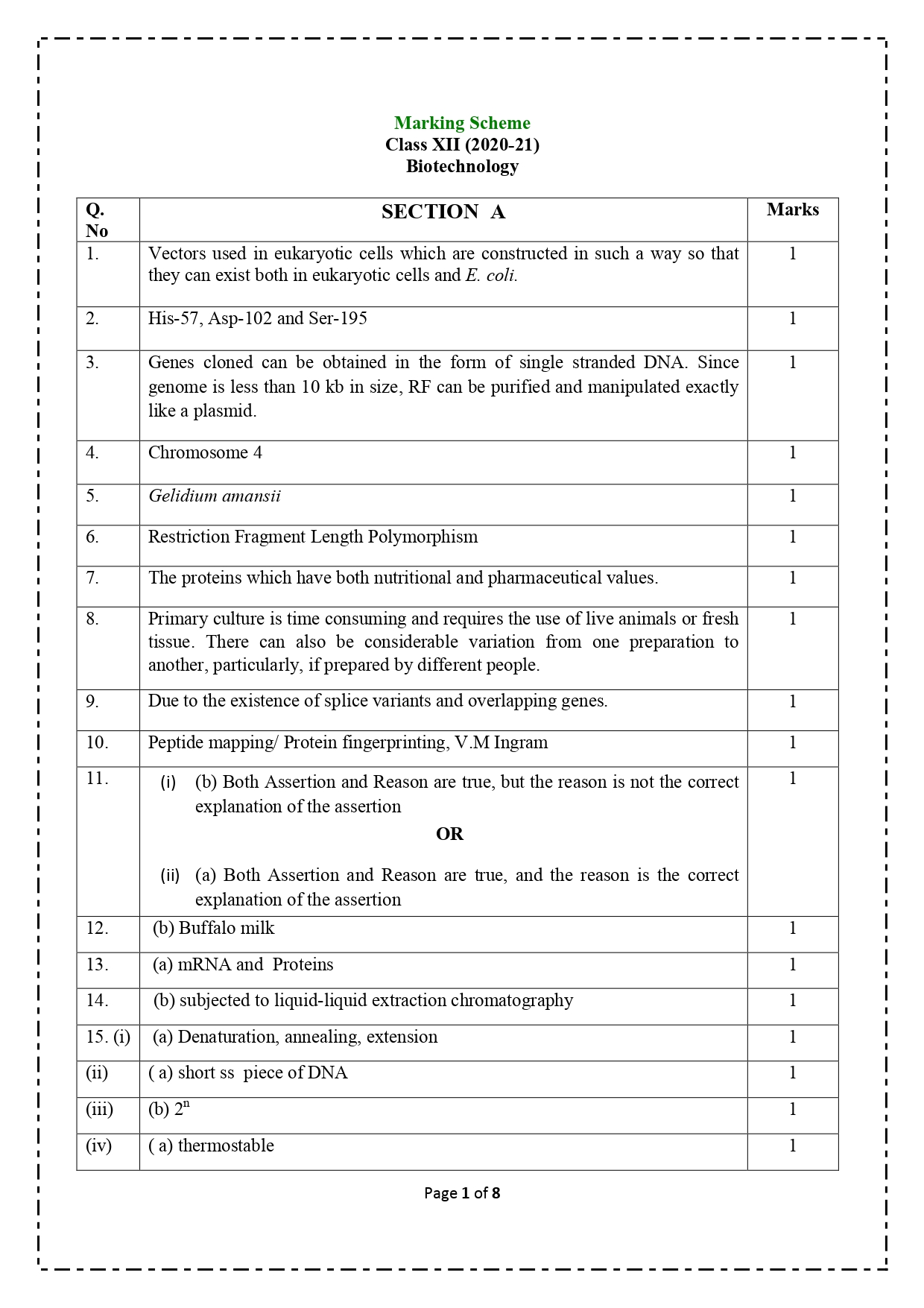
Page 1
Class XII (2020-21)
Biotechnology
Q. SECTION A Marks
No
1. Vectors used in eukaryotic cells which are constructed in such a way so that 1
they can exist both in eukaryotic cells and E. coli.
2. His-57, Asp-102 and Ser-195 1
3. Genes cloned can be obtained in the form of single stranded DNA. Since 1
genome is less than 10 kb in size, RF can be purified and manipulated exactly
like a plasmid.
4. Chromosome 4 1
5. Gelidium amansii 1
6. Restriction Fragment Length Polymorphism 1
7. The proteins which have both nutritional and pharmaceutical values. 1
8. Primary culture is time consuming and requires the use of live animals or fresh 1
tissue. There can also be considerable variation from one preparation to
another, particularly, if prepared by different people.
9. Due to the existence of splice variants and overlapping genes. 1
10. Peptide mapping/ Protein fingerprinting, V.M Ingram 1
11. (i) (b) Both Assertion and Reason are true, but the reason is not the correct 1
explanation of the assertion
OR
(ii) (a) Both Assertion and Reason are true, and the reason is the correct
explanation of the assertion
12. (b) Buffalo milk 1
13. (a) mRNA and Proteins 1
14. (b) subjected to liquid-liquid extraction chromatography 1
15. (i) (a) Denaturation, annealing, extension 1
(ii) ( a) short ss piece of DNA 1
(iii) (b) 2n 1
(iv) ( a) thermostable 1
Page 1 of 8
Page 2
16. (i) a) MS medium 1
(ii) d) 5.7 1
(iii) a) Somatic hybridisation 1
(iv) b) transgenic 1
(v) a) any part of the plant 1
SECTION B
17 m/z= M+ nH + /n 2
m/z=20,005/5=4001
m/z=20,004/4= 5001
m/z=20,003/3=6668
m/z=20,002/2=10,001
m/z=20,001/1=20,001
Sequence—It detects protein ions at m/z=4001, 5001, 6668, 10001 and
20,001respectively
OR
Normal and thallasaemic erythrocytes obtained and their lysates analysed
Protein fingerprinting/2-D gel electrophoresis/MALDI-TOF/SDS-PAGE can
identify if α or β chain is absent.
(Any one technique can be described)
18 (i) Nucleotide Sequence 1
(ii) Three dimensional structure of proteins 1
19 Two diseases showing gene polymorphism with complex inheritance 1
• Common late-onset Alzheimer's disease
• Migraine 1
OR
a) Unigene
1
b) The curator reviews and checks newly submitted data to ensure that
biological features are adequately described and the conceptual 1
translations of any coding regions obey known rules.
20 Leukemia (Cancerous blood cells), Heart disease, Heart attack (cardiac tissue 2
damage). Paralysis (spinal cord injury), Alzheimer's, Parkinson's, Huntington's
(dead brain cells) and Burns (damaged skin cells)
(Any two).
Page 2 of 8
Page 3
tissues, gametoclones are plant variants with gametophytic origin obtained
from tissue such as pollen or egg cell.
Larkin and Scowcroft (1981) proposed the term 'somaclones' 1
22 Bulk purchase of chemicals and other raw materials would bring down costs. 1
The labour cost decreases sharply with increase in production.
1
23 a) No, animal cells need a CO2 incubator. 1
b) Interferons are proteins secreted by virally infected cells and interfere 1
with viral propagation.
24 Metagenomics approach has been developed to identify and select microbial 2
genes synthesizing novel molecules.
This approach utilizes the large number of microbial genomes present in an
environmental niche (eg. in soil, in water such as ocean or in human gut).
These genomes are contributed by both the culturable and the nonculturable
variety of microbes and together constitute metagenome.
25 Advantages : 2
Homogenous genetic population//Controlled physico-chemical environment//
Easy to add genes (Transfection) // regulate protein levels (RNAi). Available
in adequate numbers to do chemical study//Easy production of
biopharmaceuticals. //No ethical clearance required. //Cost effective screening
assays.
(Any two )
SECTION C
26 3
Food systems Functional Mode of action
Property
(i) Eggless cakes Whipping/ Forms Stable film
foaming
(ii) Soups Viscosity Thickening/ water
binding
(iii) Coffee whiteners Emulsification Formation and
stabilization of fat
emulsions
Page 3 of 8
Page 4
(c) GCCTCATTCGAAGCCTGA 1
Restriction enzymes recognize palindromic sequences. 1
OR
3
28. Cultivation of adult stem cells from bone marrow and their differentiation into 2
specialized cells
Ernest McCulloch and James Till 1
29 • Production of healthy oils with altered fatty acid profiles. 3
• Modification of starch properties for specific uses.
• Favourable change of grain storage products and their chemical composition
to improve the processing of bread making with wheat flour, malting of barley
and brewing of beer.
Page 4 of 8
Page 5
• Development of blue roses/ blue coloured cotton which is otherwise not
possible by conventional plant breeding because of the absence of blue
pigment in roses/ cotton
• Development of tear-less onions, caffeine-free coffee and low nicotine
tobacco.
(Any three)
30 Processing raw information: The experimentally determined sequence (raw 3
information) is processed using bioinformatics tools into genes, the proteins
encoded and their function, the regulatory sequences, and inferring
phylogenetic relationships.
Genes: Gene prediction can be done by using computer programs like
GeneMark for bacterial genomes and GENSCAN for eukaryotes.
Proteins: Protein sequences can be inferred from the predicted genes by using
simple computer programs.
Regulatory sequences: Regulatory sequences can also be identified and
analysed by using bioinformatics tools.
Inferring phylogenetic relationships: Information regarding the relationships
between organisms can be obtained by aligning multiple sequences,
calculating evolutionary distance and constructing phylogenetic trees.
Making a Discovery: Using the bioinformatics tools and databases, the
functions of unknown genes can be predicted.
(Any three )
SECTION D
31 BCAA are Branched chain amino acids 2
BCAA: ile, leu,val, lys, trp
(Any two)
They-
• are essential for the biosynthesis of muscle protein 2
• help in increasing the bio-availability of high complex carbohydrates
• reduce muscle breakdown and act as an energy source before and after
exercise. Hence while maintaining exercise performance and delaying
exhaustion BCAAs are very important for muscle growth.
(Any 2 points)
Biological value- It measures the amount of protein nitrogen that is retained by
the body from a given amount of protein nitrogen that has been consumed 1
Page 5 of 8
Page 6
(i) Blood products and vaccines e.g. Factor IX for treating hemophilia
(ii) Therapeutic antibodies and enzymes e.g. Monoclonal antibodies
OKT3 for preventing graftness.
(iii) Therapeutic hormones and growth factors e.g. Insulin to treat
diabetes.
(iv) Regulatory factors e.eg. Interferons for antiviral properties.
(v) Analytical applications e.g. Horse radish peroxidase for ELISA.
5
(vi) Industrial enzymes e.g. Papain for meat tenderization.
(vii) Fuctional non catalytic proteins e.g. Kappa casein for milk protein
stabilization.
(viii) Nutraceutical proteins eg. Infant food formulation to provide
adequate nutrition for infant.
These products are of commercial value to the Biotechnology industry.
(Any 5)
32 Principle of Insertional Inactivation- When cloned DNA is inserted into a gene 1
it inactivates its functioning. Sequence/ insert cloned into vectors within genes
of antibiotic resistance, leads to loss of function.
Steps
1. Host cells (E. coli cells) with recombinant pBR322 plasmid are first plated
on solid media (agarose containing) with the antibiotic ampicillin (assume
that the insert has been ligated within the tetracycline resistance gene).
Colonies from every single cell plate having the plasmid will develop 3
overnight
2. A petri plate containing solid media with antibiotic tetracycline is kept
carefully under aseptic conditions(Laminar flow hood)
3. A circular piece of velvet or velvet paper is aligned and pressed onto the
colony containing ampicillin plate (master plate).With the same alignment it
is pressed onto the tetracycline plate. Overnight only colonies not
containing the insert will grow while due to insertional inactivation no
colonies will grow which have the insert.The colonies which have the insert
can easily be scored off by comparing the two plates.
Page 6 of 8
Page 7
(diagram)
OR
Steps involved:
1. Isolation of a DNA fragment containing a gene of interest that needs to 4
be cloned (called as insert).
2. Generation of a recombinant DNA (rDNA) molecule by insertion of
the DNA fragment into a carrier DNAmolecule called vector (e.g.
plasmid) that can self replicate within a host cell.
3. Transfer of the rDNAinto an E. coli host cell (process called
transformation).
4. Selection of only those host cells carrying the rDNA and allowing them
to multiply thereby multiplying the rDNA molecules.
Paul Berg, Herbert Boyer, Annie Chang and Stanley Cohen. 1
(Any two)
33 a) The sample containing the microbes (e.g. soil) is put in a nutritive medium
and allowed to grow in shake cultures.
5
The growth conditions (e.g. temperature, nutrients) in the medium are
provided and these favour the growth of microbes of our interest.
b) Screening is done using a method where the organism will show its desired
properties.
For example, if we are looking for a microorganism, which produces an
antibiotic, we may detect it by growing the culture on an agar plate in the
presence of that bacterium against which antimicrobial activity is desired.
Immunological methods are also available in which the microbes producing
products are detected using specific antibodies.
Use of probes, which enable the detection of organisms capable of producing
specific products.
OR
Page 7 of 8
Page 8
5
1. Nutrients added without removal of Nutrients added with removal
culture of culture
2. Volume increases Volume constant
3. Used for high cell density Used for Biomass or
metabolite production
(X)- Cell density
(S) – Substrate concentration
(QS)- Cell Specific substrate turn over rate
Page 8 of 8
Document Details
| Board / Org | CBSE |
| Exam | Class 12 |
| Type | Marking Scheme |
| Pages | 8 |
| Updated | 30 Apr 2026 |