APTET Question Paper with Answers 15 Jun 2018 Paper 2 Social Science (Shift 1)
Finished viewing? Save it for later —
Download APTET Question Paper with Answers 15 Jun 2018 Paper 2 Social Science (Shift 1) (PDF · 65 pages)About APTET Question Paper with Answers 15 Jun 2018 Paper 2 Social Science (Shift 1)
APTET Question Paper with Answers 15 Jun 2018 Paper 2 Social Science (Shift 1) is available here for free download. Published by Andhra Pradesh Exams for Andhra Pradesh Teacher Eligibility Test, this question paper can be viewed online or downloaded as a PDF (65 pages). Candidates preparing for Andhra Pradesh Teacher Eligibility Test can use APTET Question Paper with Answers 15 Jun 2018 Paper 2 Social Science (Shift 1) to understand the exam pattern, the type of questions asked, and the overall difficulty level.
Frequently Asked Questions
How can I download APTET Question Paper with Answers 15 Jun 2018 Paper 2 Social Science (Shift 1)?
Open this page and click the Download button to save APTET Question Paper with Answers 15 Jun 2018 Paper 2 Social Science (Shift 1) as a PDF. It is completely free on AglaSem Docs.
Is APTET Question Paper with Answers 15 Jun 2018 Paper 2 Social Science (Shift 1) free to download?
Yes. APTET Question Paper with Answers 15 Jun 2018 Paper 2 Social Science (Shift 1) can be viewed online and downloaded as a PDF free of cost on AglaSem Docs.
How many pages does APTET Question Paper with Answers 15 Jun 2018 Paper 2 Social Science (Shift 1) have?
APTET Question Paper with Answers 15 Jun 2018 Paper 2 Social Science (Shift 1) contains 65 pages, which you can read online or download together as a single PDF.
Where can I find more Andhra Pradesh Teacher Eligibility Test study material?
You can find more Andhra Pradesh Teacher Eligibility Test question papers, sample papers, syllabus, and answer keys on AglaSem Docs.
APTET Question Paper with Answers 15 Jun 2018 Paper 2 Social Science (Shift 1) – Text
Read the full text of this question paper below — useful to quickly search, copy and reference the content online without downloading the PDF.
📄 View text version (56 pages)
Page 1
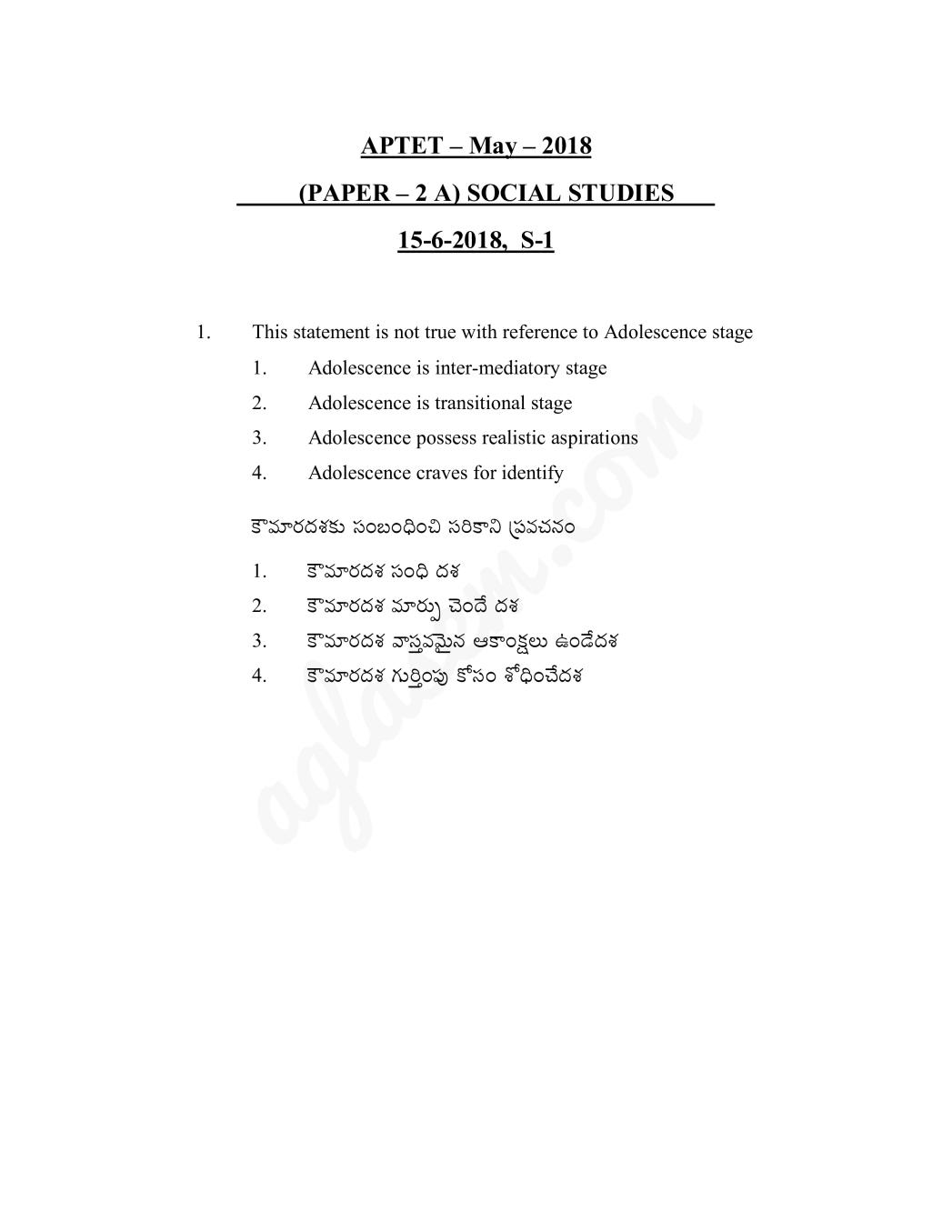
(PAPER – 2 A) SOCIAL STUDIES
15-6-2018, S-1
1. This statement is not true with reference to Adolescence stage
1. Adolescence is inter-mediatory stage
2. Adolescence is transitional stage
3. Adolescence possess realistic aspirations
4. Adolescence craves for identify
1.
2.
3.
4.
Page 2
identically equal individuals are selected and one among them
is for experimental group and the other is for control group is
1. Equal group method
2. Equal pair method
3. Random group method
4. General selection method
3. Gessel observation dome is useful for the following
observation
1. Non-participated
2. Participated
3. Naturalistic
4. Introspection
Page 3
intelligence.
1. Ability model – Conspantin Vasli Petraids
2. Trait model – Peter Salove, John Mayer
3. Mixed model – Danial Golman
4. Type model - Gardner
5. This Defense Mechanism is known as ‘motivated forgetting’
1. Displacement
2. Regression
3. Identification
4. Repression
Page 4
1. Restricted home environment
2. Examinations stress
3. Participation in co-curricular activities
4. Poor self concept
7. In this stage of Kohlberg’s moral development one feels that
confining to social systems is important
1. Pre conventional morality
2. Post conventional morality
3. Conventional morality
4. Natural conventional morality
Page 5
1. Family relations
2. Command over other gangs
3. Games, Fun
4. Political relations
9. The personality test in which one identifies his feelings in
Animals and Birds is
1. Thematic Apperception Test
2. Rorschak Inkblot Test
3. Children’s Apperception Test
4. General Aptitude Test Battery (GATB)
Page 6
1. Prediction is not exact
2. All competencies may not be measured
3. Results are different in different contexts
4. Useful for Research Purpose
11. According to Erickson, the virtue called ‘Reliability’ forms at
this Psycho social critical situation is
1. Identity Vs Identity confusion
2. Intimacy Vs Isolation
3. Generativity Vs Stagnation
4. Integrity Vs Despair
Vs
Vs
Vs
Vs
Page 7
1. Mechanical Aptitude
2. Clerical Aptitude
3. Aesthetic Aptitude
4. Scholastic Aptitude
13. Rama is preparing for Residential School Entrance Test. She
was given reinforcement by way of ‘praise’ by her teacher for
every 20 questions she answered. The reinforcement schedule
is
1. Continuous
2. Fixed Interval
3. Fixed Ratio
4. Variable
Page 8
‘Animism’ is noticed
1. Formal operational
2. Concrete operational
3. Sensory motor
4. Pre operational
15. This Thorndike’s law promotes revision and recall
1. Law of Readiness
2. Law of Effect
3. Law of Exercise
4. Law of Imitation
Page 9
1. Retention
2. Performance
3. Attention
4. Reinforcement
17. Memorizing through experimentation is
1. Immediate memory
2. Rote memory
3. Active memory
4. Association memory
Page 10
1. Need for love, affection, belongingness
2. Need for self actualization
3. Need for safety
4. Physiological needs
19. This aspect obstructs smooth learning
1. Learning the items by arranging in a meaningful order
2. Learning without time gap
3. Learning with concentration
4. Learning by getting feedback
Page 11
bullock cart also learning to climb a tree
1. Positive
2. Negative
3. Zero
4. Bilateral
21. The concept of More Knowledged Other (MKO) is related to
this theory and theorist
1. Cognitive theory - Piaget
2. Theory of instruction - Bruner
3. Social Learning - Bandura
4. Constructivistic theory - Vygotsky
(MKO)
Page 12
theory
1. Trial and error learning
2. Classical conditioning
3. Insight learning
4. Operant conditioning
Page 13
phobia. The teacher ascertained full information and prepared
Sukanya to analyses the problem herself, to find the solution
and also to implement it on her own. This counselling
process is -
1. Directive counselling
2. Non-Directive counselling
3. Eclectic counselling
4. Authoritative counselling
Page 14
1. Students are passive
2. Teaching is based on teacher centered methods
3. Equal importance to every member of the group
4. No importance to individual difference of students
25. According to Heether’s ‘many levels of inquiry’ theory, in
this stage of inquiry learning, the intrinsic motivation is
developed in students and they raise to the level of researcher
on their own
1. Confirmation inquiry
2. Structured inquiry
3. Guided inquiry
4. True inquiry
Page 15
1. Dysgraphia
2. Dyslexia
3. Dyscalculia
4. Dysphasia
27. This statement is not an evidence for student centered
classroom
1. Situations of knowledge construction appears
2. Classroom management proceeds in group activities
3. Students express their views freely
4. Evaluation is limited to classroom experience
Page 16
1. Improvement of standards in teachers
2. Improvement of standards in examination system
3. Overcoming anxiety, unhealthy competition in
examinations
4. Up-scaling overall functioning of education
department
NCF-2005
29. The following is an individual learning method
1. Seminar
2. Discussions
3. Brain storming
4. Distance Education
Page 17
1. Learning is knowledge construction
2. Individuals learning can promote through conditions
3. More importance should be given to teaching method
than teaching items
4. Knowledge is not beyond the experiences of an
individual
Page 27
Choose the meaning of the word, ‘Providence’ in the sentence
above.
1. Pleasure
2. Fortune
3. Hell
4. God
62. Choose the word that refers to “a person who can do anything
for money.”
1. Mercenary
2. Fatalist
3. Spendthrift
4. Misogynist
63. Choose the word without a prefix.
1. input
2. press
3. bicycle
4. introvert
Page 28
1. Chimny
2. Chimney
3. Chimnee
4. Chimnney
65. Choose the sentence in which the word, ‘mind’ is used as a
verb.
1. Mind your business.
2. You are out of mind.
3. Your mind is not well today.
4. He has a sound mind.
66. The sitar can produce harmonious music.
Choose the opposite word of ‘harmonious’.
1. Disharmonious
2. Harsh
3. Unharmonious
4. Sincere
67. The boy came across a gold chain on the road.
Choose the meaning of the phrasal verb, ‘came across’.
1. Showed proudly
2. Lost unexpectedly
3. Decorated
4. Found unexpectedly
Page 29
This sentence indicates;
1. a refusal
2. a wish
3. a present habit
4. an obligation
69. Choose the correct sentence with respect to the use of articles.
1. Man is a mortal.
2. The man is a mortal.
3. Man is mortal.
4. The man is the mortal.
70. Advani persisted ……….. going there.
Choose the correct preposition that fits the blank.
1. for
2. to
3. in
4. with
71. Choose the word that can be used to write a relative clause as
well as noun clause.
1. That
2. If
3. Because
4. Since
Page 30
1. Don’t eat too many sweets.
2. Why don’t we eat too many sweets ?
3. Let’s eat too many sweets.
4. Please don’t eat too many sweets.
73. He saw that.
Choose the correct question tag for this sentence.
1. is it ?
2. is he ?
3. doesn’t he ?
4. didn’t he ?
74. Shut the door.
This sentence is ;
1. interrogative
2. imperative
3. assertive
4. exclamation
75. Ram said, “Wood floats on water.”
Choose the reported speech of this sentence.
1. Ram said that wood floated on water.
2. Ram asked the wood to float on water.
3. Ram said if wood floats on water.
4. Ram said that wood floats on water.
Page 31
1. were
2. are
3. is
4. have
77. I …………. the work so I am free now.
Choose the correct tense form that fits the blank.
1. had completed
2. have completed
3. complete
4. will complete
78. The country mouse felt his heart beating very fast.
The part of speech of the word, ‘country’ is;
1. a noun
2. an adjective
3. an adverb
4. a verb
79. She is a fine player ……….. she is so small.
Choose the linker that completes the sentence meaningfully.
1. because
2. so
3. although
4. so that
Page 32
These two sentences can be combined as;
1. You need not hurry to catch up the train.
2. You must hurry to catch the train.
3. You must hurry if you will catch the train.
4. You must hurry when you will catch the train.
81. Choose the grammatically correct sentence from the
following.
1. Aruna is more prettiest girl in the class.
2. Aruna is more prettier girl in the class.
3. Aruna is the prettiest girl in the class.
4. Aruna is prettier as more girls in the class.
82. Did you see the snake the next day
This sentence ends with;
1. a full stop
2. a comma
3. a question mark.
4. an exclamatory mark.
83. Choose the word that should begin with a capital letter.
1. letter
2. pleasure
3. turkish
4. indicate
Page 33
1. Some water was taken in a glass.
2. The teacher stood by the principal.
3. She has taught me a lesson.
4. He has done this work.
85. Delhi is …………. cities of India.
Choose the grammatically correct expression that fits the
blank.
1. more crowded
2. one of the more crowded
3. one of the most crowded
4. as crowded as
86. In a letter, ‘the heading’ consists of
1. subscription
2. a quotation
3. the writer’s address and the date
4. the signature of the writer
87. Choose the list of words in the correct alphabetical order.
1. sing, sang, sung, singing
2. sang, sing, singing, sung
3. sung, sing, singing, sang
4. sang, singing, sing, sung
Page 34
Choose the synonym of the word, ‘sufficient.’
1. shelter
2. scare
3. adequate
4. requisite
89. Read the following passage and choose the correct
answer to the question.
Man cuts down hundreds of trees every year to build houses,
to make furniture, to cook food and to make paper. If this
continues, one day there will be no more trees in the world.
What will happen then? We will all die!
. We cut down trees;
1. to plant new trees.
2. to make others die.
3. to deforest.
4. to fulfill our needs.
Page 35
answer to the question.
Man cuts down hundreds of trees every year to build houses,
to make furniture, to cook food and to make paper. If this
continues, one day there will be no more trees in the world.
What will happen then? We will all die!
The problem described in this passage is;
1. deforestation
2. pollution
3. lack of buildings
4. water scarcity
Page 36
1. Mercator’s knowledge
2. Mercator’s wisdom
3. Mercator’s work plan
4. Mercator’s projection
92. ‘Tundras’ means
1. Very rainy area
2. Very hot area
3. Very cold area
4. Hilly area
Page 37
1. 1988
2. 1989
3. 1987
4. 1990
94. Permanent settlement of land revenue was introduced by this
Governor General
1. Cornvallis
2. Warren Hastings
3. Lord Dalhousie
4. William Bentink
Page 38
1. Bal Gangadhara Tilak
2. Bipin Chandra Paul
3. Netaji Subhash Chandra Bose
4. Gopala Krishna Ghokale
96. Jallianwalla Bagh massacre was occurred in the year
1. 1921
2. 1920
3. 1919
4. 1922
Page 39
1. Swami Ramananda Theertha
2. Jamalapuram Kesava Rao
3. J.V. Narsinga Rao
4. Bhagyareddy Varma
98. The biggest Canyon in the world is on the river
1. Nile
2. Mississippi
3. Ganga
4. Colorado
Page 40
1. Stratosphere
2. Mesosphere
3. Thermosphere
4. Troposphere
100. The largest producer of oil seeds in the world
1. Iraq
2. Saudi Arabia
3. India
4. England
Page 41
the year
1. 2006
2. 2007
3. 2005
4. 2004
102. The outer part of the earth is
1. Mantle
2. Crust
3. Core
4. Outer core
Page 42
and IST (India Standard Time) is
1. 3½ hours
2. 2½ hours
3. 5½ hours
4. 4½ hours
3½
2½
5½
4½
104. The first country to allow voting rights for all groups of
people was
1. USA
2. Russia
3. India
4. New Zealand
Page 43
the year
1. 1957
2. 1958
3. 1956
4. 1955
106. The Article of the Indian constitution that aims to provide
Free and Competent legal services to the weaker sections of
the society is
1. 39 (A)
2. 39 (B)
3. 39 (C)
4. 39 (D)
107. First Mookie Cinema in Telugu
1. Bhakta Prahlada
2. Bhishma Pratigna
3. Karna
4. Kuchela
Page 44
1. Giuseppe Mazzini
2. Victor Emmanuel-II
3. Otto von Bismark
4. Anton von Werner
II
109. Alluri Sita Ramaraju was born in the year
1. 1877
2. 1887
3. 1897
4. 1907
110. According to World Human Development Index-2013, the
rank of India was
-
1. 92
2. 146
3. 136
4. 157
Page 45
1. Florence Owens
2. Kustodiev
3. Dorothea lange
4. Eric Hobsbawm
112. The immediate cause of 1st world war
1. Murder of Arch Duke Fronze Ferdinand
2. Murder of Alexander-I
3. Murder of Queen Mary
4. Murder of Victor Immanuel-II
I
II
Page 46
China and England are known as
1. World wars
2. Asia – Europe wars
3. Industrial wars
4. Opium wars
114. The slogan ‘Garibi Hatao’ was given by
1. Indira Gandhi
2. Lal Bahadur Shastri
3. M.G. Ramachandran
4. Rajiv Gandhi
Page 47
1. Delta
2. Antarvedi (Do-Ab)
3. Island
4. Peninsula
116. Founder of Nigerian National Democratic party
1. Herbert Mecaulay
2. Nnamdi Azikiwe
3. Ken Sarowiwa
4. Kwame Nkrumah
Page 48
Jawaharlal Nehru’ was
1. Indira Gandhi
2. Rajiv Gandhi
3. Sardar Vallabh Bhai Patel
4. Lal Bahadur Shastri
118. Panchsheel Policy was formulated by
1. Jawaharlal Nehru
2. Jaya Prakash Narayan
3. Sardar Vallab Bhai Patel
4. Dr. Babu Rajendra Prasad
Page 49
1. Sun yat - sen
2. Chaiang Kai Shek
3. Maw Zedong
4. Jiang Zemin
120. Indian Government enacted food security Act in this year
1. 2003
2. 2005
3. 2016
4. 2013
Page 50
1. Effects of mining
2. Effects of fossil fuel consumption
3. Effects of DDT
4. Effects of construction of large dams
DDT
122. The battle of Plassey occurred in
1. 1767 AD
2. 1757 AD
3. 1777 AD
4. 1787 AD
Page 51
1. Thomas Jefferson
2. William Henry Harrison
3. Franklin D. Rosevelt
4. George Washington
124. One of the most impressive remains of Hampi Vijayanagara
is
1. The lotus mahal
2. The queen’s bath
3. Elephant stables
4. Mahanavami Dibba
Page 52
during this period
1. 1750 – 1850 AD
2. 1760 – 1860 AD
3. 1850 – 1950 AD
4. 1900 – 2000 AD
1750 – 1850
1760 – 1860
1850 – 1950
1900 – 2000
126. The Abhaya Shasana of Motupalli was laid by
1. Ganapati Deva
2. Rudra Deva
3. Pratapa Rudra
4. Rudrama Devi
Page 53
1. Babur
2. Humayun
3. Akbar
4. Jahangir
128. The famous stupa and monasteries of Nagarjunakonda were
built by
1. Mauryas
2. Ikshvakas
3. Vishnu Kundinulu
4. Satavahanas
Page 54
Mahajanapadas known as
1. Bhaga
2. Bali
3. Chouth
4. Sardeshmukhi
130. Number of time zones in the world
1. 15
2. 18
3. 19
4. 24
Page 55
September
1. Gongura panduga
2. Paccha panduga
3. Koya panduga
4. Chintala panduga
132. The Leader of Chirala Perala Movement was
1. Duggirala Gopala Krishnayya
2. Tanguturi Prakasam
3. Kasheenadhuni Nageswara Rao
4. Konda Venkatappayya
Page 56
1. Taitteriya Upanishad
2. Mundakopanishad
3. Esha Vasyopanishad
4. Kathopanishad
134. The Indian Mathematician, who created the decimal system
was
1. Kautilya
2. Aryabhatta
3. Kasyapa
4. Bhana
Page 57
1. Patel
2. Patla
3. Karanam
4. Inspector
136. The water layer present in between the layers of rock under
the earth is called as
1. Pervious rock
2. Aquifer
3. Water level
4. Granite
Page 58
1. Nandadevi
2. Mount Everest
3. Kanchenjunga
4. Kilimanjaro
138. The official languages Act was passed in the year
1. 1964
2. 1965
3. 1963
4. 1962
Page 59
construction
1. Principle of child centeredness
2. Principle of readiness
3. Forward looking principle
4. Principle of rigidity
140. In our country, as per the recommendations of Secondary
Education Commission Social Science is introduced as one of
the main subjects in our school curriculum from this year
Page 60
teaching aid
1. Projected aid
2. Activity aid
3. Non-projected aid
4. Graphic aid
142. The book “The protestant ethic and the spirit of capitalism”
written by
1. John Locke
2. Karl Marx
3. Max Weber
4. Christopher Columbus
Page 61
developmental stages’ – is the belief of
1. Jean Piaget
2. Vygotsky
3. Novak
4. Posner
144. In the five –Es (5Es) learning model, 5 E’s represent
1. Encourage, explain, explore, elaborate, evaluate
2. Engage, explore, explain, elaborate, evaluate
3. Ethics, explore, encourage, express, evaluate
4. Explore, energetic, explain, encourage, evaluate
E (5Es) E
Page 62
test is
1. Logical validity
2. Predictive validity
3. Factoral validity
4. Face validity
1.
2.
3.
4.
146. The educationist who explained the stages of lesson planning
1. J. F. Herbart
2. Lester B. Stands
3. Bosing
4. Devis
1. J. F.
2.
3.
4.
Page 63
in a Zoo is
1. Direct
2. Individual
3. Vicarious
4. Audio
148. Select the correct statement
1. Examination is a part of evaluation
2. Evaluation is part of examination
3. There is no relation between examination and
evaluation
4. Examination is more comprehensive when compared
to evaluation
Page 64
Duties”. This question is intended to achieve this objective.
1. Application
2. Understanding
3. Knowledge
4. Skill
150. “Intelligent participation in any discussion requires a
knowledge of map of the world” – said by
1. J. M. Forrester
2. M. P. Muffat
3. J. B. Wesley
4. Rudyard Kipling
Page 65
Paper-II(A) - Telugu Medium - Set-J (S.S) 15.06.2018 Morning Session
Q.Nos CDP Q.Nos Telugu Q.Nos English Q.Nos Social Q.Nos Social
1 3 31 4 61 4 91 4 121 3
2 2 32 2 62 1 92 3 122 2
3 1 33 3 63 2 93 1 123 1
4 3 34 1 64 2 94 1 124 4
5 4 35 1 65 1 95 1 125 1
6 3 36 4 66 2 96 3 126 1
7 3 37 1 67 4 97 1 127 1
8 3 38 4 68 2 98 4 128 2
9 3 39 2 69 3 99 4 129 1
10 4 40 2 70 3 100 3 130 4
11 1 41 4 71 1 101 3 131 1
12 1 42 3 72 1 102 2 132 1
13 3 43 4 73 4 103 3 133 4
14 4 44 1 74 2 104 4 134 2
15 3 45 3 75 4 105 3 135 2
16 3 46 2 76 3 106 1 136 2
17 3 47 3 77 2 107 2 137 4
18 2 48 4 78 2 108 1 138 3
19 2 49 3 79 3 109 3 139 4
20 3 50 2 80 2 110 3 140 1
21 4 51 3 81 3 111 4 141 2
22 3 52 1 82 3 112 1 142 3
23 2 53 2 83 3 113 4 143 1
24 3 54 4 84 1 114 1 144 2
25 4 55 2 85 3 115 2 145 2
26 2 56 3 86 3 116 1 146 1
27 4 57 3 87 2 117 4 147 1
28 3 58 3 88 3 118 1 148 1
29 4 59 4 89 4 119 1 149 2
30 2 60 1 90 1 120 4 150 4
Document Details
| Board / Org | Andhra Pradesh Exams |
| Exam | Andhra Pradesh Teacher Eligibility Test |
| Type | Question Paper |
| Pages | 65 |
| Updated | 09 Jun 2026 |