Finished viewing? Save it for later —
Download ICSE Class 10 Syllabus 2027 French (PDF · 5 pages)About ICSE Class 10 Syllabus 2027 French
ICSE Class 10 Syllabus 2027 French is available here for free download. Published by CISCE for Class 10, this syllabus can be viewed online or downloaded as a PDF (5 pages). Candidates preparing for Class 10 can use ICSE Class 10 Syllabus 2027 French to understand the exam pattern, the type of questions asked, and the overall difficulty level.
Frequently Asked Questions
How can I download ICSE Class 10 Syllabus 2027 French?
Open this page and click the Download button to save ICSE Class 10 Syllabus 2027 French as a PDF. It is completely free on AglaSem Docs.
Is ICSE Class 10 Syllabus 2027 French free to download?
Yes. ICSE Class 10 Syllabus 2027 French can be viewed online and downloaded as a PDF free of cost on AglaSem Docs.
How many pages does ICSE Class 10 Syllabus 2027 French have?
ICSE Class 10 Syllabus 2027 French contains 5 pages, which you can read online or download together as a single PDF.
Where can I find more Class 10 study material?
You can find more Class 10 question papers, sample papers, syllabus, and answer keys on AglaSem Docs.
ICSE Class 10 Syllabus 2027 French – Text
Read the full text of this syllabus below — useful to quickly search, copy and reference the content online without downloading the PDF.
📄 View text version (5 pages)
Page 1
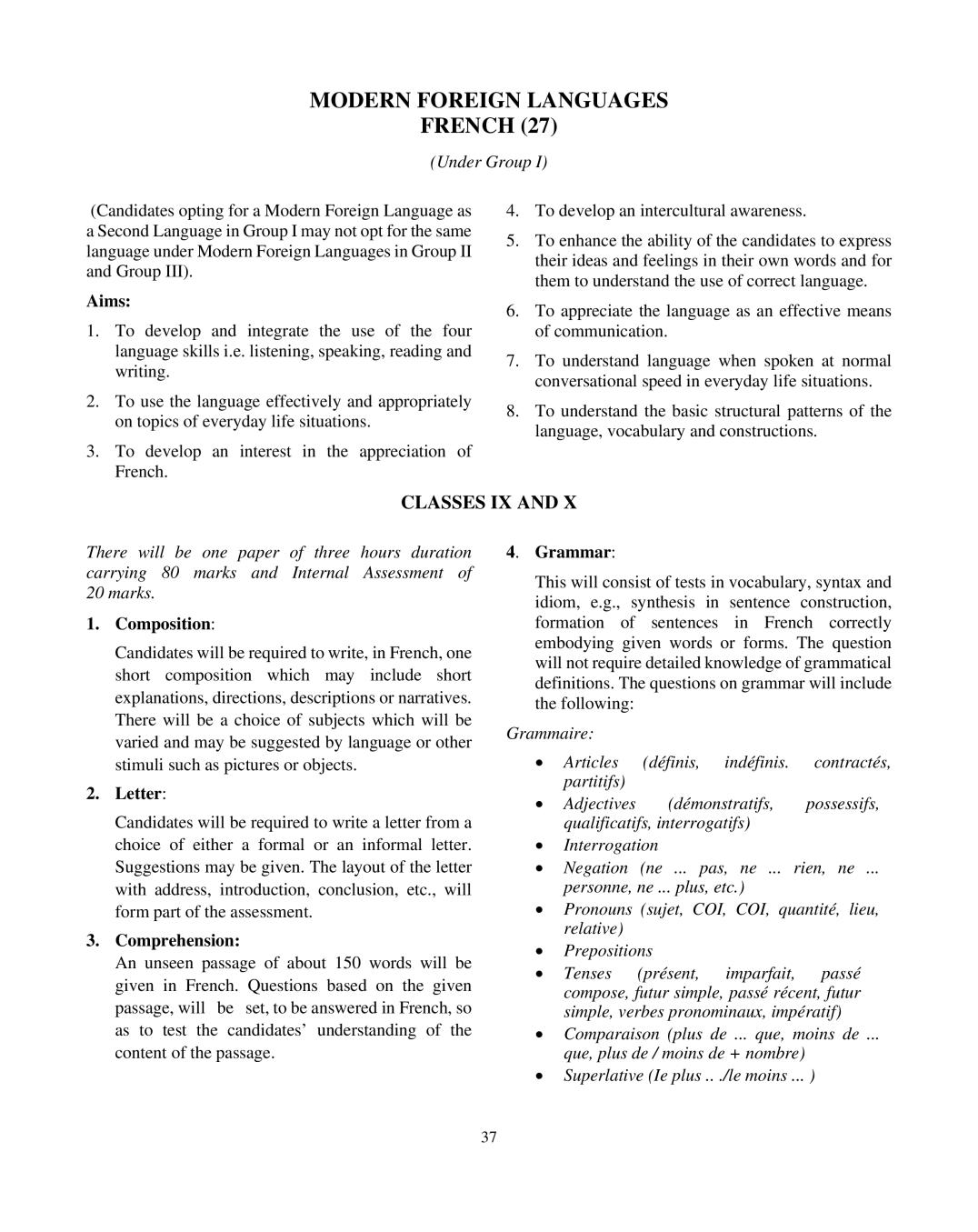
FRENCH (27)
(Under Group I)
Candidates opting for a Modern Foreign Language as a Second Language in Group I may not opt for the
same language under Modern Foreign Languages in Group II and Group III.
Aims: 5. To enhance the ability of the candidates to express
their ideas and feelings in their own words and for
1. To develop and integrate the use of the four
them to understand the use of correct language.
language skills i.e. listening, speaking, reading
and writing. 6. To appreciate the language as an effective means
of communication.
2. To use the language effectively and appropriately
on topics of everyday life situations. 7. To understand language when spoken at normal
conversational speed in everyday life situations.
3. To develop an interest in the appreciation of
French. 8. To understand the basic structural patterns of the
language, vocabulary and constructions.
4. To develop an intercultural awareness.
CLASSES IX AND X
There will be one paper of three hours duration 4. Grammar
carrying 80 marks and Internal Assessment of This will consist of tests in vocabulary, syntax and
20 marks. idiom, e.g., synthesis in sentence construction,
1. Composition formation of sentences in French correctly
Candidates will be required to write, in French, embodying given words or forms. The question
one short composition which may include short will not require detailed knowledge of
explanations, directions, descriptions or grammatical definitions. The questions on
narratives. There will be a choice of subjects grammar will include the following:
which will be varied and may be suggested by • Articles (définis, indéfinis. contractés,
language or other stimuli such as pictures or partitifs)
objects. • Adjectifs (démonstratifs, possessifs,
2. Letter qualificatifs, interrogatifs)
Candidates will be required to write a letter from • Interrogation (pronoms interrogatifs,
a choice of either a formal or an informal letter. combien, comment, où, quand,
Suggestions may be given. The layout of the letter pourquoi,depuis quand ......etc.)
with address, introduction, conclusion, etc., will • Négation (ne ... pas, ne ... rien, ne ...
form part of the assessment. personne, ne ... plus, etc.)
3. Comprehension • Pronoms (sujets, démonstratifs, possessifs,
An unseen passage of about 150 words will be COD, COI, quantité, lieu, relatifs simples)
given in French. Questions based on the given • Prépositions (à / de, lieu (e.g. chez, entre,
passage, will be set, to be answered in French, devant, à côté de, temps e.g. avant,
so as to test the candidates’ understanding of the après,pendant, pour), les noms
content of the passage. géographiques,movement (e.g. jusqu’à,
vers),d'autres (e.g. contre, malgré, sans,
sauf, selon)
• Temps (présent, imparfait, passé
composé, futur proche, passé récent,
futur simple, verbes pronominaux,
40
Page 2
• Comparatifs (Qualité et quantité - formes experiences and memories).
régulières et irrégulières - plus de ... que, • Accommodation (e.g. holiday homes, hotels,
moins de ...que, plus de / moins de + reservations, rent/hire a place, the stay, types
nombre ... etc.) of boarding, etc.).
• Superlatifs (les formes régulières et • Restaurant (e.g. ordering food, menu,
irrégulières -Ie plus .. ./le moins ... etc. ) different cuisines, recipes, etc.).
Conjugation exercises (for testing verbs), gap filling • Directions (e.g. traffic rules, road safety,
(for testing articles, pronouns, prepositions), giving directions, following and
correcting errors (for testing adjectives, negation, understanding maps).
comparative etc.), Making questions and negative • Holiday Activities (e.g. at the sea shore, at
sentences, correcting jumbled sentences etc. the mountains, in the city, countryside,
5. Translation and/or Dialogue Writing: abroad, etc.).
• One short passage will be set for translation • Services (e.g. public services at the hotel,
from French into English. airport, shops, train station, restaurant,
• One passage will be set for translation from library, etc.).
English into French. 3. Topic C - Work & Lifestyle
• Dialogue writing (Around 150 words) based • Home Life (e.g. household chores, domestic
on situations faced in everyday life. Hints may animals, guests and outings, family life, etc.).
be given. • Everyday Living and Health (e.g.
Annexe communications and technology, food habits
Communication (oral and written) skills that can be and lifestyle, the human body, health and
covered from any book used for teaching: illness, advice and precautions, visit to a
doctor, pharmacist etc.).
1. Topic A - Myself
• Work Experience (e.g. internships, world of
• Self, Family and Friends (e.g. talk about self,
work, experiences, etc.).
family and friends, physical description,
personality and sentiments, personal • Leisure (e.g. cinema, concerts, theatre, park,
relationships, generation gap, friendship and entertainment, social media, television,
pets). newspapers, etc.).
• Important Events (e.g. festivals: religious, • Shopping (e.g. brands, clothes and
national, international, family; celebrations, accessories, modes of payment, budget,
special occasions, invitations, culture, expenses and consumption, fashion and
customs). lifestyle, sale, shopping malls, grocery
shopping, supermarkets, local markets etc.).
• Interests and Hobbies (e.g. sports, books,
films, music, likes, dislikes). • The Environment (e.g. natural environment,
problems, causes and solutions, technology,
• Home and Locality (e.g. city/ village life,
seasons and weather, World environment
description of one’s home, furnishings and
day, Earth day, etc.).
the surroundings, shops and places in the
Teaching and study resource books:
vicinity).
• Ado - published by CLE International
• Daily Routine (e.g. adverbs of time and
frequency, weekend and weekly routine at • Bravo - Published by Hatier Didier
home and school/workplace, the outings, • Entre Jeunes - published by CBSE
everyday communication). NOTE: The Class X - ICSE examination paper will
• School (e.g. school system, subjects, be set on the entire syllabus prescribed for the
professions, teachers, time-table, school subject.
uniform, the academic year, school activities, The Class IX internal examination is to be conducted
stationary and supplies, school experiences). on the portion of this syllabus that is covered during
2. Topic B - Holiday Time & Travel the academic year.
• Travel, Transport and Tourism (e.g. CISCE has not prescribed bifurcation of the syllabus
vacations, modes of transport, duration, for this subject.
41
Page 3
1. Schools will prepare, conduct and record compositions; the stimuli may be:
assessments of the Listening, Speaking and • a piece of recorded music.
Creative Writing Skills of candidates as follows: • a series of recorded sounds.
• a picture/photograph.
Class IX: Three assessments in the course of the • an opening sentence or phrase.
year.
• a newspaper/magazine clipping or report.
Class X: Two assessments in the course of the
• one piece of factual writing which should be
year.
informative or argumentative.
2. Pattern of Assessment
• one piece of expressive writing which is
a) Listening Skills descriptive and imaginative.
A passage of about 300 words is read aloud by • preparation of film/book review.
the examiner twice at normal reading speed
It is also suggested that students be made aware of
(about 110 words a minute). Candidates may
contemporary forms of written communication, such
make brief notes during the readings. They
as fax, memo, etc.
then answer an objective type test based on the
passage, on the paper provided.
b) Speaking Skills EVALUATION
Each candidate is required to make an oral The assessment will be conducted jointly by the
presentation for about two minutes, which will subject teacher and the external examiner who will
be followed by a discussion on the subject each assess the candidate. (The External Examiner
with the examiners, for about three minutes. may be a teacher nominated by the Head of the School
Subjects for presentation may include who could be from the faculty but not teaching the
narrating an experience, providing a language in the section/class. For example, a teacher
description, giving directions, expressing an of French of Class VIII may be deputed to be an
opinion, giving a report, relating an anecdote External Examiner for Class X Language projects).
or commenting on a current event.
Award of Marks (20 Marks)
A candidate may refer to brief notes in the
course of the presentation but reading or Subject Teacher (Internal Examiner) 10 marks
excessive dependence on notes will be External Examiner 10 marks
penalized.
The total marks obtained out of 20 (Listening
It is recommended that candidates be given Skills: 5 marks; Speaking Skills: 5 marks and Creative
an hour for preparation of their subject for
Writing: 10 marks) are to be sent to CISCE by the
presentation and that they be given a choice of
subject, on a common paper. Head of the School. The Head of the School will be
responsible for the online entry of marks on CISCE’s
c) Creative Writing Skills
CAREERS portal by the due date.
Each candidate is required to write short
compositions based on the suggested Schools are required to maintain a record of all
assignments. assessments conducted in Listening, Speaking and
SUGGESTED ASSIGNMENTS Creative Writing Skills for candidates of Classes IX
FOR CLASSES IX AND X and X. These include copies of the assessment tests,
Aural: Listening to a conversation/talk/reading of a topics for presentation and marks awarded. This
short passage and then writing down the relevant or record will be maintained for a period of up to two
main points in the specified number of words and months after the declaration of the results of ICSE (10)
answering the given questions. examinations of the candidates concerned.
Oral: Prepared speech/declamation; impromptu
speech/debate/discussion; report/interview; elocution;
role-play / general conversation on selected topics.
42
Page 4
CREATIVE WRITING (CLASSES IX & X)
Grade Content/Analysis of Idea, Expression/ Effective Structure/ Organisation Vocabulary/ Use of Originality/ Marks
Thought/ Feeling Expression of Idea of Material Words, Phrases Imaginative/
Innovative
I The candidate analyses the ideas, The candidate expresses The work is very well The use of vocabulary The work is 4
feelings and experiences the ideas, thoughts and structured an introduction, exhibits a high level of imaginative
effectively. feelings effectively. body and conclusion, competence in handling interesting and
Reasoning is logical and effective. paragraphing and language. engrossing.
appropriate sentence
construction.
II The candidate analyses the ideas, The candidate expresses The work is very well The vocabulary exhibits The candidate's 3
feelings and experiences with the ideas thoughts and structured with some competence of word work is quite
well-defined explanations, feelings well and with sense of conclusion and of usage; correctness of interesting and
reasoning is logical and clarity. paragraph lengths. grammar and spelling. engrossing.
persuasive.
III The candidate analyses the idea, The candidate expresses The work is fairly well The candidate uses The candidate 2
feelings and experiences with a the ideas, thoughts and structured; straightforward demonstrates the
fair degree of detail and feelings fairly well and Candidate follows simple vocabulary and fairly ability to sustain the
explanation. Reasoning is fairly with a fair degree of paragraphing. good pattern of interest of the
logical and persuasive. clarity. spellings. reader.
IV The candidate attempts to analyze The candidate expresses The work shows some The candidate's The candidate is, to 1
ideas, feelings and experiences the idea, thoughts and understanding of vocabulary is limited and some extent, able to
with simple explanation and feelings intelligibly and paragraphing and the spelling, punctuation sustain the interest
detail. Reasoning and arguments in simple language. structure. and grammar is of the reader.
are not very convincing. sometimes poor.
V The candidate attempts a basic The candidate is unable The candidate does not There is consistent The candidate is 0
analysis of ideas, feelings and to expresses the ideas, display an understanding weakness in spelling, unable to sustain the
experiences with few simple thoughts and feelings, of structure and punctuation and interest of the
explanations and few details. Is uses simple language and paragraphing. grammar. reader.
unable to present proper work is not very
arguments. intelligible.
43
Page 5
ORAL ASSIGNMENT (CLASS X)
Grade Fluency of Language Subject Matter Organization Vocabulary/ Understanding Gesture Marks
Delivery
I Speaks with fluency and Matter is relevant, Content is well Uses appropriate While speaking, the Uses natural and 3
has full operational rich in content and sequenced and well vocabulary and candidate emphasizes spontaneous
command over the original. organized. pronounces words the important points. gestures that are
language. correctly. not out of place.
II The candidate speaks The subject matter The content is The candidate While speaking the Uses some natural 2
with fairly good fluency is mostly relevant, satisfactorily pronounces most candidate emphasizes gestures.
and has reasonable consisting of a sequenced and well words correctly and most important points.
operational command of few original ideas. organized. uses simple
the language. vocabulary.
III The candidate speaks The subject matter The subject content is The candidate While speaking, the Uses very few 1
with poor fluency and is irrelevant and very poor and lacks pronounces many candidate emphasizes natural gestures.
does not communicate lacks originality. organisational words incorrectly and some important
except for the most basic structure. uses inappropriate points.
information. vocabulary.
IV The candidate cannot The subject matter The subject content The candidate is While speaking, the Uses no natural 0
communicate even the is negligible. comprises of mere unable to correctly candidate is unable to gestures.
most basic information. words with no pronounce most words emphasize important
structured sentences. and has a limited points.
vocabulary.
45
Document Details
| Board / Org | CISCE |
| Exam | Class 10 |
| Type | Syllabus |
| Pages | 5 |
| Updated | 04 Aug 2026 |