Edudel Syllabus Class 10 Social Science
Finished viewing? Save it for later —
Download Edudel Syllabus Class 10 Social Science (PDF · 11 pages)About Edudel Syllabus Class 10 Social Science
Edudel Syllabus Class 10 Social Science is available here for free download. Published by Delhi School Education for Class 10, this syllabus can be viewed online or downloaded as a PDF (11 pages). Candidates preparing for Class 10 can use Edudel Syllabus Class 10 Social Science to understand the exam pattern, the type of questions asked, and the overall difficulty level.
Frequently Asked Questions
How can I download Edudel Syllabus Class 10 Social Science?
Open this page and click the Download button to save Edudel Syllabus Class 10 Social Science as a PDF. It is completely free on AglaSem Docs.
Is Edudel Syllabus Class 10 Social Science free to download?
Yes. Edudel Syllabus Class 10 Social Science can be viewed online and downloaded as a PDF free of cost on AglaSem Docs.
How many pages does Edudel Syllabus Class 10 Social Science have?
Edudel Syllabus Class 10 Social Science contains 11 pages, which you can read online or download together as a single PDF.
Where can I find more Class 10 study material?
You can find more Class 10 question papers, sample papers, syllabus, and answer keys on AglaSem Docs.
Edudel Syllabus Class 10 Social Science – Text
Read the full text of this syllabus below — useful to quickly search, copy and reference the content online without downloading the PDF.
📄 View text version (26 pages)
Page 1
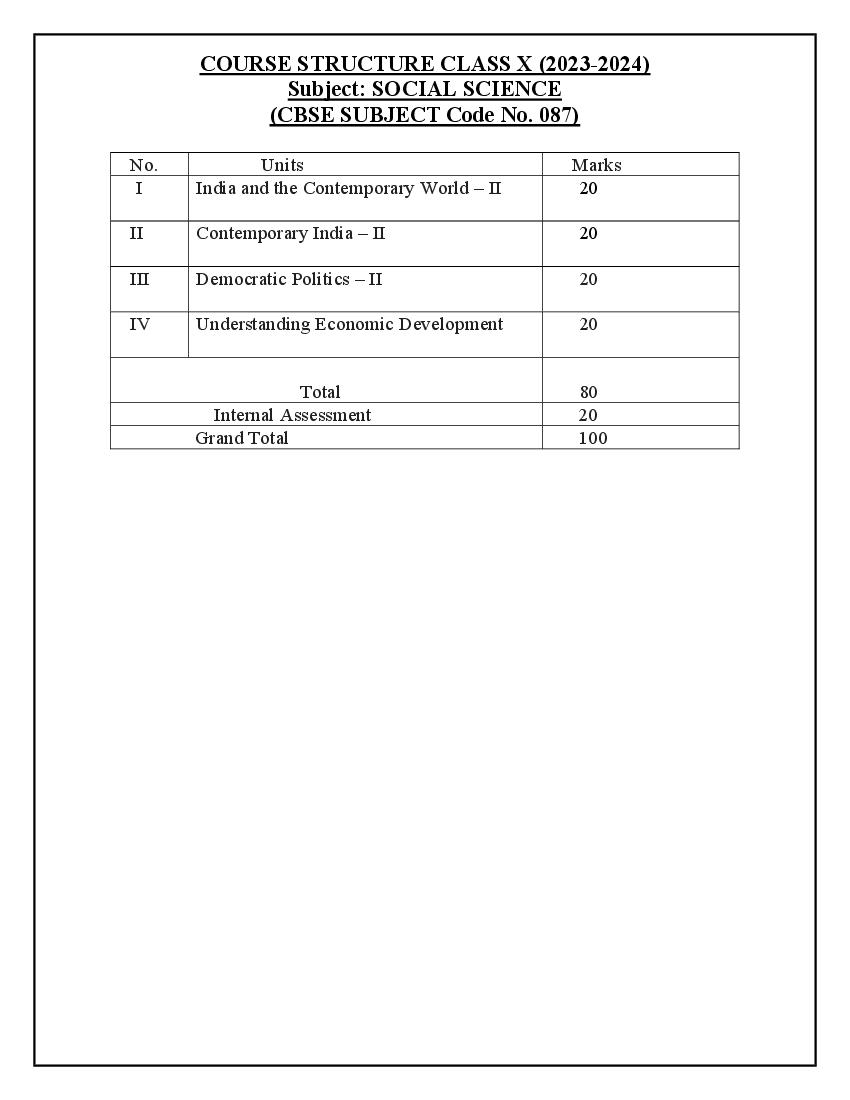
Subject: SOCIAL SCIENCE
(CBSE SUBJECT Code No. 087)
No. Units Marks
I India and the Contemporary World – II 20
II Contemporary India – II 20
III Democratic Politics – II 20
IV Understanding Economic Development 20
Total 80
Internal Assessment 20
Grand Total 100
Page 2
Books Chapter No. Specific Learning Suggested Teaching Learning
and Name Objectives LearningProcess Outcome with
Specific
Competencies
India I Examine the impact Watch Videos/ read Infer how the
and the The Rise of of the French Textual materials/read French
Contemp Nationalism in Revolution on the related novels on the Revolution
orary Europe European countries French revolution had an impact
World – in the making of the followed by a Class room on the
II Nation state. discussion and European
Explore the nature of presentation. countries in the
the diverse social World café/ Panel making of
movements of the discussion/ debate using nation state.
time. (1830-1848) Collaborative learning, to Enumerate and
Examine the ways by explore the diverse social evaluate the
which the idea of groups and present it as a validity of the
nationalism emerged group. nature of the
and led to the Use of graphic organizers diverse social
formation of nation to explain the idea of movements of
states. unification of states to the time
Comprehend how form one nation. Analyse and
the World War I was (Italy/Germany/Greece) infer how the
triggered by the Visual representation of idea of
scramble for the map of Pre-First nationalism
colonies in the World War. Europe emerged and
Balkan states followed by the Class led to the
discussion and reflection formation of
activity based on the map nation states in
of Post First World War Europe and
Europe elsewhere.
Illustrate that,
the quest for
imperialism
triggered the
First World
War.
India II Explore various Sequence chart /story Illustrate
and the Nationalism in facets of Board/ Story telling various facets
Contemp India Nationalistic pedagogy to Illustrate of
orary movements that various facets of Nationalistic
World – ushered in the sense Nationalistic movements movements
II of Collective that ushered in the sense that ushered in
Belonging of Collective Belonging the sense of
Discuss the impact Students will examine Collective
of the First World textual content and other Belonging
War on triggering
Page 3
movements (Khilafat through PPT. aspects of the
& Non-cooperation Viewing the relevant First World
Movement) in India. Snippets from the movies War that
Assess/ appraise the /video clippings triggered two
role of Mahatma depicting various events defining
Gandhi and other involving Gandhiji and movements
leaders in the two other leaders and present (Khilafat &
movements (NCM & findings through a panel Non-
CDM) discussion or seminars. cooperation
Movement) in
India
Evaluate the
effectiveness
of the
strategies
applied by
Gandhiji and
other leaders in
the two
movements.
India IV Examine Pre & Post Watch relevant Videos/ Enumerate the
and the The Age of economic, political, Visuals/ documentaries/ features of
Contemp Industrialisatio social features of Pre the movie clippings on Pre& Post
orary n and Post features of Pre & Post economic,
World – Note: The Industrialization. economic, political, social political,
II chapter is to be Analyse the impact features of Pre and Post social features
assessed in the of Industrialisation in Industrialization of Pre and Post
periodic the colonies with Debate on the impact of Industrializati
assessment only specific focus on Industrialization in the on
India. colonies with specific Analyze and
focus on India. infer how the
industrializatio
n impacted
colonies with
specific focus
on India.
Democrat Power - sharing Examines and Read relevant Newspaper Enumerates
ic Politics- comprehends how articles/ clippings on the need for
II democracies handle Power sharing and power sharing
demands and need present the findings in the in democracy.
for power sharing. form of flow chart Analyse and
Analyse the Discuss various forms of infer the
Challenges faced by power-sharing challenges
countries like Classroom discussion on faced by
Belgium and Sri challenges faced by Belgium and
Lanka ensuring Belgium& Sri Lanka in Sri Lanka in
effective power ensuring effective power ensuring
sharing sharing Power sharing.
Page 4
Power Sharing contrast the
Techniques used by power sharing
India, Sri Lanka and of India with
Belgium Sri Lanka and
Read Textual resource Belgium.
and other resources and Summarize the
present findings through purpose of
graphic organizers. power sharing
in preserving
the unity and
stability of a
country.
2 Comprehend the Group discussion on the Analyse and
Federalism theory and Practice distribution of powers infer how
of Federalism in between Union and state federalism is
India. Government and present being
Analyse the policies the outcomes through practiced in
and politics that has presentations. India.
strengthened Debate on policies and Analyse and
federalism in politics that strengthens infer how the
practice. Federalism in practice policies and
and present through mind politics that
map has
strengthens
federalism in
practice.
3 Examines the role Skit /street play to Enumerates
Gender, and differences of enumerate how the how the
Religion and Gender, religion and differences in gender, differences in
Caste Caste in practicing religion and caste impact gender,
Democracy in India. the practicing healthy or religion and
otherwise in a caste impact
Analyses the Democracy. the practicing
different expressions Graphic method to healthy or
based on these Analyse and infer how otherwise in a
differences are different expressions Democracy
healthy or otherwise based on differences in Analyses and
in a democracy Gender, Religion and infers how
Caste are healthy or different
unhealthy in a expressions
democracy. based on the
differences in
Gender,
Religion and
Caste are
healthy or
unhealthy in a
democracy
Page 5
orary Resources and significance, the resources are how the
India -II Development interdependence, interdependent in nature resources are
utilization and the need to develop interdependent
development need of them in India and present , justify how
Planning of in the form of Venn planning is
resources in India. diagram essential
Summarise the Use of maps, charts, and judicious
rationale for other tools to identify utilization of
development of patterns and trends of resources and
resources land utilization the need to
Comprehends the Case study and debate on develop them
reasons for non- the topic “Is the in India
optimal utilization of development acting as an
land in India. adversary for Infers the
Analyse the need to conservation” and rationale for
conserve all the present a report in the development
resources form of PPT. of resources
Examine the Analyse and
significant role for evaluate data
resource planning in and
the light of the information
present requirements related to non-
in India optimal land,
utilization in
India.
Appraise and
infer the need
to conserve all
resources
available in
India suggest
remedial
measures for
optimal
utilization of
underutilized
resources
Contemp 2 Examine the Read newspaper articles/ Enumerate
orary Forest and importance of watch videos on how
India -II Wildlife conserving forests deforestation and need conservation
Resources and wild life and for conservation and of forests and
their through world café wildlife are
interdependency in strategy present your interdependent
maintaining the findings. in nature and
ecology for the Debate how in maintain the
sustainable developmental works, ecology of
development of grazing wood cutting India.
India. have impacted on the
Page 6
grazing and wood the forests. infer how
cutting in the Use art integration some of the
development and strategy to summarize developmental
degradation and present the reasons works, grazing
for conservation of wood cutting
Comprehends the biodiversity in India have impacted
reasons for under sustainable on the survival
conservation of development. or otherwise of
biodiversity in India the forests.
under sustainable Summarizes
development. the reasons for
conservation
of biodiversity
in India under
sustainable
development.
Contemp 3 Examine the reasons Brainstorming session to Enumerate
orary Water for conservation of discuss the scarcity of why the water
India -II Resources water resource in water and present resource of
India. through graphic India to be
Analyse and infer organizers conserved.
how the Prepare a PPT to Summarize the
multipurpose summarize the roles of roles of
projects are multipurpose projects in Multipurpose
supporting the supporting the water projects n
requirement of water requirement of India. supporting the
in India. water
requirement of
India.
Understa 1 Examine the Hot seat strategy to Enumerate
nding Development significance of enumerate different different and
Economic designing suitable developmental Goals that examine the
Developm developmental goals helps in nation building different
ent in shaping the Case study to analyse and processes
nation. infer how the per capita involved in
Examine the income depicts the setting
importance of per economic condition of developmental
capita income and the nation. Goals that
compare the per Graphic organizer to helps in nation
capita income of compare and contrast the building
various countries to t relation between HDI Analyse and
infer about reasons and PCI infer how the
for the variance Declamation to Analyses per capita
Analyse the HDI in the multiple perspectives income depicts
relation to PCI. on the need development the economic
Examine the need for condition of
Sustainable the nation.
development Evaluate the
development
Page 7
been set for the
nation by the
Planning
commission of
India -with
specific
reference to
their efficacy,
implemental
strategies,
relevance to
current
requirements
of the nation
Compare and
contrast how
the per capita
income of
some
Understa 2 Analyse and Data analyse various Analyses and
nding Sectors of the evaluate the sectors and their infer how the
Economic Indian economic activities contribution in GDP and economic
Developm Economy in different sectors NDP. activities in
ent and how they Research based strategy different
contribute to the to propose solutions to sectors
overall growth and identified problems in contribute to
development of the different sectors based on the overall
Indian economy. their understanding. growth and
Identify problems in Read Newspaper articles development
different sectors and and group discuss to of the Indian
propose solutions Summarize how the economy.
based on their organised and
understanding of the unorganised sectors are Propose
sectors. providing employment solutions to
Analyse the major and the challenges faced identified
employment by them problems in
generating sectors different
and observe the sectors based
challenges faced in on their
an effort to provide understanding
employment to all.
Examines the role of Summarize
Unorganised sector how the
in impacting PCI organised and
currently and unorganised
proposes suggestive sectors are
steps to reduce the providing
unorganised sector employment
for more productive and the
Page 8
GDP faced by them
Enumerates
Examine and infer the role of
the essential role of unorganised
the Public and sector in
Private sectors the impacting PCI
present trends of PPP currently and
and efficacy of the proposes
initiative suggestive
steps to reduce
the
unorganised
sector for more
productive
contributions
to GDP
Enumerates
and infer the
essential role
of the Public
and Private
sectors the
present trends
of PPP and
efficacy of the
initiative.
Note: Above mentioned Syllabus is to be completed by 15 th September 2023.
Revision of syllabus for Mid Term Examination.
Mid Term Exam
Page 9
Name Learning LearningProcess with Specific
Objectives Competencies
India and the III Explore Initiate an Inquiry Summarize the
Contemporary The Making of a various based learning changes that
World – II Global World. aspects of how using world café’ transformed the
Sub topic 1 to the world strategy and world in terms of
1.3 changed present your economy,
Will be profoundly in findings through political, cultural
the 19th café conversation and technological
evaluated in century in strategy of each areas.
Board Exam terms of area (transformed Depict the global
Economic, the world in terms interconnectedness
Political, of economy, from the Pre
Social, political, cultural modern to the
Cultural and and technological present day.
technological aspects.) Enumerate the
areas. Art integration and destructive impact
Analyse the gallery walk to of colonialism on
destructive depict the the livelihoods of
impact of interconnectedness. colonized people
colonialism on Students examine
the economy the photographic
and the display/ new paper
livelihoods of cutting that depict
colonised the destructive
people. impact of
colonialism on the
livelihoods of
colonised people
and present their
understandings in
the form of
Newsletter/ cartoon
strips/
For Inter
For Inter Disciplinary Refer Annexure
Disciplinary Project with Refer Annexure IV IV
Project chapter 7 of
Geography: Life
Sub topics 2 lines of National
Economy and
Page 10
1815-1914 Economics:
Globalization and
Sub Topic 3 the Indian
The Inter War Economy
economy
Sub Topic 4
Rebuilding of
world Economy:
the post war era.
India and the V Examine the Flow chart to depict Enumerate the
Contemporary Print culture development the development of development of
World – II and the Modern of Print from Print Print from its
World its beginnings Declamation on the beginnings in East
in East Asia to profound Asia to its
its expansion transformation of expansion in
in Europe and people due to the Europe and India.
India print revolution. Comment on the
Analyse the Use of Venn statement that the
impact of the diagram to compare print revolution
spread of the advantages of was not just a way
technology and hand written books of producing book
consider how and the printed but profound
social life and books transformation of
culture Interpret and infer people.
changed with from pictures, Compare and
coming of cartoons, extracts contrast the old
print from propaganda tradition of hand
literature on written
important events manuscripts
and issues with versus the print
focus on print technology.
culture. Summarize the
role of Print
revolution and its
impact on World
& India’s
political, social
and economic
condition.
Democratic 4 Examine the Role play the role, Enumerates the
Politics-II Political Parties role, purpose purpose and no. of role, purpose, and
and no. of Political Parties in no. of Political
Political Democracy Parties in
Parties in Reads newspapers, Democracy
Democracy watches video Justifies the
Evaluates the clippings to justify contribution made
contributions the contributions by national and
made by made by national regional political
national and and regional parties in
regional political parties in successful
Page 11
parties in functioning of Indian democracy.
making or Indian democracy.
otherwise of
Indian
democracy.
Democratic 5 Comprehends Graphic organizer Enumerates how a
Politics-II Outcomes of the expected to enumerates how success of
Democracy and actual a success of democracy
outcomes of democracy depends depends on quality
democracy in on quality of of government,
view of quality government, economic
of government, economic wellbeing, in
economic wellbeing, in equality, social
wellbeing, in equality, social differences,
equality, social differences, conflict, freedom
differences, conflict, freedom and dignity.
conflict, and dignity Analyses and
freedom and Case study to infers why
dignity. Analyses and infers sometimes the gap
Analyses the why sometimes the occurs between
reasons behind gap occurs between expected outcome
gap that occurs expected outcome and actual
in conversion and actual outcome outcome effects
of expected effects the success the success of
outcomes into of Democracy. Democracy.
actual
outcomes of
democracy in
various
respects:
quality of
government,
economic
well-being,
inequality,
social
differences and
conflict and
finally
freedom and
dignity.
Contemporary 4 Examine the Discusses the Enumerate how
India -II Agriculture crucial role challenges faced by agriculture plays a
played by farmers, such as low contributory role in
agriculture in productivity, lack of Indian economy
our economy modern technology,
and society. inadequate irrigation Analyses and infers
facilities, and post- the challenges
harvest losses and faced by the
Page 12
challenges through PPT community in India
faced by the Identifies and
farming Reads Newspapers summarizes
community in and panel discusses various aspects of
India. the challenges faced agriculture,
Comprehends by the farming including crop
the various community in India production, types
aspects of of farming, modern
agriculture, Use of graphic agricultural
including crop organizers to practices, and the
production, distinguish the impact of
types of traditional and agriculture on the
farming, modern farming environment.
modern methods
agricultural
practices, and
the impact of
agriculture on
the
environment.
Contemporary 5 Comprehends Usage of textual Analyses and
India -II Minerals and the formation resource, mind infers how
Energy of different maps, pie charts to different types of
Resources types of Analyse and infer minerals are
minerals, how different types formed, where
location, their of minerals are they are found,
uses, formed, where they their uses,
importance for are found, their importance for
human life and uses, importance human life and the
the economy. for human life and economy
Analyses the the economy Infers the resource
importance of Use graphic distribution to
minerals and organizers to Infer real-world
natural the resource situations and
resources for distribution to real- proposes
economic world situations strategies for
development and proposes sustainable use of
of the country strategies for natural resources
their sustainable use of Differentiates
distribution, natural resources between the
and sustainable Use of flow chart to conventional and
use. Differentiate nonconventional
Distinguishes between the sources of energy.
between the conventional and
conventional non-conventional
and non- sources of energy
conventional
sources of
energy.
Page 13
India -II Manufacturing between differentiate between various
Industries various types between various types of
of types of manufacturing
manufacturing manufacturing industries based
industries industries based on on their input
based on their their input materials,
input materials, processes, and end
materials, processes, and end products, and
processes, and products. analyse their
end products, Utilizes the textual significance in the
and analyse information (data Indian economy.
their given through Enumerates the
significance in various impact of
the Indian maps/graphs) to manufacturing
economy. Enumerates the industries on the
Examines the impact of environment, and
impact of manufacturing develop strategies
manufacturing industries on the for sustainable
industries on environment, and development of
the develop strategies the manufacturing
environment, for sustainable sector.
and develop development of the Infers the relation
strategies for manufacturing between
sustainable sector. availability of raw
development Uses Case Studies material and
of the to Infers the location of the
manufacturing relation between Industry
sector. availability of raw
Analyses the material and
relation location of the
between the Industry
availability of
raw material
and location of
the Industry
Contemporary 7 Inter Refer Annexure IV Refer Annexure IV
India -II Life Lines of disciplinary
National project with
Economy Chapter 3 of
Only Map items History: The
to be evaluated making of
in Board Exams. Global world
and Chapter 4
of Economics:
Globalization
and the Indian
Economy
Page 14
Economic Money and money as a Enumerate how money plays as a
Development Credit medium of money plays as a medium exchange
exchange in all medium exchange in all transactions
transactions of in all transactions of goods and
goods and of goods and services since
services since services since ancient times to
ancient times ancient times to the the present times
to the present present times Analyse and infer
times. Case based study to various sources of
Analyse the Analyse and infer Credit
different various sources of Summarizes the
sources of Credit significance and
credit Guest Speaker role of self-help
Identify the Programme (bank groups in the
significance manager/ a self-help betterment of the
and role of group member) to economic
self-help Summarizes the condition of rural
groups in the significance and people/women.
betterment of role of self-help
the economic groups in the
condition of betterment of the
rural economic condition
people/women. of rural people/
women.
Page 15
Economic Globalization concept of other resources to concept of
Development and the Indian globalization analyse and infer globalization and
Economy and its the key drivers of its definition,
Note: To be definition, globalization and evolution, and
evaluated in the evolution, and their role in impact on the
board impact on the shaping the global global economy.
examination global economic Evaluate the key
Sub topics: economy. landscape. role of the key
What is Explore the Inter disciplinary major drivers of
Globalization? details of the Project with chapter globalization and
Factors that key drivers of 3 of History: “The their role in
have enabled globalization making of a Global shaping the global
Globalisation and their role world” and chapter economic
in shaping the 7 of Geography: landscape in
global “Life lines of various countries
economic National Economy” Enumerates the
landscape in significance of
various role of G20 and its
countries.. significance in the
Examines the light of India's
significance of present role
role of G20
and its
significance in
the light of Refer Annexure IV
India's present
role
Inter
Sub topics: disciplinary Refer Annexure IV
Production Project with
across the Chapter 3 of
countries History: The
Chinese toys in making of Global
India & World World and
trade chapter 7 of
organisation Geography:
The Struggle Lifelines of
For A Fair National
Globalisation Economy
5 Project work Refer Annexure III Refer Annexure
Consumer Rights Refer III
OR Annexure III
Social Issues
OR
Sustainable
Development
Project Work
Page 16
Revision of Syllabus for Pre Board Examination.
Revision of Syllabus for Annual Examination.
Whole Syllabus will be evaluated in Annual Examination.
Annual Exam 2024
CLASS X
LIST OF MAP ITEMS
Subject Name of the Chapter List of Areas to be pointed on the Map
History Nationalism in India I. Congress sessions:
1920 Calcutta
1920 Nagpur.
1927 Madras session,
II. Satyagraha movements:
Kheda
Champaran.
Ahmedabad mill workers
III. Jallianwala Bagh
IV. Dandi march
Geography Resources and Identify: Major soil Types
Development
Water Resources Locating and Labelling:
Salal
Bhakra Nangal
Tehri
Rana Pratap Sagar
Sardar Sarovar
Hirakud
Nagarjuna Sagar
Tungabhadra
Agriculture Identify:
Major areas of Rice and Wheat
Largest/ Major producer states of Sugarcane, Tea, Coffee,
Rubber, Cotton and Jute
Minerals and Energy Identify:
Resources a. Iron Ore mines
Mayurbhanj
Durg
Bailadila
Bellary
Kudremukh
b. Coal Mines
Raniganj
Bokaro
Talcher
Neyveli
Page 17
Digboi
Naharkatia
Mumbai High
Bassien
Kalol
Ankaleshwar
Locate& label: Power Plants
a. Thermal
Namrup
Singrauli
Ramagundam
b. Nuclear
Narora
Kakrapara
Tarapur
Kalpakkam
Manufacturing I. Manufacturing Industries (Locating and Labelling Only)
Industries Cotton Textile Industries:
a. Mumbai b. Indore c. Surat d. Kanpur e. Coimbatore
Iron and Steel Plants:
a. Durgapur b. Bokaro c. Jamshedpur d. Bhilai e.
Vijayanagar f. Salem
Software Technology Parks: a. Noida b. Gandhinagar c.
Mumbai d. Pune e. Hyderabad f. Bengaluru g. Chennai. h.
Thiruvananthapuram
Lifelines of National Locating and Labelling:
Economy a. Major sea ports
Kandla
Mumbai
Marmagao
New Mangalore
Kochi
Tuticorin
Chennai
Vishakhapatnam
Paradip
Haldia
b. International Airports:
Amritsar (Raja Sansi - Sri Guru Ram Dass jee)
Delhi (Indira Gandhi)
Mumbai (Chhatrapati Shivaji)
Chennai (Meenam Bakkam)
Kolkata (Netaji Subhash Chandra Bose)
Hyderabad (Rajiv Gandhi)
Note: Items of Locating and Labelling may also be given for Identification.
Page 18
Type of Questions Marks (80) Percentage
1 Mark MCQs (20x1) 25%
(Inclusive Of Assertion, Reason, Differentiation &Stem) 20
2 Marks Narrative Questions (4x2) 8 10%
(Knowledge, Understanding, Application, Analysis, Evaluation
,Synthesis & Create)
3 Marks Narrative Questions (5x3) 15 18.75%
(Knowledge, Understanding, Application, Analysis, Evaluation,
Synthesis & Create)
4 MARKS Case Study Questions (3x4) 12 15%
(Knowledge, Understanding, Application, Analysis, Evaluation
n, Synthesis & Create)
5 Mark Narrative Questions (4x5) 20 25%
(Knowledge, Understanding, Application, Analysis,
Evaluation, Synthesis & Create)
Map Pointing 5 6.25%
Weightage to Competency Levels
Sr. Competencies Marks Percentage
No. (80)
1 Remembering and Understanding: Exhibiting memory of previously 24 30%
learned material by recalling facts, terms, basic concepts, and answers;
Demonstrating understanding of facts and ideas by organizing,
translating, interpreting, giving descriptions and stating main ideas.
2 Applying: Solving problems to new situations by applying acquired 11 13.25%
knowledge, facts, techniques and rules in a different way.
3 Formulating, Analysing, Evaluating and Creating: 40 50%
Examining and breaking information into parts by identifying
motives or causes; Making inferences and finding evidence to
support generalizations; Presenting and defending opinions by
making judgments about information, validity of ideas, or quality of
work basedon a set of criteria;
Compiling information together in a different way by combining
elements in a new pattern or proposing alternative solutions.
4 Map Skill 5 6.25%
Total 80 100
Page 19
Competencies to develop;
Every student has to compulsorily undertake one project The students need;
on Collaboration
Use analytical skills
Consumer Awareness Evaluate the situations during disasters.
OR Synthesize the information
Social Issues Find creative solutions
OR Strategies the order of solutions
Sustainable Development Use right communication skills
Objectives: The main objectives of giving project
work on Consumer awareness are to
create awareness in them about Consumer Rights
ensure their participation in consumer awareness
programs
ensure their participation in disaster mitigation
plans
Enable them to create awareness and
preparedness among the community.
The project work should also help in enhancing the
Life Skills of the students.
(Integrate with art wherever possible)
Guidelines:
In order to realize the expected objectives completely, it would be required of the principals/ teachers to
muster support from various local authorities and organizations like the Disaster Management Authorities,
Relief, Rehabilitation and the Disaster Management Departments of the States, Office of the District
Magistrate/ Deputy Commissioners, Fire Service, Police, Civil Defence etc. in the area where the schools
are located.
The distribution of marks over different rubrics relating to Project Work is as follows:
S. No. Rubrics Marks
a Content accuracy, originality and 2
Collaborative skills
b Competencies exhibited and 2
Presentation
c Viva Voce 1
1. The project carried out by the students should subsequently be shared among themselves through
interactive sessions such as exhibitions, panel discussions, etc.
2. All documents pertaining to assessment under this activity should be meticulously maintained by
the schools.
3. A Summary Report should be prepared highlighting:
Objectives realized through individual work and group interactions;
Calendar of activities;
Innovative ideas generated in the process
List of questions asked in viva voce.
4. It is to be noted here by all the teachers and students that the projects and models prepared
should be made from eco-friendly products without incurring too much expenditure.
5. The Project Report can be handwritten or digital.
Page 20
will include self-assessment and peer assessment, and progress of the child in project-based and
inquiry-based learning, art integrated activities, experiments, models, quizzes, role plays, group
work, portfolios, etc., along with teacher assessment. (NEP-2020)
7. Must be done at school only as specific periods are allocated for project work
8. The Project work can culminate in the form of Power Point
Presentation/Exhibition/Skit/albums/files/song and dance or culture show /story telling/debate/panel
discussion, paper presentation and whichever is suitable to Visually Impaired Candidates.
9. Records pertaining to projects (internal assessment) of the students will be maintained for a period
of three months from the date of declaration of result for verification at the discretion of Board. Sub-
judice cases, if any or those involving RTI / Grievances may however be retained beyond three
months.
Interdisciplinary Project of class X
10 periods
M.M 05
Subject Name of the Specific learning Suggested Teaching Learning outcome Time
Name chapter objectives Learning Process with specific Schedule for
and competencies Completion
Chapter
No.
History Making of a Trace the Project Analyse the The Schools
Chapter Global world history of The teachers may use the implication of to do IDP
III globalization following pedagogies in globalization for between the
and point out facilitating the students in local economies. months of
the shifts completion of Discuss how April and
within the Interdisciplinary Project. globalization is September at
process. 1) Constructivism experienced the School
Analyse the 2) Inquiry based learning differently by under the
implication of 3) Cooperative learning different social guidance of
globalization 4) Learning station groups. teacher.
on local 5) Collaborative learning Integrate various (Carry-over of
economies. 6) dimensions of project to
Examines the Videos/Visuals/document globalisation in home must be
importance of aries/movie clippings terms of cultural / strictly
transportation 7) Carousel technique political/ social avoided)
for the 8) Art integrated learning /economic
economic 9) Group Discussions aspects)
growth and Appraise the
development in evolution of
Multiple Assessment:
India. Globalisation and
Ex. Surveys /
the global trends
Interviews
/ Research work/
7 Lifelines of Analyse the Observation/ Story based
Geograp National impactof
Economy Presentation/ Art
hy roadways
integration/ Quiz/
and railways
Debate/role play/ viva,
on the
national /group discussion, /visual
economy expression/ interactive
Evaluates the bulletin boards/ gallery
challenges walks/ exit cards/
faced bythe concept maps/ peer
Page 21
railway sector integration /Self-
in thecountry assessment/integration
Discuss how of technology etc.
globalization
isexperienced
differently by
differentsocial
groups.
4 Globalization Connect the
Economi and the role of
cs Indian means of
Economy transport
and
communicat
ionin the
process of
globalizatio
n.
Investigate
the factors
that
facilitated
the growth
on MNC ‘s
Guidelines:
● It involves combining 2 or more disciplines into one activity-more coherent and integrated. The generally
recognized disciplines are economics, History, Geography, Political Science, a sample plan has been enclosed)
Kindly access the link given below
● Methodology (A sample interdisciplinary project plan Link has been provided to get an insight about IDP.
● Topic: The Making of a Global World, Globalisation and Life lines of Economy
https://docs.google.com/document/d/1668TKkRt80r4kbjJ_Y7zg4mF3Vq1Y9k/edit?usp=sharing&ouid=118125
194144302880481&rtpof=true&sd=true
Instructions:
Objectives and Outcomes need to be picked from Rationale and Specific Objectives considering the
local context.
Plan of the project:
A suggestive 10 days’ plan given below which you may follow or you can create on your own, based on
the templates provided in the handbook.
Process:
Initial collaboration among students to arrange their roles, areas of integration, area of investigation and
analysis, roles of students
Team leader: Main collaborator
Team members:
Note: Teacher to allocate the roles as per the abilities of the students.
Final submission based on course deliverables as given in the template below the 10-day plan.
Assessment Plan: to be done by the teacher clearly mentioning the Rubrics
Report, poster and video Acknowledgements: Reflections & Expression of Gratitude as given in the
template given below the 10-day plan
Page 22
Day 1: Introduction to the Interdisciplinary Project and Setting the Context:
Brief overview of the project and its objectives to be given by the teachers.
History teacher to Introduce the historical context of the World War II and its aftermath through inquiry
method.
Make the students to Group discuss the impact of World War II on the global economy. Teacher to refer
annexure III for rubrics)
Day 2: The Great Depression:
Students to watch a video from the link, https://www.youtube.com/watch?v=62DxELjuRec
https://www.youtube.com/watch?v=gqx2E5qIV9s
and to discuss the causes and consequences of the Great Depression and the role of mass production
and consumption in the Great Depression and present a group PPT /report on consequences of the
Great Depression on the global economy.
Day 3: India and the Great Depression:
Students to collect material related to Indian economic conditions during the Great depression and
relate it to the present economic condition of India and US through a visit to the library.
As a group activity they need to present a collage of their findings.( Refer Annexure III for Rubrics)
Day 4: Rebuilding the World Economy and Interlinking Production across countries
Teachers to Use Jigsaw method, To make the students to sit in groups and to give each group a
part of the handout with information about process taken to rebuild economy and how the
production across countries got interlinked. Make the groups to compile the information by
moving from group to group.
Make them discuss the post-war recovery efforts and their impact on the global economy
Study the role of the Bretton Woods Institutions in rebuilding the world economy and present
their learnings through Art Integrated Project. Refer Annexure III For rubrics.
Day 5: The Early Post-War Years: The role of Waterways and Airways
The teacher distributes the Handout 1 given below to the groups and asks them to find answers
to the questions posed at the end of Hand out and present it in groups using Café conversations
mode. Refer Annexure III for rubrics.
Study the challenges faced by the world in the early post-war years
Discuss the efforts made towards decolonization and independence of nations
Day 6: Post war settlement and Bretton Woods institutions
Make the students read the material given in
https://en.wikipedia.org/wiki/Bretton_Woods_system
Page 23
Rubrics.
Day 7: Decolonization and independence The Role
The students will read the handout 2 given below and present a role play of the support rendered
by the World Trade Organisation in building new nations. Refer Annexure III for rubrics
Introduction to the World Trade Organization
Study the role of the WTO in promoting fair trade practices
Day 8: End of Bretton Woods and the Beginning of Globalization:
https://www.imf.org/external/about/histend.htm#:~:text=End%20of%20Bretton%20Woods%20system,-
The%20system%20dissolved&text=In%20August%201971%2C%20U.S.%20President,the%20breakdown%20
of%20the%20system.
Organise an interview with a financial expert/economist/ lecturer/professor . Based on the
information they gathered, the students can submit a report on the findings. (Refer Annexure III
for rubrics).
Discuss the reasons for the end of the Bretton Woods system
Day 9: Impact of Globalization in India and role of Waterways and Airways in Globalisation of
India.
https://www.jagranjosh.com/general-knowledge/new-economic-policy-of-1991-objectives-features-and-
impacts-1448348633-1
● The students will read the material given in the above link, and design a report on what would have
happened to India if this stand wasn’t taken and present it as a radio talk show. They will link the role of
Waterways and airways in the achievement of India in globalisation.
● Study the impact of globalization on the Indian economy
● Discuss the challenges faced by India in the process of globalization
Day 10.Final presentation
● Conclude the interdisciplinary project and summarize the key takeaways.
Page 24
Handout Title: The Role of Waterways and Airways in Post-World War II- World and India
Introduction: After the end of World War II, the world faced significant economic, social, and political
changes. The role of waterways and airways in shaping the post-war world and India is crucial to
understand. In this handout, we will discuss the impact of waterways and airways on the global
economy and how it helped India in its development.
Waterways: In the post-World War II era, waterways played a crucial role in the movement of goods
and people. The improvement of ports and waterways allowed for more efficient transportation of
goods and helped to spur economic growth.
The increased demand for goods and services, combined with the development of shipping
technologies, allowed for the expansion of international trade. This helped to boost the world economy
and allowed for the growth of industries in many countries, including India.
In India, the development of waterways and ports helped to improve the country's economy. The
country's long coastline and several rivers made it an ideal location for the transportation of goods. The
growth of ports and waterways in India allowed for the movement of goods from one part of the country
to another, helping to spur economic growth and development.
Airways: After World War II, the development of air transportation revolutionized the world's
economy. The expansion of air travel allowed for faster and more efficient transportation of goods and
people, which helped to boost the world economy.
In India, the growth of airways helped to connect different parts of the country and made it easier for
people and goods to move from one place to another. This helped to spur economic growth and
development in India.
The growth of air transportation in India also allowed for the expansion of international trade. Indian
businesses could now easily access foreign markets, which helped to boost the country's economy.
Conclusion:
The role of waterways and airways in the post-World War II world and India was crucial in shaping
the economic and social landscape of these countries. The development of these transportation modes
helped to spur economic growth and allowed for the expansion of international trade. Understanding
the impact of waterways and airways on the world and India is crucial in understanding the economic
and social changes that took place after World War II.
Questions:
1. Mention the role of major ports in imports and exports.
2. Emergence of Deccan airways changed the entire functionalities of domestic airways>
Substantiate the statement
3. The waterways and Airways contribute to the economic growth of India. Substantiate your
answer.
Page 25
Handout Title: The Role of the World Trade Organization (WTO) in Building New Nations
Post-Colonialization
Introduction: After the end of colonialism, many countries faced significant economic and political
challenges as they worked to establish themselves as independent nations. The World Trade
Organization (WTO) played a crucial role in helping these countries to rebuild their economies and
participate in the global economy. In this handout, we will discuss the role of the WTO in building
new nations post-colonialization.
What is the WTO?
The WTO is an international organization that was established in 1995 to promote international
trade and help countries participate in the global economy.
The WTO provides a forum for countries to negotiate and enforce international trade agreements,
and helps to ensure that trade is conducted in a fair and predictable manner. The organization also
provides technical assistance and advice to help countries improve their trade policies and
participate in the global economy.
How has the WTO helped new nations post-colonialization?
After colonial rule ended, many countries faced significant economic challenges as they worked to
establish themselves as independent nations. The WTO helped these countries to participate in the
global economy by providing a forum for trade negotiations and by helping to enforce international
trade agreements.
The WTO also provided technical assistance and advice to help these countries improve their trade
policies and participate in the global economy. This helped to spur economic growth and
development in these countries, and allowed them to become more integrated into the global
economy.
By participating in the global economy, new nations post-colonialization were able to expand their
markets, attract foreign investment, and improve their economic performance. The WTO played a
crucial role in helping these countries to build their economies and establish themselves as stable,
independent nations.
Conclusion:
The WTO played a crucial role in building new nations post-colonialization by helping these
countries to participate in the global economy. The organization's trade negotiations, enforcement
of international trade agreements, and technical assistance helped to spur economic growth and
development in these countries. Understanding the role of the WTO in building new nations post-
colonialization is important in understanding the economic and political changes that took place
after the end of colonial rule
Page 26
Presentation Template By the students Both class IX&X
Name of the Student:
Members of Team:
Class10: Section:
Topics of IDP:
Title of the Project:
Objectives:
Process adopted:
Ex. Surveys / Interviews / Research work/ Observation/ Story based Presentation/ Art integration/ Quiz/
Debate/ role play/ viva,/group discussion,/visual expression/ interactive bulletin boards/ gallery walks/ exit
cards/ concept maps/ peer assessment/ art integration /Self-assessment/integration of technology etc.
Evidences: Photos, Excerpts from Interviews, observations, Videos, Research References, etc.
Over all presentation: Link of PPT, shared documents, can be digital/handwritten, as per the
convenience of the school.
Acknowledgement:
References;(websites, books, newspaper etc)
Reflections:
ANNEXURE VI
Rubrics for IDP
Rubrics Marks allocated
Research Work 1
Collaboration & Communication 1
Presentation & Content relevance 1
Competencies 2
● Creativity
● Analytical skills
● Evaluation
● Synthesizing
Total 5
Note: The Schools may give multiple sub rubrics and may bring it down to 5 marks for weightage.
Ex: Collaboration:- Teamwork/ Language fluency/ Contribution to the team/resilience etc
Research Work: - Investigation/ reading & comprehending/ compilation etc
Synthesizing:- Data collection/ Data Collation. etc
Document Details
| Board / Org | Delhi Board |
| Exam | Class 10 |
| Type | Syllabus |
| Pages | 11 |
| Updated | 22 Jul 2026 |