Edudel Syllabus 2025 Class 10 Science
Finished viewing? Save it for later —
Download Edudel Syllabus 2025 Class 10 Science (PDF · 7 pages)About Edudel Syllabus 2025 Class 10 Science
Edudel Syllabus 2025 Class 10 Science is available here for free download. Published by Delhi School Education for Class 10, this syllabus can be viewed online or downloaded as a PDF (7 pages). Candidates preparing for Class 10 can use Edudel Syllabus 2025 Class 10 Science to understand the exam pattern, the type of questions asked, and the overall difficulty level.
Frequently Asked Questions
How can I download Edudel Syllabus 2025 Class 10 Science?
Open this page and click the Download button to save Edudel Syllabus 2025 Class 10 Science as a PDF. It is completely free on AglaSem Docs.
Is Edudel Syllabus 2025 Class 10 Science free to download?
Yes. Edudel Syllabus 2025 Class 10 Science can be viewed online and downloaded as a PDF free of cost on AglaSem Docs.
How many pages does Edudel Syllabus 2025 Class 10 Science have?
Edudel Syllabus 2025 Class 10 Science contains 7 pages, which you can read online or download together as a single PDF.
Where can I find more Class 10 study material?
You can find more Class 10 question papers, sample papers, syllabus, and answer keys on AglaSem Docs.
Edudel Syllabus 2025 Class 10 Science – Text
Read the full text of this syllabus below — useful to quickly search, copy and reference the content online without downloading the PDF.
📄 View text version (7 pages)
Page 1
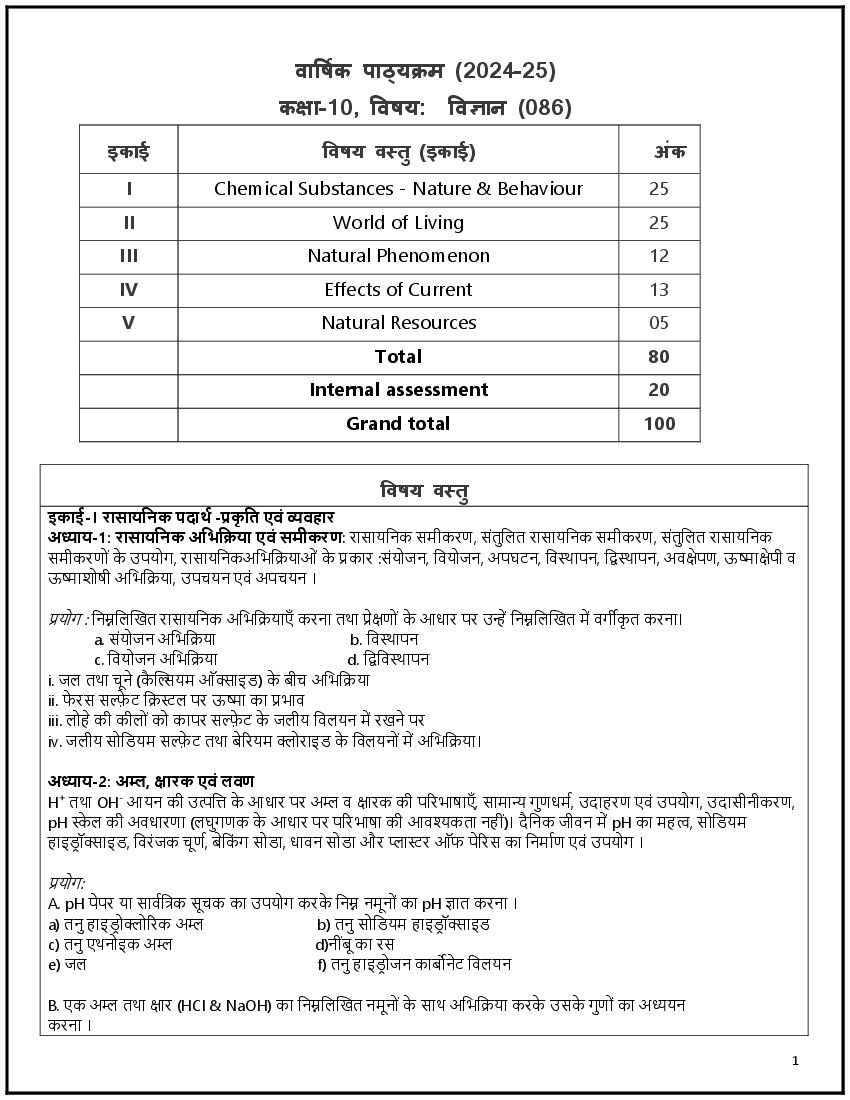
कक्षा-10, र्वषय: र्वज्ञान (086)
इकाई र्वषय वस्तु (इकाई) अंक
I Chemical Substances - Nature & Behaviour 25
II World of Living 25
III Natural Phenomenon 12
IV Effects of Current 13
V Natural Resources 05
Total 80
Internal assessment 20
Grand total 100
र्वषय वस्तु
इकाई-। रासायनिक पदार्थ -प्रकृनि एवं व्यवहार
अध्याय-1: रासायनिक अनिनिया एवं समीकरण: रासायनिक समीकरण, संतुनित रासायनिक समीकरण, संतुनित रासायनिक
समीकरणों के उपयोग, रासायनिकअनिनियाओं के प्रकार :संयोजि, नियोजि, अपघटि, निस्थापि, निस्थापि, अिक्षे पण, ऊष्माक्षे पी ि
ऊष्माशोषी अनिनिया, उपचयि एिं अपचयि ।
प्रयोग : निम्ननिखित रासायनिक अनिनियाएँ करिा तथा प्रेक्षणों के आधार पर उन्हें निम्ननिखित में िगीकृत करिा।
a. संयोजि अनिनिया b. निस्थापि
c. नियोजि अनिनिया d. निनिस्थापि
i. जि तथा चूिे (कैखियम ऑक्साइड) के बीच अनिनिया
ii. फेरस सल्फेट निस्टि पर ऊष्मा का प्रिाि
iii. िोहे की कीिों को कापर सल्फेट के जिीय निियि में रििे पर
iv. जिीय सोनडयम सल्फेट तथा बेररयम क्लोराइड के निियिों में अनिनिया।
अध्याय-2: अम्ल, क्षारक एवं लवण
H+ तथा OH- आयि की उत्पनि के आधार पर अम्ल ि क्षारक की पररिाषाएँ , सामान्य गुणधमम , उदाहरण एिं उपयोग, उदासीिीकरण,
pH स्केि की अिधारणा (िघुगणक के आधार पर पररिाषा की आिश्यकता िहीं)। दै निक जीिि में pH का महत्व, सोनडयम
हाइडरॉक्साइड, निरं जक चूणम, बेनकंग सोडा, धािि सोडा और प्लास्टर ऑफ पेररस का निमाम ण एिं उपयोग ।
प्रयोग:
A. pH पेपर या सािमनिक सूचक का उपयोग करके निम्न िमू िों का pH ज्ञात करिा ।
a) तिु हाइडरोक्लोररक अम्ल b) तिु सोनडयम हाइडरॉक्साइड
c) तिु एथिोइक अम्ल d)िींबू का रस
e) जि f) तिु हाइडरोजि काबोिे ट निियि
B. एक अम्ल तथा क्षार (HCl & NaOH) का निम्ननिखित िमू िों के साथ अनिनिया करके उसके गुणों का अध्ययि
करिा ।
1
Page 2
b) न ं क धातु
c) ठोस सोनडयम काबोिे ट
अध्याय-3 : धािु व अधािु
धातु एिं अधातु के गुणधमम , सनियता श्रे णी: आयनिक यौनगकों का निमाम ण एिं उिके गुण धमम , धातुओं के निष्कषम ण के मूि प्रिम,
संक्षारण एिं उससे सुरक्षा।
प्रयोग: नजं क (Zn), आयरि(Fe), कॉपर(Cu) तथा एल्यू मीनियम (AI) धातुओं की निम्न ििणों के साथ अनिनिया का अध्ययि करिा।
a. नजं क सल्फेट का निियि (ZnSO4)
b. आयरि सल्फेट का निियि (FeSO4)
C. कॉपर सल्फेट का निियि (CuSO4)
d. एल्यू मीनियम सल्फेट का निियि Al2(SO4) 3
इकाई || सजीव ं का सं सार
अध्याय -5 :जैव प्रिम- “सजीि” पादप एिं जं तुओं में पोषण, श्वसि, संिहि एिं उत्सजमि की मू ि अिधारणा.
प्रयोग : पिी की निल्ली की अस्थाई स्लाइड बिाकर रं ध्ों (stomata) की उपखस्थनत को दशाम िा।
प्रयोग : प्रयोग िारा दशम िा की श्वसि निया के दौराि काबमि डाईऑक्साइड गैस निकिती है ।
अध्याय -6: पादप एवं जंिुओ ं में नियंत्रण व समन्वय
पादपों में अिु ितमि गनतयाँ , पादप हामोि से पररचय, जं तुओं में नियंिण एिं समन्वय, तंनिका तंि, ऐखिक, अिै खिक और प्रनतिती
निया, रासायनिक समन्वय, जन्तु हॉमोि।
इकाई -V प्राकृनिक संसाधि
अध्याय- 13: हमारा पयाम िरण -पाररतंि, पयाम िरणीय समस्याएँ , ओजोि परत का अपक्षय, उत्पानदत कचरा एिं उसका निपटाि, जै ि
निम्नीकरण एिं अजै ि निम्नीकरण पदाथम
इकाई -III प्राकृनिक पररघटिाएँ
अध्याय - 9 : प्रकाश-पराविथि िर्ा अपविथि
गोिीय पृष्ों िारा प्रकाश का पराितमि, गोिीय दपमणों िारा प्रनतनबंब बििा, ििता केंद्र, मु ख्य अक्ष, मु ख्य फोकस, फोकस दू री, दपमण
सूि (व्युत्पनि आिश्यक िही) आिधमि, गोिीय दपमणों के उपयोग।
अपविथि: अपितमि के नियम, अपितमिां क.
गोिीय िें सों िारा अपितमि,गोिीय िें सों िारा प्रनतनबंब बिािा, िें स सूि (व्युत्पनि आिश्यक िहीं), आिधमि, िें स की क्षमता, गोिीय
िें सों के उपयोग।
प्रयोग : दू रस्थ िस्तु के िारा बििे िािे प्रनतनबंब िारा नकसी अिति दपमण तथा ii. उिि िेंस की फोकस
दू री ज्ञात करिा।
प्रयोग : निनिन्न आपति कोणों के निए कां च के आयताकार गुटके में से होकर गुजरिे िािी प्रकाश-नकरण के मागम को दशाम िा।
आपति कोण, निगमत कोण कथा अपिनतमत कोण को मापिा तथा पररणाम को ज्ञात करिा।
अध्याय - 10: मािव िे त्र िर्ा रं ग निरं गा संसार
मािि िे ि में िें स का कायम ,दृनि दोष तथा उिका संशोधि , नप्रज़्म से प्रकाश का अपितमि, प्रकाश का निक्षे पण, प्रकाश का प्रकीणमि
एिं उिका दै निक जीिि में उपयोग (सूयोदय तथा सूयाम स्त के समय सूयम के रं ग के अिािा)
प्रयोग : कां च के नप्रज़्म से गुजरिे िािी प्रकाश की नकरणों के पथ को दशाम िा।
2
Page 3
ुि त पाठ्यक्रम 13 सितम्बर, 2024 तक परू ा कर सिया जाए।
• मध्यावधि परीक्षा-2024 हे तु पाठ्यवस्तु की पन
ु रावर्ृ ि ।
• मध्यावधि परीक्षा-2024
इकाई I - रासायनिक ित्व, प्रकृनि एवं व्यवहार
अध्याय - 4: कािथ ि एवं उसके यौनगक : काबमि यौनगकों में सहसंयोजी आबंध, काबमि की सिमतोमु िी प्रकृनत, समजातीय श्रे णी,
प्रकायाम त्मक समू ह; है िोजि, ऐल्कोहाि, कीटोि, ऐखिहाइड, ऐल्केि, ऐल्कीि एिं ऐल्काइि िािे काबमि यौनगकों की िाम पद्धनत,
संतृप्त एिं असंतृप्त काबमि यौनगकों में अन्तर, काबमि यौनगकों के रासायनिक गुणधमम ( दहि, उपचयि, संकिि, प्रनतस्थापि
अनिनिया) , एथिॉि एिं एथिोइक अम्ल (केिि गुणधमम एिं उपयोग) ,साबुि और नडटजें ट।
प्रयोग : ऐनसनटक एनसड (एथिोइक अम्ल )के निम्ननिखित गुणों का अध्ययि करिा
i.गंध ii.निटमस पि /निियि पर प्रिाि
iii.जि में घुििशीिता iv.सोनडयम हाइडरोजि काबोिेटh के साथ अनिनिया
प्रयोग : कठोर ि मृ दु जि में साबुि के िमू िे की शोधि क्षमता का तुििात्मक अध्ययि करिा I
इकाई- IV नवद् युि का प्रिाव
अध्याय 11- नवद् युिः निद् युत धारा, निद् युत निििां तर एिं निद् युत धारा, ओम का नियम; प्रनतरोध एिं प्रनतरोधकता, नकसी चािक के
प्रनतरोध को प्रिानित करिे िािे कारक, प्रनतरोधों का श्रे णीिम संयोजि, प्रनतरोधों का पाश्वम िम संयोजि एिं उिका दै निक जीिि में
उपयोग, निद् युत धारा का तापीय प्रिाि एिं उिका दै निक जीिि में उपयोग, निद् युत शखि, P, V,। और R में पारस्पररक संबंध।
प्रयोग : नकसी प्रनतरोध के निििान्तर V और। की नििम रता का अध्ययि करिा और प्रनतरोध की माप करिा। V तथा । के बीच ग्राफ
िींचिा।
प्रयोग : श्रे णी िम ि पाश्वम िम में संयोनजत दो प्रनतरोधकों का पररणामी प्रनतरोध ज्ञात करिा।
अध्याय- 12 : नवद् युि धारा के चुंिकीय प्रिाव
चुंबकीय क्षे ि, क्षे ि रे िाएँ , नकसी निद् युत धारािाही चािक के कारण चुंबकीय क्षे ि, नकसी कुंडिी अथिा पररिानिका में
प्रिानहत निद् युतधारा के कारण चुंबकीय क्षे ि, नकसी निद् युत धारािाही चािक पर बि, फ़्िे नमं ग का िाम-हस्त नियम, नदि धारा (DC),
प्रत्यािती धारा (AC), AC की आिृनत, DC की अपेक्षा AC के फायदे , घरे िू निद् युत पररपथ
इकाई-II सजीव ं का सं सार
अध्याय -7 : जिि - पादप एिं जन्तुओं में जिि (अिैं नगक ि िैं नगक), जिि स्वास्थ्य- पररिार नियोजि की आिश्यकता एिं निनध |
सुरनक्षत यौि संबंध (िैं नगक) vs एचआईिी/एड् स (HIV/AIDS), गिम धारण एिं स्त्री स्वास्थ्य |
प्रयोग : तैयार स्लाइडों िारा a. अमीबा में निनििाजि b. यीस्ट एिं हाइडरा में मु कुिि का अध्ययि करिा।
प्रयोग : नकसी एक निपिी बीज के भ्रू ण के निनिन्न िागों का अध्ययि करिा (मटर, चिा या राजमा )
अध्याय -8: अिुवांनशकिा: अिु िां नशकता, मेंडि का योगदाि, िक्षणों की िंशािु गनत के नियम, निं ग निधाम रण: संनक्षप्त पररचय।
ि ट:-
• सम्पूणथ पाठ्यिम नदसंिर 13, 2024 िक पूरा कर नलया जाए ।
• प्रय ग ं का अभ्यास ;
• प्री ि र्थ एवं वानषथक परीक्षा 2025हेिु सम्पूणथ पाठ्यिम की पुिरावृनि।
3
Page 4
https://cbseacademic.nic.in/web_material/CurriculumMain25/Sec/Science_Sec_2024-25.pdf
अध्यापकों के सिए नोट :
1. प्राकृनतक संसाधिों का संघोनषत प्रबंधि (NCERT) िाग का आकिि िषम के अंत की परीक्षा में िहीं नकया जािा है । जबनक यह िाग
नशक्षानथम यों को पढ़िे के निए सौंपा गया है और इस इकाई की नकसी अिधारणा पर एक संनक्षप्त िेिि तैयार कर पोटम फोनियों में
निििे के निए प्रोत्सानहत नकया जा सकता है । यह आं तररक आकिि के निए हो सकता है और िेनडट िी नदए जा सकते हैं
(आिनधक आकिि/पोटम फोनियो)।
2. NCERT पाठ्यपुस्तक में बॉक्स में कई तथ्ों की जािकारी दी गई है । जो नशक्षानथम यों को िैचाररक स्पिता को दे िे में सहायक है ।
जबनक बॉक्स में दी गई तथ्ों की जािकारी का आकिि साि के अंत की परीक्षा में िहीं नकया जाएगा।
Question Paper Design
Class IX/X (2024-25)
Subject: Science (086)
Theory (80 marks) Duration :3 Hours
S.No. Competencies Total
1. Demonstrate Knowledge and Understanding 46%
2. Application of Knowledge/Concepts 22%
3. Formulate, Analyze, Evaluate and Create 32%
Total 100%
Note:
• Typology of Questions:
VSA including objective type questions, Assertion – Reasoning type questions; SA; LA; Source-based/
Case-based/ Passage-based/ Integrated assessment questions.
• An internal choice of approximately 33% would be provided.
Internal Assessment: 20 Marks
• Periodic Assessment – 05 marks + 05 marks
• Subject Enrichment (Practical Work) – 05 marks
• Portfolio – 05 marks .
Suggestive verbs for various competencies
• Demonstrate Knowledge and Understanding:
State, name, list, identify, define, suggest, describe, outline, summarize, etc.
• Application of Knowledge/Concepts:
Calculate, illustrate, show, adapt, explain, distinguish, etc.
• Formulate, Analyze, Evaluate and Create:
Interpret, analyze, compare, contrast, examine, evaluate, discuss, construct, etc.
4
Page 5
CLASS-10, SUBJECT: SCIENCE (086)
Unit No. Units Marks
I Chemical Substances - Nature & Behaviour 25
II World of Living 25
III Natural Phenomena 12
IV Effects of Current 13
V Natural Resources 05
Total 80
Internal assessment 20
Grand total 100
Content
Unit –I Chemical Substances – Nature and Behaviour
Chapter-1: Chemical reactions and equations- Chemical equation, Balanced chemical equation,
implications of a balanced chemical equation, types of chemical reactions: combination, decomposition,
displacement, double displacement, precipitation, endothermic exothermic reactions, oxidation and
reduction.
Practical: Performing and observing the following reactions and classifying them into:
a) Combination reaction b) Decomposition reaction
c) Displacement reaction d) Double displacement reaction
(i) Action of water on Quick lime(calcium oxide)
(ii) Action of heat on Ferrous sulphate crystals
(iii) Iron nails kept in Copper sulphate solution
(iv) Reaction between Sodium sulphate and Barium chloride solutions
Chapter-2: Acids, Bases and Salts-Their definitions in terms of furnishing of H+ and OH– ions, General
properties, examples and uses, neutralization, concept of pH scale (Definition relating to logarithm not
required), importance of pH in everyday life; preparation and uses of Sodium Hydroxide, Bleaching powder,
Baking soda, Washing soda and Plaster of Paris.
Practical : A)Finding the pH of the following samples by using pH paper / universal Indicator:
a) Dilute Hydrochloric acid b) Dilute NaOH solution
c) Dilute Ethanoic Acid Solution d) Lemon juice
e) Water f) Dilute hydrogen carbonate solution
B) Studying the properties of acids and bases (HCl & NaOH) by their reaction with:
a) Litmus solution (Blue/Red)
b) Zinc metal
c) Solid sodium carbonate
Chapter-3: Metals and Non-Metals- Properties of metals and non-metals; Reactivity series; Formation and
properties of ionic compounds; Basic metallurgical processes; Corrosion and its prevention
Practical : Observing the action of Zn, Fe, Cu and Al metals on the following salt solutions:
a) ZnSO4 (aq) (b) FeSO4 (aq) (c) CuSO4 (aq) (d) Al2(SO4)3 (aq)
Arranging Zn, Fe, Cu and Al (metals) in the decreasing order of reactivity based on the above result.
Unit II: World of Living
Chapter-5: Life processes- "living being". Basic concept of nutrition, respiration, transport and excretion in
plants and animals.
Practical: Preparing a temporary mount of a leaf peel to show stomata.
Practical: Experimentally show that carbon dioxide is given out during respiration.
Page 1
Page 6
of plant hormones; Control and co-ordination in animals: Nervous system; Voluntary, involuntary and reflex
action; Chemical co-ordination: animal hormones.
Unit V: Natural Resources
Chapter-13: Our Environment- Eco-system, Environmental problems, Ozone depletion, waste production
and their solutions. Biodegradable and non-biodegradable substances.
Unit III: Natural Phenomenon
Chapter-9: Light- Reflection and Refraction
Reflection of light by curved surfaces; Images formed by spherical mirrors, centre of curvature, principal
axis, principal focus, focal length, mirror formula (Derivation not required), magnification, application of
spherical mirrors.
Refraction; Laws of refraction, refractive index.
Refraction of light by spherical lens; Image formed by spherical lenses; Lens formula (Derivation not
required); Magnification. Power of a lens, application of spherical lenses.
Practical: Determination of the focal length of:
i) Concave mirror ii) Convex lens by obtaining the image of a distant object.
Practical: Tracing the path of a ray of light passing through a rectangular glass slab for different angles of
incidence. Measure the angle of incidence, angle of refraction, angle of emergence and interpret the result.
Chapter-10: The Human Eye and the Colourful World
Functioning of a lens in human eye, defects of vision and their corrections, Refraction of light through a
prism, dispersion of light, scattering of light, applications in daily life (excluding colour of the sun at sunrise
and sunset).
Practical: Tracing the path of the rays of light through a glass prism.
Note:
➢ The above mid-term syllabus is to be completed by September 13, 2024.
➢ Revision of syllabus for Mid –Term Examination 2024
Mid –Term Examination 2024
Unit I: Chemical Substances - Nature and Behaviour
Chapter-4: Carbon and its compounds- Covalent bonding in carbon compounds. Versatile nature of
carbon. Homologous series. Nomenclature of carbon compounds containing functional groups (halogens,
alcohol, ketones, aldehydes, alkanes and alkynes), difference between saturated hydro carbons and
unsaturated hydrocarbons. Chemical properties of carbon compounds (combustion, oxidation, addition and
substitution reaction). Ethanol and Ethanoic acid (only properties and uses), soaps and detergents.
Practical: Study of the following properties of acetic acid (Ethanoic acid):
i) odour ii) solubility in water
iii) effect on litmus paper/solution iv) reaction with Sodium hydrogen carbonate
Practical : Study of the comparative cleaning capacity of a sample of soap in soft and hard water.
Unit IV: Effects of Current
Chapter-11: Electricity- Electric current, potential difference and electric current. Ohm’s law; Resistance,
Resistivity, Factors on which the resistance of a conductor depends. Series combination of resistors, parallel
combination of resistors and its applications in daily life. Heating effect of electric current and its
applications in daily life. Electric power, Interrelation between P, V, I and R.
Practical: Studying the dependence of potential difference (V) across a resistor on the current (I) passing
through it and determine its resistance. Also plotting a graph between V and I.
Practical: Determination of the equivalent resistance of two resistors when connected in series and parallel.
Chapter-12: Magnetic effects of Current- Magnetic field, field lines, field due to a current carrying
Page 2
Page 7
Left Hand Rule, Direct current, Alternating current, frequency of AC, Advantage of AC over DC, Domestic
electric circuits.
Unit II: World of Living
Ch-7: Reproduction- Reproduction in animals and plants (asexual and sexual) reproductive health - need
and methods of family planning. Safe sex vs HIV/AIDS. Child bearing and women’s health.
Practical: Studying (a) binary fission in Amoeba, and (b) budding in yeast and hydra with the help
of prepared slides.
Practical: Identification of the different parts of an embryo of a dicot seed (Pea, gram or red kidney bean).
Ch-8: Heredity and Evolution – Heredity; Mendel’s contribution- Laws for inheritance of traits: Sex
determination: brief introduction: (topics excluded - evolution; evolution and classification and evolution
should not be equated with progress).
Note:
➢ The entire syllabus is to be completed by December 13, 2024.
➢ Revision of entire syllabus for Pre-board and Annual Examination 2025.
➢ For more information kindly visit to CBSE Academic:
https://cbseacademic.nic.in/web_material/CurriculumMain25/Sec/Science_Sec_2024-25.pdf
Note for the Teachers:
1. The chapter Management of Natural Resources (NCERT Chapter 16) will not be assessed in the
year-end examination. However, learners may be assigned to read this chapter and encouraged to
prepare a brief write up to any concept of this chapter in their Portfolio. This may be for Internal
Assessment and credit may be given (Periodic Assessment/Portfolio).
2. The NCERT text books present information in boxes across the book. These help students to get
conceptual clarity. However, the information in these boxes would not be assessed in the year-end
examination.
Question Paper Design
Class IX/X (2024-25)
Subject: Science (086)
Theory (80 marks) Duration :3 Hours
S.No. Competencies Total
1. Demonstrate Knowledge and Understanding 46%
2. Application of Knowledge/Concepts 22%
3. Formulate, Analyze, Evaluate and Create 32%
Total 100%
Note:
• Typology of Questions: VSA including objective type questions, Assertion – Reasoning type
questions; SA; LA; Source-based/ Case-based/ Passage-based/ Integrated assessment questions.
An internal choice of approximately 33% would be provided.
Internal Assessment: 20 Marks
• Periodic Assessment – 05 marks + 05 marks
• Subject Enrichment (Practical Work) – 05 marks
• Portfolio – 05 marks .
Suggestive verbs for various competencies
• Demonstrate Knowledge and Understanding: State, name, list, identify, define, suggest, describe, outline,
summarize, etc.
• Application of Knowledge/Concepts: Calculate, illustrate, show, adapt, explain, distinguish, etc.
• Formulate, Analyze, Evaluate and Create: Interpret, analyze, compare, contrast, examine, evaluate, discuss,
construct, etc.
Page 3
Document Details
| Board / Org | Delhi Board |
| Exam | Class 10 |
| Type | Syllabus |
| Pages | 7 |
| Updated | 22 Jul 2026 |