Manipur Board Class 11 Syllabus 2027 Political Science
Finished viewing? Save it for later —
Download Manipur Board Class 11 Syllabus 2027 Political Science (PDF · 7 pages)About Manipur Board Class 11 Syllabus 2027 Political Science
Manipur Board Class 11 Syllabus 2027 Political Science is available here for free download. Published by Manipur Board for Class 11, this syllabus can be viewed online or downloaded as a PDF (7 pages). Candidates preparing for Class 11 can use Manipur Board Class 11 Syllabus 2027 Political Science to understand the exam pattern, the type of questions asked, and the overall difficulty level.
Frequently Asked Questions
How can I download Manipur Board Class 11 Syllabus 2027 Political Science?
Open this page and click the Download button to save Manipur Board Class 11 Syllabus 2027 Political Science as a PDF. It is completely free on AglaSem Docs.
Is Manipur Board Class 11 Syllabus 2027 Political Science free to download?
Yes. Manipur Board Class 11 Syllabus 2027 Political Science can be viewed online and downloaded as a PDF free of cost on AglaSem Docs.
How many pages does Manipur Board Class 11 Syllabus 2027 Political Science have?
Manipur Board Class 11 Syllabus 2027 Political Science contains 7 pages, which you can read online or download together as a single PDF.
Where can I find more Class 11 study material?
You can find more Class 11 question papers, sample papers, syllabus, and answer keys on AglaSem Docs.
Manipur Board Class 11 Syllabus 2027 Political Science – Text
Read the full text of this syllabus below — useful to quickly search, copy and reference the content online without downloading the PDF.
📄 View text version (8 pages)
Page 1
Manipur Board Class
11 Syllabus 2027
Political Science
EXAM YEAR TYPE SUBJECT
Manipur Class 11 2027 Syllabus Political Science
Notes · Sample Papers · Previous Year Papers · Mock Tests
Page 2
m .co
m .co s e m
se g l a
a
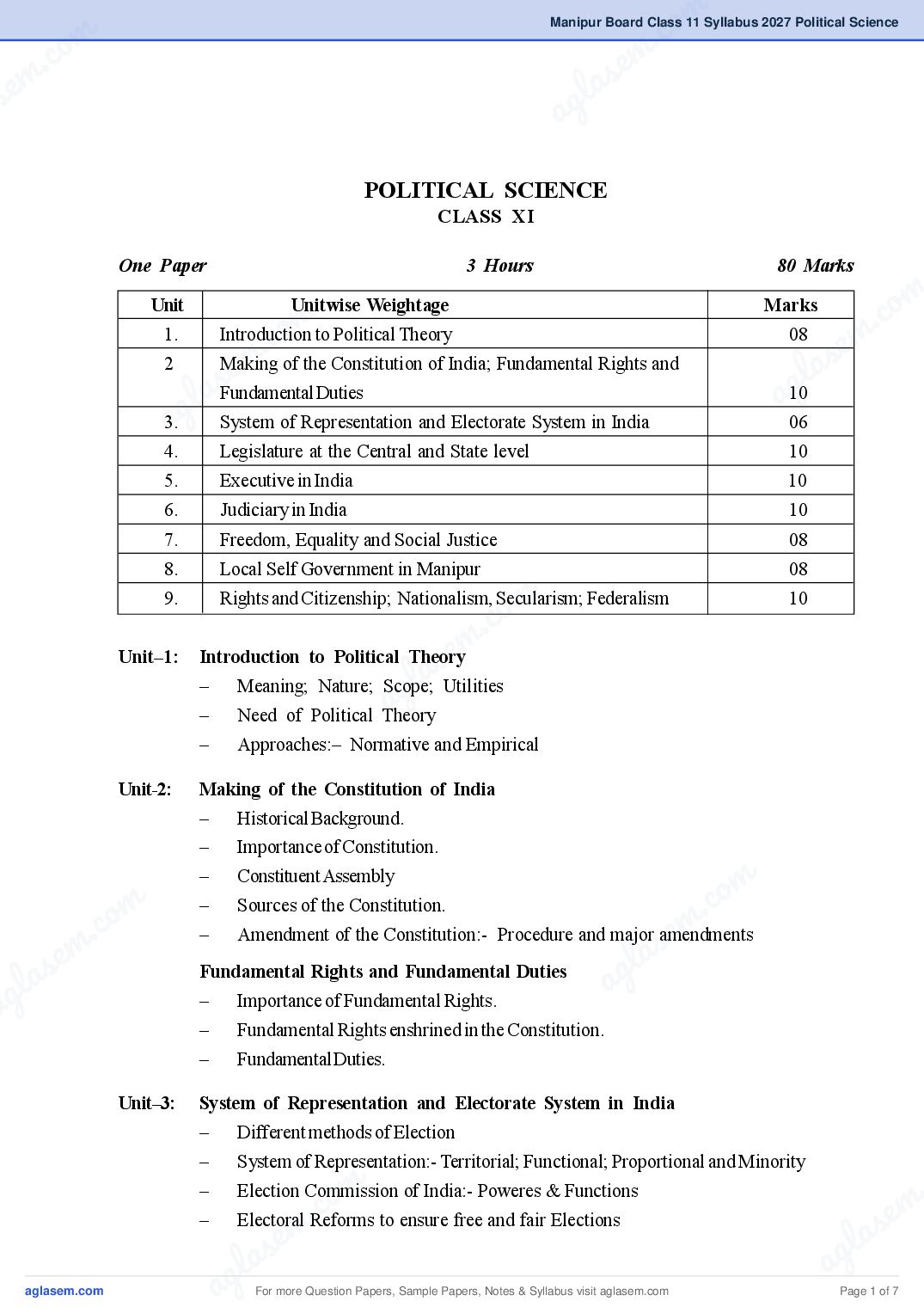
POLITICAL SCIENCE
CLASS XI
One Paper 3 Hours 80 Marks
m
.co
Unit Unitwise Weightage Marks
m
1.
.co
Introduction to Political Theory
m of the Constitution of India; Fundamental Rights and
08
s e m
2
s e
Making
l a
g la Fundamental Duties a10g
a System of Representation and Electorate System in India
3. 06
4. Legislature at the Central and State level 10
5. Executive in India 10
6. Judiciary in India 10
7. Freedom, Equality and Social Justice 08
8. Local Self Government in Manipur 08
9. m
Rights and Citizenship; Nationalism, Secularism; Federalism 10
c. o
Unit–1: s
Introduction to Political Theory em
– g la Utilities
Meaning; Nature; Scope;
–
a
Need of Political Theory
– Approaches:– Normative and Empirical
Unit-2: Making of the Constitution of India
– Historical Background.
– Importance of Constitution.
– Constituent Assembly
m
m – Sources of the Constitution. .co
m .co – Amendment of the Constitution:- Procedure and major amendments
s e m
s e g l a
la
Fundamental Rights and Fundamental Duties
g a
a –
–
Importance of Fundamental Rights.
Fundamental Rights enshrined in the Constitution.
– Fundamental Duties.
Unit–3: System of Representation and Electorate System in India
– Different methods of Election
– System of Representation:- Territorial; Functional; Proportional and Minority
–
o m
Election Commission of India:- Poweres & Functions
m .
. c s e
–
e m
Electoral Reforms to ensure free and fair Elections
l a
l as ag
ag For more Question Papers, Sample Papers, Notes & Syllabus visit Page 1 of 7
Page 3
– Union Parliament:– (Lok Sabha and Rajya Sabha) – Composition,
powers and functions.
– State Legislature:– Composition, Powers and Functions.
– Legislative Procedure.
Unit–5: Executive in India
– President of India: Election removal, formal and real Powers.
– Prime Minister and Council of Ministers:– Powers and Functions.
– Chief Minister and Council of Ministers:– Powers and Functions.
– Governor in the State:– Role and Powers.
Unit–6: Judiciary in India
– Independence of Judiciary
– Supreme Court–appointment of Judges, Powers.
– High Court–appointment of Judges, Powers.
– Public interest litigacy, Lok Adalat.
Unit–7: Freedom, Equality, Social Justice
– Meaning and kinds of Freedom, its limitations.
– Meaning and kinds of Equality: Different forms of Equality.
– Meaning and dimensions of Justice.
Unit–8: Local Self Government in Manipur
– Decentralisation of Power and its importance.
Various structures of Local Self Government and its nomenclature.
– Local Self Government in Manipur:-
Panchayats; Zilla Parishad; Municipalities; Autonomous District Council.
For more Question Papers, Sample Papers, Notes & Syllabus visit Page 2 of 7
Page 4
m .co
m .co s e m
se g l a
a
Unit–9: Rights and Citizenship.
– Rights:– meaning; kinds; Difference between Rights and Claims.
– Citizenship–meaning; types; grounds for inclusion and exclusion.
m
.co
Nationalism, Secularism; Federalism
m
–
.co
Nationalism-concept, right to self determination
s e m
– em a
a s Secularism:- Meaning; Need of a Secular State; India a secular State.
g l
g l – Federalism:- Meaning; Features. a
a
PRESCRIBED TEXTBOOKS :
1. Indian Constitution at Work
(Textbook in Political Science for Class XI)
Published by: NCERT, New Delhi
2. Political Theory
(Textbook for Class-XI)
m
.co
Published by: NCERT, New Delhi
3. e
A Study of Local Self–Government in Manipur m
By: M. Ibohal Singh
las
ag
Published by: Mutum Gourahari, Advocate, for Pakhangba Laining (Mayai Sanglen)
Heingang Kontha Makha Leikai, Imphal
REFERENCE BOOKS:
1. Indian Constitution and Political Theory for Class XI
By: B.B. Tayal
Published by: Arya Book Publications.
m
.co
2. Political Science for Class XI
m By: Avnindra Kumar Verma
m .co Published by: V.K. (India) Enterprises, New Delhi-2
s e m
s e g l a
g la a
a ——§§§——
m .
.co s e m
s em l a
g la ag
a For more Question Papers, Sample Papers, Notes & Syllabus visit Page 3 of 7
Page 5
Subject : Political Science
Class : XI
Full Marks : 80
Time : 3 Hours
WEIGHTAGE OF OBJECTIVES
Objectives Marks Percentage
Knowledge (K) 12 15
I Understanding (U) 40 50
Application (A) 24 30
Skill (S) 4 5
Total 80 100
WEIGHTAGE TO FORMS OF QUESTIONS
No. of Time
Forms of questions Marks Percentage
Questions (in minutes)
Essay/Long Answer (E/LA) 4 86 32 40
II Short Answer I (SA-I) 6 42 24 30
Short Answer II (SA-II) 4 16 8 10
Very Short Answer (VSA) 6 16 6 7.5
MCQ 10 20 10 12.5
Total 30 180 80 100
WEIGHTAGE TO CONTENTS
Marks Percentage
1 Introduction to Political Theory 8 10
2 Making of the Constitution of India, Fundamental Rights and
10 12.5
Fundamental Duties
3 System of Representation and Electoral System in India 6 7.5
4 Legislature at the Central and State level 10 12.5
III 5 Executive in India 10 12.5
6 Judiciary in India 10 12.5
7 Freedom, Equality and Social Justice 8 10
8 Local Self Government in Manipur 8 10
9 Right and Citizenship; Nationalism, Secularism and
10 12.5
Federalism
Total 80 100
IV SCHEME OF SECTIONS: NIL
V SCHEME OF OPTIONS: 50% (3Questions) in SA-I & 100% (4Questions) in Essay Type Questions
VI DIFFICULTY LEVEL :
Difficult : 30% of the total marks
Average : 50% of the total marks
Easy : 20% of the total marks
Special instructions: 1) Two questions of MCQ will be assertion-reason type questions.
2) One question of SA-I will be source-based question.
Abbreviation: K (knowledge), U (Understanding), A (Application), S (Skill), E (Essay),
SA (Short Answer), VSA (Very Short Answer), O (Objective),
MCQ (Multiple Choice Question).
For more Question Papers, Sample Papers, Notes & Syllabus visit Page 4 of 7
Page 6
m .co
m .co s e m
se g l a
a
VII. INTERNAL ASSESSMENT
In the Higher Secondary Examination (Class-XII) and Class-Xl Examination, 20
marks allotted for Internal Assessment are generally awarded through a combination of
periodic assessments and subject-related activities/project work/field work.
m
.co
COMPONENTS OF INTERNAL ASSESSMENT
SL
o m Components Marks
m
No.
. c s e
1
m
Periodic Test/Academic
e
Activities 10
l a
2
l as
Subject Related Activities/Project Work/Field Work
Total
ag
10
20
ag PERIODIC TEST/ ACADEMIC ACTIVITIES ( 10 Marks)
(1) GUIDELINES OF PERIODIC TEST:
(i) There are three periodic tests to be conducted by the institutions in the form of
pen-paper test and carrying maximum of 20 marks each.
(ii) Average mark of the best 2 (two) out of 3 (three) tests shall be noted as A and
mark awarded out of
10=(A/20)x10=A/2=M1
m
.co
(2) QUESTION DESIGN OF PERIODIC TEST (Three periodic test carrying 10
marks each):
(i)
m
Multiple Choice Question (MCQ) – 2 Questions carrying 1mark each.
e
s
(ii) Very Short Answer (VSA) - 2 Questions carrying 1 mark each.
la
ag
(iii) Short Answer (SA -II) - 1 Question carrying 2 marks.
(iv) Short Answer (SA-I) - 1 Question 1 carrying 4 marks.
PROJECT WORK/FIELD WORK (10 Marks)
Project work/field work carrying 10 marks is an independent study. Marks awarded out
of 10 (ten) in this project/activity is M2. It is usually handwritten and must include relevant
photographs, charts, diagrams, a Biography etc. The main objective is to stimulate the
creativity and imagination of the students. It makes students self-motivated and self-confident
and enable students to communicate what they see, feel and think to the society.
m
m(1) GUIDELINES OF PROJECT WORK/FIELD WORK:
.co
.co m
(a) Cover Page:
m
(i) Title of the Project.
s e
s e (ii) Name of the Student.
g l a
g la (iii) Class & Section.
a
a (iv) Roll Number.
(v) Name of School.
(vi) Academic Session.
(vii) Submitted to: Teacher's Name & Department.
(viii) Submitted by: Student's Name.
(b) Preface:
(i) Certificate: Signed by subject teacher and forwarded by the school principal.
(ii) Acknowledgement: A short note thanking subject teacher and principal
(iii) Table of Contents: Page numbers of each section.
m .
.co s e m
s em l a
g la ag
a For more Question Papers, Sample Papers, Notes & Syllabus visit Page 5 of 7
Page 7
(i) Introduction: Introduce your choice topic and why you select it:
(ii) Objectives: What do you hope to learn or prove in this study?
(iii) Literature Review: A brief notes of previous study if any relating to the
present study.
(iv) Methodology: Methods of collecting data.
(v) Data Interpretation: Results and findings of the study.
(vi) Conclusion: Your final summary of the findings.
(d) Bibliography: A list of books, articles and websites you used for your research:
(2) BEST PRACTICES FOR PROJECT REPORT:
(i) Handwritten: Ensure everything (except the cover page and printed
photographs) is written neatly in your own handwriting.
(ii) Visuals: Use coloured pens, diagrams and statistical graphs to make your data
easy to read.
(iii) Clarity: Write in clear, short sentences. Avoid dense paragraphs.
(iv) Citations: Always cite the source of your information. For example, if you get
statistics from a government website, write the exact link in your bibliography.
(3) MARKING DESIGN FOR PROJECT WORK/FIELD WORK (10 marks):
(i) Introduction - 2 marks.
(ii) Contents/Observation - 4 marks.
(iii) Conclusion - 1 mark.
(iv) Viva Voce - 3 marks
# Total Internal Assessment marks secured by the student = M1+M2.
Timeline/Schedule for Assessment
Activities Month Maximum
Marks
Periodic Test - I Up to last day of July
Periodic Test - II Up to 10th September
10
Periodic Test - III Up to last day of October
Project Work/Subject 10
November - December
Activities
Total 20
REPORTING/SUBMISSION
Marks of Periodic Test: on or before 10' November.
Test Marks out of Internal Assessment 20 marks: on or before 10" January.
GENERAL GUIDELINES
Internal Assessment should be conducted continuously throughout the
academic year.
Schools are required to maintain proper records and documentary evidence of
assessments of each and every student.
Marks should be awarded objectively and fairly bases on the student's
performance.
The Internal Assessment marks are to be uploaded by the school as per the
timeline of the CoHSEM
For more Question Papers, Sample Papers, Notes & Syllabus visit Page 6 of 7
Page 8
m .co
m .co s e m
se g l a
a
SUGGESTED TOPICS
2. Disintegration of USSR with special focus on Gorbachev.
3. Cover the negative as well as positive aspects of relationship between India and
the following countries. m
a) m
Relationship between India and Russia .co
.co
b) Relationship between India and China
m s e m
e
c) Relationship between India and Pakistan
s l a
g l a
d) Relationship between India and Bangladesh ag
a
4. ASEAN
5. European Union and India
6. BRICS
7. SAARC
8. India's Nuclear Policy
9. United Nations with focus on India's candidature in Security Council.
10. UN Agencies - UNICEF, UNESCO, WHO
m
.co
11. Pandemics: Covid 19-Its global impact (focus on worldwide cooperation and
preparedness along with controversies (please collect newspaper clippings for the
e m
same)
las
12.
13. ag
Partition of India-Theory behind it and its legacy
Comparison between NITI AAYOG and Planning Commission and their
contribution in India's Development.
14. Election Commission of India and Electoral Roll and its revision.
15. Role of Manipuri women in the Socio-Economic and political development of the
state.
*****
m
m .co
m .co s e m
s e g l a
g la a
a
m .
.co s e m
s em l a
g la ag
a For more Question Papers, Sample Papers, Notes & Syllabus visit Page 7 of 7
Document Details
| Board / Org | Manipur Board |
| Exam | Class 11 |
| Type | Syllabus |
| Pages | 7 |
| Updated | 04 Nov 2026 |