NBSE Class 11 Question Paper 2021 for Biology
Finished viewing? Save it for later —
Download NBSE Class 11 Question Paper 2021 for Biology (PDF · 3 pages)About NBSE Class 11 Question Paper 2021 for Biology
NBSE Class 11 Question Paper 2021 for Biology is available here for free download. Published by Nagaland Board for Class 11, this question paper can be viewed online or downloaded as a PDF (3 pages). Candidates preparing for Class 11 can use NBSE Class 11 Question Paper 2021 for Biology to understand the exam pattern, the type of questions asked, and the overall difficulty level.
Frequently Asked Questions
How can I download NBSE Class 11 Question Paper 2021 for Biology?
Open this page and click the Download button to save NBSE Class 11 Question Paper 2021 for Biology as a PDF. It is completely free on AglaSem Docs.
Is NBSE Class 11 Question Paper 2021 for Biology free to download?
Yes. NBSE Class 11 Question Paper 2021 for Biology can be viewed online and downloaded as a PDF free of cost on AglaSem Docs.
How many pages does NBSE Class 11 Question Paper 2021 for Biology have?
NBSE Class 11 Question Paper 2021 for Biology contains 3 pages, which you can read online or download together as a single PDF.
Where can I find more Class 11 study material?
You can find more Class 11 question papers, sample papers, syllabus, and answer keys on AglaSem Docs.
NBSE Class 11 Question Paper 2021 for Biology – Text
Read the full text of this question paper below — useful to quickly search, copy and reference the content online without downloading the PDF.
📄 View text version (3 pages)
Page 1
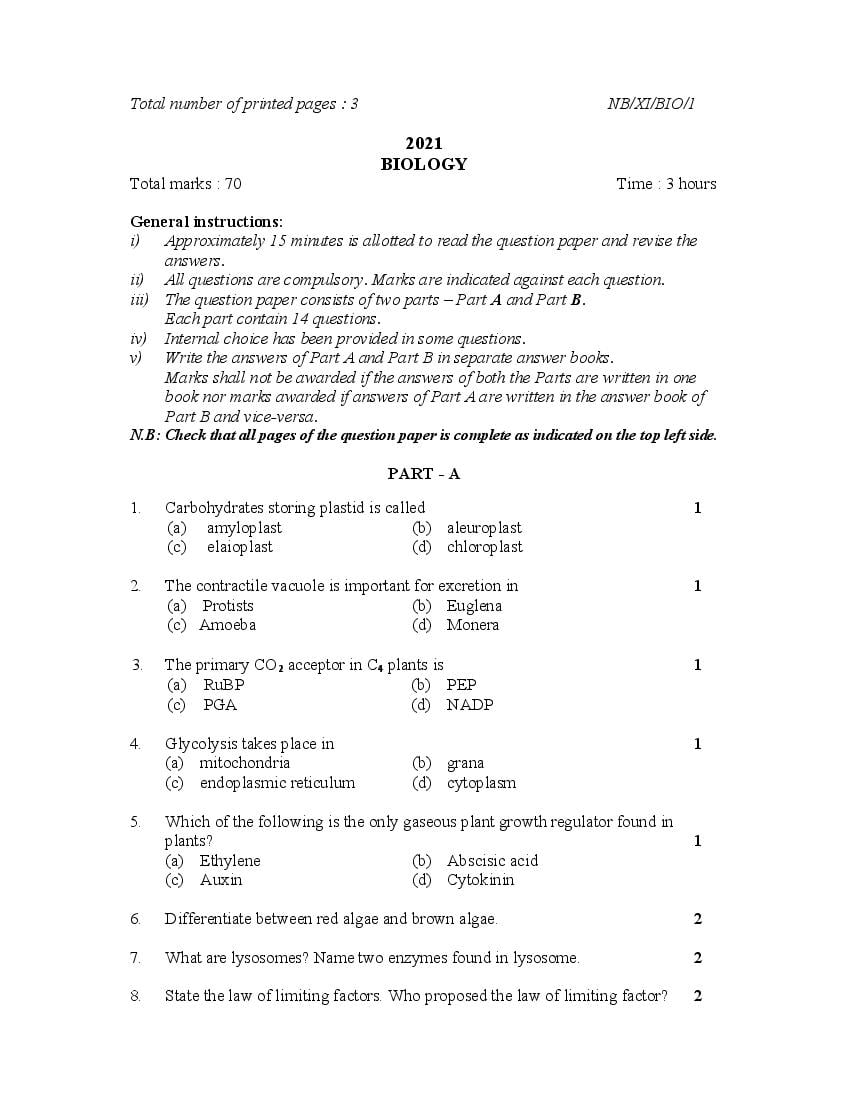
2021
BIOLOGY
Total marks : 70 Time : 3 hours
General instructions:
i) Approximately 15 minutes is allotted to read the question paper and revise the
answers.
ii) All questions are compulsory. Marks are indicated against each question.
iii) The question paper consists of two parts – Part A and Part B.
Each part contain 14 questions.
iv) Internal choice has been provided in some questions.
v) Write the answers of Part A and Part B in separate answer books.
Marks shall not be awarded if the answers of both the Parts are written in one
book nor marks awarded if answers of Part A are written in the answer book of
Part B and vice-versa.
N.B: Check that all pages of the question paper is complete as indicated on the top left side.
PART - A
1. Carbohydrates storing plastid is called 1
(a) amyloplast (b) aleuroplast
(c) elaioplast (d) chloroplast
2. The contractile vacuole is important for excretion in 1
(a) Protists (b) Euglena
(c) Amoeba (d) Monera
3. The primary CO₂ acceptor in C₄ plants is 1
(a) RuBP (b) PEP
(c) PGA (d) NADP
4. Glycolysis takes place in 1
(a) mitochondria (b) grana
(c) endoplasmic reticulum (d) cytoplasm
5. Which of the following is the only gaseous plant growth regulator found in
plants? 1
(a) Ethylene (b) Abscisic acid
(c) Auxin (d) Cytokinin
6. Differentiate between red algae and brown algae. 2
7. What are lysosomes? Name two enzymes found in lysosome. 2
8. State the law of limiting factors. Who proposed the law of limiting factor? 2
Page 2
9. Explain haplo-diplontic life cycle with the help of a diagram. 3
10. Explain any three types of chromosomes based on the position of centromere
with the help of a diagram. 3
11. a. Write three important functions of ethylene.
Or 3
b. Write three physiological functions of auxin.
12. a. Describe the structure of mitochondria with the help of a diagram.
Or 5
b. Explain the structure of cilia and flagella with the help of a diagrammatic
representation.
13. a. What is photorespiration? Explain the various factors affecting
photosynthesis.
b. Give the differences between C3 and C4 plants.
14. a. Explain the process of glycolysis with the help of a schematic representation.
Or 5
b. Explain the process of electron transport system with the help of
diagrammatic representation.
PART - B
1. Bacteria that can survive in extremely salty areas are called 1
(a) archaebacteria (b) methanogens
(c) eubacteria (d) halophiles
2. Who proposed the two kingdom classification? 1
(a) Linnaeus (b) R.H. Whittaker
(c) Aristotle (d) Darwin
3. Marasmus is caused due to deficiency of 1
(a) lipids (b) proteins
(c) amino acids (d) carbohydrates
4. O2 binds with haemoglobin in a reversible manner to form 1
(a) oxyhaemoglobin (b) carbamine haemoglobin
(c) both (a) and (b) (d) none of the above
Page 3
5. β cells of pancrease produce 1
(a) glucagon (b) insulin
(c) adrenaline (d) estrogen
6. Write a short note on cellulose. 2
7. Differentiate between cytokinesis and karyokinesis. 2
8. Explain the following terms: 2
(i) Emphysema (ii) Occupational respiratory disorder
9. Write six characteristic features of the phylum Arthropoda. 3
10. a. What is cell cycle? Diagrammatically, show cell cycle indicating formation
of two cells from one cell.
Or 3
b. Write three significances of mitosis and meiosis.
11. What is peristalsis? How does it help in digestion? 3
12. a. Explain meiosis II with the help of a labelled diagram.
Or 5
b. What are macromolecules? Give two examples. Mention four properties
of proteins.
13. a. Explain the Renin-Angiotensin regulation of kidney function.
b. Write an account on haemodialysis.
14. a. What is diabetes? What is the ultimate hormonal deficiency in this disease?
How does this affect an individual’s ability to use glucose? Mention any two
possible treatments for diabetes mellitus.
Or 5
b. Name the hormones secreted by adrenal gland. Explain their actions in
tabular form.
**********************