NBSE Class 11 Question Paper 2025 All Subjects
Finished viewing? Save it for later —
Download NBSE Class 11 Question Paper 2025 All Subjects (PDF · 146 pages)About NBSE Class 11 Question Paper 2025 All Subjects
NBSE Class 11 Question Paper 2025 All Subjects is available here for free download. Published by Nagaland Board for Class 11, this question paper can be viewed online or downloaded as a PDF (146 pages). Candidates preparing for Class 11 can use NBSE Class 11 Question Paper 2025 All Subjects to understand the exam pattern, the type of questions asked, and the overall difficulty level.
Frequently Asked Questions
How can I download NBSE Class 11 Question Paper 2025 All Subjects?
Open this page and click the Download button to save NBSE Class 11 Question Paper 2025 All Subjects as a PDF. It is completely free on AglaSem Docs.
Is NBSE Class 11 Question Paper 2025 All Subjects free to download?
Yes. NBSE Class 11 Question Paper 2025 All Subjects can be viewed online and downloaded as a PDF free of cost on AglaSem Docs.
How many pages does NBSE Class 11 Question Paper 2025 All Subjects have?
NBSE Class 11 Question Paper 2025 All Subjects contains 146 pages, which you can read online or download together as a single PDF.
Where can I find more Class 11 study material?
You can find more Class 11 question papers, sample papers, syllabus, and answer keys on AglaSem Docs.
NBSE Class 11 Question Paper 2025 All Subjects – Text
Read the full text of this question paper below — useful to quickly search, copy and reference the content online without downloading the PDF.
📄 View text version (144 pages)
Page 1
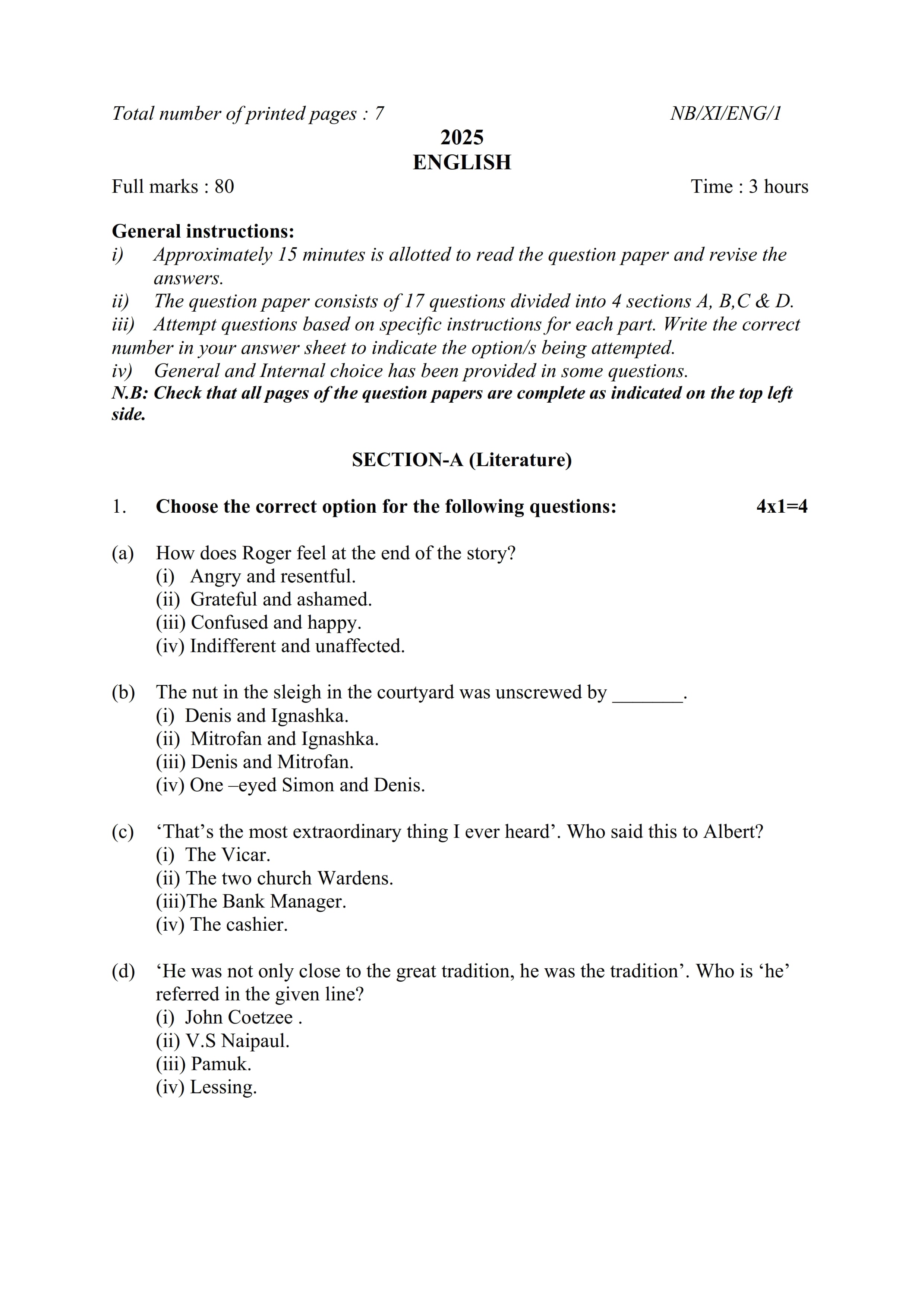
2025
ENGLISH
Full marks : 80 Time : 3 hours
General instructions:
i) Approximately 15 minutes is allotted to read the question paper and revise the
answers.
ii) The question paper consists of 17 questions divided into 4 sections A, B,C & D.
iii) Attempt questions based on specific instructions for each part. Write the correct
number in your answer sheet to indicate the option/s being attempted.
iv) General and Internal choice has been provided in some questions.
N.B: Check that all pages of the question papers are complete as indicated on the top left
side.
SECTION-A (Literature)
1. Choose the correct option for the following questions: 4x1=4
(a) How does Roger feel at the end of the story?
(i) Angry and resentful.
(ii) Grateful and ashamed.
(iii) Confused and happy.
(iv) Indifferent and unaffected.
(b) The nut in the sleigh in the courtyard was unscrewed by _______.
(i) Denis and Ignashka.
(ii) Mitrofan and Ignashka.
(iii) Denis and Mitrofan.
(iv) One –eyed Simon and Denis.
(c) ‘That’s the most extraordinary thing I ever heard’. Who said this to Albert?
(i) The Vicar.
(ii) The two church Wardens.
(iii)The Bank Manager.
(iv) The cashier.
(d) ‘He was not only close to the great tradition, he was the tradition’. Who is ‘he’
referred in the given line?
(i) John Coetzee .
(ii) V.S Naipaul.
(iii) Pamuk.
(iv) Lessing.
Page 2
2. Answer the following questions in about 30-40 words: 3x2=6
(a) How do we know that it was not the first time a nut had been taken from the
tracks?
(b) What new venture does Albert pursue after losing his job as a verger?
(c) What is Lessing’s opinion of the government of Zimbabwe?
3. Answer the following questions in about 150 words:
a. In the story ‘ Thank You M’am’, Roger change as a character from the
beginning to the end of the story. Do you think Roger was compelled to change
or did he want to change. Justify.
Or 5
b. What was the irony of the diamond maker’s life? Do you think he deserved the
unhappy circumstances he was in ? Explain.
4. Choose the correct answer from the alternatives given: 3x1=3
a. What does the poem ‘ No Men Are Foreign’ emphasize regarding human
experience and emotions?
(i) As unique and separate from one another.
(ii) As united and interconnected.
(iii) As hostile and incompatible.
(iv) As rivals in a perpetual struggle.
b. ‘If you can dream- and not make dreams your master’. In the context of the
given line, what do you understand by ‘master’?
(i) A guiding force that inspires and motivates.
(ii) A controlling influence that dominates one’s action.
(iii) A source of entertainment and leisure.
(iv) A measure of success and achievement.
c. ‘And battle –scarred lands that some corner of a vanquished field’. In the given
line, what does the word ‘vanquished’ mean?
(i) Pollute (ii) Conquered (iii) Harvest (iv) Forgotten
5. Read the lines from the poem and answer the following questions:
I. If all men count with you, but none too much;
If you can fill the unforgiving minute
With sixty seconds’ worth of distance run’.
(a) Why should ‘all men’ count but ‘none’ too much 1
(b) Why has the minute been called ‘unforgiving’? 1
Page 3
(c) Explain the last line in your own words. 1
Or
II. Men are so pleasant, so easy to please
Whenever you are with them, you’re always at ease.
Would you be slighted if I didn’t speak for hours?
a) Who says these words and to whom? 1
b) Why did he say men are pleasant and easy to please? 1
c) What is meant by ‘slighted’? 1
6. Answer the following question in about 80- 120 words:
(a) In the poem ‘No Men Are Foreign’, the poet tries to make us understand that the
differences in people are superficial. Substantiate with examples from the text.
4
Or
(b) ‘The golden fields, they lay unreaped and sere’. What cruel side of war does the
poetess highlight in this line?
7. ‘Is marriage so demoralizing as that’?
(a) Who says these words and to whom? 1
(b) What is the context in which he says these words? 2
(c) What is the view of marriage that one delivers from the characters in the
play? 2
Or
‘And now I’ll have a cup of tea, and one of those nice cucumber sandwiches you
promised me’. What is the comedy created around the cucumber sandwiches? 5
8. Answer any two of the following questions in about 150 words: 5x2=10
(a) Give a pen –portrait of Rajam.
(b) Discuss on the use of humour and comedy in R.K Narayan’s ‘Swami and
Friends’.
(c) Discuss the important themes of R.K Narayan’s ‘Swami and Friends’.
SECTION –B (Reading)
9. The Road not taken.
Two roads diverged in a yellow wood,
And sorry I could not travel both
And be one traveller, long I stood
And looked down one as far as I could
To where it bent in the undergrowth;
Page 4
Then took the other, as just as fair,
And having perhaps the better claim,
Because it was grassy and wanted wear;
Though as for that the passing there
Had worn them really about the same.
And both that morning equally lay
In leaves no step had trodden black.
Oh , I kept the first for another day!
Yet knowing how way leads on to way,
I doubted if I should ever come back.
I shall be telling this with a sigh
Somewhere ages and ages hence:
Two roads diverged in a wood, and I-
I took the one less travelled by,
And that has made all the difference.
Robert Frost.
a. Based on your reading of the poem, complete the following in the space povided:
4x½ =2
The poem is about the _____that one makes in his life. It tells about a man who comes
to a fork in the road he is travelling upon. He feels sorry that he cannot
travel_____paths as he must choose one.He looks at the two paths and decides to take
the trail_____travelled.The poet then says that he will be telling this story with a sigh,
someday in the future suggesting that he will wonder what life would have been like if
he had ______the more walked path.
b. Find words in the poem that mean the same as: 2x1=2
i. fork
ii. impartial
10. Read the following passage and answer the questions that follow:
1. All of us do some kind of work to ward off starvation or to gain sufficient material
wealth with a view to maintaining the standard of living which our physical and
intellectual powers have helped us to reach. But there is another kind of work
which is completely divorced from the burdensome process of our livelihood and
which is undertaken for the sake of amusement or interest or the direction of our
surplus stores of energy in some new and useful channels of refined tastes. This
delightful occupation combining work with pleasure or hobby, as it is properly
termed,calls for the application of our highest faculties and give proper form of
Page 5
our healthy instincts, purposeful habits and disciplined behaviour. In our carefree
and vacant hours it allows these faculties to perform their natural functions and to
display their instinctive greatness. We devote our leisure to the pursuit of this
pleasant task and derive advantages which compare favourably with those we
obtain from the bread-eating routine of our daily life. Hobbies widen the sphere of
our cultural activities,give refinement to our tastes and show us the path that leads
to our systematic mental and moral development. Our tendencies and inclination
also find in them an outlet for a healthy and progressive expression.
2. A hobby is a favourite subject or occupation that is not one’s main business. In
this age of machinery which has taken upon itself most of the laborious duties of
physical exertion formally performed by man, then creating for him pleasant
intervals of rest and leisure,it should not be difficult for him to devote some time
to the pursuit of a new interest that can add some charm, colour or zest to his life.
The spare time must not be frittered away in idleness or spent on such works as
overtaxes his mind and body after they have performed their normal functions of
the day.The new interest will be worthwhile only if it provides relaxation and
changes from ordinary occupation, banishes the drabness of routine work and
produces a feeling that life is both charming and meaningful.
3. The choice of hobbies, like the choice of books, is not easy task. Some hobbies
demand a little guidance from experienced persons. Our sudden attachment to
them without the backing of this preliminary knowledge may result in wasting of
our resources of time and money, and in the end compel us to abandon them.
Some hobbies are rather expensive, and therefore beyond the means of ordinary
people who can ill-afford to spend large sum of money on them. Not a few are
incompatible with our temperament and taste. We must not, therefore, allow the
glamour of certain hobbies to blind us to their reality. However tempting they may
appear to us, nor should we begin to cherish them thoughtlessly because we find
so many people devotedly attached to them. In the first flash of enthusiasm many
have rushed into a state of great disillusionment. In a few rare and exceptional
cases a sudden and instinctive choice of some hobbies sometimes proves to be the
right one. Scattered interests in half a dozen or more odd hobbies are also not a
desirable end.
a. What benefits do hobbies provide, according to the passage? 1
(i) financial benefits
(ii) cultural activities, refined tastes, mental and moral development
(iii) only mental development
(iv) physical exertion
b. Why does one have to be very careful in selecting a hobby? 2
c. Find the synonyms from the passage: 2x1=2
Page 6
i. Enthusiasm ii. Not able to adjust
11. Read the following passage and answer the questions that follow:
1. Anger management deals with the management of one’s anger so that the least
possible damage is felt to self, others and environment. This involves
understanding one’s anger patterns and dealing with them effectively.
2. Anger management can be broadly divided into three stages- managing anger
before it shows, managing anger when you are angry and managing anger after
getting angry, like when the damage has already been done and you are trying
to salvage the damage.
3. Psychologists have recommended a balanced approach to anger which controls
the emotions and allows the emotion to express itself in a healthy way. Some
methods of anger management are-finding agreement with the other person
than getting into a conflict, expressing your displeasure candidly without
manipulation or blackmail, stress management skills, progressive and bashing
thoughts of destruction from your mind.
4. Empathy is very difficult when one is angry but it can make all the difference in
the world. Taking other person’s point of view may seem illogical when you
are angry but with practice, it can become your second nature.
a. What are some methods of anger management?
Choose the correct option from the alternatives given: 1
i. Finding agreement with the other person.
ii. Finding disagreement with the other person.
iii. Expressing displeasure candidly.
iv. Stress management skills.
A. Only (i)
B. (i) and (ii)
C. (i), (ii) and (iii)
D. (i), (iii) and (iv)
b. Complete the sentence:
_______________seems illogical when you are angry. 1
(i) Manipulation or blackmail.
(ii) Taking other person’s point of view.
(iii) Getting into a conflict.
(iv) Bashing thoughts.
c. What does anger management involve? 1
Page 7
d. Give the antonym of the word ‘apathy’ from the passage. (para 4) 1
e. Explain the first and the second stage of anger management. 2
SECTION-C (Writing)
12. You are Veronica, the Head Girl of Riverdale Higher Secondary School, Mon.
Your school is going to organize an inter-school folk tale recitation competition.
Draft a notice in not more than 50 words inviting names of all the interested
students from classes 8-12.
Or 4
Write an informal invitation to your close friends inviting them to a dinner party
to celebrate your 18th Birthday.
13. You are Mark/Liza. Your school celebrated its 50th year with a spectacular One
Day grand function. Write a report describing the event for the local newspaper
in about 150-200 words.
Or 5
Write an essay on the topic ‘Importance of mental health in today’s generation’.
14. You are David/Jemina, you had to go to the local government hospital for a
medical check-up. You were surprised at the lack of hygiene and carelessness of
the hospital and medical staff. Write a letter to the Editor of a newspaper
expressing your genuine concern about your experiences. 6
SECTION-D (Grammar)
15. Read the following conversation and fill in the blanks. 4x1=4
Reena: I have lost my wallet.
Inspector: How did you lose it?
Reena: My pocket was picked.
Inspector : Where did it happen?
Reena : In the local market, sir.
Reena reported to the inspector______lost her wallet. The inspector asked her
_____. Reena replied_____. The inspector further ______. Reena respectfully
replied that it had happened in the local market.
16. Complete the following sentences by giving two reasons for each of them: 3x1=3
(a) She did not attend the seminar because:
(b) He was passing by the road when:
(c) I have decided not to use mobile phone since:
17. Write three effective ways to reduce food waste in your daily life.
(Remember to use Passive Voice) 3
***********************************
Page 8
2025
EDUCATION
Full marks : 80 Time : 3 hours
General instructions:
i. Approximately 15 minutes is allotted to read the question paper and revise the answers.
ii. The question paper consists of 28 questions.
iii. Marks are indicated against each question.
iv. Answers to questions carrying 1 mark should not exceed one sentence.
v. Answers to questions carrying 2 marks should not exceed 50 words.
vi. Answers to questions carrying 4 marks should not exceed 100 words.
vii. Answers to questions carrying 6 marks should not exceed 200 words.
viii. Answers to questions carrying 8 marks should not exceed 300 words.
N.B: Check that all pages of the question paper are complete as indicated on the top left side. (The figures
in the margin indicate full marks to the questions)
Choose the correct answer from the given alternatives in questions 1 to 10.
1. Who said, “Education is the creation of a sound mind in a sound body.” 1
(a) Socrates (b) Drever
(c) Aristotle (d) Plato
2. Which article enjoins the union government to promote the spread of the Hindi language?1
(a) Article 350 (b) Article 351
(c) Article 30 (d) Article 29.
3. During vedic period, which of the following is not a means of realisation of Brahma? 1
(a) Knowledge (b) Action
(c) Devotion (d) Discipline.
4. Who is known as father of modern education in India? 1
(a) Charles Grant (b) WW Hunter
(c) Charles Wood (d) William Wilberforce
5. The word discipline is derived from the__________ word 1
(a) Greek (b) German
(c) Latin (d) French.
6. Major objective of an educational programme are estimated in_________ 1
(a) Examination (b) Evaluation
(c) Measurment (d) Measurement and Evaluation
7. Mr Albert and his wife did a commendable job raising their children. They are disciplined
with the great personality as a result of good parenting at home. Which among the
following system of education is related to home? 1
(a) Formal (b) Informal
(c) Non formal (d) Home study
8. Naro a pre-school teacher makes use of Pestalozzis revolutionary thoughts and practices in
her class. She focuses on using phonetics and syllabics. This is an example of: 1
(a) Discipline (b) Introduction of new subject matter
(c) Learning of language (d) Object instruction
Page 9
9. Mr Oliver visited Nagaland. He had a wonderful time enjoying Naga food and culture, he
also witness one festival of the Naga tribe known as Monyu. Which tribe celebrates this
festival? 1
(a) Rengma (b) Phom
(c) Sangtam (d) Lotha
10. Tom teaching his grandparents how to operate a mobile phone is an example of______? 1
(a) Primary Socialisation
(b) Anticipatory Socialisation
(c) Reverse-Socialisation
(d) Super-ego
11. Without the knowledge of aims, education is like “a boat without rudder”. Justify this
statement. 2
12. What is distance education? 2
13. What are the two basic aims in Muslim system of education? 2
14. What were the community services performed by the members of the Morung? 2
15. Discuss in brief the types of discipline. 2
16. List any two canons of punishment laid down by Bentham. 2
17. What is statistics? Give one function of statistics. 1+1=2
18. Open university opened the doors of higher education to millions of aspiring students. Akala
always wanted to pursue her masters degree but could not because of family obligations. Her
dream came true when she joined open university. Mention any two features of open
university. 2
19. Discuss the early life of Froebel. 4
20. Explain the contribution of Christian missionaries in Assam. 4
21. What is culture? How can the culture of the society be preserved? 1+3=4
22. Prepare a frequency distribution table and histogram from the given data.
Marks obtained by 20 students of class XI in education (out of 100 marks) 2+2=4
60 70 80 59 57
98 75 15 11 56
70 50 12 25 38
97 55 35 36 58
23. Read the following passage carefully and answer the questions given below: - 1x4=4
Nagaland is known as land of festivals. The Nagas are fond of various kinds of festivals
prevailing in their communities. They regard festivals as an integral part of their culture and
serve as a tools for learning and passing on culture to the next generation. Traditional
dances, folksongs and folktales are an indispensable part of the culture. Each tribe has its
unique festivals, accompanied by ethnic dressing, folksongs, dances feasts and games. The
Page 10
famous war dance is performed by a group of men accompanied by folksongs and war cries
is a highlight of those festivals.
Indigenous musical instruments such as bamboo mouth organs, cup-violin, bamboo
flutes, trumpets and drums made of cattle skin and log drums are used during the festivals.
Though the number of festivals celebrated differed from tribe to tribe, every tribe celebrated
its festivals at a specified time. One can observe differences in each tribe’s festivals but the
general motive and modes of festivities remained the same.
i) What is Nagaland known as?
ii) What is the significant part of Naga culture?
iii) Name an important feature of the festivals of Nagaland.
iv) How frequent are the festivals celebrated in Nagaland?
24. a. Discuss the various process of education. 3x2=6
Or
b. What is Print media? Discuss how newspapers has a great influence on the reading
community. (1+5=6)
25. a. What system of education was proposed by Mahatma Gandhi? Discuss the educational
philosophy of Mahatma Gandhi. 1+5=6
Or
b. Explain any two major constitutional provisions of education in India. (3+3=6)
26. a. What was the mission of SSA? Discuss the objectives of SSA. 1+5=6
Or
b. Explain any six functions of evaluation. (6)
27. a. Suggest some steps to achieve National integration. 8
Or
b. Expand the abbreviation of NCERT. What are the functions of NCERT? (1+7=8)
28. a. Explain the Buddhist system of education in detail.
Or 8
b. Discuss the ways and means suggested for the participation of village community in
educational process.
***************************
Page 11
2025
PSYCHOLOGY
Full marks: 80 Time : 3 hours
General instructions:
i. Approximately 15 minutes is allotted to read the question paper and revise the answers.
ii. The question paper consists of 28 questions.
iii. Marks are indicated against each question.
iv. Answers to questions carrying 1 mark should not exceed one sentence.
v. Answers to questions carrying 2 marks should not exceed 50 words.
vi. Answers to questions carrying 4 marks should not exceed 100 words.
vii. Answers to questions carrying 6 marks should not exceed 200 words.
viii. Answers to questions carrying 8 marks should not exceed 300 words.
N.B: Check that all pages of the question paper are complete as indicated on the top left side.
(The figures in the margin indicate full marks to the questions)
Choose the correct answer from the given alternatives in questions 1 to 10.
1. When was the Indian Psychoanalytical Association established? 1
(a) 1924 (b) 1922 (c) 1942 (d) 1947
2. Modern cognitive psychology is sometimes called 1
(a) Constructivism (b) Introspection
(c) Functionalism (d) Structuralism
3. __________ comes from a Latin word, meaning “as if”. 1
(a) Quantam (b) Quart
(c) Quasi (d) Quantity
4. FGD stands for 1
(a) Focal Group Data (b) Focus Group Data
(c) Focal Group Discussion (d) Focus Group Discussion
5. Which one of the following is a monocular (psychological) cue? 1
(a) Linear Perspective (b) Retinal Disparity
(c) Convergence (d) Accommodation
6. The filter-attention theory of selective attention was developed by: 1
(a) Broadbent (b) Johnston
(c) Heinz (d) Triesman
7. Temjen is unable to distinguish between b and d, p and q, p and g, was and saw etc. the
learning disability that Temjen have is known as: 1
(a) Apraxia (b) Dysmorphia
(c) Dyslexia (d) Aphasia
8. When a desired response is reinforced every time it occurs, we call it 1
(a) Partial Reinforcement (b) Continuous Reinforcement
(c) Resistance to extinction (d) Generalization
9. Ato has the ability to go into details and workout implications of new ideas 1
(a) Originality (b) Fluency
(c) Flexibility (d) Elaboration
Page 12
10. Reasoning that is based on specific facts and observation is called. 1
(a) Inductive Reasoning (b) Deductive Reasoning.
(c) Selective Reasoning. (d) Conclusive Reasoning.
11. What is school Psychology? 2
12. Give one example of the situations where survey method can be used. List one
limitation of this method. 1+1=2
13. Psychologist and researchers used different methods for collecting information.
After data are collected, the next task is to draw conclusions. List any one
methodological approach for the analysis of data. 2
14. Explain any two factors influencing sustained attention. 1+1=2
15. Differentiate between appetitive and aversive stimuli. 2
16. Why do we need to form concepts? 2
17. Briefly explain one major obstacle to solving problems. 2
18. List any two ways of expression of the power motives according to David Mc Clelland. 2
19. Discuss any four goals of psychological enquiry. 4
Read the following passage and answer the questions.
20. Adolescence is the transitional period in a persons life between childhood and adulthood.
The addictive powers of nicotine and tobacco make it difficult to quit smoking and chewing.
It is said that adolescents who are more vulnerable to drugs, alcohol, nicotine and tobacco
use are more impulsive, aggressive, anxious, depressive and are often found to have low
self-esteem, and low expectation for achievement. Peer pressure and the need to be with
their peer group makes the adolescent either go along with their demands to try out the drugs,
alcohol, smoking and chewing of tobacco or be left out from their circle of friends and
become the outsider or the laughing stock. In some cases, adolescents who do not indulge in
all these are treated differently by their peers which effect their self-image. 2+2=4
i. What are some characteristics of adolescents who are more vulnerable to
drugs, alcohol, nicotine and tobacco use according to the passage?
ii. How does peer pressure influence adolescents decisions to experiment with
drugs, alcohol, smoking and chewing?
21. Explain the Muller-Iyer Illusion. 4
22. Suggest two techniques of mnemonics using organisation to enhance memory. 2+2=4
23. Explain the process of creative thinking. 4
24. a. Describe the various steps involved in conducting a scientific research.
Or 6
b. Discuss psychology as a discipline.
Page 13
25. a. What are the challenges faced by individuals on entry to adulthood?
Or 6
b. Explain any three factors of the perceiver that influence the perceptual processes
26. a. Naro wants to be a good dancer. To acquire the skill, she has to go through different
phases of learning process. What are the stages through which skill learning develops.
Or 6
b. Explain any three types of Long-term Memory.
27. a. Give a brief account of the evolution of Psychology.
Or 8
b. Discuss Cognitive Learning.
28. a. Explain any two major developmental changes of the childhood period. 4+4=8
Or
b. What are emotions? Mention five ways to manage negative emotions. (3+5=8)
***************************
Page 14
2025
ENTREPRENEURSHIP
Full marks: 70 Time: 3 hours
General Instructions:
i) Approximately 15 minutes is allotted to read the question paper and revise the
answers.
ii) The question paper consists of 25 questions. All questions are compulsory.
iii) Answer to questions carrying 2 marks should not exceed 50 words.
iv) Answer to questions carrying 4 marks should not exceed 100 words.
v) Answer to questions carrying 6 marks should not exceed 200 words.
vi) Answer to questions carrying 8 marks should not exceed 300 words.
vii) Internal choice has been provided in 6 marks and 8 marks questions.
N.B: Check that all pages of the question paper is complete as indicated on the top left side.
Choose the correct answer from the given alternatives in questions 1 to 10.
1. Which type of entrepreneurs are very careful while adopting change? 1
a) Innovative entrepreneurs b) Adaptive entrepreneurs
c) Fabian entrepreneurs d) Drone entrepreneurs.
2. The word ‘cloud’ denotes _______ . 1
a) Network b) Ethernet
c) Internet d) All of the above.
3. What is the initial stage of conceiving idea? 1
a) Embryo stage b) Nurture stage
c) Fledging stage d) Viable, growing enterprise.
4. Which of the following is not the characteristic of good marketing information? 1
a) Accuracy b) Clarity
c) Extravagance d) Economy.
5. Operational cost includes____________. 1
a) Fixed cost b) Variable cost
c) Both (a) and (b) d) None of the above.
6. Wear and tear expenses is an example of ______________. 1
a) Variable cost b) Fixed cost
c) Start-up cost d) Unit cost.
Page 15
7. What is the definition of “Cash Flow”? 1
a) The movement of money in and out of a business during a specific period
b) The profit earned by a business
c) The total expenses incurred by a business
d) The total revenue generated by a business.
8. Which type of tax is generally levied on price of goods and services? 1
a) Direct Tax b) Indirect Tax
c) Property Tax d) Income Tax.
9. Primary risk bearer are_________________. 1
a) Preference shareholders b) Equity shareholders
c) All the creditors d) All of the above.
10. Angel investors typically invest in ______________. 1
a) Established businesses with a proven track record
b) Early stage start-ups with high growth potentials
c) Large corporations look to expand
d) Real estate profits.
11. Write any two differences between inventor and innovators. 2
12. Write any two important entrepreneurial functions. 2
13. Discuss two types of entrepreneurs based on technology. 2
14. What are the common strengths of authoritarian business? 2
15. “Markets are people with money to spend and desire to spend” Explain this
statement in brief. 2
16. Write any two differences between fixed cost and variable cost. 2
17. What are the two methods of collecting data? 2
18. State four disadvantages of entrepreneurship. 4
19. Write any four merits of contract manufacturing. 4
20. Write any four costs that incurs at the time of starting the enterprise. 4
21. a. Define motivation. Explain five features of motivation. 1+5=6
Or
b. Explain any six essential attitudes for an entrepreneur. (6)
Page 16
22. a. Explain six characteristics of social entrepreneurship.
Or 6
b. Explain any six categories of non-insurable risk.
23. a. Explain any six differences between owner’s fund and borrowed fund.
Or 6
b. Explain any six main features of ventured capital.
24. a. Explain any eight steps in the preparation of business plan.
Or 8
b. Explain any eight benefits of networking.
25. a. “Marketing research is not a single activity that it involves a series of steps”.
Define market research. Explain seven steps involved in the process of market
research. 1+7=8
Or
b. Differentiate between E-business and traditional business. (8)
********************************
Page 17
2025
ALTERNATIVE ENGLISH
Total Marks: 80 Time: 3 hours
General instructions:
i) Approximately 15 minutes is allotted to read the question paper and revise the
answers.
ii) The question paper consists of 23 questions divided into 3 sections A, B, & C.
iii) Attempt questions based on specific instructions for each part. Write the correct
number in your answer sheet to indicate the option/s being attempted.
iv) General and Internal choice have been provided in some questions.
N.B: Check that all pages of the question paper is complete as indicated on the top left side.
SECTION – A (LITERATURE)
PROSE
1. Choose the correct answer from the alternatives given: 4x1=4
a. Christy drew it, the letter ‘A’ shaky, with awkward, wobbly sides and a
very uneven centerline. But it was the letter ‘A’. This was his _________.
(i) second attempt (ii) third attempt
(iii) fourth attempt (iv) fifth attempt
b. During his proceedings at the Bhopal district court, Union Carbide was
directed to pay an interim relief sum of __________ .
(i) 5,300 million (ii) 3,500 million
(iii) 5,300 crore (iv) 3,500 crore
c. The author answered to meet the woman at Foyot’s on_________.
(i) Thursday, at half past twelve
(ii) Tuesday, at half past twelve
(iii) Thursday, at half past two
(iv) Tuesday, at half past two
d. In ‘The Fly’ the photograph of the boy in uniform standing over the table
had been there for _____________.
(i) over six years (ii) about six months
(iii) over five years (iv) about four months
2. Describe how Christy’s mother first discovers that something was wrong with him
during the early stages of his life. 2
3. What was the terrible truth that the relatives hid from Sunil? 2
4. Why is the story ‘Dream Children’ subtitled ‘A Reverie’? Explain briefly. 3
Page 18
5. a. “…such a distance there is betwixt life and death…” Explain the
significance of the line in light of the context.
Or 4
b. How did the author have his revenge in the end? Was it really a revenge?
6. a. The boss lifted the corpse on the end of the paper knife and flung it into
the waste paper basket. But such a grinding feeling of wretchedness
seized him that he felt positively frightened.
(i) What is the ‘corpse’ being referred to here? 1
(ii) What emotional reaction did the boss experience after disposing the
corpse? 1
(iii) Which word is a synonym for ‘wretchedness’? 1
a. Distress b. Contentment
c. Comfort d. Bliss
(iv) In what ways does the boss’ experience serve as a metaphor for
broader conflicts or struggles with the story? 2
Or
b. There he lay for the next four or five days, his pain slowly becoming more
bearable as he was nursed and treated by the hospital staff. But all the
while, he was seized by a deep foreboding about what had become of his
family. The local administration flashed details about him on the radio.
(i) Who is ‘he’ referred to? (1)
(ii) Why was ‘he’ laying there for four or five days? (1)
(iii) What does ‘deep foreboding’ mean in this line? (1)
(iv) Why did the local administration flash details about him? (2)
POETRY
7. Choose the correct answer from the alternatives given: 2x1=2
a. What is the primary theme of the poem ‘Mending Walls’?
(i) The importance of tradition
(ii) The conflict between nature and civilization
(iii) The role of barrier and boundaries in human relationship
(iv) The significance of communication
b. In the poem ‘She Walks in Beauty’, the word ‘cloudless’ is an illusion to
the woman’s ________.
(i) physical beauty (ii) spiritual beauty
(iii) intellectual beauty (iv) both internal and external beauty
8. In the poem ‘The Slave’s Dream’, how does the dream contrast with the
slave’s reality? 2
9. What does the poet mean by ‘I shall have to eat dirt’? 2
Page 19
10. Critically analyse the lines given below in about 60-90 words. Answer any
one (1). 1x4=4
a. It is that I am afraid of
And that fear can become a delirium.
It is fear of my money-mad fellowman.
We must have some money
To save us from eating dirt.
b. One shade the more, one ray the less
Had half impaired the nameless grace
Which waves in every raven tress
Or softly lightens o’er her face;
Where thoughts serenely sweet express.
11. a. He did not feel the driver’s whip,
Nor the burning heat of day;
For Death had illuminated the Land of Sleep,
And his lifeless body lay
A worn-out fetter, that the soul
Had broken and thrown away!
(i) Why did he not feel ‘the driver’s whip’? 1
(ii) Which poetic device has been used in the above lines? 1
(iii) In death, _________ is liberated. 1
(iv) What is the comparison being brought out in the above lines? 2
Or
b. Before I built a wall I’d ask to know
What I was walling in or walling out,
And to whom I was like to give offence.
Something there is that doesn’t love a wall.
That wants it down.
(i) Why does the speaker want to know what they are separating
with the wall? (1)
(ii) Why is it important for the speaker to consider who might be
offended? (1)
(iii) Which word is an antonym for ‘offence’? (1)
a. Violation b. Insult
c. Respect d. Esteem
(iv) What is the significance of the phrase ‘something there is that
doesn’t love a wall’? (2)
DRAMA
12. Who is Philip Harlow and how did he die? 2
Page 20
13. Mrs. Dorchester: I do believe you are jealous of the present generation.
Mrs. Payne-Dexter: I am, I am fiercely jealous.
a. Why is Mrs. Payne-Dexter jealous of the present generation? 1
b. What does this imply about Mrs. Payne-Dexter’s personality? 2
14. a. While narrating how she (Mrs. Dorchester) got hold of the amber locket,
she cleverly manages to get vital information out from Mrs. Blanchard to
lend credibility to it. Cite those instances. 5
Or
b. Why should a woman remain in bondage when there is at every chance
for a better alliance!
(i) Who is the speaker here? (1)
(ii) How does ‘Bondage’ reflect broader societal or cultural
constraints on woman at the time? (2)
(iii) How does the notion of ‘a better alliance’ challenge the idea of
remaining in bondage? (2)
FICTION
15. Who had the ‘memory of a new and shameful loyalty’? 1
16. Why does Jack paint his face? 2
17. How does Ralph’s treatment of Piggy change over the course of the novel? 3
18. a. We’ve got to have rules and obey them. After all, we are not savages.
We’re English and English are the best at everything. So we’ve got
to do the right thing.
(i) Who is the speaker? 1
(ii) What does the speaker say about the importance of rules? 1
(iii) How does this statement reflect about the speaker’s understanding
of human nature? 2
Or
b. “More wood! All of you get more wood!” Life became a race with the fire
and the boys scattered through the upper forest. To keep a clean flag of
flame flying on the mountain was the immediate end and no one looked
further.
(i) “More wood! All of you get more wood!” who is the speaker? (1)
(ii) Why do they need to keep the flame flying? (1)
(iii) What does the flag of flame represent? (2)
19. a. Give a character sketch of Jack. Do you think his transformation affected
the group? Give reasons.
Page 21
Or 5
b. Why do the boys attempt to get back Piggy’s specs and get the other
boys to maintain a signal fire fail?
SECTION – B (GRAMMAR)
20. Answer the following as directed in the brackets: 4x1=4
a. My friends believe that I will be the ‘player of the match’. (State
whether the underlined verb is feeling or mental verb)
b. She has ________ in bed for seven days after the sickness. (laid/lain/lay)
(Choose the correct verb)
c. She gave them a message. (Underline the verb and state whether it is
transitive, intransitive or ditransitive)
d. Everybody ______ (is, are) eager to reach the finishing line. (Tick the
correct verb)
21. Answer the following as directed in the brackets: 3x1=3
a. He spoke loudly, therefore everyone could hear him. (Underline the
connecting verb)
b. She hurriedly packed her things and went out. (Underline the adverb
and mention their type)
c. Write the superlative form of the adverb ‘little’.
22. Answer the following as directed in the brackets: 3x1=3
a. He was practicing how to play football. (Rewrite the sentence into
Past Perfect Continuous Tense)
b. This time tomorrow we ________ (enjoy) in the hills. (Rewrite the
sentence into Future Continuous Tense)
c. I eat breakfast everyday. (State the tense)
SECTION – C (READING)
23. Read the passage given below and answer the questions that follow:
1. There are so many ways of enjoying ourselves, and one of the pleasantest is
to meet interesting people. The world is full of remarkable men and women, but
even if we had to go over the earth to visit them, we should still not be able to
encounter more than a small fraction of the people we admire. Soldiers, statesmen,
writers, scientist, inventors, actors, painters most of whom we shall never meet.
But there is one easy way to get to know them, and that is by reading the
biographies that are written about them.
2. A biography is the life story of a real person. If it is a good biography, it
brings its subject vividly to life as if he/she were standing in the same room. In a
biography, you can find out all about them, what they did when they were children
Page 22
and the way in which they went about their work and the friends they made. It is
not surprising that so many people like to read biographies for they are a kind of
window into a person’s life. Moreover, anyone who read biographies meets not
only the person who are alive today but those who lived in the past centuries. The
men and women whose lives are worth remembering stretch over the whole
history, like a great lighted procession, and we could never make their
acquaintance if it were not for biographies.
3. It is true that a biographer has an easier time of it if the man he/she is
writing about is still alive. James Boswell, for instance, could sit in the same room
with Dr. Johnson, with his eyes and ears open like a good reporter’s listening
delightedly and remembering what he heard, so that when he came to write his
book he could transfer Johnson’s bossy, magnificent self to paper and catch the
very sound of his voice. If the subject is no longer living and his/her life has to be
reconstructed from documents, the biographer has a more difficult time of it.
Everyone leaves record of themselves, and it is the biographer’s task to put them
together and bring back a living person.
4. This sense of reality, of showing great people as they really were, is one of
the best thing about biography. A non-reader, for instance, might think of George
Washington as being the way he is shown in the dollar bills, strong minded and
dignified in a stuffed kind of way, with his unyielding mouth and glassy eyes. But
a good biography shows the real man because he somehow soared above the
troubles of ordinary people, confusion, discouragement and a sense of defeat; he
was a great man because he never gave in them.
5. A good portrait can sometimes bring a person back to life, but even then it
fixes him/her at just one moment of time. The picture of Longfellow, for instance,
show him with a beard, and it is hard to remember that he was once a small boy
going to school, or a young man trying to work out his first rhymes. Cicero is a
marble figure in a toga, and no one would guess what a complex, sensitive,
brilliant and irritating man he was in real life. A biography of Cicero brings him
back as his friends in politics knew him, and a schoolroom bust turns into an
interesting person to know.
6. A good biography takes away the sense of ‘costume’ that often blocks our
imagination when we think about the past. Because Napoleon wore a cocked hat
and Queen Elizabeth a starched ruff, we forgot that these were just their ordinary
clothes, and we think of them as a remote, unfamiliar, and just a little odd. It is
time that turns clothes into costumes, and a good biography can destroy time.
What happened to Abraham Lincoln or Joan of Arc becomes ‘now’ as long as you
are reading about them, and no one who reads a good biography of Leonardo da
Vinci could ever again think that Renaissance Italy was peopled by remote figures
Page 23
in improbable costumes. A biography brings the time to life again, just as it brings
the people and it makes the world a more spacious and interesting place to live in.
a. What is the easy way to meet interesting people? 1
(i) Go all over the earth to visit them
(ii) Encounter small fraction of people we admire
(iii) By reading the biographies written about them
(iv) Meet remarkable men and women when they are alive
b. How can you meet a person who lived in all the past centuries? 1
(i) To find them when they were still children
(ii) To read their biographies
(iii) To know about their works and friends they made
(iv) To vividly picture as if they were standing in the same room
c. What is the best thing about biography? 1
(i) A good biography shows a real man
(ii) To leave a record of oneself
(iii) The ability to soar above the troubles of ordinary people
(iv) The sense of reality of showing great people as they really are
d. What is regarded as failure in comparison to his/her biography? 1
(i) Costumes
(ii) Ordinary people’s biography
(iii) Portrait
(iv) Politics
e. Find the synonym of – 1+1=2
(i) Portion (paragraph 1)
(ii) Inflexible (paragraph 4)
f. Why are biographies referred to as ‘a kind of window into a person’s
life’? 2
g. How can a good biography take away the sense of ‘costumes’ that often
blocked our imagination? 2
***************************
Page 25
Page 26
Page 27
Page 28
Page 30
Page 31
Page 32
Page 33
Page 34
2025
TENYIDIE
Total Marks: 80 Time: 3 hours
General instructions:
i) Approximately 15 minutes is allotted to read the question paper and revise the
answers.
ii) The question paper consists of 19 questions divided into 4 sections A, B, C & D.
iii) Attempt questions based on specific instructions for each part. Write the correct
number in your answer sheet to indicate the option/s being attempted.
iv) General and Internal choice have been provided in some questions.
N.B: Check that all pages of the question paper is complete as indicated on the top left side.
SECTION – A (Kesi Mhaphrü)
1. Thedzeu phrülie di ketsokebako kelashülie:
1. U tsiepfumia teiki rüzourü chücü pekraya. Mhotsou zo phi rüyachü nunu
kegeikecü dze si petsa phiya. Themia kelhou puotei kekreikecü mu rüdirülikezhü
tuoi chüterhü kechü doko rei va puo va puo ki krei miemie parte. Kijürü Kenieu
(2nd World War) liro rüzourü, mhotsourü, pemorü mu puorhi kekreikecü pete kesa
di kegei. Terhü hau shiebo-u ro Germanymia. Puoe puo rünyie chü kehiekecü teiu
nu teicie 10-15 doki mhachü kehieselieta.
2. Kijürü Kenieu teicie 1939 cie Kera zha 15 nhie sede derei chüsechü di terhü
chü peciecüu liro Tsiarie zha 25, 1939 nhie sede. Germanymia-e therie nunu
zanuoko ze terhü chüketuo dojü-u batakecü la puo sie puopuo di whuo voketuo
dojü bata. Uko krüta-u, Hitler-e süla Tsiarie zha 25 nhie Poland whuo sedeketuo
ahza khashü derei Italymia krütau Mussolini ükecü-ue dojülie mo üketa la puotei
shühie lawa. Tsiarie zha 31 nhie ahza kesa puo khalashü, süu medzi di
Germanymia rüpfhünuoko Rüyo zha 1, 1939 nhie Poland whuo sedeta sidi khrü
puo di zha sorou donu Poland lie tseiwa.
3. Germanymia ha puo thuo puo le pevi mu puo thuo puo üse mia ki vikuo
ücü mhokuo puo puo gei tuoya üsi. Uko ahza rethorkecü la vo tsotuo ükeshüu nu
vo tsolie petuotuo vor. Derei ukoe kuo hai voketa ki uko thuo uko pelethorwa di
sie kijü-u pete kekhaketuo kemehou-u uko gei parta. Puoe kidzütsa Poland ze
kegei. Sidi ukoe seyie pete mecha rürei mo zo sie pecha mo ngumvümia kha hulie
lho parta. Mu puoe terhü ra pekrathor se batacü sü puo rüpfhünuo shüphriepie cha
pete nu shü kevo ki ka sedeta.
4. Puoe Afrika pesotsa Britishmia dzie nunu ka vota, Russiamia kijü nu tei
kesei mu pekrie la ka votazhü. Puo Afrika pesotsa Italymia pele tha di kemethuo
Page 35
chüwa. Lutsahatsa rei themia sia pie mhapuo chü. Themia u lhounyütho ki
rüpfhünuo nu tuocü pekraya mu süla kemichie vovü rei le mo zo di kegei üya.
I. Ketsokecü hako nu puotou-u kedashülie: 4x1=4
(a) Kijürü Kenie shiebo-u liro ________.
(i) Italy (ii) Germany
(iii) Poland (iv) France
(b) Kicükipuo Germanymia Poland whuo sedeta ga?
(i) Kera zha 5, 1939 (ii) Tsiarie zha 25, 1939
(iii) Tsiarie zha 31, 1939 (iv) Rüyo zha 1, 1939
(c) Germanymia-e _______ la chütuoükeshüko chülielieya.
(i) kekuo (ii) krüta kevi
(iii) ahza (iv) mhatho kevi
(d) ‘Lhounyü’ (paragraph 4) icü cau liro _______.
(i) mevi pedzeyakezha ki
(ii) u kevitho teiu
(iii) keshürheitho teiu
(iv) kethepfutho teiu
II. Ketsokecü hako kelashülie:
(e) Kijürü Kenie teiu nu terhü puorhi kimhiecü se di kegei ga? 1
(f) Kiüdi Poland rüwhuo-u shühiewa ga? 1
(g) Germanymia krüta-u za kiüsi ga? 1
(h) ‘Kidzütsa’ (paragraph 3) icü kepetsou dieu thushülie. 1
(i) Germanymia mhokuo kicüpuo u gei tuoya üsi ga? 2
SECTION – B (Thedze Kezo)
2. Hanie puo (1) kedapie dieca 150-200 mese nunu thushülie:
a. N za Selie/Senuo. N leshüki nu kemesa kekrie dzü bakemo la
kephrünuoko bu kemezhie baketa la kerükrei nu keseshü nu ücü kecha
dzeyieleshü puo thupie leshüki mhokezhau tsüshülie.
Moro 6
b. ‘Leshüda kephrü puo kemevi’ (Benefits of reading books) icü
cayieu pemvü di leshüki khise kehou nu n diepuko le menuo di thushülie.
3. Hanie puo (1) kedapie dieca 50-60 nu thushülie:
a. Noe St. Peter Leshüki mhokezhau. N leshüki nu kepetha lietho huo ze
morosuo ba. Hau la kelishie (Advertisement) puo thushülie.
Moro 4
Page 36
b. Noe n leshüki nu Eco Club nu kethuu chü ba. Vorkezhü Zhaü nhie
mechümhatho (Social work) baketuo la kepesikeshü (notice) puo thushülie.
SECTION – C (Diezho)
4. Hako chatha khakeshü medzi di kelashülie: 12x1=12
a. Hau puoma kidiki ga? (Ketsokecü zasou-u rhieshülie)
b. Puo peu geinu tetsu. (Diebau rhieshülie)
c. Mithu hau bu a lie cüwate. (Rhiepie kebau thepfu zakie nu thushülie)
d. ‘Zivi’ hau pie tsüle dietso nu thushülie.
e. Nhicunuoko u nei di dzieda ba. (Dietho-u rhieshülie)
f. Puo khutie huo cülie. (Ketsakekra dietso-u kiu ga?)
g. Theruokesuo dzükelie ki u kepele thachütaya. (Zamho-u rhieshülie)
h. _______! Nko kuoliete. (Ungophra puo kruu pie thushülie)
i. Cha hau ze vo ro leshüki nu volie vi. (Rhiepie kebau dietso zatse
kiu ga?)
j. We diepfhüdierhu _______ mia ki pukecü mia neikemo chüwaya. (Diepe
puotou-u se khieshülie)
k. Kene nu vikelieu hau we. (Kepero zasou-u kiu ga?)
l. Tseilie leshüdanie khashü. (Leshüdanie hau se miali dieza nu thushülie)
5. Hakhro kebau Tenyidie nu thuyie chüshülie: 3
Every year from October to November, a large number of Amur Falcons arrive
in the Northeast, especially in Doyang Reservoir, Nagaland for roosting, from
South Eastern Siberia and Northern China en route to their final destinations.
Amur Falcons travel upto 22,000 kms/year – one of the longest distances of
migration among migratory birds.
SECTION – D (Diemvü)
Thedze
6. Hako donu puotou-u kedashülie: 4x1=4
a. Supuoe Oedipus mu puo nuopfü unie peyalie ga?
(i) Kediu Polybus (ii) Kediu Adrastus
(iii) Kediu Theseus (iv) Kediu Creon
b. “A puo kijüko mu puo lie puo vieko sü a mha pete se n tsüwate.” Die hau
supuo pu ga?
(i) Charles (ii) Orlando
(iii) Oliver (iv) Frederick
c. Dr. Faustus-e zha ________ donu teikijü pete hou vowata.
(i) thetha (ii) ser
(iii) se (iv) thepfü
Page 37
d. Yash Pal pfuduonuo puo, Jagdish-e ________ nunu leshüphrü ba di vor.
(i) Jabalpur (ii) Lyallpur
(iii) Quetta (iv) Calcutta
7. Apollo rüseu therhielie ketuo la Laius-e kedipuo rhülie ga? 2
8. Mecükhu-e kimhie di Faustus ki puo thuo puo dze pushü ga? 2
9. Yash Pal kelhouzha cie kitsuo mese kebaki kiükishü vor ga? Puo zuoe kiükishü
dze kimhie di puo ki pushü ga? 1+2=3
10. a. Oedipus-e Laius sü puo puo ketho-u ücü thedzethemia puorei si
mo zo derei themoumia puo ki kepu diekheu chüwata sidi tuo Thebes nu
vota.
(i) Themou-u za kedipuo ga? 1
(ii) Kedipuo la Oedipus kediu Laius dukhriwa ga? 2
(iii) Themoumia puo ki kedipuo pushü ga? 1
Moro
b. Lhithomia puoe vor Faustus kier-u khrütuoü cha di dollar hiedia se puo
tha.
(i) ‘Lhithomia’ hau supuo pu ba ga? (1)
(ii) Faustus kedipuo se puo tarhoshü ga? (1)
(iii) Lhitho-u chala nu vorkezhü ki puo nou kedipuo le tuo ga? (2)
11. a. ‘N Keneiu Zotuo’ icü thedzeu nu whuokewa kediu themia kimhiecü
puo ga? Puo kiüdi tsu ketsa nu tuota ga? Kimhie di puo bu puo nei lalie
ga? 1+2+2=5
Moro
b. Yash Pal-e shüphrücha kiu nu Ph.D kralie ga? Puo u yiedi nu
mhachükevorko thushülie. (1+4=5)
Geizo
12. Hako donu puotou-u kedashülie: 2x1=2
a. Kepenuopfü ze kepero pevilieketuoe u _______ gei ba.
(i) kecha (ii) mhale
(iii) ruopfü (iv) mhatho
b. ‘N Ba Nunu N Nei Kedalie’ geizo nu kesithomia rüli se kedipuo ze
kemejüshü ga?
(i) Seimvü (ii) Ketsie
(iii) Cienyhü (iv) Tsüüra
Page 38
13. U kitiekinu rüli pu keyiese ketsekethoura vo tsota ro kimhietatuo ga? 2
14. ‘N Ba Nunu N Nei Kedalie’geizo-u nu ükezomiae kimhie di cienyhü kezhathoko
rüli pie thie leshüphrü pedze kebako chieshü ga? 2
15. Geizo diecha hanie puo (1) kedapie puoca vatshashülie: 1x4=4
a. Kemichie ze keduo keba ki,
Kepenuopfü u nou bataya;
U neimia ze keduo bata ro,
Kepenuopfü u khie bataya.
b. Themia pete cüko kelhou rhi,
Rieshü dinu keviu rüshie,
Kevi pezie keviu sü whuo;
Geija pejü luo lalieya ge.
16. a. Shüphrü teiu voketa zenu,
U roya rei puoteiu vote.
Kehoupuorei die hau si di,
Thenou khrü zo u mhathoko nu,
Chü volienu siekelhoumiako,
Tarhoshüya kekhrie shüphrüko.
(i) Puoe kedipuo kemengu nunu leshüphrü ga? 1
(ii) Kedipuo sa moro mhatho kehoupuorei puo therhu jü üsi ga? 1
(iii) Ükezo-ue kedipuo rükra di rünoumo ba ga? 1
(iv) Puo kedipuo pie siekelhoumiako tarhoshü ga? 2
Moro
b. Khriemia donu kenienuo die chü,
Kemomia we u thuo u ki rhuo,
Pesuowa di lhou kenuotsa nu,
Rünou tuo rei nhicuzha larü.
(i) Supuoe geizo hau zoshü ga? (1)
(ii) ‘Kenienuo’ puoca liro – (1)
a) U nuonuo b) U krünuo
c) U dzüriemia d) U zemia
(iii) Kehoupuorei u shüphrü teiki leshüphrü pevilie mota ro kimhietaya
ga? (2)
(iv) Ükezo-ue suomia tarhoshü ga? (1)
Page 39
Noudo Dze
17. Akhrie dzüriepfü za supuo ga? Puo kiüdi rüna kepecie nu vota ga? 1+1=2
18. Nzhü a vor menuotacü avu keseshülie mote derei thie sü thenyhü nu voketuo
la dojü ba zo nhie?
(i) Supuoe die hau pu ga? 1
(ii) Unie supuo kiya nu voketuo la ketso ba ga? 1
(iii) Akhrie mhaphre kicüpuo se vo ga? 1
19. a. Akhrie, hieko thie thehesie vor ura tsotatuo mu a bu kedipuo se vor n
tsütuo ga?
(i) Kipuu-e kirapuo nu vortuoü ba ga? 1
(ii) Akhrie puo die kelakeshü ca puo thushülie. 2
(iii) Ura vor tsolie kemo nu kedipuo chüta ga? 2
Moro
b. Khrieo khunhie puo hieko prazhüki nu a pfhü vor süla a chazou paketuo
la puotei huoyo chalie di vo puo ze keseshü.
(i) Khrieo kedipuo la prazhüki nu Akhrie pfhü vor ga? (1)
(ii) Akhrie dielie kicüpuo pie Khrieo peleshü ga? (1)
(iii) Unie kekhoketa sie Akhrie puo mho kimhiekecü puo si üsi ga? (3)
***************************
Page 40
2025
SUMI (SÜTSAH)
Total Marks: 80 Time: 3 hours
General instructions:
i) Approximately 15 minutes is allotted to read the question paper and revise the
answers.
ii) The question paper consists of 21 questions divided into 4 sections A, B, C & D.
iii) Attempt questions based on specific instructions for each part. Write the correct
number in your answer sheet to indicate the option/s being attempted.
iv) General and Internal choice have been provided in some questions.
N.B: Check that all pages of the question paper is complete as indicated on the top left side.
KOKÜPPHA – A (Akipphi)
1. Hi aqhou yehpuakeu akivishi phino iniji akeu khochile lo:
1. Kipitimi totimi puh-aza no kükami kinimi eno kinikujo no pulo küqa aye
amini kimiji xe shini ipi no pulove no ame pime kelo akimikheu no avi 16
chighitsügho shou pime nani.
2. Thwokha tiphimini jeli atüna shitsüni kezah, ikemu lakhi likhi ye shichemo.
Atotiu puh-aza Noghi achiku, achipu kutotsü nani tishipu avi athiu azüushi aphi
athome ikhiphetsü nani. Amini kimijixe ye küghüngü cheghi, ikemu küghüngü
move aye asaqhi alomove nani, kipitimi lagha totilagha axu shumoi ipi cheni.
3. Amini kimiji mijive kemi ti anu ithulu aye, tsütsala kipitimi paghi punu aye
appu, khonhe lo achipusho, asü küda, aye tsübui keu no khapipeni, eno totimi ye
achita lo ayeho tsübui keu pili no khatsüni. Tipau kiqi ye pükhaphe momu timi
nheshu lakhakeu shi cheni. Tighenguno amini kimiji shini kelo küghüngü mülave
nosakehupano ti annuli ghenguno pishipuwo kümsüju cheni.
4. Kughono atsa pisuve keno atotiu, Puh-aza no anga no amini kimijixe
shinikeu mini akitheakile atüna ghope kutono külanike tsalani tipau paghi ikhiphe
tsü nani tithiu no tiphimini khijehi kutotsü anikeno phejoi ikhiphe nani.
5. Avi pime kemiye külanike zülo ‘KICHINI’ shipaghi nani. Tiye atotiu no
akipitiu nokilo wupu aji kimithe pesüno akhacho lo leqhino ju nani eno li ye
idesüsü akilo wove nani. Atsala aküthüni thiu ye küla süsü ighive nani ike tipau
chine kiqi ye akineh chive ipi cheghi.
6. Kichini chive hiye ashoghixe ngo amini kimiji xe lo likhino shi nani.
Aminikimji mini lo achi ajeli 4 bidi sü nani. Amini nuta lo phepuku cheni. Achipu
Page 41
akulotiu, achizü anila chi eno akhakhu chi achiku aghulou momu alapu chi hipaqo
ve keu ghi shi auva.
(a) Kutoi kemi no amini kimijixe shi cheni kea? 1
(i) Kumulhomi mighini no (ii) Kükami kinimi no
(iii) Apumi ilimi no (iv) Külaumove kemi no
(b) Aminikimijixe lo kiu ghola lono tiphimini kutotsü cheni kea? 1
(i) Kiu kiumu kutokulu lono shi cheni
(ii) Aphi lakhi amini lakhi ishi kutotsü cheni
(iii) Thwokha tiphimini ajeli atuna kutotsü cheni
(iv) Tiphimini hami likhi kutotsü cheni
(c) Amini kimijixe mini lo achi ajeli khijehi phepuku cheni kea? 1
(i) Achi ajeli 2 phepuku cheni
(ii) Achi ajeli 3 phepuku cheni
(iii) Achi ajeli 4 phepuku cheni
(iv) Achi ajeli 5 phepuku cheni
(d) Aminikimijixe lo avi khijehi pime cheni kea? 1
(i) Avi 15 shou pime cheni
(ii) Avi 16 shou pime cheni
(iii) Avi 17 shou pime cheni
(iv) Avi 20 shou pime cheni
(e) A-a kümsa lo shepichi tsülo:
Avi pime kemi ye külaunike zülo __________ shipaghi nani. 1
(f) Ghili iye hipau akivishi phino akütsü lo tsa (title) kishephe tsülo. 1
(i) Avi kiyi külakupu
(ii) Asükuda kulakupu
(iii) Kuami kinimi küküla
(iv) Amini kimijixe küküla
(g) Amini kimiji nuliqo ye hipaqo pe kushi cheni kea? 1+1=2
(i) Akhone lo
(ii) Achita lo
(h) Atsa koküpha 6 lo akeu kiqi lo ye amini müta lo achi phepuku chekeqo
yelo. 2
Page 42
KOKÜPPHA – B (Akiye)
2. Hiküma dolo lakhi atsathi 150-200 lono yelo:
a. Hiküma dolo lakhi atsathi 100-150 lono yelo:
Oje Kavito/Kavili shino now Principal lau nokiphi ki lo yekepu zü
(Drinking water) ghitsü penike qhüiniju ghi yelo.
Momu 6
b. Atsapi kiye (speech writing) shikükami tsala (Teacher’s Day) lo
‘Shikükami vechewo tiqheli kivi iqiphe cheni’ ipi keu no akimiji shi ghi
nono pini ye akhu ye lo.
3. Lakhi likhi atsathi 50 dolono yelo:
a. Yekhülha (advertisement):
Nono kaku kije ki lakhi khaqhi akeu lo kaku jeli kutomo ame kümüghü
(discount) lono je tsü akeu yekülha lono a-a ghi pitsü lo.
Momu 4
b. Pithitsa (notice) lono oje Toto/Toli shino no phulo kiphimi kuqhakulu no
mipetsü hoho shi akeu lo kiphimi kümtsü ahoho lo ighi peni keu pithitsa
lono yelo.
KOKÜPPHA – C (Tsayeh eno Pekikide)
4. Atsajo kümsalo thizüngo achipiu pe shipichi tsülo: 4x1=4
a. Asheto ki ye alaghi ________ ani.
b. Kohima ye Dimapur ngo Zunheboto küma ________ani.
c. Ghu akeloye __________ ipe kepu kumo.
d. Atsü ye ampeni _________ aki lo wovea.
5. Hipaqo ye kiu tsahjo kikije keno alaxa tsülo: 4x1=4
a. Akükütsümi ye gihu kepu ani.
b. Ishino akümla mlaqhivelo.
c. Oyekipe lo mughapeni!
d. Khuu no ahukikha hephove kea?
6. Sülekutho hipaqo kiqi yelo: 4x1=4
a. Awu kimiye toi
b. Ane nosho.
c. Ashimine aghümine
d. Asüküma atüküma
Page 43
7. Sumi tsahlo pekide suvelo: 3
Every year from October to November, a large number of Amur Falcons arrive
in the Northeast, especially in Doyang Reservoir, Nagaland for roosting, from
South Eastern Siberia and Northern China en route to their final destinations.
Amur Falcons travel upto 22,000 kms/year – one of the longest distances of
migration among migratory birds.
KOKÜPPHA – D (Tsaiko)
Küghakiche
8. Achipiu khokichile kishe phetsü lo: 4x1=4
a. Piniye mishi ye ghulo khijehi azü mu piyemo no kükhü qhipüa püzü azüta
pesü akive ghile vetsü che kea?
(i) Ghulo lakhi (ii) Ghulo kini
(iii) Ghulo küthü (iv) Ghulo bidi
b. Khuu no Khakhu eno Sheyili pama ki lo ilono kütsakungo che kea?
(i) Awo (ii) Apu
(iii) Aza kishe (iv) Apüza kishe
c. Igha ye athiküzümi khijechi ache kea?
(i) 2 kini (ii) 3 küthü
(iii) 4 bidi (iv) 5 pungu
d. Akibo shiluve kethiu pama ye kiutoi keu ki lo ngo che kea?
(i) Lakini ki
(ii) Laküthü ki
(iii) Labidi ki
(iv) Lapungu ki
9. Amüghüsü ye khiu kea? Khuuno paghili piche kea? 1+1=2
10. Khaghi ye Alhou ipi keu züqu lo khuje kuche kea? 2
11. “I no nokujo vilo piamu nokujo no itsa inimoe ipüzü amino imühava niye
anhethi ichevea, akini ipova alokütsü kühava ke nokujo kuphulumova
nokujo kishishi velo” , atsa hipaqo amüghüsü no pive kethiu ye pama akimi
anipu küxü kiu toive eno ow vetha kulu loye amüghüsü ye khiu eno pama
akimi anipu ye khuno toi ipi lu ani keno atsathi 40-50 lono yelo. 3
12. a. Lapuu kümlapuqo khipaqo kea? Awou kümlapuqo ghi kishekulu
yelo. 2+2=4
Page 44
Momu
b. Sümi khuayeh lo kiu ghola lono kughupu kighiniche kea? (4)
13. a. “Ishe no hitoi. Holo vilo pe” Nono atsala shighi chini aye, niye atsala
15 chinini. Kuchu-kusho lo niye kikhekile shimoni. Lhoxü tichetighe ghili
kumu küghamo no heqhipe achineh lo pei ithani. Tighenguno Tuku chine
ye mülla, ikemu süu chineh ye shoe.
(i) Khuu no kiphi lono hipau ghili philu kea? 1
(ii) Khuu no khu vilo paye atsala 15 chinini pi kea? 1
(iii) Lhoxu tichetighe ghili kumu kughamo no achini shini pikeu ye
khuu kea? 1
(iv) Tuku chine ye kushiye mülla kea? 1
(v) Süu chineh ye kushiye shove kea? 1
Momu
b. Li nhethi. Viluve kethiu. Liza no ishipi Husukha no o nhethi shipivi tsü
puani ke noyepa kilo womasa nani.
(i) Atsa muqo hipaqo ye khuu no xülhe lo ani kea? (1)
(ii) Khuu no khuu vilo pi keu kea? (1)
(iii) Khuu no khuu shipivi tsü kea? (1)
(iv) Husukha ye khuu nhethi shipivi tsü kea? (1)
(v) Husukha nipu shiluve keu je pilo. (1)
Leshe
14. Achipiu khokichile kishe phetsü lo: 2x1=2
a. Apumi ilimi pama sachesü wuche kelono azü mo ailiu yipe wuve
kelo apuu ye ghulo khi jehi kiu lo ngo khe kea?
(i) Ghulo lakhi akiphi qholo zü
(ii) Ghulo kini akiphi qholo zü
(iii) Ghulo küthü akiphi qholo zü
(iv) Ghulo bidi akiphi qholo zü
b. Atsü sasü khila wu kelono pühave kea?
(i) Alulo hu (ii) Ashi hawu
(iii) Iliu kelono (iv) Akha khawu
15. “Ni ghi ni zükighimi no ayewo, Aki lakhilo kipishi” Khuu no leshe lono
kushiye pi kea? 1+1=2
16. Khuu no leshe lono kütsü kügha ithulu aye xakilhe keno kiye puwotsülo
pikea? 1+1=2
Page 45
17. Mütsümishei keu lono lakhi likhi atsathi 60-90 dolono kuu pi anikeno
hepho ghi yelo: 1x4=4
a. O! Küsakusho alokümkami huni.
Küsakussho mullokinimi ye.
Niye no kho puwumona ye.
Ala chighi pesüno xaluna ighi.
b. Alhokuthu Tukah lono lhoye,
Alhokuthu Tukah thowo mullo cheni,
Pinaimu ni no aki lo wuye kuha ni wono.
18. a. O hoishe!timi shoinami no ghi kicheizü shi ilo,
Inakha Ghonili nonu Visheli avi kipimemi huye,
O nanu no kishi pu cheni ilaye,
Ipu nono qhuchemo ye,
Iza no chi kikishe ye ikhollove ala.
(i) Atsa muqo hipaqo ye khuu no leshe lono pi kea? 1
(ii) Shomami noghi kichezu shi kuu pi ani kea? 1
(iii) Inakha Ghonili nonu je ye khuu kea? 1
(iv) O nanu kishi pucheni, khuu vilo pi anikea? 1
(v) Atsajo hipaqo khuu no khuu ju alosü kelau no pi kea? 1
Momu
b. O timi kusakusho thotsü vesülu aye,
Itsüli hi hakuwuna kighiqhalo aye,
Pe mllo lhoh ala,
Ishe! Iku kithila lo ipu he,
Iza he kumllomi,
Ni tsüli kimiye.
(i) O timi küsakusho thotsü hiye ku pi ani kea? (1)
(ii) Itsüli hiye khuu tsüli kea? (1)
(iii) Kithila lo ipu he, iza he kushi ke lono pi kea? (1)
(iv) Ni tsüli kimiye khuno pi kea? (1)
(v) Khuuno leshe lono pi ani kea? (1)
Lotsüh Kiyye
19. Khuu samo lono khuu no pa müqa lo akho kimisgi xapu cheghi kea? 2
20. Khristou ye pa nipu anuliqo qhive no khila wuche kea? Pa ye kughengu no pa
kibo qhive no wuvennishi ve kea? 1+2=3
21. a. Pa no pama vilo pi “Ikisüghü u nokijo ye kushiye ihasüsü hughi ani
kea?” pama no khochile “osasü idewo veniye hughu ani” Pano pi
Page 46
khilemu shimula nokujono akeu phughi ye pühave nani.
Lamla ngo Lhelhepu pama no pi niküsami eno aloughuno pheveno
o pape wuveni kishea? Tishi no Lhelhepu ye pa pape wuveni keu
shive lakhiu ye idewove.
(i) Pa no khu pama pütsa akea? 1
(ii) O sasü idewo veniye hughi ani khuno pikea? 1
a. Panipu nopi b. Pa no ghami nopi
c. Pa küsau pama nopi d. Pa nuliqo nopi
(iii) Pa küsau idewove keu je pilo. 1
(iv) Nikusami eno alokughuno pheveno o pape wuni kasha, khuu
nopi kea? Khuu no pa gholo wuve kea. 1+1=2
Momu
b. Hikithipu mlloghime xapüsü kiu shi ache kea? Timino khochile “Niye
khila wukepu keno müthak ghenguno ke” Tile no Tsavipeu no ashiyiko
no shikeu liküküzü pa tsü tile atsathi yepua. Amllo kighide ighini kuau
lono pokalulo. Tile yepua ghikeu philuno pano pa vilo iniju niye
khikudau powu kepu kea?
(i) Hikithipu mlloghime xapüsü kiu shi ache kea? Khuu no khuu
vilo pikea? (1)
(ii) Pano ashiyikono shikeu liküküzü patsü khuu no khuu tsü keno
pama je yelo. (2)
(iii) Tile yepuaghi keu philu no pano pi niye khiküdau powu kepu
kea? Khuu no khuu vilo inijuani kea? (1+1=2)
***************************
Page 47
2025
AO
Total Marks: 80 Time: 3 hours
General instructions:
i) Approximately 15 minutes is allotted to read the question paper and revise the
answers.
ii) The question paper consists of 19 questions divided into 4 sections A, B, C & D.
iii) Attempt questions based on specific instructions for each part. Write the correct
number in your answer sheet to indicate the option/s being attempted.
iv) General and Internal choice have been provided in some questions.
N.B: Check that all pages of the question paper is complete as indicated on the top left side.
SHILEM – A (Züngang aser langzüang)
1. Agüja aliba olemji junga züngang aser tasüngdangbatemji langzüang:
1. Kibong nung apuani tsüngda kinungtsüri kinungpur nungita yariba dak
alaka kinunger aser kiyong kidanger akialu nung maparen adokdang kisüjensü aser
kisaklusak mapang awaa oa yaribaji sobaliba lir. Saka item dak alaka chitak
khutak mapa aika nung tetsüri tebur tashi itdaktsü aser takok angu. Keyi aser
pongzü asadang, arem tulu meketbanga yur koda mesüi alisang nem tetsüri
mayongtsü bangnem den mejemtzü tajung agüja parnok tashi idaktsü. Aji dang
masü tetsürtemi tasü aittsü ken tena, oriri agüja matsüngshii noktakbaji tebur
mulung akangshia tasü itshia kham akangshiba ka liasü. Alu züngar meimtepa,
ketasena aser amalitepba ajanga aser ‘par zünga’ ‘asen zünga’ ta toktepa mapa
tasak aika melamelaa akok. Item ajakji tetsüri züngapur tushia nakluba ken kar
tenlokja bangnem aser mejemtzü jemdakja ayongzükba nungi tenzük.
2. Küm shia arju nunger Tir tsükbeni ao. Arju nunger shia tsük metet-chi
tuluji ter tashi metetzüka aji kenüyongi yim atongtsü lemzüktsü. Ya kija ka atema
kanga tasak mapa ka dang masü saka tamakoktsü liasü. Arju nunger aika par
adianu tetsürtemi tsükji bentsü. Saka adianu malir aser teyarir malirji alu
züngatsüri reprangteta parnok lokteper tsükben jagi oa yari. Aser panüjisa tsük jagi
yim tonga tetsüri yari.
3. Kodang yim ka den nok adoka raradir yimtsüng shia nungi zünga Kwi
arüshi jagi aotsü aji lemtet. Parnok tongpangi aodang alu züngatsür jagi
mayongtsü aser mejemtzü agüja ken tenloktsür yok. Aser tongpang rarar meyipa
arudang arüshir lenchi züngartsürtemi chiyungtsü bener ao. Aon tajung mayongtsü
aser mejemtzü bener mangko lenchi ao. Parnok ajuruteper tepela tulu nung chia
jema ken tenlokja agizük. Züngartsütemji tongpang tejakleni oa tsükchir den
meraraka, parnoki arüshirtem lenchi ao nungji parnokjia tongpang nung shilem
agiba ama teburtemi züngatsürtem nem parnok khonang aser tetushi lemsaa
agütsü. Iba agütsübaji benjong yarnü tetsürtemjia ozümi tenarong nung anotsü
Page 48
temelaba agütsü. Tetsür shirnoksa tenarong nung yimyo ozü teben anoa ngudir
parnokji mangko lenchi aortem lir. Züngatsür rongnung karbo shiranga, manemi
aser temang mazüngi züngapur mangko lenchi motettsüsa atar. Parnokia medemer
ajanga, shi, ango, ngarungsa, mapokchi azüngken aser shi bangnem züngapur
atajema mejemtzü den bener yok. Parnokjia lenchi aor den saku züngshi aser
benjong yartsüngsangnü ozümi ‘oyimki’ anotsü khonangji agütsü.
Tasüngdangbatem: 4x1=4
(a) Bangnem tetezü
(i) chilong (ii) shi aon
(iii) lon (iv) mejemtzü
(b) Oriri tetezü
(i) ola agütsüba (ii) chiyungtsü agütsü
(iii) oset agütsüba (iv) nungitba
(c) Mangko tetezü
(i) tsükchir (ii) tokolak
(iii) nüngsang (iv) nisung
(d) Oyimki tetezü
(i) tenem ozü teben (ii) yimyo ozü teben
(iii) tenungsang (iv) tuti ozü teben
(e) Lenchi aoba tetezü kechi? 1
(f) Arju nunger shia tsük metet kwi abentsü lemzüktsü? 1
(g) Tsük bendang teyarir malirtem shirnoki koma yari? 2
(h) Tongpang nung shilem agiba tamaitsü tetsür nem kechi temelaba ajütsü? 2
SHILEM – B (Olem)
2. Ana rongnung ka shimteta ojang 150-200 tashi nung langzüang:
a. Na Temsü Jamir, ner school Principal dangi school bus peria maliba
ajanga timtem ajuruba aser bus tasen ka anepalujang ta shia shiti ka
zuluang.
Mesüra 6
b. ‘Anema alibaji rongsen’ iba ya rasaa züluang.
3. Ana rongnung ka shimteta ojang 50 shi nung langzüang:
a. Ner kiyong nung nai driving school tasen ka lapoka lir. Anungji
tejangratem arua agitsü osang kaket nung sangdong ka züluang.
Mesüra 4
b. Na school captain. Ner school saisapong sentong alitsü atema
metetdaktsü ka züluang.
Page 49
SHILEM – C (Orrlem)
4. Itemi langzüang: 9x1=9
a. Tarutsü tensa nisungi meteta mali. (Ya kechi leplashi)
b. Nübur ajungai na meteta lir. (Rarem leni meyipang)
c. Yange kechiba tongtibang?
d. ‘Tetezü’ iba ojang yange amshia oren ka sayuang.
e. ‘E’ olasü aliba ojang dena oren ka shiang.
f. Yange tetezü kechi?
g. Metsü, metsü (Item ojang amshia oren kaka tetezü balala keta yangluang)
h. Ramok leplashi teratet shiang.
i. Azü,azü (Item ojang amshia oren kaka yangluang)
j. Itemi apakijem tetezü agüjang: 3x1=3
(i) Ojilak kolepa alur
(ii) Ninang tensa manga tsübur
(iii) Tenük tebang masük
5. Itemi Ao oshi nung meyipang: 3
Every year from October to November, a large number of Amur Falcons arrive in
the Northeast, especially in Doyang Reservoir, Nagaland for roosting, from South
Eastern Siberia and Northern China en route to their final destinations. Amur
Falcons travel upto 22,000 kms/year – one of the longest distances of migration
among migratory birds.
SHILEM – D (Kaket keno zülu)
Otsü
6. Agüja aliba nungi shitak telangzüba agüjang: 4x1=4
a. Nokrang ya koba tekong nung liasü?
(i) langpangkong (ii) changkikong
(iii) japukong (iv) ongpangkong
b. Nokrang amaki Longkhum nunger nokinketer kwi ao?
(i) metsü (ii) semer
(iii) lir (iv) tenem
c. Meraket lanur ka takümji ________ ka lir.
(i) tenükshitsü (ii) tajinütsü
(iii) teprangnütsü (iv) tapayutsü
Page 50
d. ________ koda tanen makai inyaker, yamaji nübur ajaki pe lima
asoshi meranga inyaktsü angazüktsüla.
(i) tanur (ii) tain
(iii) ninang (iv) meja
7. Ozü meyipa maruba osang tongtiba dang ashidang pai kechi bilem? 2
8. Asüngteta litettsü atema tetuyuba ana shiang. 2
9. Senso tajung aser tamajung koda bendangtsü akok kuli kar agüjang. 3
10. a. Ananep tashi merangdangogo saka mapur.
(i) Ya shiba den jembi? 1
(ii) Mezapangi ozüji koba süngjangdong nung kodaser putet? 1+2=3
Mesüra
b. Tanü alimai awashi metetba lanur aginür.
(i) Awashi metetba lanurji shiba? (1)
(ii) Na awashi metetba lanur ka ta ashitsü kuli kar shiang. (3)
11. a. Ajarongmang o chaksüngnaro na ozümi yoka jajadang ‘Shir talen’ nung
atalokba rasaa shiang.
Mesüra 5
b. Hostel nung komala yimya tajung amshitsü tim?
Sangro
12. Item tasüngdangbatem nungi shitak shimteta langzüang: 2x1=2
a. Sarir tetezü
(i) tasür (ii) tsükchir
(iii) mangko (iv) yimer
b. Shiba angemshia, ajemalua meren.
(i) sensaker (ii) tulur
(iii) takar (iv) tanishir
13. ‘Tzüyimbo arakzüa alinungji tajikümtsü saker’, ya tatsü agi rateta shiang. 2
14. Kechiba akhi mapang ama kenü danga ngunüali ta menungra? 2
15. a. Ajungbena takarsang amozüka ao.
(i) Takarsang asüba anogo nung kechi atalok? 2
(ii) Yimertemi pa asoshi kechisa inyak, rasaa shiang. 2
Mesüra
Page 51
b. Küm ter, rishikangshi süngkhüm nung dang liasü.
(i) Ya koba sangro nungi agitet? (1)
(ii) Shirnok rishikangshiba indang ashir otsüji rasaa shiang. (3)
16. a. Tasütaiter aser Tasümaiter tepilaji kechisa sangro nungji ashir, rasaa
shiang.
Mesüra 5
b. Süngpu ungerkong sangro nungji shisatsü kodanga tatem maka ta ashir,
nai angatetba yari langzüang.
Yimdangjem
17. Lensenbai prangpongji koma sempa? 2
18. Tasembuba miim businessji kechi liasü? Iba nung Lenba mapa kechi liasü? 1+2=3
19. a. “Na langka ashira na?” ya shibai jembi? Lensenguba aser teyi parnok
süngkoi aoba anogo nung kechi atalok rasaa shiang? 1+4=5
Mesüra
b. Alima nung dangbo rongsen aser sentsüwangshi kishi lapoka nai
bendentettsü tashi education dak lir. Naibo aji mapayur no? Aji nai
menükshir na?
Ya shibai kechi mapang ka nung shiba dang asüngdangba, otsüji rasaa
shiang. (1+1+3=5)
***************************
Page 52
2025
LOTHA
Total Marks: 80 Time: 3 hours
General instructions:
i) Approximately 15 minutes is allotted to read the question paper and revise the
answers.
ii) The question paper consists of 20 questions divided into 4 sections A, B, C & D.
iii) Attempt questions based on specific instructions for each part. Write the correct
number in your answer sheet to indicate the option/s being attempted.
iv) General and Internal choice have been provided in some questions.
N.B: Check that all pages of the question paper is complete as indicated on the top left side.
CHIRO – A (Ekhao)
1. Motsü shi khae zesi oküpoe engao jiang janlana :
1. Nkolo eran reni oyan motsünga lo onpoe vancho. Oni na tsolo tsüka to na
tsokhying tsüka to tae vana onpoe ata chüi siracho. Onpayi ji elümoto emhok
nungra sükhying tssoe sicho. Tolia ota ji na oka ji heto ezocho. Aka Apo ha Ayo
onina mpa esisi yi silia ntia ntssoka to phyota vancho. Tsüngon motsünga lojo oka
jina ota ji, “Ata enio ntio tsotav meka eni ha oli teriv tae lia jonta ka” to ezoa
jontacho. Tsüngona lo jo onpayi na oli wotale ocho na sana oni liji joni licho. Hoji
tsükona ota na oyan ji lo oki akvü nte na aka eni li ji ejonicho alo to engathechia
wocho. Tolia oki akvüna eli tia nkhyov vanka ena meka to janlacho. Tolia hojito
onpayi liji ocho na sana joni tae licho.
2. Tsüngon motsünga lo jo ota na oka thüngi. “Ata eni li ji ochoang na ejonia
sana owo chetavka to ezoa owo cheta vanle, opo ha ayo oni na echü lina chiro oni
liji, Aka ha Ango oni li shi ji lichung ero to tintayile” to okhen nsia khüta jonta
vocho. “Aka okhanalia nino ayo sükhyimjo ji lo tsokthekhe, ayio Apo sükhyimjo
jilo tssokthevü ka”, to ezocho. Oni na cheta vantasi mmyuale oka jo oyo sükyimjo
ji nnri rüma elachoe sicho. Opo jo sükyimjo ji ericho saküma ntia ntsso na
echülikvüi sosi rheyicho . Hoji to lyui oka ji ompvü tae tssoe sio na elümoto
nungratsünga, Ayio apoti kaje, ata jo echülikvü apo ha ayo oni phana rheyithaka
je to phyoa ompvü tae yingsüyingloa vancho. Hoji esüa ota na ha oka ji nchümi
zesi elümoto nungra nchümcho. Ombo na opo thüngi ayio nchüngo chümpoe
yipvüka to phyole opona ango chümpoe jo ni kyuvüka chongo ti yipa to ezocho.
Tole ngao jina ntia ntssoka to ezoa chümpoe chongocho. Ombo na chümpoe echüi
jiang na bhari, loksa, tükta okhen nsita vamo jiang zeta vancho. Müngale beno
khümkhani tvü…tvü…to khüta kokhüng jiang lo pyakae yipae sirasi omboti tae
kümi siajo elümoto ombo kyua opo thüngi yile, opona ana ni ezontsacho la nibobo
yanchoka to ezocho.
Page 53
3. Ojyua enyathüng to jo opo ha oyo oni na live tona wokochü tona honochü
to tseni pia, heto ozocho “Echüi tona eküm to zhükhvü yakchi sanati lanphei
tsokhe” to ezoa echüi metae na eküm metae chiyitokcho. Tole ombona otsotso ntio
kvütvü tseni picho sana to nchüma zehüngo ji tsükona echüi metae na lanphei zele
live tona wokochü, hono chü to tae tssocho. Küma elani tsentani hansi eküm
metae na chiyilanphei zele otsi tona wokoso, honosoto tssoajo olanina tsosi oka
thüngi oyi, “Aka echüi metae jo nmhonka, enina vana evamo eküm metae shilo
mmhomo ka” to ezocho to motsü yütala.”
Engoa shiang lona elamo ji ethünga: 4x1=4
(a) Oyan jilo onpoe jina otsoe kvüta vancho la?
(i) Mezhü (ii) Ethüm
(iii) Eni (iv) Motsünga
(b) Ochona onpayi li jiang jonicho la?
(i) Oyamo kyon na (ii) Opo ha oyo oni na
(iii) Wopan na (iv) Oyani eloe jiang na
(c) Echüli chümpoe evan jiang jo ntio lyuta vancho la?
(i) Okhen denta vancho
(ii) Osü tükta vancho
(iii) Bhari, loksa tükta okhen nsita vancho
(iv) Tssayanta vancho
(d) Opo na otsoe ji thüngi ntio ezocho la?
(i) Chümpoe chongo ti yipa (ii) Chongo yipa
(iii) Chümpoe jo orari vanka (iv) Chümpoe jo elüm münga
(e) Ntio tsso jina oka na oyo sükyimjo ji lo tsokthele sükyimjo ji elachoe
sicho la? 1
(f) Ocho na opo sükyimjo lo tsokchecho la? 1
(g) Onpayi lo eloeroro jina ntio tsso jina nungracho la? 1
(h) Echüi jiang na müngale ntio kümra yicho la? 1
(i) Ntio tsso jina onpayi ji emhoknungra ekümo lo tssoe sicho la? 1
(j) Ngaro ji opo ha oyo oni na ntio ntio tseni pia echüi tona eküm to zhükvü
lio ji yakchi sanati lanphei tsole to ezocho la? 1
CHIRO – B (Eramo)
2. Oküpoe pi elio jiang lo na ni lümcho motsünga (1) yitsüng 150-200 na
epemo erana:
a. Nino mman thüngoe tsüktssen (Doctor) khacho. Kohima yantsüi ‘Kohima
Hospital’ ji lo mman thüngoe tsüktssen lhidong ejüngi lia to yithen kako
Page 54
lona hungcho. Nino Lithüngo/Lithünglo. Lhidong ji etssov tsükona ni
chokata vana osi ni tssothokle to thüngoe na ni cheka kako osi ethelan
eli jiang theta erana.
Mekana 6
b. ‘Khapheni khayatha’ (Discipline) shijo enhünga yuta shilo yilan
opvü motsünga. Khaphen enya sanrhyu lo yidong shi nsam tsükona erana.
3. Oküpoe pi elio shiang lo na motsünga yitsüng 50 na erana:
a. Nina osü, jokhüp yenphen ethan tsüngon 17 Emhvü, 2025 lo chanchia
la. Shishophen ji ethan tsso ji tsükona osü, jokhüp jiang topvü 50%
sechochi yenalato yithen kako lo erankae ntsijanta erana.
Mekana 4
b. Nino nte yankho jilo loroe khyingroe esopvüi, nte yankho ji ntssüngrünga
vantav tsükona ntssüngrüng khitav sa ji ntsijanta tsükona yankho ntsijanta
vaphen jilo kvüto erani vav sana erana.
CHIRO – C (Lothayi Nsanlan)
4. Shiang janlana:
a. Echakyi shiang yichak pia: 1+1=2
(i) Shiali kvü
(ii) Hapvüro na shancho
b. Tssoyio yi (verb) jo ntio la? Tssoyio yi ejyuka eni erana. 2
c. Myingtsayi olan olan jiang lona mezhü erana. 2
5. Etssyuchi epio ji ephan erana:
a. Siano – ora- vanala. (Zonkayi khi pyingtoka) 1
b. Ombo kyon mmhom nchyua. (Engao yiren kümtoka) 1
c. Eranpvüi ________ na kako __________ eranala. (Etsyukayi yitsüng
theta) 1
d. Ombo eli khatolia ematha nli. (Yishen yi ji lo sekata) 1
e. John na phyocho, “Ana a elhi ji thakthaka” (Erhüyi kümtoka) 1
f. ‘Jüma’ yitsüng shi yichak motsünga pia yiren nsüngria. 1
6. Yiren shiang Lothayi na khophia: 3
Every year from October to November, a large number of Amur Falcons arrive in
the Northeast, especially in Doyang Reservoir, Nagaland for roosting, from South
Eastern Siberia and Northern China en route to their final destinations. Amur
Falcons travel upto 22,000 kms/year – one of the longest distances of migration
among migratory birds.
Page 55
CHIRO – D (Motsüran Ekhao)
7. Engao shiang akvülo elamo ji ethüngi janlana: 4x1=4
a. Omotsü na nri khyingroe ji oli etük kvüta echen pia jontokcho la?
(i) Tirok (ii) Taro
(iii) Tokvü (iv) Mongo
b. ‘Gonga’ jo ntio mying la?
(i) Mmhorü (ii) Emi ji tssiro mying
(iii) Emi ji mangsü (iv) Emi ji nyanya
c. ‘Hanphantsi’ shi jo
(i) Hono phani siphen (ii) Otsi rüphen
(iii) Ohan ekvüphen (iv) Otssüng olan motsünga
d. Samson eloe ji jo ocho la?
(i) Orpah (ii) Ruth
(iii) Mahlon (iv) Delilah
8. Maliloroe ji opoang na ntiolyui etsoyu jiang zakle tsokhani siala to engathüng
malilo na kvüto janlancho la? 2
9. Isaac Newton na barhi motsünga lo malanthi motsünga elongo ji zeta vamo
ji yakchia ntio yanchecho la? 2
10. Omon loroe jina omotsü thüngi ntio hantokcho la osi kvüto ezocho la? 3
11. a. Newton na nchüng ete na tsütsata evamo konchanphen ji kvütolyui
yanchecho la?
Mekana 4
b. Ete Lotha epensü ‘Yantüng’ shi eroroa erana.
12. a. Ni thojü tsüphov ji kvülo jücho sana osi ni ntssonshiv tsükona
kvütolyui ni chüng khokvü sana hoji a-ezoa to ana jonjia chonala.
(i) Yiren shijo ocho na phyocho la? 1
(ii) Samson na echung kvüta ejiphia ezocho la? 1
(iii) Eloe jina okhaiti kvütolyui Samson thojü ji ntsicho sana eroroa
erana. 3
Mekana
b. Loroe jo kiaman soa nvan, hoji tsükona enhüngo tssiro omeori nkhyingo
tvü hansi oyi e shenia.
(i) Tssiro ji jo kvüto tsacho la? (1)
Page 56
(ii) Tssiro ji jo ocho na eküma vancho la? (1)
(iii) Rishanthüng na tssiro elaro tssüngyao oha lio ji jo ntio la? (1)
(iv) Rishanthüng na Malilo thüngi kvüto ezosi tssiro ji yana wocho la?(2)
Chungiyi
13. Engao shiang akvülo elamo ji ethüngi janlana: 2x1=2
a. Pyalani oyi nridongo pyata. Yiren shi jo chungiyi kvülo na
khichecho la?
(i) Sükhying sosi tsata (ii) Yantsae
(iii) Mmhorü (iv) Elhi lo lüm theta
b. Chungiyi shantiwoe jilo ‘Ti phyuphi le’ to ephyo ji yichak jo ntiola?
(i) Ekhena, emhoka elani tüngcho tüngria titssole
(ii) Emata, ngashüta to titssole
(iii) Haroka, lümtsoka titssole
(iv) Lümtssoa, ntssohüng titssole
14. Sükhying sosi yalong tonga tsao jiang sothena ntio mmhayiv randannicho la? 2
15. Chungiyi ‘Mmhorü’ jilo mmhorü ji tsükona ntio ephyanchei ejüala? 2
16. a. Nri tongo oyi pyaka lancho to ephyo ji yichak ji erana.
Mekana 4
b. Ventyu vo eshonga to e chükhamvü to ephyo ji eroroa erana.
17. a. Nte elhi lo lümtheta, nonghoriden,
Lümbüm thei elhi tssoa.
Nte nchümnri topvü pia, nonghoriden,
Nte etho topvü thei tssoa.
(i) Khensae ji na ntio theta elhi tssole to nonghori jiang
ntssongcho la? 1
(ii) Vanphen ntssonvü lo vanhünga tssona ntio etssov lia to khennsoe
ji na nonghori jiang ezocho la? 2
(iii) Ntio tsükona elhi lo lümbüm thev shikvü la? 2
Mekana
b. Mmhorü, mmhorü emüng ratsüina
Tüngra kia evamo, ntio nchüo khena;
Mekana omhyik kvütvü na ni tsükmüng
Ekyuthav hetvü joying khokcho la?
Ekoni kvüta ejung osi oyaki na,
Ni mhyikkina kia evamo omi jiang
Ntio echo kvütvü poni eshoni khi
Page 57
Ntio khe na tsayae hansi yicho la?
(i) Chungiyi Mmhorü shijo ochona erancho la? (1)
(ii) Ocho na Mmhorü mhyik osi tsükmüng ji liyingcho la? (1)
(iii) Mmhorü mhyik ji jo ntio esücho la? (1)
(iv) Liyingpvüo jina mmhorü ji ntio meta lo na hansi oyi liyingcho
sana erana. (2)
Nchümntan Motsü
18. Ntio tsükona Arilao yingaden na Arilao ji mhyiktssoraki benkacho la? 2
19. Oyamo Kyon jiangna nothephen janale ntio elhi tssotacho la? 3
20. a. Ayio a khümo opvü ntoka na kvüto janlam ato? Arilao yingaloroe
thüngi jo kvüto phyov ato? Ombo na hoji to nchüma vanathüng ntio
tssocho sana erana. Elani ombo na Lankonrhoni ntoki kvüto ezocho
sana erana. 3+2=5
Mekana
b. Arilao jo kvütvü kyon la osi oyamo na pyozhü nshümi owo kvütolyui
chütokcho la? (5)
***************************
Page 58
2025
HISTORY
Full marks: 80 Time: 3 hours
General instructions:
i) Approximately 15 minutes is allotted to read the question paper and revise the
answers.
ii) The question paper consists of 28 questions.
iii) Marks are indicated against each question.
Answer to questions carrying 2 marks should not exceed 50 words.
Answer to questions carrying 4 marks should not exceed 100 words.
Answer to questions carrying 6 marks should not exceed 200 words.
Answer to questions carrying 8 marks should not exceed 300 words.
N.B: Check that all pages of the question paper are complete as indicated on the
top left side.
Choose the correct answer from the given alternative: 10x1=10
1. Emerkar, who was associated with the first event of the Sumerian trade,
was the ruler of; 1
(a ancient Uruk city (b) ancient Lebanon city
(c) ancient Nile city (d) ancient Aral city
2. The following question consist of two statements – Assertion (A)
and Reason (R)
A: Writing started only when the society needed to keep records of
transactions.
R: In urban life, transactions took place at different times, there were many
people to do them and the deal was also about many kinds of goods.
Choose the appropriate answer from the option given below; 1
(a) A is true but R is false
(b) A is false but R is true
(c) Both A & R are true and R is the correct explanation of A
(d) Both A & R are true but R is not the correct explanation of A
3. Match the following: 1
Column A Column B
a. Genghis Khan occupied Manchuria in i. 1220
b. Genghis Khan occupied Bhukara in ii. 1223
c. Genghis Khan last campaigned in iii. 1227
d. Genghis Khan died in iv. 1216
(a) A-ii, B-i, C-iv, D-iii (b) A-iv, B-i, C-ii, D-iii
(c) A-iii, B-ii, C-iv, D-i (d) A-iii, B-i, C-iv, D-ii
Page 59
4. Identify the wrong statement about the Mongols. 1
(a) The Mongols were masters of espionage and psychological warfare.
(b) The basic weapon of the Mongols was the compound large bow.
(c) The Mongols horses grazed only on the open range.
(d) In the course of the campaign, they use to go for diplomatic talk with
the enemy.
5. The name of the 23 mile wide waterway between England and France is 1
(a) Revolution path (b) French Channel
(c) English Channel (d) Revolution Channel
6. The following question consist of two statements – Assertion (A)
and Reason (R)
A: The elite had an important role in the social process.
R: The elite’s important role in the social process was due to their
control over the land.
Choose the appropriate answer from the option given below; 1
(a) Both A & R are true and R is the correct explanation of A
(b) Both A & R are true but R is not the correct explanation of A
(c) A is true but R is false
(d) A is false but R is true
7. Identify the one which is wrongly matched. 1
(a) Machiavelli – The prince (b) Thomas Moore - Utopia
(c) Cervantes – Don Quixote (d) Erasmus – The Art of War
8. The following question consist of two statements – Assertion (A)
and Reason (R)
A: In the medieval age, the ideal man was a doctor who could discover
cures for diseases.
R: In the medieval age, people lived in an atmosphere of authority.
Choose the appropriate answer from the option given below; 1
(a) Both A & R are true and R is the correct explanation of A
(b) Both A & R are true but R is not the correct explanation of A
(c) A is true but R is false
(d) A is false but R is true
9. Who was Thomas Jefferson? 1
(a) Scientist (b) US military general
(c) Jurist (d) Philosopher
Page 60
10. The following question consist of two statements – Assertion (A)
and Reason (R)
A: After the seventeenth century, France, Holland and England started
extending their trading activities.
R: They started establishing their colonies in America and Africa.
Choose the appropriate answer from the option given below; 1
(a) Both A & R are true and R is the correct explanation of A
(b) Both A & R are true but R is not the correct explanation of A
(c) A is true but R is false
(d) A is false but R is true
11. Explain the first form of writing. 2
12. ‘Many factors account for the fact that western Christians came to
accept the claim of supremacy of the Roman bishop’. Cite some examples
in support of the statement. 2
13. Give any two weaknesses of the feudal society. 2
14. ‘There were guilds or associations or unions of the townsmen in the
feudal society’. Mention the role of the guilds in the feudal society. 2
15. Name any two famous paintings of Leonardo Da Vinci. 2
16. When and for what purpose the British established their settlement in
Australia? 1+1=2
17. How did slavery come to an end in America? 2
18. Mention any two reforms brought by General Mac Arthur in Japan
during the occupation period. 2
19. How were the slaves treated in the Roman society? 4
20. Briefly narrate the incident of gold rush in North America. 4
21. Mention any four economic reforms made by the Meiji Government. 4
22. Read the source below and answer the questions that follow:
Roman Society
A modern feature of the Roman society was the widespread prevalence
of the nuclear families. Adult son did not live with their parents. The adult brothers
rarely shared common hold. The women gave dowry during the marriage alliances
and she remained a primary heir to her father. The males married in their twenties or
Page 61
early thirties and women were married off in their late teens or early twenties.
Marriages were usually arranged but women were generally dominated by their
husbands. Finally, fathers had much control over the children, sometimes to the
shocking degree. For example, the father was legal owner of life and death in
exposing unwanted children, by leaving them in the cold to die.
Source: Raghunath: Themes in World History
a. What type of marriages were common in the Roman society? (1)
b. Based on the passage, what type of power did the male parent have? (1)
c. Cite some instances from the passage that suggest, ‘Joint family’
system was not a feature of the Roman society. (2)
23. Read the source below and answer the questions that follow:
Serfs
Serfs cultivated plots of land, but these belonged to the lord. Much of the
produce from this had to be given to the lord. They also had to work on the land which
belonged exclusively to the lord. They received no wages and could not leave the
estate without the lord’s permission. The lord claimed a number of monopolies at the
expense of his serfs. Serfs could use only their lord’s mill to grind their flour, his oven
to bake their bread, and his wine-presses to distill wine and beer. The Serfs had to pay
a fee if he wanted to receive the blessing from the lord to marry.
Source: Raghunath: Themes in World History
a. Why were the serfs unable to become financially independent? (2)
b. Suggest some instances which proves the statement, ‘The lord
claimed a number of monopolies at the expense of his serfs’. (2)
24. a. Describe briefly the features of early cities.
Or 6
b. “Settlements began to develop in Southern Mesopotamia from
5000 BC”. State the role played by temples and kings in the process
of development.
25. a. Highlight the position of women in Europe during the 15th & 16th
centuries.
Or 6
b. “In the realm of religion, the renaissance acted as a disruptive face”.
Explain the changes that Renaissance brought within the Christian
Church.
26. a. Describe the distinct characteristics of the Mongolian Nomadic
society.
Or 8
b. Describe the career and achievements of Kublai Khan.
27. a. Discuss the role played by Zaibatsu in Japan’s economy.
Or 8
b. Discuss the incident of China and Formosa.
Page 62
28. On the map given below, 6 (six) areas have been numbered as 1, 2, 3, 4,
5 and 6. Name these numbered countries places which represent the
following: 6x1=6
(a) Holy Roman Empire
(b) Cherokee tribes
(c) Mongol Empire
(d) Meiji rule
(e) Salisbury Cathedral
(f) Opium War
****************************
Page 63
2025
ACCOUNTANCY
Full marks: 80 Time: 3 hours
General Instructions:
i) Approximately 15 minutes is allotted to read the question paper and revise the answers.
ii) The question paper contains 28 questions. All questions are compulsory.
iii) Answer to questions carrying 2 marks should not exceed 50 words.
iv) Answer to questions carrying 4 marks should not exceed 100 words.
v) Answer to questions carrying 6 marks should not exceed 200 words.
vi) Answer to questions carrying 8 marks should not exceed 300 words.
vii) Internal choice has been provided in 6 marks and 8 marks questions.
N.B: Check that all pages of the question paper is complete as indicated on the top left
side.
Choose the correct answer from the given alternatives in questions 1 to 10.
1. Financial position of business is determined by _____________. 1
a) Financial accounting b) Cost accounting
c) Management accounting d) All of the above.
2.If accounting information is based on facts and it is verifiable by documents, it has the
quality of _____________. 1
a) Relevance b) Reliability
c) Understandability d) Comparability.
3. Any expenditure, the full benefit of which is received during one accounting period is
termed as _________________. 1
a) Current liability b) Current asset
c) Capital expenditure d) Revenue expenditure.
4. Drawing account is ____________. 1
a) Personal Account b) Real Account
c) Nominal Account d) All credit transactions.
5. On 1st May 2024, in cash book bank overdraft balance was 2,000. On depositing
10,000 into bank and giving a cheque of 7,200 for rent, the balance will be______. 1
a) 4,800(Dr.) b) 4,800 (Cr.)
c) 800 (Dr.) d) 800 (Cr.)
Page 64
6. Debit note is the source of writing _________. 1
a) A debit entry in an Account b) A sale to a person
c) Sales Return Book d) Journal proper.
7. Depreciation charged at the end of the year will be debited to ____________. 1
a) Asset A/C b) Purchase A/C
c) Goods A/C d) Depreciation A/C.
8. Balance of Petty Cash is____________. 1
a) Expense b) Income
c) Liability d) Assets.
9. If sales are 2,000 and the rate of gross profit on cost of goods sold is 25%, then
the cost of goods sold will be__________. 1
a) 1,600 b) 1,500
c) 1,700 d) 1,800.
10. Net profit of a firm before charging manager’s commission is 21,000. If the
manager is entitled to 5% commission after charging such commission, how
much the manager will get as commission? 1
a) 1,000 b) 1,050
c) 950 d) 750.
11. Why is expenditure classified into capital and revenue? 2
12. Mr. X commenced business on 1st April, 2023 with a capital of 5,00,000. On 31st
March, 2024, his assets were worth 7,80,000 and liabilities 70,000. Find out his
closing capital and profits earned during the year. 2
13. State whether the following receipts would be treated as capital receipts or
revenue receipts. Give reasons. 1+1=2
i) Received 1,00,000 subsidy from State Government.
ii) Investments which were purchased in 2020 for 10,00,000 sold in
2024 for 2,00,000.
14. Prepare a trial balance from the following information: 2
Particulars Amount ( )
Prepaid expenses 5,000
Outstanding rent 2,000
Bad debts recovered 4,000
Interest on investment 1,000
Bank overdraft 1,000
Due from Vinod 12,000
Investment 15,000
Capital 24,000
Page 65
15. State any two source documents. 2
16. Write any four goods and services on which levy of GST is exempted. 2
17. Write any two differences between Cash Book and Cash Account. 2
18. Salary of 2,100 was posted as 2,000 in Salary A/C and advertisement of
7,700 was posted as ₹7,800. Identify the type of error and state its meaning. 2
19. Explain any four advantages of accounting. 4
20. Explain any four merits of Indian Accounting Standard. 4
21. Pass Journal Entries in the books of Ashok Brothers, assuming that all
transactions have been entered within the state of Nagaland assuming CGST @ 6%
and SGST @ 6%. 4
Date Particulars ₹
2.3.2024 Purchased goods for ₹2,00,000 on credit
5.3.2024 Sold goods for ₹ 3,00,000 on credit
22.3.2024 Rent for ₹20,000 paid by cheque
31.3.2024 Payment made of balance amount of GST
22. From the following information, prepare the Bank Reconciliation Statement as
on 31st December 2024. 4
i) Debit balance as per cash book 10,000.
ii) A cheque for 500 issued in favour of Karan has not been presented for payment.
iii) A cheque for 295 deposited in the bank has been dishonoured.
iv) A sum of 800 deposited in the bank has been credited as 80 in the pass book.
v) Payment side of cash book has been undercast by 200.
23. Rectify the following errors: 4x1=4
i) Credit sales to Mr. X 7,000 were recorded as 7,200.
ii) Credit purchase to Mr. Y 9,000 were recorded as 9,900.
iii) Goods returned to Mr. Z 4,000 were recorded as 4,040.
iv) Goods returned from Miss Ruby 1,000 were recorded as 1,600.
24. a. Explain any six accounting concepts.
Or 6
b. Explain the process of accounting.
25. a. Journalise the following transactions in the books of Mr. Robert.
i) 5,000 due from Mr. John are now bad debts.
Page 66
ii) Goods worth 10,000 were destroyed by fire.
iii) Charge depreciation @ 10% for two months on machine costing 3,00,000.
iv) Salaries due to clerks 20,000.
v) Paid into bank for opening a Current Account 10,000.
vi) Received 14,800 from Mr. A in full settlement of his account 15,000.
Or 6
b. Write any six points of difference between journal and ledger.
26.a. Record the following transactions in a Cash Book with cash and bank columns:
2024 Particulars
Nov. 1 Cash in hand 31,510
Cash at Bank 91,401
Nov. 2 Received a cheque for rent and paid it into bank. 990
Nov. 5 Bought goods for 50,000; trade discount 20%
payment made by cheque.
Nov. 15 Paid trade expenses 120
Nov. 16 Paid into bank 4,000
Nov. 17 Paid insurance charges 100
Nov. 25 Sold goods for 80,000; trade discount 10%;
received a cheque for the same.
Nov. 28 Received cheque from Jack & Co. 6,000
Nov. 30 Purchased 100 National plan certificate of 100
each at 95 each and paid for them by cheque.
Or 6
b. Record the following transactions in a cash book with cash and bank columns.
2024 Particulars
Jan.1 Bank overdraft 12,000
Cash in hand 2,300
Jan.7 Cheque received from Ram 4,000 and discount
allowed 200
Jan.8 Deposited the above cheque into bank
Jan.12 Deposited into bank 200
Jan.15 Received a money order from Mr. Z 500
Jan.16 Money withdrawn from bank for office use 300
Jan.18 Bank charges 20
Jan.20 Interest on bank overdraft 1,000
Page 67
27. a. On 1st April 2015, Ashoka Limited purchased machinery costing 5,00,000 plus
IGST @ 12%. On 1st July 2018, the machinery was sold for 2,00,000 plus IGST@
12%. Prepare Machinery Account calculating depreciation @ 10% per annum on
original cost method. Accounts are closed on 31st March each year.
Or 8
b. A company purchased a second-hand machine on 1st April, 2016 for 30,000 and
immediately spent 4,000 on its repairs and 1,000 on its installation. On 1st
October 2018 the machine was sold for 25,000. Prepare Machinery Account after
charging depreciation @ 10% per annum by Diminishing Balance Method, assuming
that the books are closed on 31st March every year. IGST was charged @ 12% on
purchase and sale of machine.
28 a. The following is the trial balance of Mr. Alex as at 31st March, 2024
Name of Accounts Dr ( ) Cr ( )
Capital 25,000
Building 30,000
Furniture 2,640
Scooter 4,000
Returns Inward & Outward 2,300 1,600
Stock on 1st April 2023 8,000
Purchases & Sales 33,800 56,040
Bad debts 300
Carriage inward 700
General expenses 1,200
Bad-debts provision 700
Bank loan 5,000
Interest on bank loan 300
Commission 900
Insurance & Taxes 2,000
Scooter expenses 2,600
Salaries 4,400
Cash in hand 2,000
Debtors & Creditors 3,000 8,000
Total 97,240 97,240
st
Prepare the Final Accounts for the year ending 31 March 2024 taking into
account the following adjustments:
i) Closing stock on 31st March 2024 was valued at 4,340.
ii) Commission include 300 being commission received in advance.
iii) Salaries have been paid for 11 months.
iv) Bank loan has been taken at 10% per annum interest.
v) Depreciate building by 5% and scooter by 10%.
vi) Write off 200 as further bad debts and maintain bad debts provision at
5% on debtors.
Page 68
Or 8
b. Prepare Trading and Profit & Loss Account for the year ended 31st March, 2023
and Balance Sheet as at that date from the following trial balance:
Name of Accounts Dr ( ) Cr ( )
Capital 10,000
Cash 1,500
Bank overdraft 2,000
Purchases & Sales 12,000 15,000
Returns 1,000 2,000
Establishment expenses 2,200
Taxes & insurance 500
Bad debts & Bad debts provision 500 700
Debtors & Creditors 5,000 2,000
Commission 500
Deposits 4,000
Opening stock 3,000
Drawings 1,400
Furniture 600
Bills Receivable & Bills Payable 3,000 2,500
Total 34,700 34,700
Adjustments:
i) Salaries 100 and taxes 200 are outstanding but insurance 50 is prepaid.
ii) Commission 100 is received in advance for next year.
iii) Interest 210 is to be received on deposits and interest on bank overdraft
300 is to be paid.
iv) Bad debts provision is to be maintained at 1,000 on debtors.
v) Depreciate furniture by 10 %.
vi) Stock on 31st March 2023 was valued at 4,500.
***************************
Page 69
2025
CHEMISTRY
Total marks : 70 Time : 3 hours
General instructions:
i) Approximately 15 minutes is allotted to read the question paper and revise the
answers.
ii) The question paper consists of 34 questions. All questions are compulsory.
iii) Marks are indicated against each question.
iv) Internal choice has been provided in some questions.
N.B: Check that all pages of the question paper is complete as indicated on the top left side.
1. The existence of different compounds in the same crystalline form
is called 1
(a) allotropy (b) polymorphism
(c) isomorphism (d) atomicity
2. The maximum number of unpaired electrons is present in 1
(a) Fe2+ (b) Fe3+
(c) Fe4+ (d) Fe
3. The diagonal partner of element B is 1
(a) Li (b) Al
(c) Mg (d) Si
4. Which of the following molecules have trigonal bipyramidal shape? 1
(a) [Ni(CN)4]2− (b) SF6
(c) [CrF6]3− (d) PCl5
5. For isothermal process, 1
(a) dT = 0 (b) dp = 0
(c) dq = 0 (d) dv = 0
6. Water is 1
(a) protophobic substance (b) protophilic substance
(c) amphoteric substance (d) aprotic substance
7. The oxidizing agent in the following reaction is
Zn (s) + Cu2+(aq) → Zn2+ (aq) + Cu (s). 1
(a) Zn(s) (b) Cu2+(aq)
(c) Zn2+(aq) (d) Cu(s)
Page 70
8. The functional group present in 3-methyl butanal is 1
(a) ⸺CHO (b)
(c) CH2OH (d) −COOH
9. Maleic acid and fumaric acid are the forms of 1
(a) chain isomers (b) conformations
(c) geometrical isomers (d) optical isomers.
10. The general formula of alkene is 1
(a) CnH2n+1 (b) CnH2n+2
(c) CnH2n-1 (d) CnH2n
11. State Gay-Lussac’s law of combining volume. 1
12. Give one example of isotones. 1
13. Arrange the following in increasing order of radius: 1
Metallic radius, covalent radius, Vander waal’s radius.
14. Write two applications of electrochemical series. 1
15. Write the IUPAC name of CH3 −CH2−CO−CH3. 1
16. Write the chemical equation for Wurtz reaction. 1
17. Why is the outer electronic configuration of copper 3d104s1 and not
3d94s2? 2
18. a. Assign the block, period and group of element with atomic number 28.
Or 2
b. What is the cause of anomalous behavior of the first member element
of a group in s and p block compared to the other elements in the same
group.
19. a. Define (i) Bond angle (ii) Dipole moment.
Or 2
b. Differentiate between sigma bond and pi-bond.
Page 71
20. Write the conjugate acid and base of the following: H2O, HCO3 . 2
21. State Henry’s Law. Give one of its application. 2
22. Complete the following reactions: 2
i) H 3C CH CH 2 Br2 ccl ? 4
ii) 3Cl 2 ?
sunlight
23. a. Calculate the percentage composition of KClO3.
Or 3
b. Calculate the volume occupied by 1022 molecules of a gas at 300K
and 760mn.
24. i) What is electron gain enthalpy?
ii) Chlorine has more negative electron gain enthalpy than Fluorine.
Why? 3
25. What is hybridization? Draw the structure and describe the
hybridization of SF6 . 3
26. Draw the molecular orbital diagram of C2 molecules. Calculate the bond
order and predict the magnetic behavior. 3
27. Define entropy. What is the S.I. unit of change in entropy? Predict the
value of entropy change for spontaneous reaction. 3
28. a. State Le Chatelier’s principle. What is the effect of change of
temperature and pressure for the reaction?
N 2 ( g ) 3H 2 ( g ) 2 NH 3 ( g ); H 92.4 KJ
Or 3
b. What is meant by solubility product constant? Write the expression for the
solubility product constant of PbCl2 and BaSO4 .
29. a. What is oxidation number? Calculate the oxidation number of Cr in
Cr2 O72 and S in H2SO4 .
Or 3
b. Write the balance equation for the reaction of potassium
dichromate(K2Cr2O7) with sodium sulphite (Na2SO3) in acidic
medium to give chromium(III) ions and sulphate ion.
Page 72
30. What is inductive effect? Explain the different types of inductive effect
giving suitable examples. 3
31. Define carboanions. NH3 acts as a nucleophile and BF3 acts as an
electrophile. Why? 3
32. i). State Heisenberg’s uncertainty principle. Write its mathematical
expression.
ii). A cricket ball weighing 100g is to be located within 0.1 A . What is
the uncertainty in velocity? (h=6.6×10⁻³⁴JS). 5
33. a. i) State the first law of thermodynamics.
ii) Derive the relationship between ∆ H and ∆U.
iii) Calculate the standard interval energy change for the reaction.
OF2(g) + H2O(g) →O2(g) + 2HF(g) at 298K.
Given, standard enthalpies of formation in KJ mol-1are
OF2(g) = +20, H2O(g) = −250 and HF(g)=−270.
Or 5
b. i) Define Gibbs energy and enthalpy.
ii) Calculate the enthalpy formation of methane (CH4) from the
following data:
a) C(s) + O2(g) →CO2(g) ,∆rH˚= −393.5KJmol-1
1
b) H2(g) + O2 ( g ) H 2 O(l ); rH 285.8KJmol 1
2
c) CH4(g) +2O2(g) →CO2(g) + 2H2O(l) ,∆rH˚= −890.3KJmol-1
34. a. i) What are conformers? Draw the Newman project of ethane molecule.
ii) State Markovnikov and anti Markovnikov’s rule and give its
chemical reactions.
Or 5
b. i) State Huckel’s rule.
ii) Give the preparation of acetylene from calcium carbide.
iii) Write the reaction and mechanism for nitration of benzene.
**********************
Page 73
2025
SOCIOLOGY
Full marks : 80 Time : 3 hours
General instructions:
i. Approximately 15 minutes is allotted to read the question paper and revise the answers.
ii. The question paper consists of 28 questions.
iii. Marks are indicated against each question.
iv. Answers to questions carrying 1 mark should not exceed one sentence.
v. Answers to questions carrying 2 marks should not exceed 50 words.
vi. Answers to question carrying 4 marks should not exceed 100 words.
vii. Answers to questions carrying 6 marks should not exceed 200 words.
viii. Answers to questions carrying 8 marks should not exceed 300 words
N.B: Check that all pages of the question paper are complete as indicated on the top left side.
Choose the correct answer from the given alternatives from questions 1 to 10.
1. Auguste Comte, the father of sociology belongs to which nationality? 1
(a) Dutchman (b) Italian (c) Portuguese (d) Frenchman
2. Who defined, “Sociology as the science which attempts the interpretative understanding of
social actions”? 1
(a) Auguste Comte (b) Emile Durkheim (c) Max Weber (d) Karl Marx
3. Which degree of Kinship is achieved through the institution of marriage? 1
(a) Secondary kin (b) Tertiary kin (c) Primary kin (d) Consanguineous kin
4. The term ‘ ’ denotes the rule of one man or woman. 1
(a) Monarchy (b) Democracy (c) Monogamy (d) Polygamy
5. There are different types of social processes. How many types are there? 1
(a) 3 (b) 2 (c) 4 (d) 5
6. What is the struggle that occurs when people try to maximize their own rewards at the
expense of others? 1
(a) Assimilation (b) Cooperation (c) Accommodation (d) Competition
7. Who used the term ‘social norms’ for the first time? 1
(a) T.B. Bottomore (b) W.G. Summer (c) M. Sherif (d) R.K. Morton
8. are approved standards of behaviour passed on from one generation to the next. 1
(a) customs (b) norms (c) folkways (d) values
9. What is pastoral societies’ economy based on? 1
(a) Agriculture (b) domestication of animals (c) hunting (d) industries
Page 74
10. Which of the following is not a direct cause of pollutant substances? 1
(a) air pollution (b) water pollution (c) noise pollution (d) soil pollution.
11. Where is the word ‘society’ derived from? Give its etymological meaning. 2
12. Why is social control a necessity in society? 2
13. Name the two basic forms of marriage? What is the basic difference? 2
14. Briefly explain the term ‘mixed economy’. 2
15. Distinguish in brief between ascribed and achieved status. 2
16. Write any two attributes of social stratification. 2
17. What is Durkheim’s notion of ‘Division of Labour’? 2
18. Mention the four stages of development of human society according to Karl Marx. 2
19. Read the passage given below and answer the questions that follow. 2+2=4
Primary and secondary groups are two types of social groups that play essential roles in shaping
individual behaviour and social interactions. Primary groups are typically small, close-knit and
involve emotional connection. In contrast, secondary groups are large, more impersonal and
often organised around a specific goal.
The secondary groups are playing a very important role in the modern civilised and
industrialised societies. For a long time, the primary groups could meet the essential
requirements of the people. But due to the growth of cities and population, differentiation of
interests, secondary group have become a necessity. As a result, the simple face-to-face groups
could no longer serve the needs of the people. Today, much of our activities and achievements
are carried on through secondary groups. They provide opportunities for us to achieve our goals
and express our talents. Thus, much of our attitudes, outlook, ideas and ideologies are shaped and
moulded by them.
(a) How have secondary groups become essential in modern industrialised societies compared to
primary groups?
(b) In what way do secondary groups influence individual attitudes and social norms?
20. Write about the different forms of cooperation. 4
21. Explain the various classification of social functions as classified by R.K. Merton. 4
22. Write a note on the emergence of environmental crisis. 4
23. Briefly discuss Karl Marx theory of class and class struggle. 4
Page 75
24. a. Discuss about the origin and study of sociology.
Or 6
b. Describe the similarities and dissimilarities between sociology and political science.
25. a. What is socialization? Briefly explain the four stages in the process of socialization. 2+4=6
Or
b. Discuss the agencies of socialization. (6)
26. a. What is social class? List the four distinctive features of the class system.
Or 2+4=6
b. What is social mobility? Explain the different types of social mobility.
27. a. What is kinship? Explain the various types of kinship usages. 2+6=8
Or
b. There are broadly two systems of education. Explain. (8)
28. a. Why is non-participant observation difficult to conduct? Write down its advantages and
dis-advantages. 2+6=8
Or
b. Differentiate between personal and telephonic interview method. State two merits and
demerits of personal interview method. (4+4=8)
*********************
Page 76
2025
BUSINESS STUDIES
Full marks: 80 Time: 3 hours
General Instructions:
i) Approximately 15 minutes is allotted to read the question paper and revise the
answers.
ii) The question paper consists of 28 questions. All questions are compulsory.
iii) Answer to questions carrying 2 marks should not exceed 50 words.
iv) Answer to questions carrying 4 marks should not exceed 100 words.
v) Answer to questions carrying 6 marks should not exceed 200 words.
vi) Answer to questions carrying 8 marks should not exceed 300 words.
vii) Internal choice has been provided in 6 marks and 8 marks questions.
N.B: Check that all pages of the question paper is complete as indicated on the top
left side.
Choose the correct answer from the given alternatives in questions 1 to 10.
1. Dishonesty of employees is the _____________type of business risk. 1
a) Human b) Natural
c) Economic d) Government policies.
2. Production of sugarcane is related to which type of industry? 1
a) Synthetic industry b) Extractive
c) Processing d) Assembling.
3. Which is the basic inherent principle of co-operative organization? 1
a) One for all and all for one b) Each for one and all for each
c) Each for all and all for each d) None of the above.
4. The portion of the net profit which is not distributed among shareholders as
dividend is called _________ . 1
a) Equity shares b) Preference shares
c) Debentures d) Retained earnings.
5. Which clause of Memorandum defines powers and limitations of a company? 1
a) Name clause b) Object clause
c) Situation clause d) Liability clause.
6. The full form of ICICI is ______________. 1
a) Indian Capital Investment and Credit Investment
b) Industrial Credit and Investment Corporation of India
c) Industrial Corporation and Credit Investment of India
d) None of the above.
Page 77
7. Small businesses are helpful to generate_______________. 1
a) More employment b) Economic strength
c) Both (a) and (b) d) Corruption.
8. Under which method of fund arrangement comes ‘The advance payment’? 1
a) Angel investment b) Quick money
c) Bootstrapping d) Crowd funding.
9. Business taking place between ___________is known as international business. 1
a) Two states b) Two cities
c) Two countries d) Two districts.
10. When was WTO formed? 1
a) 1st January 1995 st
b) 1 January 2009
c) 31st January 1995 d) 15th January 2009.
11. Categorise the following activities into business, profession and employment. 2
i) Provide medical services
ii) Work in factories
iii) Managers
iv) Wholesalers.
12. Write any two common properties that are included in Joint Hindu Family. 2
13. It is a facility provided by banks and other financial institutions in which the user can
do financial transactions on his smart phone, tablet, i-pad, i-pod etc. To do this a
special software is used known as app. All the banks and other financial institutions
have their own app generated and by downloading on the users device, they can use
the facilities.
i) Identify the type of digital payment in the above case. 1
ii) Mention any two facilities in this system. 1
14. State any four contents of Partnership Deed. 2
15. Write any two cases in favour of social responsibility. 2
16. What is Geographical Indication (GI)? Write one unique product which can represent
GI for Nagaland. 1+1=2
17. Write any four natures of International Business. 2
Page 78
18. Explain any two types of itinerant retailer. 2
19. Distinguish any four points between company and partnership. 4
20. Explain any four benefits of e-commerce. 4
21. Environment Protection is being linked with business because business activities have
freely contributed to many types of pollution. There are some business units which
spreads pollution of more than one type. Simultaneously in which environment faces a
threat from business. Therefore, it becomes a moral duty of business man to take some
positive steps for controlling this problem. In the light of this statement, answer the
following:
i) Explain the type of business pollution. 2
ii) What is the role of businessmen in checking pollution? 2
22. Aso, Naro and Ati all the three are the residents of the same village. All the three have
completed their MBA education. They want that the village should benefit from their
education. With this aim they want to do a business that would help to generate more
employment, provide economic strength, opportunity for artisans, contribute to
balanced regional development, provide standard of living. All the three persons
planned to set a small-scale industry. They set up a small-scale industrial unit in their
own village.
Do you think they will be able to contribute to the development of rural India?
If yes, Explain the role of small business in rural India. 4
23. Explain any four benefits of international business firms. 4
24. a. Classify and elaborate the causes of business risk involved in the following cases
and explain the meaning.
i) Ankit had a match stick factory in Nepal which got destructed by the recent
earthquake. 2
ii) Mr. Tia, a Senior Manager in a Telecom Company shared confidential
information about the company with a competitor which led to huge losses
for the company. 2
iii) Type writers becoming redundant. 2
Or
b. Explain the various stages of development of commerce activities in India. (6)
Page 79
25. a. Explain any six types of digital payments. 6
Or
b. Priya owner of “Rakhi Fertilizers’ Company” goes to State Bank of India to open her
Savings Account.
On visiting the bank, she learns that there are some other type of accounts
available which is better than the Savings Account. Explain any three such type of
Accounts. (3x2=6)
26. a. Explain the nature of business finance.
Or 6
b. Explain any six features of Inter-Corporate Deposits (ICD).
27. a. Explain any eight features of public enterprises. 8
Or
b. Explain any four advantages and four disadvantages of Government Companies.
(4+4=8)
28. a. Mr. John recently came across an advertisement of a supply of weight reducing
equipment in the newspaper. The product is being manufactured by a small trader
and is available for sale throughout the country by placing an order through post.
The buyer has been given an option of cash on delivery or digital cash as a payment
option.
i) Identify the type of sale purchase being described in the above case and write the
meaning.
ii) Explain any six features of such trade. 2+6=8
Or
b. Explain any four main documents used in internal trade and four terms used in trade.
(4+4=8)
**********************
Page 80
2025
POLITICAL SCIENCE
Full marks : 80 Time : 3 hours
General instructions:
i) Approximately 15 minutes is allotted to read the question paper and revise the answers.
ii) The question paper consists of 28 questions.
iii) Marks are indicated against each question.
N.B: Check to ensure that all pages of the question paper are complete as indicated on the
top left side.
Choose the correct answer from the given alternatives in questions 1 – 10 (1x10=10)
1. Which of the following is a way of acquiring citizenship according to the Citizenship
Act of 1955?
(a) Through acquiring property (b) Through business investment
(c) By naturalization (d) By winning national awards
2. Who among the following thinkers held a positive view of liberty?
(i) John Locke (ii) T.H. Green
(iii) Harold Laski (iv) Hobhouse
Codes
(a) (i), (ii) and (iii) (b) (ii), (iii) and (iv)
(c) (i), (ii) and (iv) (d) (ii) and (iv)
3. ‘Justice protects the rights of the individuals as well as the order of the society’.
Who said this?
(a) John Rawls (b) J. Bentham
(c) D. D. Raphael (d) Mac Iver
4. Which of the following is not a measure to promote secularism?
(a) Role of education
(b) Role of mass media
(c) Religious education in public school
(d) Balance growth of various communities
5. In India, the single transferable vote system is followed for the election of
(a) President of India (b) Members of the Lok Sabha
(c) Speaker of the Lok Sabha (d) Leader of Opposition Party
6. Who regulates the debates and proceedings of the House in India?
(a) President (b) Prime Minister
(c) Chairman of the Rajya Sabha (d) Speaker of the Lok Sabha
7. The Supreme Court of India has original jurisdiction over
(i) Dispute between states
(ii) Dispute between states and Union Government
(iii) Cases related to Fundamental Rights
(iv) Constitutional cases
Codes
(a) (i), (ii) and (iii) (b) (i), (ii) and (iv)
(c) (ii), (iii) and (iv) (d) (iii) and (iv)
Page 81
8. Which of the following factor should be taken into account as regard to the formation
of new state under the Indian Union?
(a) Customs and sentiments of the people
(b) Common language of that region
(c) Administrative convenience and economic viability
(d) Religious beliefs of the people of that area
9. Which of the following Amendment Act provided guidelines for Panchayati Raj Act
in the states?
(a) The Constitution Sixty-ninth Amendment Act,1991
(b) The Constitution Seventieth Amendment Act,1992
(c) The Constitution Seventy-first Amendment Act,1992
(d) The Constitution Seventy-third Amendment Act,1993
10. The democratic character of the Indian states includes
(i) Individual freedom and right of the people
(ii) Social justice and affirmative actions
(iii) Concentration of power
(iv) Universal Adult Franchise
Codes
(a) (i), (ii) and (iii) (b) (i), (ii) and (iv)
(c) (i), (iii) and (iv) (d) (ii), (iii) and (iv)
Answer the following questions in about 50 words 2x8=16
11. Who coined the term ‘political culture’? What does it mean? (1+1=2)
12. Each state is supposed to possess an attribute of ‘continuity’, what does this
feature mean? (2)
13. What is meant by double nationality? State two countries having this
principle. (1+1=2)
14. Write any two ways in which equality can be promoted. (2)
15. What is a constitution? When did the Constitution of India come into force? (1+1=2)
16. Give any two merits of proportional representation. (2)
17. Mention any two special provisions with respect to the State of Nagaland as
enlisted in Article 371-A. (2)
18. Briefly explain any two functions of Municipal Corporations. (2)
Answer the following questions in about 100 words 4x5=20
19. Explain four scopes of the study of Political Science. (4)
20. Justify with four reasons the need for an independent judiciary. (4)
21. Mention four provisions of the Constitution of India that can be enacted by
the Parliament by simple majority. (4)
22. Read the following passage carefully and answer the questions that follows. (1+1+2=4)
The right to free speech, which enables the individual to think freely and speak
freely, is absolutely essential for social life. The right to free speech, which includes
freedom of speech is of great significance in a democracy, because democracy stand for
government by free discussion and criticism. In democratic state of the west, the widest
scope is given to freedom of thought and expression, but in totalitarian states, the
individual has forfeited this right. The right to freedom of expression is advantageous in
Page 82
a democratic state as people can exchange their views and opinion freely and make
constructive suggestions to improve governance. The government can be freely criticized
and grievances can be brought to the notice of the authorities concerned. Government
can take advantage of the views of the public. (Theory and Govt. Machinery by B.K.
Gokhale)
i. What is a democratic from of government?
ii. State any one way on how a totalitarian state controls its citizens.
iii. Why is the right to freedom of speech important in a democracy? Give two reasons.
23. Read the passage given below and answer the questions that follow: (1x4=4)
The executive arm of the Indian government is bifurcated into two distinct
categories: political executives and permanent executives. The former encompasses
elected representatives and appointed officials who are entrusted with the responsibility
of formulating policy decisions, whereas the later comprises career bureaucrats who are
selected through a rigorous competitive examination process and are tasked with
implementing those decisions enacted by the former. The political executives, including
the President, Prime Minister, and their respective Councils of Ministers, are accountable
to the legislature and are responsible for providing direction and leadership to the
administration. Conversely, the permanent executives, comprising of Indian
Administrative Service, Indian Police Service and Indian Foreign Service officers are
accountable to the political executives and are responsible for ensuring continuity and
stability in administration.
The dichotomy between political and permanent executive is essential to ensure
that policy decisions are made with the democratic principles of accountability and
representation, while also ensuring that implementation is carried out in a professional
and apolitical manner. (Internet Source)
i. Who is accountable to the legislature in India?
(a) Permanent executives (b) Political executives
(c) Bureaucrats (d) Administrators
ii. What is the primary distinction between political executives and permanent
executives?
(a) Methods of selection and appointment
(b) Policy formulation and implementation
(c) Accountability to the legislature
(d) Degree of autonomy in decision-making
iii. Why is dichotomy between political and permanent executive essential in India?
(i) To ensure that policy decisions are made in a professional manner
(ii) To ensure that implementation is carried out in apolitical manner
(iii) To ensure that policy decisions are made in a democratic way
(iv) To ensure that accountability is fixed with the permanent executives
Codes
(a) (i), (ii) and (iii) (b) (i), (iii) and (iv)
(c) (i), (ii) and (iv) (d) (ii), (iii) and (iv)
Page 83
iv. The primary responsibility of the permanent executive is to
(a) Formulate policy decisions
(b) Provide direction and leadership
(c) Implement policy decisions
(d) Ensure accountability to the legislature
Answers the following questions in about 200 words. 6x3=18
24. a. Discuss any three main features of a nation.
Or (6)
b. Explain any three factors that force people to leave their own country
and become refugees in the neighboring countries.
25. a. ‘Rights and responsibilities are corelative’. In the light of the given
statement, examine any three principal duties of a citizen. (6)
Or
b. Define secularism. Explain five reasons to justify why we need a secular
state in modern times. (1+5=6)
26. a. Explain the executive, legislative and the judicial powers of the
President of India.
Or (6)
b. Explain the powers and functions of the Rajya Sabha.
Answer the following questions in about 300 words 8x2=16
27. a. What is meant by liberty? Explain the differences between the negative
and the positive liberty. (2+6=8)
Or
b. Examine four ways to secure justice. (8)
28. a. Briefly explain eight salient features of the Constitution of India.
Or (8)
b. Discuss the differences between the Fundamental Rights and the Directive
Principles of State Policy.
************************
Page 84
2025
PHYSICS
Total marks : 70 Time : 3 hours
General instructions:
i) Approximately 15 minutes is allotted to read the question paper and revise the
answers.
ii) The question paper consists of 34 questions. All questions are compulsory.
iii) Marks are indicated against each question.
iv) Internal choice has been provided in some questions.
N.B: Check that all pages of the question paper is complete as indicated on the top left side.
1. The number of significant figure for 6.0023g cm−3 is 1
(a) 5 (b) 3
(c) 1 (d) 4
2. A body is moving with velocity 30ms−1 towards east. After 10s, its velocity
becomes 40ms−1 towards north. The average acceleration of the body is 1
−2 −2
(a) 5ms (b) 1ms
(c) 7ms −2
(d) 7 ms 2
3. A force vector applied on a mass is represented as,
and accelerates the mass with 1ms−2. What will be the mass of the body? 1
(a) 10 2kg (b) 2 10kg
(c) 10 kg (d) 20 kg
4. A man starts walking from a point on the surface of the earth (assumed
smooth) and reaches diagonally opposite point. What is the work done
by him? 1
(a) zero (b) positive
(c) negative (d) nothing can be said.
5. The motion of planets in the solar system is an example of conservation of 1
(a) mass (b) linear momentum
(c) angular momentum (d) energy.
Page 85
6. The escape velocity of a body of mass ‘m’ is given by 1
GM 2GM
(a) (b)
R R
2GMm 2GM R
(c) (d)
R R
7. Shearing causes change in 1
(a) length (b) breadth
(c) volume (d) shape.
8. The thermodynamic process in which internal energy remains constant is 1
(a) adiabatic (b) isothermal
(c) isochoric (d) isobaric
9. For an ideal gas, PV = XT, where X is a constant, X must be proportional to 1
(a) mass of the gas molecule
(b) absolute temperature
(c) number of gas molecules in the vessel
(d) kinetic energy of the gas.
10. A S.H.M is represented by F(t)=10sin (20t+0.5).The amplitude of SHM is 1
(a) A=30 (b) A=20
(c) A=10 (d) A=5.
11. Name the physical quantity whose unit is Newton second. 1
12. Define radius of gyration. . 1
13. A glass rod coated with wax does not become wet when dipped in water.
Why? 1
14. State the second law of thermodynamics. . 1
15. As per kinetic theory, what is the cause of pressure exerted by a gas? 1
16. What will be the change in time period of a spring pendulum when
taken to the moon? 1
Page 86
17. a. Find the magnitude
and direction for a rectangular components of a
given vector A .
Or 2
b. A projectile is fired with an initial velocity ‘u’ at an elevation angle Ө
from the ground. Find the equation of its trajectory.
18. Position –time graph of a point object is shown in the adjoining
figure. Determine the 2
a) velocity for time interval 0 to 6s
b) velocity for time interval 6 to 15s.
19. State and prove Work-Energy Theorem. 2
20. a). Four particles of masses m, 2m, 3m and 4m respectively are placed
in order at the corners of a square of side 1m as shown in the figure.
Locate the position of the centre of mass.
Or 2
b). A 2 kg mass is rotating on a circular path of radius 0.8 m with an
angular speed of 100rad s-1. If somehow radius of the path becomes
1.0m, then what will be the new angular speed of the mass? Assume
that no external torque is acting on the mass.
21. Derive the relation between torque and moment of inertia. 2
22. Find the gravitational potential energy for a system of two particles. 2
Page 87
23. If the speed of light (c), gravitational constant (G) and Planck’s constant
(h) be chosen as the fundamental units, find the dimensions of mass (m). 3
24. Derive an expression for the maximum velocity of a car while moving
on a banked road. 3
25. a. A block of mass 1.0kg is dragged along a level surface at constant
speed by a hanging block of mass 0.2kg as shown in the fig. Calculate
i) the tension in the string.
ii) co-efficient of kinetic friction between the
block and the surface (g=10ms-2)
Or 3
b. Three blocks A, B and C of mass 1kg, 4 kg and 2 kg respectively
are placed on a smooth horizontal plane and forces F1=120 N and
F2=50N are applied on the blocks as shown in the following figure.
Find.
i) the acceleration of the system.
ii) the normal force between 1 Kg block and 4 kg block and
iii) the net force on 2 kg block.
26. What is a perfectly inelastic collision? Find an expression for loss in
kinetic energy in an inelastic collision between two objects. 3
27. a. Prove Kepler’s law of areas as a consequence of conservation of
angular momentum principle.
Or 3
b. Show that the time period of a satellite depends only on the orbital
radius.
Page 88
28. a. Derive an expression for elastic potential energy of a strained body.
Or 3
b. Show that the relation between the three coefficients of thermal
3
expansion is given by 3 .
2
29. Derive the relation P1 V1 = P2 V2 for an adiabatic process. 3
30. State the law of equipartition of energy. Using this law, find the ratio of
the specific heats of diatomic gases. 3
31. Derive an expression for total energy of a particle executing simple
harmonic motion. 3
32. What is centripetal acceleration? Derive an expression for centripetal
acceleration of a particle in uniform circular motion along a plane. What
will be the direction of the velocity and acceleration at any instant? 1+3+1=5
33. a. State and prove Bernoulli’s principle of a liquid having streamline
flow. What will be the equation if the tube is horizontal?
Or 1+3+1=5
b. What is a venturimeter? Derive an expression for the velocity of
fluid flowing through a venturimeter.
34. a. Discuss Newton’s formula for the speed of longitudinal waves in air.
What correction was applied by Laplace?
Or 1+4= 5
b. What are beats? Discuss the formation of beats analytically and
find the expression for the beat frequency.
**********************
Page 89
2025
FUNDAMENTALS OF BUSINESS MATHEMATICS
Full marks: 80 Time: 3 hours
General Instructions:
i) Approximately 15 minutes is allotted to read the question paper and revise
the answers.
ii) The question paper consists of 28 questions. All questions are compulsory.
iii) Questions 1 to 10 carry 1 mark each.
iv) Questions 11 to 18 carry 2 marks each.
v) Questions 19 to 23 carry 4 marks each.
vi) Questions 24 to 26 carry 6 marks each.
vii) Questions 27 and 28 carry 8 marks each.
viii) Internal choice has been provided in 6 marks and 8 marks questions.
N.B: Check that all pages of the question paper is complete as indicated on the top
left side.
Choose the correct answer from the given alternatives in questions 1 to 10.
1. If then the value of x is ____________. 1
a) 1 b) 1 c) 2 d) .
2
2. Which is quadratic mixed surd? 1
3
a) 2 b) 5 c) 23 7 d) 3 5 .
1 1 1
3. If x y z and xyz=1 then ________________ .
a b c
1
a) a+b+c=1 b) a+b+c=0
c) a+b+c=−1 d) a+b+c ≠ 0 .
4. The centre of x2+y2−5x+6y−5=0 is____________. 1
a) 5 2 ,3 b) 5 2 ,3
c) 5 2 ,3 d) .
Page 90
5. If the actual depth of a pond is 3.67m but it is recorded as 3.50 m. What
is the relative error? 1
17 0 17
a) b)
3 5 35
0 17 17
c) d) .
35 35
6. The simple interest on 8,000 for 3 years at 3% per annum is_____________. 1
a) 720 b) 60
c) 100 d) 120.
7. 280 divided among A, B and C in the proportion of 2:5:7 is __________ . 1
a) 40: 100: 140 b) 40: 80: 160
c) 60: 100: 120 d) 60: 80: 140.
8. What percent of 320 is 16? 1
a) 7.5% b) 6.5%
c) 5.5% d) 5% .
9. A person sells an article at a profit of 10% on selling price, his cost price
is 270. Find the selling price. 1
a) 400 b) 300
c) 200 d) 100.
10. A man makes a profit of on sale. How much does it represent on cost? 1
a) b) 10%
c) 7 111 % d) 6 111 % .
.
1
11. If a=2, find the value of 1 1 (1 a 3 ) 1
1 3
2
12. Find the least number which when added to 5678 makes it a perfect square.
Also find the square root of this perfect square. 2
13. In what time will a sum of money double itself at 2.5% per annum the simple
interest? 2
14. A sum of money invested at 4% simple interest amounts to 6,000 in 5 years.
How much will it amount to in 10 years at 2% per annum simple interest? 2
15. The students of a university in the beginning of the year 1965 was 2150. If the
rate of increase of the student is 10 per thousand, find the number of students at
the beginning of the year 1975. 2
Page 91
2 3 5
16. Divide 5,400 among A, B and C in the proportion of : : . 2
3 4 6
17. If 20% of a number is added to16, the result is the number itself. Find the
number. 2
18. The price of an article was 1,200 and it has recently increased by 5%. Find
the present value. 2
2ab xa xb
19. If x , prove that 2. 4
ab xa x b
20. If c (2n, 3): c (n, 2) = 12:1 find n. 4
3 7
21. Simplify: 5 8 of 4
8 9
9 10
22. A father leaves 36,200 in a bank at 5% simple interest for his 3 daughters
A, B and C and their ages being 2, 5 and 8 years old respectively. If each gets
the same amount at the age of 18. Find their shares at their father’s death. 4
23. Mr. X purchased a car from Mr. Y on credit. If the cost of the car is 90,000
and the rate of interest is 8% per annum compound interest compounded
semi- annually. Calculate the interest paid by Mr. X to Mr. Y after a year and
a half. 4
24. a. Solve for x and y:
33x.32y=37 and 4x+y=8xy
Or 6
b. Evaluate cube root of 72 32 5
25. a. Find the equation of the line passing through the point of intersection of
the lines 2x-3y+4=0 and 3x+4y-5=0 and perpendicular to the line 6x-7y+8=0.
Or 6
b. Find the equation of the circle passing through (0,1) and (4,3) and having its
centre on the line 4x-5y=5.
3
36 6 16
26. a. Show that 3log log 2 log log 2 (Without using log table)
25 27 125
Or 6
50
11
b. If log 11= 1.0414, then show that 100 .
10
Page 92
27.a. A milk vendor sells two grades of milk at 18 and 16 per litre gaining 10%
and 5% respectively. If he mixes the two in the ratio of 11:21 and sells the
mixture at 20 per litre, what percentage gain does he earn?
Or 8
b. A dealer sells 10 articles at 10% profit and 12 articles at 20% profit. Had he
sold them all at uniform profit of 14%, he would have received 16 less, find
the cost price of each article.
28. a. Five boys and five girls are to be seated in a row. In how many ways can
they be seated if
i) All boys must be seated in the five left most seats?
ii) John and Mary must be seated together?
Or 4+4=8
b. i) If 9 p r 72 , find the value of r.
ii) From the digits 1,2,3,4,5,6 how many three digits odd numbers can be
formed when
a) The repetition of digits is not allowed
b) The repetition of digits is allowed.
********************************
Page 93
2025
ECONOMICS
Total marks : 80 Time : 3 hours
General instructions:
i) Approximately 15 minutes is allotted to read the question paper and
revise the answers.
ii) The question paper consists of 28 questions.
iii) Marks are indicated against each question.
iv) Answers to questions carrying 1 mark should not exceed one sentence.
v) Answers to questions carrying 2 marks should not exceed 50 words.
vi) Answers to questions carrying 4 marks should not exceed 80 words.
vii) Answers to questions carrying 6 marks should not exceed 120 words.
viii) Answers to questions carrying 8 marks should not exceed 200 words.
N.B: Check that all pages of the question paper is complete as indicated on the top left side.
Choose the correct answer from the given alternative:
1. Ms. Siwale is interested in knowing the change in quantity produced by a
farmer with fall in price of the product. Which branch of economics would
she study to ascertain the change? 1
a) macroeconomics b) normative economics
c) microeconomics d) positive economics
2. Suppose a given piece of land which is equally fit for production of rice,
wheat and grams yields from cultivation is 10,000, 9,000 and 8,000
respectively. If the farmer decides to produce rice, what will be its
opportunity cost? 1
a) 9,000 b) 8,000
c) 17,000 d) 10,000
3. es is 1
a) always positive
b) always negative
c) sometimes positive and sometimes negative
d) between 0 and 1
4. In a short run period, a firm can change 1
a) only variable factors b) only fixed factors
c) both variable and fixed factors d) neither variable not fixed factors
Page 94
5. Arrange the five stages of statistical investigation in order 1
i) presentation of data
ii) analysis of data
iii) collection of data
iv) interpretation of data
v) organization of data
a) iii, v, ii, i, iv b) iii, i, v, iv,ii
c) i, ii, iii, iv, v d) iii, v, i, ii, iv
6. Which of the following is not a characteristic of statistics? 1
a) an aggregate facts b) qualitatively expressed
c) collected in a systematic manner d) affected by multiplicity of causes
7. Read the following statements- Assertion (A) and Reason (R) 1
Assertion (A): Primary data is suitable for the studies where high degree of
accuracy is required
Reason (R): Secondary data require less time and money resources in
comparison with the primary data
Choose the correct alternative:
a) both Assertion (A) and Reason (R) are true and Reason (R) is the
correct explanation of Assertion (A)
b) both Assertion (A) and Reason (R) are true but Reason (R) is not the
correct explanation of Assertion (A)
c) Assertion (A) is true but Reason (R) is false
d) Assertion (A) is false but Reason (R) is true
8. A multiple-bar diagram is used to study 1
a) one variable b) only two variables
c) two or more related variables d) differences of certain related values
9. The index number for base year is always 1
a) 1000 b) 200
b) 100 d) 10
10. In time series, seasonal variations can occur within a period of 1
a) four years b) three years
c) less than one year d) nine years
11. Define disequilibrium. What are the equilibrium conditions? 1+1= 2
Page 95
12. What is percentage method of price elasticity of supply? Give its formula.1+1=2
13. The price elasticity of demand for a commodity is 2. A household demands 20
units of the commodity when its price is 5 per unit. How many units of the
commodity will the household demand when its price falls to 4 per unit? 2
14. Suppose the demand for jeans increases. At the same time because of an
increase in price of cotton, the supply of jeans decreases. How will it affect
the price and quantity sold of jeans? 2
15. State the four functions of statistics. 2
16. Why is census not conducted in 2021 in India? Give any two reasons. 2
17. State any two objectives of tabulation. 2
18. “Index numbers reveals trends and tendencies”. Explain. 2
19. Explain any two central problems of an economy. 4
20. Due to improvement in technology and government’s policy, marginal cost
of production of mobiles have gone down.
i) What will be the effect on supply of mobiles? 2
ii) Show diagrammatically the shift in supply curve. 2
21. Explain the elasticity of two intersecting demand curves with the help of a
diagram. 4
22. Draw a pie diagram to represent the following information regarding the
expenditure of a family on various items during a month: 4
Item Food Clothing Rent Other expenses
Amount ( 8000 2000 3000 5000
Alternate question for the visually impaired students:
Explain any four advantages of graphs. 4
23. Calculate the mean from the following data. 4
Marks 0 – 10 10 – 20 20 – 30 30 – 40 40 – 50 50 – 60
No. of students 5 10 25 30 20 10
Page 96
24. a. Explain any three factors determining price elasticity of demand.
Or 6
b. Explain any three features of a monopoly market.
25. a. Explain the conditions of consumer’s equilibrium in case of a single
good and explain the utility schedule.
Or 6
b. Explain the condition of producer’s equilibrium under TR – TC
approach with the help of a diagram.
Alternate question for the visually impaired students:
State the relationship between ATC, AVC and MC.
26. a. Draw ogive (more than and less than) from the following frequency
distribution:
Marks 0 – 10 10 – 20 20 – 30 30 – 40 40 – 50 50 – 60
No. of students 6 4 5 10 12 3
Alternate question for the visually impaired students:
Prepare a relative and percentage frequency distribution from the
following data.
Marks 0–5 5 – 10 10 – 15 15 – 20 20 – 25
No. of students 5 22 13 8 2
Or 6
b. Compute Karl Pearson’s correlation co-efficient from the given data:
X 25 40 30 25 10 5 10 15 30 20
Y 10 25 40 15 20 40 28 22 15 5
27. a. Explain the change in supply and change in quantity supplied with
suitable diagrams.
Or 8
b. Explain the law of demand with the help of diagram and schedule.
Page 97
Alternate question for the visually impaired students:
a. Explain any four factors affecting supply.
Or 8
b. Explain any four exceptions to the law of demand.
28. a. Find the modal income from the following data by grouping method.
Marks 200 – 250 – 300 – 350 – 400 – 450 – 500 – 550 –
250 300 350 400 450 500 550 600
No. of 2 5 10 20 30 18 8 4
students
Or 8
b. Given the daily expenditure of 100 families in a town, compute Q1 and
Q3 from the following data.
Expenditure 0–5 5 – 10 10 – 15 15 – 20 20 – 25
(in )
No. of 4 3 6 5 2
families
*************************
Page 98
2025
BIOLOGY
Total marks : 70 Time : 3 hours
General instructions:
i) Approximately 15 minutes is allotted to read the question paper and revise the
answers.
ii) All questions are compulsory. Marks are indicated against each question.
iii) The question paper consists of two parts – Part A and Part B.
Each part contain 15 questions.
iv) Internal choice has been provided in some questions.
v) Write the answers of Part A and Part B in separate answer books.
Marks shall not be awarded if the answers of both the Parts are written in one
book nor marks awarded if answers of Part A are written in the answer book of
Part B and vice-versa.
N.B: Check that all pages of the question paper is complete as indicated on the top left side.
PART - A
1. Which of the following is a green algae? 1
(a) Volvox (b) Porphyra
(c) Laminaria (d) Fucus
2. Inflorescence axis is called 1
(a) Rachis (b) Pedicel
(c) Petiole (d) Peduncle
3. The correct statement for endodermis is 1
(a) They are present below the epidermis and are made up of
collenchymatous cells.
(b) They are few to many and made up of parenchymatous cells.
(c) They are composed of single layer of vertically elongated cells and are
present in dicot stems.
(d) They maybe single layered or multilayered and are one cell thick in roots.
4. Match the cell organelle in column I with its functions in column II 1
Column I Column II
(i) Mitochondria (A) It fixes free CO2 of the atmosphere
(ii) Chloroplast (B) It digest intracellular substances and
removes worn out cell organelles
(iii) Lysosomes (C) It provides mechanical support to the
colloidal matrix of cytoplasm
(iv) Endoplasmic reticulum (D) It contains enzymes that catalyses
oxidative phosphorylation of ADP to ATP
(a) i(D), ii(C), iii(A), iv(B) (b) i(D), ii(A), iii(B), iv(C)
(c) i(B), ii(C), iii(D), iv(A) (d) i(C), ii(A), iii(D), iv(B)
Page 99
5. Splitting of water is associated with 1
(a) Inner surface of thylakoids (b) Lumen of thylakoids
(c) Photosystem I (c) Both Photosystem I and Photosystem II
6. Write two rules for assigning scientific names to plants. 2
7. a. Differentiate between open vascular bundle and closed vascular bundle.
Or 2
b. Give two anatomical characteristics of dicot roots.
8. What is the main difference between intussusception and accretion? 2
9. Define plasmolysis. Give its one importance. 2
10. Briefly describe the life cycle of pteridophytes. 3
11. Draw a neat labelled diagram of axile and parietal placentation. 3
12. a. Briefly describe the photosynthetic units or light harvesting complexes.
Or 3
b. Give three significance of the Krebs cycle.
13. What is growth rate? Differentiate between arithmetic growth rate and
geometric growth rate. 3
14. a. Discuss the ultrastructure of nucleus with the help of a diagram.
Or 5
b. Draw a labelled diagram of bacterial cell and mention its characteristics.
15. a. State Blackman’s Law of limiting factor. Explain the factors affecting
photosynthesis.
Or 5
b. Explain Krebs cycle with schematic representation.
PART –B
1. Virus envelope is known as 1
(a) capsid (b) virion
(c) nucleoprotein (d) core
2. Single celled eukaryotes are included in 1
(a) Protista (b) Fungi
(c) Archaea (d) Monera
3. Match the following and choose the correct option.
Column A Column B 1
A) Carbohydrates I) Trypsin
B) Protein II) Cholesterol
C) Nucleic Acid III) Insulin
D) Lipid IV) Adenylic Acid
Page 100
(a) A(III), B(I), C(IV), D(II) (b) A(II), B(III), C(IV), D(I)
(c) A(III), B(IV), C(I), D(II) (d) A(IV), B(I), C(II), D(III)
4. Respiratory centre is present in 1
(a) cerebellum (b) cerebrum
(c) medulla oblongata (c) hypothalamus
5. Pacemaker is 1
(a) AV-node (b) SA-node
(c) Bundle of His (d) Purkinje fibres
6. a. Why are lichens used as indicators of air pollution?
Or 2
b. Write two points of difference between cartilaginous and bony fishes.
7. What enables cockroach to walk on vertical surface? 2
8. Why is interphase described as a preparatory phase? 2
9. Kidneys of desert mammals have long Henle’s loop. Why? 2
10. a. Draw a well labelled diagram of the leg of a cockroach.
Or 3
b. Describe in brief the external features of the thorax of cockroach.
11. a. What are the three main factors that affect oxygen dissociation curve
of haemoglobin?
Or 3
b. Why is closed circulatory system more advantageous and more advanced?
12. In old age, people suffer from stiff and inflamed joints. What is this condition
called? What are the possible reasons for these symptoms? 3
13. How do hormones maintain sugar level in the blood? 3
14. a. What are micromolecules? Write its three main characteristics.
Or 5
b. Explain the structure of spindle in metaphase stage (animal cell) with a neat
labelled diagram.
15. a. What is osmoregulation? How is it achieved in sharks, amphibians, reptiles,
birds and desert mammals?
Or 5
b. What is a brainstem? Describe the unique features of human brain.
***********************
Page 101
2025
COMPUTER SCIENCE
Total marks : 70 Time : 3 hours
General instructions:
i) Approximately 15 minutes is allotted to read the question paper and revise the
answers.
ii) The question paper consists of 21 questions. All questions are compulsory.
iii) Marks are indicated against each question.
N.B: Check that all pages of the question paper are complete as indicated on the top left side.
1. Choose the correct answer from the given alternatives: 10x1 = 10
(a) Which of the following is an interpreted language?
i) C ii) C++
iii) Python iv) None of these
(b) What does ‘B’ represent in the hexadecimal number system?
i) 9 ii) 11
iii) 10 iv) 12
(c) Which of the following is a Universal Gate?
i) NOR ii) OR
iii) XOR iv) XNOR
(d) Python is a
i) Procedural language ii) object-oriented language
iii) functional iv) all of these
(e) Which of the following commands will create a list?
i) List 1 = list () ii) List 1 = []
iii) List 1 = list ([1, 2, 3]) iv) All of the above
(f) Which is the following is mutable?
i) List ii) String
iii) Tuple iv) Dictionary
(g) What is the output of ‘A’ + ‘B’?
i) ‘A + B’ ii) ‘AB’
iii) A’ + B’ iv) AB’
(h) What will be the output of the following?
a=8
i=1
while a :
print (a)
i=i+1
a = a/2
print (i)
Page 102
i) 8, 4, 2, 1 ii) 8, 4, 2, 1, 0
iii) 8, 4, 2, 1, 0.5 iv) infinite loop
(i) Which file must be there in a package?
i) __init__.py ii) __initialize__.py
iii) __.py __ init iv) init__.py
(j) When was the IT Act amended?
i) 2004 ii) 2008
iii) 2014 iv) 2019
2. Write the steps to convert a decimal number to a binary number. 2
3. Write the ASCII code for each character for: KimThompson. 2
4. What are the most important uses of Python? 2
5. Which operator is used for calculating Ab and to find out the remainder in
Python? 2
6. If L = [2, 4, 8, 16, 32, 64], write the output of L[2] and L[−1]. 2
7. What is the difference between spyware and virus? 2
8. What is meant by copyright infringement? 2
9. Define: (i) Escape sequence (ii) Expression statement 2
10. a. Differentiate between compiler, interpreter and assembler.
Or 3
b. Explain the different types of software.
11. What are the various design approaches of problem solving? 3
12. a. Explain the following functions vis-à-vis python lists:
i) extend ( ) ii) pop ( ) iii) sort ( )
Or 3
b. Explain the purpose of the following operator’s vis-à-vis lists with examples.
i) + ii) * iii) in
13. Explain indexing and slicing in Tuples. 3
14. a. What is a dictionary in Python? Is dictionary a sequence?
Or 3
b. Explain some of the Built-in functions of a dictionary.
15. Explain a Python program to calculate ab. 3
16. What is ternary operator? Write its syntax. 3
Page 103
17. a. Explain some of the important functions of random module.
Or 3
b. What are module and library? Explain its importance.
18. a. How is Python different from other programing language? Explain.
Or 5
b. List and explain some of the development environments available in Python.
19. a. Explain the different types of errors in Python.
Or 5
b. State the features of Jupyter.
20. a. Explain the different types of Cyber bullying.
Or 5
b. What is social media? State some of the prominent forums.
21. a. Define intellectual property. Explain the different types of intellectual
property.
Or 5
b. Distinguish between open data and open source.
************************
Page 104
2025
INFORMATICS PRACTICES
Total marks : 70 Time : 3 hours
General instructions:
i) Approximately 15 minutes is allotted to read the question paper and revise the
answers.
ii) The question paper consists of 22 questions. All questions are compulsory.
iii) Marks are indicated against each question.
iv) Internal choice has been provided in some questions.
N.B: Check that all pages of the question paper are complete as indicated on the top left side.
1. Choose the correct answer from the given alternatives: 10x1 = 10
(a) Which method of Float class can convert its value to string?
i) toString() ii) ConvertToString()
iii) parseToString() iv) parseString()
(b) ________ class can be instanciated to create a list box.
i) JComboBox ii) JList
iii) JdropDown iv) JListBox
(c) Which of the following is called a bottom tested loop?
i) while loop ii) do while loop
iii) for loop iv) None of these
(d) Identation increases the_______ of program.
i) length ii) clarity
iii) readability iv) usability
(e) Which of the following is not an example of RDBMS?
i) Oracle ii) SQL Server
iii) MySQL iv) COBOL
(f) Set A is having 3 values and B is having 4 values. The cartesian product
of A and B will be______.
i) 12 values ii) 7 values
iii) value iv) no value
(g) How can one remove a table?
i) By Drop Command ii) By Remove Command
iii) By Delete Command iv) None of these
(h) Which statement is used to create a database in MySQL?
i) Create ii) Alter
iii) Make iv) Drop
(i) How do one display all the columns from a table name “Emp”?
i) SELECT * FROM Emp; ii) SELECT Emp;
iii) SELECT * BY Emp; iv) SELECT [all] FROM Emp;
Page 105
(j) % is a _________ character.
i) pattern matching ii) percentile operator
iii) modulo operator iv) none of these
2. Write short notes on Serial Ports and Control Bus. 2
3. What is JVM? What is the name of Java compiler? 2
4. What are Integer class and Float class? 2
5. Write short notes on if-else statement. 2
6. What is meant by Nested loop? 2
7. Describe any two features of a good program. 2
8. Discuss any two characteristics of DBMS. 2
9. How can one create tables in MySQL? 2
10. What is meant by Null-ability and Auto Increment in MySQL? 2
11. Write short notes on the following numeric functions: 2
(i) ROUND () (ii) TRUNCATE ()
12. Write any two features of MOOCs. 2
13. Explain any three impacts of viruses on the computer. 3
14. a. What is an array? Explain any two types of array in Java.
Or 3
b. Differentiate between JRadioButton and JCheckBox.
15. Discuss in brief any three phase of SDLC. 3
16. Explain the various Record Based Models. 3
17. a. Write short notes on:
(i) TCL (ii) DQL (iii) DCL
Or 3
b. Discuss any three operators in MySQL with examples.
Page 106
18. a. What are the various characteristics of e-learning?
Or 3
b. Write the benefits of e-business.
19. a. Write short notes on:
(i) SMPS (ii) Microprocessor (iii) Slots
(iv) Optical Character Reader (v) Cache
Or 5
b. What is a file? What are the different type of files and their uses?
20. a. Discuss in brief the features of Java Programming Language.
Or 5
b. What is NetBeans? What are the various screen segments of NetBeans
Window?
21. a. Explain any five rules of Codd in context of MySQL.
Or 5
b. Mention the names and purposes of any five data types available in
MySQL.
22. a. Discuss the various grouping functions available in MySQL.
Or 5
b. What is a Key? Explain the different types of key in MySQL.
*************************
Page 107
2025
PHILOSOPHY
Full marks: 80 Time: 3 hours
General instructions:
i) Approximately 15 minutes is allotted to read the question paper and revise the
answers.
ii) The question paper consists of 28 questions.
iii) Marks are indicated against each question.
Answer to questions carrying 2 marks should not exceed 50 words.
Answer to questions carrying 4 marks should not exceed 100 words.
Answer to questions carrying 6 marks should not exceed 200 words.
Answer to questions carrying 8 marks should not exceed 300 words.
N.B: Check that all pages are complete as indicated on the top left side.
Choose the correct answer from the given option in Questions 1-10.
1. Induction by parity of reasoning is a process of 1
(a) Observation (b) Inference
(c) Experiment (d) Hypothesis
2 When a chemist produces water by combining gases of hydrogen and
oxygen, it is an example of 1
(a) Observation (b) Natural experiment
(c) Scientific observation (d) Experiment
3. Non-Observation is a 1
(a) Positive fallacy (b) Negative fallacy
(c) Experimental observation (d) Not a fallacy
4. Hypothesis is the starting point of 1
(a) Deduction (b) Induction
(c) Observation (d) Experiment
5. The three functions of the experimental methods is the discovery and
proof of a causal connection by 1
(a) induction (b) deduction
(c) elimination (d) simple enumeration
6. Logic is concerned with 1
(a) mediate knowledge (b) immediate knowledge
(c) mediate and immediate knowledge (d) None of the above
7. Terms like teacher/student are 1
(a) Absolute term (b) Relative term
(c) Negative term (d) Privative term
Page 108
8. Assertion: When the agent is known the law or plan according to
which it acts is unknown, it is 1
Reason:
(a) Hypothesis concerning law (b) Hypothesis concerning agent
(c) Hypothesis concerning collocation(d) Hypothesis Non-Fingo
9. Assertion: He will probably come tomorrow is a 1
Reason:
(a) Necessary proposition (b) Assertory proposition
(c) Real proposition (d) Problematic proposition
10. Assertion: According to Rule 7, a syllogism must consist of 1
Reason:
(a) one proposition (b) two proposition
(c) three proposition (d) four proposition
11 What is Induction Per Simple enumeration? 2
12 What is the literal meaning of observation? 2
13 Distinguish between a hypothesis and a theory. 2
14. Write two defects of the Method of Agreement. 2
15. What is Formal Logic? 2
16. Name the laws of thought in logic. 2
17. Define simple and composite terms. 2
18. What is a proposition? 2
19. A man is found on a railway track wounded and lifeless. Frame two
hypothesis about the cause of the death. 4
20. Is logic a science or an art? Give reasons. 4
21. State the law of identity and the law of sufficient reason. 2+2=4
22. What fallacy is committed when we violate the rule ‘Every syllogism
must contain three and only three terms’? 4
23. Symbolise the following sentences . 2+2=4
a) You will succeed in life if and only if you do not give up.
b) If the wind blows fast, then houses will be uprooted and people
will have bad time.
Page 109
24. a) What is scientific induction? What are the characteristics of
scientific induction? (2+4=6)
Or
b) What are the steps involved in induction? (6)
25. a) What is experiment? Give the distinction between observation
and experiment. (2+4=6)
Or
b) What are the kinds of fallacies of observation? Explain. (1+5=6)
26. a) Explain the values of symbols used in logic. 6
Or
b) Construct truth table of the following (Any two) (3+3=6)
i. ~ p (p v q)
ii. ~ (p ≡ q) v~ (p ≡ q)
iii. (p . q) ≡ (p v q)
27. a) State the principle of canon of the method of con-comitant
variation. Explain the joint method of agreement and difference
with symbolic examples. (2+6=8)
Or
b) i. What is Experimental Method?
ii. State the special feature of the Method of Residue.
iii. Write one concrete and symbolic example each of the method
of concomitant variation. (2+2+4=8)
28. a) What is a fallacy? Explain the fallacy of Ambiguous Major and
Ambiguous Minor. (2+3+3=8)
Or
b) What are the symbols used for Major terms, minor terms and
middle terms in a syllogism? Explain the fallacy of illicit major
and illicit minor. (3+5=8)
***********************
Page 110
2025
FINANCIAL MARKETS MANAGEMENT
Marks: 70 Time: 3 hours
General instructions:
i) Approximately 15 minutes is allotted to read the question paper and revise the
answers.
ii) The question paper consists of 26 questions.
iii) Marks are indicated against each question.
iv) Internal choice has been provided in 6 marks questions.
N.B: Check that all pages of the question paper is complete as indicated on the top left side.
Choose the correct answer from the given alternatives:
1. Derivative is a product whose value is derived from the value of one or more
basic variables called 1
a) index b) underlying
c) demateralization d) depository
2. XYZ Co. has 120 million shares in issue. The current market price is 100.
The market capitalization of company XYZ is 1
a) 12,000 million b) 10,000 million
c) 1,20,000 million d) 1,000 million
3. Mr. Angtok borrowed 10,000 from the bank to purchase a household item.
He agreed to repay the amount in 8 months plus simple interest at an interest
rate of 10% per annum. What will be the interest payable by Mr. Angtok after
8 months? 1
a) 650 b) 660
c) 667 d) 665
4. Funds which invest in debt as well as equity instrument are called 1
a) equity funds b) debt funds
c) real estate funds d) hybrid funds
5. The difference between the returns generated by the benchmark index and the
index fund is known as 1
a) tracking error b) sector fund
c) index fund d) NAV
Page 111
6. Exit loads are paid by the investors in the scheme, if they exit one of the scheme 1
a) after a specified time period
b) before a specified time period
c) when there is contigent deffered sales charge
d) when the portfolio is being churned
7. The sovereign gold bonds scheme in India was launched in 1
a) October 2012 b) November 2015
c) October 2015 d) December 2016
8. Debt papers can have term to maturity of as high as 20 years and more or as
low as _______ days and less. 1
a) 90 b) 95
c) 100 d) 105
9. The minimum permissible size for investment in sovereign gold bond is 1
a) 0.5 grams b) 1 gram
c) 2 grams d) 2.5 grams
10. DDT stands for 1
a) Direct Dividend Tax b) Dividend Distribution Tax
c) Dividend Direct Tax d) Debenture Distribution Tax
11. Write the main difference between the primary market and secondary market. 2
12. Chingmei works as a waiter in a five star hotel in Mumbai. While serving the
customer, he overhears his customer at the table saying that he has made profits
higher than expected by investing in securities market. So Chingmei also decides
to make a nominal investment from his savings in the stock market in pursuit of
higher gains.
In context of the above case:
Name the types of accounts required to start investing in the stock market. 2
13. Calculate the value of a deposit of 2,000 made today, 3 years hence if the
interest rate is 10% . 2
14. What is meant by current liabilities and provisions? 2
15. Mention the two parts of mutual fund offer document. 2
16. Write any two disadvantages of holding physical gold. 2
17. Explain any four long-term financial options available for investment. 4
Page 112
18. Explain the different kinds of issues. 4
19. The director of a company wants to modernize its plant and machinery by
making a public issue of shares. They wish to approach the stock exchange,
while the finance manager prefers to approach a consultant for the new public
issue of shares.
i) Advise the director whom to approach - the stock exchange or a consultant. 1
ii) Mention any three methods which the company may adopt for the new
public issue of shares. 3
20. Explain the terms: 1x4 =4
i) index funds
ii) midcap funds
iii) sectoral funds
iv) arbitrage funds
21. Write any four points under stress testing of assets. 4
22. State any four advantages of mutual funds. 4
23. a. What are the precautions one must take before investing in the stock
exchange?
Or 6
b. Explain the details required to be mentioned on the contract note issued
by the stock broker.
24. a. What should one look for in a profit and loss account?
Or 6
b. Write the formulae to calculate liquidity ratios.
25. a. Discuss the open ended and close ended funds.
Or 6
b. Explain how to analyze cash level in portfolios.
26. a. Explain any six product details of sovereign gold bonds.
Or 6
b. Explain the valuation of securities.
**********************************
Page 113
2025
MATHEMATICS
Full marks: 80 Time: 3 hours
General instructions:
i) Approximately 15 minutes is allotted to read the question paper and revise the answers.
ii) The question paper consists of 22 questions. All questions are compulsory.
iii) Marks are indicated against each question.
iv) Internal choice has been provided in some questions.
v) Use of simple calculators (non-scientific and non-programmable) only is permitted.
N.B: Check that all pages of the question paper are complete as indicated on the top left side.
Section – A
1. Choose the correct answer from the given alternatives:
(a) If A = (2, 4) and B = [3, 5), then A ∩ B is 1
(i) (2, 5) (ii) [3, 4] (iii) (3, 4) (iv) [3, 4)
{ ( ) ( )}
(b) If 𝑓 (𝑥) = 𝑥 , then the value of is 1
( )
(i) 18 (ii) 27 (iii) 29 (iv) 31
(c) Let f ∶ R → R: 𝑓 (𝑥) = 𝑥 + 3, then the pre-image of 19 is 1
(i) ±4 (ii) 4 (iii) −4 (iv) none of these
(d) The value of cos is 1
(i) 1 (ii) 0 (iii) −1 (iv)
(e) The conjugate of i3 is 1
(i) i (ii) −i (iii) 0 (iv) −1
(f) If −3𝑥 + 17 < −13, then 1
(i) 𝑥 ∈ (10, ∞) (ii) 𝑥 ∈ [10, ∞) (iii) 𝑥 ∈ (−∞, 10] (iv) 𝑥 ∈ [−10,10]
(g) How many different teams of 7 players can be chosen out of 10 players? 1
(i) 720 (ii) 120 (iii) 70 (iv) None of these
(h) The 6th term of the G.P 2, 6, 18, 54, ……. is 1
(i) 525 (ii) 486 (iii) 471 (iv) 576
(i) The distance between the points A(−2, 1, −3) and B(4, 3, −6) is 1
(i) 0 units (ii) 4 units (iii) 7 units (iv) 12 units
Page 114
(j) Which of the following cannot be the probability of occurrence of an event? 1
(i) 0 (ii) (iii) (iv) 1
Section – B
2. If A = {2, 3} and B = {3, 5}, find (A × B) and n(A × B). 2
3. The large hand of a clock is 42 cm long. How many centimetres does its extremity
move in 20 minutes? 2
4. If cos𝑥 + cos𝑦 = and sin𝑥 + sin𝑦 = , prove that tan = . 2
5. If 18Cr = 18Cr + 2, find rC5. 2
6. Expand − using binomial expansion. 2
7. Which term of the G.P √3, 3, 3√3, …. is 729? 2
8. Show that the points P(3, −2, 4), Q(1, 1, 1) and R(−1, 4, 2) are collinear. 2
9. Evaluate lim . 2
→
10. In a single throw of two dice, find the probability of getting:
(i) a sum less than 6 (ii) the sum as a prime number. 2
Section – C
11. Find the domain and the range of the real function 𝑓(𝑥) = . 4
12. a. Prove that cos10°cos30°cos50°cos70° = .
Or 4
b. If 𝐴 + 𝐵 + 𝐶 = 𝜋, prove that sin(𝐵 + 𝐶 − 𝐴) + sin(𝐶 + 𝐴 − 𝐵) − sin(𝐴 + 𝐵 − 𝐶) =
4cos𝐴cos𝐵sin𝐶.
13. a. If a and b are real numbers such that 𝑎 + 𝑏 = 1, then show that a real value of x
will satisfy the equation = (𝑎 − 𝑖𝑏).
Or 4
b. If z1 is a complex number other than −1 such that |𝑧 | = 1 and 𝑧 = , then
show that 𝑧 is purely imaginary.
14. Solve < 2, 𝑥 ∈ 𝑅. 4
Page 115
15. a. From a class of 14 boys and 10 girls, 10 students are to be chosen for a competition,
at least including 4 boys and 4 girls. The 2 girls who won the prizes last year
should be included. In how many ways can the selection be made?
Or 4
b. How many numbers can be formed with the digits 2, 3, 4, 5, 4, 3, 2 so that the
odd digits occupy the odd places?
16. A triangular park has two of its vertices as B(−4,1) and C(2, 11). And the third vertex
A is a point dividing the line joining the points (3,1) and (6, 4) in the ratio 2:1. 4
Based on the above information, answer the following questions:
(i) What will be the co-ordinate of the third vertex A? (2)
(ii) Find the equation of the line passing through A and parallel to BC. (2)
17. a. Differentiate 𝑐𝑜𝑠𝑥 from the first principle.
Or 4
b. If 𝑦 = + , prove that 2𝑥𝑦 = − .
18. Two dice are thrown together. What is the probability that the sum of the numbers
on the two faces is neither divisible by 3 nor by 4? 4
Section – D
19. a. In a survey of 100 students, the number of students studying the various
languages is found as: English only 18; English but not Hindi 23; English and
Sanskrit 8; Sanskrit and Hindi 8; English 26; Sanskrit 48 and no language 24.
Find (i) How many students are studying Hindi?
(ii) How many students are studying English and Hindi both?
(iii) How many students studies exactly one language?
Or 5
b. If U = {1, 2, 3, 4, 5, 6, 7, 8, 9}, A = {1, 2, 3, 4} and B = {2, 4, 6, 8} and C = {1,
4, 5, 6}, then verify that:
(i) A − B = A ∩ B (ii) (A − B) ∪ (B − A) = (A ∪ B) − (A ∩ B)
(iii) A − (B ∪ C) = (A − B) ∩ (A − C)
20. a. Find the sum of the series . 4 + .44 + .444 + ⋯ to n terms.
Or 5
b. Show that the ratio of the sum of first n terms of a G.P to the sum of the terms
from (n + 1)th to (2n)th terms is .
21. a. Find the equation of the circle passing through the point (−1, 3) and having its
centre at the point of intersection of the lines 𝑥 − 2𝑦 = 4 and 2𝑥 + 5𝑦 + 1 = 0.
Or 5
Page 116
b. Find the lengths of the major and minor axes; coordinate of the vertices;
coordinate of the foci; eccentricity and the length of the latus rectum of the ellipse
16𝑥 + 25𝑦 = 400.
22. a. Find the mean deviation about the mean for the following data
Marks 10 – 20 20 – 30 30 – 40 40 – 50 50 – 60 60 – 70
obtained
Number of 8 6 12 5 2 7
students
Or 5
b. Using short cut method, find the mean, variance and standard deviation for the
following data.
Class 30 – 40 40 – 50 50 – 60 60 – 70 70 – 80 80 – 90 90 – 100
Frequency 3 7 12 15 8 3 2
*************************************
Page 117
2025
ENVIRONMENTAL EDUCATION
Total marks: 70 Time : 3 hours
General instructions:
i) Approximately 15 minutes is allotted to read the question paper and revise the
answers.
ii) The question paper consists of 26 questions. All questions are compulsory.
iii) Marks are indicated against each question.
iv) Internal choice has been provided in some questions.
N.B: Check that all pages of the question paper is complete as indicated on the top left side.
1. Decomposers are also called 1
(a) Producers (b) Consumers
(c) Microconsumers (d) Carnivores
2. Van Panchayat is a village level institution set up in Uttar Pradesh for the 1
(a) Management of trade (b) Management of forests
(c) Management of agriculture (d) Management of child labour
3. Which of the following country is expected to be the leading source of global
warming gas emission country by 2050? 1
(a) China (b) Japan
(c) Bangladesh (d) Bhutan
4. A permanent or semi-permanent change in the residence of an individual person
or group of people is called 1
(a) Migration (b) Floating population
(c) Immigration (d) Non-residents
5. Economic growth aims to improve 1
(a) Health and happiness (b) Health and hygeine
(c) Social needs (d) Quality of life
6. Which of the following is a major sector that contributes to the development of
a society? 1
(a) Illiteracy (b) Unemployment
(c) Self employment (d) Poverty
7. Process of restoring land to its natural setting after industrial and commercial
activities are over is 1
(a) Deforestation (b) Vegetation
(c) Resource depletion (d) Land reclamation
Page 118
8. Which of the following is a non-biodegradable pollutant? 1
(a) Wood (b) Paper
(c) Vegetables (d) Pesticide
9. The first priority in hazardous waste management is 1
(a) Reuse of waste (b) Increase the quality
(c) Reduce the quantity (d) Increase the quantity
10. An occupational disease caused by inhalation of bagasse or sugarcane dust is
1
(a) Byssinosis (b) Silicosis
(c) Asbestosis (d) Bagasosis
11. Define environmental ethics. 2
12. Write two advantages of globalisation. 2
13. What is noise pollution? List two consequences of noise pollution. 2
14. Write any two adverse effects of global warming on human society. 2
15. Write two consequences of high lead levels in children. 2
16. List two advantages of using CNG. 2
17. Differentiate between solar and nuclear energy. 2
18. Explain briefly how population and development has emerged as two sides of
the same coin. 4
19. Explain briefly how brick kiln creates environmental problems. 4
20. State any four methods of disposal of hazardous industrial wastes. 4
21. Write any four measures to control environmental pollution in mega cities.
4
22. Mention four environmental consequences of using coal. 4
23. a. Write any six traditional methods of rainwater harvesting in India. 6
Or
b. Write short notes on:
(i). Desertification (ii). Overgrazing (iii). Overcultivation (2+2+2=6)
Page 119
24. a. What is the legal age of marriage for boys and girls according to Child
Marriage Restraint Act 1978 in India? Write the four impacts of child
marriage on the development of society.
Or 2+4=6
b. What are campaigns? Write four ways through which campaign programmes
can be launched.
25. a. Write three advantages and environmental benefits of using non-conventional
sources of energy. 3+3=6
Or
b. ‘Energy efficiency is the goal to reduce the amount of energy’. Suggest six
ways to save energy. (6)
26. a. What are landslides? Write any four impacts and two preventive
measures of landslides.
Or 2+4+2=8
b. Define drought. Write four impacts and two preventive measures
of drought.
************************
Page 120
2025
Information Technology ES (Vocational)
Total marks: 50 Time: 2 hours
General instructions:
i) Approximately 10 minutes is allotted to read the question paper and revise the
answers.
ii) All questions are compulsory.
iii) The question paper consists of 21 questions.
iv) Marks allocated to every question are indicated against it.
N.B: Check that all pages of the question paper are complete as indicated on the top left side.
1. Choose the correct answer from the given alternatives: 10x1=10
i. The measure of physical distance between people when they communicate is
(a) Kinesis (b) Proxemics
(c) Haptics (d) Gestures
ii. The short cut key used to open insert table dialog box is
(a) Ctrl+F 11 (b) Ctrl+F 12
(c) Ctrl+F 13 (d) Ctrl+F 14
iii. In SMART goals, the acronym S stands for
(a) Small (b) Special
(c) Setting (d) Specific
iv. In business cycle, the phase in which growth of business slows down and
unemployment increases is
(a) Contraction (b) Peak
(c) Expansion (d) Trough
v. Which of the following is an example of renewable energy?
(a) Diesel (b) Solar
(c) Coal (d) Petrol
vi. ITes is also referred to as
(a) Cloud computing (b) Business intelligence
(c) Web based services (d) E-commerce
vii. The total number of calls handled by a call centre team over given period of time
(a) Hold time (b) Talk time
(c) Call monitoring `(d) Call volume
viii. Which policy establishes rules for appropriate attire in a workplace?
(a) Dress code (b) Performance review
(c) Punctuality (d) Employee record
ix. Risks that are associated with performing physical task in an uncomfortable way
(a) Repetitive strain injury (b) Stress and fatigue
(c) Physical hazard (d) Ergonomic hazard
x. To log into Free CRM ,which of the following is commonly required?
(a) User name (b) Email ID
(c) One time password (d) Phone number
Page 121
Answer the following questions in one word or one sentence:
2. What is visual communication? 1
3. Define ICT. 1
4. What is E-waste? 1
5. What is data analytics? 1
6. What are blended calls? 1
7. Why is CRM used in business? 1
8. What is data entry? 1
9. What are voice disorders? 1
Answer the following questions in 20-50 words:
10. Write two importance of personal hygiene. 2
11. What is software as a service? 2
12. Write any two key growth factors of the IT sector in India. 2
13. State two key attributes of a CRM domestic voice representative. 2
14. Differentiate between upsell and cross sell. 2
15. Differentiate between telemarketing and collections. 2
16. What are biological hazards and chemical hazards? 2
17. What are emergencies at workplace? Give an example. 1+1=2
Answer the following questions in 60-100 words:
18. a. What is international business? Write any three differences between
domestic and international business.
Or 1+3=4
b. What is human resource outsourcing? Write any three steps of human
resource outsourcing process.
19. Briefly explain any four qualities to be developed to make a tele-sale call. 4
20. Briefly explain any four standard organizational policies. 4
21. a. Briefly explain any four steps for prevention of disasters and risk events
in a workplace.
Or 4
b. Briefly explain any four common types of emergencies that can happen
in a workplace.
******************************************
Page 122
2025
Tourism & Hospitality (Vocational)
Total marks : 50 Time : 2 hours
General instructions :
i) Approximately 10 minutes is allotted to read the question paper and revise the
answers.
ii) All questions are compulsory.
iii) The question paper consists of 21 questions.
iv) Marks allocated to every question are indicated against it.
N.B: Check to ensure that all pages of the question paper are complete as indicated on the top
left side.
1. Choose the correct answer from the given alternatives: 10x1=10
i. It is a step for effective time management.
(a) Organize (b) Learning
(c) Feedback (d) Self-reflection
ii. IT is a combination of computer hardware and
(a) Courseware (b) Artificial Intelligence
(c) Software (d) Engineering
iii. The objective of this mission is to clean towns, cities as well as villages in India.
(a) Swachh Bharat Mission (b) Open Defecation Free Mission
(c) National Green Tribunal (d) Green India Mission
iv. This type of tourism involves a huge group of people travelling together to
a certain location.
(a) Alternative tourism (b) Culture tourism
(c) Ecotourism (d) Mass tourism
v. When a visitor travels in his country of residence, he is a
(a) Domestic tourist (b) Internal tourist
(c) Local tourist (d) Outbound tourist
vi. Whose job is it to collect baggage from the vehicle and transfer it to the room
in a hotel?
(a) Doorman (b) Bellboy
(c) Receptionist (d) Driver
vii. It is a typical way of greeting in India.
(a) Shake hands (b) Hello
(c) Jai Hind (d) Namastey
viii. Which of the following is the correct sequence of guest cycle?
(a) Registration, Checked-in, Reservation, Checked-out
(b) Reservation, Checked-in, Registration, Checked-out
(c) Registration, Reservation, Checked-in, Checked-out
(d) Checked-in, Reservation, Registration, Checked-out
ix. As a Meet and Greet Officer, which of the following is not required?
(a) Hard labour (b) Intelligence
(c) Influential background (d) Knowledge of attractions
Page 123
x. The communication that moves in both the upward and downward direction
is known as
(a) upward communication (b) downward communication
(c) horizontal communication (d) vertical communication
Answer the following questions in one word or one sentence:
2. State any one quality of self-motivated people. 1
3. What is a word processor? 1
4. What is the goal of sustainable development? 1
5. Mention any two meet and greet services. 1
6. What is meant by roster management? 1
7. Why is guest arrival transfer important? 1
8. Write two emergency issues which Meet & Greet Officer may encounter
while dealing with the guest. 1
9. What are the two broad categories of communication? 1
Answer the following questions in 20-50 words:
10. Briefly explain any two elements of communication. 2
11. What is entrepreneurship? List any two values of an entrepreneur. 1+1=2
12. Differentiate between a hotel and a motel. 2
13. List any four soft skills required for meet and greet services. 2
14. Write two importance of travel companies in travel bookings. 2
15. Write two customer assistance to be considered upon checked-in to the hotel. 2
16. Explain in brief any two key sources of information for Meet & Greet Officer. 2
17. What are barriers to communication? State any two communication barriers.
1+1=2
Answer the following questions in 60-100 words:
18. a. Explain any four from the 5A’s of the tourism industry.
Or 4
b. Explain four factors that will help the Meet & Greet Officer in greeting
customers effectively.
19. Describe four steps and procedures for handling customer complaints by
tourism and hospitality service provider. 4
20. a. Name the two foundations of good customer service. Explain three
techniques and traits of a customer service professional. (1+3=4)
Or
b. Explain four ways to deal with customers when they are irritated,
dissatisfied or enrage. 4
21. Explain four techniques to establish good customer relationship. 4
**************************************
Page 124
2025
Retail (Vocational)
Total marks : 50 Time : 2 hours
General instructions :
i) Approximately 10 minutes is allotted to read the question paper and revise the answers.
ii) All questions are compulsory.
iii) The question paper consists of 21 questions.
iv) Marks allocated to every question are indicated against it.
N.B: Check to ensure that all pages of the question paper are complete as indicated on the top
left side.
1. Choose the correct answer from the given alternatives: 10x1=10
i. One of the main indicators of someone’s attitude is
a) gestures b) kinesics
c) facial expression d) eye gaze
ii. All the functions with the writer application are accessible from this element.
a) Menu bar b) Side bar
c) Status bar d) Toolbars
iii. It reflects how people conduct themselves in their respective fields.
a) Respect for work b) Social values
c) Personal values d) Professional values
iv. It takes action in cases involving environmental problems and has the power to send
to jail or impose severe penalties on those responsible for environmental damage.
a) National Green Tribunal b) Green India Mission
c) National Solar Mission d) Swachh Bharat Abhiyan
v. The organized retail sector is regulated by the
a) Local Committees b) Government
c) Non-Governmental Organizations d) District Administration
vi. Which of the following is not a feature of good customer service or the 4Ps
of customer service?
a) Politeness b) Promptness
c) Persistence d) Personalization
vii. Which of the following is necessary to enable the store to determine whether
a customer is credit worthy?
a) Credit check b) Price check
c) Credit score d) Credit term
viii. Which of the following about the customer is important to understand what influences
their buying decisions?
a) Capacity b) Ability
c) Appearance d) Behavior
ix. The promises related to after-sale service, such as delivery of products, support by
phone calls, etc. is related to
a) easy shopping b) competent service
c) offer d) quality
Page 125
x. Wet floors and spillages can lead to
a) emergency b) destruction
c) spoilage d) accident
Answer the following questions in one word or one sentence:
2. What is perspective? 1
3. Which menu allows you to add images to a document? 1
4. List any two entrepreneurial attitudes. 1
5. State one role of the government in promoting green economy. 1
6. Define credit sales. 1
7. What is proforma sales? 1
8. List two features of product. 1
9. List any two types of equipment and material used for health and safety
in retail store. 1
Answer the following questions in 20-50 words:
10. State any two benefits of team work. 2
11. Differentiate between organized and unorganized retailing. 2
12. What is a retail business? Give two examples. 1+1=2
13. What is credit check? List any two reasons for performing credit check.
1+1=2
14. State any two characteristics of credit sales. 2
15. Briefly explain two methods of selling in retail. 2
16. Briefly explain any two techniques to encourage customer loyalty. 2
17. Suggest any two tips to avoid health and safety incidents. 2
Answer the following questions in 60-100 words:
18. a. Explain any four skills required of a sales associate.
Or 4
b. Describe any four steps to determine the creditworthiness of a new
customer.
19. a. Explain any four techniques of closing a sale.
Or 4
b. Describe any four objectives of sales promotion.
20. What is buying motivation? Briefly explain any three Cs of buying. 1+3=4
21. What is accident? Explain any three ways to deal with accidents. 1+3=4
******************************************
Page 126
2025
Healthcare (Vocational)
Total marks: 50 Time: 2 hours
General instructions:
i) Approximately 10 minutes is allotted to read the question paper and revise the
answers.
ii) All questions are compulsory.
iii) The question paper consists of 21 questions.
iv) Marks allocated to every question are indicated against it.
N.B: Check that all pages of the question paper are complete as indicated on the top left side.
1. Choose the correct answer from the given alternatives: 10x1=10
i. The message sent should be brief and to the point in order for the intended actions
to be taken is
(a) Complete message (b) Clear message
(c) Precise message (d) Correct message
ii. Character traits or skills that are considered positive is
(a) Weakness (b) Strength
(c) Arrogance (d) Dishonesty
iii. The bottommost part of the writer window is
(a) Status bar (b) Toolbar
(c) Menu bar (d) Document area
iv. Doctor who specialize in diagnosing diseases using laboratory tests is called
(a) Anaesthesiologist (b) Surgeons
(c) Radiologist (d) Pathologist
v. Increased body temperature above normal range is called
(a) Fever (b) Hypertension
(c) Hyperthermia (d) Tachypnoea
vi. A device frequently used in cardiac arrest situation:
(a) Oxygen supply (b) Defibrillator
(c) Suction pump (d) Stethoscope
vii. Deficiency of which vitamin causes night blindness?
(a) Vitamin A (b) Vitamin C
(c) Vitamin B (d) Vitamin D
viii. Suddenly weakening or stiffness on one side of the body, slurred speech and
trouble comprehending speech are all signs of
(a) Heart attack (b) Choking
(c) Stroke (d) Allergic reaction
ix. Staff workers get ready for surgery in which zone?
(a) Semi-restricted zone (b) Restricted zone
(c) Unrestricted zone (d) Support zone
x. This occur when the skin or other tissues are exposed to corrosive substances
like acids or alkalis
(a) Thermal burns (b) Chemical burns
(c) Radiation burns (d) Friction burns
Page 127
Answer the following questions in one word or one sentence:
2. What is visual communication? 1
3. What is time management? 1
4. Name any two options under menu bar. 1
5. Who is a medical receptionist? 1
6. Give two functions of carbohydrates. 1
7. Write two importance of primary healthcare. 1
8. What is the purpose of traction? 1
9. What is known as burn? 1
Answer the following questions in 20-50 words:
10. Briefly explain any two values possessed by an entrepreneur. 2
11. Mention two aims of green economy based under public and private
investments. 2
12. Enlist four main types of housekeeping department in hospitals. 2
13. What is disaster? Give one importance of disaster management. 1+1=2
14. What is epithelial tissue? Give one function. 1+1=2
15. Mention two indicators of enhanced maternal health under Millennium
Development Goals(MDGs). 2
16. Briefly explain any two risk factors associated with child’s accident at home. 2
17. Define first aid. What is the purpose of first aid? 1+1=2
Answer the following questions in 60-100 words:
18. (a) Explain any four requisites for better feeding during old age.
Or 4
(b) Explain any four methods to conduct an effective rescue and evacuation
drill.
19. Explain any four types of bones. 4
20. (a) Explain any four triage categories of colour coding used in hospital.
Or 4
(b) Explain any four significant use of splint.
21. Explain any four roles and functions of ‘on call duty doctor’. 4
**************************************
Page 128
2025
Beauty and Wellness
Total marks: 50 Time: 2 hours
General instructions:
i) Approximately 10 minutes is allotted to read the question paper and revise the
answers.
ii) All questions are compulsory.
iii) The question paper consists of 21 questions.
iv) Marks allocated to every question are indicated against it.
N.B: Check that all pages of the question paper are complete as indicated on the top left side.
1. Choose the correct answer from the given alternatives: 10x1=10
i. Which of the following is an example of written communication?
(a) Television (b) Telephone
(c) Flyers (d) Radio
ii. In this phase, the growth of business slows down and unemployment increases:
(a) Expansion (b) Trough
(c) Contraction (d) Peak
iii. Which mission under “green economy” acts as a kind of judiciary and take action in
cases involving environmental problems and has the power to send to jail or impose
severe penalties on those responsible for environmental damage?
(a) NAPCC (b) NGT
(c) SBA (d) GIM
iv. Carcinogens are substances that can cause
(a) Tubercolosis (b) Cancer
(c) Diabetes (d) Pneumonia
v. This type of face bleach contains oxidising agents:
(a) Natural face bleach (b) Anti-ageing face bleach
(c) Chemical face bleach (d) Fruit bleach
vi. The muscles which include the trapezius and splenius muscles is
(a) Neck (b) Facial
(c) Shoulder (d) Leg
vii. Which nail condition symptoms include broken, chipped and irregularly shaped
nails?
(a) Fungal infection (b) Psoriasis
(c) Ingrown nails (d) Nail biting
viii. Pituitary, thyroid, parathyroid, adrenal and pineal gland are a part of which system?
(a) Muscular system (b) Endocrine system
(c) Respiratory system (d) Digestive system
ix. A device used for melting wax for hair removal, candle making and wax art is
(a) Waxing spatula (b) Wax warmer
(c) Waxing strips (d) Waxing collars
Page 129
x. Which of the following is known as the resting phase of hair growth cycle?
(a) Telogen (b) Catagen
(c) Anagen (d) Exogen
Answer the following questions in one word or one sentence:
2. What is phonetics? 1
3. Define value. 1
4. State one role of private agencies in promoting green economy. 1
5. What is rejuvenation? 1
6. What is a sheet mask? 1
7. Give one usage of nail file. 1
8. Define waxing. 1
9. Name the tool used for plucking hairs from the eyebrows. 1
Answer the following questions in 20-50 words:
10. State two qualities of self-motivated people. 2
11. State the process on how to save a document in a computer. 2
12. Mention two benefits of skin bleaching. 2
13. Why is maintenance of record cards important in a salon? 2
14. What is skin warming? Name two types of skin warming techniques. 1+1=2
15. What is microwave facial device? Give one important use. 1+1=2
16. What are the two parts of skeletal system? . 2
17. Why is it important to perform skin sensitivity test before waxing? 2
Answer the following questions in 60-100 words:
18. (a) Enumerate four common risks associated with electricity at workplace.
Or 4
(b) Enumerate four threats and risks associated with posture, lifting and
carrying objects.
19. (a) What are sweat glands? Explain the three types. 1+3=4
Or
(b) Write any four process of natural ageing. (4)
20. State four aftercare advices for pedicure. 4
21. What is hair structure? Describe briefly the three layers of the hair. 1+3=4
******************************************
Page 130
2025
Electronics (Vocational)
Total marks: 50 Time: 2 hours
General instructions:
i) Approximately 10 minutes is allotted to read the question paper and revise the
answers.
ii) All questions are compulsory.
iii) The question paper consists of 21 questions.
iv) Marks allocated to every question are indicated against it.
N.B: Check that all pages of the question paper are complete as indicated on the top left side.
1. Choose the correct answer from the given alternatives: 10x1=10
i. These involves deliberate head and hand movements such as thumbs up or
affirmative head shake
(a) Gestures (b) Kinesics
(c) Haptics (d) Artifacts
ii. The short cut key to print a document is
(a) Ctrl+P (b) Ctrl+Q
(c) Ctrl+V (d) Ctrl+X
iii. Which of the following serves as a judiciary for matters involving preservation of
environment, forests as well as natural resources?
(a) Green club (b) Eco club
(c) National green tribunal (d) National green mission
iv. The frequency of alternating current in India is
(a) 80 hertz (b) 70 hertz
(c) 60 hertz (d) 50 hertz
v. Which of the following cable is used for light transmission?
(a) Coaxial (b) Optical fibre
(c) PVC (d) XLPE
vi. The device that allows one to measure current in the wire without connecting to a
circuit
(a) Megger meter (b) Clamp meter
(c) Line tester (d) Multimeter
vii. An LED works on
(a) AC (b) DC
(c) Both AC and DC (d) Non-linear supply
viii. In all non-current carrying metallic parts of an electrical system, the main purpose of
earthing is to maintain
(a) High voltage (b) Medium voltage
(c) Low voltage (d) Zero voltage
ix. Which type of assembly is used for motor controlled centres (MCC)?
(a) Door (b) Shelf
(c) Bucket (d) Cable
Page 131
x. The process of removing insulation from wire is
(a) Stripping (b) Marking
(c) Cutting (d) Crimping
Answer the following questions in one word or one sentence:
2. What is visual communication? 1
3. What is a word processor? 1
4. Write any two examples of renewable energy. 1
5. Name the factors which affect the resistance value of a wire. 1
6. In a four band resistor, the colour code is yellow, violet, orange and gold.
What is the value of resistance for this resistor? 1
7. Define electrocution. 1
8. State one use of line tester. 1
9. What is lug? 1
Answer the following questions in 20-50 words:
10. Write briefly any two essential values of an entrepreneur. 2
11. State two benefits of teamwork. 2
12. Differentiate between field and variable resistor. 2
13. What is MCB? Write the main function of an MCB. 2
14. What is electrical earthing? Draw the symbol of electrical earthing. 2
15. What is megger meter? Name the types of megger meter. 2
16. Write a short note on four band resistor. 2
17. State any two steps used in high voltage rescue. 2
Answer the following questions in 60-100 words:
18. a. Explain briefly series and parallel circuit with the help of suitable diagram.
Or 4
b. Explain briefly static and dynamic electricity. (2+2=4)
19. What are lightning arrestors? List four uses of lightning arrestors. 2+2=4
20. Explain briefly four characteristics to be considered for cabling and wiring. 4
21. a. Explain briefly any four measures to prevent electric shocks at workplace.
Or 4
b. Write four first aid practices in the event of an accident.
**********************************
Page 132
2025
Agriculture (Vocational)
Total marks: 50 Time: 2 hours
General instructions:
i) Approximately 10 minutes is allotted to read the question paper and revise the
answers.
ii) All questions are compulsory.
iii) The question paper consists of 21 questions.
iv) Marks allocated to every question are indicated against it.
N.B: Check that all pages of the question paper are complete as indicated on the top left side.
1. Choose the correct answer from the given alternatives: 10x1=10
i. These measures the distance between people when they communicate
(a) Haptics (b) Artifacts
(c) Proxemics (d) Kinesics
ii. In business cycle, the following stage is characterized by employment increase,
business growth and rise in prices
(a) Expansion (b) Peak
(c) Contractions (d) Trough
iii. Transportation sector of green economy tries to reduce pollution by using
cleaner fuels such as
(a) Coal (b) Petrol
(c) Diesel (d) Electricity
iv. The bottommost part of the writer window is called
(a) Document (b) Status bar
(c) Menu bar (d) Side bar
v. A plant stem growing horizontally underground or across the soil surface is known as
(a) Bulbous plants (b) Rhizomatous plants
(c) Tuberous plants (d) Cormous plants
vi. Which of the following plant growth regulator is also called ‘ripening hormone”?
(a) Ethylene (b) Auxins
(c) Cytokinins (d) Gibberellins
vii. The uppermost part of the graft combination is called
(a) Rootstock (b) Seed
(c) Scion (d) Leaf
viii. Which of the following soil is also known as ‘Bangar’?
(a) Ancient alluvium (b) Fresh alluvium
(c) Red soil (d) Black soil
ix. A multifunctional device used in forestry and agriculture to cut woody material is
(a) Pruning saw (b) Bill hook
(c) Tree pruner (d) Hand cultivator
x. The major arid soil producing state in India is
(a) Maharashtra (b) Karnataka
(c) Jammu and Kashmir (d) Rajasthan
Page 133
Answer the following questions in one word or one sentence:
2. What is floriculture? 1
3. What is the primary purpose of growing medium? 1
4. Define weeding. 1
5. What is plant propagation? 1
6. State the uses of a sprayer. 1
7. What is soil texture? 1
8. What is E-waste? 1
9. Write one advantage of using a word processor. 1
Answer the following questions in 20-50 words:
10. What are cut flowers? Give an example. 2
11. Differentiate between wet and dry nursery. 2
12. Differentiate between potting and repotting. 2
13. What is air layering? Give an example. 2
14. Write two uses of a spade. 2
15. What is soil sampling? Write one advantage of soil sampling. 2
16. Write two advantages of time management. 2
17. Briefly explain two methods business people handle in solving problems. 2
Answer the following questions in 60-100 words:
18. a. What are ornamental plants? Explain the classification of ornamental plants
based on life span. 1+3=4
Or
b. Write four precautions taken during preparation of nursery bed. (4)
19. a. Briefly explain artificial methods of asexual propagation.
Or 4
b. Write four necessary precautions taken while preparing for budding.
20. Explain any four methods of cleaning of tools and equipments. 4
21. Briefly explain any four physical properties of soil. 4
******************************************
Page 134
2025
Automotive (Vocational)
Total marks: 50 Time: 2 hours
General instructions:
i) Approximately 10 minutes is allotted to read the question paper and revise the
answers.
ii) All questions are compulsory.
iii) The question paper consists of 21 questions.
iv) Marks allocated to every question are indicated against it.
N.B: Check that all pages of the question paper are complete as indicated on the top left side.
1. Choose the correct answer from the given alternatives: 10x1=10
i. It is an adjustable gauge for establishing and transforming angles
(a) Feeler gauge (b) Bevel gauge
(c) Bore gauge (d) Telescopic gauge
ii. The fuel pump main function is to transfer fuel from the tank to the
(a) Engine (b) Spark plug
(c) Injectors (d) Cylinder
iii. In which of the following type of transmission, two different clutches are used to
shift gears?
(a) Manual transmission (b) Automatic transmission
(c) Semi-automatic transmission (d) Dual clutch transmission
iv. To maintain proper lubrication and prevent harming the gears and bearings, we
need to
(a) Check the oil level (b) Use the right viscosity
(c) Replace the oil (d) Use the right oil
v. Which of the following is a function of tyres?
(a) To stop the vehicle (b) To accelerate vehicle
(c) Wheel balancing (d) Sustain the vehicle’s weight
vi. The brakepads are housed on a device called
(a) Piston (b) Calliper
(c) Rotor (d) Dust boot
vii. A deliberate head and hand movements, such as thumbs up or an affirmative head
shake is an example of
(a) Gestures (b) Proxemics
(c) Body language (d) Facial expressions
viii. Weaknesses are also known as
(a) Areas of empowerment (b) Areas of strength
(c) Areas of self awareness (d) Areas for grooming
ix. Short cut key for find and replace is
(a) Ctrl+Z (b) Ctrl+X
(c) Ctrl+V (d) Ctrl+H
Page 135
x. Which of the following is considered to be the highest point in business cycle?
(a) Expansion (b) Peak
(c) Contraction (d) Trough
Answer the following questions in one word or one sentence:
2. Write any two engineering drawing tools. 1
3. Give two examples of fasteners. 1
4. What is an odometer? 1
5. Write one function of wheels. 1
6. What is a word processor? 1
7. State one importance of communication. 1
8. What is self-management? 1
9. List two values of an entrepreneur. 1
Answer the following questions in 20-50 words:
10. State two roles of private agencies in promoting green economy. 2
11. Briefly describe two rules to be followed in dimensioning technique. 2
12. Explain any two tools used for removal of fasteners in a vehicle. 2
13. Differentiate between metals and non-metals. 2
14. What is a micrometer? Name any two parts of a micrometer. 2
15. Write any two procedures to repair tubeless tyres using string plugs. 2
16. Briefly explain two ways to adjust disc brake in vehicles. 2
17. What is wheel? List two types of wheels. 2
Answer the following questions in 60-100 words:
18. a. Explain four basic steps of casting.
Or 4
b. Explain four components of machining operations.
19. What is an engine? Explain any three steps to inspect an engine. 1+3=4
20. a. Explain any four methods involved in lubrication of gear box.
Or 4
b. Write four differences between radial and cross ply tyres .
21. What is a clutch? Briefly describe three actions to be followed to maintain clutch.
1+3=4
*********************************
Page 136
2025
GEOGRAPHY
Total marks: 70 Time: 3 hours
General instructions:
i) Approximately 15 minutes is allotted to read the question paper and revise the
answers.
ii) All questions are compulsory. Marks are indicated against each question.
iii) The question paper consists of 30 questions divided into Section A and Section B.
iv) Internal choice has been provided in some questions.
N.B: Check that all pages of the question paper is complete as indicated on the top left side.
Section –A
1. Geomorphology is concerned with the study of 1
(a) Soil (c) Water
(b) Landforms (d) Man-made features
2. Which one of the following is the highest cloud in the sky? 1
(a) Cirrus (c) Stratus
(b) Nimbus (d) Cumulus
3. I. Roughly 35 units of the solar radiation are reflected back to space even before
reaching the earth’s surface. 1
II. The reflected amount of radiation is called the albedo of the earth.
(a) Only statement I is correct.
(b) Only statement II is correct.
(c) Both statements are correct but not related to one another.
(d) Both statements are correct and related to one another.
4. Maximum temperature of ocean water is found at 1
(a) Equator (c) Tropic of Capricorn
(b) Tropic of Cancer (d) Arctic Circle
5. Which of the following has the highest salinity? 1
(a) Dead sea (c) Lake Van
(b) Caspian sea (d) Salt lake
6. Define geography. 2
7. What is Seismology? 2
8. What is a spring tide? 2
Page 137
9. Distinguish between:
a. Divergent and convergent boundaries.
Or 3
b. P waves and S waves.
10. Explain the evolution of valley sinks or uvalas. 3
11. What is relative humidity? 3
12. What are the causes of loss of biodiversity? 3
13. a. What is chemical weathering? Explain in brief the four main process of
chemical weathering.
Or 5
b. What is meant by transportation work of the river? What are the four
activities which take place in the transportation work of the river?
14. a. Mention any five characteristic features of trade winds.
Or 5
b. What is insolation? Explain any four factors influencing it.
15. On the given world map, four areas are numbered. Choose any two and match
with the names given below. 1+1=2
a. Indo-Australian plate
b. Mozambique
Page 138
For visually impaired students in lieu of Q.no.15
a. In which country is Indo-Australian plate located?
b. Mozambique is in which continent?
Section - B
16. The meridian which gives us the Indian Standard Time (IST) : 1
(a) 97 25 ' East longitude (c) 82 30 ' East longitude
(b) 68 7 ' East longitude (d) 7 30 ' East longitude
17. An island country located in the Indian Ocean 1
(a) Bangladesh (c) Myanmar
(b) Maldives (d) Pakistan
18. Assertion(A)- It is projected that by year 2100, global temperature will warm
about 2 C.
Reason(R)- According to the current prediction, the sea level will rise by 48cm
by the end of 21st Century. 1
(a) Only (A) is correct
(b) Only (R) is correct
(c) Both (A) and (R) are correct and (R) correctly explains (A)
(d) Both (A) and (R) are correct but not related to each other
19. Tropical deciduous forests are also called the 1
(a) Monsoon forest (c) Thorn forest
(b) Moist deciduous forest (d) Wet forest
20. Which one of the following states in India experiences floods frequently? 1
(a) Bihar (c) West Bengal
(b) Assam (d) Uttar Pradesh
21. What is Khadar? 2
22. State any two consequences of an earthquake. 2
23. Why are there more droughts in Central and Western India? 2
24. What is flood? When do floods occur? 2
25. Explain briefly why India is known as a sub continent? 3
26. Read the following passage and answer the following: 3
The Himalayas along with other peninsular mountains are young, weak and
flexible in their geological structure unlike the rigid and stable peninsular
Page 139
block. Consequently, they are still subjected to the interplay of exogenic and
endogenic forces, resulting in the development of faults, fold and thrust plains.
These mountains are tectonic in origin, dissected by fast flowing rivers which
are in their youthful stage. Various landforms like gorges, V-shaped valleys,
rapids, waterfalls, etc. are indicative of this stage.
a. What are the differences in the geological structure of the Himalayas and
peninsular block?
b. Write the result of interplay between endogenic and exogenic forces
reflected in the relief of India.
c. How can you say that the rivers flowing in the Himalayas are still in their
young age?
27. a. State three reasons for the declining of wildlife in India.
Or 3
b. Explain Agro-forestry.
28. a. Name the three river system of the Himalayas. Briefly explain any two
usability of rivers in India.
Or 5
b. Write any five differences between West coastal plains and East coastal
plains.
29. a. Notwithstanding the broad climate unity, the climate of India has many
regional variations. Elaborate this statement giving examples.
Or 5
b. Mention five reasons for the declining of wildlife in India. What are the
steps taken by the Government of India to conserve wildlife?
30. On the given map of India, five areas are numbered. Choose any three and
match with the names given below. 1+1+1=3
a. Kaveri Basin
b. Kaziranga National Park
c. The Great Indian Desert
Page 140
For visually impaired students in lieu of Q.no.30
a. In which state is Kaveri Basin located?
b. Where is Kaziranga National Park located?
c. The Great Indian Desert is in which state?
*****************************************
Page 141
2025
MUSIC
Total marks : 70 Time : 3 hours
General instructions:
i) Approximately 15 minutes is allotted to read the question paper and revise the
answers.
ii) The question paper consists of 34 questions.
iii) Marks are indicated against each question.
iv) Internal choice is given in questions carrying 4 and 6 marks.
N.B: Check that all pages of the question paper is complete as indicated on the top left side.
1. How many notes are there in a chromatic scale? 1
2. Name one instrument that uses alto clef. 1
3. How many semitones are there in an augmented 4th? 1
4. Give the meanings of ‘brio’ and ‘pesante’. 1
5. Write the enharmonic equivalent of B .
1
6. Write the main beats for time. 1
7. Name the subdominant chord of G major. 1
8. In the key of C major, which two chords create a plagal cadence? 1
9. Which two triads are often considered the most important chords in a key? 1
10. Name the following pattern: 1
11. What is the full form of SATB? 1
12. What is the relative minor key of E major? 1
Page 142
13. Write two more repeats of the given ostinato. 2
14. Continue the rhythm to fit the following phrases. Write the words
correctly below. 2
“ Charlie over the ocean, sailing by quickly,
back to the shore.”
Char - lie o - ver the
15. Draw the correct clef sign before the note: 2
16. Work out the keys of the following music: 2
a)
b)
17. Add time signature to the given music. 2
a)
b)
Page 143
18. Name the harmonic rhythm in the following music: 1+1=2
a)
b)
19. Label the following: 1+1=2
a)
b)
20. Write a tune for cello using the first five degrees of the G major scale
to the given rhythm. Use key signature and finish on the tonic. 2
21. Add passing notes below the asterisks: 2
22. Using semibreves, draw the dominant 7th chord in the key of A major in
the treble stave. Use key signature. 2
Page 144
Answer any five from questions 23-29
23. Write the following tunes using alto clef so that they sound at the
same pitch. 2+2=4
a)
b)
a) E major, going down and then up in alto stave.
24. Write the following scales using minims with key signature as directed: 2+2=4
b) D melodic minor scale, going up then down in the treble stave.
25. Label the triads with roman numerals below and chord symbols above
the stave: 4
26. Identify the cadence and label them with chord symbols and roman
numerals: 2+2=4
27. Draw the following intervals up from the given notes : 4x1=4
Page 145
28. Transpose the following tune as directed: 2+2=4
up a perfect 5th
a)
down a ferfect 4th
b)
29. Draw the following tonic triads in root position, first inversion and
second inversion as directed. Use minims and insert key signature. 2+2=4
a) G minor (alto clef)
b) A major (treble clef)
Answer any three from questions 30-34.
30. Using minims, write out the 4-part chords for SATB, using chords
shown by the roman numerals. Double the root in each case. Use
key signature. 3+3=6
a) D minor - iv
b) G major - V
31. Using semibreves, write triads on the tonic, subdominant and dominant
degrees of the scale in the given keys. Label them with chord symbols
and roman numerals. Use key signature and necessary accidentals. 3+3=6
a) D harmonic minor scale, bass clef, going down.
b) G melodic minor scale, treble clef, going up.
32. Using triplet quavers, write broken chords as directed. Finish no less
than 2 leger lines above/below the stave. Use key signature. 3+3=6
(Start on F , first space)
a) F minor tonic triad, going up, treble clef.
b) A minor tonic triad, going down, bass clef. (Start on A-fifth line)
Page 146
33. Use notes from the chords shown by the roman numerals to create: 3+3=6
a) A bass line for the given melody. Add repeated notes and octaves.
i V iv i
b) A tune for the bass line. Add some unaccented passing notes.
I IV V I
34. Look at the music and answer the questions given. 6x1=6
a) Name the tonic of this piece.
b) What is the meaning of ‘animato’?
c) Name the harmonic rhythm of bars 1-3.
d) Label the last two chords of this piece with roman numerals
to show the chord progression. (bass part)
e) Name the intervals between the two notes marked with asterisks(*)
in bar 2.
f) Identify the accidental found in the last bar, treble part.
*************************************