Manipur Board Class 11 Syllabus 2027 Psychology
Finished viewing? Save it for later —
Download Manipur Board Class 11 Syllabus 2027 Psychology (PDF · 4 pages)About Manipur Board Class 11 Syllabus 2027 Psychology
Manipur Board Class 11 Syllabus 2027 Psychology is available here for free download. Published by Manipur Board for Class 11, this syllabus can be viewed online or downloaded as a PDF (4 pages). Candidates preparing for Class 11 can use Manipur Board Class 11 Syllabus 2027 Psychology to understand the exam pattern, the type of questions asked, and the overall difficulty level.
Frequently Asked Questions
How can I download Manipur Board Class 11 Syllabus 2027 Psychology?
Open this page and click the Download button to save Manipur Board Class 11 Syllabus 2027 Psychology as a PDF. It is completely free on AglaSem Docs.
Is Manipur Board Class 11 Syllabus 2027 Psychology free to download?
Yes. Manipur Board Class 11 Syllabus 2027 Psychology can be viewed online and downloaded as a PDF free of cost on AglaSem Docs.
How many pages does Manipur Board Class 11 Syllabus 2027 Psychology have?
Manipur Board Class 11 Syllabus 2027 Psychology contains 4 pages, which you can read online or download together as a single PDF.
Where can I find more Class 11 study material?
You can find more Class 11 question papers, sample papers, syllabus, and answer keys on AglaSem Docs.
Manipur Board Class 11 Syllabus 2027 Psychology – Text
Read the full text of this syllabus below — useful to quickly search, copy and reference the content online without downloading the PDF.
📄 View text version (5 pages)
Page 1
Manipur Board Class
11 Syllabus 2027
Psychology
EXAM YEAR TYPE SUBJECT
Manipur Class 11 2027 Syllabus Psychology
Notes · Sample Papers · Previous Year Papers · Mock Tests
Page 2
m .co
m .co s e m
se g l a
a
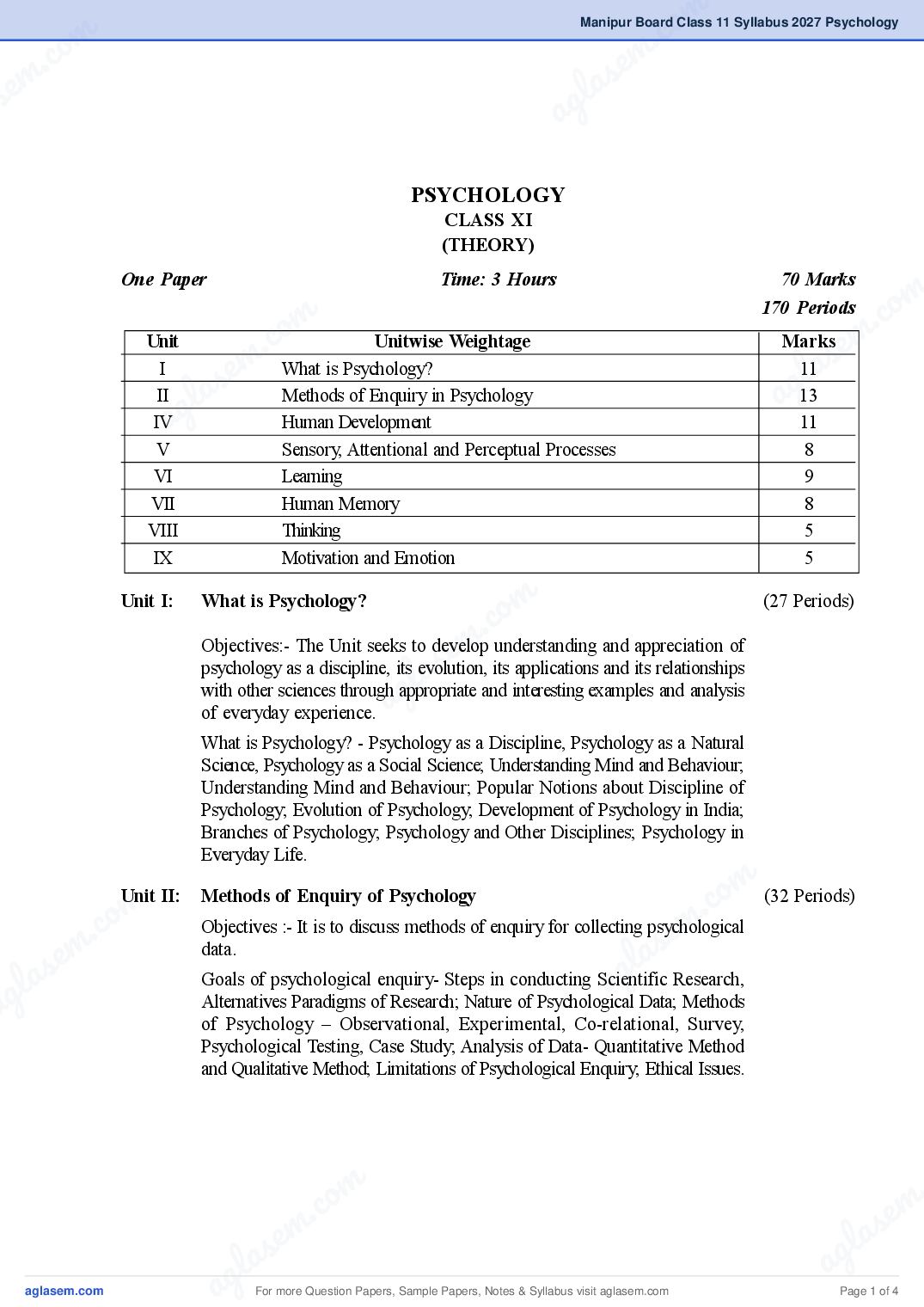
PSYCHOLOGY
CLASS XI
(THEORY)
One Paper Time: 3 Hours 70 Marks
m
m 170 Periods
.co
Unit
m .co Unitwise Weightage Marks
s e m
I
s e What is Psychology? 11
l a
II
g l a Methods of Enquiry in Psychology ag
13
a
IV Human Development 11
V Sensory, Attentional and Perceptual Processes 8
VI Learning 9
VII Human Memory 8
VIII Thinking 5
IX Motivation and Emotion 5
m
c. o
Unit I: What is Psychology? (27 Periods)
e m
Objectives:- The Unit seeks to develop understanding and appreciation of
las
psychology as a discipline, its evolution, its applications and its relationships
of everyday experience. ag
with other sciences through appropriate and interesting examples and analysis
What is Psychology? - Psychology as a Discipline, Psychology as a Natural
Science, Psychology as a Social Science; Understanding Mind and Behaviour;
Understanding Mind and Behaviour; Popular Notions about Discipline of
Psychology; Evolution of Psychology; Development of Psychology in India;
Branches of Psychology; Psychology and Other Disciplines; Psychology in
Everyday Life.
m (32 Periods)
Unit II:
m Methods of Enquiry of Psychology
.co
m .co em
Objectives :- It is to discuss methods of enquiry for collecting psychological
s
s e data.
g la Research,
g la a
Goals of psychological enquiry- Steps in conducting Scientific
a Alternatives Paradigms of Research; Nature of Psychological Data; Methods
of Psychology – Observational, Experimental, Co-relational, Survey,
Psychological Testing, Case Study; Analysis of Data- Quantitative Method
and Qualitative Method; Limitations of Psychological Enquiry; Ethical Issues.
m .
.co s e m
s em l a
g la ag
a For more Question Papers, Sample Papers, Notes & Syllabus visit Page 1 of 4
Page 3
Objectives : To deal with Variations in development and the developmental tasks
during the life span.
Meaning of Development - Life-span Perspective on Development; Factors
Influencing Development; Context of Development; Overview of Developmental
Stages - Prenatal Stage, Infancy, Childhood, Challenges of Adolescence,
Adulthood and Old age.
Unit V: Sensory, Attentional and Perceptual Processes (18 Periods)
Objectives : To aim at understanding how various sensory stimuli are received,
attended to and given meaning.
Knowing the World; Nature and Varieties of stimulus; Sense Modalities -
Functional limitation of sense organs, Attentional processes - Selective Attention
and Sustained Attention; Perceptual Processes - Processing Approaches in
Perception; The Perceiver; Principles of Perceptual Organisation; Perception of
Space, Depth and Distance - Monocular and Binocular Cues; Perceptual
constancies; Illusions; Socio-Cultural Influences on Perception.
Unit VI: Learning (20 Periods)
Objectives : This unit focuses on how one acquires new behaviour and how
changes in behaviours take place.
Nature of learning; Paradigms of Learning; Classical Conditioning - Determinants
of Classical Conditioning; Operant/Instrumental Conditioning
- Determinants of Operant Conditioning, Key Learning Processes; Observational
Learning; Cognitive Learning; Verbal learning; Skill Learning; Factors Facilitating
Learning; Learning Disabilities.
Unit VII: Human Memory (19 Periods)
Objectives : This unit deals with how information is received, stored, retrieved
and lost. It will also discuss how memory can be improved.
Nature of Memory; Information Processing Approach - The Stage Model;
Memory system–Sensory, Short-Term, Long-Term Memories; Levels of
Processing; Types of Long-term Memory-Declarative and Procedural, Episodic
and Semantic; Nature and Causes of Forgetting - Forgetting due to Trace Decay;
Interference and Retrieval Failure; Enhancing Memory - Mnemonics using
Images and Organisation
Unit VIII:Thinking (14 Periods)
Objectives : This Unit deals with thinking and related processes like reasoning,
problem-solving, decision making and creative thinking. The relationship between
thought and language will also be discussed.
Nature of Thinking - Building Blocks of Thought; The Process of Thinking;
Problem Solving; Reasoning; Decision making; Nature and Process of Creative
Thinking - Nature of Creative thinking, Process of Creative thinking; Thoughts
and Language; Development of Language and Language Use.
For more Question Papers, Sample Papers, Notes & Syllabus visit Page 2 of 4
Page 4
m .co
m .co s e m
se g l a
a
Unit IX: Motivation and Emotion (14 Periods)
Objectives : This Unit focuses on why human beings behave as they do.
It also deals with how people experience positive and negative events and
respond to them.
Nature of motivation; Types of Motives - Biological Motives, Psychosocial m
m
motives – Achievement, Affiliation, Power; Maslow’s hierarchy of needs; Nature .co
.co
of emotions; Physiological, Cognitive and Cultural bases of Emotions; Managing
m s e m
e
Negative Emotions; Enhancing Positive Emotions.
s l a
g l a ag
a
PRACTICAL
CLASS XI
One Paper 3 Hours 30 Marks
(Projects, Experiments, Small Studies, etc.) 60 Periods
m
.co
The students shall be required to undertake one project and conduct three practicals. The
m
e
project would involve the use of different methods of enquiry and related skills. Practicals would
s
la
involve undertaking experiments and conducting small studies, exercises, related to the topics
Thinking). ag
covered in the course (Human development, Learning, Memory, Motivation, Perception, Attention,
PRESCRIBED TEXTBOOK:
Introduction to Psychology Part I
(A Textbook for Class XI)
Published by: NCERT, New Delhi.
m
m .co
.co m
——§§§——
m s e
s e g l a
g la a
a
m .
.co s e m
s em l a
g la ag
a For more Question Papers, Sample Papers, Notes & Syllabus visit Page 3 of 4
Page 5
QUESTION PAPER
Subject : PSYCHOLOGY
Paper : Theory
Class : XI
Full Mark : 70
Time : 3 hours
WEIGHTAGE TO OBJECTIVES
Objectives Marks Percentage
Knowledge (K) 10 15
I Understanding (U) 35 50
Application (A) 21 30
Skill (S) 4 5
Total : 70 100
WEIGHTAGE TO FORMS OF QUESTIONS:
Form of Questions No. of Question Time (in minute) Marks Percentage
Essay/Long Answer(E/LA) 3 60 15 21
Short Answer (SA-I) 6 36 18 26
II Short Answer(SA-II) 10 40 20 29
Very Short Answer(VSA) 7 21 7 10
MCQ 10 20 10 14
Total: 36 180 70 100
WEIGHTAGE TO CONTENT:
UNIT/CONTENTS : Marks
I What is Psychology 11
II Methods of Enquiry in Psychology 13
IV Human Development 11
III V Sensory, Attentional and Perceptual Processes 8
VI Learning 9
VII Human Memory 8
VIII Thinking 5
IX Motivation and Emotion 5
Total : 70
IV SCHEME OF SECTIONS : Nil
V SCHEME OF OPTIONS : Internal option will be given in Essay Type Question & SA-I.
VI DIFFICULTY LEVEL :
Difficult : 30% of the total marks
Average : 50% of the total marks
Easy : 20% of the total marks
Special Instruction: 1) Two questions of MCQ will be assertion-reason type question.
2) One question of SA-I will be source based question
Abbreviation : K(Knowledge), U(Understanding), C(Comprehension), Exp.(Expression), Skill(S),
E(Essay Type), SA (Short Answer Type), VSA (Very Short Answer Type),
MCQ(Multiple Choice Question)
For more Question Papers, Sample Papers, Notes & Syllabus visit Page 4 of 4
Document Details
| Board / Org | Manipur Board |
| Exam | Class 11 |
| Type | Syllabus |
| Pages | 4 |
| Updated | 04 Nov 2026 |