NIOS Class 12 Question Paper 2022 (Apr) Early Childhood Care and Education
Finished viewing? Save it for later —
Download NIOS Class 12 Question Paper 2022 (Apr) Early Childhood Care and Education (PDF · 8 pages)About NIOS Class 12 Question Paper 2022 (Apr) Early Childhood Care and Education
NIOS Class 12 Question Paper 2022 (Apr) Early Childhood Care and Education is available here for free download. Published by NIOS for NIOS Class 12, this question paper can be viewed online or downloaded as a PDF (8 pages). Candidates preparing for NIOS Class 12 can use NIOS Class 12 Question Paper 2022 (Apr) Early Childhood Care and Education to understand the exam pattern, the type of questions asked, and the overall difficulty level.
Frequently Asked Questions
How can I download NIOS Class 12 Question Paper 2022 (Apr) Early Childhood Care and Education?
Open this page and click the Download button to save NIOS Class 12 Question Paper 2022 (Apr) Early Childhood Care and Education as a PDF. It is completely free on AglaSem Docs.
Is NIOS Class 12 Question Paper 2022 (Apr) Early Childhood Care and Education free to download?
Yes. NIOS Class 12 Question Paper 2022 (Apr) Early Childhood Care and Education can be viewed online and downloaded as a PDF free of cost on AglaSem Docs.
How many pages does NIOS Class 12 Question Paper 2022 (Apr) Early Childhood Care and Education have?
NIOS Class 12 Question Paper 2022 (Apr) Early Childhood Care and Education contains 8 pages, which you can read online or download together as a single PDF.
Where can I find more NIOS Class 12 study material?
You can find more NIOS Class 12 question papers, sample papers, syllabus, and answer keys on AglaSem Docs.
NIOS Class 12 Question Paper 2022 (Apr) Early Childhood Care and Education – Text
Read the full text of this question paper below — useful to quickly search, copy and reference the content online without downloading the PDF.
📄 View text version (8 pages)
Page 1
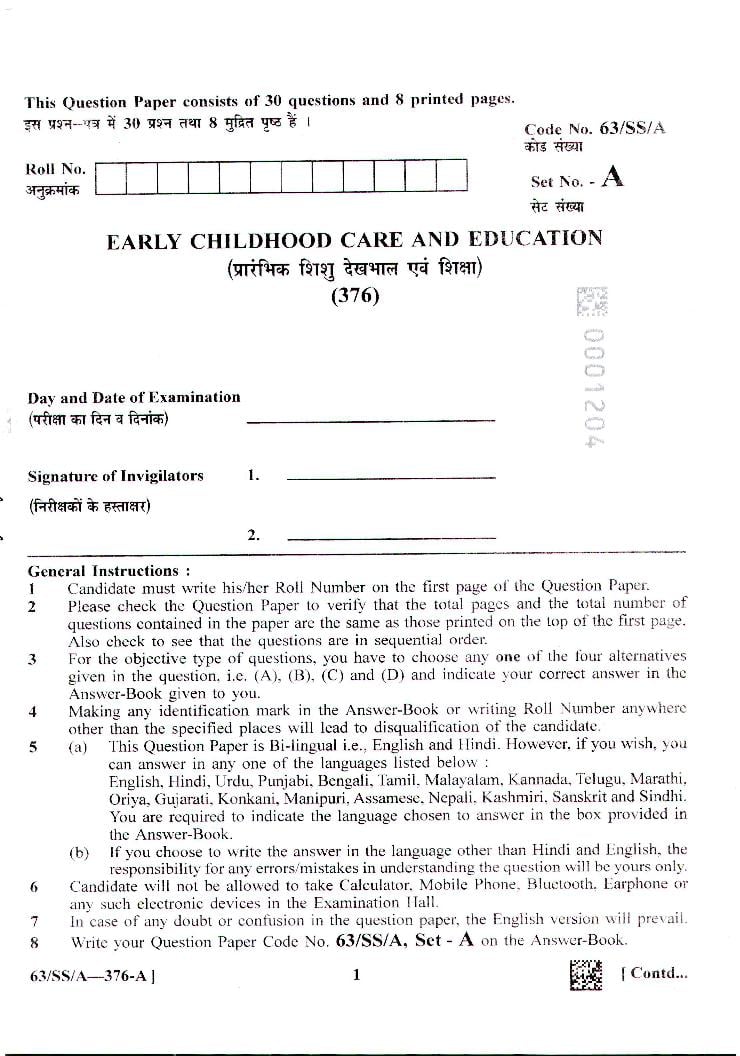
~ 1A:/";f--"'P!"~ 30 1A:/";f"ff~ 8 ~ T'O ~ I Code No. 63/SS/A
~ tf@TI
Roll No.
~j*,qiGfl [ I Set No. - A
~~
EARLY CHILDHOOD CARE AND EDUCATION
(-mf1{q; ~1~ ~1ffi'T ~ ~1~)
(376)
c.,)
o
Day and Date of Examination
N
(-qfrlm "GflT 'R;J q ~) C)
~
Signature of Invigilators 1.
2.
General Instructions :
1 Candidate must write his/her Roll Number on the first page of the Question Paper.
2 Please check the Question Paper to verify that the total pages and the total number of
questions contained in the paper are the same as those printed on the top of the first page.
Also check to see that the questions are in sequential order.
3 For the objective type of questions, you have to choose anyone of the four alternatives
given in the question, i.e. (A), (B), (C) and (D) and indicate your correct answer in the
Answer-Book given to you.
4 Making any identification mark in the Answer-Book or writing Roll Number anywhere
other than the specified places will lead to disqualification of the candidate.
S (a) This Question Paper is Bi-lingual i.e., English and Hindi. However, if you wish, you
can answer in anyone of the languages listed below :
English, Hindi, Urdu, Punjabi, Bengali, Tamil, Malayalam, Kannada, Telugu, Marathi,
Oriya, Gujarati, Konkani, Manipuri, Assamese, Nepali, Kashmiri, Sanskrit and Sindhi.
You are required to indicate the language chosen to answer in the box provided in
the Answer-Book.
(b) If you choose to write the answer in the language other than Hindi and English, the
responsibility for any errors/mistakes in understanding the question will be yours only.
6 Candidate will not be allowed to take Calculator, Mobile Phone, Bluetooth, Earphone or
any such electronic devices in the Examination Hall.
7 In case of any doubt or confusion in the question paper, the English version will prevail.
8 Write your Question Paper Code No. 63/SS/A, Set - A on the Answer-Book.
63/SS/A-376-A 1 1 [ Contd ...
Page 2
1 w~rm >i!?~ in ~ ~ -q-r m -3i j}hlOiiCfl i3rcT!?Zl" fu"@' I
2 rp:r:rr >i!?~ "Cf))\Jlfu B ~ >i!?~ in ~'~ d"m >i!?-;:fT c6T msc:rr ~ tr %- ~ >iWi ~
in ~<!fB ~ t9Gl i I ~ ~ c6T \Jlfu 'ifr Cf)\ B ~ >i!?'1 ~ w:r it %' I
3 Cf<jRtSO >i!?-;:fT it ~ "'qR ~Cflwi (A), (B), (C) ~ (D) it # coW ~ i3Tf{ ~ %- crm m
~ i3Tf{ gffi1CflI it i3Dl=f ~ i3Tf{ ~ 1
4 i3Tf{ gffiiCflI it ~-~ ~ ~~ ~ ~ in 0iRlftCfdW 'ifr 01j}hliiCfl ~ -q-r
wmm "Cf))~ otHliQl ~ I
5 (co) ~ >i!?'1-1:f3r ~ ~.m it i ~mc, ~ -qct ftm I m 'ifr, -qfc:: i3Dl=f ~ -aT "#r¬ rrm ~
M~ ~iti3Tf{-a:~%':
~, ftm, ~ ~, ~, ~, li<'1iQl<'1l1, ~, ~, liDir, ~, 2\i1<ICtl,
~, lOifOlgfl, ~, ~, Cfi!?~, ~ ~ fum I
~ i3Tf{ -gfu1CflI it fuD; Tft:; ~ it ffi"@ ~ i3Dl=f ~ ~ it i3Tf{ Wmr ~ %' I
("&) -qfc:: i3Dl=f ftm -qct ~ in -3i mftCfdM ~ ~ it i3Tf{ ~ %', -aT >i!?-;:fT "Cf))~
it ~ "CJT"ffi ~ I J I<'1RI tl"i em f\i1,..q ~ I fl inCffi ~ m-m I
6 wmm"Cf)) wm ~ it ~~JtG(, 'i"I~I~<'1 m, ~~, ~iQ(4)'1'1 ~ M 'ifr ~ill3§ I3qCf)(OI
"Cf))-Jt- \iiFr em ~ ~ i I
7 >i!?~ it M 'ifr ~ in m ~~ ~m c6T ~ it ~ ~ tr l=fR.T iT<rr I
8 ~ i3Tf{ gffiiCflI it >i!?~ c6T ?fiTs ~ 63/SS/A, & - A fu"@' I
63/SS/A-376-AJ 2 t:~r::~l Contd ...
m
Page 3
(~ ~l~ ~'%'( -qcj ~lm)
(376)
Time : 3 Hours] [Maximum Marks : 80
~: 3~J [~ : 80
Note: All questions are compulsory and carry marks as indicated against each question.
Choose the correct answer from the options given below :
-;f'rit ~ ~ fC'lCl'l(itiY if "B "Btl ~ ~ :
I'
1 Cognitive development refers to : 1
(A) process of acquiring social norms
(B) development of ability to think
CC) changes in proportion of body structure
CD) increase in body weight and height
fi $11'11,Y CI'l fcrcnrn ~ "CI'l"\ill ~ :
(A) tllYIMCI'l YI'1~sl' cit ~ m ~~ cit
(B) ~ ~ ~ q;-r fcrcnrn
(C) !?M ~ ~ if; ~ if Q\l:Clct'1
(D) !?M if; crwr i3fn: ~ if ~
2 Pre-speech form of communication involves : 1
(A) Development of vocabulary
(B) Babbling
(C) Speaking in small sentences
(D) Pronouncing in a wrong manner
~ ~ if; Wl if ~ if !?"f"Iilwr m ~:
(A ) !?1Ge: 1CI t:'1"'1 q;-r fcrcnrn
(B) cili$cili$ 1'1 1
(C) ~~if~
CD) ~ ~ "B \3 -c'q 1 < 0 1 "CI'l\'1T
63/SS/A-376-A] 3 m [Contd ...
~?:"~
Page 4
(A) Germinal stage (B) Foetal stage
"
(C) Embryonic stage (D) Implantation stage
~cf ~ coi ~ ~OT t
" j
(A) \i1lfJ'i(1\31cmn (B) ~~
( I
(C) .~~ i3fCl<:m CD) ~liq(1lhR (~) i3icRm
4 Ceph (locaudal principle of development is :
(A) near
e-
to far sequence of development
t-\
(B) Toe to head sequence of development
, , ,
(C) Head to Toe sequence of development
CD) Far to near sequence of development
~~ mrn q)f \31~ %' :
(A) '1Tff ~ ~ ~ Chi mrn
1j
(B) ltt ern ~
~ ft[-{ Cfq) q)f mrn
C C) rut ~ ~ ern 0~
. I
Cfq) q)f mrn
Explain the following in one sentence only :
1
i
5 Psychological Needs. 1
, )
~~~~I
6 Components of ECCE.
63/SS/A---376-A I 4 f.11:~
~ [Contd ...
Page 5
8 "Rightsof the child. 1
9 Health Needs of the child. 1
10 Symbolic play. 1
11 What are intervention therapies ~t ,>..-"
can be used for children with disability. 2
(\.,j
~ ~-~ ~~ ~ ~ ~ ~ftiiJji~1 ~ ~ ~ ~ "GIT WFcJT t ?
12 State the benefits of collaborative learning. 2
13 What steps will you take to ensJii'
r ~~)
"gender equitable participation" of 2
children in school ?
63/SS/A-376-A] 5 ~ [Contd ...
Page 6
15 What are "creative activities" ? 2
16 What activities can be done by a teacher to promote writing readiness ? 2
/~ w.r\ctT' cnl- ~ ~ ifl ~ ~ ~T~f1lT &rn cp::rr ~ ctr
\jff~~ ?
17 Briefly state the "roles and responsibilities" of an ECCE teacher. 2
~ { m m ~ 0f't.?:fTClCI? cnT II ~ dn fu1 u4 ~In:i:{Y" ifl m if ~ ~ -¬ rr
~I
18 How can the parents and community be involved in an ECCE centre? 2
19 What are the different types of records in an ECCE centre ? 2
20 What is the difference between participant and non-participant observation ? 2
""',".,
:-:-,P'I' [C on td ...
63/SS/A-376-A ] 6 '."!.~%
. .
Page 7
National Curriculum Framework.
22 What is 'theme based' ECCE programme? Discuss with a suitable example. 4
23 What are the impacts of childhood on subsequent life? 4
24 "A child develops as a whole". Justify the statement. 4
25 How can 'assistive technologies' support inclusion ? 4
26 How can ECCE teachers create an enriched environment for children? 6
27 Briefly describe the management and utilization of fund in context of ECCE. 6
63/SS/A-376-A] 7 [ Contd ...
Page 8
an ECCE center.
~ m m ~ ~ ~ ~ ~ 0fR \j4Cf){OrY ~ ~ ciT lJ~ m~ concol COTqoR
cit I
29 How do parents and teachers contribute to
(,
the
)
overall development of 6
children?
I
~ 0fR ~Tw.n ~ ~ if ~ ~~ fcrc:nm if t?IlI~1'i ~ ~ ?
30 Discuss the prevalent issues related to the administrative process in ECCE. 6
)
~ m m ~ if lJ~II("1~Cf) ftom if ~ :¢r 1:1\, ~ ~ I
I )
( )
'1
(
, )
( )
(~ )
I l
r )
, )
I J:.-.
( .j
)
\ )
l
( )
d •
63/SS/A-376-A] 8
Document Details
| Board / Org | NIOS |
| Exam | NIOS Class 12 |
| Type | Question Paper |
| Pages | 8 |
| Updated | 30 Apr 2026 |