AISSEE 2021 Question Paper Class 6 Paper 1 Set A Tamil
Finished viewing? Save it for later —
Download AISSEE 2021 Question Paper Class 6 Paper 1 Set A Tamil (PDF · 32 pages)About AISSEE 2021 Question Paper Class 6 Paper 1 Set A Tamil
AISSEE 2021 Question Paper Class 6 Paper 1 Set A Tamil is available here for free download. Published by Sainik School for AISSEE, this question paper can be viewed online or downloaded as a PDF (32 pages). Candidates preparing for AISSEE can use AISSEE 2021 Question Paper Class 6 Paper 1 Set A Tamil to understand the exam pattern, the type of questions asked, and the overall difficulty level.
Frequently Asked Questions
How can I download AISSEE 2021 Question Paper Class 6 Paper 1 Set A Tamil?
Open this page and click the Download button to save AISSEE 2021 Question Paper Class 6 Paper 1 Set A Tamil as a PDF. It is completely free on AglaSem Docs.
Is AISSEE 2021 Question Paper Class 6 Paper 1 Set A Tamil free to download?
Yes. AISSEE 2021 Question Paper Class 6 Paper 1 Set A Tamil can be viewed online and downloaded as a PDF free of cost on AglaSem Docs.
How many pages does AISSEE 2021 Question Paper Class 6 Paper 1 Set A Tamil have?
AISSEE 2021 Question Paper Class 6 Paper 1 Set A Tamil contains 32 pages, which you can read online or download together as a single PDF.
Where can I find more AISSEE study material?
You can find more AISSEE question papers, sample papers, syllabus, and answer keys on AglaSem Docs.
AISSEE 2021 Question Paper Class 6 Paper 1 Set A Tamil – Text
Read the full text of this question paper below — useful to quickly search, copy and reference the content online without downloading the PDF.
📄 View text version (32 pages)
Page 1
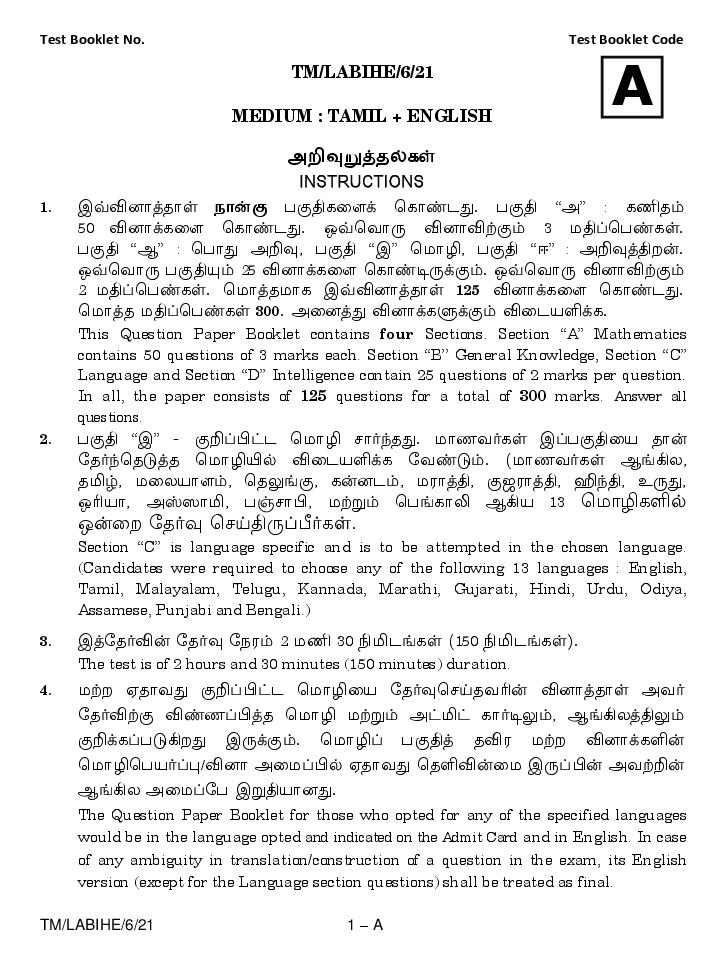
TM/LABIHE/6/21
MEDIUM : TAMIL + ENGLISH
A
AÔÄÖzuÀPÒ
INSTRUCTIONS
1. CÆÂÚõzuõÒ |õßS £SvPøÍU öPõshx. £Sv ‘‘A’’ : Pou®
50 ÂÚõUPøÍ öPõshx. JÆöÁõ¸ ÂÚõÂØS® 3 ©v¨ö£sPÒ.
£Sv ‘‘B’’ : ö£õx AÔÄ, £Sv ‘‘C’’ ö©õÈ, £Sv ‘‘D’’ : AÔÄzvÓß.
JÆöÁõ¸ £Sv²® 25 ÂÚõUPøÍ öPõsi¸US®. JÆöÁõ¸ ÂÚõÂØS®
2 ©v¨ö£sPÒ. ö©õzu©õP CÆÂÚõzuõÒ 125 ÂÚõUPøÍ öPõshx.
ö©õzu ©v¨ö£sPÒ 300. AøÚzx ÂÚõUPÐUS® Âøh¯ÎUP.
This Question Paper Booklet contains four Sections. Section ‘‘A’’ Mathematics
contains 50 questions of 3 marks each. Section ‘‘B’’ General Knowledge, Section ‘‘C’’
Language and Section ‘‘D’’ Intelligence contain 25 questions of 2 marks per question.
In all, the paper consists of 125 questions for a total of 300 marks. Answer all
questions.
2. £Sv ‘‘C’’ & SÔ¨¤mh ö©õÈ \õº¢ux. ©õnÁºPÒ C¨£Svø¯ uõß
÷uº¢öukzu ö©õÈ°À Âøh¯ÎUP ÷Ásk®. (©õnÁºPÒ B[Q»,
uªÌ, ©ø»¯õÍ®, öu¾[S, PßÚh®, ©µõzv, Sáµõzv, î¢v, E¸x,
J›¯õ, Aìéõª, £g\õ¤, ©ØÖ® ö£[Põ¼ BQ¯ 13 ö©õÈPÎÀ
JßøÓ ÷uºÄ ö\´v¸¨¥ºPÒ.
Section ‘‘C’’ is language specific and is to be attempted in the chosen language.
(Candidates were required to choose any of the following 13 languages : English,
Tamil, Malayalam, Telugu, Kannada, Marathi, Gujarati, Hindi, Urdu, Odiya,
Assamese, Punjabi and Bengali.)
3. Cz÷uºÂß ÷uºÄ ÷|µ® 2 ©o 30 {ªh[PÒ (150 {ªh[PÒ).
The test is of 2 hours and 30 minutes (150 minutes) duration.
4. ©ØÓ HuõÁx SÔ¨¤mh ö©õÈø¯ ÷uºÄö\´uÁ›ß ÂÚõzuõÒ AÁº
÷uºÂØS Âsn¨¤zu ö©õÈ ©ØÖ® Amªm Põºi¾®, B[Q»zv¾®
SÔUP¨£kQÓx C¸US®. ö©õȨ £Svz uµ ©ØÓ ÂÚõUPÎß
ö©õÈö£¯º¨¦/ÂÚõ Aø©¨¤À HuõÁx öuÎÂßø© C¸¨¤ß AÁØÔß
B[Q» Aø©¨÷£ CÖv¯õÚx.
The Question Paper Booklet for those who opted for any of the specified languages
would be in the language opted and indicated on the Admit Card and in English. In case
of any ambiguity in translation/construction of a question in the exam, its English
version (except for the Language section questions) shall be treated as final.
TM/LABIHE/6/21 1–A
Page 2
ÂÚõzuõÒ AøÚzx £UP[PøͲ® •Êø©¯õP öPõskÒÍuõ ? GÚ
EÖv£kzvU öPõÒЮ£i AÔÁÖzu¨£kQÓõºPÒ.
The Question Paper Booklet is of 32 pages. Please check and ensure that the Question
Paper Booklet is complete and contains all the pages.
6. AøÚzx ÂÚõUPÐUS® ©õnÁºPÒ OMR ÂøhzuõÎÀ ©mk÷©
Âøh¯ÎUP ÷Ásk®.
Answer all questions in the OMR Answer Sheet only.
7. ÂÚõzuõÎß EÒ÷Í OMR ÂøhzuõÒ C¸US®. ÂÚõzuõøÍ uõ[PÒ
vÓUP AÝ©vzuÄhß OMR ÂøhzuõÎß £SvPÎÀ ÷uøÁ¯õÚ
ÂÁµ[PøÍ PÁÚ©õP Fuõ AÀ»x P¸¨¦ {Ó ø© öPõsh £¢x •øÚ
÷£Úõ ©mk÷© £¯ß£kzv {µ¨£ ÷Ásk®.
The OMR Answer Sheet is inside this Question Paper Booklet. When you are directed
to open the Question Paper Booklet, take out the OMR Answer Sheet and fill the
particulars carefully with blue/black ball point pen only.
8. JÆöÁõ¸ ÂÚõÂØS® E[PÒ £v»õP J÷µ J¸ ÁmhzvÀ ©mk® ø©
wmhÄ®. }[PÒ J÷µ ÂÚõÂØS JßÔØS ÷©Ø£mh Ámh[PÎÀ ø©
wmiÚõÀ E[PÒ £vÀ uÁÓõÚ Âøh¯õP P¸u¨£k®.
Darken only one circle as your answer for each question. If you darken more than one
circle for the same question, your answer will be treated as wrong.
9. Cz÷uºÂÀ uÁÓõÚ ÂøhUS ©v¨ö£s SøÓUP¨£h ©õmhõx.
There is no negative marking for a wrong answer.
10. OMR ÂøhzuõÎÀ ÷uøÁ¯ØÓ SÔ±kPÒ ö\´¯UThõx ÷©¾® AuøÚ
©hUP÷Áõ, P\UP÷Áõ ö\´uõÀ OMR AÆÂøhzuõÒ ©v¨¥k ö\´¯¨£h
©õmhõx.
Do not make unnecessary marks on the OMR Answer Sheet or fold or attempt to
deface it. If you do so, your OMR Answer Sheet will not be evaluated.
11. ÂÁµ[PøÍ £vÂhÄ®, Âøh¯ÎUPÄ® Fuõ / P¸¨¦ ø© öPõsh
£¢x•øÚ ÷£ÚõøÁ ©mk÷© £¯ß£kzuÄ® ö£ß]À £¯ß£kzuU
Thõx.
Use Blue/Black Ball Point Pen only for writing particulars on this page and for
writing answers. Do not use pencil.
TM/LABIHE/6/21 2–A
Page 3
ChzvÀ ©mk÷© ö\´¯ ÷Ásk®. OMR uõÎøÚ £¯ß£kzu TShõx.
Rough work is to be done on the space provided for this purpose in the Question Paper
Booklet only and not on the OMR Answer Sheet.
13. ÷uºÄ •i¢uÄhß OMR ÂøhzuõÎøÍ ÷uºÄ |hzx£Á›h®
\©º¤zu¨¤ß ÷uºÄ AøÓø¯ Âmk öÁÎ÷¯ÓÄ®.
On completion of the test, hand over the OMR Answer Sheet to the Invigilator before
leaving the Room/Hall.
14. uõ[PÒ ÂÚõzuõøÍ u[PÐhß Gkzxa ö\À»»õ®.
You are allowed to take away this Question Paper Booklet with you.
15. ÂÚõzuõÎß SÔ±k A. u[PÐUS ÁÇ[P¨£mh OMR ÂÚõzuõξ® J÷µ
CODE EÒÍuõ GÚ EÖv ö\´x öPõÒÍÄ®. HuõÁx ©õØÓ® C¸¨¤ß
÷uºÄ |hzx£Á›h® EhÚi¯õP öu›Âzx ©õØÖ OMR ÂÚõzuõÒ ©ØÖ®
ÂøhzuõøÍ ö£ØÖUöPõÒÍÄ®.
The CODE for this Booklet is A. Make sure that the CODE printed on the OMR
Answer Sheet is the same as that on this Question Paper Booklet. In case of
discrepancy, report the matter immediately to the Invigilator for replacement of both
the Question Paper Booklet and the OMR Answer Sheet.
16. SÔ¨¤mh Chzøu uµ ÂÚõzuõÒ /OMR ÂøhzuõÎß G¢u £Sv°¾®
u[PÍx £vÄ Gsøn GÊuU Thõx.
Do not write your Roll No. anywhere else except in the specified space in the Question
Paper Booklet/OMR Answer Sheet.
17. OMR ÂøhzuõÎÀ uÁÖPøÍ \›ö\´¯ £¯ß£kzu¨£k® öÁÒøÍ
vµÁzøu £¯ß£kzuU Thõx..
Do not use white fluid for carrying out any correction on the OMR Answer Sheet.
TM/LABIHE/6/21 3–A
Page 4
Pou¯À / MATHEMATICS
1. •Ê GsPÒ G¢ua ö\¯À•øÓ°ß RÌ ‰h¨£mi¸US®?
(1) PÈzuÀ (2) ÁSzuÀ
(3) ö£¸UPÀ (4) CøÁ AøÚzv¾®
Whole numbers are closed under which operation ?
(1) Subtraction (2) Division
(3) Multiplication (4) All of these
2. 1 ªÀ¼¯ÛØS¨ ¤ßÚº
(1) 2 ªÀ¼¯ß (2) 1000001 (3) 100001 (4) 10001
The successor of 1 million is
(1) 2 million (2) 1000001 (3) 100001 (4) 10001
3. Gs ÷PõmiÀ \©z öuõø»ÂÀ O, U, S, V, R, X, W, T, P, Q ©ØÖ® Y
¦ÒÎPÒ Aø©¢xÒÍÚ. }Í® OP SÔUS® ¤ßÚ©õÚx
1 7 4 6
(1) (2) (3) (4)
5 5 5 5
The points O, U, S, V, R, X, W, T, P, Q and Y on the number line are equidistant. The
fraction represented by length OP is
1 7 4 6
(1) (2) (3) (4)
5 5 5 5
4. G¢u Cµsk Akzukzu •Ê GsPÐUQøh÷¯ ¤ßÚ® 5
7
Aø©¢xÒÍx ?
(1) 0 ©ØÖ® 1 (2) 5 ©ØÖ® 7 (3) 5 ©ØÖ® 6 (4) 6 ©ØÖ® 7
5
The two consecutive integers, between which the fraction lies, are
7
(1) 0 and 1 (2) 5 and 7 (3) 5 and 6 (4) 6 and 7
5. ¤ßÁ¸ÁÚÁØÖÒ Gx ]Ô¯ ¤ßÚ®?
4 5 5 5
(1) (2) (3) (4)
5 3 6 2
Which of the following is the smallest fraction ?
4 5 5 5
(1) (2) (3) (4)
5 3 6 2
TM/LABIHE/6/21 4–A
Page 5
6 ©ØÖ® 864 BS®. AvÀ J¸ Gs 96 GÛÀ, ©ØöÓõ¸ GsønU
Psk¤iUPÄ®.
(1) 84 (2) 45 (3) 54 (4) 24
The HCF and LCM of two numbers are 6 and 864 respectively. If one number is 96,
find the other number.
(1) 84 (2) 45 (3) 54 (4) 24
7. Cµsk GsPÎß «.ö£.Á. 12 ©ØÖ® AÆöÁsPÎß ÷ÁÖ£õk 12.
¤ßÁ¸ÁÚÁØÖÒ GøÁ AÆöÁsPÍõP C¸UP •i²®?
(1) 84, 96 (2) 66, 78 (3) 70, 82 (4) 62, 78
The HCF of two numbers is 12 and their difference is 12. Which of the following can
be the numbers ?
(1) 84, 96 (2) 66, 78 (3) 70, 82 (4) 62, 78
8. 9, 12 ©ØÖ® 15 BQ¯ JÆöÁõßÓõ¾® ÁS£hU Ti¯ ªPa ]Ô¯
GsønU PshÔP.
(1) 60 (2) 90 (3) 120 (4) 180
Find the smallest number that is divisible by each one of 9, 12 and 15.
(1) 60 (2) 90 (3) 120 (4) 180
9. J¸ SÔ¨¤mh ¤µõsm ÷\õ¨&£Ähº J¸ £õUöPm < 15 US
ÂØP¨£kQÓx. J¸ háÛß (£ßÛµsk) Âø» < 144. 8 háß
£õUöPmkPÎÀ C»õ£a \uÃu® GßÚ?
(1) 20 (2) 25 (3) 24 (4) 36
A certain brand of soap-powder is sold at < 15 per packet. It costs < 144 a dozen.
What is the profit in percent on 8 dozen packets ?
(1) 20 (2) 25 (3) 24 (4) 36
10. 37, 56, 93 BQ¯ GsPøÍ ÁS¨£uõÀ •øÓ÷¯ 1, 2 ©ØÖ® 3 GÚ
«v°øÚ AÎUPU Ti¯ ªP¨ ö£›¯ GsønU PshÔP.
(1) 9 (2) 18 (3) 15 (4) 12
Find the greatest number that will divide 37, 56, 93 leaving remainder 1, 2 and 3
respectively.
(1) 9 (2) 18 (3) 15 (4) 12
TM/LABIHE/6/21 5–A
Page 6
÷Áø»°øÚ 5 |õmPÎÀ ö\´x •iUP GzuøÚ BsPÒ
÷uøÁ¨£kÁõºPÒ?
(1) 10 (2) 8 (3) 40 (4) 12
If 10 men can do a piece of work in 4 days, how many men will be required to get the
same work done in 5 days ?
(1) 10 (2) 8 (3) 40 (4) 12
12. 21 BkPÍõÀ 15 ©õkPÎß AÍÂØSa \õ¨¤h •i²®. 35 ©õkPÎß
AÍÂØS GzuøÚ BkPÍõÀ \õ¨¤h •i²®?
(1) 38 (2) 49 (3) 37 (4) 41
21 goats eat as much as 15 cows. How many goats eat as much as 35 cows ?
(1) 38 (2) 49 (3) 37 (4) 41
13. 9 PõºPÒ ‰»® J¸ ö©UPõÛU < 36,000 \®£õvUQÓõº. J¸ ÷ÁøÍ
J¸ |õÐUS 27 PõºPÒ Á¢uõÀ, 1 |õÎÀ AÁº GÆÁÍÄ Á¸©õÚ®
DmkÁõº?
(1) < 1,08,000 (2) < 1,80,000
(3) < 1,00,800 (4) < 1,00,080
A mechanic earns < 36,000 on 9 cars. How much will he earn in 1 day, if in a day he
receives 27 cars ?
(1) < 1,08,000 (2) < 1,80,000
(3) < 1,00,800 (4) < 1,00,080
14. x : y = 3 : 5 GÛÀ, 3x + 4y : 8x + 5y&Cß ÂQuzøuU PshÔP.
(1) 39 : 49 (2) 29 : 50
(3) 29 : 49 (4) 39 : 50
If x : y = 3 : 5, find the ratio 3x + 4y : 8x + 5y.
(1) 39 : 49 (2) 29 : 50
(3) 29 : 49 (4) 39 : 50
TM/LABIHE/6/21 6–A
Page 7
(1) 6 (2) 54
(3) 7 (4) 252
Find the value of m, if 3, 18, m, 42 are in proportion.
(1) 6 (2) 54
(3) 7 (4) 252
16. J¸ NCC •PõªÀ 1200 £°Ø]¯õͺPÒ £[÷PØQßÓÚº. AvÀ
900 £°Ø]¯õͺPÒ Si¯µ_ vÚ •PõªØSz
÷uº¢öukUP¨£mkÒÍÚº. ÷uº¢öukUP¨£mh ©ØÖ®
÷uº¢öukUP¨£hõu |£ºPÎß GsoUøPUQøh÷¯¯õÚ ÂQu®
GßÚ?
(1) 300 : 120 (2) 4 : 1 (3) 3 : 1 (4) 120 : 130
In an NCC Camp, 1200 trainees are participating out of which 900 are selected for
Republic Day Camp. What is the ratio between the number of selected and
non-selected cadets ?
(1) 300 : 120 (2) 4 : 1 (3) 3 : 1 (4) 120 : 130
17. J¸ ø£¯ß < 450 US J¸ ¦zuPzøu ÂØÓõÀ, AÁß 10% |èhzøu
AøhQÓõß. 10% C»õ£® ö£Ó, ÂØ£øÚ Âø» GßÚÁõP C¸UP
÷Ásk®?
(1) < 500 (2) < 600 (3) < 550 (4) < 525
If a boy sells a book for < 450, he makes a loss of 10%. To gain 10%, what should be
the selling price ?
(1) < 500 (2) < 600 (3) < 550 (4) < 525
18. J¸Áº J¸ J¼ö£¸UQ°øÚ < 7,500&US 20% »õ£® öPõsk®
©ØöÓõ¸ J¼ö£¸UQ°øÚ < 8,100&US 10% |èh® øÁzx®
ÂØ£øÚ ö\´QÓõº. AÁ›ß ö©õzu |èh® AÀ»x C»õ£zøuU
PshÔP.
(1) |èh® = < 300 (2) |èh® = < 350
(3) »õ£® = < 300 (4) »õ£® = < 350
A man sells one speaker for < 7,500 at a profit of 20% and another speaker for
< 8,100 at a loss of 10%. Find his total loss or profit.
(1) Loss = < 300 (2) Loss = < 350
(3) Profit = < 300 (4) Profit = < 350
TM/LABIHE/6/21 7–A
Page 8
(1) 3950 (2) 411 (3) 412 (4) 3949
Simplify (8 + 4 – 2) (17 – 12) 10 – 89 = _________ .
(1) 3950 (2) 411 (3) 412 (4) 3949
20. _¸USP 0·05 + 1·5 5 10 0·5 = _________ .
(1) 4·25 (2) 42·5 (3) 0·425 (4) 0·42
Simplify 0·05 + 1·5 5 10 0·5 = _________ .
(1) 4·25 (2) 42·5 (3) 0·425 (4) 0·42
21. _¸USP 7 + 5 – 2 (7 + 89) – 94 2 + (33 3 + 9 2 – 7) 11 = _________ .
(1) 254 (2) – 225 (3) – 235 (4) 245
Simplify 7 + 5 – 2 (7 + 89) – 94 2 + (33 3 + 9 2 – 7) 11 = _________ .
(1) 254 (2) – 225 (3) – 235 (4) 245
22. J¸ ÁS¨£øÓ°À EÒÍ 20 ©õnÁºPÎß \µõ\› Gøh 160 Q÷»õ
©ØÖ® «u•ÒÍ 5 ©õnÁºPÎß Gøh 50 Q÷»õ, GÛÀ
ÁS¨£øÓ°À EÒÍ ö©õzu ©õnÁºPÎß \µõ\› Gøh°øÚU
PshÔP.
(1) 138 Q÷»õ (2) 183 Q÷»õ (3) 140 Q÷»õ (4) 150 Q÷»õ
The average weight of 20 boys in a class is 160 kg and that of the remaining 5 boys is
50 kg. Find the average weight of all the boys in the class.
(1) 138 kg (2) 183 kg (3) 140 kg (4) 150 kg
23. J¸ SÊÂÀ EÒÍ 7 ©õnÁºPÒ ö£ØÓ ©v¨ö£sPÎß
\µõ\›¯õÚx 226. AvÀ BÖ ÷£º Gkzu ©v¨ö£sPÍõÚx
•øÓ÷¯ 340, 180, 260, 56, 275 ©ØÖ® 307 GÛÀ, HÇõÁx ©õnÁß
Gkzu ©v¨ö£sønU PshÔP.
(1) 160 (2) 162 (3) 163 (4) 164
The average marks obtained by 7 students in a group is 226. If the marks obtained by
six of them are 340, 180, 260, 56, 275 and 307 respectively, find the marks obtained
by the seventh student.
(1) 160 (2) 162 (3) 163 (4) 164
TM/LABIHE/6/21 8–A
Page 9
|õmPÎÀ 240 £õºøÁ¯õͺPЮ Á¸øP u¸QßÓÚº. bõ°ØÖU
QÇø©°øÚ ©õuz öuõhUP©õPÄ® 30 |õmPøͲ® Eøh¯ J¸
©õuzvÀ Á¸® \µõ\› £õºøÁ¯õͺPÒ GßÚÁõP C¸US®
(1) 280 (2) 285 (3) 290 (4) 295
A library has an average of 510 visitors on Sundays and 240 on other days. The
average number of visitors in a month of 30 days starting with Sunday is
(1) 280 (2) 285 (3) 290 (4) 295
25. J¸ ÷£mì÷©ß 17 Áx ÷£õmi°À 87 µßPÒ Gkzuõº, Cuß ‰»®
AÁµx \µõ\› 3 AvP›UQÓx. 17 Áx ÷£õmi°ß ¤ßÚº AÁµx
\µõ\›ø¯U PshÔP.
(1) 36 (2) 37 (3) 38 (4) 39
A batsman makes a score of 87 runs in the 17th match and thus increases his average
by 3. Find his average after the 17th match.
(1) 36 (2) 37 (3) 38 (4) 39
26. 1, 3, 5, 7, 9, 11, 13 BQ¯ÁØÔß \µõ\›
(1) 7 (2) 8 (3) 7·5 (4) 8·5
Average of 1, 3, 5, 7, 9, 11, 13 is
(1) 7 (2) 8 (3) 7·5 (4) 8·5
27. y Cß x% BÚx 100 ©ØÖ® z Cß y% BÚx 200, GÛÀ x ©ØÖ® z
BQ¯ÁØÖUS Cøh÷¯¯õÚ öuõhº¤øÚU PshÔP.
(1) z=x (2) 2z = x
(3) z = 2x (4) z = 3x
If x% of y is 100 and y% of z is 200, then find the relation between x and z.
(1) z=x (2) 2z = x
(3) z = 2x (4) z = 3x
28. J¸ Gsoß I¢vÀ CµsiÀ, ‰ßÔÀ J¸ £[QÀ |õßQÀ J¸
£[PõÚx 15. AÆöÁsoß 40%&Cß ©v¨¦ GßÚ?
(1) 140 (2) 150 (3) 180 (4) 200
One-fourth of one-third of two-fifth of a number is 15. What will be 40% of that
number ?
(1) 140 (2) 150 (3) 180 (4) 200
TM/LABIHE/6/21 9–A
Page 10
C¸¢uõÀ, A¢u GsnõÚx
(1) 14 (2) 16 (3) 18 (4) 20
If 15% of 40 is greater than 25% of a number by 2, then the number is
(1) 14 (2) 16 (3) 18 (4) 20
30. J¸ ö\ÆÁP Âøͯõmk ø©uõÚzvß }Ízøua ö\.«. ©v¨¤À
PshԯĮ, Auß £µ¨£ÍÄ 700 \xµ «mhº ©ØÖ® AP»® 25 «.
(1) 28 (2) 280
(3) 2800 (4) 2500
Find the length of a rectangular playground in cm whose area is 700 sq.m and
breadth is 25 m.
(1) 28 (2) 280
(3) 2800 (4) 2500
31. Gί Ámi ÂQuzvÀ Ámi ÂQuzvß ©v¨ø£¨ ÷£õßÓ
Á¸h[PÐUS < 1,200 PhøÚ ŸÚõ Áõ[Q²ÒÍõº. AÁº < 432
Ámi¯õPU Phß Põ»zvß CÖv°À ö\¾zv°¸¢uõÀ, Ámi Ãu®
GßÚ?
(1) 3·6 (2) 6
(3) 18 (4) 10
Reena took a loan of < 1,200 with simple interest for as many years as the rate of
interest. If she paid < 432 as interest at the end of the loan period, what was the rate
of interest ?
(1) 3·6 (2) 6
(3) 18 (4) 10
32. PiPõµzvß ÷|µ® CµÄ 7·15 BP C¸US® ÷£õx HØ£kzx®
÷Põnzvß ö£¯øµU SÔ¨¤kP.
(1) SÖ[÷Põn® (2) ö\[÷Põn®
(3) ›÷Põn® (4) ÷|ºU÷Põn®
Write the name of the angle formed when the clock time is 7·15 pm.
(1) Acute angle (2) Right angle
(3) Obtuse angle (4) Straight angle
TM/LABIHE/6/21 10 – A
Page 11
|Pµzvß AvP£m\ öÁ¨£{ø»°øÚU PõmkQÓx. C¢u
AmhÁøn°À EÒÍ uPÁÀPøͨ £¯ß£kzv¨ ¤ßÁ¸®
÷PÒÂPÐUS¨ £v»ÎUPÄ® :
{³¯õºU |PµzvÀ Ph¢u Á¸h ÷©, áýø» ©ØÖ® ö\¨h®£º BQ¯
‰ßÖ ©õu[PÎß \µõ\› AvP£m\ (Cµsk u\©¨ ¦ÒÎPÒ)
öÁ¨£{ø» GßÚ?
©õu® áÚÁ› ©õºa ÷© áýø» ö\¨h®£º |Á®£º
AvP£m\
öÁ¨£{ø»,
ö\À]¯ì 3 9 21 29 24 11
AÍÂÀ
(1) 21·65C (2) 24·66C (3) 25·52C (4) 26·23C
The table below shows the maximum temperatures in New York City last year. Use
the information in this table and answer the following :
What was the average maximum temperature (upto 2 decimal places) of three months
May, July and September last year in New York City ?
Month Jan. Mar. May Jul. Sept. Nov.
Maximum
3 9 21 29 24 11
temperature, in C
(1) 21·65C (2) 24·66C (3) 25·52C (4) 26·23C
34. Põø» ÷ÁøÍ öÁ¨£{ø»¯õÚx – 10C ©ØÖ® Cx ©õø» ÷|µzvÀ
3 iQ› AÍÂØSU SøÓ¢x Âmhx. GÛÀ ©õø» ÷|µ öÁ¨£{ø»
GßÚ?
(1) – 7C (2) – 23C (3) – 13C (4) – 12C
In the morning, the temperature was – 10C and it decreased 3 degrees by the
evening. What was the temperature in the evening ?
(1) – 7C (2) – 23C (3) – 13C (4) – 12C
35. J¸ ö\ÆÁPz ÷uõmhzvß }Í® 185 «. ©ØÖ® AP»® 220 «.
÷uõmhzvß ø©¯zvÀ Cµsk \õø»PÒ ^µõÚ 4 « AP»zvÀ,
JßÖ }ÍzvØS Cøn¯õPÄ® ©ØöÓõßÖ AP»zvØS
Cøn¯õPÄ® ÷£õh¨£mkÒÍx \õø»PøÍ J¸ \xµ «mh¸US
< 1·25 GßÓ ©v¨¤À ^º ö\´x \©ß£kzxÁuØPõÚ ö\»ÂøÚU
PshÔP
(1) < 3,900 (2) < 3,010 (3) < 4,010 (4) < 2,005
A rectangular garden is 185 m long and 220 m wide. It has two roads in its centre of
uniform width of 4 m, one parallel to its length and the other parallel to its breadth.
Find the cost of levelling the roads at < 1·25 per sq.m.
(1) < 3,900 (2) < 3,010 (3) < 4,010 (4) < 2,005
TM/LABIHE/6/21 11 – A
Page 12
(1) 1 10–1 m (2) 1 10–2 m
(3) 1 102 m (4) 1 103 m
One decimeter is equal to
(1) 1 10–1 m (2) 1 10–2 m
(3) 1 102 m (4) 1 103 m
37. ÷µõ©ß GÊzxPÎÀ, J¸ SÔ±k v¸®£¨ £¯ß£kzu¨£mhõÀ,
Auß ©v¨¦ GÆÁÍÄ •øÓ Á¢uõ¾® ö£¸UP¨£h ©õmhõx.
(1) \› (2) uÁÖ
(3) ö\õÀ» •i¯õx (4) Cµsk® \©®
In Roman numeration, if a symbol is repeated, its value is not multiplied as many
times as it occurs.
(1) True (2) False
(3) Cannot say (4) Both are equal
38. J¸ AøµÁmhzvß ÂmhzuõÀ J¸ Ámhzvß G¢uöÁõ¸
¦Òΰ¾® HØ£kzu¨£k® ÷Põn©õÚx
(1) 45 (2) 180
(3) 90 (4) 60
The angle subtended by the diameter of a semicircle on any point on the circle is
(1) 45 (2) 180
(3) 90 (4) 60
39. J¸ ªP¨ ö£›¯ PÚa \xµzvß £UP[PÒ 44 ö\.«. AUPÚa
\xµzv¼¸¢x 4 ö\.«. öPõsh ]Ô¯ PÚa \xµ[PÒ öÁmi
GkUP¨£kQßÓÚ. GÛÀ SøÓ¢u£m\® J¸ PÚ\xµzuõÀ
`Ǩ£mh GzuøÚ ]Ô¯ PÚa \xµ[PøÍ E¸ÁõUP •i²®?
(1) 888 (2) 729
(3) 164 (4) 33
A big cube has each portion of 44 cm. Tiny cubes of 4 cm portion each are cut from
that. Then how many tiny cubes will be formed that are surrounded by at least one
cube ?
(1) 888 (2) 729
(3) 164 (4) 33
TM/LABIHE/6/21 12 – A
Page 13
öPõsh J¸ ö\ÆÁP ÁiÁz öuõmi •ÊÁx® uspº
{µ¨£¨£mkÒÍx öuõmi°À EÒÍ }›ß PÚAÍøÁU
PshԯĮ.
(1) 180 cm3 (2) 1200 cm3
(3) 440 cm3 (4) 1440 cm3
A rectangular tank 15 cm long, 12 cm wide and 8 cm high was completely filled with
water. Find the volume of water in the tank.
(1) 180 cm3 (2) 1200 cm3
(3) 440 cm3 (4) 1440 cm3
41. HÖÁ›ø\°À Á›ø\¨£kzu¨£mh ¤ßÚ[PøÍ G¢u ¸¨£z
öu›Ä PõmkQÓx?
5 7 3 13 5 7 13 3
(1) < < < (2) < < <
8 12 4 16 8 12 16 4
5 3 13 7 7 5 3 13
(3) < < < (4) < < <
8 4 16 12 12 8 4 16
Which option shows fractions arranged in ascending order ?
5 7 3 13 5 7 13 3
(1) < < < (2) < < <
8 12 4 16 8 12 16 4
5 3 13 7 7 5 3 13
(3) < < < (4) < < <
8 4 16 12 12 8 4 16
42. 945·341 – 1042·792 + 875·435 + 31·025 ©v¨¦ GßÚ?
(1) 908·004 (2) 810·008
(3) 795·659 (4) 809·009
What is the value of 945·341 – 1042·792 + 875·435 + 31·025 ?
(1) 908·004 (2) 810·008
(3) 795·659 (4) 809·009
TM/LABIHE/6/21 13 – A
Page 14
GÚÄ® AuØPkzu 160 Q.«. yµzøu 80 Q.«./©o ÷|µ® GßÓ
÷ÁPzv¾® PhUQÓõº, GÛÀ _ØÖ»õÂß •uÀ 320 Q.«. yµzvß
\µõ\› ÷ÁP® GßÚ
(1) 35·55 Q.«./©o ÷|µ® (2) 36 Q.«./©o ÷|µ®
(3) 71·11 Q.«./©o ÷|µ® (4) 71 Q.«./©o ÷|µ®
A man on tour travels first 160 km at 64 km/hr and the next 160 km at 80 km/hr. The
average speed for the first 320 km of the tour is
(1) 35·55 km/hr (2) 36 km/hr
(3) 71·11 km/hr (4) 71 km/hr
44. N GßÓ 3 C»UP GsnõÀ 2272 ©ØÖ® 875 BQ¯ GsPøÍ ÁSUS®
÷£õx J÷µ «v ©v¨¦ QøhUQÓx. N Gsoß C»UP[PÎß
Tku»õÚx
(1) 10 (2) 11 (3) 12 (4) 13
On dividing 2272 as well as 875 by a 3-digit number N, we get the same remainder.
The sum of the digits of N is
(1) 10 (2) 11 (3) 12 (4) 13
45. áý¼¯õÂØS xoPøÍz xøÁUP •i°øÚ A»[P›UP, Eøh
©õØÓ 1 ©o ÷|µ•® ©ØÖ® Põø» EnÄ \õ¨¤h 1 ©o ÷|µ•®
2 4
GkUQÓx. GÛÀ áý¼¯õ £ÒÎU Th® ö\À»z u¯õµõÁuØS
GÆÁÍÄ ÷|µ® GkUS®?
3
(1) ©o ÷|µ® (2) 1 ©o ÷|µ®
4
2 5
(3) ©o ÷|µ® (4) ©o ÷|µ®
4 4
1 1
It takes Julia hour to wash, comb her hair and put on her clothes and hour to
2 4
have her breakfast. How much time does it take Julia to be ready for school ?
3
(1) hour (2) 1 hour
4
2 5
(3) hour (4) hour
4 4
46. ¤ßÁ¸® G¢u ÷µõ©ß Gs uÁÓõÚx?
(1) LXII (2) XCI (3) LC (4) XLIV
Which of the following numbers in Roman Numerals is incorrect ?
(1) LXII (2) XCI (3) LC (4) XLIV
TM/LABIHE/6/21 14 – A
Page 15
(1) 6 (2) 12 (3) 8 (4) 4
How many faces are there in a cuboid ?
(1) 6 (2) 12 (3) 8 (4) 4
48. GÀ»õz vø\Pξ® •iÂÀ»õ©À ›Áøh²® J¸ uÍ ÷©Ø£µ¨¦
CÆÁõÖ AøÇUP¨£kQÓx.
(1) \©uÍ® (2) ÷|º÷Põk
(3) ÷Põmkz xsk (4) ¦ÒÎ
A flat surface which extends indefinitely in all directions is called a
(1) Plane (2) Line
(3) Line segment (4) Point
49. Cµsk {µ¨¦ ÷Põn[PÐUS Cøh÷¯¯õÚ ÷ÁÖ£õk 10. GÛÀ
Cµsk ÷Põn[PÎß ©v¨¦PøÍU PnUQkP.
(1) 55, 45 (2) 40, 50
(3) 50, 60 (4) 100, 90
The difference between two complementary angles is 10. Calculate the values of both
the angles.
(1) 55, 45 (2) 40, 50
(3) 50, 60 (4) 100, 90
50. Pzu›UPõ´, öÁsøhUPõ´ ©ØÖ® öÁ[Põ¯® BQ¯ÁØÔß ö©õzu
Gøh 48.057 Q÷»õ Qµõ®. Pzu›UPõ´ ©ØÖ® öÁsøhUPõ´
BQ¯ÁØÔß Gøh 5.35 Q÷»õ Qµõ® ©ØÖ® 24.52 Q÷»õ Qµõ©õP
C¸¢uõÀ, öÁ[Põ¯zvß Gøh°øÚU PshԯĮ.
(1) 17·187 Q÷»õ Qµõ® (2) 18·187 Q÷»õ Qµõ®
(3) 17·180 Q÷»õ Qµõ® (4) 18·180 Q÷»õ Qµõ®
The total weight of brinjal, lady-finger and onion is 48·057 kg. If brinjal and
lady-finger weigh 5·35 kg and 24·52 kg respectively, find the weight of onion.
(1) 17·187 kg (2) 18·187 kg
(3) 17·180 kg (4) 18·180 kg
TM/LABIHE/6/21 15 – A
Page 16
ö£õx AÔÄ / GENERAL KNOWLEDGE
51. ÁõPÚzvß ÷ÁPzvøÚ AÍÂh¨ £¯ß£k® \õuÚ® Gx?
(1) Uµõ÷Áõ«mhº (2) ÷ÁP©õÛ
(3) _ÇÀ÷ÁP©õÛ (4) Q÷»õ«mhº
Which device is used to measure the speed of vehicles ?
(1) Gravometer (2) Speedometer
(3) Gyroscope (4) Kilometer
52. C¢v¯õ G¢u {øÚÄa ]ßÚzv¼¸¢x uÚx ÷u]¯a ]ßÚzøu
HØÖU öPõskÒÍx?
(1) P¤»Áìx (2) íìvÚõ§º
(3) \õµ|õz (4) £õÛ£m
From which monument did India adopt its National Emblem ?
(1) Kapilavastu (2) Hastinapur
(3) Sarnath (4) Panipat
53. ¤ßÁ¸® G¢u |hÚzvß £õo°À G¨÷£õx® ©Põ£õµu® ©ØÖ®
µõ©õ¯nzv¼¸¢x Pøu / P¸zx¸ GkUP¨£k®?
(1) ÷©õQÛ¯õmh® (2) Jiê
(3) £µu|õmi¯® (4) Sa]¦i
In which of the following styles of dance is the story/theme always taken from
Mahabharata and Ramayana ?
(1) Mohiniattam (2) Odissi
(3) Bharatanatyam (4) Kuchipudi
54. |® ÷u]¯ |õmPõmiø¯ (\õPõ \Põ¨u®) Ai¨£øh¯õPU öPõsh
©õu[PøÍa \›¯õÚ Á›ø\°À Á›ø\¨£kzuÄ® — a&ø\zµõ
b&øÁåõPõ c&öá°ìuõ d&Båõuõ:
(1) abcd (2) bcda (3) dacb (4) cdab
Arrange the months based on our National Calendar (Saka Era) in correct serial
order — a-Chaitra b-Vaishakha c-Jyaishtha d-Aashada :
(1) abcd (2) bcda (3) dacb (4) cdab
55. ¤ßÁ¸ÁÚÁØÔÀ Gx ÷£õº ©õÚ®?
(1) ÷uáõì (2) x¸Æ
(3) ÷£õ°[ C-17 S÷Íõ¨©õìhº (4) ÷\mhU
Which one of the following is a combat aircraft ?
(1) Tejas (2) Dhruv
(3) Boeing C-17 Globemaster (4) Chetak
TM/LABIHE/6/21 16 – A
Page 17
(1) ÷hÂì ÷Põ¨ø£ (2) \õ®¤¯ßì iµõ¤
(3) \¢÷uõè iµõ¤ (4) v÷¯õuº iµõ¤
Which of the following cups/trophies is associated with football ?
(1) Davis Cup (2) Champions Trophy
(3) Santosh Trophy (4) Deodhar Trophy
57. GÖ®¦PÒ u[PÒ Sʼ¸US® GÖ®¦PøÍ GÆÁõÖ Aøh¯õÍ®
Psk öPõÒЮ?
(1) {Ózvß ‰»® (2) •Pzvß ‰»®
(3) ©nzvß ‰»® (4) E¯µzvß ‰»®
How do ants recognize ants from their group ?
(1) By colour (2) By face
(3) By smell (4) By height
58. ¤ßÁ¸ÁÚÁØÔÀ £ÓøÁ Áͺ¨¦ £sønPÎÀ ÁͺUP¨£kÁx
Gx?
(1) öÁÒÍõk (2) ö\®©Ô¯õk
(3) ÷PõÈ (4) SvøµPÒ
Which of the following is domesticated in poultry farms ?
(1) Goat (2) Sheep
(3) Hen (4) Horses
59. ______________ |õÂøÚ ‰i, EnÂÀ EÒÍ µ\õ¯Ú[PÐhß
ÂøÚ¯õØÖQÓx.
(1) _øÁ ö©õmkPÒ (2) _¸USzuø\
(3) £À (4) ÷uõÀ
The ___________ cover the tongue and react to chemicals in food.
(1) Taste Buds (2) Sphincters
(3) Teeth (4) Skin
60. EnÄPøͨ £u¨£kzx® ÷£õx EøÓ£Û GßÚ ö\´QÓx?
(1) EnÂøÚ CÖUP©õP øÁUQÓx
(2) EnÂß _øÁ°øÚ¨ ¦zxnºÄhß øÁUQÓx
(3) ~sq°›PÎß Áͺa]ø¯
(4) ÷©ØPshøÁ GxĪÀø» {ÖzxQÓx
What does freezing do when preserving foods ?
(1) Keeps the food product hard
(2) Keeps the flavours of the food fresh
(3) Stops growth of micro-organisms
(4) None of the above
TM/LABIHE/6/21 17 – A
Page 18
yµzvØSU öPõsk ö\À»¨£kÁuØSU Põµn® AÁØÔß
(1) ]ÓSPÒ öPõsh ÂøuPÒ
(2) ö£›¯ ©ØÖ® •i°øÇPÒ {øÓ¢u ÂøuPÒ
(3) }sh ©ØÖ® ÷©hõÚ £Ç[PÒ
(4) _ÇÀ ÂøuPÒ
Seeds of drumstick and maple are carried over long distances by wind because they
possess
(1) winged seeds.
(2) large and hairy seeds.
(3) long and ridged fruits.
(4) spiny seeds.
62. _____ Gߣx µõáìuõÛß £õµ®£›¯ ©øÇ}º ÷\P›¨¦ ~m£©õS®.
(1) hõ[Põ (2) Põvß (3) £õÁi (4) SAß
__________ is a traditional rainwater harvesting technique of Rajasthan.
(1) Taanka (2) Khadin (3) Bavadi (4) Kuan
63. ¤ßÁ¸ÁÚÁØÔÀ Gx usp›À Pøµ¢xÂk®?
(1) ©s (2) _snõ®¦ yÒ
(3) \ºUPøµ (4) Gsön´
Which of the following will dissolve in water ?
(1) Soil (2) Chalk Powder
(3) Sugar (4) Oil
64. ¤ßÁ¸ÁÚÁØÔÀ Gx öuõØÖ ÷|õ´?
(1) }›ÈÄ ÷|õ´ (2) A®ø© ÷|õ´
(3) AÀø\©º (4) ¦ØÖ÷|õ´
Which of the following is a communicable disease ?
(1) Diabetes (2) Chicken pox
(3) Alzheimer’s (4) Cancer
65. ©ø» HÖ® ÷£õx, |õ® ö\´¯ ÷Ási¯x
(1) •ß÷ÚõUQ Áøͯ ÷Ásk®
(2) ¤ß÷ÚõUQ Áøͯ ÷Ásk®
(3) ÷|µõP |hUP ÷Ásk®
(4) £UPÁõmiÀ |hUP ÷Ásk®
To climb the mountains, we have to
(1) Bend forward
(2) Bend backwards
(3) Walk straight
(4) Walk sideways
TM/LABIHE/6/21 18 – A
Page 19
GߣÁµõÀ Pmh¨£mh ÁõÛ¯À Tº÷|õUS {ø»¯zvß ö£¯º
GßÚ
(1) ö\[÷Põmøh (2) Sx¨ªÚõº
(3) á¢uº ©¢uº (4) uõä ©íõÀ
Name an astronomical observatory built in the 18th century by Rajput King Sawai Jai
Singh of Rajasthan.
(1) Red Fort (2) Qutub Minar
(3) Jantar Mantar (4) Taj Mahal
67. _____________ EÒ £õøÓPÒ, uõxUPÒ ÷£õßÓÁØøÓ EÒÍhUQ¯x.
(1) ÁÎ ©sh»® (2) E°›U÷PõÍ®
(3) AøµU÷PõÍ® (4) ¦ÂU÷PõÍ®
_____________ includes internal rocks, minerals, etc.
(1) Atmosphere (2) Biosphere
(3) Hemisphere (4) Geosphere
68. £» »m\UPnUPõÚ BskPÐUS •ß¦ ¦øuUP¨£mh uõÁµ[PÒ
©ØÖ® »[SPÎß Ga\[PÒ CÆÁõÖ AÔ¯¨£kQßÓÚ
(1) \õzv¯©õÚ C¸¨¦PÒ (2) ¦øu£iÁ G›ö£õ¸ÒPÒ
(3) E°º G›ö£õ¸Ò (4) E°¹mk BØÓÀ
The remains of plants and animals that were buried millions of years ago are known
as
(1) potential reserves (2) fossil fuels
(3) biomass fuel (4) animate power
69. µ\SÀ»õ ___________ Cß ¤µ£»©õÚ CÛ¨¦.
(1) ÷©ØS Á[P® (2) £g\õ¨
(3) ÷PµÍõ (4) C©õa\» ¤µ÷u\®
Rasgulla is a popular sweet of ___________ .
(1) West Bengal (2) Punjab
(3) Kerala (4) Himachal Pradesh
70. ¤ßÁ¸ÁÚÁØÔÀ C¢v¯õÂß £Ç[Si \‰P® Gx?
(1) £siuºPÒ (2) áõm
(3) ¤À (4) £g\õ¤
Which of the following is a tribal community of India ?
(1) Pandits (2) Jaat
(3) Bhil (4) Punjabi
TM/LABIHE/6/21 19 – A
Page 20
(1) £Û (2) y]
(3) }º vÁø»PÒ (4) £Û¨¦øP
Clouds are mostly made of
(1) snow (2) dust
(3) water droplets (4) smog
72. ¤ßÁ¸® G¢u¨ £øh¨¤ØS Áõì÷uÆ ÷©õî AÁºPÐUS 29 Áx
\µìÁv \®©ß ¸x ÁÇ[P¨£mhx?
(1) »õìm ]Àmµß Bº]Æ (2) ö\U¦U
(3) v ìm÷µg\º øhŸì (4) H \õ[ L£õº G {³ ÷h
For which of the following works has Vasdev Mohi been awarded the 29th Saraswati
Samman ?
(1) Lost Children Archive (2) Chequebook
(3) The Stranger Diaries (4) A Song for a New Day
73. IUQ¯ |õkPÒ ö£õxa \ø£USz uø»ø© ÁQzu •uÀ C¢v¯º
¯õº?
(1) |mÁº ][ (2) V.K. Q¸èn ÷©Úß
(3) v¸©v. Âᯠ»m_ª £sim (4) v¸©v. C¢vµõ Põ¢v
Who was the first Indian to be the President of U.N. General Assembly ?
(1) Natwar Singh (2) V.K. Krishna Menon
(3) Smt. Vijaya Lakshmi Pandit (4) Smt. Indira Gandhi
74. ©Ûu Eh¼ß ¤ßÁ¸® G¢u¨ £õPzvÀ ¯ºøÁ _µ¨¤PÒ
CÀø»?
(1) uø»°ß ÷©À ÷uõÀ (2) AUSÒ
(3) EukPÒ (4) EÒÍ[øPPÒ
In which of the following parts of the human body are sweat glands absent ?
(1) Scalp (2) Armpits
(3) Lips (4) Palms
75. P[Põ¸Âß CÍ[Smi°øÚ GßÚöÁßÖ AøÇUQ÷Óõ®?
(1) L÷£õÀ (2) ÷PõÀm
(3) ÷áõ´ (4) P¨
What do we call the young one of a Kangaroo ?
(1) Foal (2) Colt
(3) Joey (4) Cub
TM/LABIHE/6/21 20 – A
Page 21
ö©õȨ£õh® / LANGUAGE
(uªÌ ö©õÈ°øÚz ÷uº¢öukzuÁºPÐUS ©mk®)
RÌPsh £Svø¯ £izx ÂÚõUPÒ 76 to 80 Âøh u¸P.
J¸ Ahº¢u PõmiÀ J¸ E¯µ©õÚ, £µ¢x ›¢u ©µ® C¸¢ux AvÀ
£À÷ÁÖ £ÓøÁPÒ TkPmi ÁõÌ¢uÚ. A¨£ÓøÁ TmhzvÀ J¸ Á¯uõÚ
AÔÁõΨ £ÓøÁ C¸¢ux. Ax ©µzvß Ai°À J¸ ]Ö öPõi ÁͺÁøu
£õºzx ©ØÓ £ÓøÁPÎh® |õ® C¨÷£õ÷u Cøu ¤k[Q Âk÷Áõ®,
CÀø»ø¯ÛÀ Ax ö£›uõP Áͺ¢u ¤ß Auß«x HÔ ÷ÁmøhUPõµºPÒ Á¢x
|®ø© ¤izx öPõßÖ ÂkÁõºPÒ GÚU TÔ¯x. BÚõÀ, ©ØÓ £ÓøÁPÒ Cøu
ö£›uõP GkzxP öPõÒÍÂÀø». ]» Põ»® ö\ßÓx A¢u ]Ô¯öPõi Áͺ¢x
©µEa] Áøµ Á¢xÂmhx. A[Q¸¢u ÷ÁmøhUPõµß, öPõi ÁͺÁøu²®
©µzvÀ £ÓøÁPÒ TkPmi ÁõÌÁøuÄ® PÁÛzxU öPõs÷h C¸¢uõß. J¸
|õÒ uUP \©¯® £õºzx £ÓøÁPøÍ ¤iUP, öPõiø¯ ¤izx ©µzvÀ HÔ Áø»
›zuõß. CuøÚ AÔ¯õu £ÓøÁPÒ Áø»°À ]UQU öPõskU uÂzuÚ.
AÔÁõίõÚ ‰zu £ÓøÁ ö\õßÚøu ÷PmPõuvØPõP Á¸¢vÚ. AÔÁõÎ
£ÓøÁ ©ØÓ £ÓøÁPÎß AÁ»U Sµø»U ÷Pmk J¸ ÷¯õ\øÚø¯ TÔ¯x
÷Áhß |õøÍ Põø» |®ø© ¤iUP Á¸Áõß AÁß CÓ¢u £ÓøÁPøÍ
¸®£©õmhõß GÚ÷Á, |õ® AÁß Á¸® ÷£õx CÓ¢uøu ÷£õÀ |i¨÷£õ®.
AÁß |õ® CÓ¢x Âm÷hõ® GÚ Gso R÷Ç GÔ¢x ÂkÁõß. Pøh] £ÓøÁ
R÷Ç ÂÊ¢ux® |õ® AøÚÁ¸® £Ó¢xÂk÷Áõ® GßÓx ©ØÓ £ÓøÁPß
CuøÒ HØÖ A¨£i÷¯ ö\´uÚ. Pøh] £ÓøÁø¯ ÷Áhß R÷Ç GÔ¢ux®
AøÚzx £ÓøÁPЮ ¸möhÚ £Ó¢x u¨¤a ö\ßÓÚ.
76. Á¯vÀ ‰zu¨ £ÓøÁ GzuøP¯x ?
(1) ÷\õ®÷£Ô (2) AÔÁõÎ
(3) ÷£õµõÎ (4) H©õÎ
77. ©µzvß Ai°À Áͺ¢u öPõiø¯ ¤izx ©µzvÀ Áø»ø¯ ›zux ¯õº ?
(1) ÷ÁmøhUPõµß (2) ÷PõmøhUPõµß
(3) ÷Áø»UPõµß (4) Põmk ©Ûuß
78. Áø»°À ]UQ¯ £ÓøÁPÎß AÁ»USµø» ÷Pmh AÔÁõΨ £ÓøÁ
GßÚ TÔ¯x ?
(1) £øÓÁPøÍ CÓ¢ux ÷£õÀ |iUPa ö\õßÚx
(2) £ÓøÁPÒ AøÚzøu²® Áø»²hß £ÓUPa ö\õßÚx
(3) £ÓøÁPøÍ ¤iUP Á¸® ÷ÁmøhUPõµøÚ uõUPa ö\õßÚx
(4) £ÓøÁPÒ AøÚzx® ÷ÁhÛh® C¸¢x u¨£•i¯õx GÚU TÔ¯x
TM/LABIHE/6/21 21 – A
Page 22
(1) AøÁ CÓ¢x ÂmhÚ GÚ {øÚzx
(2) AÁØÓõÀ £¯ÛÀø» GÚ {øÚzx
(3) AøÁ ©¯UPzvÀ EÒÍuõP {øÚzx
(4) AøÁ u®ø© uõUQ Âk÷©õ GÚ £¯¢x
80. ÷ÁmøhUPõµß, Guß ÁȯõP ©µzvß Ea]US ö\ßÖ Áø» ›zuõß
(1) ©µzvß QøÍPøͨ ¤izx
(2) ©µzvß Ai°À Áͺ¢u öPõi°øÚ¨ ¤izx
(3) ©µzvÀ J¸ P°ØÔøÚ Pmi
(4) ©µzvß Ai°¼¸¢x uõÂa ö\ßÖ
¤ßÁ¸® ö\õØöÓõhºPøÍ ö£õ¸Ò £k®£i Ch® ©õØÔ Aø©UPÄ®.
81. £µõ©›zuõÀ / _ØÖ `Çø» y´ø©¯õP / uºUP»õ® / öuõØÖ ÷|õ´PøÍz
(A) (B) (C) (D)
(1) BADC (2) DCAB (3) ABCD (4) DBAC
82. Hx® / Dk Cøn / CÀø» / PiÚ EøǨ¤ØS
(A) (B) (C) (D)
(1) DBAC (2) BDCA (3) CBAD (4) DCAB
83. 10.00 ©oUS / ö\À» EÒ÷Íß / |õß CßÖ Põø» / Á[QUS
(A) (B) (C) (D)
(1) CDBA (2) CADB (3) BCDA (4) DBAC
84. ÷Põimh Chzøu {µ¨¦P.
P¸®¤À C¸¢x öÁÀ»® ____________ PõQu® u¯õ›UP¨£kQÓx.
(1) ©mk® (2) ÷©¾® (3) AÀ»x (4) ©ØÖ®
85. BÌ¢x _________________ AvP ©v¨ö£s GkUP»õ®.
(1) £izuuõÀ (2) £izuõÀ (3) £izuvÚõÀ (4) £izuvÀ
86. CÛ¨¦ _øÁ _________________ ªPÄ® ¤iUS®.
(1) AÁÎh® (2) AÁÒ (3) AÁÐUS (4) AÁÐhß
87. C[S _____________ ©øÇ ö£´QÓx.
(1) ÷|ØÔ¼¸¢x (2) |õøÍUS
(3) ÷|ØÖhß (4) |õøÍ°¼¸¢x
88. Aøh¨¦USÔ°À TÔ²ÒÍx ÷£õÀ ö\´P.
AÁÒ GßÝøh¯ _______________ u[øP.
(\›¯õÚ £s¦¨ ö£¯øµ £¯ß£kzxP)
(1) E¯º¢u (2) AvP (3) CøÚ¯ (4) {øÓ¯
TM/LABIHE/6/21 22 – A
Page 23
(\›¯õÚ J¸ø© / £ßø© £¯ß£kzxP)
(1) ]» (2) J¸ (3) ]Ø]» (4) £»
90. ÷|ØÖ ©õø» ©øÇ _____________ . (\›¯õÚ ÂøÚa ö\õÀø» £¯ß£kzxP)
(1) ö£´ux (2) ö£´²®
(3) ö£´QÓx (4) CvÀ HxªÀø»
91. ªP¨ ö£õ¸zu©õÚ Âøhø¯ ÷uº¢öuk ‘‘ªuªg]¯’’ GßÓ ö£õ¸Ò£k®
ö\õÀ.
(1) SøÓÁõÚ (2) ÷£õx©õÚ
(3) AÍÁõÚ (4) ªPÄ® AvP©õÚ
92. ‘‘PiÚ©õÚ’’ GßÓ ö\õÀ¼ß Gvºaö\õÀ Gx ?
(1) {øÓÁõÚ (2) GÎuõÚ (3) E¯ºÁõÚ (4) ªøP¯õÚ
93. £À÷ÁÖ Â»[SPøͨ £µõ©›US® Ch® Gx ?
(1) A¸[Põm]¯P® (2) \µnõ»¯®
(3) |¢uÁÚ® (4) §[PõÁÚ®
94. ‘‘PnÁß’’ Gߣuß ö£s£õÀ Gx ?
(1) Azøu (2) u[øP (3) AUPõ (4) ©øÚÂ
95. ‘‘ªøP¯õÚ’’ Gߣuß Gvºaö\õÀ Gx ?
(1) SøÓÁõÚ (2) uõÌÁõÚ (3) GÎuõÚ (4) E¯ºÁõÚ
96. ‘‘BÚ¢u®’’ GÚ¨ ö£õ¸Ò£k® ö\õÀ Gx ?
(1) ¸¨£® (2) ÷\õP® (3) Á¸zu® (4) ©QÌa]
97. Pkø©¯õP EøǨ£Áøµ G[ÁõÖ AøÇUQ÷Óõ® ?
(1) ÷£õµõÎ (2) £õmhõÎ (3) ¯õ£õ› (4) §\õ›
98. ©õÚ ÷£õUSÁµzx CßÖ {Ózu¨£mhx ______________ £Û¨ö£õÈÄ
AvP©õP C¸¢ux.
(1) HöÚÛÀ (2) BøP¯õÀ (3) GuØS (4) G¨£i
99. ________________ }Í® uõsku¼À •uÀ £›_¨ ö£ØÓÁº.
(1) AÁº (2) AÁºPÒ (3) Ax (4) AøÁPÒ
100. AÁº ©¸zxÁ® ________________
(1) £izuuõ ? (2) £izu÷uõ ?
(3) £izuÁµõ ? (4) £izuÁºPÍõ ?
TM/LABIHE/6/21 23 – A
Page 24
~snÔÄzvÓß / INTELLIGENCE
101. öPõkUP¨£mh öuõh›À Akzux GßÚ?
A, C, F, H, K, M, .......
(1) N (2) Y (3) P (4) M
What comes next in the given series ?
A, C, F, H, K, M, .......
(1) N (2) Y (3) P (4) M
102. µõSÀ ÷|µõPU QÇUS ÷|õUQ |hUP Bµ®¤zuõº. AÁº J¸
SÔ¨¤mh yµ® |h¢x ¤ßÚº uÚx Á»x £UP® v¸®¤ «sk®
|hUQÓõº. AÁº C¨÷£õx G¢uz vø\°À ö\ÀQÓõº?
(1) ÁhUS (2) QÇUS (3) öuØS (4) ÷©ØS
Rahul started walking straight towards East. He walks a certain distance and then
turns towards his right and walks again. In which direction is he heading now ?
(1) North (2) East (3) South (4) West
103. öPõkUP¨£mh ¸¨£[Pμ¸¢x, ö£õ¸¢uõu JßøÓz ÷uºÄ
ö\´P.
(1) £[PÍõ÷uè : hõUPõ (2) ¤÷µ]À : ›¯À
(3) ø\¨µì : hõ»º (4) Dµõß : ›¯õÀ
From the given options, choose the odd one out.
(1) Bangladesh : Taka (2) Brazil : Real
(3) Cyprus : Dollar (4) Iran : Rial
104. uõ߯õ GߣÁº G›U GߣÁøµ Âh Á¯uõÚÁº.
QÎL¨ GߣÁº uõ߯õøÁ Âh Á¯uõÚÁº.
G›U GߣÁº QÎL¨ø£ Âh Á¯uõÚÁº.
•uÀ Cµsk TØÖPÒ Esø©¯õP C¸¢uõÀ, ‰ßÓõÁx TØÓõÚx
(1) \› (2) uÁÖ
(3) {a\¯©ØÓx (4) CÁØÔÀ HxªÀø»
Tanya is older than Eric.
Cliff is older than Tanya.
Eric is older than Cliff.
If the first two statements are true, the third statement is
(1) True (2) False
(3) Uncertain (4) None of these
TM/LABIHE/6/21 24 – A
Page 25
10, 100, 200, 310, ?
(1) 420 (2) 410 (3) 430 (4) 400
What will come at the place of the question mark ?
10, 100, 200, 310, ?
(1) 420 (2) 410 (3) 430 (4) 400
106. B Cß \÷Põu› A. B Cß uõ´ C. C Cß u¢øu D. E Gߣx D Cß uõ´. D
Ehß A °ß EÓÄ•øÓ GßÚ?
(1) uõzuõ (2) £õmi
(3) ©PÒ (4) ÷£zv
A is B’s sister. C is B’s mother. D is C’s father. E is D’s mother. Then how is A related
to D ?
(1) Grandfather (2) Grandmother
(3) Daughter (4) Grand-daughter
107. J¸SÔ¨¤mh SÔ±mk ö©õÈ°À, COMPUTER Gߣx RFUVQNPC
GÚ GÊu¨£mkÒÍx. AUSÔ±mk ö©õÈ°À MEDICINE Gߣx
GÆÁõÖ GÊu¨£k®?
(1) MFEDJJOE (2) EOJDEJFM
(3) MFEJDJOE (4) EOJDJEFM
In a certain code language, COMPUTER is written as RFUVQNPC. How will
MEDICINE be written in that code language ?
(1) MFEDJJOE (2) EOJDEJFM
(3) MFEJDJOE (4) EOJDJEFM
108. öußQÇUS ÁhUPõPÄ®, ÁhQÇUS ÷©ØPõPÄ® ©õÔÚõÀ, ÷©ØS
GßÚÁõS®?
(1) ÁhQÇUS (2) Áh÷©ØS
(3) öußQÇUS (4) öuß÷©ØS
If South-East becomes North, North-East becomes West and so on, what will West
become ?
(1) North-East (2) North-West
(3) South-East (4) South-West
TM/LABIHE/6/21 25 – A
Page 26
A«›ß uµÁ›ø\ 16 Áx ChzvÀ EÒÍx. A÷\õU A«¸US
6 Ch[PÒ R÷Ç EÒÍõº. A÷\õUQß uµÁ›ø\ Rȸ¢x G¢u
ChzvÀ C¸US®?
(1) 23 Áx (2) 32 Áx (3) 24 Áx (4) 30 Áx
In a class of 45 students, Amir’s rank from the top is 16th. Ashok is 6 ranks below
Amir. What is Ashok’s rank from the bottom ?
(1) 23rd (2) 32nd (3) 24th (4) 30th
110. öPõkUP¨£mhGÊzx öuõh›ß CøhöÁÎPÎÀ öuõhºa]¯õP
øÁUP¨£k® G¢u J¸ GÊzx öuõhº AuøÚ¨ §ºzv ö\´²®?
_ ab _ b _ aba _ _ abab.
(1) abbaa (2) bbaab (3) abaab (4) aaaba
Which one set of letters when sequentially placed at the gaps in the given letter series
shall complete it ?
_ ab _ b _ aba _ _ abab.
(1) abbaa (2) bbaab (3) abaab (4) aaaba
111. C¢uz öuõhøµU Põq[PÒ : 2, 1, (1/2), (1/4), ...
Akzx Áµ ÷Ási¯ Gs Gx?
(1) 1/3 (2) 1/8 (3) 2/8 (4) 1/16
Look at this series : 2, 1, (1/2), (1/4), ...
What number should come next ?
(1) 1/3 (2) 1/8 (3) 2/8 (4) 1/16
112. J÷µ öuõhºø£U öPõsh \›¯õÚ ©õØÖ £vø»z ÷uºÄ ö\´P.
SCD, TEF, UGH, _________, WKL
(1) CMN (2) UJI (3) VIJ (4) IJT
Choose the correct alternative that has the same relation.
SCD, TEF, UGH, _________, WKL
(1) CMN (2) UJI (3) VIJ (4) IJT
113. ‘WAY’ Gߣx 679 BPÄ®, ‘MAY’ Gߣx 579 BPÄ® SÔ¯õUP®
ö\´¯¨£mhõÀ, ‘YAW’ Gߣx GßÚÁõPU SÔ¯õUP® ö\´¯¨£k®
(1) 976 (2) 769 (3) 679 (4) 579
If ‘WAY’ is coded as 679, ‘MAY’ is coded as 579, then ‘YAW’ will be coded as
(1) 976 (2) 769 (3) 679 (4) 579
TM/LABIHE/6/21 26 – A
Page 27
""TmhÀ'' GßÓõÀ, ¤ßÁ¸Áuß ©v¨¦ GßÚ
10 5 + 3 – 2 ?
(1) 24 (2) 52 (3) 9 (4) 10
If ‘+’ means ‘‘Minus’’, ‘–’ means ‘‘Multiply’’, ‘’ means ‘‘Add’’, then what is the value of
10 5 + 3 – 2 ?
(1) 24 (2) 52 (3) 9 (4) 10
115. \›¨£kzx : øu¯À :: v¸zx : _________
(1) ö\¨£Ûk (2) £Êx£õº
(3) øPö¯Êzx (4) ©õØÔa ö\´
mend : sewing : : edit : _________
(1) darn (2) repair
(3) manuscript (4) makeshift
116. ÷Põimh Ch[PøÍ {µ¨¦P.
PiÁõÍ® : Svøµ :: Pmk¨£õmk SÊ : _________
(1) ©õÚ Kmk|º (2) PiÁõÍ®
(3) \©uÍ® (4) Kmk|º
Fill in the blank.
rein : horse : : control panel : _________
(1) pilot (2) bit
(3) plane (4) rider
117. SÊÂÀ EÒÍ ö\õØPÎÀ ö£õ¸zu® SøÓÁõP EÒÍ
Áõºzøuø¯z ÷uºÄ ö\´P.
(1) MS ö£°sm (2) L÷£ì¦U
(3) Áõméõ¨ (4) iÂmhº
Choose the word which is least like the words in the group.
(1) MS Paint (2) Facebook
(3) WhatsApp (4) Twitter
TM/LABIHE/6/21 27 – A
Page 28
Áõºzøuø¯z ÷uºÄö\´P.
Qmhõº
(1) Cø\USÊ (2) B]›¯º (3) £õhÀPÒ (4) \µ[PÒ
Choose the word that is a necessary part of the underlined word.
Guitar
(1) Band (2) Teacher (3) Songs (4) Strings
119.
ö£õ¸zu©õÚ ©õØÖ £vø»z ÷uº¢öuk¨£uß ‰»® CµshõÁx
÷áõiø¯¨ §ºzv ö\´¯Ä®.
(1) (2) (3) (4)
Complete the second pair by selecting the appropriate alternative.
(1) (2) (3) (4)
120. J¸ ©Ûuß 6 Q.«. öuØ÷P |h¢x, Chx¦Ó® v¸®¤ 4 Q.«. yµ®
|h¢x, «sk® Chx £UP® v¸®¤ 5 Q.«. |hUQÓõº. AÁº
C¨÷£õx G¢uz vø\°À ö\ÀQÓõº?
(1) öuØS (2) ÁhUS (3) QÇUS (4) ÷©ØS
A man walks 6 km south, turns left and walks 4 km, again turns left and walks 5 km.
Which direction is he facing now ?
(1) South (2) North (3) East (4) West
TM/LABIHE/6/21 28 – A
Page 29
(1) N (2) O
(3) P (4) M
Which letter replaces the question mark ?
(1) N (2) O
(3) P (4) M
122. B»¯a ÷\ÁPº £Uu›h®, ‘‘45 {ªh CøhöÁΰÀ ©o
J¼UQÓx. Pøh]¯õP ©o 5 {ªh[PÐUS •ß¦ J¼zux.
Akzu ©o Põø» 7:45 ©oUS J¼UP EÒÍx.’’ GÚU TÔÚõº
GÛÀ G¢u ÷|µzvÀ AÁº uPÁø»¨ £Uu¸US ÁÇ[QÚõº?
(1) Põø» 6:55 ©o (2) Põø» 7:00 ©o
(3) Põø» 7:05 ©o (4) Põø» 7:40 ©o
The priest told the devotee, ‘‘The bell rings at regular intervals of 45 minutes. The
last bell rang 5 minutes ago. The next bell is due to be rung at 7:45 am.’’ At what time
did the priest give this information to the devotee ?
(1) 6:55 am (2) 7:00 am
(3) 7:05 am (4) 7:40 am
TM/LABIHE/6/21 29 – A
Page 30
(1) 4 (2) 12 (3) 16 (4) 10
How many triangles are there in the figure given below ?
(1) 4 (2) 12 (3) 16 (4) 10
124. J¸ SÔ¯õUP ö©õÈ°À, ‘BOMBAY’ "Gߣx ‘CNNABX’ GÚU
SÔ°h¨£mkÒÍx, GÛÀ ‘DELHI’ Gߣx GßÚÁõPU SÔ¯õUP®
ö\´¯¨£mi¸US®?
(1) EDMJG (2) GMDEJ
(3) DEGMJ (4) EDMGJ
In a code, ‘BOMBAY’ is coded as ‘CNNABX’, then what will be the code of ‘DELHI’ ?
(1) EDMJG (2) GMDEJ
(3) DEGMJ (4) EDMGJ
125. ÷Põimh Ch[PøÍ {µ¨¦P.
¤›zuÀ : JßÔønzuÀ :: £Êx : _________
(1) AqSuÀ (2) uÒÐ
(3) £õv¨¦ (4) ^µõUS
Fill in the blank.
segregate : unify : : repair : _________
(1) approach (2) push
(3) damage (4) outwit
TM/LABIHE/6/21 30 – A
Page 31
SPACE FOR ROUGH WORK
TM/LABIHE/6/21 31 – A
Page 32
SPACE FOR ROUGH WORK
TM/LABIHE/6/21 32 – A
Document Details
| Board / Org | Sainik School |
| Exam | AISSEE |
| Type | Question Paper |
| Pages | 32 |
| Language | tamil |
| Updated | 30 Apr 2026 |