Manipur Board Class 11 Syllabus 2027 Biology
Finished viewing? Save it for later —
Download Manipur Board Class 11 Syllabus 2027 Biology (PDF · 10 pages)About Manipur Board Class 11 Syllabus 2027 Biology
Manipur Board Class 11 Syllabus 2027 Biology is available here for free download. Published by Manipur Board for Class 11, this syllabus can be viewed online or downloaded as a PDF (10 pages). Candidates preparing for Class 11 can use Manipur Board Class 11 Syllabus 2027 Biology to understand the exam pattern, the type of questions asked, and the overall difficulty level.
Frequently Asked Questions
How can I download Manipur Board Class 11 Syllabus 2027 Biology?
Open this page and click the Download button to save Manipur Board Class 11 Syllabus 2027 Biology as a PDF. It is completely free on AglaSem Docs.
Is Manipur Board Class 11 Syllabus 2027 Biology free to download?
Yes. Manipur Board Class 11 Syllabus 2027 Biology can be viewed online and downloaded as a PDF free of cost on AglaSem Docs.
How many pages does Manipur Board Class 11 Syllabus 2027 Biology have?
Manipur Board Class 11 Syllabus 2027 Biology contains 10 pages, which you can read online or download together as a single PDF.
Where can I find more Class 11 study material?
You can find more Class 11 question papers, sample papers, syllabus, and answer keys on AglaSem Docs.
Manipur Board Class 11 Syllabus 2027 Biology – Text
Read the full text of this syllabus below — useful to quickly search, copy and reference the content online without downloading the PDF.
📄 View text version (11 pages)
Page 1
Manipur Board Class
11 Syllabus 2027
Biology
EXAM YEAR TYPE SUBJECT
Manipur Class 11 2027 Syllabus Biology
Notes · Sample Papers · Previous Year Papers · Mock Tests
Page 2
m .co
m .co s e m
se g l a
a
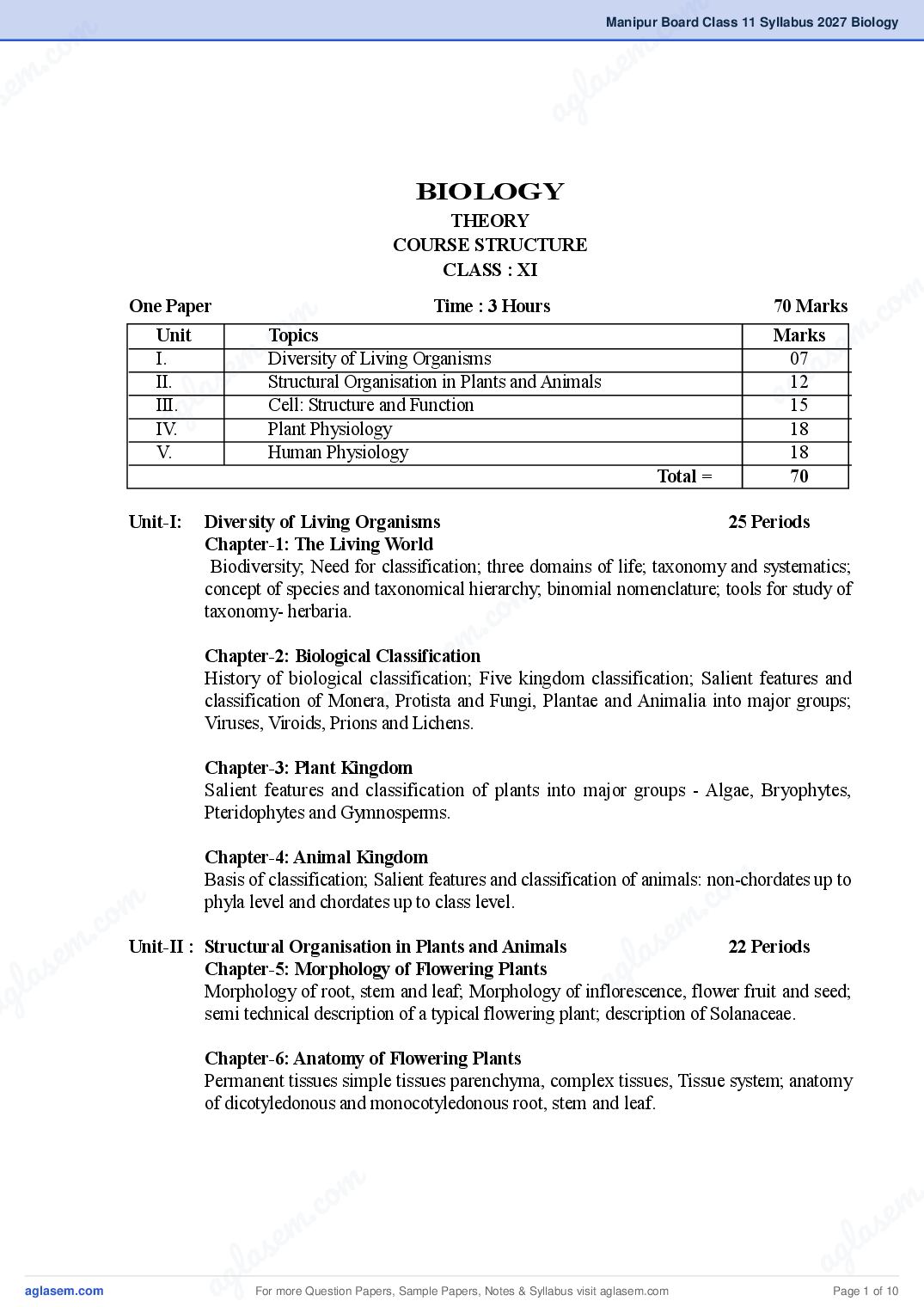
BIOLOGY
THEORY
COURSE STRUCTURE
CLASS : XI
m
One Paper
m Time : 3 Hours 70 Marks
.co
Unit
m .co
Topics Marks
s e m
I.
s e Diversity of Living Organisms 07
l a
II.
g
III.l a Structural Organisation in Plants and Animals
Cell: Structure and Function ag
12
15
a
IV. Plant Physiology 18
V. Human Physiology 18
Total = 70
Unit-I: Diversity of Living Organisms 25 Periods
Chapter-1: The Living World
Biodiversity; Need for classification; three domains of life; taxonomy and systematics;
concept of species and taxonomical hierarchy; binomial nomenclature; tools for study of
m
.co
taxonomy- herbaria.
e m
las
Chapter-2: Biological Classification
History of biological classification; Five kingdom classification; Salient features and
ag
classification of Monera, Protista and Fungi, Plantae and Animalia into major groups;
Viruses, Viroids, Prions and Lichens.
Chapter-3: Plant Kingdom
Salient features and classification of plants into major groups - Algae, Bryophytes,
Pteridophytes and Gymnosperms.
Chapter-4: Animal Kingdom
m
Basis of classification; Salient features and classification of animals: non-chordates up to
m phyla level and chordates up to class level.
c. o Unit-II : Structural Organisation in Plants and Animals .co
m s em 22 Periods
s e g la
la
Chapter-5: Morphology of Flowering Plants
g a
Morphology of root, stem and leaf; Morphology of inflorescence, flower fruit and seed;
a semi technical description of a typical flowering plant; description of Solanaceae.
Chapter-6: Anatomy of Flowering Plants
Permanent tissues simple tissues parenchyma, complex tissues, Tissue system; anatomy
of dicotyledonous and monocotyledonous root, stem and leaf.
m .
.co s e m
s em l a
g la ag
a For more Question Papers, Sample Papers, Notes & Syllabus visit Page 1 of 10
Page 3
Organ and organ systems; morphology and anatomy of frog.
Unit-III: Cell- Structure and Function 40 Periods
Chapter-8: Cell-The Unit of Life
What is a cell? Cell theory; an overview of a cell; structure and function of prokaryotic and
eukaryotic cell; plant and animal cell, cell membrane, cell wall, endomembrane system-
endoplasmic reticulum, golgi apparatus, vacuoles, mitochondria, plastids, ribosomes;
cytoskeleton - cilia and flagella, centrosome and centrioles; nucleus.
Chapter-9: Biomolecules
Analysis of chemical composition; Primary and Secondary Metabolites; Structure and
function of Biomacromolecules: Proteins, Polysaccharides, Lipids and Nucleic acids.
Enzymes: Properties; mechanism of enzyme action; factors affecting enzyme activity;
classification and nomenclature; co-factors.
Chapter-10: Cell Cycle and Cell Division
Cell cycle, mitosis, meiosis and their significance.
Unit-IV: Plant Physiology 45 Periods
Chapter-13: Photosynthesis in Higher Plants
Photosynthesis as a mean of autotrophic nutrition; site of photosynthesis, pigments involved
in photosynthesis (elementary idea); photochemical and biosynthetic phases of
photosynthesis; cyclic and non cyclic photophosphorylation; chemiosmotic hypothesis;
photorespiration; C3 and C4 pathways; factors affecting photosynthesis.
Chapter-14: Respiration in Plants
Exchange of gases; cellular respiration - glycolysis, fermentation (anaerobic), TCA cycle
and electron transport system (aerobic); energy relations - number of ATP molecules
generated;amphibolic pathways; respiratory quotient.
Chapter-15:
Plant - Growth and Development
Growth: characteristic; phases of plant growth; growth rate; conditions of growth;
differentiation, dedifferentiation and redifferentiation; sequence of developmental processes
in a plant cell; growth regulators - auxin, gibberellin, cytokinins, ethylene, ABA.
Unit-V: Human Physiology 45 Periods
Chapter-17: Breathing and Exchange of Gases
Respiratory organs in animals; Respiratory system in humans; mechanism of breathing
and its regulation in humans - exchange of gases, transport of gases and regulation of
respiration,respiratory volume; disorders related to respiration - asthma, emphysema,
occupational respiratorydisorders.
For more Question Papers, Sample Papers, Notes & Syllabus visit Page 2 of 10
Page 4
m .co
m .co s e m
se g l a
a
Chapter-18: Body Fluids and Circulation
Composition of blood, blood groups- ABO and Rh, coagulation of blood; composition of
lymph and its function;human circulatory system - Structure of human heart and blood
vessels; cardiac cycle, cardiac output, ECG; double circulation; regulation of cardiac activity;
disorders of circulatory system -hypertension, coronary artery disease, angina pectoris,
m
.co
heart failure.
m
.co
Chapter-19: Excretory Products and Their Elimination
m s e m
e
Modes of excretion - ammonotelism, ureotelism, uricotelism; human excretory system –
s l a
g l a
structure and function; urine formation, osmoregulation; regulation of kidney function -
ag
a renin - angiotensin,atrial natriuretic factor, ADH and diabetes insipidus; role of other organs
in excretion; disorders -uraemia, renal failure, renal calculi, nephritis; dialysis and artificial
kidney.
Chapter-20: Locomotion and Movement
Types of movement - ciliary, flagellar, muscular; skeletal muscle- contractile proteins and
muscle contraction; skeletal system and its functions; joints; disorders of muscular and
skeletal system -myasthenia gravis, tetany, muscular dystrophy, arthritis, osteoporosis, gout.
m
Chapter-21: Neural Control and Coordination
.co
em
Neuron and nerves; Nervous system in humans - central nervous system; peripheral nervous
l as
system and visceral nervous system; generation and conduction of nerve impulse.
ag
Chapter-22: Chemical Coordination and Integration
Endocrine glands and hormones; human endocrine system - hypothalamus, pituitary, pineal,
thyroid, parathyroid, adrenal, pancreas, gonads; mechanism of Hormone action (elementary
idea).
m
m .co
m .co s e m
s e g l a
g la a
a
m .
.co s e m
s em l a
g la ag
a For more Question Papers, Sample Papers, Notes & Syllabus visit Page 3 of 10
Page 5
(PRACTICAL)
CLASS-XI
Time : 3 Hours Marks : 30 Periods : 60
1. Experiments and spotting 20 Marks
2. Record of one investigatory Project and Viva based on the Project. 5 Marks
3. Class-record and Viva based on the experiments. 5 Marks
Total = 30 Marks
A. List of Experiments.
1. Study and describe locally available common flowering plants from the following family
(Solanaceae) including dissection and display of floral whorls and anther and ovary to
show number of chambers. Types of root (Tap and Adventitious); Stem (Herbaceous and
woody); Leaf (arrangement, shape, venation, simple and compound).
2. Preparation and study of T.S. of dicot and monocot roots and stems (primary).
3. Study of distribution of stomata in the upper and lower surface of leaves.
4. Tests for the presence of sugar, starch, protiens and fats. To detect them in suitable
plant and animal meterials.
5. Separation of plant pigments through paper chromatography.
6. To study the rate of respiration in flower buds/leaf tissues and germinating seeds.
7. To test the presence of urea in urine.
8. To detect the presence of sugar in urine/blood sample.
9. To detect the presence of albumin in urine.
10. To detect the presence of bile salts in urine.
B. Study/observation of the following (spotting)
1. Study parts of a compound microscope.
2. Study of the specimens and identification with reasonsBacteria, Oscillatoria, Spirogyra,
Rhizopus, Mushroom, Yeast, Liverwort, Moss, Fern, pines and one lichen.
3. Study of specimens and identification with reasons - Amoeba, Hydra, Liverfluke, Ascaris,
leech, earthworm, prawn, silkworm, honeybee, snail, starfish, shark, Rohu, frog, lizard,
pigeon and rabbit.
4. Study of tissues, and diversity in shapes and sizes of plant and animal cells (e.g. palisade
cells, guard cells, parenchyma, Xylem and mammalian blood smear) through temporary/
permanent slides.
For more Question Papers, Sample Papers, Notes & Syllabus visit Page 4 of 10
Page 6
m .co
m .co s e m
se g l a
a
5. Study of mitosis in onion root tip cells and animal cells (grasshopper) from permanent
slides.
6. Study and identification of different types of inflorescences.
7. Observation and comments on the experimental set up for showing :
m
(a) Anaerobic respiration.
m .co
(b)
.co
Phototropism.
s e m
em
(c) Apical bud removal.
s l a
g la To study human skeleton and different types of joints. ag
a8.
9. Study of external morphology of frog through models.
PRESCRIBED TEXTBOOKS : CLASS XI
1. Biology
Textbook for Class XI.
Published by : NCERT, New Delhi.
m
.co
REFERENCE BOOKS :
s em
1. Elementary Biology Vol. I
g la
a
By : K.N. Bhatia and M.P. Tyagi
Published by : Trueman Book Company, Jalandhar - 144 008.
2. Companion Biology for Class XI
By : K. Bhatti.
Published by : S. Dinesh & Co. Jalandhar - 144 008
3. Saraswati Lab Manual Biology for Class-XI (NCF 2023 Aligned)
m
.co
By: Rajesh Kumar Srivastav
m
.co
Published by: New Saraswati House (India) Private Limited, New Delhi-110002
e m
e m 4.
l
Comprehensive Laboratory Manual in Biology for Class XI (New Edition)as
las By : Dr. J.P. Sharma a g
ag Published by : Laxmi Publications (P) Ltd., New Delhi - 110 002.
5. A Textbook of Practical Biology for Class-XI
By : Dr. N. Mohendra Singh
Published by : Writers’ Book Store, Pologround, Imphal.
m .
.co s e m
s em l a
g la ag
a For more Question Papers, Sample Papers, Notes & Syllabus visit Page 5 of 10
Page 7
QUESTION PAPER
Subject : BIOLOGY
Paper : Theory
Class : XI
Full Mark : 70
Time : 3 Hours
WEIGHTAGE TO OBJECTIVES:
Objectives Marks Percentage
Knowledge(K) 10 15
I Understanding (U) 35 50
Application (A) 21 30
Skill (S) 4 5
Total: 70 100
WEIGHTAGE TO FORMS OF QUESTIONS:
No. of
FORM OF QUESTIONS Time(in minutes) Marks Percentage
questions
Essay/Long Ans: (E/LA) 3 60 15 21
II Short Answer (SA-I) 6 37 18 26
Short Answer (SA-II) 10 40 20 29
Very Short Answer(VSA) 7 21 7 10
MCQ 10 22 10 14
Total: 36 180 70 100
WEIGHTAGE TO CONTENT:
Unit CONTENTS Marks Percentage
I Diversity of Living Organisms 7 10
II Structural Organization in Plants and Animals 12 17
III III Cell Structure and Function 15 21
IV Plant Physiology 18 26
V Animal Physiology 18 26
Total: 70 100
IV SCHEME OF SECTIONS: NIL
SCHEME OF OPTIONS: i) Internal option will be given in Essay Type Questions.
V ii) Internal option will be given in three questions of SA-I including one case
study based question.
VI DIFFICULTY LEVEL :
Difficult : 35% of the total marks
Average : 50% of the total marks
Easy : 15% of the total marks
Abbreviation: K(Knowledge), U(Understanding), A(Application),S(Skill), E/LA(Essay Type/Long Answer
Type), SA(Short Answer Type), VSA(Very Short Answer Type), O(Objective Type). MCQ
Multiple Choice Question).
N.B.: Assertion and reasoning: 2(two) Questions in MCQ.
Source Based Question: 1(one) Question in SA-I
For more Question Papers, Sample Papers, Notes & Syllabus visit Page 6 of 10
Page 8
m .co
m .co s e m
se g l a
a
DESIGN OF
QUESTION PAPER
Subject : BIOLOGY
Unit/Paper : Practical
m
.co
Class : XI
m
.co
Time : 3 Hours
e m
e m Full Marks : 30
l as
las
MARKING SCHEME :
a4 gmarks
ag SECTION - A (Any one)
Q. 1
(a) Item 1 : Description of a flowering plant.
(i) Dissect and Display 1
(ii) Diagram and labelling 2
(iii) Comments on Floral Characters 1
Total = 4
m
.co
(b) Item 2 and 3 :Preparation of Slide of Transverse Section of dicot and monocot
m
roots and stems (primary) and observation of distribution of
e
Stomata
las
(i) Preparation of slide
(ii) Diagram and labellingag
1
2
(iii) Comments - 2 points 1
Total = 4
SECTION - B (Any two) 4+4 = 8 marks
Q.2
(a) Item 6 : Plant Physiology experiments : Respiration.
(i) Experimentation/Setting of experiment 1 m
m (ii) Observations 1
.co
m .co (iii) Inference and Result
s e
1 m
s e (iv) Precautions
g l a 1
la
Total = 4
g a
a (b) Items 4 & 5 : Tests for presence of Sugar, Starch, Proteins and Fats in suitable
plant materials, paper chromatography of plant pigments.
(i) Experimentation/Setting of experiment 1
(ii) Observations 1
(iii) Inference and result 1
(iv) Precautions 1
Total = 4
m .
.co s e m
s em l a
g la ag
a For more Question Papers, Sample Papers, Notes & Syllabus visit Page 7 of 10
Page 9
materials, urine test for urea, presence of sugar in urine/blood,
presence of albumin and bile salts in urine.
(i) Experimentation 1
(ii) Observations 1
(iii) Inference and Result 1
(iv) Precautions 1
Total = 4
SECTION - C (Spotting) 4+4 = 8 marks
Q.3 Item 1- 8 : (Two spots each from plants and animals)
(i) Identification 1
(ii) Comments - 2 points 1
Total = 2
SECTION - D 5 marks
Q.4 Investigatory Project :
(i) Aim and object 1
(ii) Materials and Methods 1
(iii) Summary of the project 1
(iv) Viva Voce on projecrt record 2
Total = 5
Q.5 Laboratory Record 5 Marks
(i) Completeness of practical work 1
(ii) Regularity in submitting record 1
(iii) Neatness and accuracy of record 1
(iv) Viva Voce on laboratory record 2
Total = 5
For more Question Papers, Sample Papers, Notes & Syllabus visit Page 8 of 10
Page 10
m .co
m .co s e m
se g l a
a
DESIGN OF
QUESTION PAPER
Subject : BIOLOGY
Unit/Paper : Practical
m
.co
Class : XI
m
.co
Time : 3 Hours
e m
e m Full Marks : 30
l as
las
MARKING SCHEME :
a4gmarks
ag SECTION - A (Any one)
Q. 1
(a) Item 1 : Description of a flowering plant.
(i) Dissect and Display 1
(ii) Diagram and labelling 2
(iii) Comments on Floral Characters 1
Total = 4
m
.co
(b) Item 2 and 3 :Preparation of Slide of Transverse Section of dicot and monocot
m
roots and stems (primary) and observation of distribution of
e
Stomata
las
(i) Preparation of slide
(ii) Diagram and labellingag
1
2
(iii) Comments - 2 points 1
Total = 4
SECTION - B (Any two) 4+4 = 8 marks
Q.2
(a) Item 6 : Plant Physiology experiments : Respiration.
(i) Experimentation/Setting of experiment 1 m
m (ii) Observations 1
.co
m .co (iii) Inference and Result
s e1 m
s e (iv) Precautions
g l a 1
la
Total = 4
g a
a (b) Items 4 & 5 : Tests for presence of Sugar, Starch, Proteins and Fats in suitable
plant materials, paper chromatography of plant pigments.
(i) Experimentation/Setting of experiment 1
(ii) Observations 1
(iii) Inference and result 1
(iv) Precautions 1
Total = 4
m .
.co s e m
s em l a
g la ag
a For more Question Papers, Sample Papers, Notes & Syllabus visit Page 9 of 10
Page 11
materials, urine test for urea, presence of sugar in urine/blood,
presence of albumin and bile salts in urine.
(i) Experimentation 1
(ii) Observations 1
(iii) Inference and Result 1
(iv) Precautions 1
Total = 4
SECTION - C (Spotting) 4+4 = 8 marks
Q.3 Item 1- 8 : (Two spots each from plants and animals)
(i) Identification 1
(ii) Comments - 2 points 1
Total = 2
SECTION - D 5 marks
Q.4 Investigatory Project :
(i) Aim and object 1
(ii) Materials and Methods 1
(iii) Summary of the project 1
(iv) Viva Voce on projecrt record 2
Total = 5
Q.5 Laboratory Record 5 Marks
(i) Completeness of practical work 1
(ii) Regularity in submitting record 1
(iii) Neatness and accuracy of record 1
(iv) Viva Voce on laboratory record 2
Total = 5
For more Question Papers, Sample Papers, Notes & Syllabus visit Page 10 of 10
Document Details
| Board / Org | Manipur Board |
| Exam | Class 11 |
| Type | Syllabus |
| Pages | 10 |
| Updated | 04 Nov 2026 |