NBSE Class 11 Question Paper 2021 for Environmental Education
Finished viewing? Save it for later —
Download NBSE Class 11 Question Paper 2021 for Environmental Education (PDF · 3 pages)About NBSE Class 11 Question Paper 2021 for Environmental Education
NBSE Class 11 Question Paper 2021 for Environmental Education is available here for free download. Published by Nagaland Board for Class 11, this question paper can be viewed online or downloaded as a PDF (3 pages). Candidates preparing for Class 11 can use NBSE Class 11 Question Paper 2021 for Environmental Education to understand the exam pattern, the type of questions asked, and the overall difficulty level.
Frequently Asked Questions
How can I download NBSE Class 11 Question Paper 2021 for Environmental Education?
Open this page and click the Download button to save NBSE Class 11 Question Paper 2021 for Environmental Education as a PDF. It is completely free on AglaSem Docs.
Is NBSE Class 11 Question Paper 2021 for Environmental Education free to download?
Yes. NBSE Class 11 Question Paper 2021 for Environmental Education can be viewed online and downloaded as a PDF free of cost on AglaSem Docs.
How many pages does NBSE Class 11 Question Paper 2021 for Environmental Education have?
NBSE Class 11 Question Paper 2021 for Environmental Education contains 3 pages, which you can read online or download together as a single PDF.
Where can I find more Class 11 study material?
You can find more Class 11 question papers, sample papers, syllabus, and answer keys on AglaSem Docs.
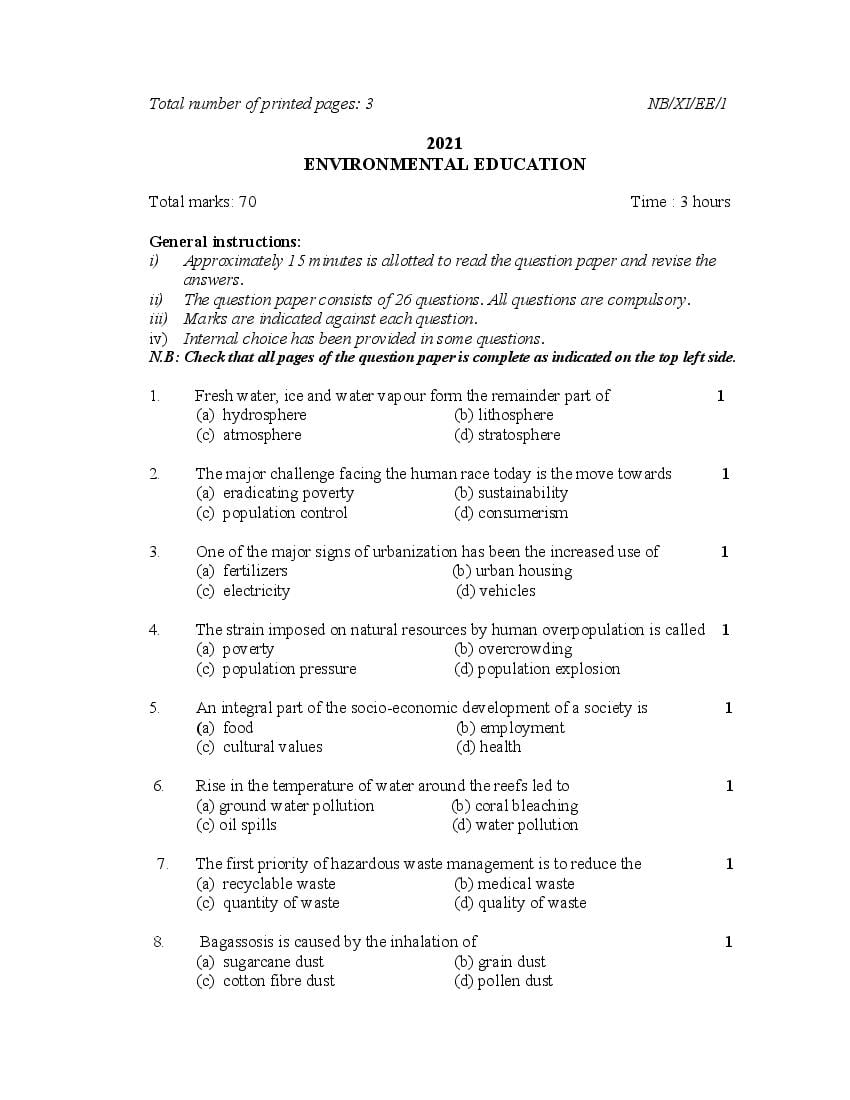
NBSE Class 11 Question Paper 2021 for Environmental Education – Text
Read the full text of this question paper below — useful to quickly search, copy and reference the content online without downloading the PDF.
📄 View text version (3 pages)
Page 1
2021
ENVIRONMENTAL EDUCATION
Total marks: 70 Time : 3 hours
General instructions:
i) Approximately 15 minutes is allotted to read the question paper and revise the
answers.
ii) The question paper consists of 26 questions. All questions are compulsory.
iii) Marks are indicated against each question.
iv) Internal choice has been provided in some questions.
N.B: Check that all pages of the question paper is complete as indicated on the top left side.
1. Fresh water, ice and water vapour form the remainder part of 1
(a) hydrosphere (b) lithosphere
(c) atmosphere (d) stratosphere
2. The major challenge facing the human race today is the move towards 1
(a) eradicating poverty (b) sustainability
(c) population control (d) consumerism
3. One of the major signs of urbanization has been the increased use of 1
(a) fertilizers (b) urban housing
(c) electricity (d) vehicles
4. The strain imposed on natural resources by human overpopulation is called 1
(a) poverty (b) overcrowding
(c) population pressure (d) population explosion
5. An integral part of the socio-economic development of a society is 1
(a) food (b) employment
(c) cultural values (d) health
6. Rise in the temperature of water around the reefs led to 1
(a) ground water pollution (b) coral bleaching
(c) oil spills (d) water pollution
7. The first priority of hazardous waste management is to reduce the 1
(a) recyclable waste (b) medical waste
(c) quantity of waste (d) quality of waste
8. Bagassosis is caused by the inhalation of 1
(a) sugarcane dust (b) grain dust
(c) cotton fibre dust (d) pollen dust
Page 2
9. The energy associated with the flow of electric charge is 1
(a) solar energy (b) electrical energy
(c) kinetic energy (d) mechanical energy
10. The principal energy source for millions of people in developing
countries is 1
(a) coal (b) petroleum
(c) firewood (d) electricity
11. Write any two objectives of conservation of environment. 2
12. Mention any two effects of acid rain. 2
13. What is deforestation? Give one effect of deforestation. 2
14. Name any two important voluntary organisations in Nagaland at state or district
level acting in public interest. 2
15. Write the full form of NPCB and CFCs. 2
16. Write any two ways to reduce noise pollution. 2
17. State any two adverse effects of global warming on human society. 2
18. Differentiate between floral and faunal environment. 2+2= 4
19. Explain briefly the effects of using synthetic pesticides in rural areas. 4
20. Differentiate between quality of life and standard of life. 4
21. Mention any four aims of Eco-club. 4
22. Write the four natural factors which cause river floods. 4
23. a. Suggest any six factors for country’s development.
Or 6
b. Write any six basic components of development.
24. a. What is composting? Write five benefits of compost. 1+5=6
Or
b. What is incineration? Give three benefits and two drawbacks of incineration.
(1+3+2=6)
Page 3
25. a. Mention any three advantages and three environmental consequences of
hydel energy. 3+3=6
Or
b. Write four advantages and two limitations of geothermal energy.
(4+2=6)
26. a. What is cyclone? Write four impacts of cyclones on environment. Suggest
two preventive measures of cyclone. 2+4+2=8
Or
b. What is an earthquake? Mention three impacts of earthquake on
environment. Give three preventive measures of earthquake. (2+3+3=8)
************************