AISSEE 2021 Question Paper Class 6 Paper 1 Set A Hindi
Finished viewing? Save it for later —
Download AISSEE 2021 Question Paper Class 6 Paper 1 Set A Hindi (PDF · 36 pages)About AISSEE 2021 Question Paper Class 6 Paper 1 Set A Hindi
AISSEE 2021 Question Paper Class 6 Paper 1 Set A Hindi is available here for free download. Published by Sainik School for AISSEE, this question paper can be viewed online or downloaded as a PDF (36 pages). Candidates preparing for AISSEE can use AISSEE 2021 Question Paper Class 6 Paper 1 Set A Hindi to understand the exam pattern, the type of questions asked, and the overall difficulty level.
Frequently Asked Questions
How can I download AISSEE 2021 Question Paper Class 6 Paper 1 Set A Hindi?
Open this page and click the Download button to save AISSEE 2021 Question Paper Class 6 Paper 1 Set A Hindi as a PDF. It is completely free on AglaSem Docs.
Is AISSEE 2021 Question Paper Class 6 Paper 1 Set A Hindi free to download?
Yes. AISSEE 2021 Question Paper Class 6 Paper 1 Set A Hindi can be viewed online and downloaded as a PDF free of cost on AglaSem Docs.
How many pages does AISSEE 2021 Question Paper Class 6 Paper 1 Set A Hindi have?
AISSEE 2021 Question Paper Class 6 Paper 1 Set A Hindi contains 36 pages, which you can read online or download together as a single PDF.
Where can I find more AISSEE study material?
You can find more AISSEE question papers, sample papers, syllabus, and answer keys on AglaSem Docs.
AISSEE 2021 Question Paper Class 6 Paper 1 Set A Hindi – Text
Read the full text of this question paper below — useful to quickly search, copy and reference the content online without downloading the PDF.
📄 View text version (36 pages)
Page 1
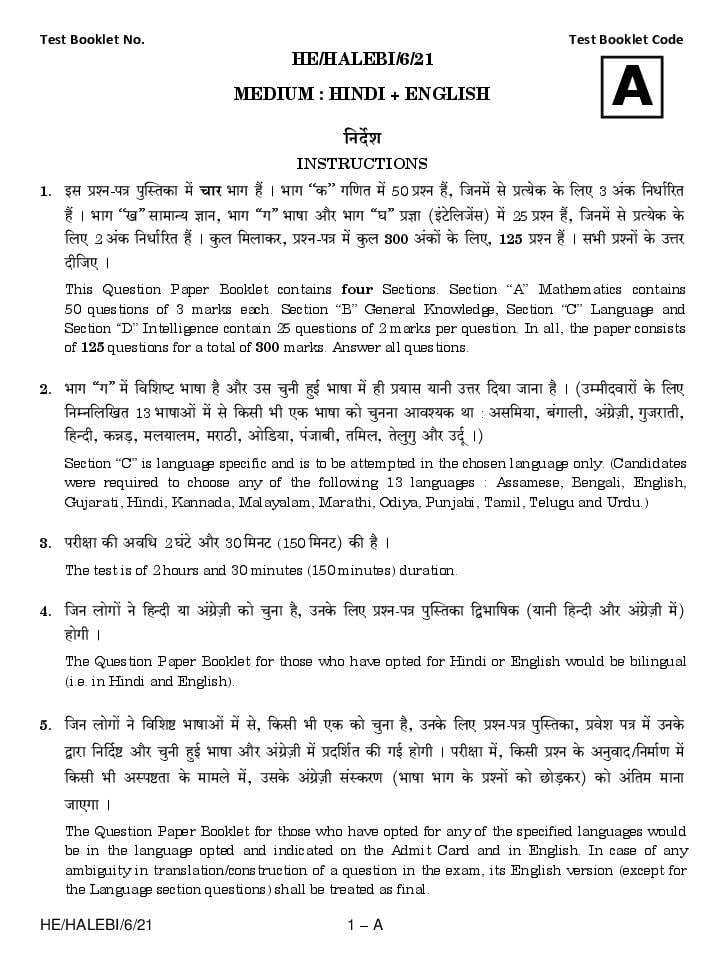
HE/HALEBI/6/21
MEDIUM : HINDI + ENGLISH A
{ZX}e
INSTRUCTIONS
1. Bg àíZ-nÌ nwpñVH$m _| Mma ^mJ h¢ & ^mJ ‘‘H$’’ J{UV _| 50 àíZ h¢, {OZ_| go àË`oH$ Ho$ {bE 3 A§H$ {ZYm©[aV
h¢ & ^mJ ‘‘I’’ gm_mÝ` kmZ, ^mJ ‘‘J’’ ^mfm Am¡a ^mJ ‘‘K’’ àkm (B§Q>o{bO|g) _| 25 àíZ h¢, {OZ_| go àË`oH$ Ho$
{bE 2 A§H$ {ZYm©[aV h¢ & Hw$b {_bmH$a, àíZ-nÌ _| Hw$b 300 A§H$m| Ho$ {bE, 125 àíZ h¢ & g^r àíZm| Ho$ CÎma
Xr{OE &
This Question Paper Booklet contains four Sections. Section ‘‘A’’ Mathematics contains
50 questions of 3 marks each. Section ‘‘B’’ General Knowledge, Section ‘‘C’’ Language and
Section ‘‘D’’ Intelligence contain 25 questions of 2 marks per question. In all, the paper consists
of 125 questions for a total of 300 marks. Answer all questions.
2. ^mJ ‘‘J’’ _| {d{eîQ> ^mfm h¡ Am¡a Cg MwZr hþB© ^mfm _| hr à`mg `mZr CÎma {X`m OmZm h¡ & (Cå_rXdmam| Ho$ {bE
{ZåZ{b{IV 13 ^mfmAm| _| go {H$gr ^r EH$ ^mfm H$mo MwZZm Amdí`H$ Wm : Ag{_`m, ~§Jmbr, A§J«oµOr, JwOamVr,
{hÝXr, H$Þ‹S>, _b`mb_, _amR>r, Amo{S>`m, n§Om~r, V{_b, VobwJw Am¡a CXÿ© >&)
Section ‘‘C’’ is language specific and is to be attempted in the chosen language only. (Candidates
were required to choose any of the following 13 languages : Assamese, Bengali, English,
Gujarati, Hindi, Kannada, Malayalam, Marathi, Odiya, Punjabi, Tamil, Telugu and Urdu.)
3. narjm H$s Ad{Y 2 K§Q>o Am¡a 30 {_ZQ> (150 {_ZQ>) H$s h¡ &
The test is of 2 hours and 30 minutes (150 minutes) duration.
4. {OZ bmoJm| Zo {hÝXr `m A§J«oµOr H$mo MwZm h¡, CZHo$ {bE àíZ-nÌ nwpñVH$m {Û^m{fH$ (`mZr {hÝXr Am¡a A§J«oµOr _|)
hmoJr &
The Question Paper Booklet for those who have opted for Hindi or English would be bilingual
(i.e. in Hindi and English).
5. {OZ bmoJm| Zo {d{eï> ^mfmAm| _| go, {H$gr ^r EH$ H$mo MwZm h¡, CZHo$ {bE àíZ-nÌ nwpñVH$m, àdoe nÌ _| CZHo$
Ûmam {Z{X©ï> Am¡a MwZr hþB© ^mfm Am¡a A§J«oµOr _| àX{e©V H$s JB© hmoJr & narjm _|, {H$gr àíZ Ho$ AZwdmX /{Z_m©U _|
{H$gr ^r Añnï>Vm Ho$ _m_bo _|, CgHo$ A§J«oµOr g§ñH$aU (^mfm ^mJ Ho$ àíZm| H$mo N>mo‹S>H$a) H$mo A§{V_ _mZm
OmEJm &
The Question Paper Booklet for those who have opted for any of the specified languages would
be in the language opted and indicated on the Admit Card and in English. In case of any
ambiguity in translation/construction of a question in the exam, its English version (except for
the Language section questions) shall be treated as final.
HE/HALEBI/6/21 1–A
Page 2
Bg_| g^r n¥îR> h¢ &
The Question Paper Booklet is of 36 pages. Please check and ensure that the Question Paper
Booklet is complete and contains all the pages.
7. g^r àíZm| Ho$ CÎma Ho$db Amo.E_.Ama. CÎma-nÌH$ _| hr X| &
Answer all questions in the OMR Answer Sheet only.
8. Amo.E_.Ama. CÎma-nÌH$, àíZ-nÌ nwpñVH$m Ho$ A§Xa hr h¡ & O~ AmnH$mo àíZ-nÌ nwpñVH$m ImobZo H$m {ZX}e {X`m
OmVm h¡, V~ Amo.E_.Ama. CÎma-nÌH$ {ZH$mb b| Am¡a {ddaU H$mo Ü`mZnyd©H$, Ho$db Zrbo/H$mbo ~m°b nm°B§Q> noZ go
hr ^a| &
The OMR Answer Sheet is inside this Question Paper Booklet. When you are directed to open
the Question Paper Booklet, take out the OMR Answer Sheet and fill the particulars carefully
with blue/black ball point pen only.
9. àË`oH$ àíZ Ho$ {bE AnZo CÎma Ho$ ê$n _| Ho$db EH$ Jmobo H$mo hr ^a| (Jham H$a|) & `{X Amn Cgr àíZ Ho$ {bE
EH$ go Á`mXm Jmobo H$mo Jham H$aVo h¢, Vmo AmnHo$ Odm~ H$mo µJbV _mZm OmEJm &
Darken only one circle as your answer for each question. If you darken more than one circle for
the same question, your answer will be treated as wrong.
10. µJbV CÎma Ho$ {bE {ZJo{Q>d _m{Hª$J Zht h¡ &
There is no negative marking for a wrong answer.
11. Amo.E_.Ama. CÎma-nÌH$ na AZmdí`H$ {ZemZ Z ~ZmE± `m \$moëS> Z H$a| `m Cgo {dê${nV ({S>\o$g) H$aZo H$m à`mg
Z H$a| & `{X Amn Eogm H$aVo h¢ Vmo AmnHo$ Amo.E_.Ama. CÎma-nÌH$ H$m _yë`m§H$Z Zht {H$`m OmEJm &
Do not make unnecessary marks on the OMR Answer Sheet or fold or attempt to deface it. If you
do so, your OMR Answer Sheet will not be evaluated.
12. Bg n¥îR> na {ddaU Am¡a CÎma {bIZo Ho$ {bE Ho$db Zrbo/H$mbo ~m°b nm°B§Q> noZ H$m Cn`moJ H$a| & nopÝgb H$m
BñVo_mb Z H$a| &
Use Blue/Black Ball Point Pen only for writing particulars on this page and for writing answers.
Do not use pencil.
HE/HALEBI/6/21 2–A
Page 3
Amo.E_.Ama. CÎma-nÌH$ na &
Rough work is to be done on the space provided for this purpose in the Question Paper Booklet
only and not on the OMR Answer Sheet.
14. narjm nyar hmoZo na, H$j/hm°b N>mo‹S>Zo go nhbo {ZarjH$ (BZ{d{OboQ>a) H$mo Amo.E_.Ama. CÎma-nÌH$ gm¢n
X| &
On completion of the test, hand over the OMR Answer Sheet to the Invigilator before leaving the
Room/Hall.
15. AmnH$mo Bg àíZ-nÌ nwpñVH$m H$mo AnZo gmW bo OmZo H$s AZw_{V h¡ &
You are allowed to take away this Question Paper Booklet with you.
16. Bg nwpñVH$m Ho$ {bE {X`m J`m H$moS> A h¡ & AmnH$mo gw{ZpíMV H$aZm h¡ {H$ Amo.E_.Ama. CÎma-nÌH$ na _w{ÐV
{H$`m J`m H$moS>, Bg àíZ-nÌ nwpñVH$m Ho$ hr g_mZ h¡ & {dg§J{V hmoZo na àíZ-nÌ nwpñVH$m Am¡a Amo.E_.Ama.
CÎma-nÌH$ XmoZm| H$mo ~XbZo Ho$ {bE _m_bo H$s gyMZm VËH$mb {ZarjH$ (BZ{d{OboQ>a) H$mo X| &
The CODE for this Booklet is A. Make sure that the CODE printed on the OMR Answer Sheet is
the same as that on this Question Paper Booklet. In case of discrepancy, report the matter
immediately to the Invigilator for replacement of both the Question Paper Booklet and the OMR
Answer Sheet.
17. AnZm H«$_m§H$ (amob Z.) àíZ-nÌ nwpñVH$m/Amo.E_.Ama. CÎma-nÌH$ _| {XE JE {Z{X©îQ> ñWmZ H$mo N>m‹oS>H$a H$ht Am¡a
Zht {bI| &
Do not write your Roll No. anywhere else except in the specified space in the Question Paper
Booklet/OMR Answer Sheet.
18. Amo.E_.Ama. CÎma-nÌH$ na {H$gr ^r Vah Ho$ gwYma H$aZo Ho$ {bE g\o$X Vab nXmW© (white fluid) H$m Cn`moJ
Zht H$a| &
Do not use white fluid for carrying out any correction on the OMR Answer Sheet.
HE/HALEBI/6/21 3–A
Page 4
J{UV / MATHEMATICS
1. {H$g g§{H«$`m Ho$ A§VJ©V nyUmªH$ g§d¥V (~§X) hmoVo h¢ ?
(1) KQ>mZm (2) ^mJ
(3) JwUZ (4) BZ_| go g^r
Whole numbers are closed under which operation ?
(1) Subtraction (2) Division
(3) Multiplication (4) All of these
2. 1 {_{b`Z H$s AZwdVu (AJbr) g§»`m h¡
(1) 2 {_{b`Z (2) 1000001 (3) 100001 (4) 10001
The successor of 1 million is
(1) 2 million (2) 1000001 (3) 100001 (4) 10001
3. {~ÝXþ O, U, S, V, R, X, W, T, P, Q VWm Y g§»`m aoIm na g_mZ Xÿar na h¢ & bå~mB© OP Ûmam
{Zê${nV {^Þ h¡
1 7 4 6
(1) (2) (3) (4)
5 5 5 5
The points O, U, S, V, R, X, W, T, P, Q and Y on the number line are equidistant. The
fraction represented by length OP is
1 7 4 6
(1) (2) (3) (4)
5 5 5 5
4. Xmo H«$_mJV nyUmªH$, {OZHo$ _Ü` _| {^Þ 5 pñWV h¡, h¢
7
(1) 0 Am¡a 1 (2) 5 Am¡a 7 (3) 5 Am¡a 6 (4) 6 Am¡a 7
5
The two consecutive integers, between which the fraction lies, are
7
(1) 0 and 1 (2) 5 and 7 (3) 5 and 6 (4) 6 and 7
5. {ZåZ{b{IV _| go H$m¡Z-gm {^Þ g~go N>moQ>m h¡ ?
4 5 5 5
(1) (2) (3) (4)
5 3 6 2
Which of the following is the smallest fraction ?
4 5 5 5
(1) (2) (3) (4)
5 3 6 2
HE/HALEBI/6/21 4–A
Page 5
H$s{OE &
(1) 84 (2) 45 (3) 54 (4) 24
The HCF and LCM of two numbers are 6 and 864 respectively. If one number is 96,
find the other number.
(1) 84 (2) 45 (3) 54 (4) 24
7. Xmo g§»`mAm| H$m HCF 12 h¡ VWm CZH$m A§Va 12 h¡ & `h g§»`mE± {ZåZ{b{IV _| go H$m¡Z-gr hmo gH$Vr
h¢ ?
(1) 84, 96 (2) 66, 78 (3) 70, 82 (4) 62, 78
The HCF of two numbers is 12 and their difference is 12. Which of the following can
be the numbers ?
(1) 84, 96 (2) 66, 78 (3) 70, 82 (4) 62, 78
8. Eogr g~go N>moQ>r g§»`m kmV H$s{OE Omo 9, 12 Ed§ 15 àË`oH$ go ^mÁ` h¡ &
(1) 60 (2) 90 (3) 120 (4) 180
Find the smallest number that is divisible by each one of 9, 12 and 15.
(1) 60 (2) 90 (3) 120 (4) 180
9. gm~wZ-nmCS>a H$m EH$ {d{eîQ> ~«mÊS> < 15 à{V n¡Ho$Q> _| ~oMm OmVm h¡ & BgH$s bmJV < 144 à{V XO©Z
h¡ & 8 XO©Z n¡Ho$Q>m| na à{VeV _| bm^ {H$VZm hmoJm ?
(1) 20 (2) 25 (3) 24 (4) 36
A certain brand of soap-powder is sold at < 15 per packet. It costs < 144 a dozen.
What is the profit in percent on 8 dozen packets ?
(1) 20 (2) 25 (3) 24 (4) 36
10. dh ~‹S>r-go-~‹S>r g§»`m kmV H$s{OE {Oggo 37, 56, 93 H$mo ^mJ XoZo na eof\$b H«$_e: 1, 2 Am¡a 3
ahoJm &
(1) 9 (2) 18 (3) 15 (4) 12
Find the greatest number that will divide 37, 56, 93 leaving remainder 1, 2 and 3
respectively.
(1) 9 (2) 18 (3) 15 (4) 12
HE/HALEBI/6/21 5–A
Page 6
{H$VZo AmX{_`m| H$s Amdí`H$Vm hmoJr ?
(1) 10 (2) 8 (3) 40 (4) 12
If 10 men can do a piece of work in 4 days, how many men will be required to get the
same work done in 5 days ?
(1) 10 (2) 8 (3) 40 (4) 12
12. 21 ~H$[a`m± 15 Jm`m| Ho$ ~am~a Mmam MaVr h¢ & {H$VZr ~H$[a`m± 35 Jm`m| Ho$ ~am~a Mmam Ma|Jr ?
(1) 38 (2) 49 (3) 37 (4) 41
21 goats eat as much as 15 cows. How many goats eat as much as 35 cows ?
(1) 38 (2) 49 (3) 37 (4) 41
13. EH$ _¡Ho${ZH$ 9 H$mam| go < 36,000 H$_mVm h¡ & `{X 1 {XZ _| Cgo 27 H$ma| àmá hmoVr h¢, Vmo dh
1 {XZ _| {H$VZm H$_mEJm ?
(1) < 1,08,000 (2) < 1,80,000
(3) < 1,00,800 (4) < 1,00,080
A mechanic earns < 36,000 on 9 cars. How much will he earn in 1 day, if in a day he
receives 27 cars ?
(1) < 1,08,000 (2) < 1,80,000
(3) < 1,00,800 (4) < 1,00,080
14. `{X x : y = 3 : 5, Vmo 3x + 4y : 8x + 5y H$m AZwnmV kmV H$s{OE &
(1) 39 : 49 (2) 29 : 50
(3) 29 : 49 (4) 39 : 50
If x : y = 3 : 5, find the ratio 3x + 4y : 8x + 5y.
(1) 39 : 49 (2) 29 : 50
(3) 29 : 49 (4) 39 : 50
HE/HALEBI/6/21 6–A
Page 7
(1) 6 (2) 54
(3) 7 (4) 252
Find the value of m, if 3, 18, m, 42 are in proportion.
(1) 6 (2) 54
(3) 7 (4) 252
16. EH$ NCC H¡$ån _| 1200 à{ejmWu ^mJ bo aho h¢ {OZ_| go 900 H$mo JUV§Ì {Xdg H¡$ån Ho$ {bE MwZm
J`m h¡ & MwZo hþE Ed§ Zht MwZo hþE H¡$S>oQ>m| H$s g§»`m Ho$ ~rM AZwnmV {H$VZm hmoJm ?
(1) 300 : 120 (2) 4:1 (3) 3:1 (4) 120 : 130
In an NCC Camp, 1200 trainees are participating out of which 900 are selected for
Republic Day Camp. What is the ratio between the number of selected and
non-selected cadets ?
(1) 300 : 120 (2) 4:1 (3) 3:1 (4) 120 : 130
17. `{X EH$ b‹S>H$m {H$gr nwñVH$ H$mo < 450 _| ~oMVm h¡, Vmo Cgo 10% H$s hm{Z hmoVr h¡ & 10% bm^
àmá H$aZo Ho$ {bE {dH«$` _yë` {H$VZm hmoZm Mm{hE ?
(1) < 500 (2) < 600 (3) < 550 (4) < 525
If a boy sells a book for < 450, he makes a loss of 10%. To gain 10%, what should be
the selling price ?
(1) < 500 (2) < 600 (3) < 550 (4) < 525
18. EH$ AmX_r EH$ ñnrH$a H$mo 20% Ho$ bm^ na < 7,500 _| ~oMVm h¡ Am¡a Xÿgao ñnrH$a H$mo 10% H$s
hm{Z na < 8,100 _| ~oMVm h¡ & CgH$s Hw$b hm{Z AWdm bm^ kmV H$s{OE &
(1) hm{Z = < 300 (2) hm{Z = < 350
(3) bm^ = < 300 (4) bm^ = < 350
A man sells one speaker for < 7,500 at a profit of 20% and another speaker for
< 8,100 at a loss of 10%. Find his total loss or profit.
(1) Loss = < 300 (2) Loss = < 350
(3) Profit = < 300 (4) Profit = < 350
HE/HALEBI/6/21 7–A
Page 8
(1) 3950 (2) 411 (3) 412 (4) 3949
Simplify (8 + 4 – 2) (17 – 12) 10 – 89 = _________ .
(1) 3950 (2) 411 (3) 412 (4) 3949
20. gab H$s{OE 0·05 + 1·5 5 10 0·5 = _________ .
(1) 4·25 (2) 42·5 (3) 0·425 (4) 0·42
Simplify 0·05 + 1·5 5 10 0·5 = _________ .
(1) 4·25 (2) 42·5 (3) 0·425 (4) 0·42
21. gab H$s{OE 7 + 5 – 2 (7 + 89) – 94 2 + (33 3 + 9 2 – 7) 11 = _________ .
(1) 254 (2) – 225 (3) – 235 (4) 245
Simplify 7 + 5 – 2 (7 + 89) – 94 2 + (33 3 + 9 2 – 7) 11 = _________ .
(1) 254 (2) – 225 (3) – 235 (4) 245
22. EH$ H$jm _| 20 b‹S>H$m| H$m Am¡gV ^ma 160 kg h¡ VWm eof 5 b‹S>H$m| H$m 50 kg h¡ & H$jm Ho$ g^r
b‹S>H$m| H$m Am¡gV ^ma kmV H$s{OE &
(1) 138 kg (2) 183 kg (3) 140 kg (4) 150 kg
The average weight of 20 boys in a class is 160 kg and that of the remaining 5 boys is
50 kg. Find the average weight of all the boys in the class.
(1) 138 kg (2) 183 kg (3) 140 kg (4) 150 kg
23. EH$ g_yh _| 7 {dÚm{W©`m| Ûmam àmá Am¡gV A§H$ 226 h¡ & `{X CZ_| go N>h Ûmam àmá {H$E JE A§H$
H«$_e: 340, 180, 260, 56, 275 VWm 307 h¢, Vmo gmVd| {dÚmWu Ûmam àmá {H$E JE A§H$ kmV
H$s{OE &
(1) 160 (2) 162 (3) 163 (4) 164
The average marks obtained by 7 students in a group is 226. If the marks obtained by
six of them are 340, 180, 260, 56, 275 and 307 respectively, find the marks obtained
by the seventh student.
(1) 160 (2) 162 (3) 163 (4) 164
HE/HALEBI/6/21 8–A
Page 9
30 {XZ Ho$ _hrZo _| AmJ§VwH$m| H$s Am¡gV g§»`m {H$VZr hmoJr ?
(1) 280 (2) 285 (3) 290 (4) 295
A library has an average of 510 visitors on Sundays and 240 on other days. The
average number of visitors in a month of 30 days starting with Sunday is
(1) 280 (2) 285 (3) 290 (4) 295
25. EH$ ~„o~mµO 17d| _¡M _| 87 aZm| H$m ñH$moa ~ZmVm h¡ Am¡a Bg àH$ma CgH$m Am¡gV 3 go ~‹T> OmVm
h¡ & 17d| _¡M Ho$ ~mX CgH$m Am¡gV kmV H$s{OE &
(1) 36 (2) 37 (3) 38 (4) 39
A batsman makes a score of 87 runs in the 17th match and thus increases his average
by 3. Find his average after the 17th match.
(1) 36 (2) 37 (3) 38 (4) 39
26. 1, 3, 5, 7, 9, 11, 13 H$m Am¡gV h¡
(1) 7 (2) 8 (3) 7·5 (4) 8·5
Average of 1, 3, 5, 7, 9, 11, 13 is
(1) 7 (2) 8 (3) 7·5 (4) 8·5
27. `{X y H$m x% 100 h¡ VWm z H$m y% 200 h¡, Vmo x Am¡a z Ho$ ~rM g§~§Y kmV H$s{OE &
(1) z=x (2) 2z = x
(3) z = 2x (4) z = 3x
If x% of y is 100 and y% of z is 200, then find the relation between x and z.
(1) z=x (2) 2z = x
(3) z = 2x (4) z = 3x
28. {H$gr g§»`m Ho$ 2/5do Ho$ EH$-{VhmB© H$m EH$-Mm¡WmB© 15 h¡ & Cg g§»`m H$m 40% {H$VZm hmoJm ?
(1) 140 (2) 150 (3) 180 (4) 200
One-fourth of one-third of two-fifth of a number is 15. What will be 40% of that
number ?
(1) 140 (2) 150 (3) 180 (4) 200
HE/HALEBI/6/21 9–A
Page 10
(1) 14 (2) 16 (3) 18 (4) 20
If 15% of 40 is greater than 25% of a number by 2, then the number is
(1) 14 (2) 16 (3) 18 (4) 20
30. EH$ Am`VmH$ma Iob Ho$ _¡XmZ H$s bå~mB© go_r _| kmV H$s{OE {OgH$m joÌ\$b 700 dJ© _r. VWm Mm¡‹S>mB©
25 _r. h¡ &
(1) 28 (2) 280
(3) 2800 (4) 2500
Find the length of a rectangular playground in cm whose area is 700 sq.m and
breadth is 25 m.
(1) 28 (2) 280
(3) 2800 (4) 2500
31. arZm Zo < 1,200 H$m G$U gmYmaU ã`mO na CVZo hr dfmªo Ho$ {bE {b`m {OVZr ã`mO Xa h¡ & `{X CgZo
< 432 H$m ã`mO G$U Ad{Y Ho$ A§V _| {X`m, Vmo ã`mO Xa {H$VZr Wr ?
(1) 3·6 (2) 6
(3) 18 (4) 10
Reena took a loan of < 1,200 with simple interest for as many years as the rate of
interest. If she paid < 432 as interest at the end of the loan period, what was the rate
of interest ?
(1) 3·6 (2) 6
(3) 18 (4) 10
32. O~ K‹S>r _| 7:15 pm ~O aho hm|, Vmo Bg_| ~Zo H$moU H$m Zm_ {b{IE &
(1) Ý`yZ H$moU (2) g_H$moU
(3) A{YH$ H$moU (4) grYm H$moU
Write the name of the angle formed when the clock time is 7:15 pm.
(1) Acute angle (2) Right angle
(3) Obtuse angle (4) Straight angle
HE/HALEBI/6/21 10 – A
Page 11
OmZH$mar H$m à`moJ H$s{OE Am¡a {ZåZ{b{IV Ho$ CÎma Xr{OE :
Ý`y`m°H©$ eha _| {nN>bo df© Ho$ VrZ _hrZm| _B©, OwbmB© Am¡a {gVå~a H$m Am¡gVZ A{YH$V_ Vmn_mZ
(2 Xe_bd ñWmZm| VH$) {H$VZm Wm ?
_hrZm OZdar _mM© _B© OwbmB© {gVå~a Zdå~a
A{YH$V_ Vmn_mZ, C _| 3 9 21 29 24 11
(1) 21·65C (2) 24·66C (3) 25·52C (4) 26·23C
The table below shows the maximum temperatures in New York City last year. Use
the information in this table and answer the following :
What was the average maximum temperature (upto 2 decimal places) of three months
May, July and September last year in New York City ?
Month Jan. Mar. May Jul. Sept. Nov.
Maximum
3 9 21 29 24 11
temperature, in C
(1) 21·65C (2) 24·66C (3) 25·52C (4) 26·23C
34. àmV:H$mb H$m Vmn_mZ – 10C Wm Am¡a gm`§H$mb VH$ `h 3 {S>J«r KQ> J`m Wm & gm`§H$mb _| Vmn_mZ
{H$VZm Wm ?
(1) – 7C (2) – 23C (3) – 13C (4) – 12C
In the morning, the temperature was – 10C and it decreased 3 degrees by the
evening. What was the temperature in the evening ?
(1) – 7C (2) – 23C (3) – 13C (4) – 12C
35. EH$ Am`VmH$ma ~JrMm 185 _r. b§~m Am¡a 220 _r. Mm¡‹S>m h¡ & BgHo$ ~rM _| 4 _r. H$s EH$g_mZ Mm¡‹S>mB©
H$s Xmo g‹S>H|$ h¢, EH$ BgH$s bå~mB© Ho$ g_mÝVa Am¡a Xÿgar BgH$s Mm¡‹S>mB© Ho$ g_mÝVa & < 1·25 à{V dJ©
_r. go g‹S>H$m| H$mo bodb (g_Vb) H$amZo H$s bmJV kmV H$s{OE &
(1) < 3,900 (2) < 3,010 (3) < 4,010 (4) < 2,005
A rectangular garden is 185 m long and 220 m wide. It has two roads in its centre of
uniform width of 4 m, one parallel to its length and the other parallel to its breadth.
Find the cost of levelling the roads at < 1·25 per sq.m.
(1) < 3,900 (2) < 3,010 (3) < 4,010 (4) < 2,005
HE/HALEBI/6/21 11 – A
Page 12
(1) 1 10–1 _r. (2) 1 10–2 _r.
(3) 1 102 _r. (4) 1 103 _r.
One decimeter is equal to
(1) 1 10–1 m (2) 1 10–2 m
(3) 1 102 m (4) 1 103 m
37. amo_Z g§»`m nÕ{V _|, `{X H$moB© g§Ho$Vmja ~ma-~ma AmVm h¡, Vmo BgH$m _mZ CVZr ~ma JwZm Zht {H$`m
OmVm {OVZr ~ma dh AmVm h¡ &
(1) gË` (2) AgË`
(3) H$hm Zht Om gH$Vm (4) XmoZm| g_mZ h¢
In Roman numeration, if a symbol is repeated, its value is not multiplied as many
times as it occurs.
(1) True (2) False
(3) Cannot say (4) Both are equal
38. d¥Îm Ho$ {H$gr {~ÝXþ na AY©dÎ¥ m Ho$ ì`mg Ûmam A§V[aV H$moU hmoJm
(1) 45 (2) 180
(3) 90 (4) 60
The angle subtended by the diameter of a semicircle on any point on the circle is
(1) 45 (2) 180
(3) 90 (4) 60
39. EH$ ~‹S>o KZ H$m àË`oH$ ^mJ 44 go_r h¡ & Bggo àË`oH$ 4 go_r ^mJ Ho$ N>moQ>o-N>moQ>o KZ H$mQ>o OmVo h¢ &
H$_-go-H$_ EH$ KZ Ûmam {Kao hþE {H$VZo N>moQ>o KZ ~Z|Jo ?
(1) 888 (2) 729
(3) 164 (4) 33
A big cube has each portion of 44 cm. Tiny cubes of 4 cm portion each are cut from
that. Then how many tiny cubes will be formed that are surrounded by at least one
cube ?
(1) 888 (2) 729
(3) 164 (4) 33
HE/HALEBI/6/21 12 – A
Page 13
h¡ & Q>¢H$ _| ^ao hþE nmZr H$m Am`VZ kmV H$s{OE &
(1) 180 KZ go_r (2) 1200 KZ go_r
(3) 440 KZ go_r (4) 1440 KZ go_r
A rectangular tank 15 cm long, 12 cm wide and 8 cm high was completely filled with
water. Find the volume of water in the tank.
(1) 180 cm3 (2) 1200 cm3
(3) 440 cm3 (4) 1440 cm3
41. H$m¡Z-gm {dH$ën ~‹T>Vo hþE H«$_ _| ì`dpñWV {^Þm| H$mo Xem©Vm h¡ ?
5 7 3 13 5 7 13 3
(1) < < < (2) < < <
8 12 4 16 8 12 16 4
5 3 13 7 7 5 3 13
(3) < < < (4) < < <
8 4 16 12 12 8 4 16
Which option shows fractions arranged in ascending order ?
5 7 3 13 5 7 13 3
(1) < < < (2) < < <
8 12 4 16 8 12 16 4
5 3 13 7 7 5 3 13
(3) < < < (4) < < <
8 4 16 12 12 8 4 16
42. 945·341 – 1042·792 + 875·435 + 31·025 H$m _mZ Š`m h¡ ?
(1) 908·004 (2) 810·008
(3) 795·659 (4) 809·009
What is the value of 945·341 – 1042·792 + 875·435 + 31·025 ?
(1) 908·004 (2) 810·008
(3) 795·659 (4) 809·009
HE/HALEBI/6/21 13 – A
Page 14
na H$aVm h¡ & `mÌm Ho$ àW_ 320 {H$_r H$s Am¡gV Mmb h¡
(1) 35·55 {H$_r/K§Q>m (2) 36 {H$_r/K§Q>m
(3) 71·11 {H$_r/K§Q>m (4) 71 {H$_r/K§Q>m
A man on tour travels first 160 km at 64 km/hr and the next 160 km at 80 km/hr. The
average speed for the first 320 km of the tour is
(1) 35·55 km/hr (2) 36 km/hr
(3) 71·11 km/hr (4) 71 km/hr
44. 3-A§H$m| H$s g§»`m N Ûmam 2272 VWm 875 H$mo {d^m{OV H$aZo na h_| EH$ hr eof\$b àmá hmoVm h¡ &
N Ho$ A§H$m| H$m `moJ\$b h¡
(1) 10 (2) 11 (3) 12 (4) 13
On dividing 2272 as well as 875 by a 3-digit number N, we get the same remainder.
The sum of the digits of N is
(1) 10 (2) 11 (3) 12 (4) 13
45. Oy{b`m H$mo 1 KÊQ>m H$n‹S>o YmoZo, AnZo ~mbm| _| H§$Kr H$aZo Am¡a AnZo H$n‹S>o nhZZo Ho$ {bE bJVm h¡
2
VWm 1 KÊQ>m ZmíVm H$aZo _| bJVm h¡ & Oy{b`m H$mo ñHy$b OmZo Ho$ {bE V¡`ma hmoZo _| {H$VZm g_`
4
bJVm h¡ ?
3 2 5
(1) KÊQ>m (2) 1 KÊQ>m (3) KÊQ>m (4) KÊQ>m
4 4 4
1 1
It takes Julia hour to wash, comb her hair and put on her clothes and hour to
2 4
have her breakfast. How much time does it take Julia to be ready for school ?
3 2 5
(1) hour (2) 1 hour (3) hour (4) hour
4 4 4
46. amo_Z g§»`m§H$m| _§o {ZåZ{b{IV _| go H$m¡Z-gr g§»`m µJbV h¡ ?
(1) LXII (2) XCI (3) LC (4) XLIV
Which of the following numbers in Roman Numerals is incorrect ?
(1) LXII (2) XCI (3) LC (4) XLIV
HE/HALEBI/6/21 14 – A
Page 15
(1) 6 (2) 12 (3) 8 (4) 4
How many faces are there in a cuboid ?
(1) 6 (2) 12 (3) 8 (4) 4
48. EH$ gnmQ> gVh Omo g^r {XemAm| _| A{ZpíMV ê$n go ~‹T>Vr h¡, dh H$hbmVr h¡
(1) g_Vb (2) aoIm
(3) aoImIÊS> (4) {~ÝXþ
A flat surface which extends indefinitely in all directions is called a
(1) Plane (2) Line
(3) Line segment (4) Point
49. Xmo nyaH$ H$moUm| Ho$ ~rM AÝVa 10 h¡ & XmoZm| H$moUm| Ho$ _mZm| H$s JUZm H$s{OE &
(1) 55, 45 (2) 40, 50
(3) 50, 60 (4) 100, 90
The difference between two complementary angles is 10. Calculate the values of both
the angles.
(1) 55, 45 (2) 40, 50
(3) 50, 60 (4) 100, 90
50. ~¢JZ, q^S>r Am¡a ß`mO H$m Hw$b ^ma 48·057 {H$J«m h¡ & `{X ~¢JZ Am¡a q^S>r H$m ^ma H«$_e: 5·35 {H$J«m
Am¡a 24·52 {H$J«m h¡, Vmo ß`mO H$m ^ma kmV H$s{OE &
(1) 17·187 {H$J«m (2) 18·187 {H$J«m
(3) 17·180 {H$J«m (4) 18·180 {H$J«m
The total weight of brinjal, lady-finger and onion is 48·057 kg. If brinjal and
lady-finger weigh 5·35 kg and 24·52 kg respectively, find the weight of onion.
(1) 17·187 kg (2) 18·187 kg
(3) 17·180 kg (4) 18·180 kg
HE/HALEBI/6/21 15 – A
Page 16
gm_mÝ` kmZ / GENERAL KNOWLEDGE
51. {H$g `§Ì H$m à`moJ dmhZm| H$s Mmb _mnZo Ho$ {bE {H$`m OmVm h¡ ?
(1) J«odmo_rQ>a (2) ñnrS>mo_rQ>a
(3) JmBamoñH$mon (4) {H$bmo_rQ>a
Which device is used to measure the speed of vehicles ?
(1) Gravometer (2) Speedometer
(3) Gyroscope (4) Kilometer
52. ^maV Zo {H$g ñ_maH$ go AnZm amîQ´>r` àVrH$ MwZm ?
(1) H${nbdñVw (2) hpñVZmnwa
(3) gmaZmW (4) nmZrnV
From which monument did India adopt its National Emblem ?
(1) Kapilavastu (2) Hastinapur
(3) Sarnath (4) Panipat
53. {ZåZ{b{IV _| go {H$g Z¥Ë` e¡br _| H$hmZr/àg§J h_oem _hm^maV Am¡a am_m`U go br OmVr h¡ ?
(1) _mo{hZrAÅ>_ (2) AmoS>rgr
(3) ^aVZmQ>ç_ (4) Hw$Mrnw‹S>r
In which of the following styles of dance is the story/theme always taken from
Mahabharata and Ramayana ?
(1) Mohiniattam (2) Odissi
(3) Bharatanatyam (4) Kuchipudi
54. h_mao amîQ´>r` H¡$boÊS>a (eH$ g§dV²) Ho$ AmYma na _hrZm| H$mo ghr H«$_ _| ì`dpñWV H$s{OE —
a-M¡Ì b-d¡emI c-Á`oîR> d-Amfm‹T> :
(1) abcd (2) bcda (3) dacb (4) cdab
Arrange the months based on our National Calendar (Saka Era) in correct serial
order — a-Chaitra b-Vaishakha c-Jyaishtha d-Aashada :
(1) abcd (2) bcda (3) dacb (4) cdab
55. {ZåZ{b{IV _| go H$m¡Z-gm b‹S>mHy$ dm`w`mZ h¡ ?
(1) VoOg (2) Yw«d
(3) ~moB§J C-17 ½bmo~_mñQ>a (4) MoVH$
Which one of the following is a combat aircraft ?
(1) Tejas (2) Dhruv
(3) Boeing C-17 Globemaster (4) Chetak
HE/HALEBI/6/21 16 – A
Page 17
(1) S>o{dg H$n (2) M¡pån`Ýg Q´>m°\$s
(3) g§Vmof Q´>m°\$s (4) XodYa Q´>m°\$s
Which of the following cups/trophies is associated with football ?
(1) Davis Cup (2) Champions Trophy
(3) Santosh Trophy (4) Deodhar Trophy
57. Mt{Q>`m± AnZo g_yh H$s Mt{Q>`m| H$mo H¡$go nhMmZVr h¢ ?
(1) a§J Ûmam (2) Mohao Ûmam
(3) J§Y Ûmam (4) D±$MmB© Ûmam
How do ants recognize ants from their group ?
(1) By colour (2) By face
(3) By smell (4) By height
58. {ZåZ{b{IV _| go H$m¡Z-gm nmoëQ´>r \$m_mªo _§o nmbVy h¡ ?
(1) ~H$ar (2) ^o‹S> (3) _wJu (4) Kmo‹S>o
Which of the following is domesticated in poultry farms ?
(1) Goat (2) Sheep (3) Hen (4) Horses
59. ___________ Or^ na \¡$br hþB© hmoVr h¢ Am¡a ^moOZ _| agm`Zm| go A{^{H«$`m H$aVr h¢ &
(1) ñdmX H${bH$mE± (2) Adamo{Y{Z`m± (g§da{U`m±)
(3) Xm±V (4) ËdMm
The ___________ cover the tongue and react to chemicals in food.
(1) Taste Buds (2) Sphincters
(3) Teeth (4) Skin
60. ImÚ n[aajU H$aVo g_` {h_rH$aU Š`m H$aVm h¡ ?
(1) ImÚ CËnmX H$mo H$R>moa aIVm h¡
(2) ImÚ H$s gwJ§Y H$mo VmOm aIVm h¡
(3) gyú_Ordm| H$s d¥{Õ H$mo amoH$Vm h¡
(4) Cn`w©º$ _| go H$moB© Zht
What does freezing do when preserving foods ?
(1) Keeps the food product hard
(2) Keeps the flavours of the food fresh
(3) Stops growth of micro-organisms
(4) None of the above
HE/HALEBI/6/21 17 – A
Page 18
(1) gnj ~rO hmoVo h¢ &
(2) ~‹S>o Am¡a ~mb dmbo ~rO hmoVo h¢ &
(3) b§~o Am¡a H$Q>H$ dmbo \$b hmoVo h¢ &
(4) eybr ~rO hmoVo h¢ &
Seeds of drumstick and maple are carried over long distances by wind because they
possess
(1) winged seeds.
(2) large and hairy seeds.
(3) long and ridged fruits.
(4) spiny seeds.
62. __________ amOñWmZ H$s naånamJV dfm©-Ob g§J«hU VH$ZrH$ h¡ &
(1) Q>m±H$m (2) I{S>Z (3) ~md‹S>r (4) Hw$Am±
__________ is a traditional rainwater harvesting technique of Rajasthan.
(1) Taanka (2) Khadin (3) Bavadi (4) Kuan
63. {ZåZ{b{IV _| go H$m¡Z-gm Ob _| KwboJm ?
(1) _¥Xm (2) MmH$ nmCS>a
(3) MrZr (4) Vob
Which of the following will dissolve in water ?
(1) Soil (2) Chalk Powder
(3) Sugar (4) Oil
64. {ZåZ{b{IV _| go H$m¡Z-gm g§H«$m_H$ amoJ h¡ ?
(1) _Yw_oh (S>m`{~Q>rµO) (2) N>moQ>r _mVm ({MH$Z nm°Šg)
(3) AëµOmB_a (4) H¡$Ýga
Which of the following is a communicable disease ?
(1) Diabetes (2) Chicken pox
(3) Alzheimer’s (4) Cancer
65. nd©Vm| na M‹T>Zo Ho$ {bE, h_|
(1) AmJo H$s Amoa PwH$Zm Mm{hE (2) nrN>o H$s Amoa PwH$Zm Mm{hE
(3) grYo MbZm Mm{hE (4) {VaN>m (EH$-Vaµ\$m) MbZm Mm{hE
To climb the mountains, we have to
(1) Bend forward (2) Bend backwards
(3) Walk straight (4) Walk sideways
HE/HALEBI/6/21 18 – A
Page 19
~VmBE &
(1) bmb {H$bm (2) Hw$Vw~ _rZma
(3) OÝVa _ÝVa (4) VmO _hb
Name an astronomical observatory built in the 18th century by Rajput King Sawai Jai
Singh of Rajasthan.
(1) Red Fort (2) Qutub Minar
(3) Jantar Mantar (4) Taj Mahal
67. ____________ _| AmÝV[aH$ MÅ>mZ|, I{ZO, Am{X gpå_{bV hmoVo h¢ &
(1) dm`w_ÊS>b (2) Ord_ÊS>b
(3) JmobmY© (4) ^y_ÊS>b
_____________ includes internal rocks, minerals, etc.
(1) Atmosphere (2) Biosphere
(3) Hemisphere (4) Geosphere
68. bmIm| dfmªo nhbo Ho$ nm¡Yo Am¡a OmZdam| Ho$ Xµ\$Z {H$E JE Adeofm| H$mo OmZm OmVm h¡
(1) g§^mì` [aµOd© (2) Ordmí_ BªYZ
(3) O¡d_mÌm BªYZ (4) gOrd e{º$
The remains of plants and animals that were buried millions of years ago are known
as
(1) potential reserves (2) fossil fuels
(3) biomass fuel (4) animate power
69. agJw„m ___________ H$s bmoH${à` {_R>mB© h¡ &
(1) npíM_ ~§Jmb (2) n§Om~
(3) Ho$ab (4) {h_mMb àXoe
Rasgulla is a popular sweet of ___________ .
(1) West Bengal (2) Punjab
(3) Kerala (4) Himachal Pradesh
70. {ZåZ{b{IV _| go H$m¡Z-gm ^maV H$m EH$ OZOmVr` g_wXm` h¡ ?
(1) n§{S>V (2) OmQ>
(3) ^rb (4) n§Om~r
Which of the following is a tribal community of India ?
(1) Pandits (2) Jaat
(3) Bhil (4) Punjabi
HE/HALEBI/6/21 19 – A
Page 20
(1) ~\©$ Ho$ (2) Yyb Ho$
(3) Ob H$s ~y±Xm| Ho$ (4) Yy_-H$mohao Ho$
Clouds are mostly made of
(1) snow (2) dust
(3) water droplets (4) smog
72. {ZåZ{b{IV _| go H$m¡Z-gr H¥${V Ho$ {bE dmgXod _mohr H$mo 29dm± gañdVr gå_mZ àXmZ {H$`m J`m ?
(1) bmoñQ> {MëS´>Z AmH$m©Bd (2) MoH$~wH$
(3) X ñQ´>|Oa S>m`arµO (4) E gm±J \$m°a E Ý`y S>o
For which of the following works has Vasdev Mohi been awarded the 29th Saraswati
Samman ?
(1) Lost Children Archive (2) Chequebook
(3) The Stranger Diaries (4) A Song for a New Day
73. `y.EZ. _hmg^m (OZab Agoå~br) Ho$ AÜ`j ~ZZo dmbo àW_ ^maVr` H$m¡Z Wo ?
(1) ZQ>da qgh (2) dr.Ho$. H¥$îU _oZZ
(3) lr_Vr {dO`m bú_r n§{S>V (4) lr_Vr B§{Xam Jm±Yr
Who was the first Indian to be the President of U.N. General Assembly ?
(1) Natwar Singh (2) V.K. Krishna Menon
(3) Smt. Vijaya Lakshmi Pandit (4) Smt. Indira Gandhi
74. _mZd eara Ho$ {ZåZ{b{IV _| go H$m¡Z-go ^mJ _| ñdoX J§«{W`m± AZwnpñWV hmoVr h¢ ?
(1) {eamodëH$ (2) H$m±I (~Jb)
(3) hm|R> (AmoîR>) (4) hWo{b`m±
In which of the following parts of the human body are sweat glands absent ?
(1) Scalp (2) Armpits
(3) Lips (4) Palms
75. H§$Jmê$ Ho$ N>moQ>o ~ƒo H$mo h_ Š`m H$hVo h¢ ?
(1) µ\$mob (2) H$moëQ>
(3) OmoB©$ (4) H$~$
What do we call the young one of a Kangaroo ?
(1) Foal (2) Colt
(3) Joey (4) Cub
HE/HALEBI/6/21 20 – A
Page 21
{hÝXr ^mfm
(Ho$db {hÝXr ^mfm H$m à`mg H$aZo dmbm| Ho$ {bE)
76. àíZ Ho$ ZrMo {XE JE {dH$ënm| _| go C{MV {dH$ën H$m M`Z H$s{OE :
‘Ohm± OmZm H${R>Z hmo’
(1) O§Jb (2) XþJ©_ (3) J_Zr` (4) AJ_
77. {ZåZ{b{IV eãX Ho$ {bE ghr {dnarVmW©H$ eãX ({dH$ën) H$m M`Z H$s{OE :
g§`moJ
(1) ào_ (2) Agh`moJ (3) {d`moJ (4) Xþ…I
78. {ZåZ{b{IV eãX Ho$ {bE ghr g§{Y-{dÀN>oX ({dH$ën) H$m M`Z H$s{OE :
{JarÝÐ
(1) {Ja + BªÐ (2) {J[a + BªÐ (3) {Jar + B§Ð (4) {J[a + B§Ð
79. {ZåZ{b{IV eãX _o| à`wº$ CngJ© Ho$ ghr {dH$ën H$m M`Z H$s{OE :
{ZíMb
(1) {Ze² (2) {Za
(3) {Z: (4) {Ze
80. àË`oH$ àíZ Ho$ ZrMo {XE JE {dH$ënm§o _| go C{MV {dH$ën Mw{ZE :
{ZåZ{b{IV _| go H$m¡Z-gm eãX ~mXb H$m n`m©`dmMr eãX h¡ ?
(1) Aå~a (2) JJZ (3) ObX (4) ZraO
81. hf© eãX H$m {dbmo_ eãX h¡
(1) Xþ…Ir (2) {dfmX
(3) AàgÞ (4) H$îQ>
82. {ZåZ{b{IV dmŠ`/eãX g_yh Ho$ {bE {XE JE {dH$ënm| _| go C{MV eãX H$m M`Z H$s{OE :
‘Omo g~H$mo g_mZ ÑpîQ> go XoIVm hmo’
(1) gÁOZ (2) g§Ý`mgr (3) g_Xeu (4) namonH$mar
83. gmW©H$ dmŠ` ~ZmZo Ho$ {bE {ZåZ{b{IV eãXm|/eãX g_yhm| H$mo ì`dpñWV H$s{OE & {dH$ënm| _| go ghr
{dH$ën H$m M`Z H$s{OE :
Jm` H$m / VmµOm / XÿY nrVm h±ÿ / _¢
(A) (B) (C) (D)
(1) DBAC (2) DABC (3) ABCD (4) BCDA
HE/HALEBI/6/21 21 – A
Page 22
(1) AmeudmX (2) Am{edm©X (3) Am{e©dmX (4) Amerdm©X
85. [aº$ ñWmZ ^aZo Ho$ {bE Cn`wº$ {dH$ën Mw{ZE :
{Og na A{^`moJ bJm`m J`m hmo dh __________ H$hbmVm h¡ &
(1) A{^`moJr (2) AnamYr (3) A{^`wº$ (4) ^Jmo‹S>m
86. àíZ Ho$ ZrMo {XE JE {dH$ënm§o _| go C{MV {dH$ën H$m M`Z H$s{OE :
{ZåZ{b{IV _| go H$m¡Z-gm eãX A{ÛVr` H$m n`m©`dmMr eãX h¡ ?
(1) AmíM`©OZH$ (2) AZmoIm (3) AZwn_ (4) Anyd©
87. {ZåZ{b{IV _| go H$m¡Z-gm eãX nËWa H$m n`m©`dmMr eãX Zht h¡ ?
(1) nd©V (2) àñVa
(3) Cnb (4) nmfmU
{ZåZ{b{IV AZwÀN>oX H$mo Ü`mZnyd©H$ n‹T>H$a nyN>o JE àíZm| Ho$ {bE ghr {dH$ën Mw{ZE (àíZ g§»`m
88 go 92) :
{Za§Va l_ H$aZo go eara ñdñW ahVm h¡ & g_mO _| Ord§VVm ~Zr ahVr h¡ & `{X l_ H$aZm N>mo‹S> {X`m
OmE Vmo g_mO J{VeyÝ` hmo OmE & l_ H$s gmW©H$Vm Ho$ ~mao _| _hmË_m Jm±Yr Zo H$hm Wm – O~ l_ H$aZm h¡
Vmo CËnmXH$ l_ hr Š`m| Z {H$`m OmE & Jm±YrOr Ho$ CËnmXH$ l_ H$m VmËn`© `h h¡ {H$ l_ go Hw$N> MrµO H$s
àm{ßV hmo, Mmho `e hmo, Mmho àJ{V hmo & Bggo l_ H$aZo _| AmZ§X AmEJm & l_ Ho$ à{V {ZîR>m Am¡a gå_mZ
H$s ^mdZm h_mar ghO àd¥{Îm hmoZr Mm{hE & dñVwV: h_mao {dH$mg H$m, h_mar CÞ{V H$m _yb_§Ì h¡ – l_ &
g\$bVm H$m _yb_§Ì Am¡a àJ{V H$s gr‹T>r n[al_ go hr àmßV hmoVr h¡ & n[al_, gmhg Am¡a H$_© H$m
Mmobr-Xm_Z H$m gmW h¡ & Omo _Zwî` n[al_ H$aVm h¡, dh gmhgr ^r hmoVm h¡ &
88. ñdñW eara Ho$ {bE Š`m Amdí`H$ h¡ ?
(1) H$gaV H$aZm (2) {Za§Va l_
(3) Ord§VVm (4) àJ{V
89. n[al_, gmhg Am¡a H$_© H$m Mmobr-Xm_Z H$m g§~§Y H¡$go h¡ ?
(1) n[al_r Am¡a gmhgr bmoJm| H$mo ng§X {H$`m OmVm h¡ &
(2) gmhgr H$_©`moJr hmoVo h¢ &
(3) Omo _Zwî` H$_© H$aVm h¡ dh gmhgr ^r hmoVm h¡ &
(4) n[al_, gmhg EH$-Xÿgao Ho$ nyaH$ Zht h¢ &
90. Jm±YrOr Zo l_ H$s gmW©H$Vm {H$ggo _mZr h¡ ?
(1) n[al_ H$aZo go (2) gå_mZ H$s ^mdZm go
(3) l_ Ho$ à{V {ZîR>m go (4) CËnmXH$ l_ go
91. gmW©H$Vm eãX H$m {dbmo_ eãX h¡
(1) g\$bVm (2) àmg§{JH$Vm (3) {ZaW©H$Vm (4) Cn`mo{JVm
92. l_ H$aZo _| AmZ§X H$~ AmEJm ?
(1) O~ h_ ñdñW hm|Jo (2) g_mO _| J{VeyÝ`Vm Zht hmoJr
(3) O~ _Z _| gå_mZ H$s ^mdZm hmoJr (4) O~ l_ go Hw$N> MrµO H$s àm{ßV hmoJr
HE/HALEBI/6/21 22 – A
Page 23
narjm XoZo dmbm
(1) narjH$ (2) {dÚmWu
(3) narjmWu (4) {ejmWu
94. {dbmo_ eãX Ty>±{‹T>E :
namO`
(1) O` (2) AO` (3) hma (4) namYrZ
95. {ZåZ{b{IV eãX _| à`wº$ àË`` Ho$ ghr {dH$ën H$m M`Z H$s{OE :
{dÚmb`
(1) b` (2) Amb` (3) ` (4) Ab`
96. {ZåZ{b{IV eãX H$m ñÌrqbJ ê$n Mw{ZE :
OoR>
(1) OoR>mZr (2) {OR>mZr (3) OoR>mBZ (4) {OR>mBZ
97. {ZåZ{b{IV _| go nwq„J eãX h¡ :
(1) ZXr (2) Xodr
(3) H${dVm (4) M§Ð_m
98. b‹S>H$s eãX H$m ~hþdMZ ê$n h¡
(1) b‹S>{H$`m± (2) b‹S>H$s (3) b‹S>{H$`| (4) b‹S>H$sE§
99. _whmdao H$m ghr AW© {b{IE :
A±JyR>m {XImZm
(1) PyR> ~mobZm (2) AdgadmXr hmoZm
(3) _m¡Ho$ na BZH$ma H$aZm (4) YmoIm XoZm
100. _whmdao H$m ghr AW© {b{IE :
AµŠb na nËWa n‹S>Zm
(1) _yI© ~Z OmZm (2) ~w{Õ g_mßV hmo OmZm
(3) gmoMZo {dMmaZo H$s j_Vm Z ahZm (4) ~‹S>r MmoQ> bJ OmZm
HE/HALEBI/6/21 23 – A
Page 24
LANGUAGE
(Only for those attempting English Language)
Read the following passage and answer the questions (Q. 76 – 78) by choosing the
most appropriate option :
Zeus and Prometheus
From the very first, humans had trouble with the Greek Gods. Most Gods thought of
humans as toys. But Gods made friends with the humans. One of those Gods was
Prometheus. The first people created by the Gods lived happily together. They thought the
Gods were wonderful. But their children were not as grateful or as content. The children
argued among themselves, and sometimes even argued with the Gods. Zeus was very
disappointed at mankind. He decided to punish mankind by depriving them of a very
important tool — fire. Prometheus felt sorry for his human friends. Fire was important for
many things such as heat and cooking. Prometheus stole a lightning bolt from Zeus and
gave it to mankind. That’s when man discovered fire.
Zeus was furious as Prometheus had defied Zeus. He ordered Prometheus be chained to a
rock as punishment for stealing his lightning bolt, and for going behind his back to help the
humans. To make Prometheus even more miserable, Zeus sent storms to beat angry waves
against Prometheus, helplessly chained to his rock. Zeus made the sun shine really
brightly now and then to burn his skin. It was Hercules who finally released the helpless
God from his chains.
76. Which of the following statements is not true about Zeus and Prometheus ?
(1) Most Greek Gods saw humans as a means of their entertainment.
(2) Prometheus was chained to a rock as he was a God.
(3) Zeus was an unforgiving God who did not like to be disobeyed.
(4) Hercules emerged as the saviour of Prometheus.
HE/HALEBI/6/21 24 – A
Page 25
(1) They kept asking him for fire.
(2) The humans misused his lightning bolt.
(3) The humans were quarrelsome and didn’t respect the Gods.
(4) The humans were not intelligent enough to discover fire.
78. What is the meaning of the underlined word : ‘Prometheus had defied Zeus’ ?
(1) Prometheus had worshipped Zeus all his life.
(2) Prometheus had defamed Zeus.
(3) Prometheus detested Zeus for his attitude.
(4) Prometheus had disregarded the authority of Zeus.
Fill in the blanks with the most appropriate option.
79. The news is all ___________ the internet.
(1) on (2) through (3) over (4) near
80. We studied about ____________ Roman Empire in school.
(1) a (2) an (3) the (4) no article
81. There was no one else in the room __________ Collin.
(1) accept (2) except (3) axcept (4) acept
Rearrange the following words/phrases to make meaningful sentences. Choose the
correct sequence.
82. the sun / you / of / must / stay out
(A) (B) (C) (D) (E)
(1) ECADB (2) ABCDE (3) BDECA (4) DECAB
83. I / immediately / salary / my / want
(A) (B) (C) (D) (E)
(1) BAEDC (2) AEDCB (3) DCAEB (4) EADCB
HE/HALEBI/6/21 25 – A
Page 26
There are some diseases that are inherited. (Identify the kind of Noun)
(1) ‘diseases’ is a proper noun
(2) ‘diseases’ is an abstract noun
(3) ‘diseases’ is a collective noun
(4) ‘diseases’ is a common noun
85. After school you and ________ must discuss a few things. (Choose the correct pronoun)
(1) him (2) me (3) I (4) we
86. It is quite warm, ___________ ? (Use a Question Tag)
(1) is it (2) wasn’t it (3) isn’t it (4) was it
87. Leave your bags at the gate. (Identify the type of sentence)
(1) Imperative (2) Declarative
(3) Interrogative (4) Exclamatory
88. Near the equator, the sun ____________ greater quantities of water.
(Choose the correct form of the verb)
(1) is evaporating (2) evaporates
(3) has evaporated (4) evaporate
89. Choose the correct spelling :
(1) appartment (2) aparttment (3) apartment (4) apartmant
90. Today is the _____________ day of my life. (Choose the correct adjective)
(1) more important (2) less important
(3) important (4) most important
91. Poets are known to fly in their thoughts.
(Choose the word nearest in meaning to the underlined word)
(1) sore (2) sour (3) soar (4) sure
HE/HALEBI/6/21 26 – A
Page 27
Which of the following options is the meaning of the word ‘exhausted’ ?
(1) Very hot (2) Very polluted
(3) Very fresh (4) Very tired
93. A confectioner is a person who ___________ .
(1) sells tools (2) sells confetti
(3) sells sweets (4) sells clothes
94. The captain __________ along with the players.
(1) was present (2) was presenting
(3) have been presenting (4) has been presenting
95. Choose the word that means the opposite of MORTAL.
(1) Unmortal (2) Immortal (3) Inmortal (4) Dismortal
96. A ____________ of thieves was caught by the Police.
(1) swarm (2) pack (3) team (4) batch
97. It has become his habit to _________ do his homework and then copy it from others.
(1) always (2) often (3) frequently (4) never
98. There were several __________ at the conference.
(1) women (2) woman (3) wemens (4) womans
99. ‘To beat around the bush’ means
(1) to turn violent against a stranger.
(2) to avoid saying something because it is uncomfortable.
(3) to come to the main point of the conversation.
(4) to start a fire in the forest.
100. My father is a bookworm, he ___________ books to films and sports.
(1) is prefer (2) prefer (3) prefers (4) are prefer
HE/HALEBI/6/21 27 – A
Page 28
àkm (B§Q>o{bO|g) / INTELLIGENCE
101. Xr JB© ûm¥§Ibm _| AJbm Š`m AmEJm ?
A, C, F, H, K, M, .......
(1) N (2) Y (3) P (4) M
What comes next in the given series ?
A, C, F, H, K, M, .......
(1) N (2) Y (3) P (4) M
102. amhþb Zo grYo nyd© H$s Amoa MbZm Ama§^ {H$`m & dh Hw$N> Xÿa VH$ Mbm Am¡a {\$a AnZr Xm`t Amoa _w‹S>m
VWm {\$a go Mbm & A~ CgH$m _wI {H$g {Xem _| h¡ ?
(1) CÎma (2) nyd© (3) X{jU (4) npíM_
Rahul started walking straight towards East. He walks a certain distance and then
turns towards his right and walks again. In which direction is he heading now ?
(1) North (2) East (3) South (4) West
103. {XE JE {dH$ënm| _| go {df_ H$m M`Z H$s{OE &
(1) ~m§½bmXoe : Q>H$m (2) ~«mµOrb : [a`b
(3) gmBàg : S>m°ba (4) B©amZ : [a`mb
From the given options, choose the odd one out.
(1) Bangladesh : Taka (2) Brazil : Real
(3) Cyprus : Dollar (4) Iran : Rial
104. VmÝ`m E[aH$ go ~‹S>r h¡ &
pŠb\$ VmÝ`m go ~‹S>m h¡ &
E[aH$ pŠb\$ go ~‹S>m h¡ &
`{X àW_ Xmo H$WZ gË` h¢, Vmo Vrgam H$WZ h¡
(1) gË` (2) AgË` (3) A{ZpíMV (4) BZ_| go H$moB© Zht
Tanya is older than Eric.
Cliff is older than Tanya.
Eric is older than Cliff.
If the first two statements are true, the third statement is
(1) True (2) False (3) Uncertain (4) None of these
HE/HALEBI/6/21 28 – A
Page 29
10, 100, 200, 310, ?
(1) 420 (2) 410 (3) 430 (4) 400
What will come at the place of the question mark ?
10, 100, 200, 310, ?
(1) 420 (2) 410 (3) 430 (4) 400
106. A, B H$s ~hZ h¡ & C, B H$s _m± h¡ & D, C Ho$ {nVm h¢ & E, D H$s _m± h¡ & Vmo A H$m D go Š`m g§~§Y
h¡ ?
(1) XmXm (2) XmXr
(3) nwÌr (4) nm¡Ìr
A is B’s sister. C is B’s mother. D is C’s father. E is D’s mother. Then how is A related
to D ?
(1) Grandfather (2) Grandmother
(3) Daughter (4) Grand-daughter
107. EH$ {d{eîQ> Hy$Q> ^mfm _| COMPUTER H$mo RFUVQNPC Ho$ ê$n _| {bIm OmVm h¡ & Cgr Hy$Q>
^mfm _| MEDICINE H$mo {H$g àH$ma {bIm OmEJm ?
(1) MFEDJJOE (2) EOJDEJFM
(3) MFEJDJOE (4) EOJDJEFM
In a certain code language, COMPUTER is written as RFUVQNPC. How will
MEDICINE be written in that code language ?
(1) MFEDJJOE (2) EOJDEJFM
(3) MFEJDJOE (4) EOJDJEFM
108. `{X X{jU-nyd© CÎma hmo OmE, CÎma-nyd© npíM_ hmo OmE Am¡a Bgr àH$ma H«$_ Omar aho, Vmo npíM_ Š`m hmo
OmEJm ?
(1) CÎma-nyd© (2) CÎma-npíM_
(3) X{jU-nyd© (4) X{jU-npíM_
If South-East becomes North, North-East becomes West and so on, what will West
become ?
(1) North-East (2) North-West
(3) South-East (4) South-West
HE/HALEBI/6/21 29 – A
Page 30
ZrMo go AemoH$ H$m H«$_ H$m¡Z-gm h¡ ?
(1) 23dm± (2) 32dm± (3) 24dm± (4) 30dm±
In a class of 45 students, Amir’s rank from the top is 16th. Ashok is 6 ranks below
Amir. What is Ashok’s rank from the bottom ?
(1) 23rd (2) 32nd (3) 24th (4) 30th
110. Ajam| Ho$ H$m¡Z-go EH$ g_wƒ` H$mo Xr JB© Aja ûm¥§Ibm Ho$ Imbr ñWmZm| _| H«$_mZwgma aIZo go ûm¥§Ibm
nyar hmoJr ?
_ ab _ b _ aba _ _ abab.
(1) abbaa (2) bbaab (3) abaab (4) aaaba
Which one set of letters when sequentially placed at the gaps in the given letter series
shall complete it ?
_ ab _ b _ aba _ _ abab.
(1) abbaa (2) bbaab (3) abaab (4) aaaba
111. Bg ûm¥§Ibm H$s Amoa Xo{IE : 2, 1, (1/2), (1/4), ...
AmJo AmZo dmbr g§»`m H$m¡Z-gr hmoJr ?
(1) 1/3 (2) 1/8 (3) 2/8 (4) 1/16
Look at this series : 2, 1, (1/2), (1/4), ...
What number should come next ?
(1) 1/3 (2) 1/8 (3) 2/8 (4) 1/16
112. dh ghr {dH$ën Mw{ZE {Og_| dhr g§~§Y hmo &
SCD, TEF, UGH, _________, WKL
(1) CMN (2) UJI (3) VIJ (4) IJT
Choose the correct alternative that has the same relation.
SCD, TEF, UGH, _________, WKL
(1) CMN (2) UJI (3) VIJ (4) IJT
113. `{X ‘WAY’ H$mo 679 Ho$ ê$n _| Hy${Q>V {H$`m OmVm h¡, ‘MAY’ H$mo 579 Ho$ ê$n _| Hy${Q>V {H$`m OmVm h¡,
Vmo ‘YAW’ H$mo Hy${Q>V {H$`m OmEJm
(1) 976 (2) 769 (3) 679 (4) 579
If ‘WAY’ is coded as 679, ‘MAY’ is coded as 579, then ‘YAW’ will be coded as
(1) 976 (2) 769 (3) 679 (4) 579
HE/HALEBI/6/21 30 – A
Page 31
Š`m h¡ ?
(1) 24 (2) 52 (3) 9 (4) 10
If ‘+’ means ‘‘Minus’’, ‘–’ means ‘‘Multiply’’, ‘’ means ‘‘Add’’, then what is the value of
10 5 + 3 – 2 ?
(1) 24 (2) 52 (3) 9 (4) 10
115. gwYmaZm : grdZ ({gbmB©) : : g§nmXZ H$aZm : _________
(1) aµ\y$ H$aZm$ (2) _aå_V H$aZm
(3) hñV{b{n (4) H$m_MbmD$
mend : sewing : : edit : _________
(1) darn (2) repair
(3) manuscript (4) makeshift
116. [aº$ ñWmZ H$s ny{V© H$s{OE &
bJm_ : Kmo‹S>m : : H§$Q´>mob n¡Zb : _________
(1) MmbH$ (nm`bQ>) (2) {~Q> (3) g_Vb (4) Kw‹S>gdma
Fill in the blank.
rein : horse : : control panel : _________
(1) pilot (2) bit (3) plane (4) rider
117. dh eãX Mw{ZE Omo g_yh Ho$ eãXm| go g~go H$_ {_bVm h¡ &
(1) E_.Eg. noÝQ> (2) \o$g~wH$
(3) ìhmQ²>gEn (4) {Q²>dQ>a
Choose the word which is least like the words in the group.
(1) MS Paint (2) Facebook
(3) WhatsApp (4) Twitter
HE/HALEBI/6/21 31 – A
Page 32
{JQ>ma
(1) ~¡ÊS> (2) {ejH$ (3) JmZo (4) Vma|
Choose the word that is a necessary part of the underlined word.
Guitar
(1) Band (2) Teacher (3) Songs (4) Strings
119.
Cn`wº$ {dH$ën H$m M`Z H$aHo$ {ÛVr` `w½_ H$mo nyam H$s{OE &
(1) (2) (3) (4)
Complete the second pair by selecting the appropriate alternative.
(1) (2) (3) (4)
120. EH$ AmX_r 6 {H$_r X{jU H$s Amoa MbVm h¡, ~mE± _w‹S>H$a 4 {H$_r MbVm h¡, {\$a Xþ~mam ~mE± _w‹S>Vm h¡
Am¡a 5 {H$_r MbVm h¡ & A~ CgH$m _w±h {H$g {Xem H$s Amoa h¡ ?
(1) X{jU (2) CÎma (3) nyd© (4) npíM_
A man walks 6 km south, turns left and walks 4 km, again turns left and walks 5 km.
Which direction is he facing now ?
(1) South (2) North (3) East (4) West
HE/HALEBI/6/21 32 – A
Page 33
(1) N (2) O
(3) P (4) M
Which letter replaces the question mark ?
(1) N (2) O
(3) P (4) M
122. nwOmar Zo EH$ ^ŠV H$mo H$hm, ‘‘K§Q>r 45 {_ZQ> Ho$ {Z`{_V A§Vamb na ~OVr h¡ & A§{V_ K§Q>r 5 {_ZQ>
nhbo ~Or Wr & AJbr K§Q>r 7:45 am na ~OoJr &’’ nwOmar Zo ^ŠV H$mo `h gyMZm {H$g g_` na Xr
Wr ?
(1) 6:55 am (2) 7:00 am
(3) 7:05 am (4) 7:40 am
The priest told the devotee, ‘‘The bell rings at regular intervals of 45 minutes. The
last bell rang 5 minutes ago. The next bell is due to be rung at 7:45 am.’’ At what time
did the priest give this information to the devotee ?
(1) 6:55 am (2) 7:00 am
(3) 7:05 am (4) 7:40 am
HE/HALEBI/6/21 33 – A
Page 34
(1) 4 (2) 12 (3) 16 (4) 10
How many triangles are there in the figure given below ?
(1) 4 (2) 12 (3) 16 (4) 10
124. EH$ Hy$Q> _|, ‘BOMBAY’ H$mo ‘CNNABX’ Ho$ ê$n _| Hy${Q>V {H$`m OmVm h¡, Vmo ‘DELHI’ H$m Hy$Q> Š`m
hmoJm ?
(1) EDMJG (2) GMDEJ
(3) DEGMJ (4) EDMGJ
In a code, ‘BOMBAY’ is coded as ‘CNNABX’, then what will be the code of ‘DELHI’ ?
(1) EDMJG (2) GMDEJ
(3) DEGMJ (4) EDMGJ
125. [aº$ ñWmZ H$s ny{V© H$s{OE &
AbJ H$aZm : EH$ H$a XoZm : : _aå_V H$aZm : _________
(1) nmg AmZm (2) Y¸$m XoZm
(3) {~Jm‹S> XoZm> (4) AnZr MmbmH$s go _mV XoZm
Fill in the blank.
segregate : unify : : repair : _________
(1) approach (2) push
(3) damage (4) outwit
HE/HALEBI/6/21 34 – A
Page 35
SPACE FOR ROUGH WORK
HE/HALEBI/6/21 35 – A
Page 36
SPACE FOR ROUGH WORK
HE/HALEBI/6/21 36 – A
Document Details
| Board / Org | Sainik School |
| Exam | AISSEE |
| Type | Question Paper |
| Pages | 36 |
| Language | hindi |
| Updated | 30 Apr 2026 |