AISSEE 2021 Question Paper Class 6 Paper 1 Set A Gujarati
Finished viewing? Save it for later —
Download AISSEE 2021 Question Paper Class 6 Paper 1 Set A Gujarati (PDF · 32 pages)About AISSEE 2021 Question Paper Class 6 Paper 1 Set A Gujarati
AISSEE 2021 Question Paper Class 6 Paper 1 Set A Gujarati is available here for free download. Published by Sainik School for All India Sainik School Entrance Examination, this question paper can be viewed online or downloaded as a PDF (32 pages). Candidates preparing for All India Sainik School Entrance Examination can use AISSEE 2021 Question Paper Class 6 Paper 1 Set A Gujarati to understand the exam pattern, the type of questions asked, and the overall difficulty level.
Frequently Asked Questions
How can I download AISSEE 2021 Question Paper Class 6 Paper 1 Set A Gujarati?
Open this page and click the Download button to save AISSEE 2021 Question Paper Class 6 Paper 1 Set A Gujarati as a PDF. It is completely free on AglaSem Docs.
Is AISSEE 2021 Question Paper Class 6 Paper 1 Set A Gujarati free to download?
Yes. AISSEE 2021 Question Paper Class 6 Paper 1 Set A Gujarati can be viewed online and downloaded as a PDF free of cost on AglaSem Docs.
How many pages does AISSEE 2021 Question Paper Class 6 Paper 1 Set A Gujarati have?
AISSEE 2021 Question Paper Class 6 Paper 1 Set A Gujarati contains 32 pages, which you can read online or download together as a single PDF.
Where can I find more All India Sainik School Entrance Examination study material?
You can find more All India Sainik School Entrance Examination question papers, sample papers, syllabus, and answer keys on AglaSem Docs.
AISSEE 2021 Question Paper Class 6 Paper 1 Set A Gujarati – Text
Read the full text of this question paper below — useful to quickly search, copy and reference the content online without downloading the PDF.
📄 View text version (32 pages)
Page 1
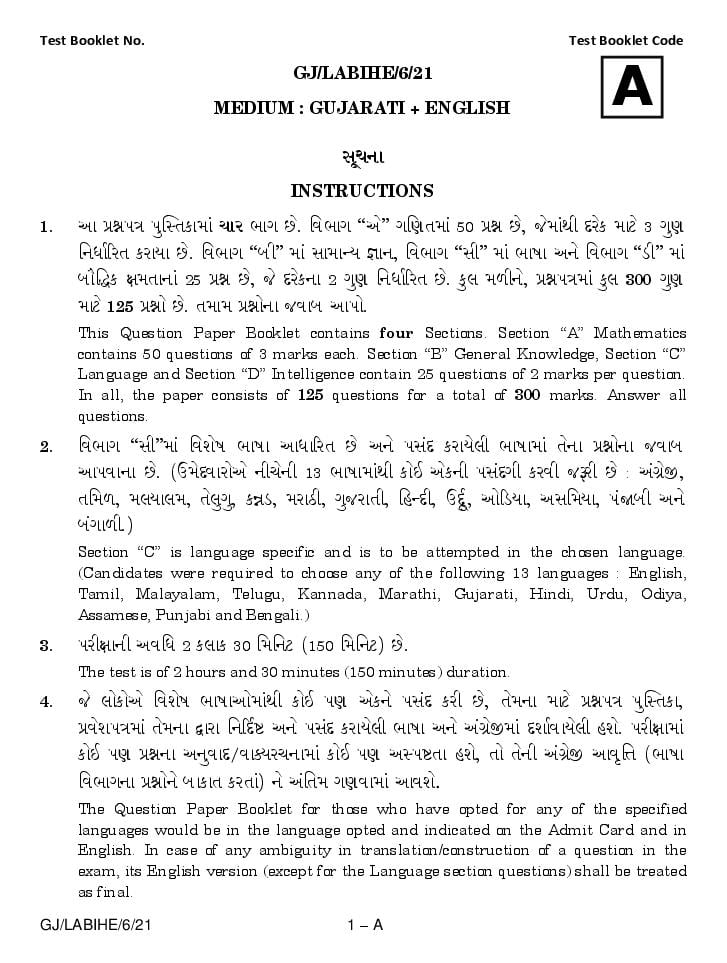
GJ/LABIHE/6/21
MEDIUM : GUJARATI + ENGLISH
A
k|Q_p
INSTRUCTIONS
1. Ap âñ`Ó `y[õsL$pdp„ Qpf cpN R>¡. rhcpN ‘‘A¡’’ NrZsdp„ 50 âñ R>¡, S>¡dp„\u v$f¡L$ dpV$¡ 3 NyZ
r_^p®qfs L$fpep R>¡. rhcpN ‘‘bu’’ dp„ kpdpÞe op_, rhcpN ‘‘ku’’ dp„ cpjp A_¡ rhcpN ‘‘X$u’’ dp„
bp¥rÙL$ ndsp_p„ 25 âñ R>¡, S>¡ v$f¡L$_p 2 NyZ r_^p®qfs R>¡. Ly$g dmu_¡, âñ`Ódp„ Ly$g 300 NyZ
dpV$¡ 125 âñp¡ R>¡. sdpd âñp¡_p S>hpb Ap`p¡.
This Question Paper Booklet contains four Sections. Section ‘‘A’’ Mathematics
contains 50 questions of 3 marks each. Section ‘‘B’’ General Knowledge, Section ‘‘C’’
Language and Section ‘‘D’’ Intelligence contain 25 questions of 2 marks per question.
In all, the paper consists of 125 questions for a total of 300 marks. Answer all
questions.
2. rhcpN ‘‘ku’’dp„ rhi¡j cpjp Ap^pqfs R>¡ A_¡ `k„v$ L$fpe¡gu cpjpdp„ s¡_p âñp¡_p S>hpb
Ap`hp_p R>¡. (Dd¡v$hpfp¡A¡ _uQ¡_u 13 cpjpdp„\u L$p¡C A¡L$_u `k„v$Nu L$fhu S>êfu R>¡ : A„N°¡Æ,
srdm, dgepgd, s¡gyNy, L$ßX$, dfpW$u, NyS>fpsu, rlÞv$u, Dv|$® y, Ap¡qX$ep, Akrdep, `„Åbu A_¡
b„Npmu.)
Section ‘‘C’’ is language specific and is to be attempted in the chosen language.
(Candidates were required to choose any of the following 13 languages : English,
Tamil, Malayalam, Telugu, Kannada, Marathi, Gujarati, Hindi, Urdu, Odiya,
Assamese, Punjabi and Bengali.)
3. `funp_u Ahr^ 2 L$gpL$ 30 rdr_V$ (150 rdr_V$) R>¡.
The test is of 2 hours and 30 minutes (150 minutes) duration.
4. S>¡ gp¡L$p¡A¡ rhi¡j cpjpAp¡dp„\u L$p¡C `Z A¡L$_¡ `k„v$ L$fu R>¡, s¡d_p dpV$¡ âñ`Ó `y[õsL$p,
âh¡i`Ódp„ s¡d_p Üpfp r_qv$®ô$ A_¡ `k„v$ L$fpe¡gu cpjp A_¡ A„N°¡Ædp„ v$ip®hpe¡gu li¡. `funpdp„
L$p¡C `Z âñ_p A_yhpv$/hp¼efQ_pdp„ L$p¡C `Z Aõ`ô$sp li¡, sp¡ s¡_u A„N°¡Æ Aph©rÑ (cpjp
rhcpN_p âñp¡_¡ bpL$ps L$fsp„) _¡ A„rsd NZhpdp„ Aphi¡.
The Question Paper Booklet for those who have opted for any of the specified
languages would be in the language opted and indicated on the Admit Card and in
English. In case of any ambiguity in translation/construction of a question in the
exam, its English version (except for the Language section questions) shall be treated
as final.
GJ/LABIHE/6/21 1–A
Page 2
b^p S> `p_p„ ^fph_pfu R>¡.
The Question Paper Booklet is of 32 pages. Please check and ensure that the Question
Paper Booklet is complete and contains all the pages.
6. sdpd âñp¡_p S>hpb a¼s Ap¡A¡dApf DÑfhludp„ S> Ap`p¡.
Answer all questions in the OMR Answer Sheet only.
7. Ap¡A¡dApf DÑfhlu, Ap âñ`Ó `y[õsL$p_u A„v$f S> R>¡. Äepf¡ sd_¡ âñ`Ó `y[õsL$p Mp¡ghp_p¡
r_v$£i A`pe, Ðepf¡ Ap¡A¡dApf DÑfhlu blpf L$pY$p¡ A_¡ rhNsp¡_¡ a¼s hpv$mu/L$pmu bp¸g `p¸CÞV$
`¡_ hX¡$ Ýep_`|h®L$ `|fp¡.
The OMR Answer Sheet is inside this Question Paper Booklet. When you are directed
to open the Question Paper Booklet, take out the OMR Answer Sheet and fill the
particulars carefully with blue/black ball point pen only.
8. v$f¡L$ âñ dpV$¡ Ap`_¡ DÑf_¡ ê$`dp„ a¼s A¡L$ S> Np¡m (Np¡mpL$pf)_¡ OpVy$„ L$fhp_y„ R>¡. Å¡ sd¡ A¡ âñ
dpV¡$ A¡L$ \u h^y Np¡m_¡ OpVy$„ L$fip¡ sp¡ sdpfp S>hpb_¡ Mp¡V$p¡ NZu g¡hpi¡.
Darken only one circle as your answer for each question. If you darken more than one
circle for the same question, your answer will be treated as wrong.
9. Mp¡V$p S>hpb dpV$¡ L$p¡C _L$pfpÐdL$ NyZ _\u.
There is no negative marking for a wrong answer.
10. Ap¡A¡dApf DÑfhlu `f rb_S>êfu r_ip_ _ L$fp¡ A\hp hpmip¡ _l] L¡ $s¡_¡ dfX$hp_p¡ A\hp
Qp¡mhp_p¡ âepk `Z _ L$fp¡. sd¡ Aphy„ L$fip¡ sp¡ sdpfu Ap¡A¡dApf DÑfhlu_y„ d|ëep„L$_ L$fhpdp„
Aphi¡ _l].
Do not make unnecessary marks on the OMR Answer Sheet or fold or attempt to
deface it. If you do so, your OMR Answer Sheet will not be evaluated.
11. Ap `p_p„ `f rhNsp¡ A_¡ S>hpb gMhp dpV$¡ a¼s hpv$mu/L$pmu bp¸g `p¸CÞV$ `¡__p¡ S> D`ep¡N
L$fp¡. `¡[Þkg_p¡ D`ep¡N _ L$fip¡.
Use Blue/Black Ball Point Pen only for writing particulars on this page and for writing
answers. Do not use pencil.
GJ/LABIHE/6/21 2–A
Page 3
fl¡i¡, Ap¡A¡dApf DÑfhlu `f _l].
Rough work is to be done on the space provided for this purpose in the Question Paper
Booklet only and not on the OMR Answer Sheet.
13. `funp `|fu \pe A¡V$g¡ hN®M„X$/lp¡gdp„\u blpf _uL$msp„ `l¡gp„ r_funL$ (C[ÞhrS>g¡V$f)_¡
Ap¡A¡dApf DÑfhlu kp¢`u v$¡hu.
On completion of the test, hand over the OMR Answer Sheet to the Invigilator before
leaving the Room/Hall.
14. sd_¡ Ap âñ`Ó `y[õsL$p sdpfu kp\¡ gC S>hp_u d„S|>fu R>¡.
You are allowed to take away this Question Paper Booklet with you.
15. Ap `y[õsL$p_¡ A`pe¡gp¡ L$p¡X$ A R>¡. Mpsfu L$fp¡ L¡$ Ap¡A¡dApf DÑfhlu `f A„qL$s L$fpe¡gp¡ L$p¡X$ A¡
S> R>¡, S>¡ Ap âñ`Ó `y[õsL$p_u D`f g¿ep¡ R>¡. Apdp„ L$p¡C `Z a¡f S>Zpe sp¡ Ap bpbs¡
spÐL$prgL$ S> r_funL$_y„ Ýep_ v$p¡fu_¡, s¡d_¡ âñ`Ó `y[õsL$p A_¡ Ap¡A¡dApf DÑfhlu- b„_¡ bv$gu
Ap`hp L$lp¡.
The CODE for this Booklet is A. Make sure that the CODE printed on the OMR
Answer Sheet is the same as that on this Question Paper Booklet. In case of
discrepancy, report the matter immediately to the Invigilator for replacement of both
the Question Paper Booklet and the OMR Answer Sheet.
16. sdpfp¡ ¾$dp„L$ (fp¡g _„.) âñ`Ó `y[õsL$p/Ap¡A¡dApf DÑfhludp„ A`pe¡gu r_^p®qfs S>Áep rkhpe
buS>¡ ¼ep„e gMip¡ _l].
Do not write your Roll No. anywhere else except in the specified space in the Question
Paper Booklet/OMR Answer Sheet.
17. Ap¡A¡dApf DÑfhlu `f L$p¡C `Z fus¡ ky^pfp¡ L$fhp dpV$¡ ìlpCV$ IL$ S>¡hp ka¡v$ âhplu `v$p \®_p¡
D`ep¡N L$fip¡ _l].
Do not use white fluid for carrying out any correction on the OMR Answer Sheet.
GJ/LABIHE/6/21 3–A
Page 4
NrZs / MATHEMATICS
1. L$C NprZrsL$ âq¾$epdp„ `|Zp¯L$ k„¿ep b„^ \pe R>¡ ?
(1) bpv$bpL$u (2) cpNpL$pf
(3) NyZpL$pf (4) Apdp„_u b^u S
Whole numbers are closed under which operation ?
(1) Subtraction (2) Division
(3) Multiplication (4) All of these
2. 1 rdrge__u `R>u_u k„¿ep R>¡
(1) 2 rdrge_ (2) 1000001 (3) 100001 (4) 10001
The successor of 1 million is
(1) 2 million (2) 1000001 (3) 100001 (4) 10001
3. k„¿ep f¡Mp `f tbv$yAp¡ O, U, S, V, R, X, W, T, P, Q s\p Y k„¿ep f¡Mp `f kdp_ A„sf¡ R>¡.
g„bpC OP L$ep¡ A`|Zp¯L$ v$ip®hpe R>¡ ?
1 7 4 6
(1) (2) (3) (4)
5 5 5 5
The points O, U, S, V, R, X, W, T, P, Q and Y on the number line are equidistant. The
fraction represented by length OP is
1 7 4 6
(1) (2) (3) (4)
5 5 5 5
4. L$ep b¡ `|Zp¯Lp¡_u$ hÃQ¡ A`|Zp¯L$ 5 Aph¡gp¡ R>¡ ?
7
(1) 0 A_¡ 1 (2) 5 A_¡ 7 (3) 5 A_¡ 6 (4) 6 A_¡ 7
5
The two consecutive integers, between which the fraction lies, are
7
(1) 0 and 1 (2) 5 and 7 (3) 5 and 6 (4) 6 and 7
5. _uQ¡_pdp„\u L$ep¡ A`|Zp¯L$ kp¥\u _p_p¡ R>¡ ?
4 5 5 5
(1) (2) (3) (4)
5 3 6 2
Which of the following is the smallest fraction ?
4 5 5 5
(1) (2) (3) (4)
5 3 6 2
GJ/LABIHE/6/21 4–A
Page 5
96 lp¡e sp¡ buÆ L$C li¡ ?
(1) 84 (2) 45 (3) 54 (4) 24
The HCF and LCM of two numbers are 6 and 864 respectively. If one number is 96,
find the other number.
(1) 84 (2) 45 (3) 54 (4) 24
7. b¡ k„¿epAp¡_p¡ NykpA (HCF) 12 R>¡ A_¡ s¡d_p¡ saphs `Z 12 R>¡. sp¡ Ap b„_¡ k„¿ep
_uQ¡_pdp„\u L$C lp¡C iL¡$ ?
(1) 84, 96 (2) 66, 78 (3) 70, 82 (4) 62, 78
The HCF of two numbers is 12 and their difference is 12. Which of the following can
be the numbers ?
(1) 84, 96 (2) 66, 78 (3) 70, 82 (4) 62, 78
8. A¡hu kp¥\u _p_u k„¿ep L$C R>¡ L¡$ S>¡ 9, 12 A_¡ 15 Ap v$f¡L$ Üpfp cpÄe R>¡ ?
(1) 60 (2) 90 (3) 120 (4) 180
Find the smallest number that is divisible by each one of 9, 12 and 15.
(1) 60 (2) 90 (3) 120 (4) 180
9. kpby-`pDX$f_u A¡L$ Qp¡½$k b°pÞX$_y„ h¡QpZ ` 15 ârs `¸L¡$V$ L$fpe R>¡. s¡_u `X$sf ` 144 ârs
X$T__u R>¡. sp¡ Aphp 8 X$T_ `¸L¡$V$ `f _ap_u V$L$phpfu L¡$V$gu \pe ?
(1) 20 (2) 25 (3) 24 (4) 36
A certain brand of soap-powder is sold at ` 15 per packet. It costs ` 144 a dozen. What
is the profit in percent on 8 dozen packets ?
(1) 20 (2) 25 (3) 24 (4) 36
10. A¡hu kp¥\u dp¡V$u k„¿ep ip¡^p¡ L¡$ S>¡_p hX¡$ 37, 56, 93_¡ cpNhpdp„ Aph¡ sp¡ i¡j A_y¾$d¡ 1, 2 A_¡
3 fl¡.
(1) 9 (2) 18 (3) 15 (4) 12
Find the greatest number that will divide 37, 56, 93 leaving remainder 1, 2 and 3
respectively.
(1) 9 (2) 18 (3) 15 (4) 12
GJ/LABIHE/6/21 5–A
Page 6
L$fhp dpV$¡ L¡$V$gp dpZkp¡_u S>êf `X$i¡ ?
(1) 10 (2) 8 (3) 40 (4) 12
If 10 men can do a piece of work in 4 days, how many men will be required to get the
same work done in 5 days ?
(1) 10 (2) 8 (3) 40 (4) 12
12. 21 bL$fu c¡Nu dmu_¡ 15 Npe S>¡V$gp¡ Qpfp¡ MpC Åe R>¡. sp¡ L¡$V$gu bL$fu dmu_¡ 35 Npe S>¡V$gp¡
Qpfp¡ MpC Åe ?
(1) 38 (2) 49 (3) 37 (4) 41
21 goats eat as much as 15 cows. How many goats eat as much as 35 cows ?
(1) 38 (2) 49 (3) 37 (4) 41
13. A¡L$ rdL¡$r_L$ 9 L$pfdp„\u ` 36,000 L$dpe R>¡. Å¡ 1 qv$hkdp„ s¡_¡ 27 L$pf_y„ L$pd L$fhp dm¡ R>¡ sp¡ s¡
1 qv$hkdp„ L¡$V$gy„ L$dpi¡ ?
(1) ` 1,08,000 (2) ` 1,80,000
(3) ` 1,00,800 (4) ` 1,00,080
A mechanic earns ` 36,000 on 9 cars. How much will he earn in 1 day, if in a day he
receives 27 cars ?
(1) ` 1,08,000 (2) ` 1,80,000
(3) ` 1,00,800 (4) ` 1,00,080
14. Å¡ x : y = 3 : 5, sp¡ 3x + 4y : 8x + 5y _p¡ NyZp¡Ñf L¡$V$gp¡ \pe ?
(1) 39 : 49 (2) 29 : 50
(3) 29 : 49 (4) 39 : 50
If x : y = 3 : 5, find the ratio 3x + 4y : 8x + 5y.
(1) 39 : 49 (2) 29 : 50
(3) 29 : 49 (4) 39 : 50
GJ/LABIHE/6/21 6–A
Page 7
(1) 6 (2) 54
(3) 7 (4) 252
Find the value of m, if 3, 18, m, 42 are in proportion.
(1) 6 (2) 54
(3) 7 (4) 252
16. A¡L$ NCC L¡$ç`dp„ 1200 spgudp\}Ap¡ cpN gC füp R>¡ S>¡dp„\u 900_¡ âÅkÑpL$qv$_ L¡$ç` dpV$¡
`k„v$ L$fpe R>¡. `k„v$ L$fpe¡gp A_¡ `k„v$ _l] \e¡gp L¡$X¡$V¹$k_u k„¿ep hÃQ¡_p¡ NyZp¡Ñf L¡$V$gp¡ li¡ ?
(1) 300 : 120 (2) 4:1 (3) 3:1 (4) 120 : 130
In an NCC Camp, 1200 trainees are participating out of which 900 are selected for
Republic Day Camp. What is the ratio between the number of selected and
non-selected cadets ?
(1) 300 : 120 (2) 4:1 (3) 3:1 (4) 120 : 130
17. Å¡ A¡L$ R>p¡L$fp¡ L$p¡C `yõsL$_¡ < 450dp„ h¡Q¡ R>¡, sp¡ s¡_¡ 10% Mp¡V$ Åe R>¡. 10% _ap¡ fmhp dpV$¡
s¡Z¡ h¡QpZ qL»$ds L¡$V$gu fpMhu `X¡$
(1) < 500 (2) < 600 (3) < 550 (4) < 525
If a boy sells a book for < 450, he makes a loss of 10%. To gain 10%, what should be
the selling price ?
(1) < 500 (2) < 600 (3) < 550 (4) < 525
18. A¡L$ dpZk 20% _ap\u A¡L$ õ`uL$f < 7,500 dp„ h¡Q¡ R>¡ A_¡ buSy>„ õ`uL$f, 10% Mp¡V$ MpC_¡
< 8,100 dp„ h¡Q¡ R>¡. sp¡ s¡_u Ly$g Mp¡V$ A\hp _ap¡ ip¡^p¡.
(1) Mp¡V$ = < 300 (2) Mp¡V$ = < 350
(3) _ap¡ = < 300 (4) _ap¡ = < 350
A man sells one speaker for < 7,500 at a profit of 20% and another speaker for
< 8,100 at a loss of 10%. Find his total loss or profit.
(1) Loss = < 300 (2) Loss = < 350
(3) Profit = < 300 (4) Profit = < 350
GJ/LABIHE/6/21 7–A
Page 8
(1) 3950 (2) 411 (3) 412 (4) 3949
Simplify (8 + 4 – 2) (17 – 12) 10 – 89 = _________ .
(1) 3950 (2) 411 (3) 412 (4) 3949
20. kpvy$„ ê$` Ap`p¡ 0·05 + 1·5 5 10 0·5 = _________ .
(1) 4·25 (2) 42·5 (3) 0·425 (4) 0·42
Simplify 0·05 + 1·5 5 10 0·5 = _________ .
(1) 4·25 (2) 42·5 (3) 0·425 (4) 0·42
21. kpvy$„ ê$` Ap`p¡ 7 + 5 – 2 (7 + 89) – 94 2 + (33 3 + 9 2 – 7) 11 = _________ .
(1) 254 (2) – 225 (3) – 235 (4) 245
Simplify 7 + 5 – 2 (7 + 89) – 94 2 + (33 3 + 9 2 – 7) 11 = _________ .
(1) 254 (2) – 225 (3) – 235 (4) 245
22. A¡L$ hN®M„X$dp„ 20 R>p¡L$fpAp¡_y„ kf¡fpi hS>_ 160 qL$N°p A_¡ bpL$u_p 5 R>p¡L$fpAp¡_y„ 50 qL$N°p R>¡. sp¡
hN®_p sdpd R>p¡L$fpAp¡_y„ kf¡fpi hS>_ L¡$V$gy„ li¡ ?
(1) 138 qL$N°p (2) 183 qL$N°p (3) 140 qL$N°p (4) 150 qL$N°p
The average weight of 20 boys in a class is 160 kg and that of the remaining 5 boys is
50 kg. Find the average weight of all the boys in the class.
(1) 138 kg (2) 183 kg (3) 140 kg (4) 150 kg
23. A¡L$ S|>\dp„ 7 rhÛp\}Ap¡A¡ d¡mh¡gp kf¡fpi NyZ 226 R>¡. Å¡ s¡dp„_p R> Üpfp A_y¾$d¡ 340, 180,
260, 56, 275 A_¡ 307 NyZ d¡mhpep lp¡e, sp¡ kpsdp rhÛp\}A¡ L¡$V$gp NyZ d¡mìep li¡ ?
(1) 160 (2) 162 (3) 163 (4) 164
The average marks obtained by 7 students in a group is 226. If the marks obtained by
six of them are 340, 180, 260, 56, 275 and 307 respectively, find the marks obtained
by the seventh student.
(1) 160 (2) 162 (3) 163 (4) 164
GJ/LABIHE/6/21 8–A
Page 9
sp¡ frhhpf\u iê$ \sp, 30 qv$hk_p drl_pdp„ dygpL$psuAp¡_u kf¡fpi k„¿ep L¡$V$gu li¡ ?
(1) 280 (2) 285 (3) 290 (4) 295
A library has an average of 510 visitors on Sundays and 240 on other days. The
average number of visitors in a month of 30 days starting with Sunday is
(1) 280 (2) 285 (3) 290 (4) 295
25. A¡L$ b¡V¹$kd¡_ 17 du d¡Qdp„ 87 f__p¡ õL$p¡f b_ph¡ R>¡ A_¡ Ap fus¡ s¡_u kf¡fpi 3 S>¡V$gu h^u
Åe R>¡. 17 du d¡Q `R>u s¡_u kf¡fpi L¡$V$gu li¡ ?
(1) 36 (2) 37 (3) 38 (4) 39
A batsman makes a score of 87 runs in the 17th match and thus increases his average
by 3. Find his average after the 17th match.
(1) 36 (2) 37 (3) 38 (4) 39
26. 1, 3, 5, 7, 9, 11, 13 _u kf¡fpi L¡$V$gu \pe ?
(1) 7 (2) 8 (3) 7·5 (4) 8·5
Average of 1, 3, 5, 7, 9, 11, 13 is
(1) 7 (2) 8 (3) 7·5 (4) 8·5
27. Å¡ y _y„ x% 100 R>¡ s\p z _y„ y% 200 R>¡, sp¡ x A_¡ z hÃQ¡_p¡ k„b„^ ip¡^p¡.
(1) z=x (2) 2z = x
(3) z = 2x (4) z = 3x
If x% of y is 100 and y% of z is 200, then find the relation between x and z.
(1) z=x (2) 2z = x
(3) z = 2x (4) z = 3x
28. L$p¡C k„¿ep_p b¡ `„Qdp„i_p A¡L s©rsep„i_p¡ A¡L$ Qsy\p¯i 15 \pe R>¡. sp¡ Ap k„¿ep_p 40% L¡$V$gp
\pe ?
(1) 140 (2) 150 (3) 180 (4) 200
One-fourth of one-third of two-fifth of a number is 15. What will be 40% of that
number ?
(1) 140 (2) 150 (3) 180 (4) 200
GJ/LABIHE/6/21 9–A
Page 10
(1) 14 (2) 16 (3) 18 (4) 20
If 15% of 40 is greater than 25% of a number by 2, then the number is
(1) 14 (2) 16 (3) 18 (4) 20
30. A¡L$ g„bQp¡fk S>¡_y„ n¡Óam 700 Qp¡fk duV$f A_¡ `lp¡mpC 25 duV$f R>¡, s¡_u g„bpB k¡dudp„ L¡$V$gu
s¡ ip¡^p¡.
(1) 28 (2) 280
(3) 2800 (4) 2500
Find the length of a rectangular playground in cm whose area is 700 sq.m and
breadth is 25 m.
(1) 28 (2) 280
(3) 2800 (4) 2500
31. fu_pA¡ < 1,200 _y„ F>Z kpv$p„ ìepS> `f A¡V$gp„ hjp£ dpV$¡ gu^y„, S>¡V$gp¡ s¡_p¡ ìepS>v$f R>¡. Å¡
s¡ZuA¡ F>Z_u dyv$s_p A„s¡ < 432_y„ ìepS> Q|L$ìey„ lp¡e sp¡ ìepS>v$f L¡$V$gp¡ li¡ ?
(1) 3·6 (2) 6
(3) 18 (4) 10
Reena took a loan of < 1,200 with simple interest for as many years as the rate of
interest. If she paid < 432 as interest at the end of the loan period, what was the rate
of interest ?
(1) 3·6 (2) 6
(3) 18 (4) 10
32. Äepf¡ OqX$epmdp„ kp„S>_p 7:15 hpNu füp lp¡e, sp¡ s¡dp„ L$ep¡ M|Zp¡ fQpe R>¡
(1) gOyL$p¡Z (2) L$pV$L$p¡Z
(3) Nyê$ L$p¡Z (4) kyf¡ML$p¡Z
Write the name of the angle formed when the clock time is 7:15 pm.
(1) Acute angle (2) Right angle
(3) Obtuse angle (4) Straight angle
GJ/LABIHE/6/21 10 – A
Page 11
D`ep¡N L$fu_¡ _uQ¡_p S>hpb Ap`p¡ :
Þe|ep¡L®$ il¡fdp„ Ns hj®_p ÓZ drl_p d¡, Sy>gpC A_¡ kàV$¡çbf_y„ kf¡fpi dlÑd sp`dp_ ( 2
v$ip„i õ\m ky^u) L¡$V$gy„ lsy„ ?
drl_p ÅÞeyApfu dpQ® d¡ Sy>gpC kàV$¡çbf _h¡çbf
dlÑd sp`dp_, Cdp„ 3 9 21 29 24 11
(1) 21·65C (2) 24·66C (3) 25·52C (4) 26·23C
The table below shows the maximum temperatures in New York City last year. Use
the information in this table and answer the following :
What was the average maximum temperature (upto 2 decimal places) of three months
May, July and September last year in New York City ?
Month Jan. Mar. May Jul. Sept. Nov.
Maximum
3 9 21 29 24 11
temperature, in C
(1) 21·65C (2) 24·66C (3) 25·52C (4) 26·23C
34. khpf_y„ sp`dp_ – 10C lsy„ A_¡ kp„S> ky^udp„ s¡ 3 qX$N°u S>¡V$gy„ OV$u Ney„. sp¡ kp„S>¡ sp`dp_ L¡$V$gy„
li¡ ?
(1) – 7C (2) – 23C (3) – 13C (4) – 12C
In the morning, the temperature was – 10C and it decreased 3 degrees by the
evening. What was the temperature in the evening ?
(1) – 7C (2) – 23C (3) – 13C (4) – 12C
35. A¡L$ g„bQp¡fk bNuQp¡ 185 duV$f gp„bp¡ A_¡ 220 duV$f `lp¡mp¡ R>¡. s¡_u hÃQ¡ 4 duV$f_u
A¡L$kdp_ `lp¡mpChpmp b¡ fõsp R>¡, S>¡dp„ A¡L g„bpC_¡ kdp„sf A_¡ buÅ¡, s¡_u `lp¡mpC_¡
kdp„sf R>¡. < 1.25 ârs Qp¡.du._p cph\u, fõspAp¡_¡ kd\m L$fhp `pR>m L¡$V$gp¡ MQ® \i¡ s¡
ip¡^p¡.
(1) < 3,900 (2) < 3,010 (3) < 4,010 (4) < 2,005
A rectangular garden is 185 m long and 220 m wide. It has two roads in its centre of
uniform width of 4 m, one parallel to its length and the other parallel to its breadth.
Find the cost of levelling the roads at < 1·25 per sq.m.
(1) < 3,900 (2) < 3,010 (3) < 4,010 (4) < 2,005
GJ/LABIHE/6/21 11 – A
Page 12
(1) 1 10–1 du. (2) 1 10–2 du.
(3) 1 102 du. (4) 1 103 du.
One decimeter is equal to
(1) 1 10–1 m (2) 1 10–2 m
(3) 1 102 m (4) 1 103 m
37. fp¡d_ k„¿ep `Ùrsdp„, L$p¡C k„L¡$spnf hpf„hpf Aph¡ R>¡, sp¡ S>¡V$gu hpf s¡ Aph¡ s¡V$gu hpf s¡_p„
d|ëe_p¡ NyZpL$pf L$fpsp¡ _\u.
(1) kpQy„ (2) Mp¡Vy$„
(3) L$lu _ iL$pe (4) b„_¡ kdp_ R>¡
In Roman numeration, if a symbol is repeated, its value is not multiplied as many
times as it occurs.
(1) True (2) False
(3) Cannot say (4) Both are equal
38. Np¡mpL$pf_p„ L$p¡C `Z tbv$y `f A^® Np¡mpL$pf_p ìepk Üpfp L¡$V$gp A„i_p¡ M|Zp¡ fQpe ?
(1) 45 _p¡ (2) 180 _p¡
(3) 90 _p¡ (4) 60 _p¡
The angle subtended by the diameter of a semicircle on any point on the circle is
(1) 45 (2) 180
(3) 90 (4) 60
39. A¡L$ dp¡V$p O__p¡ v$f¡L$ cpN 44 k¡du R>¡. s¡dp„\u 4 k¡du_p¡ A¡L$ A¡hp _p_p-_p_p O_ L$p`hpdp„
Aph¡ R>¡. sp¡ Ap¡R>pdp„ Ap¡R>p A¡L$ O_ Üpfp O¡fpe¡gp lp¡e s¡hp L¡$V$gp _p_p O_ b_i¡$ ?
(1) 888 (2) 729
(3) 164 (4) 33
A big cube has each portion of 44 cm. Tiny cubes of 4 cm portion each are cut from
that. Then how many tiny cubes will be formed that are surrounded by at least one
cube ?
(1) 888 (2) 729
(3) 164 (4) 33
GJ/LABIHE/6/21 12 – A
Page 13
cf¡gu R>¡. sp¡ V$p„L$udp„_p„ `pZu_y„ v$m ip¡^p¡.
(1) 180 O_ k¡du (2) 1200 O_ k¡du
(3) 440 O_ k¡du (4) 1440 O_ k¡du
A rectangular tank 15 cm long, 12 cm wide and 8 cm high was completely filled with
water. Find the volume of water in the tank.
(1) 180 cm3 (2) 1200 cm3
(3) 440 cm3 (4) 1440 cm3
41. L$ep rhL$ë`dp„ QY$sp ¾$ddp„ Np¡W$hhpdp„ Aph¡gp A`|Zp¯L$p¡ v$ip®hpep R>¡ ?
5 7 3 13 5 7 13 3
(1) < < < (2) < < <
8 12 4 16 8 12 16 4
5 3 13 7 7 5 3 13
(3) < < < (4) < < <
8 4 16 12 12 8 4 16
Which option shows fractions arranged in ascending order ?
5 7 3 13 5 7 13 3
(1) < < < (2) < < <
8 12 4 16 8 12 16 4
5 3 13 7 7 5 3 13
(3) < < < (4) < < <
8 4 16 12 12 8 4 16
42. 945·341 – 1042·792 + 875·435 + 31·025 _y„ d|ëe iy„ R>¡ ?
(1) 908·004 (2) 810·008
(3) 795·659 (4) 809·009
What is the value of 945·341 – 1042·792 + 875·435 + 31·025 ?
(1) 908·004 (2) 810·008
(3) 795·659 (4) 809·009
GJ/LABIHE/6/21 13 – A
Page 14
dykpafu, 80 qL$du/L$gpL$_u TX$`¡ `|fu L$f¡ R>¡. sp¡ dykpafu_p â\d 320 qL$du_u kf¡fpi Nrs L¡$V$gu
li¡ ?
(1) 35·55 qL$du/L$gpL (2) 36 qL$du/L$gpL
(3) 71·11 qL$du/L$gpL (4) 71 qL$du/L$gpL
A man on tour travels first 160 km at 64 km/hr and the next 160 km at 80 km/hr. The
average speed for the first 320 km of the tour is
(1) 35·55 km/hr (2) 36 km/hr
(3) 71·11 km/hr (4) 71 km/hr
44. 2272 s\p 875_¡ 3 A„L$_u b_¡gu k„¿ep N hX¡$ cpNhp\u, Ap`Z_¡ s¡V$gu S> i¡j dm¡ R>¡. sp¡
N _p A„L$p¡_p¡ kfhpmp¡ L¡$V$gp¡ \pe ?
(1) 10 (2) 11 (3) 12 (4) 13
On dividing 2272 as well as 875 by a 3-digit number N, we get the same remainder.
The sum of the digits of N is
(1) 10 (2) 11 (3) 12 (4) 13
45. S|>rgep_¡ 1 L$gpL$ L$`X$p„ ^p¡sp„, `p¡sp_p hpm Ap¡msp A_¡ L$`X$p„ `l¡fsp„ \C Åe R>¡ s\p 1 L$gpL$
2 4
_põsp¡ L$fhpdp„ gpNu Åe R>¡. sp¡ õL|$g S>hp dpV$¡ s¥epf \hpdp„ S|>rgep_¡ L¡$V$gp¡ kde gpN¡ R>¡ ?
3 2 5
(1) L$gpL (2) 1 L$gpL (3) L$gpL (4) L$gpL
4 4 4
1 1
It takes Julia hour to wash, comb her hair and put on her clothes and hour to
2 4
have her breakfast. How much time does it take Julia to be ready for school ?
3 2 5
(1) hour (2) 1 hour (3) hour (4) hour
4 4 4
46. fp¡d_ k„¿epAp¡dp„ _uQ¡_pdp„\u L$C k„¿ep Mp¡V$u R>¡ ?
(1) LXII (2) XCI (3) LC (4) XLIV
Which of the following numbers in Roman Numerals is incorrect ?
(1) LXII (2) XCI (3) LC (4) XLIV
GJ/LABIHE/6/21 14 – A
Page 15
(1) 6 (2) 12 (3) 8 (4) 4
How many faces are there in a cuboid ?
(1) 6 (2) 12 (3) 8 (4) 4
48. A¡L$ k`pV$ k`pV$u L¡$ S>¡ sdpd qv$ipAp¡dp„ Ar_[íQs`Z¡¡ h^¡ R>¡, s¡_¡ L$l¡hpe R>¡
(1) kdsg (2) f¡Mp
(3) f¡MpM„X (4) tbv$y
A flat surface which extends indefinitely in all directions is called a
(1) Plane (2) Line
(3) Line segment (4) Point
49. b¡ `|fL$ L$p¡Z_u hÃQ_p¡ saphs 10 R>¡. b„_¡ L$p¡Z_p d|ëep¡_u NZsfu L$fp¡.
(1) 55, 45 (2) 40, 50
(3) 50, 60 (4) 100, 90
The difference between two complementary angles is 10. Calculate the values of both
the angles.
(1) 55, 45 (2) 40, 50
(3) 50, 60 (4) 100, 90
50. f]NZ, c]X$p A_¡ Xy$„Nmu_y„ Ly$g hS>_ 48·057 qL$N°p R>¡. Å¡ f]NZ A_¡ c]X$p_y„ hS>_ ¾$di:
5·35 qL$N°p A_¡ 24·52 qL$Np° R>¡, sp¡ Xy$„Nmu_y„ hS>_ L¡$V$gy„ \pe ?
(1) 17·187 qL$N°p (2) 18·187 qL$N°p
(3) 17·180 qL$N°p (4) 18·180 qL$N°p
The total weight of brinjal, lady-finger and onion is 48·057 kg. If brinjal and
lady-finger weigh 5·35 kg and 24·52 kg respectively, find the weight of onion.
(1) 17·187 kg (2) 18·187 kg
(3) 17·180 kg (4) 18·180 kg
GJ/LABIHE/6/21 15 – A
Page 16
kpdpÞe op_ / GENERAL KNOWLEDGE
51. L$ep e„Ó_p¡ D`ep¡N hpl_p¡_u Nrs dp`hp dpV$¡ \pe R>¡ ?
(1) N°¡hp¡duV$f (2) õ`uX$p¡duV$f
(3) Tpefp¡õL$p¸` (4) qL$gp¡duV$f
Which device is used to measure the speed of vehicles ?
(1) Gravometer (2) Speedometer
(3) Gyroscope (4) Kilometer
52. cpfs¡ L$ep„ õdpfLdp„\u `p¡sp_y„ fpô²rQŒ `k„v$ L$ey¯ R>¡ ?
(1) L$r`ghõsydp„\u (2) l[õs_p`yfdp„\u
(3) kpf_p\dp„\u (4) `prZ`sdp„\u
From which monument did India adopt its National Emblem ?
(1) Kapilavastu (2) Hastinapur
(3) Sarnath (4) Panipat
53. _uQ¡_pdp„\u L$C _©Ðe i¥gu_u hpsp®/rhjehõsy l„d¡ip„ dlpcpfs A_¡ fpdpeZdp„\u S> g¡hpdp„
Aph¡ R>¡ ?
(1) dp¡rl_uAË$d (2) Ap¡qX$ku
(3) cfs_pV$éd (4) Ly$Qu`|X$u
In which of the following styles of dance is the story/theme always taken from
Mahabharata and Ramayana ?
(1) Mohiniattam (2) Odissi
(3) Bharatanatyam (4) Kuchipudi
54. Ap`Zp„ fpô²ue `„Qp„N (iL$k„hs)_p Ap^pf¡ _uQ¡ S>Zph¡gp drl_pAp¡_¡ kpQp ¾$ddp„ Np¡W$hp¡ —
a-Q¥Ó b-h¥ipM c-S>¡W d-AjpY :
(1) abcd (2) bcda (3) dacb (4) cdab
Arrange the months based on our National Calendar (Saka Era) in correct serial
order — a-Chaitra b-Vaishakha c-Jyaishtha d-Aashada :
(1) abcd (2) bcda (3) dacb (4) cdab
55. _uQ¡_pdp„\u L$ey„ eyÙrhdp_ R>¡ ?
(1) s¡S>k (2) ^°yh
(3) bp¡IN C-17 Ágp¡bdpõV$f (4) Q¡sL$
Which one of the following is a combat aircraft ?
(1) Tejas (2) Dhruv
(3) Boeing C-17 Globemaster (4) Chetak
GJ/LABIHE/6/21 16 – A
Page 17
(1) X¡$rhk L$` (2) Q¡[ç`eÞk V²$p¡au
(3) k„sp¡j V²$p¡au (4) v$¡h^f V²$p¡au
Which of the following cups/trophies is associated with football ?
(1) Davis Cup (2) Champions Trophy
(3) Santosh Trophy (4) Deodhar Trophy
57. L$uX$uAp¡ `p¡sp_p S|>\_u L$uX$uAp¡_¡ L¡$hu fus¡ Ap¡mM¡ R>¡ ?
(1) f„N Üpfp (2) Ql¡fp Üpfp
(3) N„^ Üpfp (4) KQpC Üpfp
How do ants recognize ants from their group ?
(1) By colour (2) By face
(3) By smell (4) By height
58. _uQ¡_pdp„\u L$p¡_¡ `p¡ëV²$u apd®dp„ DR>¡fhpdp„ Aph¡ R>¡ ?
(1) bL$fu_¡ (2) O¡V$p„_¡ (3) dfOp„_¡ (4) Op¡X$p_¡
Which of the following is domesticated in poultry farms ?
(1) Goat (2) Sheep (3) Hen (4) Horses
59. ___________ Æc `f a¡gpe¡gu lp¡e R>¡ A_¡ cp¡S>_dp„ fkpeZp¡ kp\¡ ârsq¾$ep L$f¡ R>¡.
(1) õhpv$¡ÞÖuep¡ (2) Ahfp¡r^r_Ap¡ ([õaÞ¼V$f)
(3) v$p„s (4) ÐhQp
The ___________ cover the tongue and react to chemicals in food.
(1) Taste Buds (2) Sphincters
(3) Teeth (4) Skin
60. MpÛ`v$p\®_¡ kpQhu fpMhpdp„ k„N°ldp„ äutTN_u iu c|rdL$p R>¡ ?
(1) MpÛ`v$p\®_¡ L$W$Z fpMhp_u
(2) MpÛ`v$p\®_u kp¡X$d_¡ spÆ fpMhp_u
(3) k|ÿdÆhp¡_u h©rÙ_¡ fp¡L$hp_u
(4) D`f_pdp„\u A¡L¡$e _l]
What does freezing do when preserving foods ?
(1) Keeps the food product hard
(2) Keeps the flavours of the food fresh
(3) Stops growth of micro-organisms
(4) None of the above
GJ/LABIHE/6/21 17 – A
Page 18
(1) k`n buS> lp¡e R>¡.
(2) dp¡V$p A_¡ hpmhpmp buS> lp¡e R>¡.
(3) gp„bp„ A_¡ kp„L$X$p„ am lp¡e R>¡.
(4) L$p„V$pmp„„ buS> lp¡e R>¡.
Seeds of drumstick and maple are carried over long distances by wind because they
possess
(1) winged seeds.
(2) large and hairy seeds.
(3) long and ridged fruits.
(4) spiny seeds.
62. __________ fpS>õ\p__u `f„`fpNs hfkpv$u S>mk„Qe `Ùrs R>¡.
(1) V$p„L$p (2) MqX$_ (3) bphX$u (4) L|$hp
__________ is a traditional rainwater harvesting technique of Rajasthan.
(1) Taanka (2) Khadin (3) Bavadi (4) Kuan
63. _uQ¡_pdp„\u iy„ `pZudp„ Ap¡Nmu Åe R>¡ ?
(1) dpV$u (2) Qp¡L$ `pDX$f
(3) Mp„X$ (4) s¡g
Which of the following will dissolve in water ?
(1) Soil (2) Chalk Powder
(3) Sugar (4) Oil
64. _uQ¡_pdp„\u L$ep¡ Q¡`u fp¡N R>¡ ?
(1) X$peprbV$uk (2) AR>bX$p
(3) AëTpCdf (4) L¡$Þkf
Which of the following is a communicable disease ?
(1) Diabetes (2) Chicken pox
(3) Alzheimer’s (4) Cancer
65. `h®spfp¡lZ L$fhp dpV$¡ Ap`Z¡
(1) ApNm sfa _dhy„ Å¡CA¡ (2) `pR>m sfa _dhy„ Å¡CA¡
(3) ku^p Qpghy„ Å¡CA¡ (4) A¡L$-bpSy>A¡ Qpghy„ Å¡CA¡
To climb the mountains, we have to
(1) Bend forward (2) Bend backwards
(3) Walk straight (4) Walk sideways
GJ/LABIHE/6/21 18 – A
Page 19
h¡^ipmp_y„ _pd S>Zphp¡.
(1) gpg qL$ëgp¡ (2) Ly$syb rd_pf
(3) S>„sf d„sf (4) spS>dlg
Name an astronomical observatory built in the 18th century by Rajput King Sawai Jai
Singh of Rajasthan.
(1) Red Fort (2) Qutub Minar
(3) Jantar Mantar (4) Taj Mahal
67. ____________ dp„ Ap„sqfL$ MX$Lp¡$, Mr_Å¡ hN¡f¡ kpd¡g lp¡e R>¡.
(1) hpsphfZ (2) Æhd„X$m
(3) Np¡mp^® (4) c|d„X$m
_____________ includes internal rocks, minerals, etc.
(1) Atmosphere (2) Biosphere
(3) Hemisphere (4) Geosphere
68. gpMp¡ hjp¡® `l¡gp„ v$V$pB Ne¡gp R>p¡X$ A_¡ Å_hfp¡_p Ahi¡jp¡_¡ iy„ L$l¡hpe R>¡ ?
(1) k„crhs qfTh® (2) A[ídc|s I^Z
(3) bpep¡dpk I^Z (4) kÆh ir¼s
The remains of plants and animals that were buried millions of years ago are known
as
(1) potential reserves (2) fossil fuels
(3) biomass fuel (4) animate power
69. fkNyëgp ___________ _u âQrgs rdW$pC R>¡.
(1) `ròd b„Npm (2) `„Åb
(3) L¡$fm (4) rldpQgâv$¡i
Rasgulla is a popular sweet of ___________ .
(1) West Bengal (2) Punjab
(3) Kerala (4) Himachal Pradesh
70. _uQ_pdp„\u L$ep¡, cpfs_p¡ A¡L$ Apqv$hpku kdyv$pe R>¡ ?
(1) `„qX$s (2) ÅV
(3) cug (4) `„Åbu
Which of the following is a tribal community of India ?
(1) Pandits (2) Jaat
(3) Bhil (4) Punjabi
GJ/LABIHE/6/21 19 – A
Page 20
(1) bfa_p (2) ^|m_p
(3) `pZu_p V$u`p„_p (4) ^ydpX$p_p
Clouds are mostly made of
(1) snow (2) dust
(3) water droplets (4) smog
72. _uQ¡_pdp„\u L$C L©$rs dpV$¡ hpkv$¡h dp¡lu_¡ 29dy„ kfõhsu kÞdp_ A¡_pes L$fpey„ lsy„ ?
(1) gp¡õV$ rQëX²$_ ApL$p®Ch (2) Q¡L$byL
(3) ^ õV²$¢S>f X$pefuT (4) A¡ kp¢N ap¡f A¡ Þe| X¡$
For which of the following works has Vasdev Mohi been awarded the 29th Saraswati
Samman ?
(1) Lost Children Archive (2) Chequebook
(3) The Stranger Diaries (4) A Song for a New Day
73. ey.A¡_. dlpkcp_p AÝen b__pfp â\d cpfsue L$p¡Z lsp ?
(1) _V$hftkl (2) hu.L¡$. L©$óZ d¡__
(3) îudsu rhS>ep gÿdu `„qX$s (4) îudsu C[Þv$fp Np„^u
Who was the first Indian to be the President of U.N. General Assembly ?
(1) Natwar Singh (2) V.K. Krishna Menon
(3) Smt. Vijaya Lakshmi Pandit (4) Smt. Indira Gandhi
74. dp_hifuf_p, _uQ¡_pdp„\u L$ep cpNdp„ `fk¡hp_u N°„r\Ap¡¡ lp¡su _\u ?
(1) Mp¡`fudp„ (2) bNgdp„
(3) lp¡W$ `f (4) l\¡mudp„
In which of the following parts of the human body are sweat glands absent ?
(1) Scalp (2) Armpits
(3) Lips (4) Palms
75. L$p„Np{_p _p_p bÃQp_¡ Ap`Z¡ iy„ L$luA¡ R>uA¡ ?
(1) ap¡g (2) L$p¡ëV >
(3) Å¡C $ (4) L$b
What do we call the young one of a Kangaroo ?
(1) Foal (2) Colt
(3) Joey (4) Cub
GJ/LABIHE/6/21 20 – A
Page 21
cpjp / LANGUAGE
(a¼s NyS>fpsu cpjp_p¡ âepk L$f_pfp dpV$¡)
76. _uQ¡_p iåv$ dpV¡$ kpQp¡ kdp_p\} iåv$ hpmp¡ rhL$ë` `k„v$ L$fp¡.
‘kv$ph°s’
(1) d„qv$f (2) rhÛpge (3) Aßn¡Ó (4) Þepepge
77. _uQ¡_p hp¼ep¡/iåv$kd|l dpV¡$ Ap`¡g rhL$ë`p¡dp„\u ep¡Áe rhL$ë` `k„v$ L$fp¡.
— S>¡_p¡ dpN® L$ëepZL$pfu lp¡e s¡
(1) cÖdpN} (2) kydpN} (3) rlsp\} (4) rlsL$pfu
78. _uQ¡ Ap`¡g iåv$p¡_u kpQu Å¡X$Zu hpmp¡ iåv$ `k„v$ L$fp¡.
(1) lŸ„kpsyku (2) lº„kpsy„ku (3) lºkpsyku (4) lŸkps|ku
79. _uQ¡_pdp„\u L$ep¡ iåv$ ‘s_y’_p¡ kdp_p\} iåv$ _\u ?
(1) ky„v$f (2) `psmy„ (3) _p_y„ (4) v$uL$fp¡
80. õÓutgN iåv$ ip¡^p¡.
(1) v|$^ (2) _pL$ (3) Ùpf (4) L$õs|fu
81. _uQ¡ Ap`¡g iåv$ dpV¡$ kpQp¡ k„r^-rhÃR>¡v$_p¡ rhL$ë` `k„v$ L$fp¡.
‘ch_’
(1) cp¡ + A_ (2) cp¡ + h_ (3) cp¡: + A_ (4) cp¡h¹ + A_
82. _uQ¡_p iåv$ dpV¡$ kpQp¡ rhfyÙp\} iåv$ hpmp¡ rhL$ë` `k„v$ L$fp¡.
‘Mp¡a’
(1) AZNdp¡ (2) dl¡f (3) Nyõkp¡ (4) O©Zp
83. _uQ¡ Ap`¡g iåv$_y„ iyÙ ê$` `k„v$ L$fp¡.
(1) rh`fus (2) hu`qfs (3) hu`fus (4) rh`qfs
84. ê$qY$âep¡N_p¡ kpQp¡ A\® `k„v$ L$fp¡.
Qp_L$ QX$hu :
(1) DÐkpldp„ Aphu S>hy„ (2) Nyõk¡ cfphy„
(3) sp_dp„ Aphhy„ (4) fukpC S>hy„
85. ê$qY$âep¡N_p¡ kpQp¡ A\® `k„v$ L$fp¡.
QZp gC Mphp :
(1) R>u_hu g¡hy„ (2) AhNZ_p L$fhu
(3) Mp Mp L$fhy„ (4) Cjp® \hu
GJ/LABIHE/6/21 21 – A
Page 22
(1) v$u` (2) dyLy$f (3) âv$u` (4) v$u`L$
87. _uQ¡ Ap`¡g iåv$_p¡ rhfyÙp\} iåv$ ip¡^p¡.
‘Q¡s_’
(1) ApNd_ (2) dfZ (3) bv$gp¡ (4) S>X$
88. ‘fdL$Xy„$’ iåv$ _y„ blºhQ_ ê$` R>¡ :
(1) fdL$X$pAp¡ (2) fdL$X$p¡ (3) fdL$X$p„ (4) fdL$X$php¡
89. _uQ¡ Ap`¡g iåv$ dpV¡$ kpQp¡ k„r^-rhÃR>¡v$ _p¡ rhL$ë` `k„v$ L$fp¡.
‘CÐepqv$’
(1) Crs + Aqv$ (2) Cs¹ + Apqv$ (3) Crs + Apqv$ (4) Csu + Apqv$
90. _uQ¡ Ap`¡g iåv$p¡_u kpQu Å¡X$Zu hpmp¡ iåv$ `k„v$ L$fp¡.
(1) Ar‚`qfnp (2) Ar‚`funp (3) A‚u`funp (4) A‚u`qfnp
91. _uQ¡_p iåv$ dpV¡$ kpQp¡ rhfyÙp\} iåv$ hpmp¡ rhL$ë` `k„v$ L$fp¡.
‘dp¢Ohpfu$’
(1) vy$g®c (2) Ar_ô$ (3) V$L$phpfu (4) kp¢^hpfu
92. ‘dp¡f_p IX$p Qusfhp„ _ `X¡$’ L$l¡hs_p¡ A\® S>Zphp¡.
(1) dp¡f ky„v$f `nu R>¡ s¡\u
(2) dp¡f _p IX$p f„Nu_ lp¡e R>¡ s¡\u
(3) dpsp-r`sp_p k„õL$pf-NyZp¡ bpmL$p¡dp„ Ap`p¡Ap` Aph¡ R>¡
(4) dp¡f Ap`Ï„ fpô²$ue `nu R>¡ s¡\u
93. _uQ¡_p `¥L$u L$ep rhL$ë`dp„ rhfyÙp\} iåv$p¡ _\u ?
(1) Api}hpv$ – ip` (2) N°pçe$ – i¡lfu
(3) Djp$ – k„Ýep (4) A_ph©rô$$ – vy$L$pm
94. ‘ApL$pidp„ af_pfy„’ iåv$kd|l dpV¡$ A¡L$ iåv$ Ap`p¡.
(1) c|Qf (2) S>mQf (3) M¡Qf (4) AQm
95. iåv$p¡_¡ ¾$dp_ykpf ìeh[õ\s L$fu kpQp¡ rhL$ë` `k„v$ L$fp¡.
Apv$f / dpsp-r`sp _p¡ / L$fhp¡ Å¡CA¡ / l„d¡ip
(A) (B) (C) (D)
(1) DBCA (2) DBAC (3) BCAD (4) DCAB
GJ/LABIHE/6/21 22 – A
Page 23
\u 100)
L$Z® ^_yrh®Ûp iuMhp dp„Nsp¡ lsp¡. `f„sy s¡ k|s-`yÓ (nrÓe kpfr\ A_¡ b°pûZ õÓu\u
Ds`ß `yÓ) lsp¡ dpV¡$ Öp¡ZpQpe£ A¡_¡ rhÛp iuMhhp_u _p `pX$u. Ap\u L$Z® `fiyfpd `pk¡ Nep¡.
L$Z®_¡ Mbf lsu L¡$ `fiyfpd nrÓep¡_¡ r^½$pf¡ R>¡ dpV¡$ A¡Z¡ `fiyfpd_¡ `p¡sp_p¡ `qfQe b°pûZ
sfuL¡$ Apàep¡ A_¡ ^_yrh®Ûp iuMhhp rh_„su L$fu. `fiyfpd¡ L$Z®_p¡ rióe sfuL¡$ õhuL$pf L$ep£ A_¡
`p¡s¡ S>¡ L$pC ÅZsp lsp s¡ b^y„ S> L$Z®_¡ iuMìey„.
A¡L$ qv$hk `fiyfpd L$Z®_p kp\m `f dp\y„ fpMu k|C Nep lsp. s¡ kde¡ `fiyfpd_p dp\p
_ÆL$ L$Z®_p kp\m `f A¡L$ cdfu kss X„$M dpfhp gpNu. L$Z£ rhQpey¯ L¡$ Å¡ lº„ cdfu_¡
cNpX$hp_p¡ âeÐ_ L$fui sp¡ dpfp NyfyÆ_u r_Öpdp„ Mg¡g `lp¢Qi¡ dpV¡$ s¡Z¡ Q|`L$uv$u`|h®L$ cdfu_p
X„$M_y„ vy$:M kl_ L$fu gu^y„. gp¡lu hl¡hp gpÁey„ A_¡ s¡ `fiyfpd_p Ql¡fp ky^u `lp¢Qu Ney„. gp¡lu_u
DóZsp\u `fiyfpd ÅNu Nep. iy„ bÞey„ s¡ L$Z® `pk¡\u ÅÎey„. s¡Ap¡ ÅZsp lsp L¡$ nrÓe S> Aphu
eps_p A_¡ `uX$p kl_ L$fu iL¡$. `fiyfpd¡ `X$`|R> L$fsp L$Z£ `p¡sp_p rhi¡_y„ kÐe Ål¡f L$ey¯ A_¡
Sy>Ìz„$ bp¡ghp bv$g dpau dpNu. `fiyfpd¡ dpau Ap`u _l] A_¡ L$Z®_¡ ip` Apàep¡ L¡$ Äepf¡ sy spfp
âbm iÓy kpd¡ AõÓ_p¡ D`ep¡N L$fhp dp„Nui Ðepf¡ s¡ S> nZ¡ spfu õd©rs v$Np¡ v$¡i¡. s¡dZ¡ A¡
`Z L$üy„ L¡$ sy„ `©Õhu `f_p¡ kh®î¡›$ bpZphpmu sfuL¡$ ÅZusp¡ \Ci.
96. L$p¡Z ^_yrh®Ûp iuMhp dp„Nsy„ lsy„ ?
(1) ASy>®_ (2) vy$ep£^_ (3) cud (4) L$Z®
97. L$p¡Z¡ ^_yrh®Ûp iuMhpX$hp_u _p `pX$u ?
(1) Öp¡ZpQpe® (2) `fiyfpd (3) cuód (4) bgfpd
98. L$Z®_p¡ rióe sfuL¡$ L$p¡Z¡ õhuL$pf L$ep£ ?
(1) L©$óZ (2) `fiyfpd (3) bgfpd (4) Öp¡ZpQpe®
99. L$Z®_¡ ip` L$p¡Z¡ Apàep¡ ?
(1) L©$`pQpe® (2) Ly$Þsu (3) `fiyfpd (4) eyr^r›$f
100. `fiyfpd L$C Års_p gp¡L$p¡_¡ r^½$pf¡ R>¡.
(1) b°pûZ (2) h¥íe (3) nrÓe (4) iyÖ
GJ/LABIHE/6/21 23 – A
Page 24
bp¥rÙL$ndsp / INTELLIGENCE
101. Al] A`pe¡gu î¡Zudp„ ApNm_p¡ Anf L$ep¡ Aphi¡ ?
A, C, F, H, K, M, .......
(1) N (2) Y (3) P (4) M
What comes next in the given series ?
A, C, F, H, K, M, .......
(1) N (2) Y (3) P (4) M
102. fplºg¡ `|h® qv$ipdp„ ku^y„ Qpghp_y„ iê L$ey¯. s¡ \p¡X$pL$ A„sf ky^u Qpëep¡ A_¡ `R>u `p¡sp_u S>dZu
bpSy>A¡ hþep¡ A_¡ afu Qpëep¡. lh¡ s¡_y„ dp¡Yy$„ L$C qv$ip sfa li¡ ?
(1) DÑf (2) `|h® (3) v$rnZ (4) `ròd
Rahul started walking straight towards East. He walks a certain distance and then
turns towards his right and walks again. In which direction is he heading now ?
(1) North (2) East (3) South (4) West
103. _uQ¡ A`pe¡gp rhL$ë`p¡dp„\u b„^b¡ksy„ _ lp¡e s¡_u `k„v$Nu L$fp¡.
(1) bp„Ágpv$¡i : V$L$p (2) b°prTg : qfeg
(3) kpeâk : X$p¡gf (4) Cfp_ : qfepg
From the given options, choose the odd one out.
(1) Bangladesh : Taka (2) Brazil : Real
(3) Cyprus : Dollar (4) Iran : Rial
104. spÞep A¡qfL$ L$fsp dp¡V$u R>¡.
r¼ga spÞep L$fsp dp¡V$p¡ R>¡.
A¡qfL$ r¼ga\u dp¡V$p¡ R>¡.
Å¡ `l¡gp b¡ hp¼e kpQp lp¡e sp¡ ÓuSy>„ hp¼e __________ R>¡.
(1) kpQy„ (2) Mp¡Vy$„ (3) Ar_ròs (4) Apdp„\u A¡L¡$e _l]
Tanya is older than Eric.
Cliff is older than Tanya.
Eric is older than Cliff.
If the first two statements are true, the third statement is
(1) True (2) False (3) Uncertain (4) None of these
GJ/LABIHE/6/21 24 – A
Page 25
10, 100, 200, 310, ?
(1) 420 (2) 410 (3) 430 (4) 400
What will come at the place of the question mark ?
10, 100, 200, 310, ?
(1) 420 (2) 410 (3) 430 (4) 400
106. A, B_u bl¡_ R>¡. C, B_u dpsp R>¡. D, C_p r`sp R>¡. E, D_u dpsp R>¡. sp¡ A_p¡ D kp\¡ ip¡
k„b„^ li¡ ?
(1) v$pv$p (2) v$pv$u
(3) `yÓu (4) `p¥Óu
A is B’s sister. C is B’s mother. D is C’s father. E is D’s mother. Then how is A related
to D ?
(1) Grandfather (2) Grandmother
(3) Daughter (4) Grand-daughter
107. A¡L$ Qp¡½$k Nyá cpjpdp„ COMPUTER iåv$_¡ RFUVQNPC sfuL¡$ gMpe R>¡. sp¡ Ap S>
cpjpdp„ MEDICINE iåv$ L¡$hu fus¡ gMpe ?
(1) MFEDJJOE (2) EOJDEJFM
(3) MFEJDJOE (4) EOJDJEFM
In a certain code language, COMPUTER is written as RFUVQNPC. How will
MEDICINE be written in that code language ?
(1) MFEDJJOE (2) EOJDEJFM
(3) MFEJDJOE (4) EOJDJEFM
108. Å¡ v$rnZ-`|h®, DÑf b_u Åe, DÑf-`|h® `ròd b_u Åe A_¡ Ap âL$pf¡ ¾$d Åfu fl¡, sp¡
`ròd iy„ \C S>i¡ ?
(1) DÑf-`|h® (2) DÑf-`ròd
(3) v$rnZ-`|h® (4) v$rnZ-`ròd
If South-East becomes North, North-East becomes West and so on, what will West
become ?
(1) North-East (2) North-West
(3) South-East (4) South-West
GJ/LABIHE/6/21 25 – A
Page 26
_uQ¡\u Aip¡L$_p¡ ¾$d L$ep¡ li¡ ?
(1) 23dp¡ (2) 32dp¡ (3) 24dp¡ (4) 30dp¡
In a class of 45 students, Amir’s rank from the top is 16th. Ashok is 6 ranks below
Amir. What is Ashok’s rank from the bottom ?
(1) 23rd (2) 32nd (3) 24th (4) 30th
110. _uQ¡ Ap`¡gp Anfp¡_u î¡Zudp„, L$ep A¡L$ Anfkd|l_¡ ¾$dp_ykpf Np¡W$hhp\u î¡Zu `|fu \C S>i¡ ?
_ ab _ b _ aba _ _ abab.
(1) abbaa (2) bbaab (3) abaab (4) aaaba
Which one set of letters when sequentially placed at the gaps in the given letter series
shall complete it ?
_ ab _ b _ aba _ _ abab.
(1) abbaa (2) bbaab (3) abaab (4) aaaba
111. Ap î¡Zu_u sfa Sy>Ap¡ : 2, 1, (1/2), (1/4), ...
lh¡ `R>u L$B k„¿ep Aphi¡ ?
(1) 1/3 (2) 1/8 (3) 2/8 (4) 1/16
Look at this series : 2, 1, (1/2), (1/4), ...
What number should come next ?
(1) 1/3 (2) 1/8 (3) 2/8 (4) 1/16
112. A¡hp¡ kpQp¡ rhL$ë` `k„v$ L$fp¡ S>¡dp„ A¡ S> k„b„^ lp¡e.
SCD, TEF, UGH, _________, WKL
(1) CMN (2) UJI (3) VIJ (4) IJT
Choose the correct alternative that has the same relation.
SCD, TEF, UGH, _________, WKL
(1) CMN (2) UJI (3) VIJ (4) IJT
113. Å¡ ‘WAY’_¡ 679 _p õhê`dp„ L$p¡X¡$X$ L$fpe, A_¡ ‘MAY’_¡ 579 _p õhê`dp„ L$p¡X¡$X$ L$fpe, sp¡ ‘YAW’
_¡ L$C fus¡ L$p¡X¡$X$ L$fpi¡
(1) 976 (2) 769 (3) 679 (4) 579
If ‘WAY’ is coded as 679, ‘MAY’ is coded as 579, then ‘YAW’ will be coded as
(1) 976 (2) 769 (3) 679 (4) 579
GJ/LABIHE/6/21 26 – A
Page 27
sp¡ 10 5 + 3 – 2 ?
(1) 24 (2) 52 (3) 9 (4) 10
If ‘+’ means ‘‘Minus’’, ‘–’ means ‘‘Multiply’’, ‘’ means ‘‘Add’’, then what is the value of
10 5 + 3 – 2 ?
(1) 24 (2) 52 (3) 9 (4) 10
115. kdpfhy„ : rkgpC : : k„`pv$_ (A¡qX$V$) : _________
(1) faw L$fhy„ (2) dfpds L$fhu
(3) lõsâs (4) L$pdQgpD
mend : sewing : : edit : _________
(1) darn (2) repair
(3) manuscript (4) makeshift
116. Mpgu S>Áep `|fp¡.
gNpd : Op¡X$p¡ : : L„$V²$p¡g `¡_g : _________
(1) `pCgV$ (2) rbV$ (3) àg¡_ (4) Op¡X¡$khpf
Fill in the blank.
rein : horse : : control panel : _________
(1) pilot (2) bit (3) plane (4) rider
117. A¡ iåv$_u `k„v$Nu L$fp¡ L¡$ S>¡ _uQ¡_p iåv$ kd|l kp\¡ d¡m Mpsp¡ _\u.
(1) A¡d.A¡k. `¡CÞV$ (2) a¡kbyL$
(3) hp¸V¹$kA¸` (4) V¹$huV$f
Choose the word which is least like the words in the group.
(1) MS Paint (2) Facebook
(3) WhatsApp (4) Twitter
GJ/LABIHE/6/21 27 – A
Page 28
rNV$pf
(1) b¡ÞX (2) V$uQf (3) Nusp¡ (4) spf
Choose the word that is a necessary part of the underlined word.
Guitar
(1) Band (2) Teacher (3) Songs (4) Strings
119.
ep¡Áe rhL$ë`_u `k„v$Nu L$fu_¡ buÆ Å¡X$u_¡ `|Z® L$fp¡.
(1) (2) (3) (4)
Complete the second pair by selecting the appropriate alternative.
(1) (2) (3) (4)
120. A¡L$ dpZk 6 qL$.du. v$rnZ sfa Qpg¡ R>¡, X$pbu sfa hmu_¡ 4 qL$.du. Qpg¡ R>¡, `R>u afu X$pbu sfa
hm¡ R>¡ A_¡ 5 qL$.du. Qpg¡ R>¡. lh¡ s¡_y„ dp¡Yy$„ L$C qv$ip sfa R>¡ ?
(1) v$rnZ (2) DÑf (3) `|h® (4) `ròd
A man walks 6 km south, turns left and walks 4 km, again turns left and walks 5 km.
Which direction is he facing now ?
(1) South (2) North (3) East (4) West
GJ/LABIHE/6/21 28 – A
Page 29
(1) N (2) O
(3) P (4) M
Which letter replaces the question mark ?
(1) N (2) O
(3) P (4) M
122. `|ÅfuA¡ A¡L$ c¼s_¡ L$üy„ L¡$, ‘‘O„V$ 45 rdr_V$_p r_erds A„sf¡ hpN¡ R>¡. R>¡ëgp¡ O„V$ 5 rdr_V$ `l¡gp„
hpÁep¡ lsp¡. lh¡ `R>u_p¡ O„V$ khpf¡ 7:45 L$gpL¡$ hpNi¡.’’ `|ÅfuA¡ c¼s_¡ Ap dprlsu L¡$V$gp hpÁe¡
Ap`u lsu.
(1) khpf¡ 6:55 (2) khpf¡ 7:00
(3) khpf¡ 7:05 (4) khpf¡ 7:40
The priest told the devotee, ‘‘The bell rings at regular intervals of 45 minutes. The
last bell rang 5 minutes ago. The next bell is due to be rung at 7:45 am.’’ At what time
did the priest give this information to the devotee ?
(1) 6:55 am (2) 7:00 am
(3) 7:05 am (4) 7:40 am
GJ/LABIHE/6/21 29 – A
Page 30
(1) 4 (2) 12 (3) 16 (4) 10
How many triangles are there in the figure given below ?
(1) 4 (2) 12 (3) 16 (4) 10
124. A¡L$ kp„L¡$rsL$ cpjpdp„ ‘BOMBAY’ iåv$_¡ ‘CNNABX’ sfuL¡$ gMpe R>¡, sp¡ ‘DELHI’ _¡ k„L¡$sdp„
gMhp\u L$ep¡ rhL$ë` dm¡ ?
(1) EDMJG (2) GMDEJ
(3) DEGMJ (4) EDMGJ
In a code, ‘BOMBAY’ is coded as ‘CNNABX’, then what will be the code of ‘DELHI’ ?
(1) EDMJG (2) GMDEJ
(3) DEGMJ (4) EDMGJ
125. Mpgu S>Áep `|fp¡.
AgN L$fhy„ : A¡L$ L$fu v$¡hy„ : : dfpds L$fhu : _________
(1) `pk¡ Aphhy„ (2) ^½$p¡ dpfhp¡
(3) bNpX$u _pMhy„ (4) `p¡sp_u QpgpL$u\u `fpõs L$fhy„
Fill in the blank.
segregate : unify : : repair : _________
(1) approach (2) push
(3) damage (4) outwit
GJ/LABIHE/6/21 30 – A
Page 31
SPACE FOR ROUGH WORK
GJ/LABIHE/6/21 31 – A
Page 32
SPACE FOR ROUGH WORK
GJ/LABIHE/6/21 32 – A
Document Details
| Board / Org | Sainik School |
| Exam | All India Sainik School Entrance Examination |
| Type | Question Paper |
| Pages | 32 |
| Language | gujarati |
| Updated | 26 Aug 2026 |