NBSE Class 11 Question Paper 2021 for Music
Finished viewing? Save it for later —
Download NBSE Class 11 Question Paper 2021 for Music (PDF · 6 pages)About NBSE Class 11 Question Paper 2021 for Music
NBSE Class 11 Question Paper 2021 for Music is available here for free download. Published by Nagaland Board for Class 11, this question paper can be viewed online or downloaded as a PDF (6 pages). Candidates preparing for Class 11 can use NBSE Class 11 Question Paper 2021 for Music to understand the exam pattern, the type of questions asked, and the overall difficulty level.
Frequently Asked Questions
How can I download NBSE Class 11 Question Paper 2021 for Music?
Open this page and click the Download button to save NBSE Class 11 Question Paper 2021 for Music as a PDF. It is completely free on AglaSem Docs.
Is NBSE Class 11 Question Paper 2021 for Music free to download?
Yes. NBSE Class 11 Question Paper 2021 for Music can be viewed online and downloaded as a PDF free of cost on AglaSem Docs.
How many pages does NBSE Class 11 Question Paper 2021 for Music have?
NBSE Class 11 Question Paper 2021 for Music contains 6 pages, which you can read online or download together as a single PDF.
Where can I find more Class 11 study material?
You can find more Class 11 question papers, sample papers, syllabus, and answer keys on AglaSem Docs.
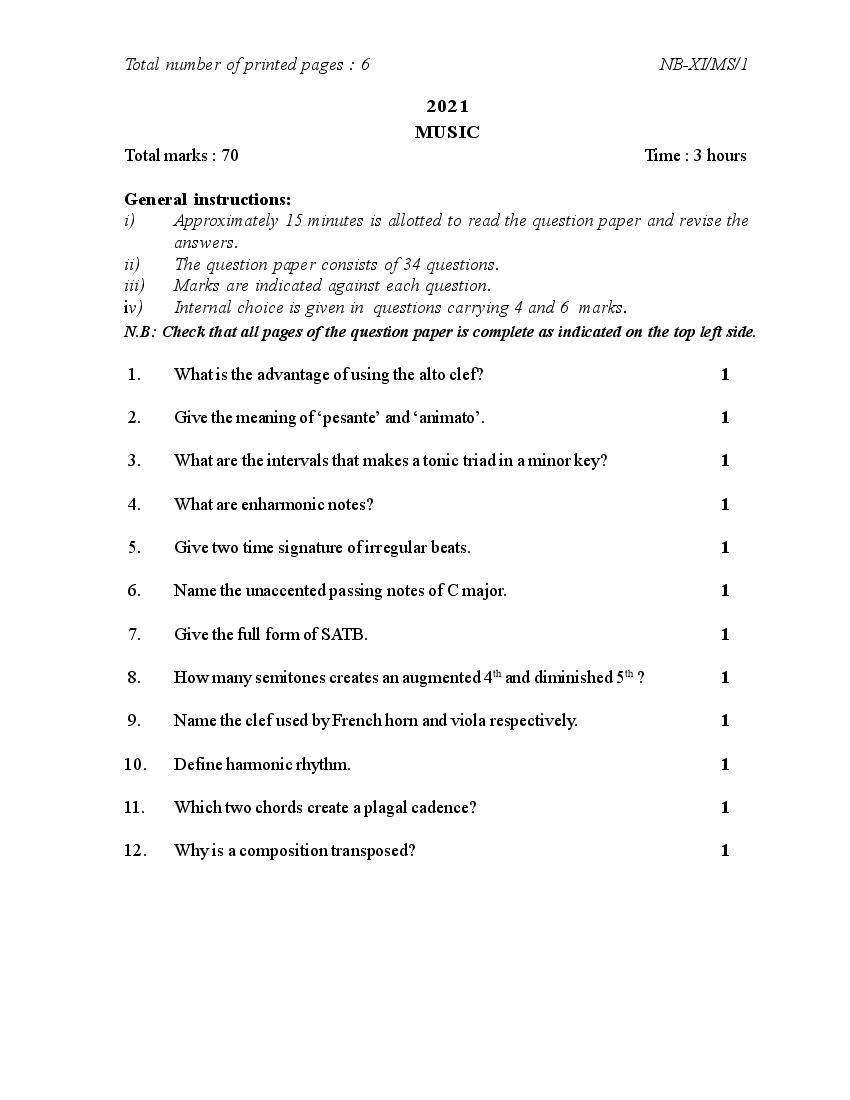
NBSE Class 11 Question Paper 2021 for Music – Text
Read the full text of this question paper below — useful to quickly search, copy and reference the content online without downloading the PDF.
📄 View text version (6 pages)
Page 1
2021
MUSIC
Total marks : 70 Time : 3 hours
General instructions:
i) Approximately 15 minutes is allotted to read the question paper and revise the
answers.
ii) The question paper consists of 34 questions.
iii) Marks are indicated against each question.
iv) Internal choice is given in questions carrying 4 and 6 marks.
N.B: Check that all pages of the question paper is complete as indicated on the top left side.
1. What is the advantage of using the alto clef? 1
2. Give the meaning of ‘pesante’ and ‘animato’. 1
3. What are the intervals that makes a tonic triad in a minor key? 1
4. What are enharmonic notes? 1
5. Give two time signature of irregular beats. 1
6. Name the unaccented passing notes of C major. 1
7. Give the full form of SATB. 1
8. How many semitones creates an augmented 4th and diminished 5th ? 1
9. Name the clef used by French horn and viola respectively. 1
10. Define harmonic rhythm. 1
11. Which two chords create a plagal cadence? 1
12. Why is a composition transposed? 1
Page 2
13. Write the enharmonic equivalents of the following notes. ½x4=2
14. What is the harmonic rhythm found in the given rhythm? What makes it so? 2
15. Draw the correct clef before each note. ½x4=2
16. Put the correct unaccented passing notes with the correct note values
below the asterisks. 2
17. Work out the key of the following music. 1+1=2
a)
b)
18. In the given music, circle the chromatic passages. 2
Page 3
19. Add time signature to the following. 1+1=2
a)
b)
20. Write the key signature of each key shown. Then write its one
octave – arpeggio in the rhythm given below. 1+1=2
a) B minor ascending to descending on treble clef.
b) A major ascending to descending on bass clef.
21. What is form in music? Give one type of form with a brief explanation. 1+1=2
22. Construct E major and A major scale descending on the alto clef.
Use key signature. 1+1=2
Answer any five from questions 23-29.
23. Rewrite the following tunes on the alto clef,so that they sound at
the same pitch: 2+2=4
a)
b)
24. Identify the cadences and label them with chord symbols and roman
numerals. 2+2=4
a) b)
Page 4
25. Label the triads with roman numerals below and chord symbols above
to show the chord progression on the staff. 2+2=4
a)
b)
26. Label the following: 1x4=4
a)
b)
c)
d)
27. Draw the correct interval above each note. ½x8=4
28. Using quaver triplets, write the broken chord to the given keys. Use
pattern of three notes ascending, with its key signature. 2+2=4
a) Key of E major on the alto clef in time.
b) Key of B major on the treble clef in time.
Finish no less than 3 leger lines above.
Page 5
29. In two bars, draw the main beats of the given time signatures. 2+2=4
a)
b)
Answer any three from questions 30-34.
30. Look at the music and answer the questions below. 1x6=6
a) In which key is this piece?
b) Name one bar in the piece where the harmonic rhythm changes on
the 3rd beat of the bar.
c) Name the intervals between the two notes marked with asterisks (*)
in bar 6.
d) Give the meaning of ‘p’ and ‘moderato’.
e) Write the first measure of the treble part of this piece in alto clef.
f) Write the key signature in alto clef.
Page 6
31. Transpose the following as directed: 3x2=6
a)
b)
c)
32. Using minims, write 4 part chords for SATB as shown by the roman
numerals. Double the root in each case. 3x2=6
a) D major - V
b) B minor - i
c) D minor - iv
33. Draw the tonic triads in root position, 1st inversion and 2nd inversions
to the following keys, using crotchet notes and key signature. Label
with chord symbols above. 3x2=6
a) F minor on tenor clef.
b) C minor on treble clef.
c) E minor on bass clef.
34. On the given scales, construct the tonic, sub-dominant and dominant
triads. Use semibreve notes and key signature with its necessary
accidentals. Label them with roman numerals below. 3x2=6
a) B harmonic minor scale descending on bass clef.
b) G melodic minor scale ascending on treble clef.
c) E natural minor scale descending on tenor clef.
*************************************