Finished viewing? Save it for later —
Download ICSE Class 10 Syllabus 2028 Commercial Studies (PDF · 6 pages)About ICSE Class 10 Syllabus 2028 Commercial Studies
ICSE Class 10 Syllabus 2028 Commercial Studies is available here for free download. Published by CISCE for Class 10, this syllabus can be viewed online or downloaded as a PDF (6 pages). Candidates preparing for Class 10 can use ICSE Class 10 Syllabus 2028 Commercial Studies to understand the exam pattern, the type of questions asked, and the overall difficulty level.
Frequently Asked Questions
How can I download ICSE Class 10 Syllabus 2028 Commercial Studies?
Open this page and click the Download button to save ICSE Class 10 Syllabus 2028 Commercial Studies as a PDF. It is completely free on AglaSem Docs.
Is ICSE Class 10 Syllabus 2028 Commercial Studies free to download?
Yes. ICSE Class 10 Syllabus 2028 Commercial Studies can be viewed online and downloaded as a PDF free of cost on AglaSem Docs.
How many pages does ICSE Class 10 Syllabus 2028 Commercial Studies have?
ICSE Class 10 Syllabus 2028 Commercial Studies contains 6 pages, which you can read online or download together as a single PDF.
Where can I find more Class 10 study material?
You can find more Class 10 question papers, sample papers, syllabus, and answer keys on AglaSem Docs.
ICSE Class 10 Syllabus 2028 Commercial Studies – Text
Read the full text of this syllabus below — useful to quickly search, copy and reference the content online without downloading the PDF.
📄 View text version (6 pages)
Page 1
INDIAN CERTIFICATE OF
SECONDARY EDUCATION
EXAMINATION
YEAR 2028
COMMERCIAL STUDIES
(63)
Page 2
Research, Development and Curriculum Division (RDCD)
CISCE
January 2026
____________________________________________________________________________________________
© Copyright, Council for the Indian School Certificate Examinations
All rights reserved. The copyright to this publication and any part thereof solely vests in the Council for the Indian
School Certificate Examinations. This publication and no part thereof may be reproduced, transmitted, distributed or
stored in any manner whatsoever, without the prior written approval of the Council for the Indian School Certificate
Examinations.
Page 3
MISSION STATEMENT
The Council for the Indian School Certificate
Examinations is committed to serving the nation's
children, through high quality educational
endeavours, empowering them to contribute towards
a humane, just and pluralistic society, promoting
introspective living, by creating exciting learning
opportunities, with a commitment to excellence.
ETHOS OF CISCE
Trust and fair play.
Minimum monitoring.
Allowing schools to evolve their own niche.
Catering to the needs of the children.
Giving freedom to experiment with new ideas
and practices.
Diversity and plurality - the basic strength for
evolution of ideas.
Schools to motivate pupils towards the
cultivation of:
Excellence - The Indian and Global
experience.
Values - Spiritual and cultural - to be the bedrock
of the educational experience.
Schools to have an 'Indian Ethos', strong roots in
the national psyche and be sensitive to national
aspirations.
Page 4
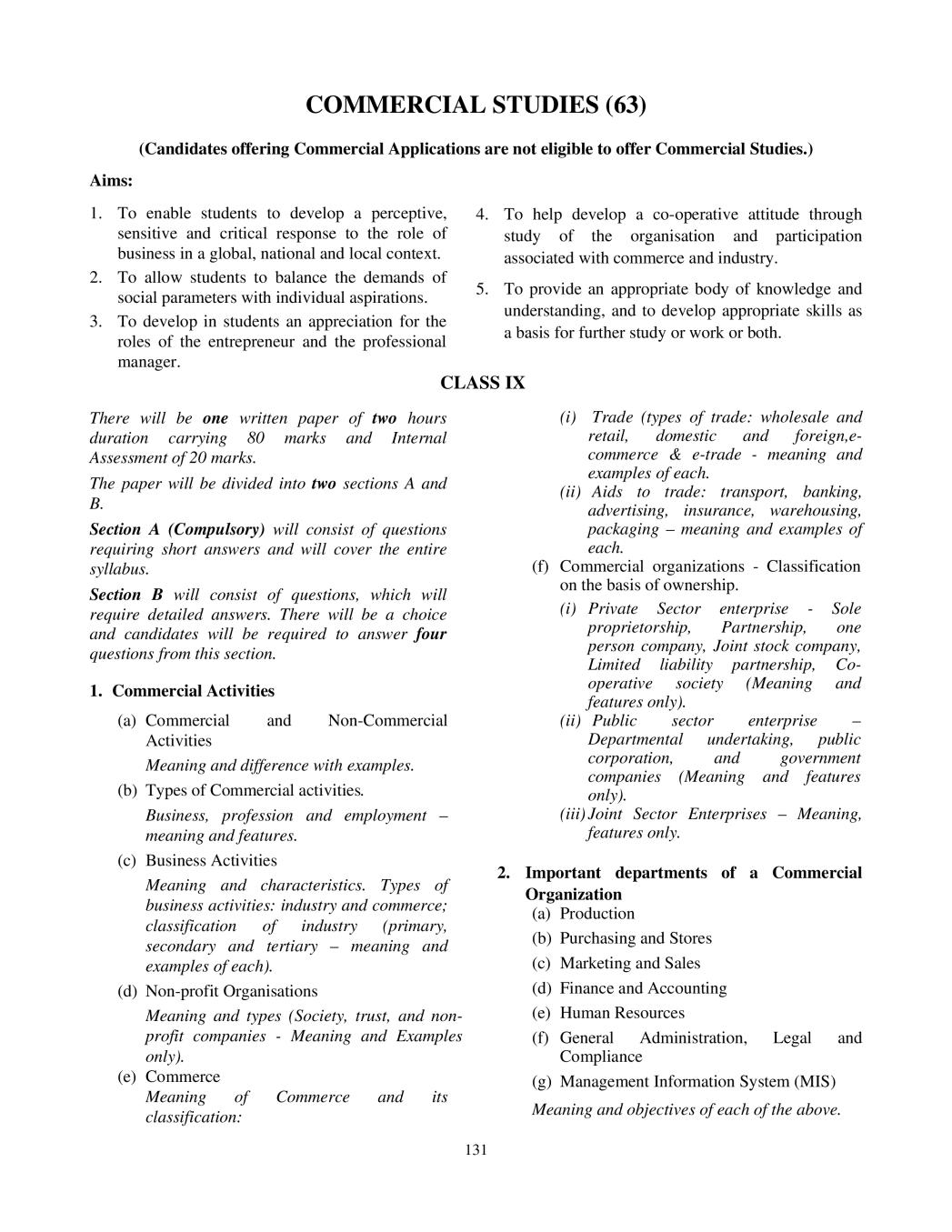
There will be one written paper of two hours duration carrying 80 marks and Internal Assessment of 20 marks.
1. Stakeholders in Commercial Organisations
(a) Meaning of stakeholder, types: Internal (shareholder, employee and employer – meaning of each) and
External stakeholders (supplier, creditor, government and society – meaning of each); differences
between internal and external stakeholders.
(b) Expectations of employers (owners and managers), employees, creditors and suppliers, government and
society from a commercial organisation.
2. Marketing and Sales
(a) Marketing
Meaning and objectives of marketing. Difference between marketing and sales.
(b) Product and service
Meaning and difference between a product and a service (with examples).
(c) Pricing
Meaning and objectives
(d) Advertising and Sales promotion
Advertising: meaning, importance of advertising; merits and demerits, difference between advertising
and publicity. Advertising Agency; meaning and functions only, Social advertising media - Concept and
examples only.
Sales promotion – meaning and techniques; difference between advertising and sales promotion.
(e) Consumer Protection
Consumer Protection Act (2019); features of the Act, rights of a consumer, Consumer exploitation;
meaning and types, Importance of consumer awareness.
(f) E-commerce
Introduction and difference between traditional methods of transactions, E-tailing, E-advertising,
E-marketing and E-security (meaning only). ERP and its modules (brief concept).
3. Finance and Accounting
(a) Capital and Revenue
Capital and revenue receipts, capital and revenue expenditure (meaning, difference and examples)
deferred revenue expenditure (meaning and examples).
(b) Final accounts of Sole Proprietorship
(i) Meaning and preparation of Trading account, Profit and Loss account and Balance sheet based on
the given trial balance with the adjustment of closing stock only.
(ii) (Preparation of manufacturing account, profit and loss on sale of assets, intangible and fictitious
assets, prepaid and accrued expenses and incomes are excluded.)
(c) Costs
Fundamental concept of Cost Classification of costs- based on behaviour (fixed, variable, semi-variable),
nature (direct, indirect).
(d) Budgeting
Meaning and utility of budgeting; comparison between budgeting and forecasting; types of budgets: sales,
production, cash, purchase and master – meaning only.
4
Page 5
(i) Capital Market
Meaning and functions of Capital Market.
(ii) Sources of raising capital.
Long term: Meaning of shares (Types; preference and equity) and debentures, differences between the
two.
Short term: loans from commercial banks (cash credit, overdraft, discounting of bills – meaning only).
4. Human Resources
(a) Recruitment, selection and training.
(i) Recruitment – meaning; sources: internal and external; advantages and disadvantages of internal and
external sources.
(ii) Selection- meaning and steps, types of selection tests.
(iii) Training – meaning, objectives and methods of training (on the job and off the job).
(b) Industrial relations and trade unions.
Industrial relations: Meaning and objectives; Trade Unions: Meaning and Functions.
(c) Social Security
Concept of Social Security; brief reference to Provident Fund, Gratuity, National Pension Scheme. (Acts
are not required).
5. Logistics
Meaning of logistics and its classification.
(a) Transportation
Modes of transportation: land (road and rail), air and water; merits and demerits of each.
(b) Warehousing
Meaning, importance and types (public, private and bonded – meaning only).
(c) Insurance
Meaning; Types of insurance: Life insurance, General insurance; (Fire, Health and Marine- meaning
only) principles of insurance.
6. Banking
(a) Central Bank
Central Bank: Meaning and functions, Difference between the Central Bank and Commercial Banks.
(b) Internet Banking
Modes of transferring money / Net Banking: NEFT, RTGS, IMPS, mobile wallets: meaning only.
ATM, Credit & Debit cards- meaning & difference, caution to be taken while using these cards.
(c) Financial fraudulent practices
Credit card fraud, false accounting, insurance fraud, intellectual property fraud, internet and cyber fraud.
A brief understanding of these types of financial fraud.
5
Page 6
(a) Environment (Protection) Act,1986 -
Features of the act.
(b) Central Pollution Control Board –
Functions only.
INTERNAL ASSESSMENT
One project as prescribed by the teacher from the syllabus.
EVALUATION
The project work is to be evaluated by the subject teacher and by an External Examiner. The External Examiner
shall be nominated by the Head of the school and may be a teacher from the faculty, but not teaching the subject
in the relevant section/class. For example, a teacher of Commerce/Accounts of Class XI may be deputed to be
the External Examiner for Class X Commercial Studies project work.
The Internal Examiner and the External Examiner will assess the candidate’s work independently.
Award of marks (20 Marks)
Subject Teacher (Internal Examiner) 10 marks
External Examiner 10 marks
The total mark obtained out of 20 are to be sent to CISCE by the Head of the school.
The Head of the school will be responsible for the online entry of marks on CISCE’s CAREERS portal by the due
date.
6
Document Details
| Board / Org | CISCE |
| Exam | Class 10 |
| Type | Syllabus |
| Pages | 6 |
| Updated | 04 Aug 2026 |