Finished viewing? Save it for later —
Download ICSE Class 10 Syllabus 2028 English (PDF · 11 pages)About ICSE Class 10 Syllabus 2028 English
ICSE Class 10 Syllabus 2028 English is available here for free download. Published by CISCE for Class 10, this syllabus can be viewed online or downloaded as a PDF (11 pages). Candidates preparing for Class 10 can use ICSE Class 10 Syllabus 2028 English to understand the exam pattern, the type of questions asked, and the overall difficulty level.
Frequently Asked Questions
How can I download ICSE Class 10 Syllabus 2028 English?
Open this page and click the Download button to save ICSE Class 10 Syllabus 2028 English as a PDF. It is completely free on AglaSem Docs.
Is ICSE Class 10 Syllabus 2028 English free to download?
Yes. ICSE Class 10 Syllabus 2028 English can be viewed online and downloaded as a PDF free of cost on AglaSem Docs.
How many pages does ICSE Class 10 Syllabus 2028 English have?
ICSE Class 10 Syllabus 2028 English contains 11 pages, which you can read online or download together as a single PDF.
Where can I find more Class 10 study material?
You can find more Class 10 question papers, sample papers, syllabus, and answer keys on AglaSem Docs.
ICSE Class 10 Syllabus 2028 English – Text
Read the full text of this syllabus below — useful to quickly search, copy and reference the content online without downloading the PDF.
📄 View text version (11 pages)
Page 1
INDIAN CERTIFICATE OF
SECONDARY EDUCATION
EXAMINATION
YEAR 2028
ENGLISH
(01)
Page 2
Research, Development and Curriculum Division (RDCD)
CISCE
January 2026
____________________________________________________________________________________________
© Copyright, Council for the Indian School Certificate Examinations
All rights reserved. The copyright to this publication and any part thereof solely vests in the Council for the Indian
School Certificate Examinations. This publication and no part thereof may be reproduced, transmitted, distributed or
stored in any manner whatsoever, without the prior written approval of the Council for the Indian School Certificate
Examinations.
Page 3
MISSION STATEMENT
The Council for the Indian School Certificate
Examinations is committed to serving the nation's
children, through high quality educational
endeavours, empowering them to contribute towards
a humane, just and pluralistic society, promoting
introspective living, by creating exciting learning
opportunities, with a commitment to excellence.
ETHOS OF CISCE
Trust and fair play.
Minimum monitoring.
Allowing schools to evolve their own niche.
Catering to the needs of the children.
Giving freedom to experiment with new ideas
and practices.
Diversity and plurality - the basic strength for
evolution of ideas.
Schools to motivate pupils towards the
cultivation of:
Excellence - The Indian and Global
experience.
Values - Spiritual and cultural - to be the bedrock
of the educational experience.
Schools to have an 'Indian Ethos', strong roots in
the national psyche and be sensitive to national
aspirations.
Page 4
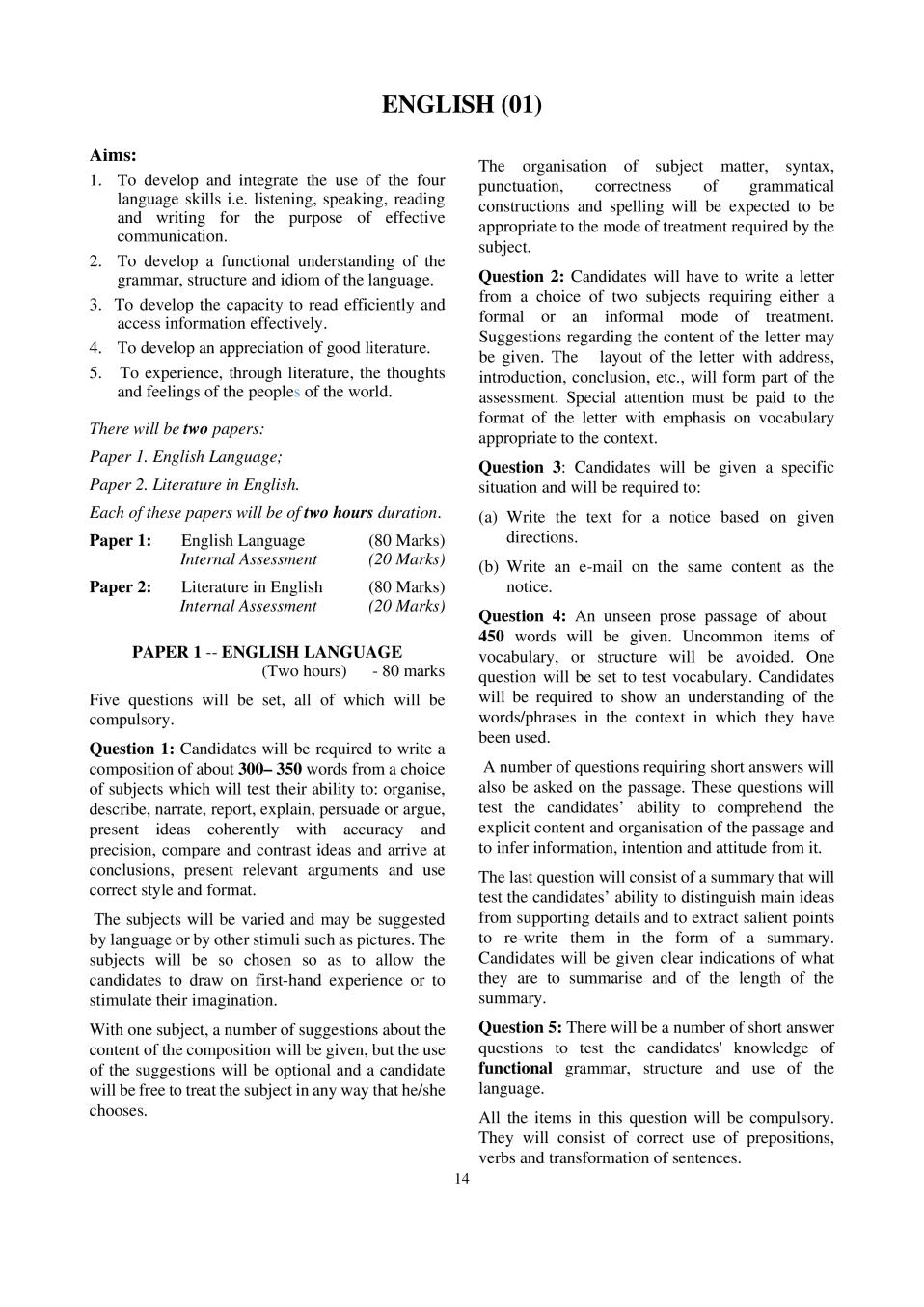
Aims:
1. To develop and integrate the use of the four language skills i.e. listening, speaking, reading and writing for
the purpose of effective communication.
2. To develop a functional understanding of the grammar, structure and idiom of the language.
3. To develop the capacity to read efficiently and access information effectively.
4. To develop an appreciation of good literature.
5. To experience, through literature, the thoughts and feelings of the peoples of the world.
CLASSES IX & X
There will be two papers: Paper 1: English Language, Paper 2: Literature in English
Each of these papers will be of two hours duration.
Paper 1: English Language (80 Marks)
Internal Assessment (20 Marks)
Paper 2: Literature in English (80 Marks)
Internal Assessment (20 Marks)
PAPER 1 - ENGLISH LANGUAGE
(Two hours) - 80 Marks
All questions will be compulsory.
Question 1: Candidates will be required to write a composition of about 300– 350 words from a choice of subjects
which will test their ability to: organise, describe, narrate, report, explain, persuade or argue, present ideas
coherently with accuracy and precision, compare and contrast ideas and arrive at conclusions, present relevant
arguments and use correct style and format.
The topics will be varied and may be suggested by language or by other stimuli such as pictures. The topics will
be so chosen so as to allow the candidates to draw on first-hand experience or to stimulate their imagination.
The organisation of subject matter, syntax, punctuation, correctness of grammatical constructions and spelling
will be expected to be appropriate to the mode of treatment required by the subject.
Question 2: Candidates will have to write a letter from a choice of two subjects requiring either a formal or a
friendly mode of treatment. Suggestions regarding the content of the letter may be given. The format of the letter
with address, introduction, conclusion, etc., will form part of the assessment. Special attention must be paid to the
format of the letter with emphasis on tone and vocabulary appropriate to the context.
Question 3: Candidates will be given a specific situation and will be required to:
(a) Write the text for a notice based on given directions.
(b) Write an e-mail on the same content as the notice.
1
Page 5
structure will be avoided. A question will be set to test vocabulary. Candidates will be required to show an
understanding of the words/phrases in the context in which they have been used.
A number of questions requiring short answers will also be asked on the passage. These questions will test the
candidates’ ability to comprehend the explicit content and organisation of the passage and to infer information,
intention and attitude from it.
The last question will consist of a summary that will test the candidates’ ability to distinguish main ideas from
supporting details and to extract salient points to re-write them in the form of a summary. Candidates will be given
a clear indication of what they are to summarise and of the length of the summary.
Question 5: There will be a number of short answer questions to test the candidates' knowledge of functional
grammar, structure and usage.
All the items in this question will be compulsory. They will consist of correct use of prepositions, conjunctions,
verbs and structure of sentences.
PAPER 2 - LITERATURE IN ENGLISH
(Two hours) - 80 Marks
Candidates will be required to answer questions based on the prescribed textbooks, which include Drama, Prose
(Short Stories) and Poetry.
Drama and Prose (Short Stories)
Questions set will be central to the text. Candidates will be required to show that they have understood the passage
and are able to clearly respond in their own words.
Excerpts may be given from the drama and prose texts leading to questions.
Poetry
A poem, or lines from poems, will be given and questions will be set to test the candidates’ response. The questions
will focus on the content, understanding and the personal response of candidates to the entire poem as a whole.
SYLLABUS TO BE COVERED
Class IX
1. DRAMA: Julius Caesar - William Shakespeare
(Acts I & II)
2. TREASURE CHEST: A Collection of ICSE Short Stories & Poems (Evergreen Publications (India)
Ltd. New Delhi)
PROSE (Short Stories):
1. Bonku Babu's Friend – Satyajit Ray
2. Oliver Asks for More – Charles Dickens
3. The Model Millionaire – Oscar Wilde
4. Home-coming – Rabindranath Tagore
5. The Boy who Broke the Bank – Ruskin Bond
2
Page 6
1. The Night Mail – W.H. Auden
2. Skimbleshanks: The Railway Cat – T.S. Eliot
3. I Remember, I Remember – Thomas Hood
4. A Doctor’s Journal Entry for August 6, 1945 – Vikram Seth
5. A Work of Artifice – Marge Piercy
NOTE: The Class IX Examination is to be conducted on the portion of the syllabus that is prescribed for
Class IX.
Class X
1. DRAMA: Julius Caesar: William Shakespeare
(Acts III, IV & V)
2. TREASURE CHEST: A Collection of ICSE Short Stories & Poems (Evergreen Publications (India)
Ltd. New Delhi)
PROSE (Short Stories):
1. With the Photographer – Stephen Leacock
2. The Elevator – William Sleator
3. The Girl Who Can – Ama Ata Aidoo
4. The Pedestrian – Ray Bradbury
5. The Last Lesson – Alphonse Daudet
POETRY:
1. Haunted Houses – H.W. Longfellow
2. The Glove and the Lions – Leigh Hunt
3. When Great Trees fall – Maya Angelou
4. A Considerable Speck – Robert Frost
5. The Power of Music – Sukumar Ray
NOTE: The ICSE (Class X) Examination paper will be set ONLY on the portion of the syllabus that is
prescribed for Class X.
3
Page 7
Paper 1 - English Language
1. Schools will prepare, conduct and record assessments of the Listening and Speaking Skills of candidates as
follows:
Class IX: Three assessments in the course of the year.
Class X: Two assessments in the course of the year.
2. Pattern of Assessment
(a) Listening Skills
A passage of about 300 words is read aloud by the examiner twice, the first time at normal reading speed
(about 110 words a minute) and the next time at a slower speed. Candidates may make brief notes during
the readings. They then answer an objective type test based on the passage, on the paper provided.
The recommended number of candidates at a sitting is 30.
(b) Speaking Skills
Each candidate is required to make an oral presentation for about two minutes, which will be followed by
a discussion on the subject with the examiners, for about three minutes.
Subjects for presentation may include narrating an experience, providing a description, giving directions
how to make or operate something, expressing an opinion, giving a report, relating an anecdote or
commenting on a current event.
A candidate may refer to brief notes in the course of the presentation but reading or excessive dependence
on notes will be penalized.
It is recommended that candidates be given an hour for preparation of their subject for presentation and that they
be given a choice of subject, on a common paper.
EVALUATION
The assessment will be conducted jointly by the subject teacher and the external examiner who will each assess
the candidate. (The External Examiner may be a teacher nominated by the Head of the School who could be from
the faculty but not teaching the subject in the section/class. For example, a teacher of English of Class VIII
may be deputed to be an External Examiner for Class X).
Award of Marks (20 Marks)
Listening Skills: 10 marks
Speaking Skills: 10 marks
The total marks obtained out of 20 are to be sent to the CISCE by the Head of the School.
The Head of the School will be responsible for the online entry of marks on the CISCE’s CAREERS portal by the
due date. Schools are required to maintain a record of all assessments conducted in Listening and Speaking Skills
for candidates of Classes IX and X. These include copies of the assessment tests, topics for presentation and
marks awarded. The record will be maintained for a period of 2 months after the ICSE (10) examinations of the
candidates concerned.
4
Page 8
Schools will set, assess and record written assignments by the candidates as given below:
Class IX: Two or three assignments of approximately 300 to 400 words each.
NOTE: Students should be encouraged to work in pairs/small groups to develop skills of collaboration and
cooperation.
Class X: Two or three assignments of reasonable length (not exceeding 1500 words in total).
SUGGESTED ASSIGNMENTS
Assignments should be based on the prescribed textbooks on the following lines:
(i) Character/thematic analysis;
(ii) Socio-economic, cultural, historical relevance / background;
(iii) Summary / paraphrase.
(iv) Appreciation of literary qualities.
(v) Identifying with a character. Putting oneself in the place of a character in given circumstances and explaining
one’s actions.
(vi) Imagine alternative outcomes or endings in a literary piece and the effect on all concerned.
(vii) Making a graphic representation of a scene/story/ poem.
(viii) Assume the persona of one of the characters (from the play/ poem/story) and record a diary entry of a
particular incident/episode.
EVALUATION
The assignments/projects are to be evaluated by the subject teacher and by an external examiner. (The External
Examiner may be a teacher nominated by the Head of the school, who could be from the faculty, but not teaching
the subject in the section/class. For example, a teacher of English of Class VIII may be deputed to be an External
Examiner for Class X, English projects.)
The Internal Examiner and the External Examiner will assess the assignments independently.
Award of Marks (20 Marks)
Subject Teacher (Internal Examiner) 10 marks
External Examiner 10 marks
The total marks obtained out of 20 are to be sent to the CISCE by the Head of the school.
The Head of the school will be responsible for the online entry of marks on the CISCE’s CAREERS portal by the
due date.
5
Page 9
ASSIGNMENT (CLASSES IX & X)
Grade Understanding/ Recall Vocabulary Context/ Correlation to Marks
Comprehension Main Idea, Other Areas
Central Theme
I The candidate accurately The candidate recalls all the The candidate uses appropriate The candidate clearly 3
understands the central idea of important points made (written/ and correct vocabulary while understands the context and
the passage as well as the verbal). recalling the points made. can widely correlate the
relevant points in the selected passage to the other areas.
passage/ talk.
II The candidate gives ideas fairly The candidate recalls some of The candidate uses correct but The candidate can moderately 2
close to the central / main idea the important points made simple vocabulary while understand the context of the
of the passage as well as (written/ verbal). recalling the points made. passage and can moderately
understands some of the correlate the passage to the
relevant points heard in the other areas.
selected passage/ talk.
III The candidate cannot fully The candidate recalls very few The candidate makes various The candidate can only faintly 1
comprehend the passage and of the important points made errors in vocabulary while understand the context of the
gives only a few ideas related (written/verbal). recalling the points made. passage and relate it to the other
to the central theme of the areas.
passage.
IV The candidate is neither able to The candidate is unable to The candidate uses incorrect The candidate is unable to 0
understand the central/main recall the important points vocabulary while recalling the understand the context of the
idea of the passage; nor able to made (written/verbal) points made. passage and is unable to
understand relevant points correlate the passage to the
heard in the passage/talk. other areas.
6
Page 10
ASSIGNMENT (CLASSES IX & X)
Grade Fluency of Language Subject Matter Organization Vocabulary/ Understanding Gesture Marks
Delivery
I Speaks with fluency and Matter is Content is well Uses appropriate While speaking, the Uses natural and 3
has full operational relevant, rich in sequenced and well vocabulary and candidate spontaneous
command over the content and organized. pronounces words emphasises the gestures that are
language. original. correctly. important points. not out of place.
II The candidate speaks The subject The content is The candidate While speaking, the Uses some 2
with fairly good fluency matter is mostly satisfactorily pronounces most candidate natural gestures.
and has reasonable relevant, sequenced and well words correctly and emphasises most
operational command of consisting of a organised. uses simple important points.
the language. few original vocabulary.
ideas.
III The candidate speaks The subject The subject content The candidate While speaking, the Uses very few 1
with poor fluency and matter is is very poor and pronounces many candidate natural gestures.
does not communicate irrelevant and lacks words incorrectly and emphasises some
except for the most basic lacks originality. organisational uses inappropriate important points.
information. structure. vocabulary.
IV The candidate cannot The subject The subject content The candidate is While speaking, the Uses no natural 0
communicate even the matter is comprises of mere unable to correctly candidate is unable gestures.
most basic information. negligible. words with no pronounce most to emphasise
structured words and has a important points.
sentences. limited vocabulary.
7
Page 11
(CLASSES IX & X)
Grade Understanding of Text Examples from Text Understanding of text- Appreciation of Critical Appreciation - Marks
(Narrative) Interpretation and Language, Personal Response
Evaluation Characterization
I The candidate The account is suitably The candidate The candidate appreciates The candidate is able to 4
demonstrates expertise in supported by relevant understands the text with and evaluates significant effectively reflect
giving an appropriate examples from the text. due emphasis on ways (structure, personal response
account of the text, with interpretation and character, imagery) in (critical appreciation) to
well-chosen reference to evaluation. which writers have the text.
narrative and situation. achieved their effects.
II The candidate The account is supported The candidate The candidate appreciates The candidate is able to 3
demonstrates a high level by examples from the understands text with and evaluates significant reflect a personal
of competence in giving text. some emphasis on ways in which writers response to the text.
an account of the text, interpretation and have achieved their
with appropriate evaluation. effects.
references to the narrative
and situation.
III The candidate The candidate The candidate recognises The candidate recognizes The candidate is able to 2
demonstrates competence understands the text and some aspects of the text some of the significant communicate a personal
in giving an account of shows a basic recognition used by authors to present ways in which the writers response, which shows
the text with some of the theme and can ideas. have used the language. appreciation.
reference to the narrative support it by a few
and situation. examples.
IV The candidate gives a The candidate The candidate relates the The candidate recognises The candidate 1
broad account of the text understands the basic text to other texts studied. differences in the way communicates a
with reference to the meaning of the text. authors write. straightforward personal
narrative and situation. response to the text.
V The candidate is unable to The candidate is unable to The candidate is unable to The candidate is unable to The candidate is unable to 0
demonstrate an understand the text or relate the text to the other recognise the differences give a personal view of
understanding of the basic support it with any texts studied. in the way authors write. the text studied.
events in the text. examples.
8
Document Details
| Board / Org | CISCE |
| Exam | Class 10 |
| Type | Syllabus |
| Pages | 11 |
| Updated | 04 Aug 2026 |