Finished viewing? Save it for later —
Download ICSE Class 10 Syllabus 2028 Fashion Designing (PDF · 7 pages)About ICSE Class 10 Syllabus 2028 Fashion Designing
ICSE Class 10 Syllabus 2028 Fashion Designing is available here for free download. Published by CISCE for Class 10, this syllabus can be viewed online or downloaded as a PDF (7 pages). Candidates preparing for Class 10 can use ICSE Class 10 Syllabus 2028 Fashion Designing to understand the exam pattern, the type of questions asked, and the overall difficulty level.
Frequently Asked Questions
How can I download ICSE Class 10 Syllabus 2028 Fashion Designing?
Open this page and click the Download button to save ICSE Class 10 Syllabus 2028 Fashion Designing as a PDF. It is completely free on AglaSem Docs.
Is ICSE Class 10 Syllabus 2028 Fashion Designing free to download?
Yes. ICSE Class 10 Syllabus 2028 Fashion Designing can be viewed online and downloaded as a PDF free of cost on AglaSem Docs.
How many pages does ICSE Class 10 Syllabus 2028 Fashion Designing have?
ICSE Class 10 Syllabus 2028 Fashion Designing contains 7 pages, which you can read online or download together as a single PDF.
Where can I find more Class 10 study material?
You can find more Class 10 question papers, sample papers, syllabus, and answer keys on AglaSem Docs.
ICSE Class 10 Syllabus 2028 Fashion Designing – Text
Read the full text of this syllabus below — useful to quickly search, copy and reference the content online without downloading the PDF.
📄 View text version (7 pages)
Page 1
INDIAN CERTIFICATE OF
SECONDARY EDUCATION
EXAMINATION
YEAR 2028
FASHION DESIGNING
(70)
Page 2
Research, Development and Curriculum Division (RDCD)
CISCE
January 2026
____________________________________________________________________________________________
© Copyright, Council for the Indian School Certificate Examinations
All rights reserved. The copyright to this publication and any part thereof solely vests in the Council for the Indian
School Certificate Examinations. This publication and no part thereof may be reproduced, transmitted, distributed or
stored in any manner whatsoever, without the prior written approval of the Council for the Indian School Certificate
Examinations.
Page 3
MISSION STATEMENT
The Council for the Indian School Certificate
Examinations is committed to serving the nation's
children, through high quality educational
endeavours, empowering them to contribute towards
a humane, just and pluralistic society, promoting
introspective living, by creating exciting learning
opportunities, with a commitment to excellence.
ETHOS OF CISCE
Trust and fair play.
Minimum monitoring.
Allowing schools to evolve their own niche.
Catering to the needs of the children.
Giving freedom to experiment with new ideas
and practices.
Diversity and plurality - the basic strength for
evolution of ideas.
Schools to motivate pupils towards the
cultivation of:
Excellence - The Indian and Global
experience.
Values - Spiritual and cultural - to be the bedrock
of the educational experience.
Schools to have an 'Indian Ethos', strong roots in
the national psyche and be sensitive to national
aspirations.
Page 4
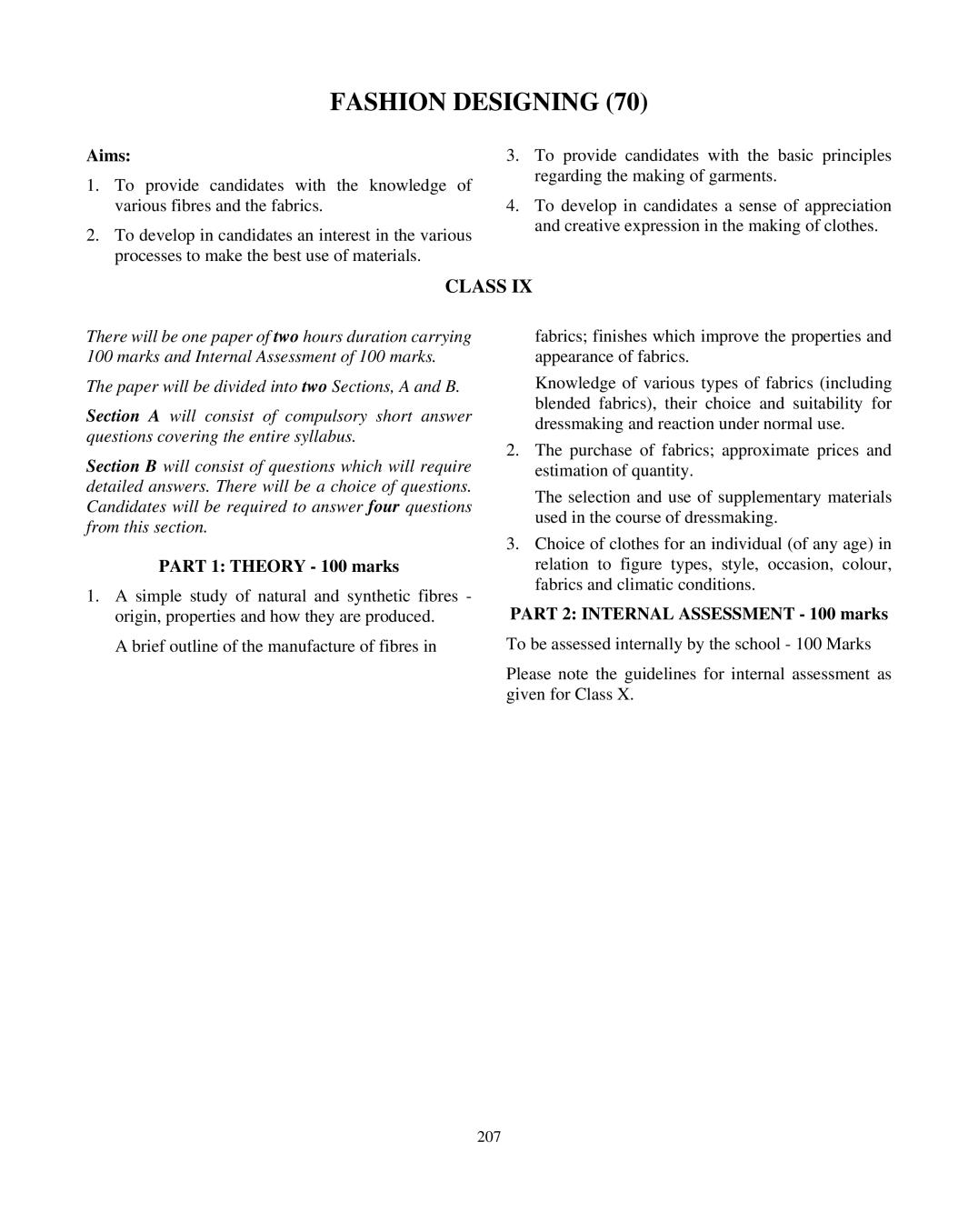
Aims:
1. To provide candidates with the knowledge of various fibres and the fabrics.
2. To develop in candidates an interest in the various processes to make the best use of materials.
3. To provide candidates with the basic principles regarding the making of garments.
4. To develop in candidates a sense of appreciation and creative expression in the making of clothes.
CLASS IX
There will be one paper of two hours duration carrying 100 marks and Internal Assessment of 100 marks.
PART 1: THEORY - 100 Marks
1. A simple study of natural and synthetic fibres - origin, properties and how they are produced.
A brief outline of the manufacture of fibres infabrics; finishes which improve the properties and appearance
of fabrics.
Knowledge of various types of fabrics (including blended fabrics), their choice and suitability for dressmaking
and reaction under normal use.
2. The purchase of fabrics; approximate prices and estimation of quantity.
The selection and use of supplementary materials used in the course of dressmaking.
3. Choice of clothes for an individual (of any age) in relation to figure types, style, occasion, colour, fabrics and
climatic conditions.
PART 2: INTERNAL ASSESSMENT – 100 Marks
To be assessed internally by the school - 100 Marks
Please note the guidelines for internal assessment as given for Class X.
CLASS X
There will be one paper of two hours duration carrying 100 marks and Internal Assessment of 100 marks.
PART 1: THEORY - 100 Marks
1. The choice, purchase, use and care of tools and equipment, including sewing machines, for dressmaking.
2. The choice and use of traditional, drafted or commercial patterns for making simple under and outer garments.
This should include knowledge of figure measurements, awareness of figure problems, simple adaptation of
patterns, layouts and cutting out, fitting, and the sequence or processes in assembling garments. Methods of
pressing.
3. The stitches and processes used in the making of simple under and outer garments.
1
Page 5
of garments and articles.
PART 2: INTERNAL ASSESSMENT
To be assessed internally by the school - 100 marks.
Practical Work in Needlework
The minimum number of assignments for each academic year
Class IX - Five practical oriented assignments as prescribed by the teacher.
Class X - Five practical oriented assignments as prescribed by the teacher.
Suggested Assignments
(i) Needlework tools and processes:
• Measuring and marking devices.
• Use of scissors, needle and thread.
• Sewing buttons, hooks and eyes, zippers.
• Use of the sewing machine.
• Practice in various stitches, making seams, darts, pleats, gathering, shirring, smocking, ruffles, etc.
(ii) The parts of a dress:
• Necklines and collars.
• Sleeves and cuffs.
• Waistline and skirts.
• Pockets; inside and outside.
• Buttons and button holes.
• Visible and invisible zippers.
(iii) Making dresses, blouses, skirts, salwar, kamiz, etc.
(iv) Sewing for the home: curtains, bedspreads, and furnishings.
(v) Sewing of children’s clothes.
Finished Work
In addition to the course work, the candidates will have to produce two dresses or combinations or a set consisting
of four pieces of finished needlework for the assessment by the External Examiner.
EVALUATION
The assignments/project work is to be evaluated by the subject teacher and by an External Examiner. The External
Examiner may be a teacher nominated by the Head of the school, who could be from the faculty, but not teaching
the subject in the section/class. For example, a teacher of Class VIII may be deputed to be an External Examiner
for Class X Fashion Designing Projects.
2
Page 6
Award of Marks (100 Marks)
Subject Teacher (Internal Examiner) 50 marks
External Examiner 50 marks
The total marks obtained out of 100 are to be sent to CISCE by the Head of the school.
The Head of the school will be responsible for the online entry of marks on CISCE’s CAREERS portal by the due
date.
3
Page 7
Criteria Planning Efficiency Working to time Manipulation Quality produced Appearance/Arrangement
plan
Grade I Follows the question set Is successful in Excellent display of With a special insight A fine aesthetic sense and artistic
(4 and systematically handling parts of the manipulative skills - into the question, the ability conveyed in the complete
marks) organises the work question set and fits can deal with a quality developed is of arrangement.
process. them within required laboratory situation a high standard.
time. efficiently.
Grade II Follows the question set Is successful in Good control of The insight into the The display of colour and
(3 except that the step by handling parts of the manipulative skills, requirements of the equipment used gives an
marks) step work shows slow question, but the has been able to deal question has been impression of sound organisation.
operational skill. smooth work appears with each situation achieved and the
to slow down. with ease. quality is good.
Grade Follows the question. Is successful in Has been successful The quality has been The arrangement appears complete
III Order of work process handling the with the manipulative developed well in part but some special details missing.
(2 shows lack of co- question, however skills in parts then but the overall effect
marks) ordination. the time link seems gradually slows lacks some
to break in some down. achievement.
area.
Grade Follows a part of the Is able to work only a Begins with a control Only few areas of Part of the arrangement is
IV question, work sequence part of the question of the skills and is quality are visible, represented but the total
(1 mark) appears disorganised. within the time unable to sustain the which affect the total appearance lacks finish and
stated. effort. result produced. composition.
Grade V Has not been able to Time and work Is unable to control No standard of quality There has been no achievement in
(0 interpret the question sequence is most and manipulate the has been achieved due either the appearance or
marks) into proper laboratory disorganised. required skills. to poor understanding. arrangement.
organisation.
4
Document Details
| Board / Org | CISCE |
| Exam | Class 10 |
| Type | Syllabus |
| Pages | 7 |
| Updated | 04 Aug 2026 |