Finished viewing? Save it for later —
Download ICSE Class 10 Syllabus 2028 Physical Education (PDF · 35 pages)About ICSE Class 10 Syllabus 2028 Physical Education
ICSE Class 10 Syllabus 2028 Physical Education is available here for free download. Published by CISCE for Class 10, this syllabus can be viewed online or downloaded as a PDF (35 pages). Candidates preparing for Class 10 can use ICSE Class 10 Syllabus 2028 Physical Education to understand the exam pattern, the type of questions asked, and the overall difficulty level.
Frequently Asked Questions
How can I download ICSE Class 10 Syllabus 2028 Physical Education?
Open this page and click the Download button to save ICSE Class 10 Syllabus 2028 Physical Education as a PDF. It is completely free on AglaSem Docs.
Is ICSE Class 10 Syllabus 2028 Physical Education free to download?
Yes. ICSE Class 10 Syllabus 2028 Physical Education can be viewed online and downloaded as a PDF free of cost on AglaSem Docs.
How many pages does ICSE Class 10 Syllabus 2028 Physical Education have?
ICSE Class 10 Syllabus 2028 Physical Education contains 35 pages, which you can read online or download together as a single PDF.
Where can I find more Class 10 study material?
You can find more Class 10 question papers, sample papers, syllabus, and answer keys on AglaSem Docs.
ICSE Class 10 Syllabus 2028 Physical Education – Text
Read the full text of this syllabus below — useful to quickly search, copy and reference the content online without downloading the PDF.
📄 View text version (35 pages)
Page 1
INDIAN CERTIFICATE OF
SECONDARY EDUCATION
EXAMINATION
YEAR 2028
PHYSICAL EDUCATION
(72)
Page 2
Research, Development and Curriculum Division (RDCD)
CISCE
January 2026
____________________________________________________________________________________________
© Copyright, Council for the Indian School Certificate Examinations
All rights reserved. The copyright to this publication and any part thereof solely vests in the Council for the Indian
School Certificate Examinations. This publication and no part thereof may be reproduced, transmitted, distributed or
stored in any manner whatsoever, without the prior written approval of the Council for the Indian School Certificate
Examinations.
Page 3
MISSION STATEMENT
The Council for the Indian School Certificate
Examinations is committed to serving the nation's
children, through high quality educational
endeavours, empowering them to contribute towards
a humane, just and pluralistic society, promoting
introspective living, by creating exciting learning
opportunities, with a commitment to excellence.
ETHOS OF CISCE
Trust and fair play.
Minimum monitoring.
Allowing schools to evolve their own niche.
Catering to the needs of the children.
Giving freedom to experiment with new ideas
and practices.
Diversity and plurality - the basic strength for
evolution of ideas.
Schools to motivate pupils towards the
cultivation of:
Excellence - The Indian and Global
experience.
Values - Spiritual and cultural - to be the bedrock
of the educational experience.
Schools to have an 'Indian Ethos', strong roots in
the national psyche and be sensitive to national
aspirations.
Page 4
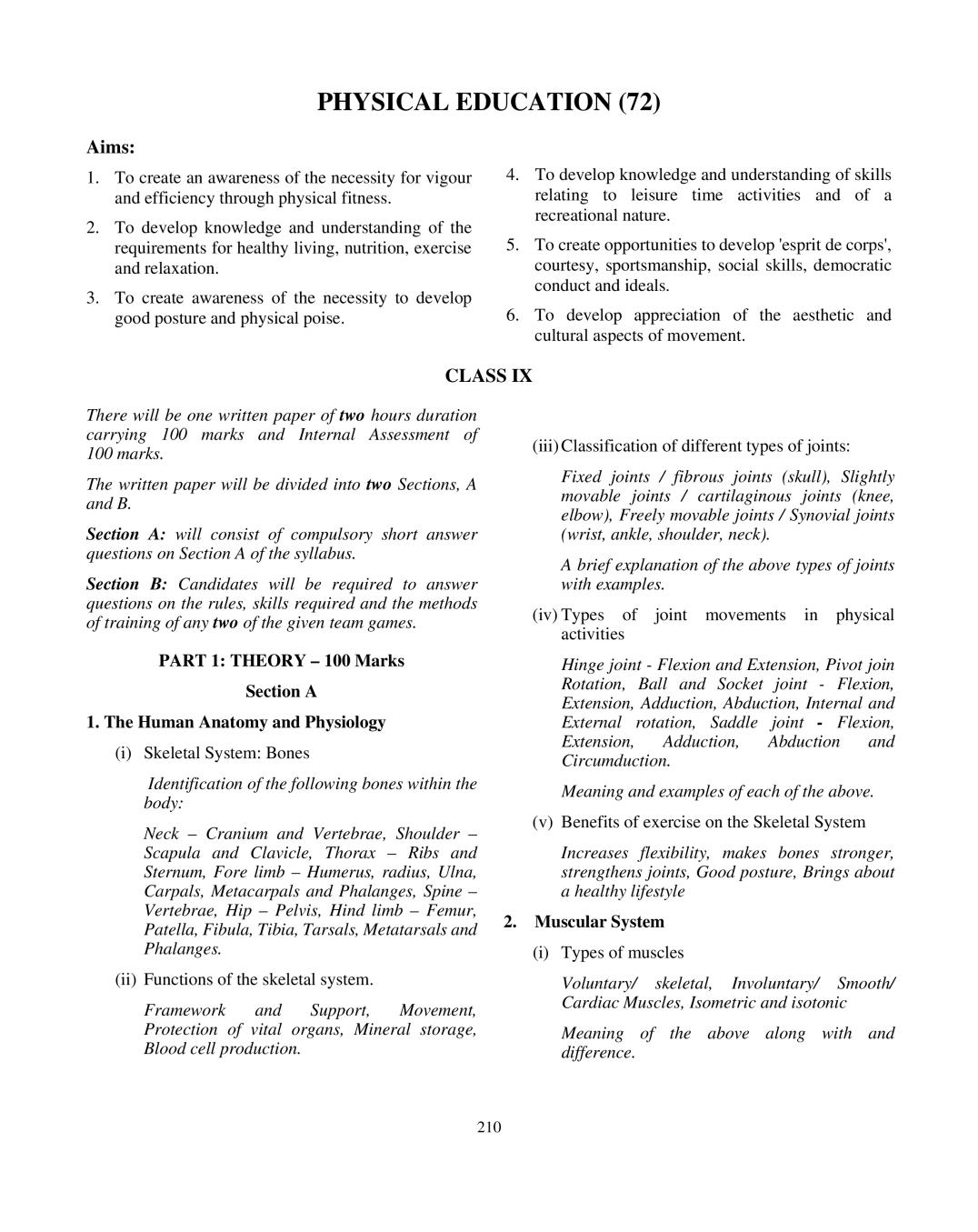
Aims:
1. To create an awareness of the necessity for vigour and efficiency through physical fitness.
2. To develop knowledge and understanding of the requirements for healthy living, nutrition, exercise and
relaxation.
3. To create awareness of the necessity to develop good posture and physical poise.
4. To develop knowledge and understanding of skills relating to leisure time activities and of a recreational
nature.
5. To create opportunities to develop 'esprit de corps', courtesy, sportsmanship, social skills, democratic conduct
and ideals.
6. To develop appreciation of the aesthetic and cultural aspects of movement.
CLASS IX
There will be one written paper of two hours duration carrying 100 marks and Internal Assessment of 100 marks.
PART 1: THEORY – 100 Marks
SECTION A
1. The Human Anatomy and Physiology
(a) Skeletal System: Bones
Identification of the following bones within the body:
Neck – Cranium and Vertebrae, Shoulder – Scapula and Clavicle, Thorax – Ribs and Sternum, Fore limb
– Humerus, radius, Ulna, Carpals, Metacarpals and Phalanges, Spine – Vertebrae, Hip – Pelvis, Hind
limb – Femur, Patella, Fibula, Tibia, Tarsals, Metatarsals and Phalanges.
(b) Functions of the skeletal system.
Framework and Support, Movement, Protection of vital organs, Mineral storage, Blood cell production.
(c) Classification of different types of joints:
Fixed joints / fibrous joints (skull), Slightly movable joints / cartilaginous joints (knee, elbow), Freely
movable joints / Synovial joints (wrist, ankle, shoulder, neck).
A brief explanation of the above types of joints with examples.
(d) Types of joint movements in physical activities
Hinge joint - Flexion and Extension, Pivot join Rotation, Ball and Socket joint - Flexion, Extension,
Adduction, Abduction, Internal and External rotation, Saddle joint - Flexion, Extension, Adduction,
Abduction and Circumduction.
Meaning and examples of each of the above.
(e) Benefits of exercise on the Skeletal System
Increases flexibility, makes bones stronger, strengthens joints, Good posture, Brings about a healthy
lifestyle.
1
Page 5
(a) Types of muscles
Voluntary/skeletal, Involuntary/ Smooth/ Cardiac Muscles, Isometric and isotonic
Meaning of the above along with and difference.
(b) Identification of Muscles
Identification of the following muscles within the body: Latissimus dorsi, Deltoid, Rotator cuffs, Pectorals,
Biceps, Triceps, Abdominals, Hip flexors, Gluteals, Hamstring group, Quadriceps group, Gastrocnemius,
Tibialis anterior.
(c) Benefits of exercise on the muscular system.
Increases strength, endurance and power, better neuromuscular coordination, improves posture,
enhances flexibility, decreases chances of injury.
3. Respiratory System
(a) Pathway of Air into the body.
The mouth/nose, Pharynx, Larynx, Trachea, Bronchi, Bronchioles, Diaphragm, Lungs, Alveoli.
A brief understanding of the above with the help of diagrams.
(b) Mechanics of Breathing
External respiration - breathing in oxygen and breathing out carbon dioxide, Diffusion of respiratory
gasses in the alveoli, Internal respiration - cellular respiration
(c) Oxygen Debt and lactic acid accumulation.
Meaning only.
(d) Second Wind.
Meaning only.
(e) Vital capacity and Tidal volume.
Meaning and difference.
(f) Benefits of exercise on the respiratory system.
Increase in tidal volume, Respiratory muscles become stronger, increase in aerobic endurance, Faster
rate of recovery to perform a physical activity.
4. Circulatory System
(a) Structure of the Heart.
Meaning and functions of: Atria (left and right atria), Ventricles (left and right ventricles), Arteries, Veins,
Capillaries.
(b) Heart rate, Stroke Volume, Cardiac output.
Meaning and difference.
(c) Mechanism of blood circulation.
A brief understanding of the process of blood circulation.
(d) Blood
(i) Composition of Blood (Plasma, Red blood cells, White blood cells, Platelets).
Meaning and functions.
2
Page 6
Brief understanding of the Blood groups; donors and recipients. Hemoglobin: function only; Systolic
and diastolic blood pressure (meaning and difference).
(e) Benefits of exercise on the Circulatory system
Increase in the size of heart, resting pulse increases, Reduction in heart related problems, Improvement
of the cardio – vascular system, Increase in hemoglobin, Faster recovery to normal pulse after physical
activity.
5. Games and Sports
Games and sports and their psychological and social benefits.
Meaning and difference between Games and sports;
Psychological and social benefits: build confidence, bring about emotional control, lead to spirit of
competitiveness, development of positive attitude, right attitude towards winning and losing, camaraderie,
respecting authority, self-esteem, patience, resilience, cooperation, team work, sportsmanship, fair play,
leadership, time management.
SECTION B
Any two of the following games are to be studied:
Cricket, Football, Hockey, Basketball, Volleyball, Badminton.
The details for each game are given below:
CRICKET
1. Knowledge of the game
2. Rules of the game
The Field of play: Diagram of the cricket field and pitch with measurements and specifications; The Ball
(Shape, Material, Circumference, Weight); The Bat (Length, Width, Material); Stumps and bails (Height,
Width); The Players (Number of players (playing eleven and substitutes); Substitutions; The Players’
Equipment; Compulsory equipment; Types of matches (One day, Five days, Four days and T20); Officials
and their duties (2 field umpires, 1 third umpire, 1 match referee and 2 scorers); The Ball in and out of Play;
Ways of a batsman getting out.
3. Fundamental skills and technique
Batting (On drive, off drive, Square cut and Leg glance); Fielding (Close catching, catching 'In the outfield',
Long barrier and Throwing); Bowling (In swing, Out swing, Yorker and Full toss); wicket-keeping (Footwork,
Catching the ball, and Diving).
4. Terminology:
Maiden over, Bouncer, Declaration, Dead ball,
Hat trick, Extra, Sight screen, Appeal, Ball-tampering,
Dead rubber, Bump ball, Bodyline Century,
Seam bowling, Danger area, Bowling, Follow-on,
Over, Power play, Dot ball, Golden duck,
No ball, Overthrow, Substitute, Nick,
3
Page 7
Tail ender, sweep shot, pull shot, Full length
pull shot, Hook shot, Flick shot, delivery,
Innings defeat, Reverse sweep, Beamer, Reverse swing,
Cover drive, Upper cut, Off cutter,
Innings, Late cut, Leg cutter,
5. National and International governing bodies of Cricket
BCCI - Board of Control for Cricket in India
ICC - International Cricket Council.
6. National and International tournaments
National Tournament: Ranji Trophy, Duleep Trophy, Vijay Hazare Trophy, Deodhar Trophy, Irani Trophy,
Indian Premier League
International Tournaments: ICC Cricket World Cup, ICC champions Trophy, ICC World T20, World Cricket
League.
FOOTBALL
1. Knowledge of the game
2. Laws of the game
The Field of play: Diagram of the Field with Measurements and Specifications, Height and Width of Goalpost,
Height of Corner flags.
The Ball: Shape, Material, Circumference, weight, Air pressure.
The Players: Number of players (playing eleven and substitutes), Number of substitutions allowed in a match,
Substitution procedure.
The Players’ Equipment, Compulsory Equipment .
The Referee: Powers and Duties, Compulsory Equipment, Referee signals.
Other match officials: Assistant Referees: Duties and Signals; Fourth official: Duties; Additional assistant
referee: Duties; Reserve assistant referee: Duties.
The Duration of the Match: Periods of play, Half-time interval, Allowance for time lost, Penalty kick,
Abandoned match.
The Start and Restart of Play: Kick-off and its Procedure (start, both halves, both halves of extra time and
restarts play after a goal), Free kicks and its Procedure (Direct and Indirect), Penalty Kicks and its Procedure,
Throw-in and its Procedure, Goal kicks and its Procedure, Corner Kicks and its Procedure.
The Ball in and out of Play.
Determining the outcome of a match: Goal scored, Winning team, Kicks from the penalty mark.
Offside: Offside position, Offside offence, No offence.
Fouls and Misconduct: Direct free kick, Indirect free kick, Disciplinary action (Yellow card and Red card),
Restart of play after fouls and misconduct.
4
Page 8
Passing (Short pass and Long pass); Trapping (Step trap, inside trap, Thigh trap, Chest trap and Head trap);
Shooting (Instep, Swerve shot, Chip and toe punt); Dribbling; Receiving; Heading; Tackle; Goalkeeping.
4. Terminology
Advantage, Additional time, Half Volley, Banana Kick,
Zonal marking, Extra time, Attacker, Bicycle Kick,
Sliding Tackle, Nutmeg, Defender, Wall Pass,
Through pass, One-on-one, Chip, Goal line
Quarter Circle, Step over, Cross, technology
(GLT).
Man-to-Man Technical area, Overlap,
Marking, Volley, Lob,
5. National and International Governing Bodies
AIFF- All India Football Federation
FIFA - Federation Internationale de Football Association
IFAB - International Football Association Board
6. National and International Tournaments
National Tournament: Santosh Trophy, Subroto Cup, Federation Cup, Durand Cup, I – League
International Tournament: FIFA World Cup, UEFA European Championship, AFC Cup
HOCKEY
1. Knowledge of the game
2. Rules of the game
Field of play: Diagram of the Field with Measurements and Specifications
Composition of teams: Number of Players, Substitution rule for Field players and Goalkeepers
Captains: Identity and Responsibility
Players’ clothing and equipment: Uniform and equipment of field players, Goalkeepers
Match and result: Duration of the match and half time, Result of match
Start and re-start of the match: Procedure of Start (centre pass) and Re-start (Bully, Free hit, Second half)
Ball outside the field: Procedure to re-start from different areas, side line, back line, after every goal
Method of scoring
Conduct of play: Players, Goalkeepers and Players with Goalkeeping Privileges; Umpires (Responsibilities
of Umpires).
Penalties and procedures for taking penalties: Awarding: Free Hit, Penalty Corner and Penalty Stroke;
Procedures: Free hit, Penalty corner, Penalty stroke
Personal Penalties: Cautions (Verbal warning); Temporary suspension: Green Card - 2 minutes suspension,
Yellow Card- 5 minutes suspension; Permanent suspension (Red Card)
5
Page 9
Field Equipment: Goal-post: (side board, back board and net); Flag post
Hockey Stick (Specification and Properties)
Ball: Shape, Material, Circumference, Weight, Colour
4. Fundamental Skills and Technique
Passing (Push, Drive and Sweep)
Trap (Upright stop & Flat stop)
Dribbling (Straight dribble, Loose dribble, Indian dribble, Dribbling pull back, One hand dribble: right hand
and reverse side)Shooting, Goalkeeping
5. Terminology
Forehand, High Stick, Under cutting, Rebound,
Playing Distance, Hooking, Jab, Rusher,
Tackle, Reverse stick, Foot, Long corner,
Back Stick, Push, Give-and-go, Through pass,
Dangerous Play, Scoop, Carry the ball, Stroke,
Field Goal, Advantage Flick, Centre pass, Cross,
Obstruction, High ball, Back pass, 16-yard hit,
Raised Ball, Shooting circle, Reverse hit,
6. National and International Governing Bodies
FIH - Fédération Internationale de Hockey (French)
IHF - Indian Hockey Federation
7. National and International tournaments
National Tournaments: All India Gurmeet Memorial Hockey Tournament. Chandigarh, All India Chhatrapati
Shivaji Hockey Tournament. Delhi, All India Indira Gold Cup Hockey Tournament, Jammu.
International Tournaments: Sultan Azlan Shah Hockey Tournament, World Hockey Cup, Champions Trophy.
BASKETBALL
1. Knowledge of the game
2. Rules and Regulations of the Game
Court: Diagram of the court with Dimensions and Specifications, Meaning of Court areas, lines, circle, semi-
circle, position of the scorer's table and substitution chairs.
Equipment needed to conduct the game
Teams: Definition, Rules, Players uniform
Injured players
Captain and Coaches: Duties and powers
Duration of Play
6
Page 10
Status of the ball: Ball Live, Ball Dead
Jump ball and Alternating possession: Jump ball: Definition, Procedure and Situations; Alternating
possession: Definition and Procedure
How the ball is played: Definition and Rule
Control of Ball: Definition, Team Control: Continues and Ends
Goal: When made and its value, Definition, Rule of scoring
Throw-in, time-out, substitution: Definition, Rules and procedures.
Game Lost by Forfeit, default, violation: Rules and Penalty
Player out of bounce and Ball Out of Bounds: Definition and Rule
Dribbling: Definition, a dribble starts, a dribble ends, rule for dribbling
Travelling: Definition, Pivot
Closely Guarded Player: Definition and Rule
3 Seconds rule, 8 Seconds rule, 24 Seconds rule and procedure
Ball returned to backcourt: Definition, Rule and Penalty
Goaltending and Interference: Definition and rule; Meaning and penalty of Interference; Penalty for The
Respective Violations.
Fouls – Definition; Personal Foul, Double Foul - Definition and Penalty; Technical Foul: Rules of conduct,
Violence, Definition and Penalty; Unsportsmanlike Foul, Disqualifying foul - Definition and Penalty
Fighting - Definition, Rule and Penalty; Penalty for the respective Fouls; Five fouls by a player; Team fouls:
Definition and Rule.
Contact: General principles: Cylinder principle, Principle of verticality, Legal guarding position, guarding a
player who controls the ball, Guarding a player who does not control the ball, A player who is in the air,
Screening (Legal and Illegal), Charging, Blocking, No charge semi-circle areas, Contacting an opponent with
the hand(s) or arm(s), Holding, PushingFree Throws - Definition, Rule and Penalty
Duties and Powers of: Officials, Table officials and Commissioner; Referee; Scorer and Assistant Scorer;
Timer; Short clock operator.
3. Fundamental Skills and Technique
Dribbling (high dribble, change of pace, crossover, between the legs and behind the back)
Passing (chest pass, bounce pass, baseball pass, outlet pass and no-look pass)
Shooting (layup, jump shot, hook shot, free throw, bank shot and slam dunk)
Defence (man to man defence, zone defence and combination defence)
Offence (early offence, set offence, motion offence, zone offence and spread offence)
Rebounding (Offensive and Defensive)
Pivot
4. Terminology
Drive, Charge, Travel,
Fake, Carry, Triple Threat,
Fast Break, Screen, Ball Handler,
Blocking, Double Dribble, Dead Ball,
7
Page 11
Loose Ball, Press, Jump ball,
Held Ball, Box out, Game clock,
Dunk, Double foul, Block,
Field Goal, Jump stop, Possession arrow
Alley-Oop, Timeout
5. National and International Governing Bodies of Basketball
BFI - Basketball Federation of India
FIBA - Federation Internationale De Basketball
6. National and International tournaments
National Tournaments: Youth National Basketball Championships, Federation Cup Basketball
Championship, UBA Pro Basketball League
International Tournaments: FIBA World, Championship, European Basketball Championship, FIBA Asia
Championship
VOLLEYBALL
1. Knowledge of the game
2. Rules of the game
Playing Area: Diagram of the Play Area with Measurements and Specifications; Diagram of Net, Antenna
and Posts with measurements and specifications
Ball: Shape, Material, Weight, Circumference, Air Pressure
Composition of teams
Players equipment and forbidden objects
Team Leaders: Responsibility of Captain, Coach and Assistant coach
Playing Format: To score a point, To win a set, To win the match
Structure of Play: The Toss, Official warm-up session, Team starting line-up, Positions and Positional fault,
Rotation and Rotation fault
States of Play: Ball in play, Ball out of play, Ball "IN", Ball "OUT"
Playing the ball: Team Hits, Characteristics of the hit, Faults in playing the ball, Ball at the net, Ball crossing
the net, Ball touching the net, Ball in the net
Player at the net: Reaching beyond the net, Penetration under the net, Contact with the net, Player's faults at
the net
Service: First service in a set, Service order, Authorization of the service, Execution of the service, Screening,
Faults made during service, Serving faults and Positional faults
Attack hit: Characteristics, Restrictions, Faults
8
Page 12
service, Blocking faults
Interruptions, Delays and Intervals: Interruptions (meaning); Number of regular game interruptions; Sequence
of regular game interruptions; Request for regular game interruptions;
Time-outs and Technical time-outs
Exceptional game interruptions: Injury/illness, External interference, Prolonged interruptions
Substitution: Limitation, Exceptional, Expulsion/disqualification, Illegal, Procedure, Improper request
Game delays: Types of delays, Delay sanctions
Intervals and change of court
Libero player: Designation of the Libero, Equipment, Actions involving the libero, Re-designation of a new
libero
Participants' conduct: Sportsmanlike conduct, Fair play
Misconduct and its sanctions: Minor misconduct, Misconduct leading to sanction, Sanction scale,
Cards used: Warning (Verbal and Yellow card); Penalty (Red card); Expulsion (Red plus Yellow card jointly);
Disqualification (Red plus Yellow card separately)
Referees: Composition, Procedures, Location, Authority and Responsibilities of: First referee, Second referee,
Scorer, Assistant scorer, Line judges.
3. Fundamental Skills and Techniques
Service (Underhand, Topspin, Float, Jump serve and Jump float)
Pass (Underarm pass and Overhand pass)
Set (Overhead and Bump)
Attack/spike (Backcourt, Line and cross-court shot, Dip, Block-abuse, Off-speed hit, Quick hit, Slide and
Double-quick hit)
Block (Single block, Double block and Triple block)
Dig
4. Terminology
Back row attack, Joust, Defence zone,
Block assist, Overlapping, Attack zone,
Side out, Back set, Foot fault,
Blocking error, Carry, Net violation,
Floater, Closing the block, Trap set,
Two set, Ball down, Reading an opponent,
Extension roll, Quick set, Cross-court attack
Free ball, Serving zone,
9
Page 13
VFI - Volleyball Federation of India
FIVB - Federation International De Volleyball
6. National and International tournaments
National Tournaments: Indian Volleyball League, Federation Cup, Poornima Trophy
International Tournaments: World Championship, World Cup Volleyball, Super Challenge Cup
BADMINTON
1. Knowledge of the game
2. Rules of the game
Court: Diagram of the court with Measurements and Specifications, Court equipment (Posts and Net)
Shuttle: Dimensions and Specifications, Testing a shuttle for speed
Racket: Diagram of the racket with Measurements and Specifications
Toss: Procedure
Scoring system
Change of ends
Service: Singles (serving and receiving courts); Doubles: Serving and receiving courts, Order of play and
position on court, Scoring and serving, Sequence of serving
Service court errors
Lets
Shuttle not in play
Continuous play, Misconduct and Penalties
Officials duties and appeals: Referee, Umpire, Service judge, Line judges
3. Fundamental Skills
Grip (Forehand grip and Backhand grip)
Footwork
Serve (High serve, Low serve, Flick serve)
Strokes (Overhead forehand stroke, Overhead backhand stroke, Underarm forehand stroke and Underarm
backhand stroke)
Shots (Clearing/lobbing, Drop shots and Smash)
4. Terminology
Short serve Deuce, Set,
Long serve Forecourt, Rubber,
Wide serve Service order, Mid-court, Lunge,
Love, Rear court, Clear lob,
All, Rally, Half smash,
10
Page 14
Carry, Net lift Wood shot
Baseline smash, Hairpin net shot, Flick,
Drive, Alley, Bird,
Push shot, Back alley, Singles footwork base
Tumbling net shot, Follow through,
5. National and International Governing Bodies of Badminton
BAI - Badminton Association of India
BWF - Badminton World Federation
6. National and International tournaments
National Tournaments: Indian Open Badminton Championship, Senior National Badminton championship.
International Tournaments: World Championship, Thomas Cup.
PART 2: INTERNAL ASSESSMENT –100 Marks
Please note the guidelines for internal assessment as given for Class X.
CLASS X
There will be one written paper of two hours duration carrying 100 marks and Internal Assessment of 100 marks.
PART 1: THEORY - 100 Marks
SECTION A
1. Human Growth and Development
(i) Growth and Development
Meaning of growth and development and difference between the two.
A brief understanding of the Stages: Infancy (0 to 5 years),Childhood (5 to 12years), Adolescence (12 to
19 years), Adulthood(19 to 65 years and above)
(ii) Factors that influence Human Growth and Development
Hereditary, Environmental, Gender, Nationality, Nutrition.
2. Physical Education
(i) Meaning of Physical Education
(ii) Objectives of Physical Education
Physical development, Psychological development, Social development, Emotional development.
3. Body types
Endomorph, Mesomorph, Ectomorph.
4. Physical Fitness
(i) Meaning of Physical fitness and its importance.
11
Page 15
Cardiovascular/respiratory endurance, Stamina, Strength, Flexibility,
Power, Speed, Coordination, Agility, Balance, Accuracy.
(iii) Factors affecting Physical Fitness.
Hereditary, Nutrition, Environment, Training (facilities and methods), Illness, Self-motivation, Emotional
stability, Lifestyle, Posture.
5. Sports Training
(i) Meaning of Sports training.
(ii) Importance of sports training and its objectives.
Builds up strength and endurance, Improves skill levels, Builds motivation, ambition and confidence,
Improves knowledge of the their sport, Increases muscle tone, Facilitates good circulation, Improves
agility and flexibility, Improves the rate of waste product disposal, Speeds up recovery time, More
resistant to injury and illness, Improves concentration, Increases self-esteem.
(A brief understanding)
(iii) Principles of Sports Training.
Individuality, Specificity, Progression, Overload, Adaptation, Recovery, Reversibility, Variance,
Frequency, Continuity, Active participation, Periodization, Intensity.
A brief understanding of the above.
6. Safety in Sports
(i) Sports related injuries.
Muscle strain/Pulled muscle, Torn ACL (anterior cruciate ligament), Torn MCL (medial collateral
ligament), Shin splints, Stress fracture, Fracture, Plantar fasciitis, sprained ankle, Tennis elbow, Low
back pain, Hip Bursitis, Concussion, Achilles tendonitis, Runner's knee.
A brief understanding of the sports injuries and first aid for these injuries.
(ii) Prevention of injuries.
Warming up and cooling down to be done; fitness of the participant; use of correct equipment and
maintaining equipment; Proper knowledge of rules of the game/ sport; Wearing the recommended
protective gear; importance of resting between workouts; supervision of coach / teacher; proper training
of skills and techniques; safe facilities.
7. Health Education
(i) Meaning and Importance of Health Education
(ii) Nutrition
Meaning of Nutrition and balanced diet. Balanced Diet - basic constituents, functions and sources:
Carbohydrates, Proteins, Fats, Vitamins, Minerals, Water, Fiber;
A brief understanding of malnutrition -undernutrition and overnutrition.
(iii) Dietary modification for Sportsperson
Calories (carbohydrates; Proteins; Vitamins; Fluid; Salts (sodium etc.)
(iv) Meal planning guidelines for various physical activities with sample menus.
12
Page 16
Various career options in Physical Education.
Coach, Physical Education Teachers, professional sportsperson, Sports management, Commentators,
Officials.
A brief understanding of the above.
SECTION B
Candidates will be required to answer questions on any two of the following team games.
Cricket, Football, Hockey, Basketball, Volleyball, Badminton.
The details for each game are given below:
CRICKET
1. Knowledge of the game
2. Rules of the game
The Field of play: Diagram of the cricket field and pitch with measurements and specifications; The Ball
(Shape, Material, Circumference, Weight); The Bat (Length, Width, Material); Stumps and bails (Height,
Width); The Players (Number of players (playing eleven and substitutes); Substitutions; The Players’
Equipment; Compulsory equipment; Types of matches (One day, Five days, Four days and T20); Officials
and their duties (2 field umpires, 1 third umpire, 1 match referee and 2 scorers); The Ball in and out of Play;
Ways of a batsman getting out
3. Fundamental skills and technique
Batting (On drive, Off drive, Square cut and Leg glance); Fielding (Close catching, Catching 'In the outfield',
Long barrier and Throwing); Bowling (In swing, Out swing, Yorker and Full toss); wicket-keeping (Footwork,
Catching the ball, and Diving)
4. Terminology
Maiden over, Overthrow, Nightwatchman,
Hat trick, Declaration, Tailender,
Extra, Appeal, Pull shot,
Dead rubber, Bodyline Bowling, Innings defeat,
Seam bowling, Dot ball, Cover drive,
Over, Substitute, Innings,
No ball, Dead ball,
Straight drive,
Bouncer, Ball-tampering,
Sweep shot,
Sight screen, Century,
Hook shot,
Bump ball, Follow-on,
Reverse sweep,
Danger area, Golden duck,
Upper cut,
Power play, Nick,
13
Page 17
Leg glance, Off cutter, Reverse swing,
Pull shot, Leg cutter,
Flick shot, Short pitch,
5. National and International governing bodies of Cricket
BCCI - Board of Control for Cricket in India
ICC - International Cricket Council
6. National and International tournaments
National Tournament: Ranji Trophy, Duleep Trophy, Vijay Hazare Trophy, Deodhar Trophy, Irani Trophy,
Indian Premier League.
International Tournaments: ICC Cricket World Cup, ICC champions Trophy, ICC World T20, World Cricket
League.
FOOTBALL
1. Knowledge of the game
2. Laws of the game
The Field of play: Diagram of the Field with Measurements and Specifications, Height and Width of
Goalpost, Height of Corner flags
The Ball: Shape, Material, Circumference, weight, Air pressure
The Players: Number of players (playing eleven and substitutes), Number of substitutions allowed in a match,
Substitution procedure
The Players’ Equipment, Compulsory Equipment
The Referee: Powers and Duties, Compulsory Equipment, Referee signals
Other match officials: Assistant Referees: Duties and Signals; Fourth official: Duties; Additional assistant
referee: Duties; Reserve assistant referee: Duties
The Duration of the Match: Periods of play, Half-time interval, Allowance for time lost, Penalty kick,
Abandoned match
The Start and Restart of Play: Kick-off and its Procedure (start, both halves, both halves of extra time and
restarts play after a goal), Free kicks and its Procedure (Direct and Indirect), Penalty Kicks and its Procedure,
Throw-in and its Procedure, Goal kicks and its Procedure, Corner Kicks and its Procedure
The Ball in and out of Play
Determining the outcome of a match: Goal scored, Winning team, Kicks from the penalty mark
Offside: Offside position, Offside offence, No offence
Fouls and Misconduct: Direct free kick, Indirect free kick, Disciplinary action (Yellow card and Red card),
Restart of play after fouls and misconduct
3. Fundamental Skills and Technique
Passing (Short pass and Long pass); Trapping (Step trap, Inside trap, Thigh trap, Chest trap and Head trap);
Shooting (Instep, Swerve shot, Chip and toe punt); Dribbling; Receiving; Heading; Tackle; Goalkeeping.
14
Page 18
Advantage, Additional time, Half Volley, Bicycle Kick,
Zonal marking, Extra time, Attacker, Wall Pass,
Sliding Tackle, Nutmeg, Defender, Goal line
Through pass, One-on-one, Chip, technology
(GLT)
Quarter Circle, Step over, Cross,Overlap,
Man-to-Man Technical Lob,
Marking, area,Volley, Banana Kick,
5. National and International Governing Bodies
AIFF - All India Football Federation
FIFA - Federation Internationale de Football Association
IFAB - International Football Association Board
6. National and International Tournaments
National Tournaments: Santosh Trophy, Subroto Cup, Federation Cup, Durand Cup, I – League
International Tournaments: FIFA World Cup, UEFA European Championship, AFC Cup
HOCKEY
1. Knowledge of the game
2. Rules of the game
Field of play: Diagram of the Field with Measurements and Specifications
Composition of teams: Number of Players, Substitution rule for Field players and Goalkeepers
Captains: Identity and Responsibility
Players’ clothing and equipment: Uniform and equipment of Field Players, Goalkeepers
Match and result: Duration of the match and half time, Result of match
Start and re-start of the match: Procedure of Start (centre pass) and Re-start (Bully, Free hit, Second half)
Ball outside the field: Procedure to re-start from different areas, side line, back line, after every goal
Method of scoring
Conduct of play: Players, Goalkeepers and Players with Goalkeeping Privileges; Umpires (Responsibilities
of Umpires).
Penalties and procedures for taking penalties: Awarding: Free Hit, Penalty Corner and Penalty Stroke;
Procedures: Free hit, Penalty corner, Penalty stroke.
Personal Penalties: Cautions (Verbal warning); Temporary suspension: Green Card - 2 minutes suspension,
Yellow Card- 5 minutes suspension; Permanent suspension (Red Card).
15
Page 19
Field Equipment: Goal-post: (side board, back board and net); Flag post
Hockey Stick (Specification and Properties)
Ball: Shape, Material, Circumference, Weight, Colour
4. Fundamental Skills and Technique
Passing (Push, Drive and Sweep)
Trap (Upright stop & Flat stop)
Dribbling (Straight dribble, Loose dribble, Indian dribble, Dribbling pull back, One hand dribble: right hand
and reverse side)
Shooting, Goalkeeping.
5. Terminology
Forehand, Push, Centre pass,
Playing Distance, Scoop, Back pass,
Tackle, Advantage Reverse hit,
Back Stick, Flick, Rebound,
Dangerous Play, High ball, Rusher,
Field Goal, Shooting circle, Long corner,
Obstruction, Under cutting, Through pass,
Raised Ball, Jab, Stroke,
High Stick, Foot, Cross,
Hooking, Give-and-go, 16-yard hit,
Reverse stick, Carry the ball,
6. National and International Governing Bodies
FIH - Fédération Internationale de Hockey (French)
IHF - Indian Hockey Federation
7. National and International tournaments
National Tournaments: All India Gurmeet Memorial Hockey Tournament. Chandigarh, All India Chhatrapati
Shivaji Hockey Tournament. Delhi, All India Indira Gold Cup Hockey Tournament, Jammu.
International Tournaments: Sultan Azlan Shah Hockey Tournament, World Hockey Cup, Champions Trophy.
BASKETBALL
1. Knowledge of the game
2. Rules and Regulations of the Game
Court: Diagram of the court with Dimensions and Specifications, Meaning of Court areas, lines, circle, semi-
circle, position of the scorer's table and substitution chairs.
16
Page 20
Teams: Definition, Rules, Players uniform
Injured players
Captain and Coaches: Duties and powers
Duration of Play
Playing time, Tied score and Extra periods
Status of the ball: Ball Live, Ball Dead
Jump ball and Alternating possession: Jump ball: Definition, Procedure and Situations; Alternating
possession: Definition and Procedure
How the ball is played: Definition and Rule
Control of Ball: Definition, Team Control: Continues and Ends
Goal: When made and its value, Definition, Rule of scoring
Throw-in, time-out, substitution: Definition, Rules and procedures.
Game Lost by Forfeit, default, violation: Rules and Penalty
Player out of bounce and Ball Out of Bounds: Definition and Rule
Dribbling: Definition, a dribble starts, a dribble ends, rule for dribbling
Travelling: Definition, Pivot
Closely Guarded Player: Definition and Rule
3 Seconds rule, 8 Seconds rule, 24 Seconds rule and procedure
Ball returned to backcourt: Definition, Rule and Penalty
Goaltending and Interference: Definition and rule; Meaning and penalty of Interference; Penalty for The
Respective Violations
Fouls – Definition; Personal Foul, Double Foul - Definition and Penalty; Technical Foul: Rules of conduct,
Violence, Definition and Penalty; Unsportsmanlike Foul, Disqualifyingfoul - Definition and Penalty
Fighting - Definition, Rule and Penalty; Penalty for the respective Fouls; Five fouls by a player; Team fouls:
Definition and Rule.
Contact: General principles: Cylinder principle, Principle of verticality, Legal guarding position, Guarding a
player who controls the ball, Guarding a player who does not control the ball, A player who is in the air,
Screening (Legal and Illegal), Charging, Blocking, No charge semi-circle areas, Contacting an opponent with
the hand(s) or arm(s), Holding, Pushing
Free Throws - Definition, Rule and Penalty
Duties and Powers of: Officials, Table officials and Commissioner; Referee; Scorer and Assistant Scorer;
Timer; Short clock operator
3. Fundamental Skills and Technique
Dribbling (high dribble, change of pace, crossover, between the legs and behind the back)
Passing (chest pass, bounce pass, baseball pass, outlet pass and no-look pass)
Shooting (layup, jump shot, hook shot, free throw, bank shot and slam dunk)
Defence (man to man defence, zone defence and combination defence)
Offence (early offence, set offence, motion offence, zone offence and spread offence)
17
Page 21
Pivot
4. Terminology
Drive, Travel, Field Goal, Air ball,
Fake, Triple Threat, Alley-Oop, Jump ball,
Fast Break, Ball Handler, Back Court, Game clock,
Blocking, Dead Ball, Press, Block,
Charge, Front Court, Box out, Possession arrow
Carry, Loose Ball, Double foul,
Screen, Held Ball, Jump stop,
Double Dribble, Dunk, Timeout
5. National and International Governing Bodies of Basketball
BFI - Basketball Federation of India
FIBA - Federation Internationale De Basketball
6. National and International tournaments
National Tournaments:
Youth National Basketball Championships, Federation Cup Basketball Championship, UBA Pro Basketball
League
International Tournaments:
FIBA World Championship, European Basketball championship, FIBA Asia Championship
VOLLEYBALL
1. Knowledge of the game
2. Rules of the game
Playing Area: Diagram of the Play Area with Measurements and Specifications; Diagram of Net, Antenna
and Posts with measurements and specifications
Ball: Shape, Material, Weight, Circumference, Air Pressure
Composition of teams
Players equipment and forbidden objects
Team Leaders: Responsibility of Captain, Coach and Assistant coach
Playing Format: To score a point, To win a set, To win the match
Structure of Play: The Toss, Official warm-up session, Team starting line-up, Positions and Positional fault,
Rotation and Rotation fault
States of Play: Ball in play, Ball out of play, Ball "IN", Ball "OUT"
Playing the ball: Team Hits, Characteristics of the hit, Faults in playing the ball, Ball at the net, Ball crossing
the net, Ball touching the net, Ball in the net.
18
Page 22
the net
Service: First service in a set, Service order, Authorization of the service, Execution of the service, Screening,
Faults made during service, Serving faults and Positional faults
Attack hit: Characteristics, Restrictions, Faults
Block: Blocking, Block contact, Blocking within the opponent's space, Block and team hits, Blocking the
service, Blocking faults
Interruptions, Delays and Intervals: Interruptions (meaning); Number of regular game interruptions; Sequence
of regular game interruptions; Request for regular game interruptions;
Time-outs and Technical time-outs
Exceptional game interruptions: Injury/illness, External interference, Prolonged interruptions
Substitution: Limitation, Exceptional, Expulsion/disqualification, Illegal, Procedure, Improper request
Game delays: Types of delays, Delay sanctions
Intervals and change of court
Libero player: Designation of the Libero, Equipment, Actions involving the libero, Re-designation of a new
libero
Participants' conduct: Sportsmanlike conduct, Fair play
Misconduct and its sanctions: Minor misconduct, Misconduct leading to sanction, Sanction scale,
Cards used: Warning (Verbal and Yellow card); Penalty (Red card); Expulsion (Red plus Yellow card jointly);
Disqualification (Red plus Yellow card separately)
Referees: Composition, Procedures, Location, Authority and Responsibilities of: First referee, Second referee,
Scorer, Assistant scorer, Line judges.
3. Fundamental Skills and Techniques
Service (Underhand, Topspin, Float, Jump serve and Jump float)
Pass (Underarm pass and Overhand pass)
Set (Overhead and Bump)
Attack/spike (Backcourt, Line and cross-court shot, Dip, Block-abuse, Off-speed hit, Quick hit, Slide and
Double-quick hit)
Block (Single block, Double block and Triple block)
Dig
4. Terminology
Back row attack, Joust, Defence zone,
Block assist, Overlapping, Attack zone,
Side out, Back set, Foot fault,
Blocking error, Carry, Net violation,
Floater, Closing the block, Trap set,
Two set, Ball down, Reading an opponent,
Extension roll, Quick set, Cross-court attack
Free ball, Serving zone,
19
Page 23
VFI - Volleyball Federation of India
FIVB - Federation International De Volleyball
6. National and International tournaments
National Tournaments: Indian Volleyball League, Federation Cup, Poornima Trophy
International Tournaments: World Championship, World Cup Volleyball, Super Challenge Cup
BADMINTON
1. Knowledge of the game
2. Rules of the game
Court: Diagram of the court with Measurements and Specifications, Court equipment (Posts and Net)
Shuttle: Dimensions and Specifications, Testing a shuttle for speed
Racket: Diagram of the racket with Measurements and Specifications
Toss: Procedure
Scoring system
Change of ends
Service: Singles (serving and receiving courts); Doubles: Serving and receiving courts, Order of play and
position on court, Scoring and serving, Sequence of serving
Service court errors
Lets
Shuttle not in play
Continuous play, Misconduct and Penalties
Officials duties and appeals: Referee, Umpire, Service judge, Line judges
4. Fundamental Skills
Grip (Forehand grip and Backhand grip)
Footwork
Serve (High serve, Low serve, Flick serve)
Strokes (Overhead forehand stroke, Overhead backhand stroke, Underarm forehand stroke and Underarm
backhand stroke)
Shots (Clearing/lobbing, Drop shots and Smash)
5. Terminology
Short serve Long serve Wide serve Service order,
Love, All, Deuce, Forecourt,
Mid-court, Rear court, Rally, Set,
Rubber, Lunge, Clear lob,
Half smash, Full smash, Carry,
20
Page 24
Tumbling net shot, Net kill, Net lift
Hairpin net shot, Alley, Back alley,
Follow through, Court, Wood shot
Flick, Bird,
Singles footwork base
6. National and International Governing Bodies of Badminton
BAI - Badminton Association of India
BWF - Badminton World Federation
7. National and International tournaments
National Tournaments: Indian Open Badminton Championship, Senior National Badminton championship
International Tournaments: World Championship, Thomas Cup
21
Page 25
Practical work will be assessed in two parts as follows:
(i) Assessment by the Teacher(s).
(ii) Assessment by an External Examiner.
1. Work to be assessed by Teacher (s) - 50 marks.
The skill and performance of the candidates will be assessed by the teacher(s), responsible for preparing the
candidates for the examination, in two of the following games and activities of their choice:
Athletics, cricket, hockey, football, handball, volleyball, softball, basketball, tennis, badminton, swimming,
dancing, gymnastics, yoga, boxing, wrestling, judo and karate, table tennis, kho-kho and kabaddi.
2. Work to be assessed by the External Examiner- 50 marks
The assessment of the work of the candidates by the External Examiner will be in two parts:
A. Physical efficiency tests.
B. Specialization tests.
A. Physical Efficiency Tests
The following tests to evaluate the physical fitness of candidates will be organised and conducted in the
presence of the External Examiner. Tests should be carried out over the duration of two days.
(a) Test 1
50 metrerun. Standing start. Timings to be taken to the nearest tenth of a second (weather should be
relatively windless without extremes of temperature).
(b) Test 2
Standing long jump. A flat non-slip surface should be used. The candidates should stand with toes just
behind the take-off line and jump when ready. After making a preliminary swing with the arms, the
candidate swings them forward vigorously, springing with both feet simultaneously to land as far forward
as possible. Distance jumped, to be measured in centimeters.
(c) Test 3
Distance run - 1000 meters run for boys, 600 meters run for girls. Time to be taken to the nearest second.
(d) Test 4
(i) Floor push-ups for boys - The boys take a front-leaning position with body supported on hands and
balls of feet; the arms are straight and at right angle to the body. He then dips or lowers the body so
that the chest nearly touches the floor, he then pushes back to the starting position by straightening
the arms and repeats the procedures as many times as possible. The arms must be completely extended
with each push-up; the body must be held straight throughout. Scoring consists of the number of
correct push-ups.
(ii) Push-ups for girls -- This is executed from a stall bar bench or a stool 32 cm high by 50 cm long and
35 cm wide. It should be placed on the floor about 15 cm from a wall so that the subjects will not take
a position too far forward. The girl should grasp the outer edges of the bench, or stool, at the nearest
corners and assume the front-leaning rest position, with the balls of her feet on the floor and with her
body and arms forming a right angle. She should then lower her body so that the upper chest touches
the near edge of the bench or stool, then raise it to a straight arm position as many times as possible.
The girl's body should be held straight throughout. If the body sways or arches, if the subject does not
go completely down or does not push completely up, half credit is given (up to 4 half credits).
22
Page 26
Shuttle run. A flat course of 10 meters is required to be measured between two parallel base lines. Behind
each base line, as a semicircle 50 cm radius with centre on the base line is required to be marked. Two
wooden blocks (10 cm x 5 cm x5 cm) are to be placed in the far semicircle. The candidate stands with
feet behind the base line, and on a signal, runs to the far lineand picks up one block which the candidate
places in the starting semicircle when he/she returns. Then turning without a rest, they run back to retrieve
the second block and carry it back across the finishline.
(f) Test 6
30 - second sit-ups. The candidate lies with his/her back on a mat or flat surface, feet about 30 cm apart
and knees flexed at right angles. The candidate's hands with fingers interlocked are placed behind the
head. A partner holds the candidate's feet in contact with the mat or floor. On the signal "Go" the candidate
sits up to touch the knees with his/her elbows. Without pause he/she returns to his/her starting position
and immediately sits up again. The number of sit-ups completed in 30 seconds are to be counted.
B. Specialization Tests
Candidates will be tested in the presence of an External Examiner, in one of the following activities listed
below:
(a) Athletics
(b) Gymnastics
(c) Swimming
(d) Dancing
(e) Yoga.
(a) Athletics - The candidates will choose any two of the following events in which they wish to be tested:
(i) Track events
Boys - 100 m, 200m, 400m, 800m and 1500m.
Girls – 50m, 100m, 200m and 800m.
(ii) Fields events
Boys - long jump, high jump, hop-step-and-jump, pole vault, shot put, discus and javelin throw.
Girls - long jump, high jump, shot put (8 lbs.) and throwing the softball.
(b) Gymnastics - The candidates will be tested in four exercises using any two of the following apparatus of
their choice:
(i) Ground/mat work
Boys - Front roll, back roll, cartwheel, headspring, handspring, handstand, and somersault.
Girls - Ballet, flexibility and agility movements -- the front split, the pirouette, the toe stand, the
ballet touch, the body sweep, the arabesque, the single- leg balance, the balance; front roll, back
roll, cartwheel.
23
Page 27
Mounts - The straight arm support mount, the squat mount, the one knee mount, and the crotch seat
mount. Poses and Movements, walking the beam, the pivot, the pirouette turn, jumping on the beam.
Dismounts -- the side- seat dismount, the front vault dismount.
(iii) Parallel bars
Boys - The straight arm support, the straddle seat, the back roll to a straddle-seat, the shoulder
balance, the single-let flank dismount, the double-leg flank dismount.
Girls - The straight arm support, swinging, the straddle seat, the forward roll.
(iv) Vaulting Horse
Boys - The side vault, the through vault, the straddle vault, the head spring vault. High horse - the
side vault, the through vault, the straddle vault. Long horse -- the through vault, the straddle vault.
Girls - The side vault, the squat stand dismount, the straddle vault, the straddle stand, the head spring
vault.
(v) Horizontal bar - (boys only)
Upward swing and dismount, swinging to mount and dismount, swinging and changing hands to
face opposite direction.
(c) Swimming - The candidates will be tested in any two of the following of their choice.
Boys - Freestyle – 50m, 100m, 200m and 400m;
Breast stroke– 50m, 100m;
Backstroke – 50m, 100m;
Butterfly stroke – 50m, 100m;
Diving - standing one-leg dive, standing semi-crouch dive, standing stationary dive, the front jump dive
from the springboard.
Girls - Freestyle – 50m, 100m and 200m;
Breast stroke– 50m, 75m;
Backstroke – 50m, 75m;
Butterfly stroke – 50m, 75m;
Diving - standing one-leg dive, standing semi-crouch dive, standing stationary dive, the front jump dive
from the springboard.
(d) Dancing - The candidates will be required to give a performance of any two of the following
dances/movements, of their choice, with suitable accompaniments:
(i) Combination of dance movements and ground-mat work.
(ii) Indian dancing -- Bharatanatyam, Kuchipudi, Kathakali, Kathak, Manipuri, Bhangra, any other folk
dance.
(iii) Western dancing -- ballet; ballroom dancing - waltz, foxtrot, tango, samba, Charleston, square
dancing; pop-dancing - jitterbug, twist, rock and roll.
(e) Yoga - The candidates will be tested in any four of the following. asanas.
Ugrasam, dhamrekhasan, singhasan, ultanmandhukasan, kukutasans, naunli, kapala, bhathi, shavasan,
shirashasan, shalabhasan, bakasan and mayurasan.
24
Page 28
The teacher(s) will assess the candidates, skill and performance in the two games and activities of their choice.
They will mark the candidates out of 50 marks as follows:
Marks
(a) Achievement of skills and performance 30
(b) Attendance 05
(c) Participation in voluntary and intramural activities 10
(d) Representation of the School at different levels 05
- Inter-School, District, State
Achievement of skills and performances
In assessing the achievement of skills and performances, the following factors should be considered:
(a) Team games (See para 2, Section B) Marks
(i) Ability in fundamental skills 15
(ii) Ability in a particular skill 05
(iii) Utilisation of fundamental
skills during a game 05
(iv) Offensive and defensive skills 05
(b) Athletics
The actual performance of the candidates should be tested in the events chosen by him/her and assessed
according to the five-point grading system given below:
Marks
A – Excellent 26-30
B - Very Good 21-25
C – Good 16-20
D – Average 11-15
E - Below Average 10 & less
(c) Swimming Marks
(i) Ability in basic skills 15
e.g. breathing, floating, arm movements, combined elementary movement, changing body positions and
directions and treading water
(ii) Ability in stroke skills 05
(iii) Ability in diving skills 05
(iv) Speed and endurance 05
25
Page 29
(i) Ability to keep rhythm 10
(ii) Expression and grace of movements 08
(iii) Ease of performance 08
(iv) Endurance 04
(e) Gymnastics Marks
(i) Willingness to perform 05
(ii) Knowledge of sequence &
Performance of exercise 15
(iii) Form, grace and ease of performance 05
(iv) Landing or recovery technique 05
(f) Boxing, Wrestling, Judo and Karate Marks
(i) Courage, confidence,
self-reliance &endurance 10
(ii) Foot work/holds 04
(iii) Offensive techniques 08
(iv) Defensive techniques 08
(g) Yoga Marks
(i) Ability to assume the posture/activity 10
(ii) Knowledge of sequence for final pose/activity 10
(iii) Perfection in posture/activity with grace & poise 05
(iv) Performing a post activity with ease & maintaining
it for a length of time with relaxation 05
METHOD OF ASSESSMENT BY THE EXTERNAL EXAMINER
Physical Efficiency Tests
The External Examiner will assess the performance of the candidates in the physical efficiency test in accordance
with the Performance Table at Appendix A attached. He/she will mark the candidates out of 30 marks based on
his assessment.
Specialisation Tests
The External Examiner will assess the performance of the candidates in the activity that they have chosen for
specialisation (See (ii) Specialisation Tests) out of 20 marks. The basis of his/her assessment for each activity is
given in the ensuing paragraphs.
26
Page 30
The candidates will be assessed in their performance in any two of the events of their choice as given in the
syllabus, in accordance with the table attached as Appendix B.
(b) Gymnastics
The candidates will be assessed in their performance in four exercises, to be nominated by the External
Examiner, using any two apparatus of the candidates' choice. The External Examiner will give marks for each
exercise as follows:
Marks
(i) Perfect performance in form, grace and timing 05
(ii) Satisfactory performance but for minor fault in form & timing 04
(iii) Performance with poor form e.g. bent knees, toes not pointed 03
(iv) No form or grace but knowledge of performance of exercise 02
(v) An attempt to perform 01
(c) Swimming
The candidates will be assessed in any two of the events of their choice in accordance with the table given at
Appendix D attached.
(d) Dancing
The candidates will be assessed in two dance performances of their choice as given in the syllabus. The
External Examiner will mark them on each performance as follows:
Qualities Marks
(i) Knowledge of the steps/poses 04
(ii) Grace and poise 02
(iii) Rhythm and timing 02
(iv) Endurance 02
(e) Yoga
The candidates will be assessed in any four of the asanas given in the syllabus, to be nominated by the External
Examiner. The External Examiner will mark the candidates in each asana as follows:
Marks
(i) Perfect performance 05
(ii) Satisfactory performance with minor error in form 04
(iii) Performance with poor form 03
(iv) No form but knowledge of how to perform the asanas 02
(v) Poor form and knowledge of performance 01
27
Page 31
PERFORMANCE TABLE - PHYSICAL EDUCATION - PHYSICAL EFFICIENCY TESTS
Marks Test No.1 Test No.2 Test No.3 Test No.4 Test No.5 Test No.6
50 m dash Standing long Distance run Push-ups Shuttle run 30 sit-ups
(Timings in seconds and jump (Timings in min and s) (Numbers) (Timings in s and (Numbers)
tenths) (Distance in cm) tenths)
Boys Girls Boys Girls Boys Girls Boys Girls Boys Girls Boys Girls
1000m 600m
5 7.3 7.7 179 164 4min 40s 2min 45s 24 20 10.4 11.0 22 15
4 7.4 8.0 172 152 4min 50s 2min 55s 16 12 10.7 11.3 20 13
3 7.6 8.3 165 146 5min 3min 05s 10 6 11.0 11.6 18 11
2 7.9 8.6 158 139 5min 10s 3min 15s 6 3 11.3 11.9 16 9
1 8.3 8.9 151 129 5min 20s 3min 25s 3 1 11.7 12.2 13 6
Note: For timings in between or higher than those indicated in the table the lower mark should be given.
For distances in between or lower than those indicated in the table the lower mark should be given.
28
Page 32
PERFORMANCE TABLE - PHYSICAL EDUCATION -SPECIALISATION TESTS
ATHLETICS - TRACK EVENTS
(All Measurements in Meters and Centimeters)
Marks 50 m 100 m 200 m 400 m 800 m 1500 m
(s and tenths) (s and tenths) (s and tenths) (s and tenths) (min and s) (min and s)
Girls Boys Girls Boys Girls Boys Boys Girls Boys
10 7.3 13.0 15.5 26.5 31.0 57.0 2:25 2:55 5:10
9 7.5 13.2 15.7 27.0 31.5 58.0 2:30 3:00 5:15
8 7.6 13.3 16.0 27.3 32.0 59.0 2:34 3:04 5:20
7 7.7 13.5 16.3 27.5 32.5 60.0 2:36 3:06 5:25
6 7.8 13.6 16.5 27.7 33.0 61.0 2:38 3:08 5:30
5 7.9 13.7 16.7 28.0 33.5 62.0 2:40 3:10 5:35
4 8.0 14.6 17.0 28.5 34.0 63.0 2:42 3:12 5:40
3 8.1 15.1 17.5 29.0 34.5 63.5 2:44 3:16 5:45
2 8.2 15.5 18.0 29.5 35.0 64.0 2:46 3:20 5:50
1 8.4 16.0 18.5 30.0 35.5 64.5 2:48 3:30 6:00
Note: For timings in between or higher than those indicated in the table the lower mark should be given.
29
Page 33
PERFORMANCE TABLE – PHYSICAL EDUCATION SPECIALIZATION TESTS
ATHELETIC – FIELD EVENTS
Marks Long Jump High Jump Shot Put Hops step & Pole Vault Discuss Javelin Soft ball
(m & cm) (m & cm) (m & cm) Jump (m & cm) (m & cm) (m & cm) Throw
12 lbs 8 lbs (m & cm) 1 kg (m & cm)
Boys Girls Boys Girls Boys Girls Boys Boys Boys Boys Girls
10 5.00 4.50 1.45 1.35 9.00 7.50 10.00 2.00 22.00 33.00 20.00
9 4.70 4.20 1.40 1.30 8.00 7.00 9.60 1.90 20.00 31.00 18.00
8 4.40 3.90 1.35 1.25 7.50 6.50 9.20 1.80 18.50 29.00 16.00
7 4.10 3.60 1.30 1.20 7.00 6.00 8.80 1.70 17.00 27.00 14.00
6 3.80 3.30 1.25 1.15 6.50 5.50 8.40 1.60 15.50 25.00 12.00
5 3.50 3.00 1.20 1.10 6.00 5.00 8.00 1.50 14.00 23.00 10.00
4 3.20 2.70 1.15 1.05 5.50 4.50 7.60 1.40 12.50 21.00 9.00
3 2.90 2.40 1.10 1.00 5.00 4.00 7.20 1.30 11.00 19.00 8.00
2 2.60 2.10 1.05 0.95 4.50 3.50 6.80 1.20 9.50 17.00 7.00
1 2.30 1.80 0.95 0.90 4.00 3.00 6.40 1.10 8.00 15.00 6.00
Note: For distance in between or lower than those indicated in the table the lower marks should be given.
30
Page 34
PERFORMANCE TABLE - PHYSICAL EDUCATION - SPECIALISATION TESTS - SWIMMING
Marks 50 m free style 100 m free style 200 m free style 400 m free 50 m breast stroke 75m 100m
(s and tenths) (min and s) (min and s) style (min and s) breast stroke breast stroke
(min and s) (min and s) (min and s)
Boys Girls Boys Girls Boys Girls Boys Boys Girls Girls Boys
10 45.0 55.0 1:30 1:50 3:00 3:40 6:00 1:05 1:20 2:00 2:15
9 46.3 56.3 1:32.5 1:53 3:05 3:46 6:10 1:07.5 1:22.5 2:03.5 2:17.5
8 47.5 57.5 1:35 1:55 3:10 3:50 6:20 1:10 1:25 2:07.5 2:20
7 50.0 60.0 1:40 2:00 3:20 4:00 6:40 1:12.5 1:27.5 2:10.5 2:25
6 52.5 62.5 1:45 2:05 3:30 4:10 7:00 1:15 1:30 2:15 2:30
5 55.0 65.0 1:50 2:10 3:40 4:20 7:20 1:17.5 1:32.5 2:18.5 2:35
4 5705 67.5 1:55 2:15 3:50 4:30 7:40 1:20 1:35 2:22.5 2:40
3 58.7 68.7 1:57.5 2:17.5 3:55 4:35 7:50 1:22 1:37 2:25.5 2:42.5
2 60.0 70.0 2:00 2:20 4:00 4:40 8:00 1:24 1:39 2:28.5 2:45
1 61.2 71.2 2:02.5 2:22.5 4:05 4:45 8:10 1:26 1:41 2:30.5 2:47
Note: For timings in between or higher than those indicated in the table the lower mark should be given.
31
Page 35
PERFORMANCE TABLE - PHYSICAL EDUCATION - SPECIALISATION TESTS - SWIMMING (CONTINUED)
Marks 50 m back 75 m back 100m 50m butterfly 75 m 100 m Diving
stroke stroke back stroke butterfly butterfly
(min and s) (min and s) stroke (min and s) stroke stroke
(min (min and s) (min and s)
and s)
Boys Girls Girls Boys Boys Girls Girls Boys Description of action
10 0:55 1:10 1:45 2:00 0:55 1:05 1:37.5 1:50 Vertical, erect body, arms and legs
9 1:00 1:15 1:52 2:00.5 0:57 1:10 1:45 1:52.5 together
8 1:02.5 1:17.5 1:56 2:05 1:00 1:12.5 1:49 1:55 Poor angle (either backward or
7 1:05 1:20 2:00 2:10 1:02.5 1:15 1:53 2:00 forward)
6 1:07.5 1:22.5 2:05 2:15 1:05 1:17.5 1:58 2:05 Poor angle, opening of arms in front,
5 1:10 1:25 2:07.5 2:20 1:07.5 1:20 2:01 2:10 side, etc.
4 1:12.5 1:27.5 2:11 2:25 1:10 1:22.5 2:04 2:15 Poor angle, opening of arms and legs
3 1:14 1:29 2:14 2:27.5 1:12.5 1:24 2:07 2:17.5
2 1:15 1:30 2:16 2:30 1:14 1:25 2:09 2:20 Poor angle, opening of arms and legs
1 1:16 1:31 2:18 2:32.5 1:16 1:26 2:11 2:25 and fight
*Note: For timings in between or higher than those indicated in the table the lower mark should be given.
32
Document Details
| Board / Org | CISCE |
| Exam | Class 10 |
| Type | Syllabus |
| Pages | 35 |
| Updated | 04 Aug 2026 |