HBSE Class 9 Sample Paper 2026 Answers Agriculture
Finished viewing? Save it for later —
Download HBSE Class 9 Sample Paper 2026 Answers Agriculture (PDF · 6 pages)About HBSE Class 9 Sample Paper 2026 Answers Agriculture
HBSE Class 9 Sample Paper 2026 Answers Agriculture is available here for free download. Published by Haryana Board for Class 9, this answer key can be viewed online or downloaded as a PDF (6 pages). Candidates preparing for Class 9 can use HBSE Class 9 Sample Paper 2026 Answers Agriculture to understand the exam pattern, the type of questions asked, and the overall difficulty level.
Frequently Asked Questions
How can I download HBSE Class 9 Sample Paper 2026 Answers Agriculture?
Open this page and click the Download button to save HBSE Class 9 Sample Paper 2026 Answers Agriculture as a PDF. It is completely free on AglaSem Docs.
Is HBSE Class 9 Sample Paper 2026 Answers Agriculture free to download?
Yes. HBSE Class 9 Sample Paper 2026 Answers Agriculture can be viewed online and downloaded as a PDF free of cost on AglaSem Docs.
How many pages does HBSE Class 9 Sample Paper 2026 Answers Agriculture have?
HBSE Class 9 Sample Paper 2026 Answers Agriculture contains 6 pages, which you can read online or download together as a single PDF.
Where can I find more Class 9 study material?
You can find more Class 9 question papers, sample papers, syllabus, and answer keys on AglaSem Docs.
HBSE Class 9 Sample Paper 2026 Answers Agriculture – Text
Read the full text of this answer key below — useful to quickly search, copy and reference the content online without downloading the PDF.
📄 View text version (6 pages)
Page 1
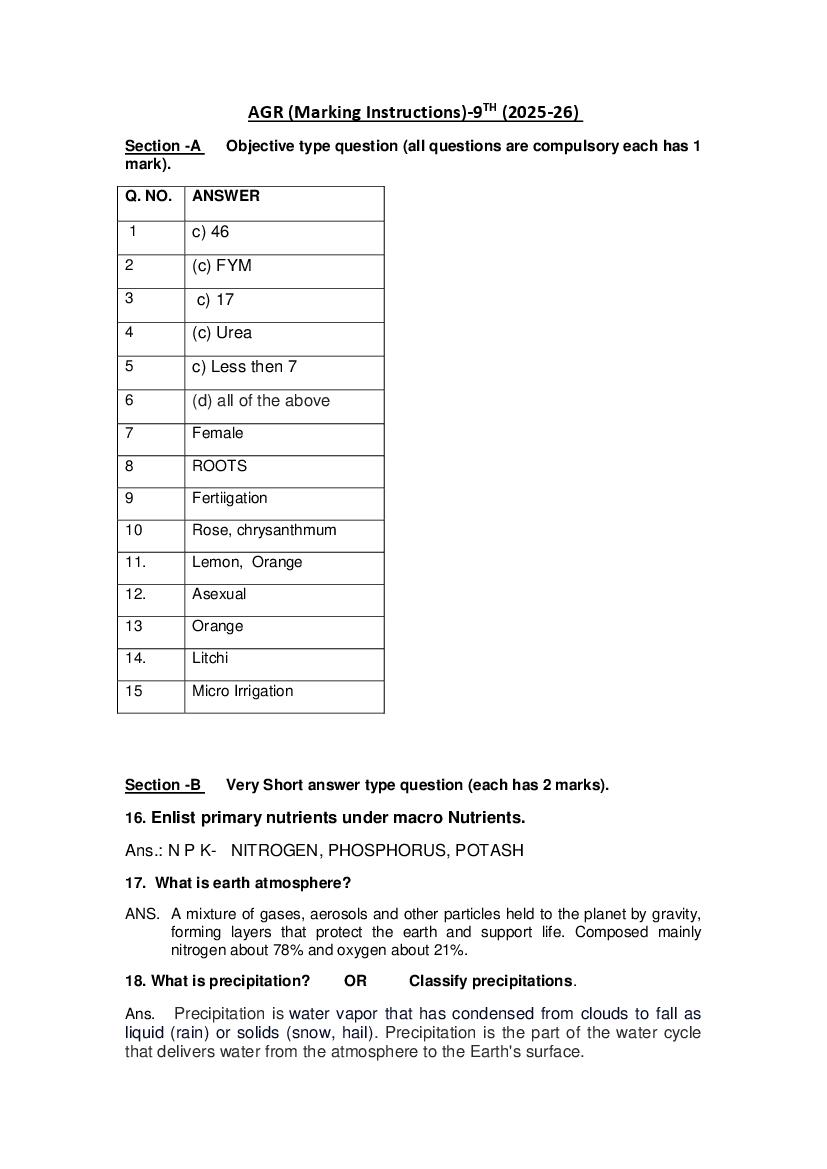
Section -A Objective type question (all questions are compulsory each has 1
mark).
Q. NO. ANSWER
1 c) 46
2 (c) FYM
3 c) 17
4 (c) Urea
5 c) Less then 7
6 (d) all of the above
7 Female
8 ROOTS
9 Fertiigation
10 Rose, chrysanthmum
11. Lemon, Orange
12. Asexual
13 Orange
14. Litchi
15 Micro Irrigation
Section -B Very Short answer type question (each has 2 marks).
16. Enlist primary nutrients under macro Nutrients.
Ans.: N P K- NITROGEN, PHOSPHORUS, POTASH
17. What is earth atmosphere?
ANS. A mixture of gases, aerosols and other particles held to the planet by gravity,
forming layers that protect the earth and support life. Composed mainly
nitrogen about 78% and oxygen about 21%.
18. What is precipitation? OR Classify precipitations.
Ans. Precipitation is water vapor that has condensed from clouds to fall as
liquid (rain) or solids (snow, hail). Precipitation is the part of the water cycle
that delivers water from the atmosphere to the Earth's surface.
Page 2
Classification: drizzle, rain, freezing rain, sleet, snow, graupel, and hail.
19. Name atleast 4 parts of a plant.
Ans. ROOT, STEM, LEAF, BRANCH, BUD
20. Name atleast 4 fruit tree found in Haryana.
ANS. GUVAVA, PITCH, LIME, MALTA
21. What is pruning? OR What is training?
ANS. Training: When a plant is made to grow with or without support,
in a desired fashion by removing or fastening some of its parts with a
view to give it a better framework or shape, the operation is called
‘training’.
OR
Pruning: Judicious removal of any part of a plant to divert sap towards
its producing areas, leading to an improvement in the quality of yield
is called ‘pruning’. It is done during the later stage of plant life when it
becomes ready to produce flowers and fruits. Decayed parts can also
be pruned off
Section -C Short answer type question (each has 3 marks).
22. Write methods of fertilizer application under rainfed and irrigated
conditions.
ANS. I. Broadcasting:
II. Placement:
III. Contact placement / combined drilling / drill placement.
IV. Side dressing
23. Describe soil testing.
Ans. Soil testing helps ascertain the status of various nutrients, soil
fertility level, pH, etc. It is important to know the fertility status and
physical properties of a soil for maximum production and rational soil
Page 3
three basic steps.
(i) Soil sampling
(ii) Soil testing
(iii) Soil test interpretation
24. Define Atmospheric Humidity.
Ans. Atmospheric humidity is the amount of water vapor present in the air, a
key factor in weather and climate that influences precipitation, cloud
formation, and human comfort. It can be expressed in several ways, including
relative humidity (the percentage of water vapor compared to the air's
maximum capacity), absolute humidity (the actual mass of water vapor), and
specific humidity (the ratio of water vapor mass to total air mass)
25. Name various branches of agriculture.
Ans. The major branches of agriculture include Agronomy (crop
management), Horticulture (fruits, vegetables, flowers), Animal Husbandry
(livestock), Forestry (trees), Fishery Science (fish), Agricultural
Engineering (equipment and structures), and Agricultural Economics
(business aspects)
26. What is tillage? name two type of farming.
Ans. tillage, in agriculture, the preparation of soil for planting and
the cultivation of soil after planting. Tillage is the manipulation of the soil into a
desired condition by mechanical means; tools are employed to achieve some
desired effect (such as pulverization, cutting, or movement). Soil is tilled to
change its structure, to kill weeds, and to manage crop residues. Types:
Dairy farming , mixed farming
OR
Name atleast three revolutions.
Ans. Green Revolution, White Revolution, Blue Revolution
Silver revolution, Round Revolution, Yellow Revolution
27. Describe key aspects of plant morphology.
OR
Classify plant life based on life cycle.
Page 4
such as roots, stems, leaves, flowers, fruits, and seeds, examining their
structure, form, size, color, and patterns. This includes understanding
different types of roots (like taproot and fibrous root systems), stem
modifications, leaf types (simple versus compound), the parts of a flower,
various fruit classifications (fleshy and dry), and the differences between
monocot and dicot seeds.
Section -D Essay answer type question (each has 5 marks).
28. What is Fertilizer? Give classifications with examples.
ANS. Fertilisers are artificially made of chemicals, which supply
essential nutrients to plants. They are available in concentrated forms
and contain higher amount of nutrients than manure, and are,
therefore, used in small quantities. There are three kinds of fertilisers
used for vegetable crops viz., nitrogenous, phosphatic and potassium.
Fertilisers can also be classified into straight, compound and mixed.
CLASSIFICATION: Sole fertiliser, MIXED Fertilizer
OR
Define plant Nutrients. Explain macro and micro nutrients.
ANS. There are a total of 17 nutritive elements, which are necessary
for the growth of plants. All elements are equally important
irrespective of their requirement or
presence in a plant.
Macro-nutrients
This is further divided into:
• Primary nutrients: These consist of Nitrogen, Phosphorus and
Potassium. These nutrients are supplied through fertilisers.
• Secondary nutrients: They include Calcium, Magnesium and Sulphur.
Micro-nutrients
Page 5
(Fe), Manganese (Mn), Copper (Cu), Zinc (Zn), Chlorine (Cl), Boron (B)
Molybdenum (Mo) and Nickel (Ni).
29. Define soil, enlist major soils found in india.
Ans. Soil is derived from the Latin word Solum. It may be defined as a
natural body developed as a result of weathering of rocks, in which
plants and other forms of life grow and prosper. It is the upper loose
layer of the earth crust rich in nutrients and minerals on which
plants grow. Soil is composed of minerals (45–50%), organic matters
(0.5–5%), water (25%) and a large number of plants, animals and
microbes.
Types: Red soil, Black Soil, Alluvial Soil, leterite soil, desert soil, forest & Hilly
soil, Marshy and Peat soil
OR
Define soil texture, describe clay and sand soil.
Soil particles namely sand, silt and clay(known as soil texture) are
classified according to their size. Clay particles are the finest and are
smaller than 0.002 mm in diameter. Loam particles are 0.002–0.02
mm in diameter. Silt particles have 0.02–2.0 mm diameter. Particles
larger than 2 mm are sand, gravel or stones. Most soils contain a
mixture of sand, silt and clay in different proportions.
30. What is IPM? Describe important pests and diseases control
methods.
Ans. IPM includes all types of control measures, such as cultural,
physical, mechanical, biological and chemical as per the suitability of
application, that control the pest population below the economic
injury level.
Cultural methods
Routine agronomic practices can be utilised for minimising pest
infestation by slight modification in timing or method of their
application. These functions are preventive methods.
Resistant cultivars, Clean cultivation, Tillage, Intercropping, Crop-rotation, Trap crops
Page 6
This reduces pest control by manual devices. Mechanical methods
along with physical and cultural methods are effective in reducing
pest populations.
Biological control
Insects have some natural enemies. Predators, parasitoids, microbes,
birds and other animals are useful in minimising insect pests.
• Predators, Parasites, Pathogens, Botanical insecticides etc.
Chemical control
Use of fungicides chemical or a combination of chemicals lethal to the
fungi that saves the host from infection is called fungicide. Fungicides,
according to their movement in the plant system, are of two types. The
first one is systemic,which when applied on plants dissolves on the
cell sap and is effective for the whole plant irrespective of where it is
applied. For example, benlate, carbendazim, metalaxyl, thiobendazol,
propiconazole, etc.
Document Details
| Board / Org | Haryana Board |
| Exam | Class 9 |
| Type | Sample Paper |
| Pages | 6 |
| Updated | 24 Sep 2026 |