HBSE Class 9 Sample Paper 2027 Home Science Marking Scheme
Finished viewing? Save it for later —
Download HBSE Class 9 Sample Paper 2027 Home Science Marking Scheme (PDF · 11 pages)About HBSE Class 9 Sample Paper 2027 Home Science Marking Scheme
HBSE Class 9 Sample Paper 2027 Home Science Marking Scheme is available here for free download. Published by Haryana Board for Class 9, this answer key can be viewed online or downloaded as a PDF (11 pages). Candidates preparing for Class 9 can use HBSE Class 9 Sample Paper 2027 Home Science Marking Scheme to understand the exam pattern, the type of questions asked, and the overall difficulty level.
Frequently Asked Questions
How can I download HBSE Class 9 Sample Paper 2027 Home Science Marking Scheme?
Open this page and click the Download button to save HBSE Class 9 Sample Paper 2027 Home Science Marking Scheme as a PDF. It is completely free on AglaSem Docs.
Is HBSE Class 9 Sample Paper 2027 Home Science Marking Scheme free to download?
Yes. HBSE Class 9 Sample Paper 2027 Home Science Marking Scheme can be viewed online and downloaded as a PDF free of cost on AglaSem Docs.
How many pages does HBSE Class 9 Sample Paper 2027 Home Science Marking Scheme have?
HBSE Class 9 Sample Paper 2027 Home Science Marking Scheme contains 11 pages, which you can read online or download together as a single PDF.
Where can I find more Class 9 study material?
You can find more Class 9 question papers, sample papers, syllabus, and answer keys on AglaSem Docs.
HBSE Class 9 Sample Paper 2027 Home Science Marking Scheme – Text
Read the full text of this answer key below — useful to quickly search, copy and reference the content online without downloading the PDF.
📄 View text version (12 pages)
Page 1
HBSE Class 9 Sample
Paper 2027 Home
Science Marking
Scheme
EXAM YEAR TYPE SUBJECT
Haryana Class 9 2027 Answer Key Home Science
Notes · Sample Papers · Previous Year Papers · Mock Tests
Page 2
m c. o
c. o
e m
em l a s
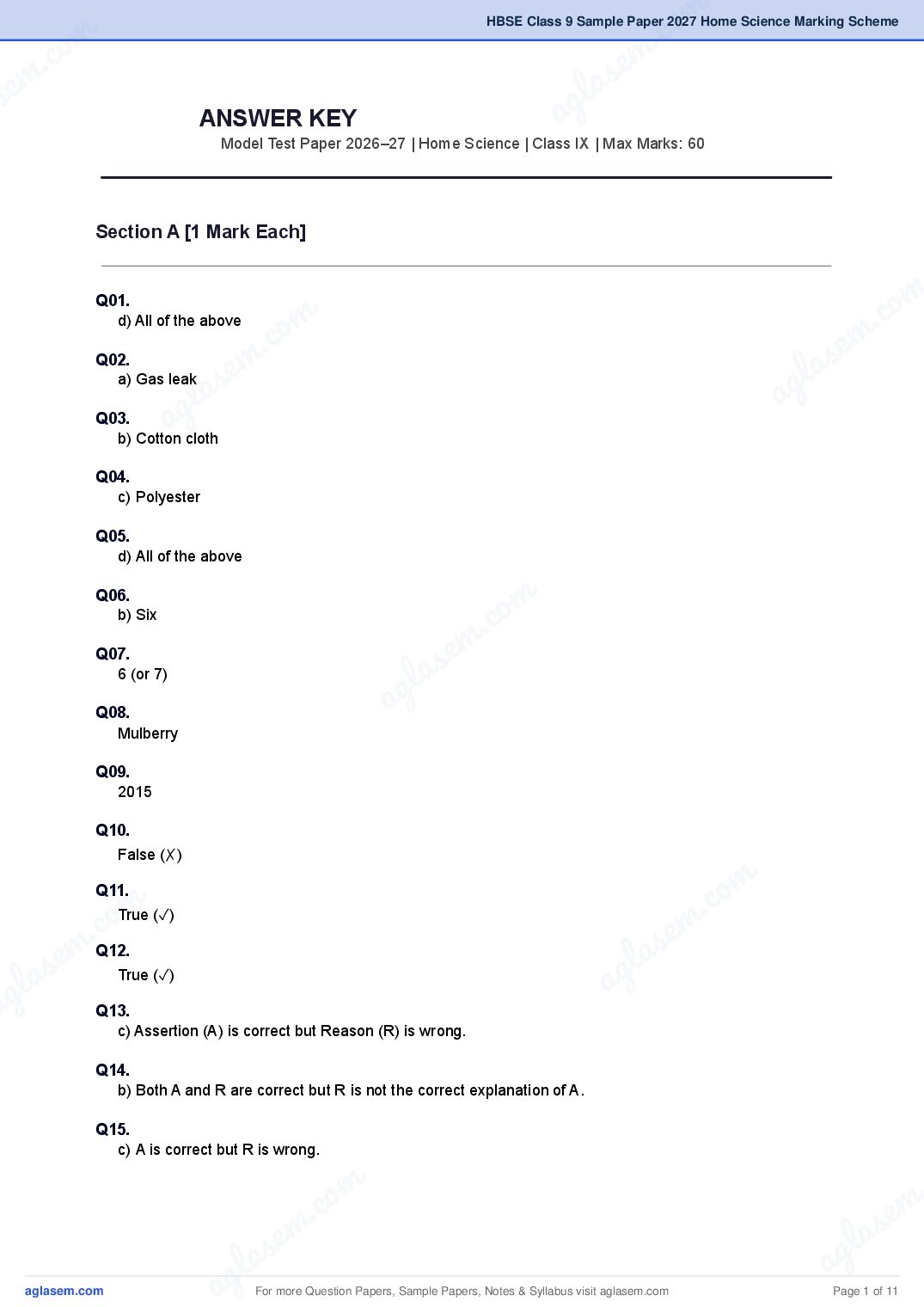
s ANSWER KEY ag
Model Test Paper 2026–27 | Home Science | Class IX | Max Marks: 60
Section A [1 Mark Each]
m
m .co
Q01.
.co e m
d) All of the above
e m las
s g
Q02.
a) Gas leak
l a a
Q03. ag
b) Cotton cloth
Q04.
c) Polyester
Q05.
d) All of the above
m
co
Q06.
.
em
b) Six
Q07.
l a s
a g
6 (or 7)
Q08.
Mulberry
Q09.
2015
Q10.
m
False (✗)
m c. o
c. o
Q11.
e m
s
True (✓)
em Q12. l a
l as ag
ag
True (✓)
Q13.
c) Assertion (A) is correct but Reason (R) is wrong.
Q14.
b) Both A and R are correct but R is not the correct explanation of A.
Q15.
c) A is correct but R is wrong.
m .
.co s e m
e m l a
l a s a g
ag For more Question Papers, Sample Papers, Notes & Syllabus visit Page 1 of 11
Page 3
Q16.
A family is the most basic and fundamental unit of society. It is a group of people related by blood,
marriage, or adoption who live together, share resources, and support one another emotionally,
socially, and economically. Key features of a family:
Q17.
The Government of India has taken significant steps to make education accessible and free for girls: •
Under the Right to Education (RTE) Act, 2009, free and compulsory education is guaranteed for all
children (boys and girls) from Classes 1 to 8 (ages 6–14).
Q18.
Development is defined as a series of progressive, orderly, and qualitative changes that occur in an
individual over their entire lifespan. It refers not just to physical growth but to the overall advancement
of a person's abilities, personality, and functioning.
— OR —
Motor Development refers to the progressive development of a child's ability to control and coordinate
the movements of their body through the growth and maturation of muscles, bones, and the nervous
system.
Q19.
Home Science is an interdisciplinary subject that deals with the science and art of managing home and
family life. Its major fields of study are:
1. Food and Nutrition.
2. Human Development and Family Studies
3. Fabric and Apparel Sciences
4. Resource Management
5. Communication and Extension
Q20.
Our homes contain several substances that can be highly toxic and dangerous, especially to children
and elderly members:
1. Chemical Cleaning Agents
2. Pest Control Products
3. Medicines and Pharmaceuticals
4. Paints, Varnishes, and Solvents
5. Batteries and Electronic Waste
Q21.
Wool is a natural animal fibre obtained by shearing (cutting) the fleece (coat of hair) from various
animals. The main sources are: 1. Sheep — The most common source of wool worldwide. Merino
sheep produce the finest quality wool.
2. Goat — Cashmere (Pashmina) wool comes
3. Rabbit
4. Camel
5. Alpaca and Llama
6. Yak
For more Question Papers, Sample Papers, Notes & Syllabus visit Page 2 of 11
Page 4
m c. o
c. o
e m
em l a s
s — OR — ag
Plant Fibres are natural textile fibres obtained from different structural parts of plants. They are
composed mainly of cellulose and are biodegradable, breathable, and eco-friendly. Classification
based on the part of the plant they come from:
1. Seed Fibres
• Cotton
2. Stem/Bast Fibres
m
.co
• Jute.
o m m
c
• Flax (Linen)
• Hemp
m . s e
3. Leaf Fibres
s e g la
• Sisal
g la a
• Coir
Q22.
a
The flooring of a bathroom requires very specific qualities due to its environment: 1. Non-Slippery /
Anti-Skid — .
2. Water-Resistant and Waterproof .
3. Easy to Clean and Hygienic
m
co
Section C [3 Marks Each]
.
s em
Q23.
g l a
a
Malnutrition is a serious public health condition that arises when a person's diet does not provide the
correct amount and variety of nutrients needed for the body to function properly. It encompasses both
too little and too much nutrition. Definition: Malnutrition is defined as a state of nutrition in which a
deficiency, excess, or imbalance of energy, protein, and other nutrients causes measurable adverse
effects on body tissues, function, and clinical outcome. Types of Malnutrition:
1. Undernutrition (Deficiency) — Occurs when the body does not receive adequate calories,
proteins, vitamins, or minerals.
m
c. o
2. Overnutrition (Excess) — Occurs when the body receives more nutrients (especially calories
m
c. o m
and fats) than it needs.
s e
s em l a
gla Q24.Differences between Growth and Development: ag
a
Aspect Growth Development
1. Nature Quantitative — involves Qualitative — refers to improvement
measurable, physical increases in in the complexity and quality of
size (height, weight, head abilities, skills, and behaviour.
circumference).
m .
.co s e m
e m l a
l a s a g
ag For more Question Papers, Sample Papers, Notes & Syllabus visit Page 3 of 11
Page 5
2. Scope Limited to physical/bodily changes Comprehensive and
only — increase in height, weight, multidimensional — includes
organ size. physical, intellectual, emotional,
social, and moral dimensions.
3. Duration Temporary — starts at conception Continuous, lifelong process —
and typically stops when the body occurs from conception until death
reaches physical maturity (around and never truly stops.
18–21 years).
4. Easily measured using instruments Difficult to measure directly —
Measurement (weighing scale, height chart). assessed through observation,
psychological tests, and behavioural
analysis.
5. Growth and development are interrelated — physical growth supports
Relationship development, but development can occur even without noticeable physical
growth (e.g., a person’s wisdom and emotional maturity continue to grow in old
age even as the body declines).
— OR —
Development of Temporary and Permanent Teeth in a Child: Teeth are essential for chewing food,
proper speech development, and maintaining the jaw structure. Children go through two sets of teeth
during their growth. Temporary Teeth (Milk Teeth / Deciduous Teeth):
• A child is born with no visible teeth, though tooth buds are already formed in the gums before birth.
• The first milk tooth (usually a lower central incisor) erupts at approximately 6 months of age.
• Eruption continues gradually through toddlerhood. By the age of 2.5 to 3 years, all 20 milk teeth
have usually emerged (8 incisors, 4 canines, 8 molars).
• Milk teeth are smaller, whiter, and have thinner enamel compared to permanent teeth.
• These teeth are crucial for chewing nutritious foods, aiding speech development, and holding space
inthe jaw for permanent teeth. Permanent Teeth:
• Around the age of 6 years, the milk teeth begin to loosen and fall out (shed) as the permanent teeth
develop below and push them out.
• The process of replacement continues gradually through childhood and adolescence.
• By approximately 12–13 years of age, most of the 28 permanent teeth have erupted.
• The final 4 wisdom teeth (third molars) erupt between the ages of 17 and 21, completing the full set
of 32 permanent teeth.
• Permanent teeth are larger, harder, more yellow-tinted, and are meant to last a lifetime with
propercare.
Q25.
Classification of Fibres on the Basis of Their Origin: Fibres are the basic units used to make yarn,
and subsequently fabric. They are broadly classified as follows: 1. Natural Fibres — Obtained directly
from nature (plants, animals, or minerals) with minimal processing.
For more Question Papers, Sample Papers, Notes & Syllabus visit Page 4 of 11
Page 6
m c. o
c. o
e m
em l a s
s a) Plant / Cellulosic Fibres: Derived from cellulose found in plants. ag
• Seed fibre: Cotton
• Bast/Stem fibre:Jute
• Leaf fibre: Sisal, Coir (coconut husk).
b) Animal / Protein Fibres: Derived from proteins secreted or produced by animals. • Silk •
Wool
c) Mineral Fibres:
m
.co
• Asbestos
m
co m
2. Man-made / Manufactured Fibres — Created artificially through chemical processes.
m . s e
la
a) Regenerated / Semi-synthetic Fibres: Made from natural cellulose chemically processed in a
s e g
a
factory.
g l
• Rayon (Viscose)
a
a
• Acetate
b) Synthetic Fibres: Entirely man-made from petrochemicals through polymerisation. •
Polyester
• Nylon
• Acrylic
• Spandex/Lycra
— OR —
o m
c
Three Characteristics of Cotton Fibre: Cotton is one of the most important and widely used natural
m .
plant fibres in the world. It is obtained from the seed pod (boll) of the cotton plant .
e
Cotton has a high moisture absorption capacitys— it can absorb up to 27 times its own weight in water.
1. Highly Absorbent and Breathable:
g linahot and humid weather.
a
This makes cotton very comfortable to wear
2 .Stronger When Wet:
Unlike many other fibres (such as wool and silk), cotton actually becomes approximately 20–30%
stronger when it is wet.
3. Lacks Elasticity and Wrinkles Easily:
Cotton has very poor elasticity — it does not stretch and return to its original shape like wool or
spandex. As a result, cotton garments lose their shape easily after wear and tend to wrinkle and crease
m
heavily after washing or sitting.
m c. o
c. o m
Q26.
s e
em These are personal, intangible resources that reside within the individual. gla
Types of Resources: Resources are broadly classified into the following types: 1. Human
s
Resources:
gla a
a • Time
• Energy
• Knowledge and Skills
• Attitude and Values
2. Non-Human / Material Resources:
These are tangible, physical assets.
• Money
m .
co
• Property and Goods
. e m
e m l a s
l a s a g
ag For more Question Papers, Sample Papers, Notes & Syllabus visit Page 5 of 11
Page 7
— OR —
Reducing Household Waste Through Reuse — With Examples: Reuse means using a product or
material again for its original purpose or for a different purpose, instead of discarding it after one use.
. Examples of Reuse in the Home:
1. Glass Jars and Bottles — Empty jam jars, pickle jars, and glass bottles can be thoroughly
washed and reused as containers for storing kitchen spices, grains, homemade preserves, or even as
pen holders.
2. Old Clothing and Fabric — Worn-out cotton sarees, bedsheets, or old T-shirts can be cut into
pieces and reused as cleaning dusters, floor wipes (pochha), or kitchen rags instead of buying new
ones.
3. Plastic Bags and Containers — Carry bags from shopping can be reused as bin liners, storage
bags, or bags for carrying vegetables and groceries on subsequent trips.
4. Newspaper and Paper Bags — Old newspapers can be used to wrap fragile items, line
cupboard shelves, or make paper bags for waste disposal.
Q27.
Selection of Clothing for Children:
1. Fabric and Material:
• Clothes should be made of soft, natural fabrics — ideally 100% cotton — as cotton is breathable,
absorbent, hypoallergenic, and gentle on a child's skin
• 2. Fit and Design:
• Clothing should be loose-fitting and comfortable to allow freedom of movement for running,
playing, bending, and sitting.
• 3. Safety:
• Avoid clothes with long drawstrings around the neck or hood — these can wrap around a child's
neck and cause strangulation.
• Clothing should not have sharp embellishments like metal studs or pins.
5. Colour and Visibility:
• Bright-coloured or light-coloured clothes are preferred — they make the child visible in public
spacesand playing areas.
Q28.
Definition of Recycling:
Recycling is the systematic process of collecting, sorting, cleaning, and reprocessing used or waste
materials so that they can be converted into new raw materials or products.
For more Question Papers, Sample Papers, Notes & Syllabus visit Page 6 of 11
Page 8
m c. o
c. o
e m
em l a s
s Common Household Items That Can Be Recycled: ag
1. Paper and Paper Products — Newspapers, magazines, cardboard boxes, paper bags, office
paper. These are pulped and made into recycled paper, tissue, or packaging material.
2. Glass — Glass bottles, jars, and containers. Glass can be melted and remoulded repeatedly
without loss of quality. Broken glass (cullet) is used in glassmaking factories.
3. Metals — Aluminium cans (cold drink/juice cans), steel tins (food cans), scrap metal. Metals are
highly recyclable and retain their properties after recycling.
m
.co
4. Plastics — Plastic bottles (water, shampoo), plastic containers, carry bags, and packaging
m
c. o m
marked with recycling symbols (■ with numbers 1–7). Different types of plastics are sorted and
m (E-waste) — Old mobile phones, batteries, chargers, computer parts. These las
processed separately.
e
s e g
a
5. Electronic Waste
l a
g Waste — Kitchen scraps, vegetable peels, and food waste can be composted (a form of
contain valuable metals (gold, copper) and toxic materials that need specialised recycling.
a
6. Organic
biological recycling) to make nutrient-rich manure for gardens.
Q29.
Types of Vitamins
1. Fat-Soluble Vitamins:
These vitamins dissolve in fats and oils. They are absorbed along with dietary fat in the small intestine
and stored in the liver and fatty tissues of the body. Because they are stored, excessive intake can
m
co
lead to toxicity (hypervitaminosis). • Vitamin A (Retinol)
.
• Vitamin D
s em
• Vitamin E
• Vitamin K
g l a
a
2. Water-Soluble Vitamins:
These vitamins dissolve in water. They are not stored in the body (except Vitamin B12) and excess
amounts are excreted through urine. They must be replenished daily through diet. • Vitamin C
(Ascorbic Acid)
• B-Complex Vitamins — A group of 8 vitamins that play vital roles in energy metabolism, nerve
function, and cell production:
– B1 (Thiamine )
m
– B3 (Niacin) — Deficiency
om D [5 Marks Each] c. o
– B9 (Folic Acid)
c.Section e m
– B12 (Cobalamin)
em l a s
s
la Q30. a g
ag
Main Functions of Protein and Its Sources of Availability: Introduction:
. Main Functions of Protein:
1. Growth and Development:
Proteins are the primary structural component of every cell in the body. They are essential for building
new tissues, developing muscles, and supporting rapid growth
2. Repair and Maintenance of Body Tissues:
m .
.co s e m
e m l a
l a s a g
ag For more Question Papers, Sample Papers, Notes & Syllabus visit Page 7 of 11
Page 9
recovery from injury, and replacement of old red blood cells .
3. Synthesis of Enzymes:
All enzymes — biological catalysts that speed up every chemical reaction in the body — are proteins.
Without enzymes, digestion, respiration, and metabolism would be impossible.
4. Synthesis of Hormones:
Many important hormones are protein in nature. For example, insulin (regulates blood sugar), growth
hormone (stimulates growth), and glucagon (raises blood sugar) are all protein hormones. These
hormones regulate critical body processes.
5. Production of Antibodies (Immune Function): The immune system produces antibodies —
specific proteins that identify and neutralise foreign substances (bacteria, viruses, allergens) in the
body.
6. Transport of Substances:
Certain proteins carry vital substances through the blood. For example, haemoglobin (a protein in red
blood cells) transports oxygen from the lungs to every cell in the body.
7. Energy Supply (Secondary Function):
Proteins provide 4 kilocalories per gram of energy. However, they are used as an energy source only
when carbohydrates and fats are insufficient.
Sources of Protein:
Animal Sources (Complete Proteins — contain all 9 essential amino acids in adequate
proportions):
• Meat (chicken, mutton, beef, pork)
• Fish and seafood (tuna, salmon, prawns)
• Eggs — considered the most perfect protein source (biological value = 100) • Milk, curd, paneer
Plant Sources (Incomplete Proteins — typically lack one or more essential amino acids):
• Pulses and legumes — moong dal, chana dal, rajma, lentils (masoor), toor dal
• Soybeans — the richest plant protein; contains all essential amino acids
• Nuts — almonds, groundnuts, cashews, walnuts
• Seeds — pumpkin seeds, sunflower seeds, sesame
• Whole grains — wheat, rice, oats (small amounts)
— OR —
Malnutrition — Definition and Main Causes: Definition:
Malnutrition is a broad term for a range of conditions caused by an imbalanced diet — one that
provides either too few, too many, or the wrong kinds of nutrients. It is not limited to hunger or
starvation; it also includes obesity and micronutrient deficiencies. Malnutrition adversely affects
physical growth, brain development, immune function, and overall quality of life. Main Causes of
Malnutrition:
1. Poverty and Economic Inequality:
Poverty is the most fundamental cause of malnutrition. Families with very low incomes cannot afford
sufficient quantities of food or a varied, nutrient-rich diet. They rely heavily on cheap, calorie-dense but
nutritionally poor foods (like refined grains), which lack essential proteins, vitamins, and minerals. Food
insecurity (not knowing where the next meal will come from) is directly linked to undernutrition.
For more Question Papers, Sample Papers, Notes & Syllabus visit Page 8 of 11
Page 10
m c. o
c. o
e m
em l a s
s 2. Lack of Education and Nutritional Awareness: ag
Even when food is available, malnutrition can occur due to poor food choices. Many people —
especially in rural areas — are not aware of the nutritional requirements of different age groups
(infants, children, pregnant women, elderly). They may not know the importance of a balanced diet,
leading to monotonous meals that lack variety. Lack of education about breastfeeding, complementary
feeding, and hygiene practices is a major cause of infant malnutrition.
3. Poor Sanitation, Hygiene, and Diseases:
m
.co
Living in unhygienic conditions leads to frequent infections such as diarrhoea, dysentery, typhoid, and
o m m
c
intestinal worm infestations. These illnesses:
. s e
em
• Reduce appetite and food intake.
• Increase the s
• Impair the absorption of nutrients from the gut.
g l a
g l a body's nutritional demands (due to fever and immune response).
a
a
• Cause the body to use up stored nutrients at a faster rate.
This creates a vicious cycle: malnutrition weakens immunity → more infections → further nutrient loss
→ worsening malnutrition.
4. Improper Infant and Young Child Feeding Practices:
• Failure to exclusively breastfeed infants for the first 6 months deprives them of essential nutrients
andantibodies present in mother's milk.
• Early or delayed introduction of complementary foods (weaning foods) after 6 months
o m
c
affectsnutritional status.
malnutritionand mortality in developing countries.m
.
• Feeding infants watered-down formula or contaminated water is a major cause of infant
s esnacks, or sugar-sweetened beverages leads
g la simultaneously.
• Feeding children primarily junk food, processed
a
toovernutrition and micronutrient deficiencies
• 5. Food Insecurity and Unequal Food Distribution:
Even when food is available at the national level, it may not reach everyone. Natural disasters (floods,
droughts), crop failures, armed conflicts, and political instability disrupt food supply chains and displace
populations. Social inequalities (gender discrimination, caste-based discrimination) may also mean that
certain groups — especially women and girls — consistently receive less food than they need.
o m
6.Cultural and Social Factors:
m women being restricted from eating certain fruits, proteins, or eggs). Gender c
.discrimination —
c. opregnant
In some communities, certain nutritious foods are avoided due to cultural taboos or superstitions (e.g.,
m
e women and girls.
em l a s
where women eat last and least — is also a significant cause of malnutrition among
s
la Q31.Definition of Resources: a g
ag
A resource is anything — tangible or intangible — that can be used by an individual, family, or
community to achieve a desired goal, meet a need, or carry out a task. Resources are the tools and
means through which people manage their lives. In the context of Home Science and family resource
management, resources enable families to fulfil their physical, emotional, social, and economic needs.
Examples of resources: time, money, energy, skills, community facilities, material goods. Main
Characteristics of Resources:
m .
co m
1. Utility:
m . s e
se g l a
l a a
ag For more Question Papers, Sample Papers, Notes & Syllabus visit Page 9 of 11
Page 11
becomes a resource only in relation to a need. For example, water is a resource when you are thirsty
or need to cook; an old sewing machine is a resource for someone who can stitch clothes but may be
useless to someone who cannot. The utility of a resource varies from person to person and situation to
situation.
2. Limitation (Scarcity):
All resources — whether time, money, energy, or natural materials — are finite and limited in supply.
No one has unlimited resources. Since human needs and wants are unlimited but resources are
scarce, choices and priorities must be made. This scarcity is the very reason why resource
management is essential. For example, each person has only 24 hours a day and a fixed income;
these must be managed wisely.
3. Inter-relatedness:
Resources are closely connected to one another — the use of one resource often affects or requires
the use of another resource. For example:
• Using time to cook a meal also requires energy, money (to buy ingredients), and knowledge/skills.
• Using money to hire a plumber saves time and energy.
This interconnectedness means that managing one resource wisely often improves the availability or
effectiveness of others.
4. Interchangeability (Substitutability):
In many situations, one resource can substitute for another to achieve the same goal. For example:
• Money can replace time and skill — instead of stitching a dress yourself, you can pay a tailor.
• Skill and knowledge can replace money — a person who knows how to repair appliances can save
the cost of hiring a technician.
• Community resources can compensate for limited personal material resources — using a public
library instead of buying books.
Interchangeability gives families flexibility in achieving their goals even when certain resources are
unavailable or insufficient.
5. Accessibility:
Resources are only effective when they are accessible to the user. A park nearby is a community
resource, but if it is unsafe or located too far away, it cannot be utilised. Similarly, internet-based
educational resources are useless without connectivity and devices. Accessibility depends on physical
availability, economic means, and social factors.
— OR —
Main Benefits/Impacts of the 5R Principle: The 5R Principle is a framework for sustainable waste
management that guides individuals and communities to reduce their environmental impact and
manage resources responsibly. The 5Rs stand for: Refuse, Reduce, Reuse, Repurpose, and
Recycle.
1. Refuse: Consciously declining to accept unnecessary items — e.g., refusing single-use plastic
bags, refusing excessive packaging, refusing promotional items you don't need. This prevents waste
at the source.
2. Reduce: Minimising the quantity of resources used and waste generated —
e.g., buying only what you need, using energy-efficient appliances, reducing food waste by meal
planning.
3. Reuse: Using items multiple times before discarding them — e.g., refilling water bottles, using
cloth bags instead of disposable ones, reusing glass jars.
For more Question Papers, Sample Papers, Notes & Syllabus visit Page 10 of 11
Page 12
m c. o
c. o
e m
em l a s
s 4. ag
Repurpose: Creatively finding a new use for an old item — e.g., turning old tyres into garden
planters, using old sarees as decorative curtains, converting crates into furniture.
5. Recycle: Processing waste materials into new products — e.g., converting waste paper into
recycled paper, melting glass bottles to make new glassware.
Main Impacts and Benefits of the 5R Principle:
1. Conservation of Natural Resources:
By reducing consumption and recycling materials, the 5Rs significantly decrease the demand for virgin
m
.co
natural resources such as timber, minerals, petroleum, and water. For instance, recycling one tonne of
o m m
c
paper saves approximately 17 trees and 26,000 litres of water. This ensures that natural resources are
. e
em as
preserved for future generations.
Manufacturing sproducts from recycled materials requires far less energy than producing them fromg l
2. Energy Savings:
laexample:
materials.gFor
a raw
a
• Recycled aluminium requires 95% less energy than aluminium made from bauxite ore.
• Recycled glass requires 30% less energy than new glass production.
• Recycled paper uses 60% less energy than virgin paper production.
These energy savings translate directly into reduced fuel consumption and lower electricity bills
3.Reduction of Landfill Waste:
m
India generates approximately 62 million tonnes of solid waste annually. A significant portion ends up in
. co
overflowing landfills that pollute soil and groundwater. By practising the 5Rs, households divert large
em
volumes of waste from landfills — extending the lifespan of existing landfills, reducing land use, and
preventing land degradation.
l a s
Decomposing organic waste in landfills a g methane, a greenhouse gas 25 times more potent
4. Pollution Mitigation and Climate Change:
releases
than CO2 in trapping heat. Reducing waste reduces methane emissions. Additionally, manufacturing
new products from raw materials generates industrial pollution (air, water, and soil). Recycling and
reusing materials reduces this industrial burden, thereby lowering greenhouse gas emissions and
helping combat climate change.
5. Economic Benefits for Households:
• Families that practise the 5Rs spend less on buying new items (reusing and repurposing
m
c. o
savesmoney).
m
c. o m
• Reducing food waste saves on grocery bills.
s e
s em l a
gla ag
a
m .
.co s e m
e m l a
l a s a g
ag For more Question Papers, Sample Papers, Notes & Syllabus visit Page 11 of 11
Document Details
| Board / Org | Haryana Board |
| Exam | Class 9 |
| Type | Answer Key |
| Pages | 11 |
| Updated | 03 Nov 2026 |