HBSE Class 9 Sample Paper 2027 Science Marking Scheme
Finished viewing? Save it for later —
Download HBSE Class 9 Sample Paper 2027 Science Marking Scheme (PDF · 17 pages)About HBSE Class 9 Sample Paper 2027 Science Marking Scheme
HBSE Class 9 Sample Paper 2027 Science Marking Scheme is available here for free download. Published by Haryana Board for Class 9, this answer key can be viewed online or downloaded as a PDF (17 pages). Candidates preparing for Class 9 can use HBSE Class 9 Sample Paper 2027 Science Marking Scheme to understand the exam pattern, the type of questions asked, and the overall difficulty level.
Frequently Asked Questions
How can I download HBSE Class 9 Sample Paper 2027 Science Marking Scheme?
Open this page and click the Download button to save HBSE Class 9 Sample Paper 2027 Science Marking Scheme as a PDF. It is completely free on AglaSem Docs.
Is HBSE Class 9 Sample Paper 2027 Science Marking Scheme free to download?
Yes. HBSE Class 9 Sample Paper 2027 Science Marking Scheme can be viewed online and downloaded as a PDF free of cost on AglaSem Docs.
How many pages does HBSE Class 9 Sample Paper 2027 Science Marking Scheme have?
HBSE Class 9 Sample Paper 2027 Science Marking Scheme contains 17 pages, which you can read online or download together as a single PDF.
Where can I find more Class 9 study material?
You can find more Class 9 question papers, sample papers, syllabus, and answer keys on AglaSem Docs.
HBSE Class 9 Sample Paper 2027 Science Marking Scheme – Text
Read the full text of this answer key below — useful to quickly search, copy and reference the content online without downloading the PDF.
📄 View text version (19 pages)
Page 1
HBSE Class 9 Sample
Paper 2027 Science
Marking Scheme
EXAM YEAR TYPE SUBJECT
Haryana Class 9 2027 Answer Key Science
Notes · Sample Papers · Previous Year Papers · Mock Tests
Page 2
m .co
m .co s e m
se g l a
Marking scheme a
class 9th 2026-27
sample paper
Paper science
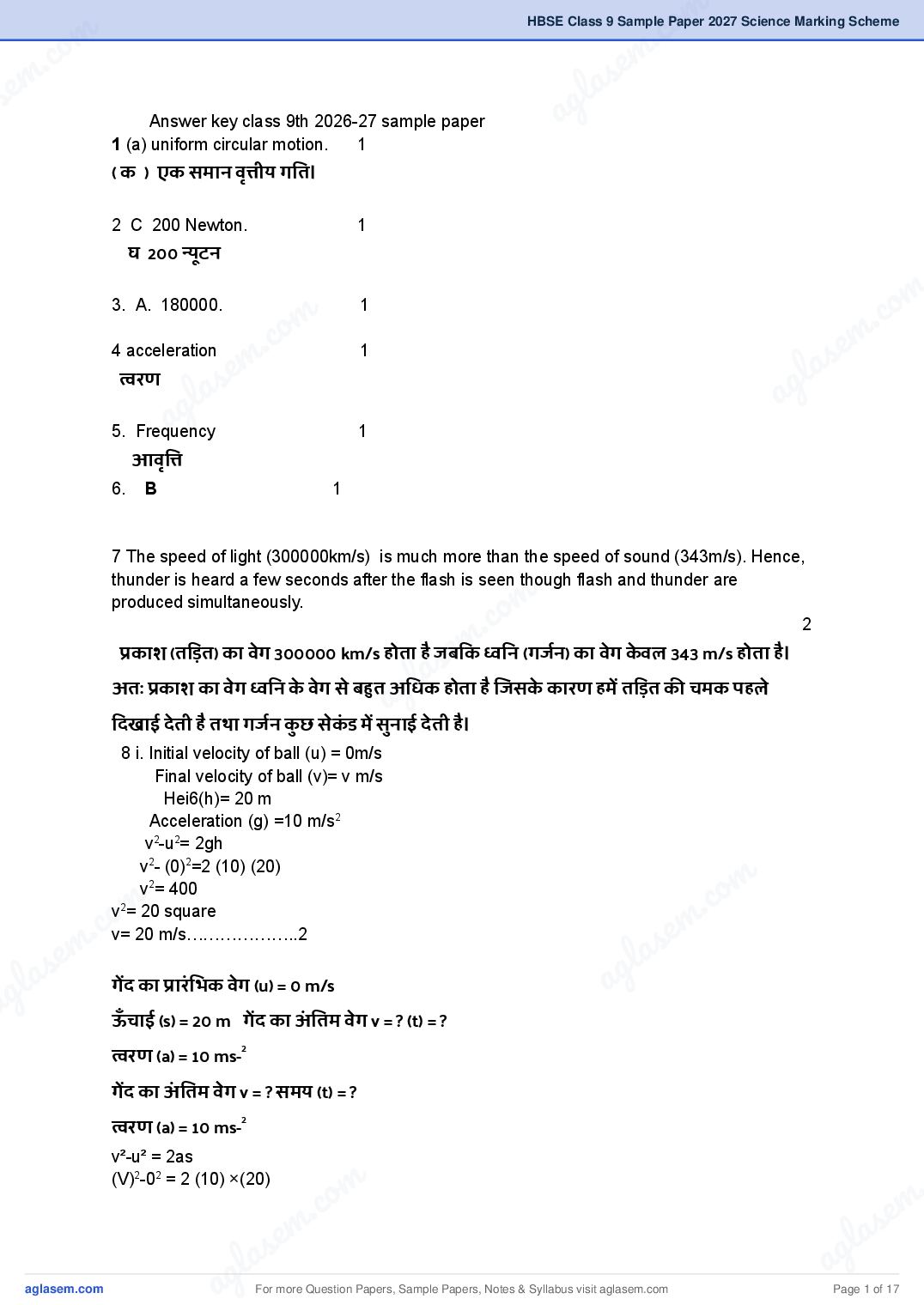
1 (a) uniform circular motion. 1
( क ) एक समान वृ्ቈीय ग त।
m
.co
2 C 200 Newton. 1
घ 200 ्ूटन m
m .co s e m
s e l a
ag
3. A. 180000. 1
g l a
a
4 acceleration 1
्रण
5. Frequency 1
आवृ ्ቈ
6. 1
m
.co
7 The speed of light (3 x 10 m/s) is much more than the speed of sound (340 m/s). Hence,
em
thunder is heard a few seconds after the flash is seen though flash and thunder are
s
produced simultaneously. 2
g lहैaजबिक ्ቜिन (गजन) का वेग केवल 332 m/s होता है।
a
्ቚकाश (तिड़त) का वेग 300000 km/s होता
अतः ्ቚकाश का वेग ्ቜिन के वेग से बहुत अ धक होता है जसके कारण हमें तिड़त की चमक पहले
िदखाई दे ती है तथा गजन कुछ सेक
ं ड में सुनाई दे ती है।
8 i. Initial velocity of ball (u) = 0m/s
Final velocity of ball (v)= v m/s
Hei6(h)= 20 m
m
.co
Acceleration (g) =10 m/s2
m
.co m
v2-u2= 2gh
m v2- (0)2=2 (10) (20)
s e
s e v2= 400
g l a
g la v2= 20 square a
a v= 20 m/s………………..2
गेंद का ्ቚारं भक वेग (u) = 0 m/s
ऊ
ँ चाई (s) = 20 m गेंद का अ
ं तम वेग v = ? (t) = ?
्रण (a) = 10 ms-2
गेंद का अ
ं तम वेग v = ? समय (t) = ?
m .
.co s e m
s em l a
g la ag
a For more Question Papers, Sample Papers, Notes & Syllabus visit Page 1 of 18
Page 3
v²-u² = 2as 02-02 = 2 (10) (20) 0² =400
(v)2 = (20) 2. v = 20 m/s.
. Or
According to Newton's third law of motion action is always equal and opposite to reaction
.The ejection of large amounts of water at a high velocity from a hose pipe in the forward
direction exerts same force in backward direction. Due to this backward force it is difficult for
a Fireman to hold a hose pipe.
उ्ቈर- एक अि शमन कमचारी को ती्ብ ग त से बहुतायत मा्ቔा में पानी फेंकने वाली रबड़ की नली को
पकड़ने में किठनाई होती है ्ቄोंिक ग त के तीसरे िनयम के अनुसार ि्ቅया और ्ቚ ति्ቅया िवपरीत िदशा
में होती है। अि शमन के पाइए से ती्ብ ग त से पानी िनकलता है तो वह उस पाइप को उतने ही वेग से
पीछे की ओर धकेलता है। जस कारण अि शमन कमचारी को पाइप पकड़ने में थोड़ी किठनाई होती है।
9 Due to inertia of motion, when suddenly brakes are applied to moving bus then we fall in
the forward direction because the lower part of our body comes to rest as the bus comes to
rest, but the upper part of body continue to move forwards due to inertia of motion.
2
जब बस ग त की अवस्था में होती है ,तो हमारा शरीर भी ग त की अवस्था में होता है, परंतु जब अचानक
बस रूकती है तो हमारे शरीर का िनचला भाग तो िवराम अवस्था में आ जाता है, परंतु ऊपर का िह्ተा
जड़् के कारण ग त की अवस्था में रहने का ्ቚय्ቌ करता है जस कारण हम आगे की ओर झुक जाते हैं।
10Ans. (a) An object with a constant acceleration but with zero velocity is possible. For
example, when a body is just released its initial velocity is zero but acceleration of freely
falling body is g = 10 m/s 1.5
(b) The situation is possible. For example, when an object moving with uniform velocity on a
circular track then acceleration is in the perpendicular direction.
1.5
उ्ቈर- (अ) हाँ, यह स्थ त संभव है। जब िकसी व्ቜु को पृ्ቚी तल से ऊपर की ओर फेंका जाता है तो
अ धकतम ऊ
ँ चाई पर व्ቜु का वेग शू् होता है, पर्ቌु ्रण स्थर रहता है।
(ब) हाँ, यह स्थ त संभव है। वृ्ቈीय पथ पर एक समान वेग से चल रही व्ቜु इसका उदाहरण है।
11 Ans. (i) When a rider rides a bicycle then muscular energy of rider converts into heat
energy and kinetic energy. The heat energy heats the riders body and kinetic energy
supplies the velocity to the bicycle, i.e., Muscular energy = Heat energy + kinetic energy,
During the transformation of energy the total energy remains constant.
For more Question Papers, Sample Papers, Notes & Syllabus visit Page 2 of 18
Page 4
m .co
m .co s em
se g la
a neither be created nor-be
(ii) Law of conservation of energy: It states that the energy can
destroyed but it can be converted from one form to another form and total energy of the
system remains constant.
(iii) The energy possessed by a body by virtue of its position and configuration is called
potential energy. 100
P.E. = mgh
m
m .co
.co m
Examples: (i) Ball lying on the floor,
m s e
s e
(ii) Stretched string of the bow. 3
l a
g l a ag
a
उ्ቈर- (1) जब हम साइिकल चलाते है तब शरीर की पेशीय ऊज ग तज ऊज में रूपा्ቌ रत हो जाती है।
पेशीय ऊज S ्ቛारा घषण के िवरूद्ध काय करने के कारण कुछ ऊज ऊ्ብा ऊज में भी बदल जाती है।
(ii) ऊज संर्ቌण का िनयमः ऊज को न तो न्ቖ िकया जा सकता है ओर न ही उ््ቐ िकया जा सकता है,
ऊज को केवल एक रूप से दूसरे रूप में बदला जा सकता है।
m
.co
(iii) स्थ तज ऊज ः व्ቜु में उसकी स्थ त अथवा आकार में प रवतन के कारण उ््ቐ ऊज स्थ तज
ऊज कहलाती है।
e m
las
स्थ तज ऊज = mgh ag
उदाहरण बांध में सं चत जल की ऊज
तने हुए धनुष की ऊज ।
OR
What is power? write its SI unit. 3
शि्ሹ िकसे कहते हैं ? शि्ሹ का एसआई मा्ቔक ल खए।
m
.co
12. Mass of object (m) = 10 kg Height (h) = 6 m g = 9.8 ms-2 Energy (E) = mgh (ii) = 10 kg
m
.co
x 9.8 m s²x 6 m = 588.0 kg m²s2 = 588 Nm = 588J. 3
m s em
s e व्ቜु का ्ቖ्ቤमान (m) = 10 kg. व्ቜु का िवस्थापन (s) = 6 m laकाय W = Fx S = 10
िकया गया
g
g la kg x 9.8 ms² x 6 m = 588.0 kg m² s² = 588 Nm = 588 J. a
a
13 a) When a force is applied on an object in the direction of displacement.
Work done = Force × Displacement. W = FxS W = FS. When the force applied in
the direction of displacement then work done is positive. 2
(b) Mass of object (m) = 15 kg Velocity of object (v) = 4 ms-1 1 Kinetic energy (e) = mv² 2 2 2
(15)(4)² = × 15 × 16 = 120 J. 2
m .
.co s e m
s em l a
g la ag
a For more Question Papers, Sample Papers, Notes & Syllabus visit Page 3 of 18
Page 5
Power of lamp (P) = ?
Power (P) = Consumed energy/ time taken P = E /T= 1000/ 10 = 100 watt.
1
(1) जब िकसी व्ቜु पर लगने वाला बल इसके िवस्थापन की िदशा में हो तो काय का ्ቤ
ं जक होगा, िकया
गया काय = बल िवस्थापन W=F×S. W = F×H. यिद िवस्थापन बल की िदशा में हो तो िकया गया
काय धना्ቒक होगा।
(ii) व्ቜु का ्ቖ्ቤमान (m) = 15 kg,...... व्ቜु का वेग (v) = 4 ms-¹ ग तज ऊज E1= 1/2mv2. =
1/2×15×16 = 120 J
(ii) लैंप ्ቛारा ्ቤय की गई ऊज (E) = 1000 J
ऊज ्ቤय करने में लगा समय (t) = 10 s लैंप की शि्ሹ (p) = ?
्ቤय ऊज (E) शि्ሹ (p) = लगा समय (t) 1000 E p = t = 100 वाट 10
अतः लैंप की शि्ሹ = 100 वाट।
OR
Define Archimedes' principle. Write two applications of Archimedes' principle.
Ans. (a) Weight: Weight of a body is defined as the force of gravitation by which the attracted
towards centre of earth. It is a vector quantity. 016 body
Unit of weight is newton (N). 2
(b) Archimedes' principle: It states that if a body is immersed in a liquid then the loss in
weight of body is equal to weight of liquid displaced by the body. i.e. Loss in weight = weight
of displaced liquid.
For example, when we pull a bucket immersed in the water of a well then we have to apply
less force due to loss in weight of bucket equal to the weight of water displaced by the
bucket.
Applications of archimedes principle are:
(i) Archimedes principle is used to determine the density of a liquid by using hydrometer.
(ii) Lacometers used for measuring the purity of the milk are based on Archimedes. 3
For more Question Papers, Sample Papers, Notes & Syllabus visit Page 4 of 18
Page 6
m .co
m .co s e m
se g l a
a
उ्ቈर- (1) िकसी व्ቜु का भार वह बल है जससे यह पृ्ቚी की ओर आक षत होती है। भार एक सिदश
रा श है
इसमें प रणाम तथा िदशा दोनों होते हैं।
m
.co
मा्ቔकः भार का मा्ቔक ्ूटन (N) है।
o m m
. c
(ii) आ कयीिडत काmसद्धांतः जब िकसी व्ቜु को िकसी ्ቖव में पूण या आ शक रूप से डु बोया जाए तो s e
s e g l a
भार में कमी l
आ a जाती है जो व्ቜु ्ቛारा हटाए गए ्ቖव के भार के बराबर होती है। a
ag
्ቤा्ቅा: एक बोकर को पूरा पानी से भर कर इसे एक टू में रखें। अब एक धागे की सहायता से प्ቓा
कमानादार तुला से लटकाए
ँ । प्र का भार नोट करें। धागे से लटकाये गये प्र को धीरे-धीरे पानी में
दूस दें । बोकर से कुछ पानी बाहर आ जाएगा। अब प्र का भार नोट करें। प्र के दोनों भारों में अ
ं तर
नोट क अब ्े में एकि्ቔत पानी का भार नोट करें। यह भार प्र के भार में कमी के बराबर होगा।
m
अनु्ቚयोगः 1.आ कमीिडज के सद्धांत पर पनडु ्ቘी बनाए जाते है। 2. लै्ሴोमीटर, हाइ्ቑोमीटर इसी
सद्धांत पर काय करते है।
m .co
s e
(खण्ड-ब) रसायन िव्ሺान g la
14 (b) milk. 1
a
(क) दूध।
15. (d). 2,8,1. 1
16. ( c ) Acetone 1
(ग) एसीटोन
17. Cobalt 1
कोबा्ቑ
o m
m c
. below
c. oits18girlevaporation: m
the process of conversion of a liquid into vapours at any temperature
s e
e m वा्ቡीकरण: in point is called evaporation. 1
l a
l as a g
िकसी ्ቖव का उसके ्ቊथनांक से कम ताप पर वा्ቜु में बदलना वा्ቡीकरण कहलाता है।
ag 19 (A) Assertion and reason both are true and reason is the correct explanation for
assertion. 1
(क) अभी कथन वह कथन दोनों सकते हैं तथा कथन, अभीकथन की सही ्ቤा्ቅा है।
20 Homogeneous mixture: A mixture which has uniform composition throughout and there
is no distinct boundary between its constituents is called a homogeneous mixture. For
example, a solution of sugar in water is a homogeneous mixture.
m .
.co s e m
s em l a
g la ag
a For more Question Papers, Sample Papers, Notes & Syllabus visit Page 5 of 18
Page 7
and there are distinct boundaries between various constituents, is called a heterogeneous.
2
समांगी िम्ቦण-वह िम्ቦण जसका संघटन एक समान हो उसे समांगी िम्ቦण कहते हैं। जैस-े जल में
चीनी का
िवषमांगी िम्ቦण-वह िम्ቦण जसका संघटन एक समान न हो अथ त् असमान हो उसे िवषमांगी िम्ቦण
कहते हैं। जैस-े जल एवं रेत का िम्ቦण तथा जल एवं चॉक का िम्ቦण। िम्ቦण, जल में नमक का िम्ቦण।
OR
Metal: Sodium Iron
Non-metal: Iodine; Carbon. Metalloid: Silicon, Germanium.
धातु-सोिडयम, लोहा। अधातु-आयोडीन, काबन।
उपधातु- स लकन जमिनयम।
21 A desert cooler cools better on a hot dry day because the higher temperature and
dryness of air i.e., low humidity increases the rate of evaporation of water. More evaporation
causes more cooling. 2
गम, शु्ቌ िदन में कूलर अ धक ठंडा करता है ्ቄोंिक गम शु्ቌ िदन में आ्ቖता कम होने के कारण दर
बढ़ जाती है।
22 Solution: A solution is a homogeneous mixture of two or more substances.
Properties of a solution:
(i) A solution is a homogeneous mixture.
(ii) The particles of a solution are smaller than 1 nm in diameter. So they cannot be seen by
naked eyes. balls
(iii) A solution is stable(iv) The solute particles cannot be separated from the solution by
ordinary process. 2
िवलयनः दो या दो से अ धक पदाथ का समांगी िम्ቦण, िवलयन कहलाता है।
िवलयन के गुण
(1) िवलयन एक समांगी िम्ቦण है।
(2) िवलयन के कण ्ቤाए में 1mm (10-9m) से भी छोटे होते हैं।
(3) इसके कणों को आँ खों से नहीं दे खा जा सकता. (4) अपने छोटे आकार के कारण िवलयन
के कण गुजर रही ्ቚकाश की िकरणपुंज को फैलाते नहीं है।
For more Question Papers, Sample Papers, Notes & Syllabus visit Page 6 of 18
Page 8
m .co
m .co s e m
se g l a
23 a
Electron
1.Electron possesses negativeProton possesses positive charge.
2 it's mass is 1/ 1840 part of mass of a hydrogen atom
3 electron revolve around in different orbits outside the nucleus
4 it is represented by e
Proton
m
.co
1 proton possesses positive charge.
m
.co m
2 it's Mafia almost the same as the mass of an atom of hydrogen.
3 protons are present in the nucleus
s e
s em
4 it is represented by p
l a
Neutron g
la ag
a
1 neutron possesses is no charge.
2 is mass is almost the same as the mass of an atom of hydrogen.
3 neutrons are also present in the nucleus.
4 it is represented by n. 3
इलैक््ॉन
1. इलैक््ॉन पर इकाई (-1.6 × 10⁻¹⁹ C) ऋण आवेश होता है।
o m
c
. का 10 वां भाग होता है। 1840
2. इलैक््ॉन का ्ቖ्ቤमान हाइ्ቑोजन के एक परमाणु के ्ቖ्ቤमान
3. इलैक््ॉन ना भक के चारों ओर िन श्चत ऊज s
m
e में च्ሪर लगाते हैं।
्ቜरों
4. इ्ቡें 'e' अ्ቌर ्ቛारा ्ቚद शत करते हैं। ag
la
्ቚोटॉन
1. ्ቚोटॉन पर इकाई (1.6 × 10⁻¹⁹ C) धन आवेश होता है।
2. ्ቚोटॉन का ्ቖ्ቤमान हाइ्ቑोजन के एक परमाणु के ्ቖ्ቤमान 1.674 × 10⁻²⁴ g के बराबर होता है।
3. ्ቚोटॉन ना भक में स्थत होते हैं।
m
m
4. इ्ቡें 'p' अ्ቌर ्ቛारा ्ቚद शत करते हैं।
.co
m .co s e m
s e ्ू्ॉन
g l a
g la 1. ्ू्ॉन पर कोई आवेश नहीं होता। a
a 2. ्ू्ॉन का ्ቖ्ቤमान ्ቚोटॉन के ्ቖ्ቤमान के बराबर होता है।
3. ्ू्ॉन भी ना भक में स्थत होते है।
4. इ्ቡें 'n' अ्ቌर ्ቛारा ्ቚद शत करते हैं।
24 Atom: An atom is the smallest particle of an element that cannot usually exist
independently and retain all its chemical properties.
m .
.co s e m
s em l a
g la ag
a For more Question Papers, Sample Papers, Notes & Syllabus visit Page 7 of 18
Page 9
independent existence under ordinary conditions.
Ion: The charged species are known as ions. A negatively charged ion is called an anion and
positively charged ion is called a cation. 3
परमाणुः तኚ᭽ का वह सूኚ᭺तव कण जसमें तኚ᭽ के सभी गुण उप स्थत हों तथा जो रासायिनक ि्ቅयाओं
में भाग ले सके परमाणु कहलाता है।
अणुः परमाणुओं से िमलकर बने पदाथ के वे सूኚ᭺तम कण जनमें पदाथ के सभी गुण उप स्थत हों तथा
जो ्ቭतं्ቔ अवस्था में रह सकें, अण कहलाते हैं।
आयनः परमाणुओं ्ቛारा इलैक््ॉन ्ቓागने अथवा ्ቇहण करने से बने आवे शत कण आयन कहलाते हैं।
OR
(1) 1 mole of He = 4g,
4g of He = 1 mole
1g of He =¼ mole
52g of He =1/4×53=13 mole . 1.5
(2). 1 mole of Fe = 56g
56g of Fe = 1 mole
1g of Fe =1/56 mole
5.6 g of Fe =1/56×5.6 mole
= 1/56×25/10=1/10 mole
=0.1 mole 1.5
(1 ) 1 मोल ही लयम = 4 g,
4g ही लयम = 1 मोल
1g ही लयम =1/ 4 मोल
52 g ही लयम = 1/ 4 × 52 = 13 मोल. 1.5
(ii) 1 मोल लोहा = 56 g
56 g लोहा = 1 मोल
1 g लोहा =1/ 56
5.6 g लोहा =1/ 56×5.6 = 1/56×5.6 =0.1 मोल
25 Solution
1. A solution is a homogeneous mixture.
2. Solute particles are very small ie less than 1 nm in diameter.
3.The particles of a solution cannot be seen even with a microscope.
For more Question Papers, Sample Papers, Notes & Syllabus visit Page 8 of 18
Page 10
m .co
m .co s e m
se g l a
a
4.The particles of a solution do not scatter a beam of light passing through it.
Colloid
1 colloid is a heterogeneous mixture
2 solute particles are bigger than that of true solution they are between one nanometer and
100 nanometer in diameter
3 the particles of colloid can be seen with the high power microscope
m
.co
4 the particles of a colloids scatter a beam of light passing through it and make its path
m
.co m
visible
m s e
Suspension
s e l a
l a
1 suspension is a heterogeneous mixture
g ag
a
2 solute particles are larger than 100 nanometer in diameter
3 the particles of a suspension can be seen by the naked eye
4 the particles of a suspension scatter a beam of light passing through it and make its path
visible. 3
िवलयन
1 यह एक समांगी िम्ቦण होता है।
2 यह पारदश िम्ቦण होता है।
o m
3 इसमें िवलय के कणों को नंगी आंखों से नहीं दे खा m
. c
जा सकता है।
s e
4 इसमें िवलय के कणों को छानकर पृथक नहीं
g la जा सकता।
िकया
a
िनल
ं बन
1 यह एक िवषमांगी िम्ቦण होता है।
2 यह एक अप पारदश िम्ቦण होता है।
3 इसमें िवलय के कणों को नंगी आंखों से दे खा जा सकता है।
4 इसमें िवलय के कणों को छानकर पृथक िकया जा सकता है।
m
m
c. oकोलाइड m.co
m 1 यह एक िवषमांगी िम्ቦण होता है। s e
s e g l a
g la a
a 2 यह एक पारभाषी िम्ቦण होता है।
3 इसमें िवलय के कणों को शि्ሹशाली सूኚ᭺दश यं्ቔ की सहायता से दे ख सकते हैं।
4 इसमें िवलय के कणों को छानकर पृथक नहीं िकया जा सकता।
26 )
(a) Calcium chloride
m .
.co s e m
s em l a
g la ag
a For more Question Papers, Sample Papers, Notes & Syllabus visit Page 9 of 18
Page 11
(b) Aluminium chloride →AlCl3. 2
(ii) C2H6.
(a) Atomic mass of C = 12 и Atomic mass of H = 1 Molecular mass of C₂H₂ = 2 x 12 + 6 x 1
24+6
= 30 u 2. 1
(b) Atomic mass of chlorine = 33.5 u Molecular mass of chlorine molecule (Cl₂) = 2 × 35.5 =
71 u. 1
(iii) Ion: The charged species are known as ion. A negatively charged ion is called an anion
e.g., Cl, O² etc.
A positively charged ion is called a cation e.g., Na+, Al³+ etc. 1
(i) (a) कैि शयम क्लोराइड → CaCl₂
(b) ऐलु म नयम क्लोराइड → AlCl3
(ii) (a) काबन (C) का परमाणु ्ቖव्यमान = 12 u हाइ्ቑोजन (H) का परमाणु ्ቖव्यमान = 1 u C₂H₂ का
आ णवक ्ቖव्यमान = 2 × 12 + 6 × 1 2 u + 6 = 30 u
(b) क्लोरीन CI का परमाणु ्ቖव्यमान = 35.5 u CL₂ का परमाणु ्ቖव्यमान = 2 × 35.5 = 71 u
(iii) आयनः परमाणुओं ्ቛारा एक या अ धक इलैक््ॉनों को ्ቓागने तथा अ त र्ሹ इलैक््ॉन ्ቇहण
करने से परमाणु आवे शत हो जाते हैं। इन आवे शत कणों को आयन कहते हैं। इलैक््ॉन ्ቓागने से
उदासीन परमाणु धनयान में बदलता है तथा इलैक््ॉन ्ቇहण करने से उदासीन परमाणु ऋणायनमें बदल
जाता है।
उदाहरण: Na+ ,Cl-.
OR
(I) Law of constant proportion: The law of constant proportion or the law of definite proportion
states that, in a chemical compound the elements are always present in a definite proportion
by mass. 1
For example: In water the ratio of mass of hydrogen to the mass of oxygen is always 1:8.
Thus, if 9 g of water is decomposed, 1 g of hydrogen and 8 g of oxygen are always
produced. 1
(ii) Polymathic ion: A group of atoms carrying charge is known as a polyatomic ion. For
example: Ammonium ion (NH4), hydroxide ion (OH), nitrate ion (NO3).
2
For more Question Papers, Sample Papers, Notes & Syllabus visit Page 10 of 18
Page 12
m .co
m .co s e m
se g l a
(iii) (HNO3): a
Atomic mass of nitrogen = 14 u
Atomic mass of hydrogen = 1 u
Atomic mass of oxygen = 16 u
Molecular mass of HNO3 = 1×1 + 1 × 14 + 3 x 16 = 1+14+48 = 63 u
Atomic mass of oxygen = 16 u. 1
m
c o m m .co
उ्ቈर- (1) स्थर अनुपात.का िनयमः िकसी रासायिनक यौिगक में तኚ᭽ सदै व एक िन श्चत ्ቖ्ቤमानों के s e
e m l a
as
अनुपात में िव्ቕमान
l होते हैं। जैसे यौिगक जल में हाइ्ቑोजन एवं आ्ቍीजन के ्ቖ्ቤमानों का अनुपात g
a
g
सदै व 1:8aहोता है चाहे जल का ्ቨोत कोई भी हो। 2
( 2 )बहुपरमाणुक आयनः परमाणुओं के वे समूह जन पर नेट आवेश पाया जाता है उसे बहुपरमाणुक
आयन कहते हैं। F
उदाहरणः NH, NO, CO, SO. 2
o m
c
. = 14 u O का परमाणु ्ቖव्यमान = 16 u
(iii) HNO3 H का परमाणु ्ቖव्यमान = 1 u N का परमाणु ्ቖव्यमान
HNO3 का परमाणु ्ቖव्यमान = 1 x 1 + 14 × 1 + 3 exm
l as 16 1+14+48= 63 น. 1
Section C biology
ag
27 (b) cell
क को शका। 1
28. C. 3
ग। 3. . 1
m
m
29. . Lithosphere
.co
m .co स्थलमंडल। 1
s e m
s e g l a
g la 30. Inter cropping a
a अ
ं तरा फस लकरन। 1
31 cell was discovered in year 1665
को शका की खोज सन 1665 में हुई। 1
m .
.co s e m
s em l a
g la ag
a For more Question Papers, Sample Papers, Notes & Syllabus visit Page 11 of 18
Page 13
place, due to strong winds and fast running water is called soil erosion.
1
मृदा अपरदन: मृदा का िक्ቡी कम से कट या वह जाना मृदा अपरदन कहलाता है मृदा अपरदन तेज वष
तेज आंधी आिद के कारण होता है।
33 C. A Assertion is true reason is false. 1
घ। अभी कथन स्ቓ है, कारण स्ቓ है।
34. B Assertion and reason both are true but reason is not the correct explanation of
Assertion. 1
क। अभी कथन और कथन दोनों स्ቓ हैं परंतु अभी कथन कथन की सही ्ቤा्ቅा नहीं है।
35 The following precautions can be taken in the school to reduce the incidence of
infectious diseases.
(1) Providing clean drinking water
(ii) Educating students about causes of infections
(iii) Time to time vaccination of students against common infectious diseases. 2
िव्ቕालय में सं्ቅामक रोगों को फैलने से रोकने के लए िन्ቖ ल खत सावधािनयाँ आवश्यक हैं:
(i) यिद कोई िव्ቕाथ रोग ्ቇ्ቜ हो जाए तो उसके अ् िव्ቕा थयों के साथ उठने-बैठने तथा खेलने पर
रोक लगानी चािहए।
(ii) िव्ቕा थयों के लए शुद्ध पेयजल की ्ቤा्ቅां करनी चािहए।
(iii) िव्ቕालय की कैंटीन में सभी खा्ቕ पदाथ को ढक कर रखना चािहए।
(iv) िव्ቕा थयों को ्ቤि्ሹगत ्ቭ्ስता की जानकारी दी जानी चािहए।
OR
Prokaryotic cell
1 prokaryotic cell is small in size
2 it contains single chromosome
3 membrane bound cell organelles are absent
Eukaryotic cell
1 eukaryotic cell is generally large
2 it contains more than one chromosome
3 membrane bounce cell organelles like mitochondria plastids are present.
्ቚोकै रयोिटक को शका
1 ्ቚोकै रयोिटक को शका का आकार छोटा होता है
2 को शका में कें्ቖक ्ቢ्ቖ नहीं होता
3 को शका में केवल एक गुणसू्ቔ पाया जाता है
For more Question Papers, Sample Papers, Notes & Syllabus visit Page 12 of 18
Page 14
m .co
m .co s e m
se g l a
यूकाय िटक को शका
a
1 यूकै रयोिटक को शका का आकार बड़ा होता है
2 को शका में कें्ቖक ्ቢ्ቖ होता है
3 को शका में एक से अ धक गुणसू्ቔ पाए जाते हैं।
36 Organic farming: Organic farming is a farming system with minimal or no use of chemical
m
m
such as fertilizers, etc. and with a maximum input of organic manures, recycled farm wastes,
.co
.co
use of bioagents such as culture of blue green algae in preparation of biofertilizers, neem
s e m
em a
leaves or turmeric specially in grain storage as biopesticides with healthy cropping system.
s l
ag
2
g la
a खेती, खेती करने की वह पद्ध त है जसमें रासायिनक उवरक, पीड़कनाशी, शाकनाशी आिद
काबिनक
का उपयोग बहुत कम या िब्ቇुल नहीं होता। इस पद्ध त में अ धका धक काबिनक खाद,
कृिष-अप श्ቖ का पुनच्ቅण, जैिवक कारक जैसे िक नील ह रत शैवाल का संवधन, जैिवक उवरक बनाने
में उपयोग िकया जाता है। नीम की प ्ቈयों तथा ह्ቘी का िवशेष रूप में जैव कीटनाशकों के रूप में खा्ቕ
सं्ቇहण में ्ቚयोग िकया जाता है। कुशल फसलीकरण पद्ध त के लए िम ्ቦत फसलीकरण,
m
.co
अ
ं तराफसलीकरण व फसल च्ቅ अपनाकर कीट, पीड़क तथा खरपतवारों को समा् करके फसल
उ्ादन को बढ़ाया जा सकता है।
s em
g a of the cell. The energy required for various
lhouse
37 Mitochondria is known as the power
a
chemical activities needed for life is released by mitochondria in the form of ATP molecules.
ATP is known as the energy currency of the cell. The inner membrane of mitochondria has
folds which create a large surface area for ATP generating chemical reaction. 2
माइ्ोकॉिन््ቑया को शका का िबजलीघर कहलाता है। माइ्ोकॉिन््ቑया में उप स्थत ऑ्ቍीकारक
एन्जाइम अवशोिषत भोजन का ऑ्ቍीकरण कर ऊज उ््ቐ करते है, जसे को शका अपने दै िनक
काय में ्ቚयोग करती है। अ त र्ሹ ऊज ATP अणुओं के रूप में भण्डा रत कर ली जाती है. m
m
c. o38 ) Three features of cardiac muscles are: m.co
m s e
s e g l a
l a (a) They are involuntary muscles. a
ag (b) They show rhythmic contraction and relaxation throughout life.
(c) These muscles are cylindrical, branched and uninucleated. 3
हृदय की पेशी को शकाओं के िन्ቖ ल खत ल्ቌण है-
(1) ये अनै ्ስक होती हैं।
(2) इनकी को शकाए
ँ बेलनाकार तथा शा खत होती है।
m .
.co s e m
s em l a
g la ag
a For more Question Papers, Sample Papers, Notes & Syllabus visit Page 13 of 18
Page 15
(4) ये पे शयाँ िबना थके जीवन भर लयव्ቛ रूप से ्ቚसार तथा संकुचन करती रहती है
OR
Differences between parenchyma collenchyma and sclerenchyma
Parenchyma
1 Cell wall is made up of cellulose
2 Cell wall is thin
Collenchyma
1 Cell wall is made of pectin and hemicellulose
2 Cell wall is irregularly thickened at the corners
Sclerenchyma
1 An additional layer of the cell wall composed mainly of lignin is present
2 Cell walls are uniformly thickened.
पेरेंकायमा
1 पेरक
े ायमा को शकाओं की को शका भ ्ቈ सैलल
ू ोज की बनी होती है
2 इसमें उ्ቈक की को शका भ ्ቈ पतली होती है
कॉलेनकाइम
1 इसमें भी को शका भ ्ቈ सैलल
ू ोज की बनी होती है
2 कॉलेनकाइम उ्ቈक की को शका भ ्ቈ कोनों पर मोटी होती है
स््ቇेरेंचायमा
1 इसमें को शका भ ्ቈ लगनेन की बनी होती है
2 इस उ्ቈक की को शका भ ्ቈ अ धक मोटी होती है।
39 The criterion for the classification of organisms belonging to kingdom monera or
protista is the presence or absence of a well defined nucleus or membrane bound cell
organelles. Kingdom monera includes organisms that do not have a well defined nucleus or
membrane bound cell organelles and these are known as prokaryotes. On the other hand
kingdom protista includes organisms with a well defined nucleus and membrane bound cell
organelles and these organisms are called eukaryotes. 3
मोनेरा अथवा ्ቚोिट्ा जैसे जीवों के वग करण के मापदंड िन्ቖ ल खत हैं।
को शकीय संरचना (ii) पोषण के ्ቨोत (iii) पोषण की िव ध तथा (iv) शारी रक संगठन। मोनेरा जीव
्ቚोिट्ा से सरल हैं। मोनेरा में उन जीवों को रखा जाता है जो एक को शकीय ्ቚोकै रयोटी जीव है जबिक
्ቚोिट्ा में एक को शकीय यूकै रयोटी जीवों को रखा जाता है।
40 Amphibians
1 Their skin is glandular and smooth
2 They do not have scales
For more Question Papers, Sample Papers, Notes & Syllabus visit Page 14 of 18
Page 16
m .co
m .co s e m
se g l a
3 Fertilization is external a
4 Their eggs have a soft covering
Reptiles
1 Skin is non glandular
2 They have scales
3 Fertilization is internal
4 Their eggs have a hard covering. 3
m
जल स्थलचर जंतु
m .co
.co
1 यह जंतु पानी और स्थल दोनों में रह सकते हैं
s e m
s em l a
ag
2 उनकी ्चा पर श्ले्ብा ्ቇं थयां पाई जाती हैं
g laश्ቇ रिहत होती है
a
3 उनकी ्चा
4 इनका हृदय ि्ቔक्ቌीय होता है
सरीसृप जंतु
1 यह जंतु केवल स्थल पर रहने में स्ቌम है
2 उनकी ्चा पर श्ले्ብा ्ቇं थयां नहीं पाई जाती
3 उनकी ्चा पर श्ቇ पाए जाते हैं
m
4 इनका हृदय 3 क्ቌीय होता है। .co
s em
g lavessels, xylem parenchyma, xylem fibres.
41 . (i) Constituents of xylem are tracheids
1 a
(ii) Areolar connective tissue is found between the skin and muscles, around blood vessels
and nerves and in the bone marrow.
(a) It fills the space inside the organs.
(b) It supports internal organs. 2
(iii ) Difference between gymnosperm and angiosperm
m
.co
Gymnosperms
m
.co
1 Seeds are exposed and maybe present in the form of cones
2 These are non flowering plants
e m
e m 3 These are mostly unisexual
l as
las 4 The stem is made up of softwood
ag
ag Angiosperms
1 Seeds are enclosed inside an ovary that matures to form a fruit
2 These are flowering plants
3 These are mostly bi sexual
4 The stem is made up of a hardwood. 2
(i) जाइलम के संघटक वािहका, वािहिनका, जाइलम पैरेंकाइमा, जाइलम तंतु।
2
m .
.co s e m
s em l a
g la ag
a For more Question Papers, Sample Papers, Notes & Syllabus visit Page 15 of 18
Page 17
अ स्थम्ሸा में पाया जाता है।
कायः
1. यह अ
ं गों के भीतर की खाली जगह को भरता है।
2. यह आंत रक अ
ं गों को सहारा ्ቚदान करता है।
3. ए रओलर उ्ቈक, उ्ቈकों की मर्ቜत में सहायता करता है। 2
ज्ቖो्ቢम और एं जयो्ቢम में अ
ं तर
ज्ቖो्ቢम
1 यह ्ቚायः पवतीय स्थान पर पाए जाते हैं
2 इसमें बी ढके हुए नहीं होते
3 इनके बीच फल के बाहर होते हैं
4 पाइनस और साइकस आिद इसके उदाहरण है
एं जयो्ቢम
1 यह ्ቚय: सभी वग के मैदानी पौधों में पाए जाते हैं
2 इनके बीच ढके हुए होते हैं
3 इनके बीच फल की भ ्ቈ में होते हैं
4 म्ሪा चना इसके उदाहरण है।
OR
(i) Functions of the stomata. 2
(a) Exchanging gases with the atmosphere.
(b) Transpiration also takes place through stomata.
(ii) Nervous tissue is formed of nerve cells or neurons. A neuron consists of a cell body with
a nucleus and cytoplasm from which long thin hair-like projections arise. Usually each
neuron has a single long part called the axon and many short, branched parts called
dendrites. Many nerve fibres bond together by connective tissue and make a nerve. The
combination of nerves and muscle enables animals to move rapidly in response to stimuli.
The brain, spinal cord and nerves all are composed of the nervous tissue. 3
Diagram of neuron from ncert book
रं् के कायः
(1) पौधों में श्वसन के लए गैसों का आदान ्ቚदान रं्ों के ्ቛारा होता है।
For more Question Papers, Sample Papers, Notes & Syllabus visit Page 16 of 18
Page 18
m .co
m .co s em
se g la
a
(2) पौधे वा्ቡो्ቜजन ि्ቅया ्ቛारा अ त र्ሹ जल को इ्ቡी रं्ों के ्ቛारा बाहर िनकालते हैं।
(b) तंि्ቔका उ्ቈकः तंि्ቔका को शका संदे शों का संवहन करने वाली मूल इकाई है। यह िवशेष रूप से ल
ं बी
होती है। तंि्ቔका उ्ቈक की को शकाए
ँ उ्ቈेजनाओं को शी्ቈता से पूरे शरीर में एक स्थान से दूसरे स्थान
तक पहु
ँ चाती हैं। म ्ቜ्ቌ, मेरूर्ሸू तथा तंि्ቔकाए
ँ सभी तंि्ቔका उ्ቈकों की बनी होती हैं। तंि्ቔका उ्ቈक
की को शकाओं को ्ूरॉन कहा जाता है। ्ूरॉन में को शकाय, केኚ᭾क तथा को शका ्ቖ्ቤ होते हैं। इससे, m
m .co
.co
ल
ं बे पतले बालों जैसी शाखाए
ँ िनकली होती है। ्ቚ्ቓेक ्ूरॉन में इस तरह का एक ल
ं बा ्ቚवध होता है,
e m
जसको ए्ቍॉन कहते
s em हैं। यह संदेशों को को शका से दूर ले जाता है। कोई भी तंि्ቔका को शका सीधीglas
दूसरी तंि्ቔकाla a
को शका से जुड़ी हुई नहीं होती। इनके बीच कुछ र्ሹ स्थान होता है जसमें बहुत ही समीप
a g
का संवहन होता है उसे अ्ቌ्ቇथन कहते हैं।
यिद हमारे पैर में दद है तो इसकी सूचना पैर में स्थत संवेदी तंि्ቔका को शका के डें्ቑाइट ्ቇहण करते हैं।
तंि्ቔका को शका उसे िव्ቕुत संकेत में बदल दे ती है। यह िव्ቕुत संकेत तांि्ቔका्ቌ के ्ቛारा ्ቚवािहत होता है
तथा अ्ቌ्ቇथन में होता हुआ यह म ्ቜ्ቌ तक पहु
ँ चता है.
्ूरो का च्ቔ एनसीईआरटी की िकताब से। m
m .co
s e
g la
a
m
m .co
m .co s e m
s e g l a
g la a
a
,
.
m .
.co s e m
s em l a
g la ag
a For more Question Papers, Sample Papers, Notes & Syllabus visit Page 17 of 18
Page 19
Document Details
| Board / Org | Haryana Board |
| Exam | Class 9 |
| Type | Answer Key |
| Pages | 17 |
| Updated | 11 Nov 2026 |