Finished viewing? Save it for later —
Download ICSE Class 10 Syllabus 2023 Yoga (PDF · 11 pages)About ICSE Class 10 Syllabus 2023 Yoga
ICSE Class 10 Syllabus 2023 Yoga is available here for free download. Published by CISCE for Class 10, this syllabus can be viewed online or downloaded as a PDF (11 pages). Candidates preparing for Class 10 can use ICSE Class 10 Syllabus 2023 Yoga to understand the exam pattern, the type of questions asked, and the overall difficulty level.
Frequently Asked Questions
How can I download ICSE Class 10 Syllabus 2023 Yoga?
Open this page and click the Download button to save ICSE Class 10 Syllabus 2023 Yoga as a PDF. It is completely free on AglaSem Docs.
Is ICSE Class 10 Syllabus 2023 Yoga free to download?
Yes. ICSE Class 10 Syllabus 2023 Yoga can be viewed online and downloaded as a PDF free of cost on AglaSem Docs.
How many pages does ICSE Class 10 Syllabus 2023 Yoga have?
ICSE Class 10 Syllabus 2023 Yoga contains 11 pages, which you can read online or download together as a single PDF.
Where can I find more Class 10 study material?
You can find more Class 10 question papers, sample papers, syllabus, and answer keys on AglaSem Docs.
ICSE Class 10 Syllabus 2023 Yoga – Text
Read the full text of this syllabus below — useful to quickly search, copy and reference the content online without downloading the PDF.
📄 View text version (11 pages)
Page 1
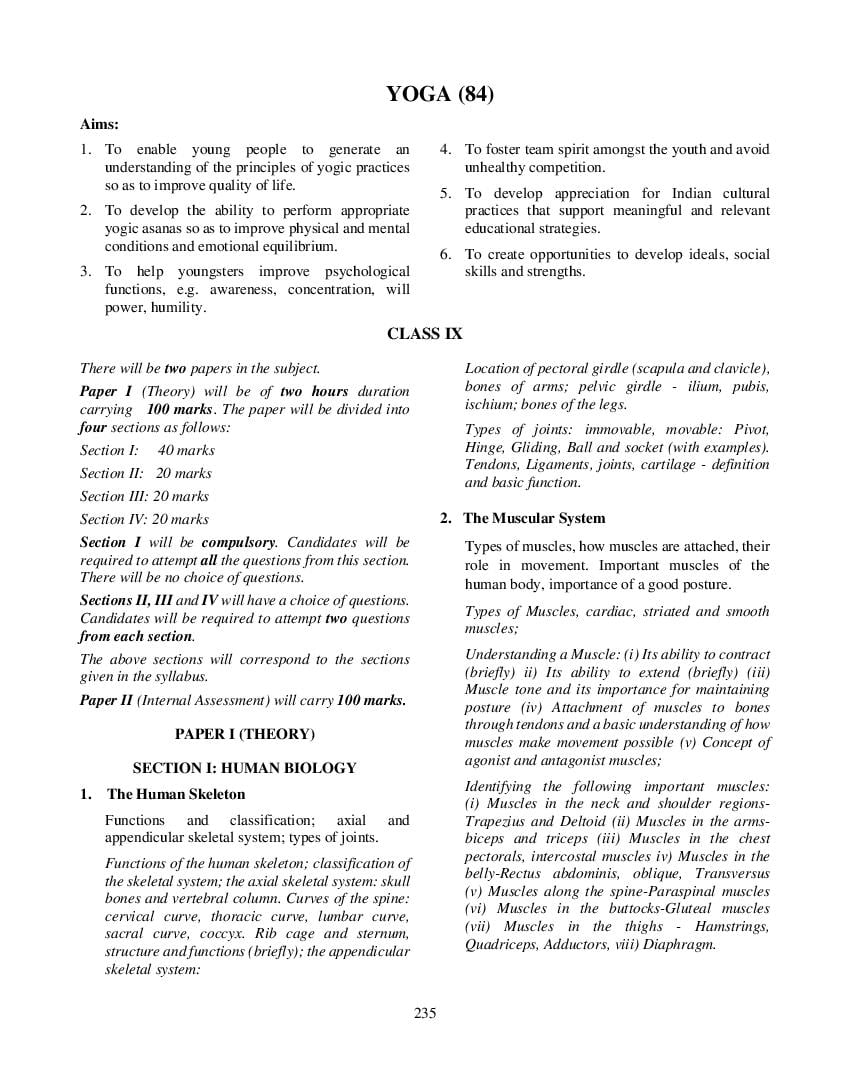
Aims:
1. To enable young people to generate an 4. To foster team spirit amongst the youth and avoid
understanding of the principles of yogic practices unhealthy competition.
so as to improve quality of life.
5. To develop appreciation for Indian cultural
2. To develop the ability to perform appropriate practices that support meaningful and relevant
yogic asanas so as to improve physical and mental educational strategies.
conditions and emotional equilibrium.
6. To create opportunities to develop ideals, social
3. To help youngsters improve psychological skills and strengths.
functions, e.g. awareness, concentration, will
power, humility.
CLASS IX
There will be two papers in the subject. Location of pectoral girdle (scapula and clavicle),
Paper I (Theory) will be of two hours duration bones of arms; pelvic girdle - ilium, pubis,
carrying 100 marks. The paper will be divided into ischium; bones of the legs.
four sections as follows: Types of joints: immovable, movable: Pivot,
Section I: 40 marks Hinge, Gliding, Ball and socket (with examples).
Tendons, Ligaments, joints, cartilage - definition
Section II: 20 marks
and basic function.
Section III: 20 marks
Section IV: 20 marks 2. The Muscular System
Section I will be compulsory. Candidates will be Types of muscles, how muscles are attached, their
required to attempt all the questions from this section. role in movement. Important muscles of the
There will be no choice of questions. human body, importance of a good posture.
Sections II, III and IV will have a choice of questions.
Candidates will be required to attempt two questions Types of Muscles, cardiac, striated and smooth
from each section. muscles;
The above sections will correspond to the sections Understanding a Muscle: (i) Its ability to contract
given in the syllabus. (briefly) ii) Its ability to extend (briefly) (iii)
Muscle tone and its importance for maintaining
Paper II (Internal Assessment) will carry 100 marks. posture (iv) Attachment of muscles to bones
through tendons and a basic understanding of how
PAPER I (THEORY)
muscles make movement possible (v) Concept of
agonist and antagonist muscles;
SECTION I: HUMAN BIOLOGY
Identifying the following important muscles:
1. The Human Skeleton
(i) Muscles in the neck and shoulder regions-
Functions and classification; axial and Trapezius and Deltoid (ii) Muscles in the arms-
appendicular skeletal system; types of joints. biceps and triceps (iii) Muscles in the chest
Functions of the human skeleton; classification of pectorals, intercostal muscles iv) Muscles in the
the skeletal system; the axial skeletal system: skull belly-Rectus abdominis, oblique, Transversus
bones and vertebral column. Curves of the spine: (v) Muscles along the spine-Paraspinal muscles
cervical curve, thoracic curve, lumbar curve, (vi) Muscles in the buttocks-Gluteal muscles
sacral curve, coccyx. Rib cage and sternum, (vii) Muscles in the thighs - Hamstrings,
structure and functions (briefly); the appendicular Quadriceps, Adductors, viii) Diaphragm.
skeletal system:
235
Page 2
that a poor posture (rounded shoulders, a hunched by some of his famous dohas.
back) can lead to headaches, backaches and
3. Mirabai
sluggishness. A poor posture also interferes with
healthy breathing. Birth and early life; Her connection from
childhood with Sri Krishna; Her marriage to
3. The Respiratory System Prince Bhojraj; Akbar disguised as a merchant
visiting her; Ill treatment at the hands of her in-
Parts of the respiratory system: role of intercostal laws after her husband's demise (incident of her
muscles, diaphragm, ribs and sternum; role of drinking the poison unaffected); Her last days in
yoga in culturing breath and improving Vrindavan; Importance of her poems and songs
respiration.
4. Ramakrishna Paramhansa
Parts of the respiratory system: Nasal cavity,
Pharynx, Larynx Trachea, Bronchi, Bronchioles, Birth and early Life; His marriage to Saradamani;
Alveoli, Lungs, (location and function of each arrival at Dakshineswar and introduction to
part); priesthood; his meeting with teachers like
The role of intercostal muscles, diaphragm, ribs Bhairavi Brahmani & Totapuri; Any three
and sternum for (i) inspiration (ii) expiration; miraculous events in his life
How yoga cultures breath and improves
respiration. SECTION III: CONCEPTS OF YOGA
1. Guru and Shishya
4. The Digestive System Importance of Guru in yoga, qualities of Guru,
The alimentary canal and the importance of a types of shishya and relationship between the
healthy diet. Guru and shishya.
The Alimentary Canal: Mouth, Oesophagus, 2. The four Purusharthas, the four Ashramas
Stomach, Liver, Pancreas, Small Intestine, Large
Intestine, Rectum, Anus (Location and function, in Basic understanding of the above.
brief, of each of the above). 3. The four Margas (Bhakti, Karma, Raja, Jnana)
Bhakti yoga: the path of emotions: love devotion
SECTION II: SAGES OF INDIA and worship, types of bhakti: saguna, nirguna and
Candidates are expected to know about the lives and para bhakti, various ways of worshipping: navdha
teachings of the following sages of India: bhakti, concept of personal god.
Karma yoga: the path of actions, various concepts
1. Valmiki of karma like (i)Karma kaushalam (excellence in
Early Life; meeting Narada and the turning point work), (ii)Nishkama karma (abandonment of
of his life; repetition of ‘Mara’ changing to expectations for the results and selfish motives),
(iii)Samatvam(equanimity), (iv) faith and
‘Rama’; formation of a Valmika (anthill) hence surrendering ego, types of karma, black, white
his name Valmiki; meeting with Rama and Sita; and black and white, karmashaya and how it
giving shelter to Sita and her sons Lava and builds up, role of karma as cause of bondage and
Kusha, when she was banished by Rama; salvation
inspiration received to write the Ramayana; Raja yoga: the path to inner world through
importance of the Ramayana and its story in brief; concentration and will to control the mind and its
liberation of Ravana through Rama. modifications, ashtanga yoga
Jnana yoga: the path of wisdom, knowledge and
2. Kabir intellect
Birth and early life; Meeting with and discipleship 4. Patanjali and his contributions to Yoga
under Swami Ramananda; His marriage; Kabir A brief story of his life, contribution to Sanskrit
as a social and religious rebel; His death in grammar, Ayurveda and the Yoga sutras.
236
Page 3
(i) Inhalation, the power or the sun aspect of
Bahiranga and Antaranga sadhna.
the breath
The Five Yamas (ii) Exhalation, the peace or the moon aspect
Ahimsa, Satya, Asteya, Brahmcharya, of the breath
Aparigraha. (c) Nadis
Ida (moon channel, left nostril), Pingala (sun
The Five Niyamas
channel, right nostril), Sushumna (central
Saucha, Santosha, Tapas, Svadhyaya, Ishwar channel) (Just a basic concept and location of
Pranidhana. above nadis).
A note on Kriya Yoga as explained in sutra 2.1
3. Psychological aspect of an asana practice
(a) Asanas
Reactivity threshold; psychological aspects of:
(b) Pranayama Meditative and relaxing postures, forward bending
(c) Pratyahara asanas, back bending asanas, standing asanas,
balancing asanas and inverted asanas.
(d) Dharana
Reactivity threshold: By watching the breath
(e) Dhyana instead of paying attention to the pain
experienced during an asana one becomes
(f) Samadhi
less reactive in day to day life as well.
Meditative and relaxing postures: bring self-
SECTION IV: PSYCHOLOGY AND discipline, relaxation and steadiness
PHYSIOLOGY OF YOGA Forward bending asanas: Bring peace,
release of tension, and humility to the mind.
1. An Understanding of Yoga Back bending asanas: Energise the system
Definition of yoga: according to Patanjali, as and enhance self-esteem.
explained in the Bhagvad Gita. (yoga is excellence Standing asanas: Help to root the practitioner
in existence. Enhance stability and endurance.
in action\works)
Balancing asanas: Increase concentration
How is yoga different from other forms of physical and focus
exercise? To be discussed with respect to the Inverted asanas: Hormone balancing hence
interconnection between mind, body, and spirit anti-anxiety and anti-depression.
and how yoga brings these into harmony with each 4. Pancha Koshas
other. Yoga also addresses imbalances and
Panch Koshas - a concept from the Taittiriya
illnesses at an organic level (the action of yoga
Upanishad: Annamaya Pranamaya, Manomaya,
reaches the inner organs and heals chronic Vijnanamaya, Anandamaya kosha.
ailments from the roots).
A basic understanding of how a human being is
2. Hatha Yoga made up of the above sheaths; how each sheath is
related to the next sheath. An understanding of
(a) Understanding the roots the relationship between life force (prana) and the
Ha (the sun) Tha (the moon). Hence Hatha physical body (Annamaya) so also an
yoga is the art and science of balancing power understanding of connection between thoughts
(the sun) with peace (the moon) as applied to: (Manomaya) and the energy flowing in the body
(i) Muscles: asanas should strengthen them (Pranamaya).
(sun aspect) and make them flexible 5. Pancha Pranas
(moon aspect).
Prana, Apana, Samana, Udana, Vyana
(ii) Degree of stretch in an asana should not
be maximum nor minimum but optimum Location and basic functions of the above 5
(balanced and so recommended). pranas.
237
Page 4
6. The Seven Chakras The practical work is divided into two sections as
Muladhara, Swadishthana, Manipura, Anahata, follows:
Visuddhi, Ajna, Sahasrara
Section A (40 Marks): Course Work - the course work
Location and functions; the element the chakra is will be assessed by the teacher on the basis of
associated with; colour of the chakra. continuous assessment. The candidate will be assessed
7. Sutras on the basis of his/her output in the following areas:
(a) Degree of effort and progress in his/her yoga
Sutras 2.29. 2.46
practice (judged through periodical tests).
The above two sutras should be known with their (b) Assisting the yoga therapy sessions.
meanings.
(c) Improving his/her own health and well being
8. Yogachara: wellness through the four pillars of through yoga therapy.
yoga (d) Participation in programmes..
(i) Ahar (diet)
Section B (60 Marks): This section will consist of
An introduction to the concepts of Sattva,
three Practical Tests.
Rajas and Tamas as applied to food; The
importance of a healthy diet and its effect on Test 1: Predetermined Asanas (30 marks)
physical, emotional and mental wellbeing. The pupil must perform any six asanas from those
Importance of the following: given below:
(a) Incorporating seasonal fresh fruit and Utthita Trikonasana, Utthita Parshvakonasana,
vegetables in the diet Virbhadrasana I, Virbhadrasana II, Parasarita Pada
Uttanasana I, Adho Mukha Shvanasana,
(b) Drinking adequate amount of water in a Shirshasana(half), Karna Pidasana.
day
Test 2: Directed asanas (20 marks)
(c) Health hazards of in taking an excess of
The pupil must perform 4 or 5 asanas of the teacher's
aerated drinks, refined flour, salt, white choice. (The teacher will select asanas from the Class
sugar, packaged foods. IX syllabus only). The teacher may test the pupil's
(d) Concept of mitahar (as in Hatha yoga), ability to adapt and modify asanas.
importance of eating right quality and Test 3: Preference of asanas (10 marks)
quantity of food. The pupil will perform 2 asanas of his/her own choice.
(ii) Vihar (relaxation and recreation) Important Notes: The pupil must choose two asanas
Importance of conscious relaxation as in from the Class IX syllabus only.
shavasana, doing recreational activities The pupil must not choose any asanas that he/she has
(developing creative hobbies) in which, body, already demonstrated in Test 1 and Test 2.
mind and emotions are involved.
The practical work is to be covered under the
(iii) Achar following categories:
Importance of discipline in routines and (A) Asanas
actions/work; for example: sleep and wake up
early, maintain meal times. 1. Vrikshasana
(iv) Vichar (thoughts) 2. Garudasana
3. Utthita Trikonasana
Positive thinking, pratipaksh bhavana,
understanding the temporary nature of the 4. Utthita Parshva Konasana
objects through Anitya bhavana, attitude of 5. Virbhadrasana I
gratitude and forgiveness, surrendering the ‘I
‘sense. 6. Virbhadrasana II
238
Page 5
8. Pada Hastasana 23. Supta Konasana
9. Adho Mukha Shvanasana
(B) The Surya Namaskar
10. Parvatasana
(C) Breathing\pranayama
11. Urdhva Prasarita Padasana
12. Supta Virasana 1. Anapanasati - sensing the incoming and
outgoing breath in the nasal passages for about
13. Ushtrasana 3 minutes to begin with in order to slow down
14. Dhanurasana thoughts. This can be eventually extended to
15. Marichyasana 1 (Twist only) 5 minutes.
16. Bharadvajasana I 2. Abdominal Breathing, the students should be
made aware that the belly should move
17. Bharadvajasana II
outwards when we inhale and move inwards
18. Malasana (Squatting only) when we exhale.
19. Shirshasana (half shirshasana,wherein,the 3. The Full Yogic breath:
student can climb the wall and rest the toes on
the wall while doing shirshasana) (a) Abdominal breath
20. Salambha Sarvangasana I (b) Thoracic breath
21. Halasana (c) Clavicular breath
239
Page 6
There will be two papers in the subject. nervous system and Parasympathetic nervous
system (location and function).
Paper I (Theory) will be of two hours duration
carrying 100 marks. The paper will be divided into The Sense Organs
four sections as follows:
Eyes: Structure and function of different
Section I: 40 marks constituent parts; common eye defects: Myopia,
Hyperopia, Cataract.
Section II: 20 marks
Ear: outer ear, middle ear, inner ear (structure and
Section III: 20 marks function of the constituent parts); the Eustachian
Section IV: 20 marks Tube; role of the ear in maintaining balance.
Section I will be compulsory. Candidates will be The sense of smell: importance of the olfactory
required to attempt all the questions from this section. nerve; flavour: a combination of taste and smell;
There will be no choice of questions. The sense of taste: The 4 fundamental tastes: sweet,
salty, bitter, sour;
Sections II, III and IV will have a choice of questions.
Candidates will be required to attempt two questions The Sense of touch: Nerve endings in the skin
from each section. related to pressure, pain, hot, cold;
How Yoga helps to maintain the health of the
The above sections will correspond to the sections nervous system and sense organs.
given in the syllabus.
Paper II (Internal Assessment) will carry 100 marks. 2. The Endocrine System
A study of the Pituitary gland, the Thyroid, the
PAPER I (THEORY) Adrenal glands and the Pancreas; role of Yoga in
SECTION I: HUMAN BIOLOGY maintaining the health of the endocrine glands.
1. The Nervous System The above must be studied with respect to the
The neuron, central nervous system and peripheral following: location, hormones secreted, effects of
nervous system, the sense organs. Role of Yoga in over-secretion and under secretion of hormones.
maintaining the health of the nervous system. How yoga helps to regulate the functioning of the
The neuron: Structure (cyton, axon, terminal endocrine glands and helps in achieving hormonal
branches, synapse, myelin sheath) and function balance.
(carry messages in the nervous system in the form
of electrical impulses); Kinds of neurons: Sensory, 3. The Circulatory System
Motor, Association. Nerves and ganglia: definition Structure and functioning of the heart; disorders of
only. the circulatory system; the lymphatic system;
The Central Nervous System: The Brain: composition of blood; role of yoga in improving
Meninges, Forebrain: Cerebrum (Temporal, blood circulation.
Parietal, Occipital, Frontal) and Diencephalon; Heart: Location, covering (pericardium),
Midbrain; Hindbrain (Cerebellum, Pons, Medulla chambers of the heart, blood vessels entering and
oblongata). Location and basic function of each of leaving the heart: Vena Cava, aorta, pulmonary
the above parts. artery, the pulmonary vein; blood supply to the
The Spinal Cord: Structure and function; Reflex heart: coronary arteries; Valves: Bicuspid,
action: Simple reflex, Conditioned reflex; Tricuspid, Semilunar Valves; Circulation of blood
in the heart: systole and diastole; blood vessel
The Peripheral Nervous System: Somatic nervous types: arteries, capillaries, veins, structure and
system: Cranial nerves and spinal nerves (the function; some of the other main blood vessels:
number of cranial and spinal nerves present in the Hepatic portal vein, Hepatic artery and vein,
body); the Autonomic nervous system: Sympathetic Renal artery and vein;
240
Page 7
atherosclerosis, arteriosclerosis, myocardial Birth and early life; his birthday is celebrated as
infarction, angina: definition of each disorder; Guru Purnima; training under his father Rishi
Composition of blood: plasma, the liquid Parasara, his role as the grandfather of Pandavas
component of blood; a brief description of the and Kauravas, his son Shuka.
structure and functions of RBC, WBC and platelets
disorders of the blood: Haemophilia, anaemia. Works: The Bhramasutras, The Mahabharata,
(The types of WBCs and the blood groups need not Srimad Bhagvatam, The Puranas, Vyasa Bhashya.
be studied); 2. Yagnavalkya
How yoga helps to improve blood circulation and Birth and education, dynamics of his relationship
hence enhances the body’s immunity. with his guru Vaisampayana (growing
4. The Excretory System disagreement between the two at the ashram, Meet
at Mount Meru, King Supriya and the formation of
Organs of excretion; Parts of the excretory system; the Krishna Yajurveda); relationship with Surya
urine formation, disorders of the excretory system; Bhagvan, King Janaka, Gargi and Maitreyi
Role of Yoga.
Works: The Yajurvedas, The Brihadaryanka and
Lungs, skin and kidneys are the three organs of Bhramanas, Yoga Yagnavalkya Samhita.
excretion; parts of the excretory system: the
Kidney, Cortex and Medulla; Ureters; Bladder; 3. Narsi Mehta
Urethra. Birth and early life, three miraculous events in his
Disorders of the excretory system: Kidney failure, life. His teaching and contributions- composition
Gout, Kidney stones; the Dialysis machine: ‘Vaishnava Jan To….’
meaning of each. 4. Sri Aurobindo
How the practice of yoga helps in maintaining the His early life and education abroad; his mastery
health of the excretory system and hence the over several European and Indian languages;
elimination of waste from the body. return to India; experience of the silent mind after
5. Personal hygiene through Yoga guidance from Lele; Sri Aurobindo as one of the
leaders of the freedom movement the newspaper -
Purpose of maintaining hygiene in Yoga; Yogic Vande Mataram; solitary confinement in Alipore
care and/or cleaning of sense organs. Jail; acquittal and journey to Pondicherry;
Purpose of maintaining hygiene in yoga: removal meeting with Mirra Alfassa who would in later
of diseases, purification of the body, maintaining years be called the Mother of the Sri Aurobindo
efficiency of the body, better immunity, long life, Ashram; Auroville, Matri Mandir and the Sri
moral and spiritual elevation. Aurobindo Society.
Yogic Care and/ or cleaning of the sense organs: Teachings of Sri Aurobindo: Yoga results in
Care of teeth, mouth, cleaning of the tongue ‘accelerated evolution’; Sri Aurobindo’s Integral
(jivhamulashodhanam: benefits and procedure), Yoga, guidelines on how man can consciously
cleaning of the ears (karnarandhradhouti collaborate with the Divine in accelerating his
procedure and its benefits); care of eyes: factors evolution (An understanding of the human
affecting the health of the eye, eye exercises-trataka consciousness as having four beings
(central fixation)-candle gazing. simultaneously coexistent in it: (1) The Physical
Being (2) The emotional being (3) the mental
SECTION II: SAGES OF INDIA being (4) The spiritual being); the triple formula
of Aspiration, Rejection and Surrender. His
Candidates are to write notes on the lives and words: ‘All life is Yoga’ – bringing perfection,
teachings of the following sages: Vyasa, Yagnavalkya, peace and harmony into all aspects of day-to-day
Narsi Mehta, Sri Aurobindo, Swami Vivekanand, life.
Ramana Maharishi. Works of Sri Aurobindo: Savitri, The Life Divine,
Synthesis of Yoga (couple of sentences on the
For each of the above sages, the candidates need to contents and/or purpose of the above books)
know briefly, two important aspects of their works.
241
Page 8
Vision of his Guru Ramakrishna: story of the Vairagya, Ishwar Pranidhana, the Pranava
seven sages and a little boy. Childhood stories of Mantra, the four virtues, Pranayama (elongating
Narendra’s courage and truthfulness. His first the bahya kumbhak), heightened awareness of the
meeting with Sri Ramakrishna and his historical senses, concentrating on a light beyond all
question: “Sir, have you seen God?” His father’s sorrow, contemplating and recollecting the
demise and leaving the family in poverty; his first experiences of dreams-filled or dreamless sleep
living experience with the Divine Mother in the during the waking state.
Kali temple at Dakshineshwar. starting the Obstacles: Vyadhi, Styana, Samshaya, Pramada,
Ramakrishna Mission order post Ramakrishna’s Alasya, Avirati, Bhrantidarshana,
demise. His travels in India right upto Alabdhahumikatva, Anavasthi-tattva.
Kanyakumari where he was inspired to travel Accompaniments of the obstacles: Dukha,
abroad; his speech at the Parliament of World Daurmansya, Angamejayatva and Shvasa
Religions. Setting up centres of the Ramakrishna Prashvasa.
Mission in the West. Setting up the Belur Math.
Inspiring speeches to Indian youth. Early death. Samadhi - definition and types of Samadhis
(Sabeej, Nirbeej, Savitarka, Nirvitarka,
Literary Works by Swami Vivekananda: Raja Savichara, Nirvichara).
Yoga, Karma Yoga, Jnana Yoga. Practical
Vedanta, My India – the India Eternal, My Master. (ii) Sadhana Pada
Kriya yoga, Kleshas, cause of pain: identification
Teachings: The soul of man is more powerful than of the seer (drashtu) with the seen; Kaivalya:
anything else; service to man is service to God; destruction of ignorance through right knowledge
His teaching of Vedanta, the world is one;
breaks the link between the seer and the seen and
civilization will be complete in the world when
India gives to the world the marvels of its leads to liberation or kaivalya (refer to Sutra 2.25,
spirituality and in exchange, receives from the the students need not learn the Sutra); Ashtang
world the marvels of modern science; to preach yoga; Pratipaksha Bhavanam (refer to Sutra 2.33,
unto mankind their divinity and how to make it the students need not learn the Sutra)
manifest in every movement of life. There can be (iii) Vibhuti Pada
no salvation if one has faith in Gods outside but Concept and definition of Samyama, study of the
no faith in oneself. The real atheist is one who following objects of samyama and the powers
doesn’t believe in himself. attained: distinguishing marks on another man’s
body, qualities of friendliness and compassion,
6. Sri Ramana Maharishi
strength such as that of an elephant, the sun, the
Birth and early life; His death experience which moon, the pole star, the naval, the pit of the throat,
led to the all-consuming question for him, “Who the head, the heart; These Vibhutis (attainments)
am I”? His travel to Thiruvannamalai; His are hindrances to achieve the spiritual goal.
Enlightenment; Setting up of the Ramana Ashram;
granting his mother moksha at the time of her (iv) Kaivalya Pada
moving on. 5 ways of spiritual accomplishment; Karma:
Teachings: Self enquiry: Who am I? and his black, white or black and white; subject and object
method of self-enquiry. (relationship between the two in the light of
Works: Who Am I, 5 Hymns to Arunachala, 40 Patanjali’s yoga sutras); Chit and Chitta; dharma
verses on Reality. megha samadhi.
SECTION III: THE YOGA SUTRAS OF SECTION IV: SOME IMPORTANT SCHOOLS
PATANJALI OF PHILOSOPHY AND SOME SUTRAS
The Four Padas 1. Some of the Orthodox Philosophies
(i) Samadhi Pada Sankhya, Yoga, Vedanta, Purva Mimansa with
Chitta Vrittis: definition of Yoga. The different respect to each philosophy - Meaning of the name,
types of Chitta Vrittis: Klishta and Aklishta; founder, dates, important texts, tenets, salvation,
Pramana Viparyaya Vikalpa, Nidra, Smriti; concept of God.
242
Page 9
Purusha and Prakriti (dualistic system) (the Patanjali Yoga Sutra 1.2, 1.14, 1.33, 2.3, 2.28
student needs to know just a basic understanding
of these terms); Gunas, 23 evolutes of Prakriti.
PAPER 2 (INTERNAL ASSESSMENT)
Tenets of Yoga
The practical work is to be divided into two sections
Yoga also called Sa Ishvara Sankhya; 5 vrittis and
as follows:
5 Chitta Bhumis; 5 kleshas; 4 virtues; Ashtang
yoga. Section A (40 Marks): Course Work - the course work
Tenets of Vedanta will be assessed by the teacher on the basis of
continuous assessment. The candidate will be assessed
Basic meaning of the following terms: Advaita, on the basis of his/her output in the following areas:
Brahman, Jagat, Mithya, Maya, Sookshma
(subtle) and Sthool (gross) buddhi (a) Degree of effort and progress in his/her yoga
practice (judged through periodical tests).
Tenets of Purva Mimansa
Importance of rituals and Mantras, concept of (b) Assisting the yoga therapy sessions.
many Gods and Goddesses, concept of divinity in
Improving his/her own health and well being
non-living objects, Karma and dharma.
through yoga therapy.
2. Some of the Heterodox Philosophies
(c) Participation in programmes.
Buddhism and Jainism with respect to each
philosophy - meaning of the name, founder, dates, Section B (60 Marks): Practical Tests - There will be
important texts, tenets, salvation, concept of God. three tests in this section – to be assessed by an
Tenets of Buddhism External Examiner.
The 4 noble truths, the 8-fold path, two schools of
Buddhism - Hinayana and Mahayana. Test 1: Predetermined Asanas (30 marks)
Tenets of Jainism The candidates must perform any six asanas from
The 3 jewels, transmigration of the soul and those given below:
moksha, everything has a jiva, no belief in Gods
and Goddesses, 24 tirthankaras, Mahavira the Ardha Chandrasana, Parivritta Trikonasana,
24th one. Chaturanga Dandasana, Salambha Shirshasana
Sarvangasana, Paschimottanasana, Urdhva
3. Contemporary Philosophies Dhanurasana, Ardha Matsyendrasana.
Eckhart Tolle's Philosophy: Power of Now Test 2: Directed asanas (20 marks)
Tenets: mind controlling the human being and his The candidate must perform 4 or 5 asanas of the
addiction to thinking; consciousness beyond the External Examiner's choice. (The examiner will select
mind; presence or the awareness space in which asanas from the Class X syllabus only). The External
thoughts arise; the Pain Body: The energy field of Examiner may test the pupil's ability to adapt and
pain, accumulated from the past that occupies the modify asanas.
mind and body periodically as an inexplicable dark
emotional state; methods to enter the eternal Now Test 3: Pupil's preference of asanas (10 marks)
as a means of breaking free from the addiction to The candidate will perform two asanas of his/her
thought:
choice.
Tuning into the awareness of the breath and
body Important Notes:
Dis-identification with the thinker, watching (a) Candidate must choose an asana from the Class X
the thought syllabus only.
Surrendering to what is, dropping the
resistance to what arises in the moment (b) Candidate must not select an asana that he/she has
Paying attention to environmental sounds and already demonstrated in Test 1 and Test 2.
tuning into the silence between the sounds
243
Page 10
following categories:
12. Paschimottanaasana
(A) Asanas
13. Marichyasana III
1. Ardha Chandrasana
14. Ardha Matsyendrasana I
2. Parivritta Trikonasana
15. Salambha Shirshasana
3. Pashva Uttanasana 16. Urdhva Dhanurasana
4. Uttanasana 17. Salambha Sarvangasana I
5. Chaturanga Dandasana 18. Halaasana
6. Urdhva Mukha Shvanasana 19. Setu Bandha Sarvangasana
7. Matsyasana
(B) Breathing\pranayama
8. Janu Shirshasana
1. Revision of the Full Yogic Breathing
9. Upavista Konasana (holding big toes, head
up) 2. Brahmari
10. Ardha Navasana Reference Book:
Light on Yoga: Yogacharya B.K.S. Iyengar - Harper
Collins, India
244
Page 11
Criteria Knowledge of Asanas Precision Achievements (Ability to Application (Interactive) Presentation
perform the classical pose)
Grade I Immediately presents Firmness and Strength Can adapt and modify as Confidence
(4 marks) the required asana alertness Flexibility required by examiner. Angle of presentation
Knows the meaning of Co-ordination Endurance (can hold the Can clearly explain the and stance between
the name of the asana Attention to details pose) purpose. poses
Knows to which Moment-to- Stability Co-operation and
general group the asana moment keenness
belongs awareness Grace and poise
Knows the benefits
Grade II Fails to respond to any one Any one of the above Any one of the above aspects Very competent at one of the Lack one of the above
(3 marks) of the above aspects. aspects lacking. inadequate. above but only partially manages aspects.
the other.
Grade III Fails to respond to two of Any two aspects Any two aspects inadequate. Attempts both but is unclear Lack two of the above
(2 marks) the above requirements. lacking. aspects.
Grade IV Fails to respond to three of Any three aspects Any three aspects Guesses both the application and Lack three of the above
(1 mark) the above requirements. lacking. inadequate. purpose. aspects.
Grade V Respond incorrectly to all Poor in all four All four aspects inadequate. Unable to apply or explain All four aspects
(0 marks) four aspects. inadequate.
245
Document Details
| Board / Org | CISCE |
| Exam | Class 10 |
| Type | Syllabus |
| Pages | 11 |
| Language | english |
| Updated | 09 Jun 2026 |