HBSE Class 9 Sample Paper 2026 Answers Home Science
Finished viewing? Save it for later —
Download HBSE Class 9 Sample Paper 2026 Answers Home Science (PDF · 7 pages)About HBSE Class 9 Sample Paper 2026 Answers Home Science
HBSE Class 9 Sample Paper 2026 Answers Home Science is available here for free download. Published by Haryana Board for Class 9, this answer key can be viewed online or downloaded as a PDF (7 pages). Candidates preparing for Class 9 can use HBSE Class 9 Sample Paper 2026 Answers Home Science to understand the exam pattern, the type of questions asked, and the overall difficulty level.
Frequently Asked Questions
How can I download HBSE Class 9 Sample Paper 2026 Answers Home Science?
Open this page and click the Download button to save HBSE Class 9 Sample Paper 2026 Answers Home Science as a PDF. It is completely free on AglaSem Docs.
Is HBSE Class 9 Sample Paper 2026 Answers Home Science free to download?
Yes. HBSE Class 9 Sample Paper 2026 Answers Home Science can be viewed online and downloaded as a PDF free of cost on AglaSem Docs.
How many pages does HBSE Class 9 Sample Paper 2026 Answers Home Science have?
HBSE Class 9 Sample Paper 2026 Answers Home Science contains 7 pages, which you can read online or download together as a single PDF.
Where can I find more Class 9 study material?
You can find more Class 9 question papers, sample papers, syllabus, and answer keys on AglaSem Docs.
HBSE Class 9 Sample Paper 2026 Answers Home Science – Text
Read the full text of this answer key below — useful to quickly search, copy and reference the content online without downloading the PDF.
📄 View text version (7 pages)
Page 1
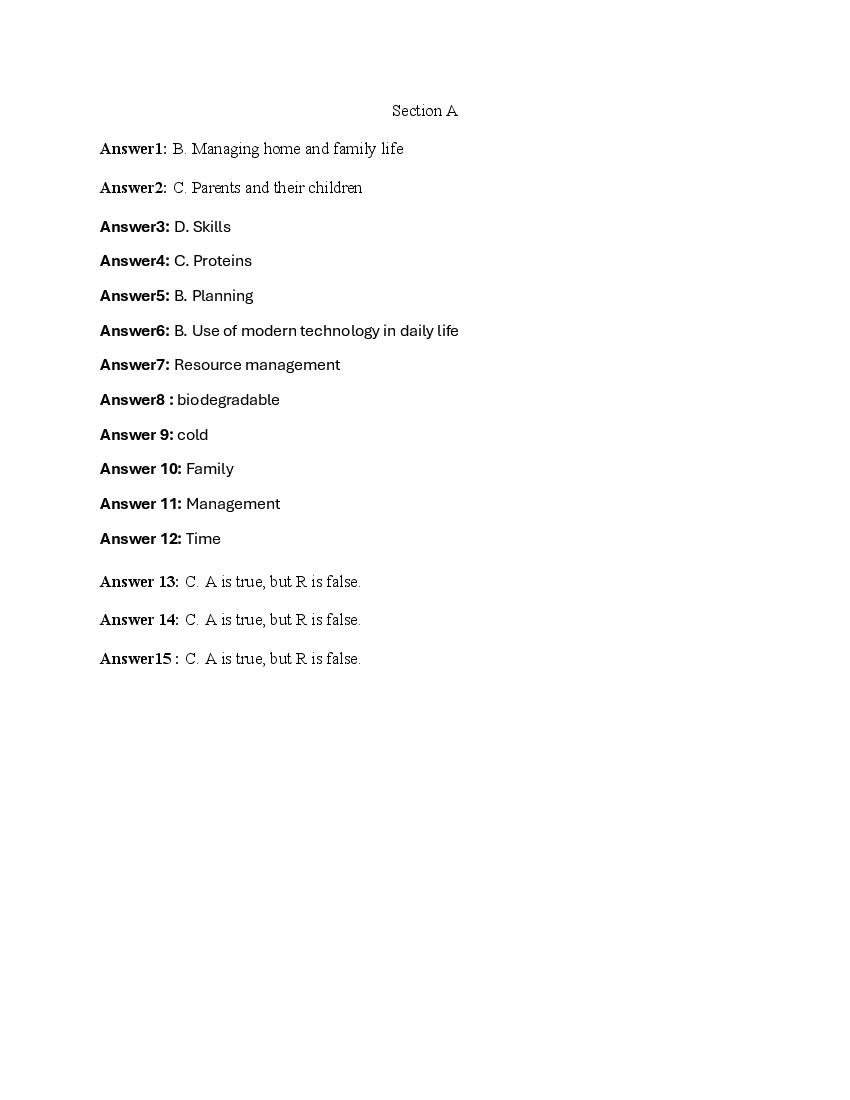
Answer1: B. Managing home and family life
Answer2: C. Parents and their children
Answer3: D. Skills
Answer4: C. Proteins
Answer5: B. Planning
Answer6: B. Use of modern technology in daily life
Answer7: Resource management
Answer8 : biodegradable
Answer 9: cold
Answer 10: Family
Answer 11: Management
Answer 12: Time
Answer 13: C. A is true, but R is false.
Answer 14: C. A is true, but R is false.
Answer15 : C. A is true, but R is false.
Page 2
Ans:16. Animal fibers are called protein fibers because they are made of proteins. Examples
include wool (from sheep) and silk (from silkworms).
Ans:17 The fat-soluble vitamins are Vitamin A, D, E, and K. These vitamins are stored in the
body's fat tissues and liver.
OR
Ans: Vitamin C is also known as Ascorbic Acid. It is a water-soluble vitamin essential for
immunity, wound healing, and iron absorption.
Ans: 18. A balanced diet is a diet that contains all the essential nutrients — carbohydrates,
proteins, fats, vitamins, minerals, water, and roughage — in the right proportions to maintain
health, growth, and proper body functioning.
Ans: 19. Wool is obtained from the hair or fleece of animals such as sheep, goats, yak,
camel, alpaca, and rabbit (Angora). These animals have a thick coat of hair that provides the
wool fibers.
Ans: 20. According to Super and Keller, “The family is a social unit consisting of a man and a
woman who are married, and children, if any, born or adopted, living together and sharing a
common household.”
OR
Ans: According to McIver and Page, “Family is a group defined by a sex relationship,
sufficiently precise and enduring to provide for the procreation and upbringing of children.”
Ans: 21. Social development refers to the process of learning to interact with others, building
relationships, and understanding social norms. It helps individuals develop communication
skills, cooperation, empathy, and responsible behavior in society.
Ans: 22. The five main fields of Home Science are:
1. Food and Nutrition
2. Human Development
3. Clothing and Textiles
Page 3
5. Communication and Extension
Section -C
Ans:23.
1. Empowerment: Girls' education empowers them to become independent and
make informed decisions.
2. Economic Growth: Educated girls contribute to the economic development of their
families and the nation.
3. Improved Health and Well-being: Educated women are more likely to ensure
better health, hygiene, and nutrition for themselves and their families.
Ans:24.
1. Meaning: Growth refers to the physical changes in the body such as increase in
height, weight, and size. Development refers to overall changes, including physical,
emotional, social, and intellectual abilities.
2. Measurement: Growth is quantitative and can be measured (e.g., in centimeters or
kilograms), while development is qualitative and cannot be measured easily.
3. Scope: Growth is a part of development, whereas development is a wider concept
that includes growth and other progressive changes.
Ans: 25.
The development of teeth in children occurs in two stages:
1. Milk Teeth (Primary Teeth): These begin to appear around 6 months of age and are
usually 20 in number. They help in chewing and speech development.
2. Permanent Teeth: These replace milk teeth starting around 6 years of age and are
usually 32 in number.
Proper nutrition and dental hygiene are essential for healthy tooth development in children.
Ans: 26.
Nutrients are the chemical substances present in food that are essential for the body's growth,
development, and maintenance of health.
The main nutrients found in food are:
1. Carbohydrates
2. Proteins
3. Fats
Page 4
5. Minerals
6. Water
7. Roughage (dietary fiber)
OR
1. Provide Energy: Carbohydrates are the main source of energy for the body. They are
quickly broken down into glucose, which fuels body functions and physical activity.
2. Protein Sparing Function: Carbohydrates prevent proteins from being used as an
energy source, allowing them to perform their primary role of body building and
repair.
3. Helps in Fat Metabolism: Carbohydrates help in the complete breakdown of fats,
preventing the formation of harmful substances like ketones in the body.
Ans: 27.
Fibers are classified into two main types based on their length:
1. Staple Fibers: These are short-length fibers that vary in size and require spinning to
form yarn.
o Examples: Cotton, Wool.
2. Filament Fibers: These are long, continuous fibers that can be used directly to make
yarn.
o Examples: Silk (natural filament), Nylon and Polyester (synthetic filaments).
OR
1. Soft and Comfortable: Cotton fiber is soft to touch, breathable, and comfortable to
wear, especially in hot climates.
2. High Absorbency: Cotton can absorb moisture well, which helps in keeping the
body cool and dry.
3. Good Strength and Durability: Cotton fibers are strong and can withstand regular
washing and wear, making them long-lasting.
Ans:28
1. Utility: Resources must be useful and help in fulfilling human needs or goals.
Page 5
and efficiently.
3. Manageability: Resources can be planned, organized, and controlled to achieve
personal, family, or societal objectives effectively.
1. Use Both Sides of Paper: Always print or write on both sides of the paper to reduce
waste.
2. Go Digital: Use electronic documents, emails, and online notes instead of paper
wherever possible.
3. Recycle and Reuse: Reuse old paper for rough work and ensure used paper is
recycled properly.
OR
Ans : Duties of Primary Caregiver or Primary assistant
1. Health Monitoring and Medical Support:
They regularly observe the patient’s health, provide basic medical care, and ensure timely
medication.
2. Emotional and Physical Care:
They support the emotional well-being of the individual and assist with daily activities
like bathing, feeding, and mobility.
3. Liaison and Guidance:
They coordinate with doctors or health services when needed and educate the family
about proper health care practices.
Section -D
Ans:30.
Main Sources of Protein:
1. Animal Sources: Meat, fish, eggs, milk, cheese, and curd – these provide complete
proteins containing all essential amino acids.
2. Plant Sources: Pulses (like lentils, chickpeas), nuts, seeds, soybeans, and whole
grains – these provide incomplete proteins but are important in a vegetarian diet.
Functions of Protein:
Page 6
2. Maintenance of Body Cells: They help in the formation and replacement of worn-
out cells.
3. Production of Enzymes and Hormones: Proteins are involved in producing
enzymes and hormones that regulate body functions.
4. Immune Function: Proteins help build antibodies that fight infections and boost
immunity.
5. Energy Supply: When carbohydrates and fats are insufficient, proteins provide
energy to the body.
OR
The physical functions of food are related to the growth, development, maintenance, and
repair of the body. These include:
1. Growth and Development: Food provides essential nutrients like proteins,
minerals, and vitamins that help in the formation of new tissues and support
overall body growth.
2. Energy Supply: Carbohydrates and fats in food act as fuel, providing the energy
required for daily activities and body functions.
3. Body Repair and Maintenance: Nutrients, especially proteins, help in repairing
damaged tissues and maintaining healthy body cells.
4. Regulation of Body Processes: Food helps regulate internal processes like
digestion, blood circulation, and temperature control through vitamins and
minerals.
5. Protection Against Diseases: Nutrients in food, like vitamins A, C, E, and
minerals, help in boosting immunity and protecting the body from infections and
illnesses.
Ans:31
Source of Silk:
Silk is a natural animal fiber obtained from the cocoon of the silkworm, mainly the Bombyx
mori. The silkworm spins the cocoon using a protein called fibroin, which forms the silk thread.
Main Physical Characteristics of Silk Fiber:
1. Lustrous Appearance: Silk has a natural shine and smooth texture, making it
attractive and luxurious.
2. Soft and Smooth: It feels soft against the skin and drapes well, providing comfort
and elegance.
3. Strong Fiber: Silk is one of the strongest natural fibers, though it loses strength
when wet.
Page 7
extent.
5. Absorbent: Silk can absorb moisture well, making it comfortable to wear in
different climates.
OR
Q: Explain physical properties of wool fiber. (5 marks)
1. Soft and Warm: Wool is a soft fiber that provides excellent insulation, keeping the
body warm in cold weather.
2. Elasticity: Wool has good elasticity, allowing it to stretch and return to its original
shape without wrinkling easily.
3. Absorbency: Wool can absorb up to 30% of its weight in moisture without feeling
wet, making it comfortable to wear.
4. Crimped Texture: Wool fibers are naturally crimped (wavy), which helps trap air
and enhance insulation.
5. Resilience: Wool is resilient and resistant to wear and tear, making it durable for
long-term use.
Document Details
| Board / Org | Haryana Board |
| Exam | Class 9 |
| Type | Sample Paper |
| Pages | 7 |
| Updated | 24 Sep 2026 |