CBSE Class 10 Food Production Question Paper 2019
Finished viewing? Save it for later —
Download CBSE Class 10 Food Production Question Paper 2019 (PDF · 8 pages)About CBSE Class 10 Food Production Question Paper 2019
CBSE Class 10 Food Production Question Paper 2019 is available here for free download. Published by CBSE for Class 10, this question paper can be viewed online or downloaded as a PDF (8 pages). Candidates preparing for Class 10 can use CBSE Class 10 Food Production Question Paper 2019 to understand the exam pattern, the type of questions asked, and the overall difficulty level.
Frequently Asked Questions
How can I download CBSE Class 10 Food Production Question Paper 2019?
Open this page and click the Download button to save CBSE Class 10 Food Production Question Paper 2019 as a PDF. It is completely free on AglaSem Docs.
Is CBSE Class 10 Food Production Question Paper 2019 free to download?
Yes. CBSE Class 10 Food Production Question Paper 2019 can be viewed online and downloaded as a PDF free of cost on AglaSem Docs.
How many pages does CBSE Class 10 Food Production Question Paper 2019 have?
CBSE Class 10 Food Production Question Paper 2019 contains 8 pages, which you can read online or download together as a single PDF.
Where can I find more Class 10 study material?
You can find more Class 10 question papers, sample papers, syllabus, and answer keys on AglaSem Docs.
CBSE Class 10 Food Production Question Paper 2019 – Text
Read the full text of this question paper below — useful to quickly search, copy and reference the content online without downloading the PDF.
📄 View text version (8 pages)
Page 1
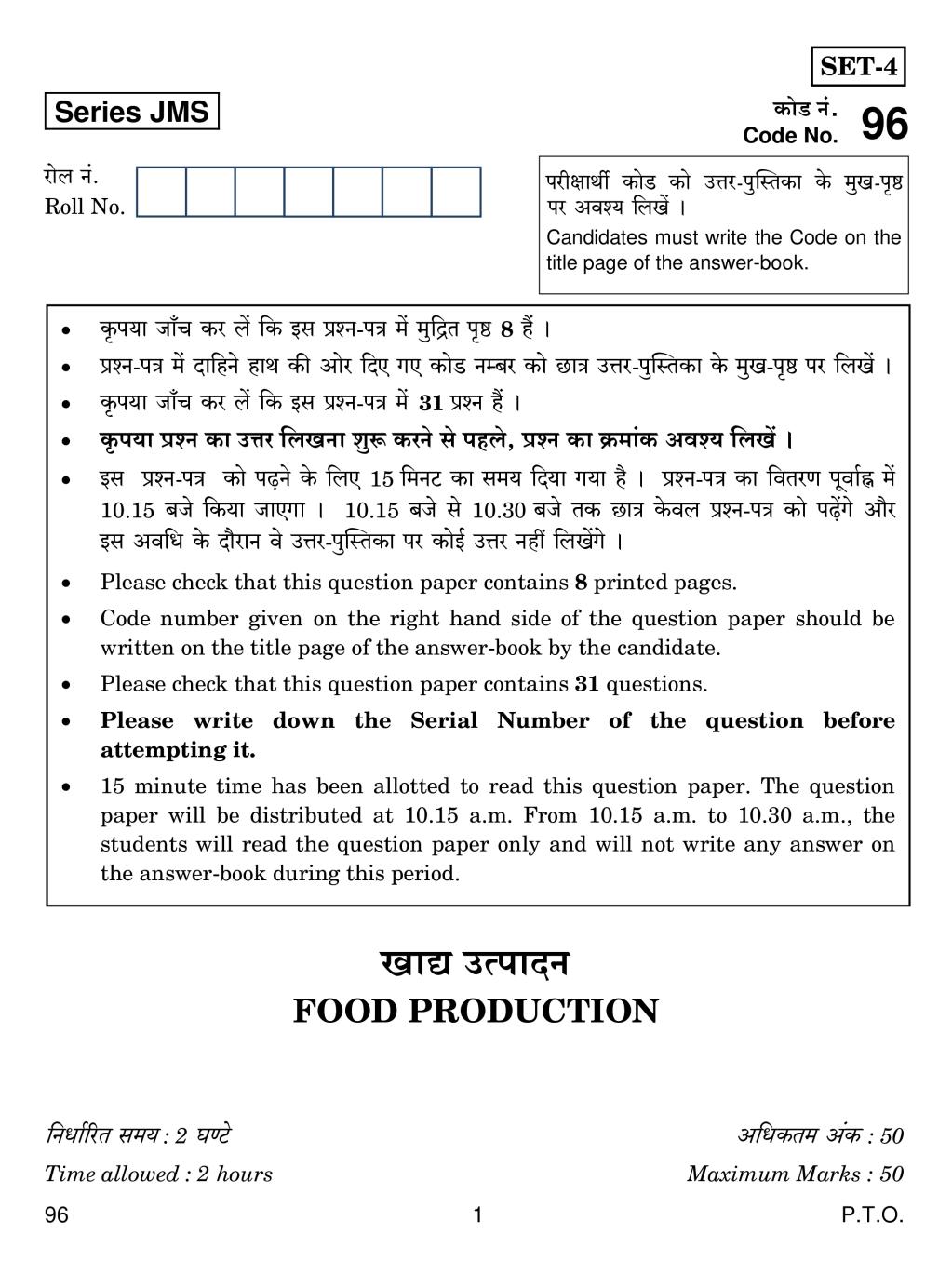
Series JMS H$moS> Z§.
Code No. 96
amob Z§. narjmWu H$moS >H$mo CÎma-nwpñVH$m Ho$ _wI-n¥ð
Roll No. >na Adí` {bIo§ &
Candidates must write the Code on the
title page of the answer-book.
H¥$n`m Om±M H$a b| {H$ Bg àíZ-nÌ _o§ _w{ÐV n¥ð> 8 h¢ &
àíZ-nÌ _| Xm{hZo hmW H$s Amoa {XE JE H$moS >Zå~a H$mo N>mÌ CÎma-nwpñVH$m Ho$ _wI-n¥ð> na {bI| &
H¥$n`m Om±M H$a b| {H$ Bg àíZ-nÌ _| >31 àíZ h¢ &
H¥$n`m àíZ H$m CÎma {bIZm ewê$ H$aZo go nhbo, àíZ H$m H«$_m§H$ Adí` {bI| &
Bg àíZ-nÌ H$mo n‹T>Zo Ho$ {bE 15 {_ZQ >H$m g_` {X`m J`m h¡ & àíZ-nÌ H$m {dVaU nydm©• _|
10.15 ~Oo {H$`m OmEJm & 10.15 ~Oo go 10.30 ~Oo VH$ N>mÌ Ho$db àíZ-nÌ H$mo n‹T>|Jo Am¡a
Bg Ad{Y Ho$ Xm¡amZ do CÎma-nwpñVH$m na H$moB© CÎma Zht {bI|Jo &
Please check that this question paper contains 8 printed pages.
Code number given on the right hand side of the question paper should be
written on the title page of the answer-book by the candidate.
Please check that this question paper contains 31 questions.
Please write down the Serial Number of the question before
attempting it.
15 minute time has been allotted to read this question paper. The question
paper will be distributed at 10.15 a.m. From 10.15 a.m. to 10.30 a.m., the
students will read the question paper only and will not write any answer on
the answer-book during this period.
ImÚ CËnmXZ
FOOD PRODUCTION
{ZYm©[aV g_` : 2 KÊQ>o A{YH$V_ A§H$ : 50
Time allowed : 2 hours Maximum Marks : 50
96 1 P.T.O.
Page 2
(i) Bg àíZnÌ ‘| 31 àíZ em{‘b h¢ {OZ‘| go Aä¶Wu H$mo {g’©$ 23 àíZ H$aZo H$s µOê$aV h¡ &
(ii) àíZnÌ Xmo IÊS>m| ‘| {d^m{OV h¡ &
I. IÊS> H$
~hþ{dH$ënr¶ àíZ/[a³V ñWmZ ^[aE/grYo àíZ : Hw$b 12 àíZ em{‘b h¢ Omo
1 – 1 A§H$ Ho$ h¢ & BZ‘| go {H$Ýht 10 àíZm| Ho$ CÎma Xr{OE &
A{V bKw CÎmar¶ àíZ : Bg_| Hw$b 7 àíZ em{‘b h¢, à˶oH$ 2 A§H$ Ho$ h¢ &
BZ‘| go {H$Ýht 5 àíZm| Ho$ CÎma Xr{OE &
bKw CÎmar¶ àíZ : Bg‘| Hw$b 7 àíZ em{‘b h¢, à˶oH$ 3 A§H$ Ho$ h¢ & BZ‘| go
{H$Ýht 5 àíZm| Ho$ CÎma Xr{OE &
II. IÊS> I
XrK© CÎmar¶/{Z~ÝYmË‘H$ àíZ : Bg‘| Hw$b 5 àíZ em{‘b h¢, à˶oH$ 5 A§H$ Ho$
h¢ & BZ‘| go {H$Ýht 3 àíZm| Ho$ CÎma Xr{OE &
General Instructions :
(i) This question paper contains 31 questions out of which the candidate
needs to attempt only 23 questions.
(ii) Question paper is divided into two sections :
I. SECTION A
Multiple choice questions/Fill in the blanks/Direct questions :
contains total 12 questions of 1 mark each. Answer any
10 questions.
Very short answer type questions : contains total 7 questions
of 2 marks each. Answer any 5 questions.
Short answer type questions : contains total 7 questions
of 3 marks each. Answer any 5 questions.
II. SECTION B
Long answer/Essay type questions : contains total 5 questions
of 5 marks each. Answer any 3 questions.
96 2
Page 3
SECTION A
{XE JE ~mah àíZm| ‘| go {H$Ýht Xg àíZm| Ho$ CÎma Xr{OE & 110=10
Attempt any ten questions out of given twelve questions.
1. ~ma-~ma EH$ hr Vob H$m VbZo ‘| Cn¶moJ H$aZo go EH$ ¶m¡{JH$ H$s CËn{Îm hmoVr h¡, {OgH$s
dOh go ¶h nMZo ‘| H${R>ZmB© H$aVm h¡ Ed§ Iam~ ñdmX XoVm h¡
(A) p½bgam°b (Glycerol) (~) ’¡$Q>r Eo{gS> (Fatty Acid)
(g) Egramo{bZ (Acerolin) (X) Cn`w©³V ‘| go H$moB© Zht
Frequently reusing the same oil for frying leads to the production of this
compound making oil difficult to digest and gives off-flavour
(a) Glycerol (b) Fatty acids
(c) Acerolin (d) None of the above
2. ³¶m hmoVm h¡ O~ àmoQ>rZ (Protein) H$mo J‘© {H$¶m OmVm h¡ ?
(A) H$moEJwboeZ (Coagulation) (~) Ho$am‘obmBµOoeZ (Caramelization)
(g) {Ob¡{Q>ZmBµOoeZ (Gelatinization) (X) Cn`w©³V ‘| go H$moB© Zht
What happens with the application of heat on proteins ?
(a) Coagulation (b) Caramelization
(c) Gelatinization (d) None of the above
3. g¡bo‘oÝS>a (salamander) EH$ CnH$aU h¡ Omo ImZm nH$mZo ‘| Cn¶moJ H$aVm h¡
(A) Z‘ Vmn (Moist heat) (~) ewîH$ Vmn (Dry heat)
(g) gm°VoB§J (Sautéing) (X) Cn`w©³V ‘| go H$moB© Zht
A salamander is an equipment used to cook food using
(a) Moist heat (b) Dry heat
(c) Sautéing (d) None of the above
4. BS>br ~ZmZo ‘| Cn¶moJ hmoVm h¡
(A) {J«S>qbJ (Griddling) (~) C~mbZm (Boiling)
(g) ^mn go (Steaming) (X) Cn`w©³V ‘| go H$moB© Zht
Idlis are prepared through
(a) Griddling (b) Boiling
(c) Steaming (d) None of the above
96 3 P.T.O.
Page 4
(A) ³bmoamo{’$b (Chlorophyll) (~) ~rQ>mboÝg (Betalains)
(g) EÝWmogm¶{ZÝg (Anthocyanins) (X) âb¡dmoÝg (Flavones)
The pigment responsible for deep red colour of beets is
(a) Chlorophyll (b) Betalains
(c) Anthocyanins (d) Flavones
6. gpãO¶m| H$s nVbr pñQ´>ßg (strips) Omo gmYmaUV: g¡ÝS>{dM AWdm ZyS>ëg (noodles)
~ZmZo ‘| à¶moJ H$s OmVr h¢, CÝh| H$hVo h¢
(A) ñbmBgoµO (Slices) (~) Oy{b¶Ýg (Juliennes)
(g) ~¡Q>Ýg (Batons) (X) Q>ÝS>© (Turned)
Vegetables cut in thin strips commonly used in preparation of sandwiches
or noodles are called
(a) Slices (b) Juliennes
(c) Batons (d) Turned
7. p³b¶a nVbo gyn (clear thin soup) H$mo Bg Zm_ go ^r OmZm OmVm h¡
(A) ~«m°W (Broths) (~) pñQ>¶y (Stews)
(g) H$m°Ýgmo‘o (Consommé) (X) {~ñH$ (Bisque)
Clear thin soups are also known as
(a) Broths (b) Stews
(c) Consommé (d) Bisque
8. {ZåZ{b{IV EH$ R>§S>o gyn H$m CXmhaU Zht h¡ :
(A) {‘{ZñÌmoZr (Minestrone) (~) OobrS> H$m°Ýgmo‘o (Jellied consommé)
(g) gmaH$s (Sarki) (X) JµOnmMmo (Gazpacho)
Following is not an example of cold soup :
(a) Minestrone (b) Jellied consommé
(c) Sarki (d) Gazpacho
9. Aê$Jwbm (Arugula) Ed§ AmBg~J© (Iceberg) gbmX Ho$ {ZåZ{b{IV ^mJ Ho$ CXmhaU h¢ :
(A) ~og (Base) (~) ~m°S>r (Body)
(g) S´>oqgJ (Dressing) (X) Jm{Z©e (Garnish)
Arugula and iceberg are examples of following part of salad :
(a) Base (b) Body
(c) Dressing (d) Garnish
96 4
Page 5
(A) boQ>çyg (Lettuce) (~) A§S>o (Eggs)
(g) Zt~y H$m ag (Lemon juice) (X) Am°{bd (Olive)
A major component of a protein salad would be
(a) Lettuce (b) Eggs
(c) Lemon juice (d) Olive
11. EH$ àH$ma H$m ~mBQ> gmBµO {’$ÝJa ’y$S> (bite-size finger food) Omo Hw$aHw$ao ~og d
gOmdQ>r Q>m°qnJ Ho$ gmW hmoVm h¡, H$hbmVm h¡
(A) ’¡$Ýgr g¡ÝS>{dM (Fancy sandwich)
(~) hm°Q> g¡ÝS>{dM (Hot sandwich)
(g) H¡$Zmno (Canapé)
(X) ~w’o$ g¡ÝS>{dM (Buffet sandwich)
A type of bite-size finger food with a crispy base and decorative topping is
called
(a) Fancy sandwich
(b) Hot sandwich
(c) Canapé
(d) Buffet sandwich
12. g¡ÝS>{dM ~ZmZo Ho$ {bE ~«oS> H$m ^ÊS>maU {H$¶m OmZm Mm{hE
(A) ’«$sµOa ‘|
(~) ao’«$sOaoQ>a ‘| {~Zm T>Ho$
(g) H$‘ao Ho$ Vmn‘mZ na
(X) H$‘ao Ho$ Vmn‘mZ na Vmn òmoV Ho$ nmg
The bread for preparation of sandwich should be stored
(a) In freezer
(b) In refrigerator without a cover
(c) At room temperature
(d) At room temperature near heat source
96 5 P.T.O.
Page 6
Attempt any five questions out of the given seven questions.
13. ‘{Ob¡{Q>ZmBµOoeZ’ (Gelatinization) eãX H$mo g‘PmBE &
Explain the term ‘Gelatinization’.
14. ImZm ~ZmZo Ho$ {H$Ýht Mma ‘w»¶ CÔoí¶m| H$s gyMr ~ZmBE &
List any four major objectives of cooking food.
15. âbm°ar (floury) Ed§ d¡³gr (waxy) Amby ‘| AÝVa ñnîQ> H$s{OE &
Differentiate between floury and waxy potatoes.
16. ImZm ~ZmZo ‘| nm¡pîQ>H$ VÎdm| H$mo gwa{jV aIZo Ho$ {H$Ýht Mma VarH$m| H$m dU©Z H$s{OE &
Describe any four ways to preserve nutrients in processing food.
17. H«$s‘ (Crème) Ed§ ߶yao (Purée) gyn H$s VwbZm Ed§ AÝVa ñnîQ> H$s{OE &
Compare and contrast Crème and Purée soups.
18. p³b¶a gyn (clear soup) H¡$go ~ZmE OmVo h¢ ?
How are clear soups prepared ?
19. g¡ÝS>{dM ~ZmZo ‘| ñàoS> (Spread) H$s Amdí¶H$Vm H$mo g‘PmBE &
Explain the importance of spreads in preparation of sandwiches.
{XE JE gmV àíZm| ‘| go {H$Ýht nm±M àíZm| Ho$ CÎma Xr{OE & 35=15
Attempt any five questions out of the given seven questions.
20. Z‘ {d{Y Ûmam ImZm ~ZmZo H$s {H$Ýht N>h {d{Y¶m| H$m C{MV CXmhaU g{hV dU©Z H$s{OE &
Describe any six moist methods of cooking giving suitable examples.
21. C{MV CXmhaUm| g{hV {gånb (simple), ‘ëQ>rnb (multiple) Ed§ EJ«rJoQ> (aggregate)
’$bm| H$s VwbZm H$s{OE Ed§ g‘PmBE &
Compare and explain simple, multiple and aggregate fruits giving
suitable examples.
96 6
Page 7
boZr Mm{hE ? g‘PmBE &
Explain the precautions to be taken while cooking beetroot so as to
prevent loss of its colour and texture.
23. VmOo ’y$bJmo^r, ’«o$ÝM ~rÝg d nmbH$ H$m M¶Z H$aZo Ho$ ‘mZX§S>m| (criteria) H$mo {b{IE &
Write the criteria for selection of fresh cauliflower, french beans and
spinach.
24. ‘‘w{bJVm°Zr’ d ‘{‘{ZñÌmoZr’ (‘Mulligatawny’ and ‘Minestrone’) gynm| H$mo CZHo$ CX²J‘
Xoe (country of origin) Ho$ Zm‘ Ho$ gmW g‘PmBE &
Describe and name the country of origin of the soups ‘Mulligatawny’ and
‘Minestrone’.
25. gbmX H$s Jm{Z©e (Garnish) ³¶m h¢ ? C{MV CXmhaU Xr{OE & do H¡$go Amdí¶H$ h¢ ?
What are salad garnishes ? Give suitable examples. How are they
important ?
26. g¡ÝS>{dM ~ZmZo ‘| Cn¶moJ H$s OmZo dmbr ~«oS> Ho$ àH$ma d JwUm| na EH$ g§{jßV {Q>ßnUr
{b{IE &
Write a short note on types and qualities of breads that can be used to
prepare sandwiches.
IÊS> I
SECTION B
{XE JE nm±M àíZm| ‘| go {H$Ýht VrZ àíZm| Ho$ CÎma Xr{OE & 53=15
Attempt any three questions out of given five questions.
27. Vmn ñWmZmÝVaU (Heat Transfer) H$s {d{^Þ {d{Y¶m| H$mo C{MV CXmhaUm| g{hV
g‘PmBE & gmYmaUV: ~«oS> H$mo ^Å>r (Oven) ‘| nH$mZo ‘| Vmn ñWmZmÝVaU H$s {H$g {d{Y
H$m Cn¶moJ hmoVm h¡ ?
Explain the various methods of heat transfer giving suitable examples.
Which method of heat transfer is used commonly in baking breads in an
oven ?
96 7 P.T.O.
Page 8
Classify vegetables with suitable examples.
29. EH$ AÀN>o ñdmñ϶ Ho$ aIaImd Ho$ {bE ’$bm| H$s Amdí¶H$Vm H$m dU©Z H$s{OE & h‘mao
X¡{ZH$ Amhma ‘| ’$bm| H$s {H$Ýht N>h Cn¶mo{JVmAm| H$s gyMr ~ZmBE Ed§ g‘PmBE &
Describe the importance of fruits in maintaining good health. List and
explain any six uses of fruits in our daily diet.
30. gbmXm| H$m dJuH$aU CZHo$ ‘w»¶ Ad¶d Ho$ AmYma na H$s{OE d g‘PmBE & gmYmaU
(Simple) d ¶m¡{JH$ gbmX (Compound Salad) EH$-Xÿgao go H¡$go {^Þ h¢ ?
Classify salads based on their major content and explain them. How are
simple and compound salads different from each other ?
31. gbmX H$mo n[a^m{fV H$s{OE & EH$ gbmX Ho$ {d{^Þ ^mJ (parts) ³¶m h¢ ? CZH$s ^y{‘H$m
Ed§ ‘hÎd H$mo g‘PmBE &
Define Salad. What are the various parts of a salad ? Explain their role
and importance.
96 8
Document Details
| Board / Org | CBSE |
| Exam | Class 10 |
| Type | Question Paper |
| Pages | 8 |
| Updated | 30 Apr 2026 |