NIOS Class 12 April 2024 Question Paper History
Finished viewing? Save it for later —
Download NIOS Class 12 April 2024 Question Paper History (PDF · 23 pages)About NIOS Class 12 April 2024 Question Paper History
NIOS Class 12 April 2024 Question Paper History is available here for free download. Published by NIOS for National Institute of Open Schooling Class 12, this question paper can be viewed online or downloaded as a PDF (23 pages). Candidates preparing for National Institute of Open Schooling Class 12 can use NIOS Class 12 April 2024 Question Paper History to understand the exam pattern, the type of questions asked, and the overall difficulty level.
Frequently Asked Questions
How can I download NIOS Class 12 April 2024 Question Paper History?
Open this page and click the Download button to save NIOS Class 12 April 2024 Question Paper History as a PDF. It is completely free on AglaSem Docs.
Is NIOS Class 12 April 2024 Question Paper History free to download?
Yes. NIOS Class 12 April 2024 Question Paper History can be viewed online and downloaded as a PDF free of cost on AglaSem Docs.
How many pages does NIOS Class 12 April 2024 Question Paper History have?
NIOS Class 12 April 2024 Question Paper History contains 23 pages, which you can read online or download together as a single PDF.
Where can I find more National Institute of Open Schooling Class 12 study material?
You can find more National Institute of Open Schooling Class 12 question papers, sample papers, syllabus, and answer keys on AglaSem Docs.
NIOS Class 12 April 2024 Question Paper History – Text
Read the full text of this question paper below — useful to quickly search, copy and reference the content online without downloading the PDF.
📄 View text version (23 pages)
Page 1
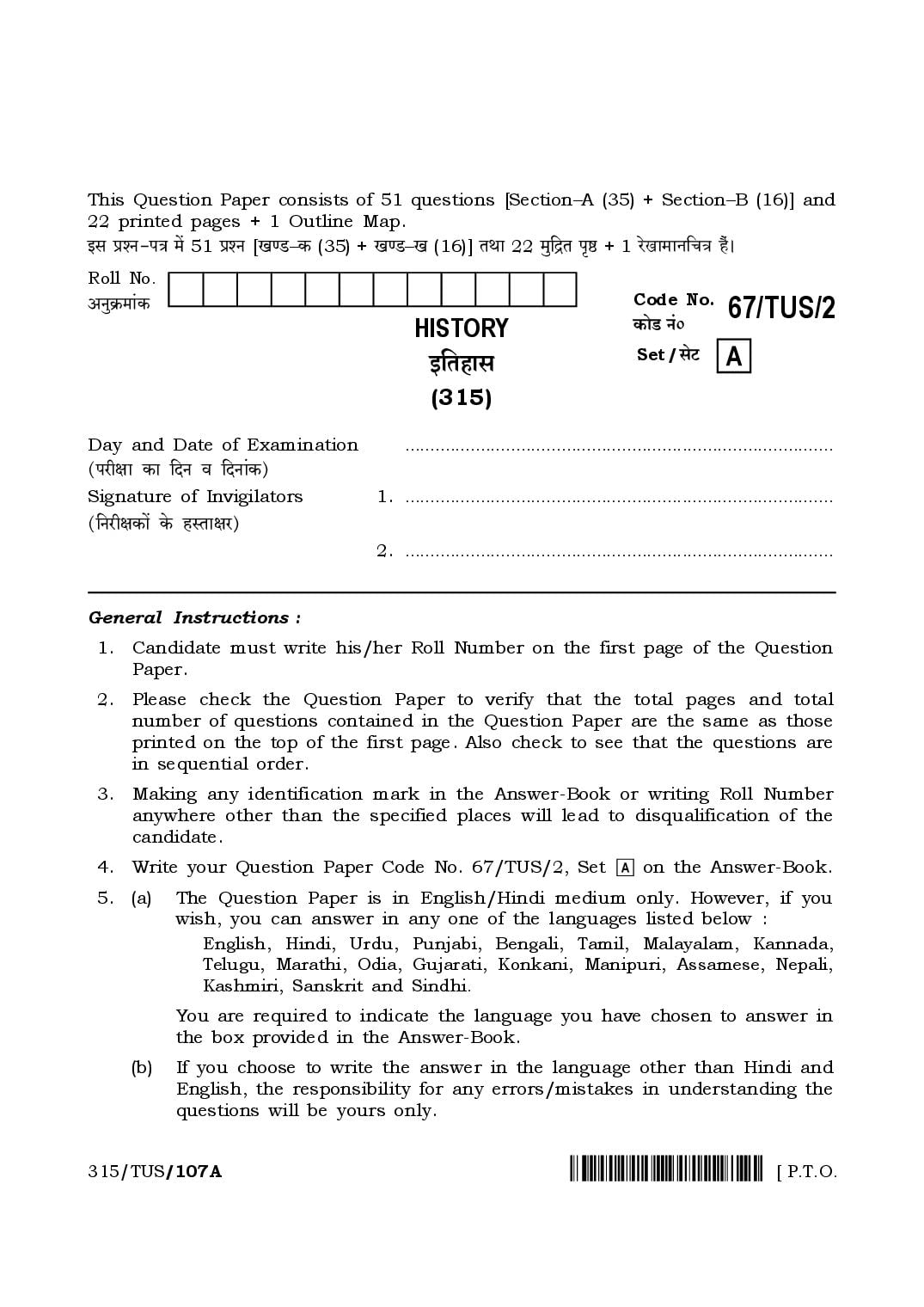
22 printed pages + 1 Outline Map.
Bg àíZ-nÌ ‘| 51 àíZ [ IÊS>–H$ (35) + IÊS>–I (16)] VWm 22 ‘w{ÐV n¥ð> + 1 aoIm‘mZ{MÌ h¡§&
Roll No.
AZwH«$‘m§H$ Code No.
67/TUS/2
u
HISTORY H$moS> Z§0
Set / goQ>
B{Vhmg
(315)
Day and Date of Examination .....................................................................................
(narjm H$m {XZ d {XZm§H$)
Signature of Invigilators 1. .....................................................................................
({ZarjH$m| Ho$ hñVmja)
2. .....................................................................................
General Instructions :
1. Candidate must write his/her Roll Number on the first page of the Question
Paper.
2. Please check the Question Paper to verify that the total pages and total
number of questions contained in the Question Paper are the same as those
printed on the top of the first page. Also check to see that the questions are
in sequential order.
3. Making any identification mark in the Answer-Book or writing Roll Number
anywhere other than the specified places will lead to disqualification of the
candidate.
4. Write your Question Paper Code No. 67/TUS/2, Set u on the Answer-Book.
5. (a) The Question Paper is in English/Hindi medium only. However, if you
wish, you can answer in any one of the languages listed below :
English, Hindi, Urdu, Punjabi, Bengali, Tamil, Malayalam, Kannada,
Telugu, Marathi, Odia, Gujarati, Konkani, Manipuri, Assamese, Nepali,
Kashmiri, Sanskrit and Sindhi.
You are required to indicate the language you have chosen to answer in
the box provided in the Answer-Book.
(b) If you choose to write the answer in the language other than Hindi and
English, the responsibility for any errors/mistakes in understanding the
questions will be yours only.
315/TUS/107A [ P.T.O.
Page 2
1. narjmWu àíZ-nÌ Ho$ nhbo n¥ð> na AnZm AZwH«$‘m§H$ Adí¶ {bI|&
2. H¥$n¶m àíZ-nÌ H$mo Om±M b| {H$ àíZ-nÌ Ho$ Hw$b n¥ð>m| VWm àíZm| H$s CVZr hr g§»¶m h¡ {OVZr àW‘ n¥ð> Ho$ g~go
D$na N>nr h¡& Bg ~mV H$s Om±M ^r H$a b| {H$ àíZ H«${‘H$ ê$n ‘| h¢&
3. CÎma-nwpñVH$m ‘| nhMmZ-{M• ~ZmZo AWdm {Z{X©ï> ñWmZm| Ho$ A{V[aº$ H$ht ^r AZwH«$‘m§H$ {bIZo na narjmWu H$mo
A¶mo½¶ R>ham¶m Om¶oJm&
4. AnZr CÎma-nwpñVH$m na àíZ-nÌ H$m H$moS> Z§0 67/TUS/2, goQ u {bI|&
5. (H$) n«íZ-nÌ Ho$db {hÝXr/A§J«oOr ‘| h¡& {’$a ^r, ¶{X Amn Mmh| Vmo ZrMo Xr JB© {H$gr EH$ ^mfm ‘| CÎma Xo
gH$Vo h¢ …
A§J«oOr, {hÝXr, CXÿ©, n§Om~r, ~§Jbm, V{‘b, ‘b¶mb‘, H$Þ‹S>, VobwJy, ‘amR>r, C{‹S>¶m, JwOamVr, H$m|H$Ur,
‘{Unwar, Ag{‘¶m, Zonmbr, H$í‘rar, g§ñH¥$V Am¡a {gÝYr&
H¥$n¶m CÎma-nwpñVH$m ‘| {XE JE ~m°³g ‘| {bI| {H$ Amn {H$g ^mfm ‘| CÎma {bI aho h¢&
(I) ¶{X Amn {hÝXr Ed§ A§J«oOr Ho$ A{V[aº$ {H$gr Aݶ ^mfm ‘| CÎma {bIVo h¢, Vmo àíZm| H$mo g‘PZo ‘| hmoZo dmbr
Ìw{Q>¶m|/Jb{V¶m| H$s {Oå‘oXmar Ho$db AmnH$s hmoJr&
315/TUS/107A 2
Page 3
B{Vhmg
(315)
Time : 3 Hours ] [ Maximum Marks : 100
g‘¶ … 3 KÊQ>o ] [ nyUmªH$ … 100
Note : (i) This Question Paper consists of 51 questions in all.
(ii) All questions are compulsory.
(iii) Marks are given against each question.
(iv) Attempt all questions either from Optional Module—6A or Optional
Module—6B in all Sections.
(v) Section–A consists of
(a) Q. Nos. 1 to 20—Multiple Choice-type Questions (MCQs) carrying
1 mark each. Select and write the most appropriate option out of the
four options given in each of these questions. An internal choice has
been provided in some of these questions. You have to attempt only
one of the given choices in such questions.
(b) Q. Nos. 21 to 35—Objective-type Questions carrying 2 marks each
(with 2 sub-parts of 1 mark each). Attempt these questions as per
the instructions given for each of the questions.
(vi) Section–B consists of
(a) Q. Nos. 36 to 41—Very Short Answer-type Questions carrying
2 marks each to be answered in the range of 30 to 50 words.
(b) Q. Nos. 42 to 47—Short Answer-type Questions carrying 3 marks
each to be answered in the range of 50 to 80 words.
(c) Q. Nos. 48 to 50—Long Answer-type Questions carrying 5 marks
each to be answered in the range of 80 to 120 words.
(d) Q. No. 51—Map-based question carrying 5 marks. (Alternative ques-
tions are given in lieu of Map-based Question for Visually Impaired
candidates)
{ZX}e … (i) Bg àíZ-nÌ ‘| Hw$b 51 àíZ h¢&
(ii) g^r àíZ A{Zdm¶© h¢&
(iii) à˶oH$ àíZ Ho$ A§H$ Cg àíZ Ho$ gm‘Zo {XE JE h¢&
(iv) d¡H$pënH$ ‘m°S>²¶b
y —6A AWdm d¡H$pënH$ ‘m°S>²¶b
y —6B ‘| go {H$gr EH$ Ho$ g^r àíZm| Ho$ CÎma {b{IE&
(v) IÊS>–H$
(a) àíZ g§»¶m 1 go 20 VH$ ~hþ{dH$ënr¶ àíZ h¢& à˶oH$ àíZ 1 A§H$ H$m h¡& BZ àíZm| Ho$
{XE JE Mma {dH$ënm| ‘| go g~go Cn¶wº$ {dH$ën H$mo MwZH$a CÎma Ho$ ê$n ‘| {b{IE& BZ‘|
go Hw$N> àíZm| ‘| AmÝV[aH$ {dH$ën àXmZ {H$¶m J¶m h¡& Eogo àíZm| ‘| AmnH$mo Ho$db {H$gr EH$
{dH$ën H$m hr CÎma {bIZm h¡&
315/TUS/107A 3 [ P.T.O.
Page 4
1 A§H$ Ho$ 2 Cn-^mJ h¢&) BZ àíZm| Ho$ CÎma {XE JE {ZX}emZwgma {b{IE&
(vi) IÊS>–I
(a) àíZ g§»¶m 36 go 41 VH$ A{V bKw CÎmar¶ àH$ma Ho$ àíZ h¢& à˶oH$ àíZ 2 A§H$ H$m
h¡ {OgH$m CÎma 30 go 50 eãXm| ‘| {bIZm h¡&
(b) àíZ g§»¶m 42 go 47 VH$ bKw CÎmar¶ àH$ma Ho$ àíZ h¢& à˶oH$ àíZ 3 A§H$ H$m h¡ {OgH$m
CÎma 50 go 80 eãXm| ‘| {bIZm h¡&
(c) àíZ g§»¶m 48 go 50 VH$ XrK© CÎmar¶ àH$ma Ho$ àíZ h¢& à˶oH$ àíZ 5 A§H$ H$m h¡ {OgH$m
CÎma 80 go 120 eãXm| ‘| {bIZm h¡&
(d) àíZ g§»¶m 51 ‘mZ{MÌ na AmYm[aV h¡& àíZ 5 A§H$ H$m h¡& ‘mZ{MÌ na AmYm[aV àíZ Ho$
~Xbo ‘|, Ñ{ï>~m{YV narjm{W©¶m| Ho$ {bE d¡H$pënH$ àíZ {XE JE h¢&
(1) Answers of all questions are to be given in the Answer-Book given to you.
g^r àíZm| Ho$ CÎma AmnH$mo Xr JB© CÎma-nwpñVH$m ‘| hr {bI|&
(2) 15 minutes time have been allotted to read this question paper. The question
paper will be distributed at 2:15 p.m. From 2:15 p.m. to 2:30 p.m., the
students will read the question paper only and will not write any answer on
the Answer-Book during this period.
Bg àíZ-nÌ H$mo n‹T>Zo Ho$ {bE 15 {‘ZQ> H$m g‘¶ {X¶m J¶m h¡& àíZ-nÌ H$m {dVaU Xmonha ‘|
2:15 ~Oo {H$¶m OmEJm& 2:15 ~Oo go 2:30 ~Oo VH$ N>mÌ Ho$db àíZ-nÌ H$mo n‹T>|Jo Am¡a Bg Ad{Y
Ho$ Xm¡amZ do CÎma-nwpñVH$m na H$moB© CÎma Zht {bI|Jo&
SECTION–A
IÊS>–H$
1. On the basis of archaeological findings, the Harappan Civilization has been
dated between which of the following periods? 1
(A) 2600 BC—1900 BC (B) 3600 BC—2700 BC
(C) 3700 BC—2800 BC (D) 4500 BC—4000 BC
nwamVmpËdH$ ImoOm| Ho$ AZwgma, h‹S>ßnm gä¶Vm H$m H$mb ³¶m h¡?
(A) 2600 B©0ny0—1900 B©0ny0 (B) 3600 B©0ny0—2700 B©0ny0
(C) 3700 B©0ny0—2800 B©0ny0 (D) 4500 B©0ny0—4000 B©0ny0
2. What is the approximate number of signs found in the Harappan script? 1
(A) 200 (B) 400
(C) 500 (D) 600
315/TUS/107A 4
Page 5
(A) 200 (B) 400
(C) 500 (D) 600
What was the main occupation of the early Vedic Aryans?
(A) Pastoralism (B) Agriculture
(C) Trading (D) Marketing
àma§{^H$ d¡{XH$ Am¶m] H$m ‘w»¶ ì¶dgm¶ ³¶m Wm?
(A) newnmbZ (B) H¥${f
(C) ì¶mnma (D) {dnUZ
3. Who was the most famous Shaka ruler? 1
(A) Vikramaditya (B) Rudradaman
(C) Rajaraja Chola (D) Krishnadeva Raya
gdm©{YH$ à{gÕ eH$ emgH$ H$m¡Z Wm?
(A) {dH«$‘m{X˶ (B) éÐX‘Z
(C) amOamO Mmob (D) H¥$îUXod am¶
4. Who is known as the father of Ayurveda? 1
(A) Charaka (B) Kanishka
(C) Chanakya (D) Harishena
Am¶wd}X Ho$ OZH$ Ho$ ê$n ‘o§ {H$go OmZm OmVm h¡?
(A) MaH$ (B) H${ZîH$
(C) MmU³¶ (D) h[afoU
315/TUS/107A 5 [ P.T.O.
Page 6
(A) Udayagiri (B) Rajgiri
(C) Patnagiri (D) Nilgiri
hmWrJwå’$m {ebmboI H$hm± h¡?
(A) CX¶{Jar (B) amO{Jar
(C) nVZm{Jar (D) Zrb{Jar
5. An important characteristic of Amaravati School of Art is known as
(A) negative art (B) narrative art
(C) modern art (D) progressive art 1
H$bm Ho$ A‘amdVr ñHy$b H$s EH$ ‘hÎdnyU© {d{eï>Vm H$hbmVr h¡
(A) ZH$mamˑH$ H$bm (B) H$WmˑH$ H$bm
(C) AmYw{ZH$ H$bm (D) àJ{Verb H$bm
6. Who, out of the following is the author of Harshacharita? 1
(A) Banabhatta (B) Kalidasa
(C) Charaka (D) Kautilya
hf©M[aV Ho$ boIH$ {ZåZ ‘| go H$m¡Z h§¡?
(A) ~mU^Å> (B) H$m{bXmg
(C) MaH$ (D) H$m¡{Q>ë¶
Which, out of the following, was the capital of the Pallavas?
(A) Patna (B) Kanchi
(C) Ratnagiri (D) Jaipur
n„dm| H$s amOYmZr {ZåZ ‘| go H$m¡Z-gr Wr?
(A) nQ>Zm (B) H$m§Mr
(C) aËZm{Jar (D) O¶nwa
315/TUS/107A 6
Page 7
Akbar? 1
(A) Maharana Pratap (B) Jaichand
(C) Man Singh (D) Birbal
{H$g amOnyV emgH$ Zo AµH$~a H$mo EH$ J§^ra MwZm¡Vr Xr?
(A) ‘hmamUm àVmn (B) O¶MÝX
(C) ‘mZqgh (D) ~ra~b
Who was the ruler from Deccan who defeated the Mughal forces during
the time of Jahangir?
(A) Malik Kafur (B) Malik Ambar
(C) Bairam Khan (D) Krishnadeva Raya
X¸$Z H$m dh H$m¡Z-gm emgH$ Wm {OgZo Ohm±Jra Ho$ g‘¶ ‘wµJb goZm H$mo ham¶m Wm?
(A) ‘{bH$ H$mµ’y$a (B) ‘{bH$ Aå~a
(C) ~¡a‘ Im§ (D) H¥$îUXod am¶
8. Who, out of the following, used to head ‘Diwan-i-Arz’ during the Sultanate
period? 1
(A) Ariz-i-Mumalik (B) Mushrif-i-Mumalik
(C) Mustaufi-i-Mumalik (D) Diwan-i-Waqoof
gëVZV H$mb Ho$ Xm¡amZ "XrdmZ-E-AO©' H$m ZoV¥Ëd {ZåZ ‘| go {H$gHo$ Ûmam {H$¶m OmVm Wm?
(A) A[aµO-E-‘w‘m{bH$ (B) ‘we[aµ’$-E-‘w‘m{bH$
(C) ‘wñVm¡µ’$s-E-‘w‘m{bH$ (D) XrdmZ-E-dHy$µ’$
The headman of village under the Mughals was known as
(A) Shiqdar (B) Muqaddam
(C) Faujdar (D) Amalguzar
‘wµJbm| Ho$ AYrZ Jm±d Ho$ ‘w{I¶m H$mo H$hm OmVm Wm
(A) {eµH$Xma (B) ‘wµH$Ô‘
(C) ’$m¡µOXma (D) A‘bJwµOma
315/TUS/107A 7 [ P.T.O.
Page 8
the following? 1
(A) Shaikh Burhanuddin Gharib (B) Shaikh Moinuddin Chishti
(C) Shihabuddin Suhrawardi (D) Baba Fariduddin
13dt eVmãXr ‘|, X¸$Z ‘| {MíVr {gb{gbo H$s ñWmnZm {ZåZ ‘| go {H$gHo$ Ûmam H$s JB© Wr?
(A) eo˜ ~wahmZwÔrZ µJar~ (B) eo˜ ‘wBZwÔrZ {MíVr
(C) {ehm~wÔrZ gwhamdXu (D) ~m~m µ’$arXþÔrZ
Out of the following, who was the earliest and the most influential Nirguna
Bhakti Saint in North India?
(A) Kabir (B) Chaitanya
(C) Tulsidas (D) Tukaram
CÎma ^maV Ho$ àma§{^H$ Am¡a g~go A{YH$ à^mdembr {ZJw©U ^{º$ g§V {ZåZ ‘| go H$m¡Z Wo?
(A) H$~ra (B) M¡Vݶ
(C) VwbgrXmg (D) VwH$mam‘
10. The credit for creation of which musical instrument, out of the following,
goes to Amir Khusrau? 1
(A) Guitar (B) Sitar
(C) Harmonium (D) Flute
A‘ra Iwgamo H$mo {H$g dmÚ ¶§Ì Ho$ Am{dîH$ma H$m lo¶ {X¶m OmVm h¡?
(A) {JQ>ma (B) {gVma
(C) hma‘mo{Z¶‘ (D) ~m±gwar
11. James Augustus Hicky published the first newspaper in India in 1780
by which of the following names? 1
(A) The Times of India (B) Bengal Gazette
(C) The Hindu (D) Navbharat Times
315/TUS/107A 8
Page 9
{H$¶m?
(A) X Q>mBåg Am°’$ B§{S>¶m (B) ~§Jmb JµOQ>
(C) X qhXÿ (D) Zd^maV Q>mBåg
12. The Ananda Math novel was written by whom of the following? 1
(A) Rabindranath Tagore (B) Mahatma Gandhi
(C) G. B. Pant (D) Bankim Chandra Chatterjee
AmZ§X ‘R> Cnݶmg {ZåZ ‘| go {H$gHo$ Ûmam {bIm J¶m Wm?
(A) adrÝÐZmW Q>¡Jmoa (B) ‘hmË‘m Jm±Yr
(C) Or. ~r. n§V (D) ~§{H$‘MÝÐ MQ>Ou
Where did the initial disturbance of the Revolt of 1857 start?
(A) Delhi (B) Meerut
(C) Jhansi (D) Barrackpore
1857 Ho$ {dÐmoh H$m àma§p^H$ Am§XmobZ H$hm± go ewê$ hþAm?
(A) {X„r (B) ‘oaR>
(C) Pm±gr (D) ~¡aH$nwa
13. When was the Arya Samaj founded by Dayananda Saraswati? 1
(A) 1575 (B) 1675
(C) 1775 (D) 1875
X¶mZ§X gañdVr Zo Am¶© g‘mO H$s ñWmnZm H$~ H$s?
(A) 1575 (B) 1675
(C) 1775 (D) 1875
315/TUS/107A 9 [ P.T.O.
Page 10
(A) War between USA and Russia
(B) Due to emergence of Nations and Nation-States
(C) Uses of weapon
(D) War between Germany and France
¶yamon ‘| amï´>dmX H$m CX¶ H¡$go hþAm?
(A) ê$g Am¡a A‘o[aH$m Ho$ ~rM ¶wÕ
(B) amï´>m| Am¡a amï´>-amÁ¶m| Ho$ CX²^d Ho$ H$maU
(C) h{W¶mam| H$m à¶moJ
(D) O‘©Zr Am¡a ’«$m§g Ho$ ~rM ¶wÕ
15. The custom of Sati was formally abolished in which year? 1
(A) 1728 (B) 1828
(C) 1829 (D) 1830
gVr àWm Am{Ia {H$g df© g‘má hþB©?
(A) 1728 (B) 1828
(C) 1829 (D) 1830
Which movement was started by Annie Besant?
(A) Ghadar (B) Satyagraha
(C) Home Rule (D) Kheda
EoZr ~og|Q> Zo H$m¡Z-gm AmÝXmobZ ewê$ {H$¶m?
(A) µJXa (B) g˶mJ«h
(C) hmo‘ê$b (D) Io‹S>m
315/TUS/107A 10
Page 11
(A) Dadabhai Naoroji (B) G. B. Pant
(C) Mahatma Gandhi (D) Bipin Chandra
à{gÕ nwñVH$ nmdQ>u EoÝS> AZ-{~«{Q>e ê$b BZ BpÊS>¶m {H$gZo {bIr?
(A) XmXm^mB© Zm¡amoOr (B) Or0 ~r0 n§V
(C) ‘hmË‘m Jm±Yr (D) {~{nZMÝÐ
17. The phase of Indian National Movement between 1885–1905 is known as
(A) Extremist (B) Moderate
(C) Socialist (D) Capitalist 1
^maVr¶ amï´>r¶ AmÝXmobZ ‘o§ 1885–1905 Ho$ ~rM Ho$ MaU H$mo ³¶m H$hm OmVm h¡?
(A) Ma‘n§Wr (B) Za‘n§Wr
(C) g‘mOdmXr (D) ny±OrdmXr
When was the Partition of Bengal announced by Lord Curzon?
(A) 1905 (B) 1907
(C) 1908 (D) 1909
bm°S>© H$µO©Z Ûmam ~§Jmb-{d^mOZ H$~ Kmo{fV {H$¶m J¶m?
(A) 1905 (B) 1907
(C) 1908 (D) 1909
18. The Morley-Minto Reforms came in which year? 1
(A) 1907 (B) 1909
(C) 1910 (D) 1911
315/TUS/107A 11 [ P.T.O.
Page 12
(A) 1907 (B) 1909
(C) 1910 (D) 1911
19. Tilak introduced which festival? 1
(A) Ganapati (B) Raslila
(C) Ramlila (D) Basant
{VbH$ Zo H$m¡Z-gm CËgd ‘ZmZo H$s ewéAmV H$s?
(A) JUn{V (B) amgbrbm
(C) am‘brbm (D) ~g§V
20. Which side did Indian soldiers fight on during the World War I? 1
(A) France (B) Britain
(C) China (D) Germany
àW‘ {díd¶wÕ ‘| ^maVr¶ g¡{ZH$ {H$g nj go b‹S>o?
(A) ’«$m§g (B) {~«Q>oZ
(C) MrZ (D) O‘©Zr
The National Fascist Party was formed by whom in 1921?
(A) Mussolini (B) Hitler
(C) Mahatma Gandhi (D) Bolsheviks
1921 ‘| {H$gHo$ Ûmam amï´>r¶ ’$m{gñQ> nmQ>u H$m JR>Z {H$¶m J¶m?
(A) ‘wgmo{bZr (B) {hQ>ba
(C) ‘hmË‘m Jm±Yr (D) ~moëeo{dH$
315/TUS/107A 12
Page 13
_____ and _____. 1×2=2
_____ Am¡a _____ O¡go Hw$N> ñWmZm| go A{¾ H$s CnmgZm Ho$ Hw$N> gmú¶ {‘bo h¡§&
22. _____ marriages were preferred even though _____ was frequent in the
later Vedic phase. 1×2=2
CÎma-d¡{XH$H$mb ‘| ¶Ú{n _____ àWm ^r àM{bV Wr, na§Vw _____ {ddmh àWm H$mo hr ~ohVa g‘Pm
OmVm Wm&
23. Iltutmish gave the Sultanate two of its basic coins, i.e., the silver _____
and the copper _____. 1×2=2
BëVwV{‘e Zo gëVZV H$mo Xmo ‘yb {g¸o$ {XE AWm©V² Mm±Xr H$m _____ VWm Vm±~o H$m _____&
24. The forces of Babur and Rana Sanga met at _____, a place near
_____ in 1527. 1×2=2
~m~a Am¡a amUm gm§Jm H$s goZmAmo§ H$m ‘wH$m~bm, _____ Ho$ nmg EH$ ñWmZ _____ ‘| 1527 ‘| hþAm&
25. The founder of second Afghan Empire, Sher Khan was a great _____ and
an able _____ . 1×2=2
{ÛVr¶ Aµ’$JmZr gm‘«mÁ¶ H$m g§ñWmnH$ eoa ImZ _____ ‘| Hw$eb Am¡a ¶mo½¶ _____ Wm&
26. Complete the following sentences (any two) : 1×2=2
{ZåZ{b{IV dm³¶m| H$mo nyam H$s{OE (H$moB© Xmo) :
(a) In June 1763, under Major Adams, British Army defeated _____, the
Nawab of Bengal.
OyZ 1763 ‘|, ‘oµOa EoS>åg Ho$ ZoV¥Ëd ‘| A§J«oOr goZm Zo ~§Jmb Ho$ Zdm~ _____ H$mo nam{OV
H$a {X¶m&
(b) Most serious restriction on the growth of Indian language newspapers
was of Lord Lytton’s _____ Act of 1878.
^maVr¶ ^mfmAm| Ho$ g‘mMma-nÌ Ho$ {dH$mg na g~go H$R>moa à{V~§Y bm°S>© {bQ>Z H$m _____ Eo³Q>
Am°’$ 1878 H$m Wm&
315/TUS/107A 13 [ P.T.O.
Page 14
devastating effect of the British policy over the rural society.
_____ ‘| ~§Jmb ‘| n‹S>m ^rfU AH$mb J«m‘rU g‘mO na {~«{Q>e gm‘«mÁ¶ H$s Zr{V Ho$ {dÜd§gH$mar
à^md H$m à‘mU h¡&
(d) By the Royal Proclamation of 1858, India’s administration was taken
over directly by the _____ abolishing the East India Company’s rule.
1858 Ho$ emhr KmofUm-nÌ go, B©ñQ> B§{S>¶m H§$nZr Ho$ emgZ H$mo g‘má H$aVo hþE ^maV H$m àemgZ
grYo Vm¡a na _____ Ho$ AYrZ H$a {X¶m J¶m&
27. The Universities of Calcutta, _____ and _____ were established in 1857.
1×2=2
gZ² 1857 ‘| H$bH$Îmm, _____ VWm _____ ‘| {díd{dÚmb¶m| H$s ñWmnZm hþB©&
28. _____ established the Ramakrishna Mission in _____. 1×2=2
_____ ‘| _____ Zo am‘H¥$îU {‘eZ H$s ñWmnZm H$s &
Some women reformers like Pandita Ramabai in Western Part, Sister _____
in Madras and _____ in Bengal played a prominent role in social
life of the 19th century. 1×2=2
Hw$N> ‘{hbm Am§XmobZH$m[a¶m| O¡go npíM‘ joÌ ‘| n§{S>Vm a‘m~mB©, ‘Ðmg ‘| {gñQ>a _____ Ed§ ~§Jmb
‘| _____ Zo 19dr§ eVmãXr Ho$ gm‘m{OH$ OrdZ ‘| ‘hÎdnyU© ^y{‘H$m H$m {Zdm©h {H$¶m&
29. _____ was the most important leader of _____ the Revolution in 1917. 1×2=2
1917 H$s _____ H«$mpÝV H$m _____ EH$ ‘hÎdnyU© ZoVm Wm &
In 1905, Japan defeated Russia in war and took over _____, the Russian
sphere of influence, in _____. 1×2=2
1905 ‘| OmnmZ Zo ¶wÕ ‘| ê$g H$mo hamH$a _____ ‘| ê$g Ho$ à^md joÌ _____ na H$ãOm H$a {b¶m&
315/TUS/107A 14
Page 15
erV ¶wÕ _____ Am¡a _____ Ho$ ~rM {ÛY«wdr¶ Q>H$amd Wm&
31. Complete the following statements (any two) : 1×2=2
{ZåZ{b{IV H$WZm| H$mo nyam H$s{OE (H$moB© Xmo) :
(a) The Russian Revolution was louded in all Asian countries and _____
people all over the world.
g^r E{e¶mB© Xoem| ‘| ê$gr H«$mpÝV H$s àe§gm H$s JB© VWm g§nUy © {díd ‘| bmoJ Bggo _____ hþE&
(b) The Turks rose in rebellion against the treaty under the leadership of
_____ after the World War I.
àW‘ {díd ¶wÕ Ho$ níMmV² VwH$m] Zo _____ Ho$ ZoV¥Ëd ‘| gpÝY Ho$ {déÕ {dÐmoh H$a {X¶m&
(c) The US President Truman formulated his policy to contain
communism which is known as _____.
A‘o[aH$s amï´>n{V Q¯>‘¡Z Zo AnZr gmå¶dmX H$mo AdéÕ H$aZo H$s Zr{V à{Vnm{XV H$s, {Ogo _____
Ho$ Zm‘ go OmZm OmVm h¡&
(d) The famous Irish writer James Joyce who introduced the technique of
‘the stream of consciousness’ in his work is called _____.
à{gÕ Am¶[ae boIH$ Ooåg Om°¶g Zo _____ Zm‘H$ AnZr nwñVH$ ‘| "X ñQ´>r‘ Am°’$
H$mpÝe¶gZog' H$s VH$ZrH$ àñVwV H$s Wr&
OPTIONAL MODULE–6A
d¡H$pënH$ ‘m°S²>¶yb–6A
( Evolution of States in India )
( ^maV ‘| amÁ¶m| H$m {dH$mg )
32. Complete the following statements (any two) : 1×2=2
{ZåZ{b{IV H$WZm| H$mo nyam H$s{OE (H$moB© Xmo) :
(a) The northern trade route called Uttarapatha while the Southern route
called _____ was under the control of Magadha.
CÎmar ì¶mnma ‘mJ© H$mo {Z¶pÝÌV H$aZo dmbm ¶h joÌ CÎmamnW H$hbmVm Wm, O~{H$ _____ H$hbmZo
dmbm X{jUr ‘mJ© ‘JY Ho$ {Z¶§ÌU ‘| Wm&
315/TUS/107A 15 [ P.T.O.
Page 16
law _____.
‘wµJb g‘«mQ>m| Ho$ VhV ^maV ‘wpñb‘ H$mZyZ _____ go em{gV hmoVm Wm&
(c) Sir William Jones had translated a great mass of Sanskrit literature
and had founded _____ of Bengal in 1785.
ga {d{b¶‘ Om|g Zo ~‹S>r ‘mÌm ‘| g§ñH¥$V gm{h˶ H$m AZwdmX {H$¶m Wm Am¡a 1785 ‘| _____
Am°’$ ~§Jmb H$s ñWmnZm H$s&
33. The strength of the British Army was very much _____ than those of
Mughal India, but had better training and _____. 1×2=2
{~«{Q>e goZm~b ‘wµJb goZm go A˶{YH$ _____, qH$Vw ~ohVa à{ejU Am¡a _____ go b¡g Wr&
34. Answer any two questions : 1×2=2
{H$Ýht Xmo àíZm| Ho$ CÎma Xr{OE :
(a) Which Buddhist monk traveled in India during Vikramaditya’s reign?
{dH«$‘m{X˶ Ho$ emgZ Ho$ Xm¡amZ {H$g ~m¡Õ {^jw Zo ^maV ‘| ^«‘U {H$¶m?
(b) Name the capital city of kingdom of Magadha.
‘JY gm‘«mÁ¶ H$s amOYmZr H$m Zm‘ {b{IE&
(c) Name Chandragupta’s minister who wrote Arthashastra.
MÝÐJwá Ho$ Cg ‘§Ìr H$m Zm‘ {b{IE Omo AW©emó H$m boIH$ Wm&
35. Answer any two questions : 1×2=2
{H$Ýhr§ Xmo àíZm| Ho$ CÎma Xr{OE :
(a) In the Allahabad Pillar Inscription, how is Samudragupta regarded
while living on the Earth?
Bbmhm~mX ñV§^ {ebmboI Ho$ AZwgma g‘wÐJwá {H$g ê$n ‘o§ n¥Ïdr na ahVo Wo?
(b) The Mughal Emperor from Akbar to Aurangzeb adopted which titles?
AµH$~a go Am¡a§JOo~ VH$ ‘wµJb emgH$m| Zo H$m¡Z-gr Cnm{Y YmaU H$s?
(c) Which system of land revenue measurement was introduced by Sher
Shah Suri and adopted and improved by Akbar?
^y{‘ amOñd ‘| ‘mn H$s dh H$m¡Z-gr àUmbr Wr Omo eoaemh gyar Ûmam ewê$ hþB© Am¡a AµH$~a
Ûmam AnZmB© VWm gwYmar JB©?
315/TUS/107A 16
Page 17
d¡H$pënH$ ‘m°S²>¶yb–6B
( Culture in India )
( ^maV ‘| gm§ñH¥${VH$ {dH$mg )
32. Complete the following statements (any two) : 1×2=2
{ZåZ{b{IV H$WZm| H$mo nyam H$s{OE (H$moB© Xmo) :
(a) People have expressed themselves and communicated cultural values
through song, dance and _____.
bmoJm| Zo JrV, Z¥Ë¶ Am¡a _____ Ho$ O[aE ñd¶§ H$mo A{^춺$ {H$¶m h¡ Am¡a gm§ñH¥${VH$ ‘yë¶
g§ào{fV {H$E h§¡&
(b) The arts of Ajanta and Ellora were patronized by the _____ and
Vakataka rulers.
AO§Vm Am¡a Ebmoam H$s H$bmAm| H$mo _____ Am¡a dmH$mQ>H$ emgH$m§o Zo g§ajU àXmZ {H$¶m&
(c) Besides Punjabi, another language in the Indian subcontinent which
is shared by the people of different countries is _____.
n§Om~r Ho$ Abmdm ^maVr¶ Cn‘hmÛrn ‘| {d{^Þ Xoem| Ho$ bmoJm| Ûmam ~mobr OmZodmbr EH$ Aݶ
^mfm _____ h¡&
33. The Buddhists adopted hundreds of popular folk stories. In the Buddhist
tradition, they were known as _____ or previous-birth stories of the _____.
1×2=2
~m¡Õm§o Zo g¡H$‹S>mo§ bmoH${චbmoH$ H$WmE± AnZm br§& ~m¡Õ na§nam ‘| do _____ AWdm _____ Ho$ nyd©-
OÝ‘ H$s H$WmAm| Ho$ ê$n ‘| OmZr OmVr h§¡&
34. Answer any two questions : 1×2=2
{H$Ýhr§ Xmo àíZm| Ho$ CÎma Xr{OE :
(a) The study of human beings is known as what?
‘mZdm| H$m Aܶ¶Z ³¶m H$hbmVm h¡?
(b) Which is the best known miniature painting on Jain religion and
philosophy?
O¡Z Y‘© Am¡a Xe©Z na g~go à{gÕ bKw {MÌ H$m¡Z-gm h¡?
315/TUS/107A 17 [ P.T.O.
Page 18
in 1821?
1821 ‘| amOm am‘‘mohZ am¶ Ûmam H$m¡Z-gm g‘mMma-nÌ àH$m{eV H$aZm ewê$ {H$¶m J¶m?
35. Answer any two questions : 1×2=2
{H$Ýht Xmo àíZm| Ho$ CÎma Xr{OE :
(a) Name the woman saint of Lord Shiva of medieval Tamil Nadu whose
literary compositions are famous.
V{‘bZmSy> Ho$ ‘ܶH$mb H$s ^JdmZ {ed H$s ‘{hbm g§V H$m Zm‘ {b{IE {OZH$s gm{hp˶H$ aMZm
à{gÕ h¡&
(b) Name any one place where early cave paintings are to be found.
{H$gr EH$ ñWmZ H$m Zm‘ {b{IE Ohm± àma§{^H$ Jw’$m-{MÌ nmE OmVo h§¡&
(c) In India, from where the earliest example of religious music come?
^maV ‘| Ym{‘©H$ g§JrV H$m g~go nhbm CXmhaU H$hm± {‘bVm h¡?
SECTION–B
IÊS>–I
36. What are the two dynasties that emerged in North India after the decline
of the Guptas? 2
Jwád§e Ho$ nVZ Ho$ ~mX CÎma ^maV ‘| C{XV hþE Xmo amOd§e H$m¡Z go Wo?
37. Mention any two functions of Ulemas under the Delhi Sultanate. 2
{X„r gëVZV Ho$ A§VJ©V Cbo‘mAm| Ho$ {H$Ýht Xmo H$m¶m] H$m C„oI H$s{OE&
Mention any two important texts written in Sanskrit during the Sultanate
period.
{X„r gëVZV Ho$ Xm¡amZ g§ñH¥$V ‘| {bIo {H$Ýht Xmo ‘hÎdnyU© J«§Wm| Ho$ Zm‘m| H$m C„oI H$s{OE&
38. Examine any two functions of Subedar in provincial administration under
the Mughals. 2
‘wJbm| Ho$ AYrZ àm§Vr¶ àemgZ ‘| gy~oXma Ho$ {H$Ýht Xmo H$m¶m] H$m narjU H$s{OE&
315/TUS/107A 18
Page 19
took?
{edmOr Zo AnZm amÁ¶m{^foH$ H$~ VWm H$hm± H$adm¶m? CÝhm|Zo H$m¡Z-gr Cnm{Y J«hU H$s?
39. Explain any two grievances of Indian Sepoys against the British during
1857. 2
1857 Ho$ Xm¡amZ {~«{Q>e Ho$ {déÕ ^maVr¶ {gnm{h¶m| H$s {H$Ýht Xmo {eH$m¶Vm| H$s ì¶m»¶m H$s{OE&
40. Who has been described as the author of ‘Detente’? What does this term
mean? Explain. 2
"S>oQ>m§Q>' H$m OZH$ {H$go H$hm OmVm h¡? Bg nX H$m ³¶m AW© h¡? ì¶m»¶m H$s{OE&
What were the important political groups in late 19th century Russia?
Explain.
19dt eVmãXr Ho$ A§V ‘| ê$g Ho$ ‘hÎdnyU© amOZ¡{VH$ g‘yh H$m¡Z go Wo? ì¶m»¶m H$s{OE&
OPTIONAL MODULE–6A
d¡H$pënH$ ‘m°S²>¶yb–6A
( Evolution of States in India )
( ^maV ‘| amÁ¶mo§ H$m {dH$mg )
41. Examine the military strength of the Mauryan Empire as per
Megasthenes. 2
‘¡JñWZrµO Ho$ AZwgma ‘m¡¶© gm‘«mÁ¶ H$s goZm H$s VmH$V H$m narjU H$s{OE>&
OPTIONAL MODULE–6B
d¡H$pënH$ ‘m°S²>¶yb–6B
( Culture in India )
( ^maV ‘| gm§ñH¥${VH$ {dH$mg )
41. Examine the uniqueness of Kalamkari textiles. 2
"H$b‘H$mar dó' H$s A{ÛVr¶Vm H$m narjU H$s{OE>&
315/TUS/107A 19 [ P.T.O.
Page 20
Jm§Yma H$bm H$s e¡br Ho$ {d{eï> bjUm| H$s ì¶m»¶m H$s{OE&
43. What measures did Balban take to emphasize that the Sultan had
absolute powers? Describe. 3
gÎmm Ho$ dM©ñd H$mo gwëVmZ Ho$ nmg H$m¶‘ aIZo Ho$ {bE ~b~Z Zo {H$Z Cnm¶m| H$mo AnZm¶m? dU©Z
H$s{OE&
44. Describe any three important points of treaty signed between the Mughals
and Bijapur in 1636. 3
1636 ‘| ‘wµJbm| Am¡a ~rOmnwa Ho$ ~rM hþB© g§{Y Ho$ {H$Ýht VrZ ‘hÎdnyU© q~XþAm| H$m dU©Z H$s{OE&
Describe the three important officials at the level of Pargana under the
Delhi Sultanate.
{X„r gëVZV Ho$ A§VJ©V naJZm ñVa Ho$ VrZ A{YH$m[a¶m| H$m dU©Z H$s{OE&
45. Discuss any three methods the British used to expand their Empire
in India. 3
^maV ‘| AnZo emgZ H$m {dñVma H$aZo Ho$ {bE {~«{Q>e Ûmam AnZmE JE {H$Ýht VrZ VarH$mo§ na MMm©
H$s{OE&
Discuss any three reasons for the Battle of Buxar in 1764.
1764 Ho$ ~³ga ¶wÕ Ho$ {H$Ýht VrZ H$maUm| na MMm© H$s{OE&
46. Explain any three important points of the Treaty of Versailles. 3
dgm©¶ g§{Y Ho$ {H$Ýht VrZ ‘hÎdnyU© {~§XwAm| H$s ì¶m»¶m H$s{OE&
What was Operation Sea Lion? Explain.
"Am°naoeZ gr bm¶Z' ³¶m Wm? ì¶m»¶m H$s{OE&
47. What efforts were made by Mikhail Gorbachev to transform and revitalize
the Soviet Union? Discuss. 3
{‘ImBb Jmo~m©Mod Zo gmo{d¶V g§K H$mo ~XbZo Am¡a nwZOu{dV H$aZo Ho$ {bE ³¶m à¶mg {H$E? MMm© H$s{OE&
315/TUS/107A 20
Page 21
1857 Ho$ {dÐmoh H$s {d’$bVm Ho$ H$maUm| H$s ì¶m»¶m H$s{OE&
Discuss the role of Sidhu and Kanhu brothers in Santhal tribal Uprising.
g§Wmb Am{Xdmgr {dÐmoh ‘| {gÕÿ Am¡a H$mZy ^mB¶m| H$s ^y{‘H$m na MMm© H$s{OE&
49. What were the causes for the Battle of Plassey in 1757? Explain. 5
1757 Ho$ ßbmgr ¶wÕ Ho$ H$maU ³¶m Wo? ì¶m»¶m H$s{OE&
Explain the essential features of Wood’s dispatch.
"dwS²>g {S>ñn¡M' H$s Amdí¶H$ {deofVmAm| H$s ì¶m»¶m H$s{OE&
OPTIONAL MODULE–6A
d¡H$pënH$ ‘m°S²>¶yb–6A
( Evolution of States in India )
( ^maV ‘| amÁ¶m§o H$m {dH$mg )
50. What were the important conditions of Subsidiary Alliance between the
British and the native Princely States? 5
{~«{Q>e Am¡a Xoer aOdm‹S>m| Ho$ ~rM ghm¶H$ g§{Y H$s ‘hÎdnyU© eV] ³¶m Wr§?
What changes the British brought in Indian social institutions to
westernize India between 1820–1850?
1820 VWm 1850 Ho$ ‘ܶ ^maV H$m npíM‘rH$aU H$aZo Ho$ {bE {~«{Q>e Zo ^maVr¶ gm‘m{OH$ g§ñWmZm|
‘| ³¶m n[adV©Z {H$E?
OPTIONAL MODULE–6B
d¡H$pënH$ ‘m°S²>¶yb–6B
( Culture in India )
( ^maV ‘| gm§ñH¥${VH$ {dH$mg )
50. How does the Indian textile reflect culture? 5
^maVr¶ dó H¡$go g§ñH¥${V H$mo Xem©Vo h¡§?
315/TUS/107A 21 [ P.T.O.
Page 22
^maVr¶ ImZ-nmZ H$s AmXV| H¡$go g§ñH¥${V H$mo Xem©Vo h¡§?
51. Mark the following places (locations) on the Indian map : 1×5=5
(i) Taxila (ii) Mathura
(iii) Sanchi (iv) Ujjaini
(v) Magadha
^maV Ho$ ‘mZ{MÌ na {ZåZ{b{IV ñWmZm| H$mo Xem©BE :
(i) Vjerbm (ii) ‘Wwam
(iii) gm§Mr (iv) CÁO{¶Zr
(v) ‘JY
Note : The following questions are for the visually impaired candidates only in
lieu of Question No. 51.
{ZX}e : {ZåZ{b{IV àíZ Ho$db Ñ{ï>~m{YV narjm{W©¶m| Ho$ {bE àíZ g§»¶m 51 Ho$ ñWmZ na h§¡&
(a) Chandragupta II married his daughter to which dynasty?
MÝÐJwá {ÛVr¶ Zo AnZr nwÌr H$m {ddmh {H$g amOd§e ‘| {H$¶m?
(b) Name the Chinese pilgrim who visited India in the reign of
Chandragupta II.
MÝÐJwá {ÛVr¶ Ho$ emgZH$mb ‘| {H$g MrZr ¶mÌr Zo ^maV H$m Xm¡am {H$¶m?
(c) Name the great Sanskrit poet and playwright who adorned the Court
of Chandragupta II.
Cg ‘hmZ g§ñH¥$V H${d Am¡a ZmQ>H$H$ma H$m Zm‘ {b{IE {OgZo MÝÐJwá {ÛVr¶ Ho$ Xa~ma H$mo
gwemo{^V {H$¶m&
(d) Which group of family did Toramana belong to?
Vmoa‘U {H$g d§e go g§~§{YV Wm?
(e) Name the Gupta prince who was able to repulse the first raids of the
Hunas.
hÿUm| Ho$ àW‘ AmH«$‘U H$mo {d’$b H$aZo dmbo Jwá d§e Ho$ amOHw$‘ma H$m Zm‘ {b{IE&
315/TUS/107A [24V—700×3] 22
Page 23
Roll No.
AZwH«$‘m§H$
Attach this map with your answer-book
INDIA—POLITICAL
Bg ‘mZ{MÌ H$mo AnZr CÎma-nwpñVH$m Ho$ gmW ZËWr H$a|
^maV—amOZ¡{VH$
315/TUS/107A 23
Document Details
| Board / Org | NIOS |
| Exam | National Institute of Open Schooling Class 12 |
| Type | Question Paper |
| Pages | 23 |
| Language | english |
| Updated | 24 Sep 2026 |