HBSE Class 9 Sample Paper 2026 Answers Mathematics
Finished viewing? Save it for later —
Download HBSE Class 9 Sample Paper 2026 Answers Mathematics (PDF · 18 pages)About HBSE Class 9 Sample Paper 2026 Answers Mathematics
HBSE Class 9 Sample Paper 2026 Answers Mathematics is available here for free download. Published by Haryana Board for Class 9, this answer key can be viewed online or downloaded as a PDF (18 pages). Candidates preparing for Class 9 can use HBSE Class 9 Sample Paper 2026 Answers Mathematics to understand the exam pattern, the type of questions asked, and the overall difficulty level.
Frequently Asked Questions
How can I download HBSE Class 9 Sample Paper 2026 Answers Mathematics?
Open this page and click the Download button to save HBSE Class 9 Sample Paper 2026 Answers Mathematics as a PDF. It is completely free on AglaSem Docs.
Is HBSE Class 9 Sample Paper 2026 Answers Mathematics free to download?
Yes. HBSE Class 9 Sample Paper 2026 Answers Mathematics can be viewed online and downloaded as a PDF free of cost on AglaSem Docs.
How many pages does HBSE Class 9 Sample Paper 2026 Answers Mathematics have?
HBSE Class 9 Sample Paper 2026 Answers Mathematics contains 18 pages, which you can read online or download together as a single PDF.
Where can I find more Class 9 study material?
You can find more Class 9 question papers, sample papers, syllabus, and answer keys on AglaSem Docs.
HBSE Class 9 Sample Paper 2026 Answers Mathematics – Text
Read the full text of this answer key below — useful to quickly search, copy and reference the content online without downloading the PDF.
📄 View text version (18 pages)
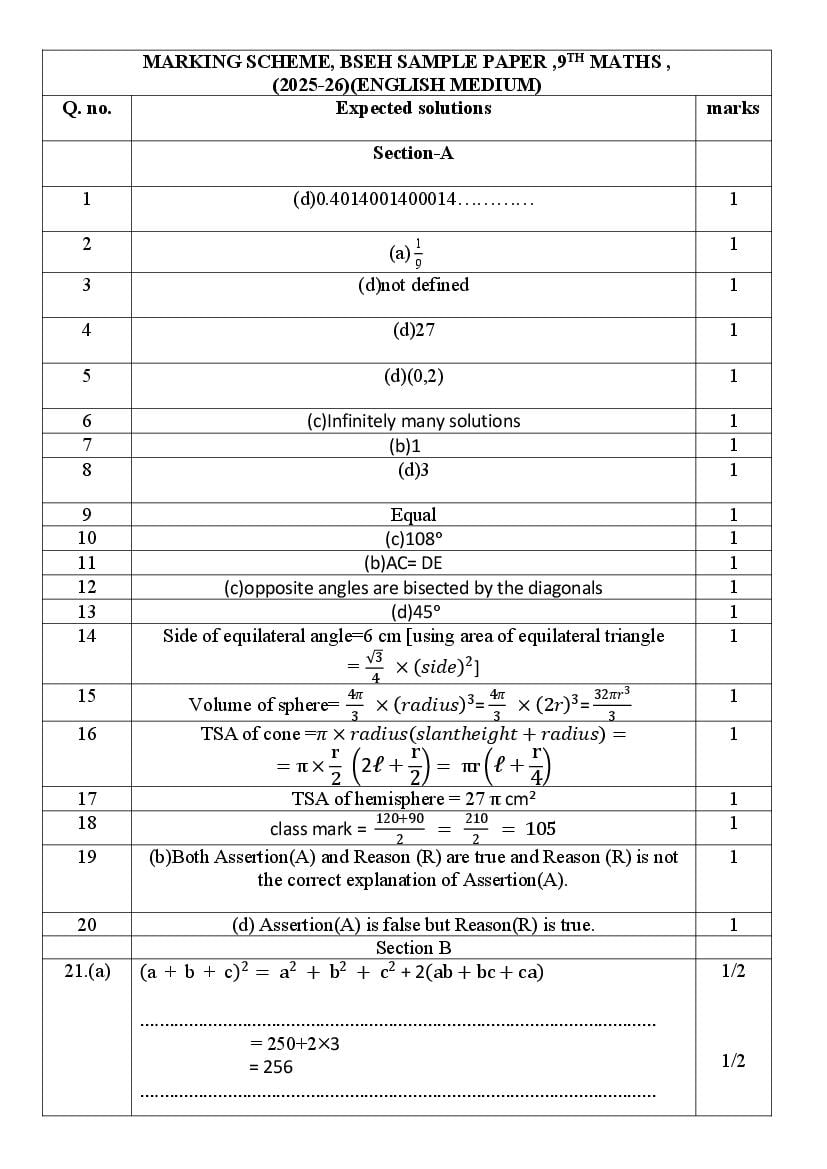
Page 1
(2025-26)(ENGLISH MEDIUM)
Q. no. Expected solutions marks
Section-A
1 (d)0.4014001400014………… 1
2 1
(a) 9 1
3 (d)not defined 1
4 (d)27 1
5 (d)(0,2) 1
6 (c)Infinitely many solutions 1
7 (b)1 1
8 (d)3 1
9 Equal 1
10 (c)108° 1
11 (b)AC= DE 1
12 (c)opposite angles are bisected by the diagonals 1
13 (d)45° 1
14 Side of equilateral angle=6 cm [using area of equilateral triangle 1
3
= × ���� 2 ]
4
15 4�
Volume of sphere= 3 × ������ 3 = 3 × 2� 3 = 3
4� 32��3 1
16 TSA of cone =� × ������(�����ℎ���ℎ� + ������) = 1
r r r
= π× 2ℓ + = πr ℓ +
2 2 4
17 TSA of hemisphere = 27 cm π 2 1
18 class mark =
120+90
=
210
= 105 1
2 2
19 (b)Both Assertion(A) and Reason (R) are true and Reason (R) is not 1
the correct explanation of Assertion(A).
20 (d) Assertion(A) is false but Reason(R) is true. 1
Section B
21.(a) a + b + c = a + b + c2 + 2 ab + bc + ca
2 2 2 1/2
….…………………………………………………………………………………………
= 250+2×3
= 256 1/2
….…………………………………………………………………………………………
Page 2
OR Let p(x) = x3 - x2 - (2 + √2)x + √2
21.(b) ∴ p(-1) = (-1)3 - (-1)2 - (2 + √2)(-1) + √2 1/2
….……………………………………………………………………..
= -1 - 1 + 2 + √2 + √2
= 2√2 ≠ 0 1/2
….……………………………………………………………………
Since the remainder of p(-1) ≠ 0, x + 1 is not a factor of
x3 - x2 - (2 + √2)x + √2. 1
22.
Coordinates of point B are B(4,3) 1/2
….……………………………………………………………………………………….
Coordinates of point M are M(-3,4)
1/2
….………………………………………………………………………………………
Coordinates of point L are L(-5,- 4)
1/2
….………………………………………………………………………………………
Coordinates of point S are S(3,- 4)
1/2
23.
AC = BD (given)
⇒ AB+BC = BC+C D
[ ∵ Point B lies between A and C and point C lies 1/2+1/2
between B and D ]
….…………………………………………………………………..
⇒ AB= CD [Subtracting equals from equals]
1/2+1/2
Page 3
∴ semi-perimeter s =
�+�+�
=
41+40+9 90
= 2 = 45 1/2
2 2
….…………………………………………………………………………………………….
Heron’s formula,Area of triangle = � � − � � − � � − � 1/2
….…………………………………………………………………………………………..
= 45 45 − 41 45 − 40 45 − 9
1/2
= 45 × 4 × 5 × 36
= 3×3×5×2×2×5×2×2×3×3
……………………………………………………………………………………………..
=3× 5 × 2 × 2 ×3 = 180 �2 1/2
25.(a) Surface area of sphere S1 = 4π r2
25 �
Decrease in diameter = 25% of 2r = 100 × 2r =
2
r 3�
Decreased diameter= 2r − =
2 2
3� 1/2
⇒ Decreased radius =
4
….………………………………………………………………………………..
3� 2 9� � 2
New surface area S2 = 4π 4 = 1/2
4
….………………………………………………………………………….
� −�
%Decrease in surface area = 2 1 × 100
�1
9� � 2
4π r2 − 1/2
= × 100
4
4π r2
….………………………………………………………………………………….
7
= × 100 = 43.75% 1/2
16
Page 4
25.(b)
Slant height,
l = �2 + ℎ2
= √(7)² + (24)² 1/2
= √49 + 576
= √625
= 25 cm
….……………………………………………………………………
Area of the sheet required to make each cap = πrl
= 22/7 × 7 cm × 25 cm 1/2+1/2
= 550 cm²
….………………………………………………………………………
Area of the sheet required to make 10 such caps = 10 × 550 cm2 =
5500 cm2 1/2
Section C
26.
5 5 3+ 5
= 3− 5 × 3+ 5
3− 5 1
….………………………………………………………………………………………
=
5 3+ 5 1
2 2
3 − 5
….………………………………………………………………………………………..
5 3+ 5
= 3−5
1/2
….…………………………………………………………………………………………
−5 3+ 5
= 2 1/2
Page 5
=(4a)³ - (3b)³ - 3(4a)²(3b) + 3(4a)(3b)² 1
….………………………………………………….
which is of the form (x - y)³ = x³ - y³ - 3x²y + 3xy² 1/2
….…………………………………………………
Here, x = 4a, y = 3b 1/2
….………………………………………………….
Hence 64a³ - 27b³ - 144a²b + 108ab² = (4a - 3b)³
= 4� − 3� 4� − 3� 4� − 3� 1
..........................................................................
28. Rewrite the equation y-2=0 as
0x+1y-2=0 1
….………………………………………………………………….
The equation in the form ax+ by+ c=0 is 0x+1y-2=0
1/2
….…………………………………………………………………..
with a=0, b=1 and c= -2. 1
12
29. In the adjoining figure, AB∥CD and CD∥EF. Also,EA⊥ AB. If
∠BEF=55°,find the values of x,y and z.
Page 6
⇒x = y 1/2
….………………………………………………………………………………..
For parallel lines, sum of interior angles on the same side of
transversal is 180°
⇒ y +55° = 180° 1/2
⇒ y = 125°
….…………………………………………………………………………….
1/2
⇒x = y = 125°
….……………………………………………………………………………………
Since AB∥CD and CD∥EF
⇒AB∥EF 1/2
∠EAB + ∠FEA = 180°
[For parallel lines, sum of interior angles on the same side of
transversal is 180°]
….……………………………………………………………………………………….
⇒90° + z +55° = 180°
1
⇒z= 35°
….…………………………………………………………………………………………..
30.(a) (i)As A,B and C are equidistant from each other.
∴ AB = BC = CA ⇒ ∆ABC is equilateral triangle ⇒ all angles are 1
equal to 60°. Therefore, ∠ BAC=60°.
….………………………………………………………………………………………..
(ii)We know that the angle subtended by the arc at the centre
of the circle is twice the angle subtended at any point on the 1/2
Page 7
….………………………………………………………………………………………
∴ ∠��� = 2∠��� = 2 × 60° = 120° 1/2
….………………………………………………………………………………………
3
(iii)Area of equilateral triangle ABC= 4 × ���� 2 = 1/2+1/2
3
= 4 × 2 2 = 3 m2
OR Draw AM ⊥ CD and BN ⊥ CD.
30.(b)
1/2
….………………………………………………………………….
Consider ΔAMD and ΔBNC
AD = BC (Given) 1
∠AMD = ∠BNC (90°)
AM = BN (Perpendicular distance between two parallel lines is same)
By RHS congruence, ΔAMD ≅ ΔBNC.
….………………………………………………………………….
Using CPCT, ∠ADC = ∠BCD.....(1)
….…………………………………………………………….. 1/2
∠BAD and ∠ADC are on the same side of transversal AD.
∠BAD + ∠ADC = 180°
∠BAD + ∠BCD = 180° [From equation(1)] 1/2
….…………………………………………………………………….
This equation proves that the sum of opposite angles
is supplementary. Hence, ABCD is a cyclic quadrilateral.
1/2
Page 8
1/2
Let the sides of an equilateral triangleABC be a cm.
….……………………………………………………………………
Area of equilateral triangleABC= Area of triangle OAB+Area of
triangle OBC +Area of triangle OAC
1/2
….…………………………………………………………………
3
⇒ × � 2 = 1/2 × a × 14+ 1/2 × a × 10+1/2 × a × 6 1/2
4
….……………………………………………………………………
⇒
3
× � 2 = 7a+5a+3a=15 a 1/2
4
….…………………………………………………………………………………………
15×4 3 1/2
⇒a=
3
×
3
= 20 3 cm
….…………………………………………………………………………………………..
2
⇒ Area of triangle ABC = 43 × 20 3 = 300 3 cm2 1/2
OR 31(b)
Page 9
Perimeter = 12x + 17x + 25x
12x + 17x + 25x = 540 (given)
54x = 540 1/2
x = 540/54
x = 10 cm
….………………………………………………………………
Therefore, the sides of the triangle:
12x = 12 × 10 = 120 cm, 17x = 17 × 10 = 170 cm, 25x = 25 × 10 =
250 cm 1
a = 120cm, b = 170 cm, c = 250 cm
Semi-perimeter(s) = 540/2 = 270 cm
….……………………………………………………………………..
By using Heron’s formula,
Area of a triangle = � � − � � − � � − �
= 270(270 − 120)(270 − 170)(270 − 250)
= 270 × 150 × 100 × 20
= 81000000
1
12
= 9000 cm2
SECTION D
32.(b) Given: Linear Equation x - 2y = 4 --- Equation (1)
i) Consider (0, 2)
By Substituting x = 0 and y = 2 in the given Equation (1)
x - 2y = 4
0 - 2(2) = 4 1
0-4=4
-4≠ 4
L.H .S ≠ R.H .S
Therefore, (0, 2) is not a solution to this equation.
….……………………………………………………………….
ii) Consider (2, 0)
By Substituting, x = 2 and y = 0 in the given Equation (1),
Page 10
2 - 2(0) = 4 1
2-0=4
2≠4
L.H .S ≠ R.H .S
Therefore, (2, 0) is not a solution to this equation.
….……………………………………………………………….
iii) (4, 0)
By Substituting, x = 4 and y = 0 in the given Equation (1)
x - 2y = 4
4 - 2(0) = 4
4-0=4 1
4=4
L.H .S = R.H .S
Therefore, (4, 0) is a solution to this equation.
….……………………………………………………………..
iv) (√2, 4√2)
By Substituting, x = √2 and y = 4√2 in the given Equation (1)
x - 2y = 4 1
√2 - 8√2 = 4
-7√2 ≠ 4
L.H .S ≠ R.H .S
Therefore, (√2, 4√2) is not a solution to this equation.
….………………………………………………………………
v) (1, 1)
By Substituting, x = 1 and y = 1 in the given Equation (1)
x - 2y = 4 1
1- 2 (1) = 4
1-2=4
-1 ≠ 4
L.H .S ≠ R.H .S
Therefore, (1, 1) is not a solution to this equation.
OR x = k2 and y = k is a solution of the equation x-5y +6 = 0
32.(a)
⇒ k2-5k+6=0 1
….…………………………………………………………………………………
⇒ k2-3k-2k+6=0
1
….…………………………………………………………………………………
⇒k(k-3)-2(k-3)=0
1
Page 11
⇒ (k-3)(k-2)=0
1
….…………………………………………………………………………………
⇒k-2=0 or k-3=0
1
⇒k=2, k=3
33.(a) Given: AB = PQ, AM = PN, BM = QN
(i) In ΔABC, AM is the median to BC.
∴ BM = 1/2 BC
In ΔPQR, PN is the median to QR.
∴ QN = 1/2 QR
It is given that BC = QR
∴ 1/2 BC = 1/2 QR
1
∴ BM = QN … (1)
….……………………………………………………………….
In ΔABM and ΔPQN,
AB = PQ (Given)
BM = QN [From equation (1)] 1
AM = PN (Given) 12
∴ ΔABM ≅ ΔPQN (Using SSS congruence criterion)
….…………………………………………………………………
⇒ ∠ABM = ∠PQN (By CPCT)
⇒ ∠ABC = ∠PQR … (2) 1
….……………………………………………………………….
(ii) In Δ ABC and Δ PQR ,
AB = PQ (Given) 1
∠ABC = ∠PQR [From Equation (2)] 12
BC = QR (Given)
Page 12
OR33.(b)
We have ∠BAC´ = ∠CAB´ [each60°] 1
….…………………………………………………..
⇒ ∠BAC´ + ∠BAC = ∠CAB´ + ∠BAC
⇒ ∠CAC´ = ∠B´AB ……………,(i) 1
….……………………………………………………………………………….
Now, in ∆ACC´and ∆AB´B
AC´= AB [sides of equilateral ∆ABC´] 1
∠CAC´ = ∠B´AB [ From(i)] 12
AC = AB´ [sides of equilateral ∆ACB´]
….……………………………………………………………………………….
∴ ∆ACC´ ≅ ∆AB´B [SAS congruence] 1
….………………………………………………………………………………..
1/2
⇒CC´= BB´ [CPCT]
34.(a) Given: ABCD is a parallelogram and DP = BQ
(i) In ΔAPD and ΔCQB,
∠ADP = ∠CBQ (Alternate interior angles for BC || AD)
AD = CB (Opposite sides of parallelogram ABCD) 1
DP = BQ (Given)
∴ ΔAPD ≅ ΔCQB (Using SAS congruence rule)
….……………………………………………………………..
(ii) Since ΔAPD ≅ ΔCQB,
∴ AP = CQ (By CPCT) 1
….………………………………………………………………
(iii) In ΔAQB and ΔCPD,
AB = CD (Opposite sides of parallelogram ABCD)
∠ABQ = ∠CDP (Alternate interior angles for AB || CD)
1
BQ = DP (Given)
∴ ΔAQB ≅ ΔCPD (Using SAS congruence rule)
Page 13
(iv) Since ΔAQB ≅ ΔCPD,
∴ AQ = CP (CPCT) 1
….……………………………………………………………..
(v) From the result obtained in (ii) and (iv), AQ = CP and AP = CQ
Since opposite sides in quadrilateral APCQ are equal to each other, 1
thus APCQ is a parallelogram.
...................................................................................
OR
34.(b) Given:ABC is a triangle in which AD is median and E is mid-point of
the median AD,E is produced to meet AC at F.
To prove:AF= 3 AC
1 1/2
….………………………………………………………………………………….
1/2
Constuction:DG∥ BF intersecting AC at G.
….…………………………………………………………………………………..
Proof:In ∆ADG
1
E is mid point of AD and EF∥ DG.
∴ AF = FG …….(i) [converse of mid-point theorem]
….…………………………………………………………………………………….
Similarly,In ∆FBC
1
D is mid point of BC and DG∥ BF.
∴ FG = GC…….(ii)
….……………………………………………………………………………..
From (i) and (ii)
1/2
AF = FG = GC ……..(iii)
Page 14
But AC= AF + FG + GC 1/2
….…………………………………………………………………………..
= AF +AF + AF = 3AF
1/2
….………………………………………………………………………………
1
⇒AF= AC
3 1/2
.
35.(a) Frequency distribution table :
Cost of living index Class marks Number of weeks
140 - 150 145 5
150 - 160 155 10
160 - 170 165 20
170 - 180 175 9
180 - 190 185 6
190 - 200 195 2
Steps to draw frequency polygon :
Since, the scale on x-axis starts at 130, a kink is shown near the origin
on x-axis to indicate that the graph is drawn to scale beginning at 130.
1/2
….……………………………………………………………
Take 2 cm along x-axis = 10 units (cost of living index).
Take 2 cm along y-axis = 5 weeks.
1/2+1/2
….………………………………………………………….
Page 15
145,155,165,175,185,195
1/2
….…………………………………………………………….
The points corresponding to the mid-points of class-intervals and
given frequencies of classes are
(145,5),(155,10),(165,20).(175,9),(185,6),(195,2) 1/2
….………………………………………………………………
Plot them on graph paper and join consecutive points by line segments
Also,Join first end point with mid-point of class 130 - 140 with zero
frequency and join the other end with mid-point of class 200 - 210
with zero frequency.
The required frequency polygon is shown alongside.
1
2
2
OR From the data given we plot the histogram as:
35.(b) Represent the lifetime (in hours) in x-axis.
Represent the number of lamps in y-axis.
Class intervals are from 300-400 till 900-1000
Take “1 unit = 10 lamps” on y–axis as the lowest value of frequency 1/2+1/2
is 14 and the highest is 86.
….………………………………………………………….
Also, since the first interval is starting from 300 and not ‘0’, we show 1/2
Page 16
….……………………………………………………………….
1
2
2
….……………………………………………………………
It can be seen from the above graph that:
(ii) The number of neon lamps having their lifetime of more than 700
hours lies in the class intervals 700 – 800, 800 – 900, 900 – 1000.
Hence, their corresponding frequencies when added up will be (74 +
62 + 48) = 184 lamps. 1
SECTION E
36. 2
(i)11 = 0.1818. . . . . . = 0. 18
1
….……………………………………………………………………………….
(ii)Let x= 0.38 = 0.38888…………
⇒10x= 3.8888…………and 100x= 38.888…………
⇒100x-10x= 38.888……- 3.888……….
⇒90x= 35
35
⇒ x = 90 =
7
1
18
….………………………………………………………………………………
(iii)Non-terminating repeating
1
….…………………………………………………………………………….
7 �
(iv) 0.38= 18 = �
1
∴m+n = 7+18=25
Page 17
To find: F = ?
We know that, F = (9/5)C + 32
By Substituting the value of C = 30° C in the equation above,
F = (9/5)C + 32
= (9/5)30 + 32 1
= 54 + 32
= 86
Therefore, the temperature in Fahrenheit is 86° F .
….……………………………………………………………..
(ii) Given, Temperature = 95° F
To find, C = ?
We know that, F = (9/5)C + 32
By Substituting the value of temperature in the above equation,
95 = (9/5)C + 32
95 - 32 = (9/5)C 1
63 = (9/5)C
C = (63 × 5)/9
C = 35
Therefore, the temperature in Celsius is 35° C.
….……………………………………………………………..
(iii) We know that, F = (9/5)C + 32
If C = 100°, then by substituting this value in the above equation,
F = (9/5)100 + 32 1
F = 180 + 32
F = 212
Therefore, if C = 100°, then F = 212°
….…………………………………………………………….
(iv) We know that, F = (9/5)C + 32
Let us consider, F = C
By Substituting this value in the equation above,
F = (9/5)C + 32
(9/5 - 1)F + 32 = 0 1
(4/5)F = - 32
F = (- 32 × 5)/4
Hence, F = - 40
Yes, there is a temperature, -40°, which is numerically the same for
both Fahrenheit and Celsius.
38.
Page 18
38. 1 1 22
= 3 ��2 ℎ = 3 × × 7 2 × 22 cm3= 1129.33cm3
7
1
….………………………………………………………..
22
(ii)The base area covered by the conical tent = ��2 = × 7 2 =
7
154cm2 1
….…………………………………………………………………………………………………………………………………….
(iii)Slant height of cone = 7 2 + 22 2 = 533 = 23.09cm
….…………………………………………………………………………….. 1/2
22
CSA of conical tent= πrl = 7 × 7 × 23.09= 507.98cm2 1
….………………………………………………………………………………………………………………………..
1cm2 is painted for 50 paise or ₹0.5.
∴ 507.98cm2 is painted for ₹507.98× 0.5 = ₹254 1/2
Document Details
| Board / Org | Haryana Board |
| Exam | Class 9 |
| Type | Sample Paper |
| Pages | 18 |
| Updated | 24 Sep 2026 |