Manipur Board Class 11 Syllabus 2027 Business Studies
Finished viewing? Save it for later —
Download Manipur Board Class 11 Syllabus 2027 Business Studies (PDF · 8 pages)About Manipur Board Class 11 Syllabus 2027 Business Studies
Manipur Board Class 11 Syllabus 2027 Business Studies is available here for free download. Published by Manipur Board for Class 11, this syllabus can be viewed online or downloaded as a PDF (8 pages). Candidates preparing for Class 11 can use Manipur Board Class 11 Syllabus 2027 Business Studies to understand the exam pattern, the type of questions asked, and the overall difficulty level.
Frequently Asked Questions
How can I download Manipur Board Class 11 Syllabus 2027 Business Studies?
Open this page and click the Download button to save Manipur Board Class 11 Syllabus 2027 Business Studies as a PDF. It is completely free on AglaSem Docs.
Is Manipur Board Class 11 Syllabus 2027 Business Studies free to download?
Yes. Manipur Board Class 11 Syllabus 2027 Business Studies can be viewed online and downloaded as a PDF free of cost on AglaSem Docs.
How many pages does Manipur Board Class 11 Syllabus 2027 Business Studies have?
Manipur Board Class 11 Syllabus 2027 Business Studies contains 8 pages, which you can read online or download together as a single PDF.
Where can I find more Class 11 study material?
You can find more Class 11 question papers, sample papers, syllabus, and answer keys on AglaSem Docs.
Manipur Board Class 11 Syllabus 2027 Business Studies – Text
Read the full text of this syllabus below — useful to quickly search, copy and reference the content online without downloading the PDF.
📄 View text version (9 pages)
Page 1
Manipur Board Class
11 Syllabus 2027
Business Studies
EXAM YEAR TYPE SUBJECT
Manipur Class 11 2027 Syllabus Business Studies
Notes · Sample Papers · Previous Year Papers · Mock Tests
Page 2
m .co
m .co s e m
se g l a
a
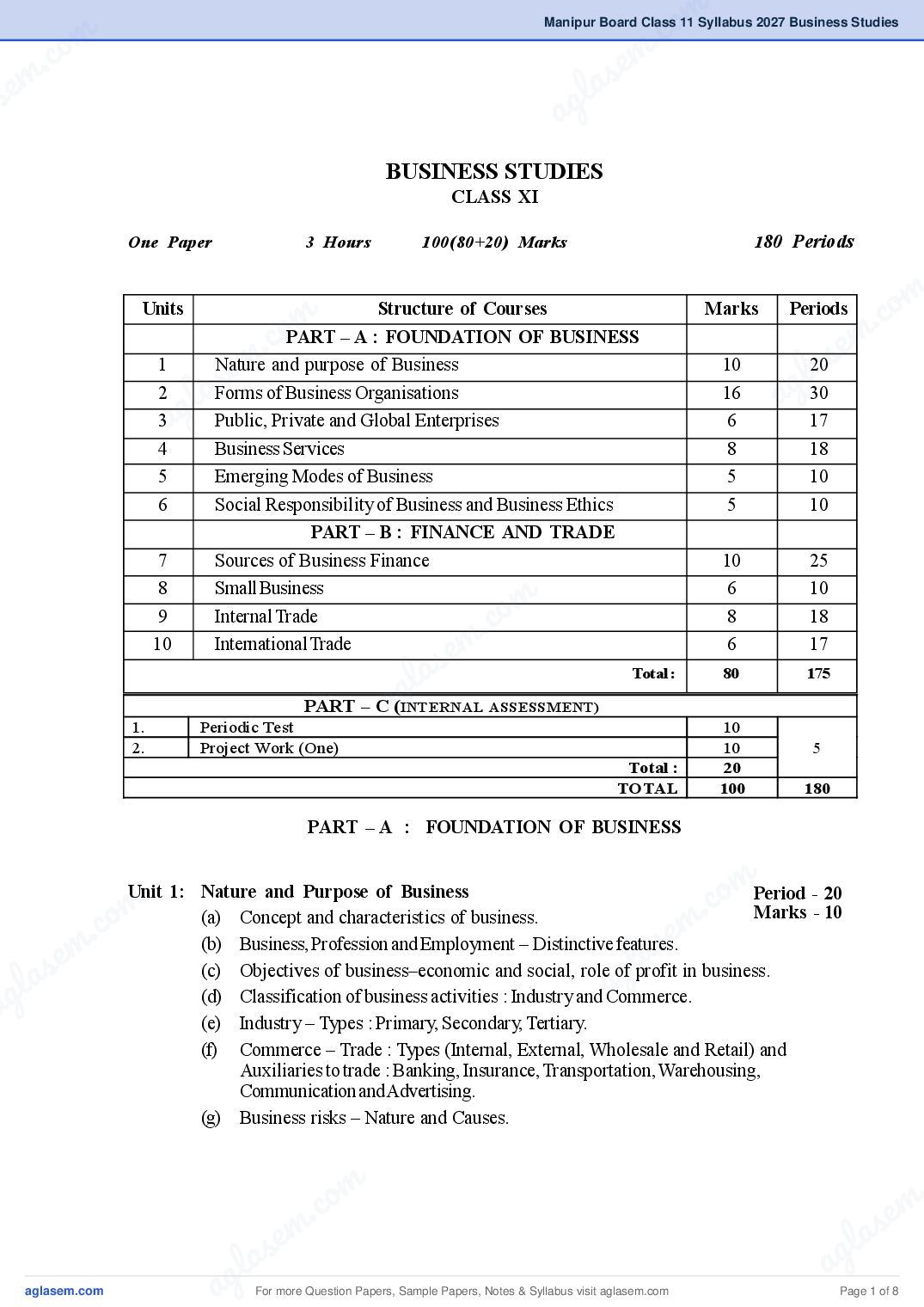
BUSINESS STUDIES
CLASS XI
One Paper 3 Hours 100(80+20) Marks 180 Periods
m
Units
m Structure of Courses Marks Periods
.co
m .coPART – A : FOUNDATION OF BUSINESS
s e m
1
e
Nature and purpose of Business
s
10
l a
20
2
g l aForms of Business Organisations 16 ag 30
3a Public, Private and Global Enterprises 6 17
4 Business Services 8 18
5 Emerging Modes of Business 5 10
6 Social Responsibility of Business and Business Ethics 5 10
PART – B : FINANCE AND TRADE
7 Sources of Business Finance 10 25
8 Small Business 6 10
m
9 Internal Trade
.co 8 18
10 International Trade
s em 6 17
g la Total : 80 175
PART – Ca(INTERNAL ASSESSMENT)
1. Periodic Test 10
2. Project Work (One) 10 5
Total : 20
TOTAL 100 180
PART – A : FOUNDATION OF BUSINESS
m
.co
Unit 1: Nature and Purpose of Business Period - 20
m
.co
Marks - 10
(a) Concept and characteristics of business.
e m
e m (b) Business, Profession and Employment – Distinctive features.
l as
las g
(c) Objectives of business–economic and social, role of profit in business.
a
ag (d) Classification of business activities : Industry and Commerce.
(e) Industry – Types : Primary, Secondary, Tertiary.
(f) Commerce – Trade : Types (Internal, External, Wholesale and Retail) and
Auxiliaries to trade : Banking, Insurance, Transportation, Warehousing,
Communication and Advertising.
(g) Business risks – Nature and Causes.
m .
.co s e m
s em l a
g la ag
a For more Question Papers, Sample Papers, Notes & Syllabus visit Page 1 of 8
Page 3
(a) Sole proprietorship : Meaning, Features, Merits and Limitations. Marks - 16
(b) Partnership : Meaning, Features, Merits and Limitations, Types of partnership and types
of partners, Registration of a partnership firm, Partnership deed.
(c) Cooperative Societies : Features, Merit and Limitations, Types.
(d) Company : Private Company, Public Company – Features, Merits and Limitations.
(e) Formation of a Company : Stages – Promotion, Incorporation and Commencement of
Business.
(f) Starting a Business – Basic factors.
Unit 3: Public, Private and Global Enterprises Period - 17
(a) Private Sector and Public Sector. Marks - 6
(b) Form of Public Sector Enterprises : Departmental Undertakings, Statutory Corporation,
Government Company (Features, Merits and Limitation)
(c) Global enterprises, Public and Private Partnership – Features.
Unit 4: Business Services Period - 18
Marks - 8
(a) Banking : Types of Bank Accounts – Saving, Current, Recurring, Fixed deposit accounts.
(b) Banking Services with particular reference to – Issue of Bank Draft, Banker’s cheque
(pay order), RTGS (Real Time Gross Settlement) NEFT (National Electronic Funds
Transfer), Bank overdraft, Cash Credit, SMS alerts.
(c) E-Banking.
(d) Insurance : Principles, Concept of Life, Health, Fire and Marine insurance.
(e) Postal and Telecom Services : Main (UPC, Registered Post, Parcel Speed Post, Courier)
and Saving services (Recurring Deposit, NSCs, KVP, PPF, MIS).
Unit 5: Emerging Modes of Business Period - 10
Marks - 5
E-Business – Scope and Benefits, Resources required for successful e-business
implementation, Online transactions, Payment mechanism, Security and Safety of business
transactions.
Unit 6: Social Responsibility of Business and Business Ethics Period - 10
(a) Concept of social responsibility. Marks - 5
(b) Case of social responsibility.
(c) Responsibility towards Investors, Consumers, Employees, Government and Community.
(d) Environmental protection and Business.
(e) Business ethics – Concept and elements.
For more Question Papers, Sample Papers, Notes & Syllabus visit Page 2 of 8
Page 4
m .co
m .co s e m
se g l a
a
PART – B : FINANCE AND TRADE
Unit 7: Sources of Business Finance Period - 25
(a) Concept of Business Finance. Marks - 10
(b) Owner’s Funds – Equity Shares, Preference Shares and Retained Earnings.
(c) Borrowed funds – Debentures and Bonds, Loan from Financial Institutions, Loans from
m
m
Commercial banks, Public Deposits, Trade Credits, ICD (Inter Corporate Deposits).
.co
.co
Unit 8: Small Business
s e m Period - 10
s em l a
gMedium
Marks - 6
l a
(a) Small Scale Enterprises – As defined by MSMED Act 2006 (Micro, Small anda
ag (b) Enterprises Development Act).
Role of small business in India – With special reference to Rural Areas
(c) Government schemes and Agencies for Small Scale Industries : NSIC (National Small
Industries Corporation) and DIC (District Industries Centre) With special reference
to Rural & Hill Areas.
Unit 9: Internal Trade Period - 18
Marks - 8
(a) Services of a Wholesaler and Retailer.
m
(b)
.co
Types of Retail Trade – Itinerants and Small Scale Fixed shops.
m
(c)
e
Large Scale Retailers – Departmental stores, Chain Stores, Mail Order Business.
s
(d)
la
Concept of Automatic Vending Machine.
g
(e)
(f)
a
Chambers of Commerce and Indusry : Basic Functions
Main Documents used in Internal Trade : Proforma Invoice, Invoice, Debit Note, Credit
Note, LR (Lorry Receipt), RR (Railway Receipt).
(g) Terms of Trade : COD Cash on Delivery), FOB (Fee on Board), CIF (Cost Insurance
and Freight), E & OE (Errors and Omissions Excepted).
Unit 10: International Trade Period - 17
(a) Concept and problems of International Trade. Marks - 6
(b) Export Import Procedure and Documents.
m
m (c) Role of WTO.
c. oPRESCRIBED TEXTBOOK : m.co
m s e
s e 1. Comprehensive Business Studies (for Class XI)
g l a
g la By: S.A. Siddiqui a
a Published by: Laxmi Publications (P) Ltd., New Delhi
REFERENCE BOOK :
1. Business Studies (For Class XI)
By: Poonam Gandhi
Published by : V.K. (India) Enterprises, New Delhi.
——§§§——
m .
.co s e m
s em l a
g la ag
a For more Question Papers, Sample Papers, Notes & Syllabus visit Page 3 of 8
Page 5
QUESTION PAPER
Subject : BUSINESS STUDIES
Paper : Theory
Class : XI
Full Mark : 100(80+20)
Time : 3 Hours
WEIGHTAGE TO OBJECTIVES:
Objectives Marks Percentage
Knowledge(K) 12 15
I Understanding (U) 44 55
Application (A) 24 30
Total: 80 100
WEIGHTAGE TO FORMS OF QUESTIONS:
FORM OF QUESTIONS No. of questions Time (in minutes) Marks Percentage
Essay/Long Answer (E/LA) 3 74 24 30
II Short Answer Type-I (SA-I) 6 42 24 30
Short Answer Type-II (SA-II) 6 24 12 15
Very Short Answer(VSA) 8 16 8 10
MCQ 12 24 12 15
Total: 35 180 m 80 100
WEIGHTAGE TO CONTENT:
PART- A (FOUNDATION OF BUSINESS) Marks Percentage
1 Nature and purpose of Business 10 12.50
2 Forms of Business Organisation 16 20.00
3 Public, Private and Global Enterprises 6 7.50
4 Business Services 8 10.00
5 Emerging modes of Business 5 6.25
6 Social Responsibility of Business and Business Ethics 5 6.25
PART- B (FINANCE AND TRADE)
7 Source of Business Finance 10 12.50
8 Small Business 6 7.50
III 9 Internal Trade 8 10.00
10 International Trade 6 7.50
Total: 80 100
PART- C (INTERNAL ASSESSMENT)
I. Periodic Test 10
IV
II. Project Work(one) 10
Total 20
V SCHEME OF SECTIONS: NIL
VI SCHEME OF OPTIONS: 50% in SA-I & 100% in Essay/ (LA)Type Questions.
DIFFICULTY LEVEL :
Difficult : 30% of the total marks
VII
Average : 50% of the total marks
Easy : 20% of the total marks
Special Instruction: 1) Two questions of MCQ will be assertion-reason type question.
2) One question of SA-I will be source based question
Abbreviation: K(Knowledge), U(Understanding), A(Application),S(Skill), E(Essay Type),
SA(Short Answer Type), VSA(Very Short Answer Type), O(Objective Type).
MCQ (Multiple Choice Question).
For more Question Papers, Sample Papers, Notes & Syllabus visit Page 4 of 8
Page 6
m .co
m .co s e m
se g l a
a
PROJECT WORK IN BUSINESS STUDIES FOR CLASS XI
Introduction
The project work in Business studies aims to help students understand the framework within
which the business operates and its interaction with the social, economic, technological and legal
m
.co
environment .
m
.co m
It also aims to empower the teachers to relate all concepts with what is happening around the
s e
ethemhelp of project work, the students are exposed to real world beyond the knowledge
world and the students’ surroundings, making them appear more clear and contextual.
s g l a
l a
With
a
ag to obtain relevant information and decide what matter to keep.
acquired from the classroom, giving them opportunities to refer materials, gather information, analyse
it further
Objectives of Project Work
By undertaking project work in Business Studies , the students will be able :
1. To develop a practical approach by using modern technologies in the field of business and
management.
2. To get an opportunity for exposure to the operational environment in the field of business
management and related services.
m
.co
3. To inculcate skills of team work, problem solving , time management, information collection,
em
analysing and synthesizing relevant information to derive meaningful conclusions.
s
a work and demonstrate his or her capabilities while
4. To get involved in the process of lresearch
g
working independently. a
Guidelines For Teachers
In order to enable students to undertake the projects with confidence, it is very necessary on the part
of the teachers to interact, support, guide, facilitate and encourage students while assigning projects to
them. The teachers should guide the students right from selection of the topic after consultation with
them. Students should be facilitated in terms of providing materials or suggesting websites or
obtaining required permission from business houses, malls for their project.
The following steps are required to be followed:
m
m .co
.co
1. Students must take any one topic during the academic session.
m s em
la
2. The project may be done in a group or individually.
s e 3. The topic should be assigned after discussion with the students g
g la awork.
in the class and should then be
a discussed at every stage of submission of the draft/final project
4. The teacher should encourage students to enhance their self esteem and carry out the project
with joy.
___
m .
.co s e m
s em l a
g la ag
a For more Question Papers, Sample Papers, Notes & Syllabus visit Page 5 of 8
Page 7
(The teacher should help students to identify any one project from the given topics)
I. Project one: Field Visit
1. Visit to a Handricraft unit
The purpose of visiting a Handicraft unit is to understand nature and scope of its business
stake holders involved and other aspects as outlined below:
a. The Raw material and the process used in the business and suppliers of raw
materials
b. The market, the buyers, the middlemen, and the areas covered.
c. Mode of payment to workers , suppliers etc.
d. Working conditions.
e. Modernisation of the process.
f. Facilities, security and training for the staff and workers.
g. Subsidies available.
h. Any other aspect that the teachers deem fit.
2. Visit to an Industry
(The students are required to observe the following)
a. Nature of the business organization.
b. Determination for location of business unit.
c. Form of business enterprise: Sole Proprietorship, Partnership. Undivided Hindu
Family, Joint Stock Company (a Multinational Company).
d. Different stages of Production/process.
e. Auxiliaries involved in process.
f. Workers employed, method of wage payment, training programmes and facilities
available.
g. Social responsibilities discharged towards workers, investors, society, environment
and government.
h. Code of conduct for employers and employees.
i. Capital structure employed-borrowed v/s owned.
j. Quality control, recycling of defective goods.
k. Subsidies available/availed.
l. Safety Measures employed. Working conditions for labour in observation of Labour
Laws.
m. Storage of raw material and finished goods.
n. Transport management for employees, raw material and finished goods.
o. Waste management.
p. Any other observation
3. Visit to a whole sale market: vegetables/ fruits/flowers/grains/garments, etc.
The students are required to observe the following:
a. Sources of merchandise.
b. Local market practices.
c. Any linked-up businesses like transporters, packagers, money landers, agents, etc.
d. Nature of the goods dealt in.
e. Mode of goods dispersed, minimum quantity sold, types of packaging employed.
f. Factors determining the price fluctuations.
g. Seasonal factors (if any) affecting the business.
For more Question Papers, Sample Papers, Notes & Syllabus visit Page 6 of 8
Page 8
m .co
m .co s e m
se g l a
a
h. Weekly / monthly non-working days.
i. Strikes, if any-causes thereof.
j. Mode of payments.
k. Wastage and disposal of dead stock.
l. Nature of price fluctuations, reason thereof.
m
.co
m. Warehousing facilities available/availed.
n.
m
Any other aspect.
.co
1. Visit to a Mall.
s e m
s em l a
laa. Number of floors, shops occupied and unoccupied. ag
The students are required to observe the following:
g
a b. Nature of shops, their ownership status.
c. Nature of goods dealt in: local brands, international brands.
d. Service business shops-spas, gym, saloons, etc.
e. Rented spaces, owned spaces.
f. Different types of promotional schemes.
g. Most visited shops.
h. Special attractions of the Mall-Food court, Gaming zone or Cinema, etc.
i. Innovative facilities.
j.
m
Parking facilities, Teachers may add more to the list.
o
II. Project Two. Project Two: Aids to Trade . c
s em Insurance and gathering information on
la
Taking any one AID TO TRADE, for example
following aspects.
a g
1. History of Insurance Lloyd’s contribution.
2. Development of regulatory Mechanism.
3. Insurance Companies in India.
4. Principles of Insurance.
5. Types of Insurance. Importance of insurance to the businessmen.
6. Benefits of crop, orchards, animal and poultry insurance to the farmers.
o m
m c
. value)
.co
7. Terminologies used (premium, face value, market value, maturity value, surrender
e m
e m
and their meanings.
a s
8. Anecdotes and interesting cases of insurance. Reference of filmsldepicting people
las ag
ag committing fraudulent acts with insurance companies.
9. Careers in Insurance.
Teachers to develop such aspects for other aids to trade.
III. Project Three: A visit to State Emporium
The purpose of this project is that it leads to –
Understand the role of State Emporium in promoting and marketing traditional handicrafts
and handloom products.
m .
.co
Study the variety of products available and their cultural , artistic and economic significance.
s e m
s em
Examine the marketing , pricing, sales promotion strategies adopted by State emporium.
l a
g la ag
a For more Question Papers, Sample Papers, Notes & Syllabus visit Page 7 of 8
Page 9
its growth and economic development.
Understanding how State Emporium support artisans craftsman and small scale industries
through organized retailing.
Understanding the role of vocational skills and abilities on the livelihood of artisans/
craftsman.
Understanding of the entrepreneurial skills and abilities of the artisans/craftsman.
Understanding of the unemployment problem of the state and role of the art and craft of the
state in generating employment opportunities.
Presentation and submission of Project Report
At the end of the stipulated term, each student will prepare and submit his/her project report.
Following essentials are required to be fulfilled for its preparation and submission
1. The total length of the project will be of 25 to 30 pages and it should be handwritten.
2. The project will be presented in a neat folder.
3. The project report will be developed in the following sequence –
a. Cover page should include the Project Title, Student information, school and year.
b. List of contents.
c. Acknowledgements and preface (acknowledging the institution, places visited
and persons who have helped.
d. Introduction.
e. Topic with Suitable Heading
f. Planning and activities done during the project.
g. Conclusions (summarized suggestions or findings, future scope of study.
h. Teacher report/observation.
i. Teachers will initial preface page.
j. The projects will be returned after evaluation. The school may keep the best
projects..
Assessment:
The Marks will be allocated on the following heads:
a. Introduction and Objectives : 2
b. Findings /contents/observations 3
c. Analysis and conclusion 2
d. Viva 3
Total = 10
____
For more Question Papers, Sample Papers, Notes & Syllabus visit Page 8 of 8
Document Details
| Board / Org | Manipur Board |
| Exam | Class 11 |
| Type | Syllabus |
| Pages | 8 |
| Updated | 04 Nov 2026 |