APTET Question Paper with Answers 14 Jun 2018 Paper 2 Social Science (Shift 1)
Finished viewing? Save it for later —
Download APTET Question Paper with Answers 14 Jun 2018 Paper 2 Social Science (Shift 1) (PDF · 67 pages)About APTET Question Paper with Answers 14 Jun 2018 Paper 2 Social Science (Shift 1)
APTET Question Paper with Answers 14 Jun 2018 Paper 2 Social Science (Shift 1) is available here for free download. Published by Andhra Pradesh Exams for Andhra Pradesh Teacher Eligibility Test, this question paper can be viewed online or downloaded as a PDF (67 pages). Candidates preparing for Andhra Pradesh Teacher Eligibility Test can use APTET Question Paper with Answers 14 Jun 2018 Paper 2 Social Science (Shift 1) to understand the exam pattern, the type of questions asked, and the overall difficulty level.
Frequently Asked Questions
How can I download APTET Question Paper with Answers 14 Jun 2018 Paper 2 Social Science (Shift 1)?
Open this page and click the Download button to save APTET Question Paper with Answers 14 Jun 2018 Paper 2 Social Science (Shift 1) as a PDF. It is completely free on AglaSem Docs.
Is APTET Question Paper with Answers 14 Jun 2018 Paper 2 Social Science (Shift 1) free to download?
Yes. APTET Question Paper with Answers 14 Jun 2018 Paper 2 Social Science (Shift 1) can be viewed online and downloaded as a PDF free of cost on AglaSem Docs.
How many pages does APTET Question Paper with Answers 14 Jun 2018 Paper 2 Social Science (Shift 1) have?
APTET Question Paper with Answers 14 Jun 2018 Paper 2 Social Science (Shift 1) contains 67 pages, which you can read online or download together as a single PDF.
Where can I find more Andhra Pradesh Teacher Eligibility Test study material?
You can find more Andhra Pradesh Teacher Eligibility Test question papers, sample papers, syllabus, and answer keys on AglaSem Docs.
APTET Question Paper with Answers 14 Jun 2018 Paper 2 Social Science (Shift 1) – Text
Read the full text of this question paper below — useful to quickly search, copy and reference the content online without downloading the PDF.
📄 View text version (58 pages)
Page 1
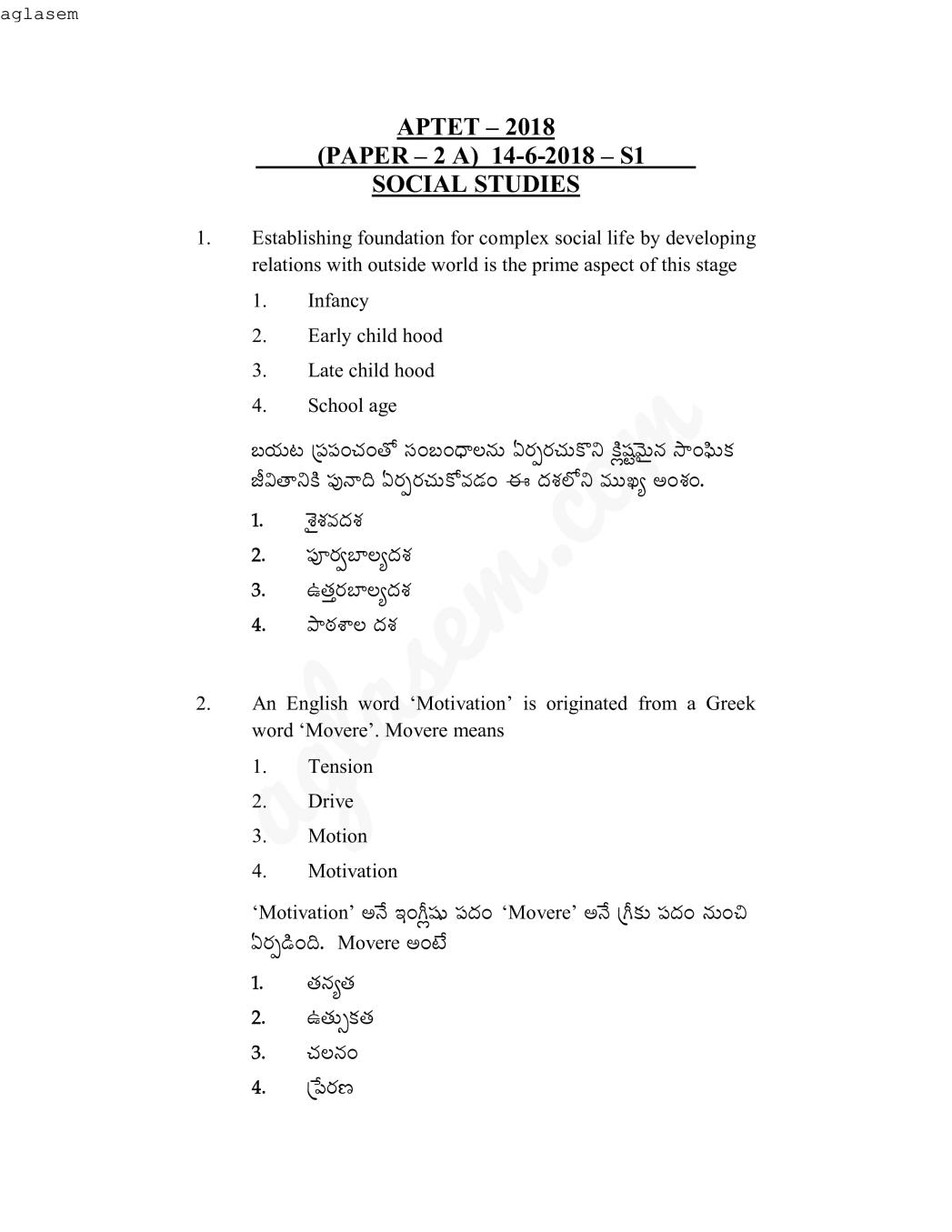
(PAPER – 2 A) 14-6-2018 – S1
SOCIAL STUDIES
1. Establishing foundation for complex social life by developing
relations with outside world is the prime aspect of this stage
1. Infancy
2. Early child hood
3. Late child hood
4. School age
2. An English word ‘Motivation’ is originated from a Greek
word ‘Movere’. Movere means
1. Tension
2. Drive
3. Motion
4. Motivation
‘Motivation’ ‘Movere’
Movere
Page 2
1. Collaborative learning
2. Observational learning
3. Co-operative learning
4. Conditional learning
4. Higher order objective in the affective domain is
1. Responding
2. Valuing
3. Receiving
4. Characterisation
Page 3
for his problem by analyzing it with the help of counsellor
1. Directive counselling
2. Non-Directive counselling
3. Eclectic counselling
4. Personal counselling
6. In experimental method, the variable which is under the
control of experimenter is
1. Independent variable
2. Dependent variable
3. Intervening variable
4. Experimental variable
Page 4
the reason is
1. Transfer of learning
2. Pro-active inhibition
3. Retroactive inhibition
4. Pygmalion effect
8. A person attained good personality by developing socially
accepted values is his
1. Mental development
2. Emotional development
3. Moral development
4. Social development
Page 5
1. Retention Encoding Retrieval
2. Retention Retrieval Encoding
3. Encoding Retrieval Retention
4. Encoding Retention Retrieval
10. Latha is doing a science experiment. Teacher is giving
reinforcement once in every five minutes, here the
reinforcement schedule is
1. Fixed Ratio Reinforcement
2. Fixed Interval Reinforcement
3. Continuous Reinforcement
4. Variable Reinforcement
Page 6
manages to hold them with his fingers. The developmental
principle here is
1. Development is the process of interaction
2. Development follows uniformity of pattern
3. Development is cumulative
4. Development proceeds from general to specific
12. Abnormal forgetting caused by mental trauma and physical
trauma is called
1. Amnesia
2. Fuge
3. Deja vu
4. Repression
Page 7
evaluation is
1. 10%
2. 40%
3. 20%
4. 50%
14. ‘Fading’ is the method used to
1. Enrich gifted children
2. Make to read partially visually handicapped
3. Improve the behavior of mentally retarded
4. Make deaf & dumb to communicate with sign
language
Page 8
Education are
1. Nursery to 5th class
2. 1st to 8th class
3. 1st to 5th class
4. Nursery to 8th class
16. The socio-cultural factor that affects human development is
1. Religious rituals
2. Food
3. Environment in which person grows
4. Accommodation
Page 9
1. Innate abilities
2. Age
3. Gender difference
4. Health
18. The theory proposed by Carl Rogers is
1. Psycho analytic theory
2. Theory of Hierarchy of needs
3. Experiential learning theory
4. Observational learning theory
Page 10
biscuits to dog. After some period, when the person rattles the
box the dog begins to salivate. Here rattling of box is a
kind of
1. Conditioned response
2. Conditioned stimulus
3. Unconditioned response
4. Unconditioned stimulus
20. The concept of ‘Object Permanence’ occurs in this stage of
Piaget’s cognitive development
1. Formal operational stage
2. Concrete operational stage
3. Sensory motor stage
4. Pre operational stage
Page 11
1. Project work
2. Brain storming
3. Seminars
4. Computer based learning
22. According to Erickson, providing adequate training, sufficient
education and good models to the children of age group
between 6 to 12 years develops this feature in them
1. Industriousness
2. Initiative
3. Identity
4. Autonomy
Page 12
qualities to others is called
1. Identification
2. Projection
3. Displacement
4. Regression
24. Social learning is also called
1. Learning through conditioning
2. Trail and error learning
3. Learning through imitation
4. Insightful learning
Page 13
children is controlled by the rewards they secure
1. Authority and social order maintaining morality
2. Good boy morality
3. Obedience and punishment orientation
4. Naive hedonistic and instrumental orientation
26. Choose the odd one from the following.
1. Experimental method
2. Lecture method
3. Activity method
4. Project method
Page 14
1. Interpersonal intelligence
2. Visual spatial intelligence
3. Intrapersonal intelligence
4. Bodily kinaesthetic intelligence
28. A plan prepared keeping in view of the lessons to be taught
month wise in an academic year is called
1. Unit plan
2. Year plan
3. Period plan
4. Classroom plan
Page 15
because
1. it is located in the central nervous system
2. it controls the amount of body growth
3. it regulates the activities of other endocrine glands
4. it is responsible for the functioning of autonomous
nervous system
30. The difference between learning with or without the support
of others by a child is called
1. Zone of proximal development
2. Social scaffolding
3. Instructional scaffolding
4. Knowledge construction
Page 25
Choose the meaning of ‘peer’ in the given context.
1. A person with a high rank
2. A person with noble ideas
3. A person of equal rank
4. A person who works hard
62. Murthy is a philanthropist.
This sentence says that Murthy:
1. devotes his service or wealth for the love of mankind
2. writes the life histories of famous people
3. abstains from taking alcohol
4. hates the people who spends too much
63. Choose the suffix that can be used to make the past form of
the verb ‘learn’.
1. -t
2. -or
3. -er
4. -ism
Page 26
1. quite
2. exasperatedly
3. vacation
4. terribley
65. Choose the sentence in which the word, ‘fair’ is used as a
noun.
1. She is not fair in this issue.
2. She is a fair lady.
3. She visited a fair yesterday.
4. She received a fair share of property from her father.
66. Raman was mainly interested in acoustics.
Choose the antonym of the word ‘interested’.
1. Uninterested
2. Misinterested
3. Noninterested
4. Ininterested
67. The car broke down in the forest.
Choose the meaning of the phrasal verb ‘ broke down’.
1. Started making noise
2. Stopped working
3. Started moving fast
4. Failed to stop
Page 27
‘Might’ in the above sentence is used to express:
1. purpose
2. uncertainty
3. gentle approach
4. obligation
69. How can we forget ……………. immortal Shakespeare.
Choose the correct article to fill in the blank.
1. a
2. an
3. the
4. no article is needed
70. He is confined ………… bed.
Choose the correct preposition that fits the blank.
1. with
2. to
3. in
4. on
Page 28
In this sentence, the noun clause is used:
1. as the object of an action verb
2. as the subject of the sentence
3. as the complement of the verb ‘be’.
4. as the object of a preposition
72. Choose the sentence that can be used in an informal situation.
1. What is your name?
2. May I know your name?
3. Will you please tell me your name?
4. Please tell me your name.
73. After all, this time you’d think that.
Choose the correct question tag for this sentence.
1. did you ?
2. aren’t you ?
3. didn’t you ?
4. wouldn’t you ?
74. Choose the negative sentence from the following
1. She never drinks milk.
2. I have made it.
3. She will do this work.
4. Why are you late ?
Page 29
Choose the reported speech of the sentence above.
1. Ram said that Sita liked swimming.
2. Ram asked Sita if she liked swimming.
3. Ram told to Sita that he likes swimming.
4. Ram told Sita that he liked swimming.
76. One of the pupils in our class ………… a car.
Choose the correct form of verb that fits the blank.
1. own
2. owns
3. owning
4. have own
77. Listen ! Someone ………… the flute.
Choose the correct tense form that fits the blank.
1. has been play
2. is played
3. is playing
4. has played
Page 30
The part of speech of the word ‘dirty’ is:
1. an adverb
2. an adjective
3. a verb
4. a conjunction
79. Choose the linker that can be used to indicate similarity.
1. On the contrary
2. Still
3. In the same way
4. However
80. The magician made a flower. He used colourful papers.
These two sentences can be combined meaningfully as:
1. The magician made colourful papers to make a flower.
2. The magician made a flower and colourful papers.
3. The magician made a flower with colourful papers.
4. The colourful papers made a flower magically.
81. Choose the grammatically correct sentence from the
following.
1. Naresh does not believe in God.
2. Naresh does not believed in God.
3. Naresh is not believing in the God.
4. Naresh does not believe in the God.
Page 31
1. a full stop
2. a question mark
3. an exclamatory mark
4. a comma
83. The comma is used:
1. to separate two or more words of the same parts of
speech that come together
2. to end a sentence in past tense
3. to mark a quotation
4. to end an interrogative sentence
84. Choose the verb in passive voice from the following.
1. inspect
2. inspects
3. inspected
4. was inspected
85. Rahul Dravid was ………… batsmen in the World.
Choose the correct expression that fits the blank.
1. one of the greater
2. one of the greatest
3. greater than
4. as great as
Page 32
choose to write:
1. a poster
2. a diary
3. a news report
4. a letter
87. Choose the list of words in correct alphabetical order.
1. one, two, three, four
2. four, one, three, two
3. two, one, four, three
4. four, three, two, one
88. The floods inundated their houses.
Choose the synonym of the word ‘inundated’.
1. submerged
2. saved
3. searched
4. opened
Page 33
In his old age, Tyagaraja set out on a pilgrimage. He went to
Tirupathi to have ‘darshan’ of Lord Venkateswara. In the
temple he saw a curtain in front of the image of the Lord. He
could not see the Lord’s image. Then he sang a song
expressing a strong desire to see the Lord. As he sang, the
curtain parted and he had ‘darshan’ of the Lord.
This passage says that;
1. Tyagaraja belonged to Tirupathi.
2. Only old people go to Tirupathi.
3. Tyagaraja visited Tirupathi on his pilgrimage.
4. Lord Venkateswara was on his pilgrimage.
90. Read the following passage and answer the question.
In his old age, Tyagaraja set out on a pilgrimage. He went to
Tirupathi to have ‘darshan’ of Lord Venkateswara. In the
temple he saw a curtain in front of the image of the Lord. He
could not see the Lord’s image. Then he sang a song
expressing a strong desire to see the Lord. As he sang, the
curtain parted and he had ‘darshan’ of the Lord.
Tyagaraja has ‘darshan’ of the Lord:
1. by removing the curtain with his hands
2. by praying to Lord with a song
3. by closing his eyes
4. by opening the door with his hands
Page 34
1. Longitudes
2. Countries
3. Continents
4. Poles
92. Partners in contract farming are
1. Farmers and officials
2. Farmers and banks
3. Farmers and companies
4. Farmers and government
Page 35
1. Authoritarian Government
2. Anarchic Government
3. Monarchy
4. Gana form of Government
94. ‘Megaliths’ are -
1. Temples
2. Burial sites
3. Stupas
4. Viharas
Page 36
1. Pasurams
2. Light music
3. Folk songs
4. Shlokas
96. First Kavya in Sanskrit literature
1. Ramayana
2. Mahabharatha
3. Bhagavatham
4. Shakuntalam
Page 37
oceans every day is known as
1. Waves
2. Floods
3. Currents
4. Tides
98. Industrial Revolution started in this Country.
1. England
2. America
3. Russia
4. India
Page 38
1. Vishnu Kundins
2. Pallavas
3. Cholas
4. Kakatiyas
100. ‘Zabt’ tax was introduced by this minister in Akbar’s court
1. Thodarmal
2. Abul Fazal
3. Birbal
4. Sangrama Singh
Page 39
1. 21 years
2. 19 years
3. 20 years
4. 18 years
102. ‘Palanati Virula Kadha’ was written by
1. Nannayya
2. Thikkana
3. Molla
4. Sreenadha
Page 40
1. Madapati Hanumatha Rao
2. Komarraju Lakshmana Rao
3. Nayani Venkata Ranga Rao
4. Ravichettu Ranga Rao
104. Quit India movement was started in the year
1. 1943
2. 1946
3. 1942
4. 1941
Page 41
associated with
1. Andhra Mahila Sabha
2. Andhra Saraswatha Sabha
3. Andhra Bhasha Sangam
4. Andhra Maha Sabha
106. Even before independence a law was made in this year on
abolition of the forced labour or vetti
1. 1927
2. 1937
3. 1947
4. 1917
Page 42
1. 1943
2. 1945
3. 1944
4. 1946
108. The first woman teacher in India
1. Savithri Bai Phule
2. Pandit Ramabai Saraswathi
3. Tarabai Shinde
4. Begum Rokiya Sakhawat Hussain
Page 43
1. Gussadi
2. Sadir
3. Kuravanji
4. Dhimsa
110. Collection of maps is called as
1. Map drawing
2. Map analysis
3. Study of maps
4. Atlas
Page 44
1. 1855 - 56
2. 1850 - 51
3. 1860 - 61
4. 1870 - 71
112. The birth place of Alluri Sita Rama Raju is
1. Pendurthi
2. Chinthapalli
3. Pandrangi
4. Rampachodavaram
Page 45
children were died at this place
1. Bhopal
2. Mysore
3. Kumbha Konam
4. Visakhapatnam
114. Prohibition of child marriage Act was enacted in the year
1. 2004
2. 2007
3. 2006
4. 2005
Page 46
1. Right against exploitation
2. Right to live
3. Right to freedom
4. Right to equality
116. The inventor of steam Engine
1. James Watt
2. Mc Adam
3. James Bindley
4. Mathew Boulten
Page 47
information on financial matter is,
1. Financial literacy
2. Book keeping
3. Banking
4. Accounting
118. The first co-operative society in the world was established in
this country.
1. England
2. America
3. France
4. Japan
Page 48
after agriculture.
1. Textile industry
2. Jute industry
3. Sugar industry
4. Iron and steel industry
120. Temperate grasslands are also called as
1. Tundras
2. Steppes
3. Taigas
4. Thorny bushes
Page 49
water is called as
1. Sea arches
2. Mushroom rock
3. Sea cliff
4. Inselburg
122. The northern most mountain range in Himalayas
1. Himadri
2. Shivalik
3. Mahabharatha ranges
4. Pir Panjal
Page 50
1. Mumbai
2. Goa
3. Calicut
4. Rann of Kutch
124. Workers work less than their potentiality is known as
1. Total unemployment
2. Under employment
3. Seasonal employment
4. Disguised unemployment
Page 51
1. 1852
2. 1862
3. 1872
4. 1882
126. The density of population per square kilometer in India as per
census 2011
1. 285
2. 382
3. 385
4. 295
127. In 2013, the IPCC conference on climate change was held at
1. London
2. New York
3. Delhi
4. Warsaw
IPCC
Page 52
1. Number of females to males in the country
2. Number of females to males in every village in a
country
3. Number of females per every 100 males in cities in the
country
4. Number of females per every 1000 males in the
country
129. In 1995, the Ford Motors company started its large plant in
India at
1. Chennai
2. Hyderabad
3. Bangalore
4. Trivendram
Page 53
1. Kolkata
2. Mumbai
3. Delhi
4. Chennai
(Census - 2011)
131. ‘Erom Sharmila’ belongs to this state
1. Manipur
2. Nagaland
3. Assom
4. Meghalaya
Page 54
annual temperature will
1. slowly increase
2. remain constant
3. be doubled
4. decrease gradually
133. The country that is called as ‘promised land’
1. Palestine
2. Russia
3. England
4. America
Page 55
‘SEZ’
1. Special Economic Zone
2. Special Education Zone
3. Special Environment Zone
4. Special Enrollment Zone
135. This country was not affected by the economic depression
during 1929-30
1. Germany
2. Russia
3. Japan
4. India
Page 56
1. James Huck
2. Adam Smith
3. Rachel Carson
4. Anil Agarwal
137. Founder of Nazi party
1. Hitler
2. Mussolini
3. Churchill
4. Bismarck
Page 57
1. 1951 - 52
2. 1952 - 53
3. 1954 - 55
4. 1947 - 48
Page 58
the illustrations of these kinds of values respectively
1. Disciplinary value, Cultural value
2. Cultural value, Democratic value
3. Social value, Moral value
4. Moral value, Political value
1.
2.
3.
4.
Page 59
for National Symbols’ are the specification of these
objectives
1. Interest, Attitude
2. Knowledge, Application
3. Application, Skill
4. Creativity, Understanding
1.
2.
3.
4.
Page 60
data sources like news papers, periodicals and other library
material etc. This is related to this objective
1. Appreciation
2. Knowledge
3. Skill
4. Understanding
1.
2.
3.
4.
Page 61
down the curriculum, the academic authority shall take into
consideration of the following
1. All round development of the child
2. Building up child’s knowledge, potentiality and talent
3. Conformity with the values enshrined in the
constitution
4. Development of physical and mental abilities of the
child to the fullest extent
(a)
1.
2.
3.
4.
Page 62
this,
1. The term sociology should be used in place of Social
Science
2. The term Social Science should be used in place of
Sociology
3. The term Civics should be used in place of Political
Science
4. The term Political Science should be used in place of
Civics
1.
2.
3.
4.
144. One of the following statements is not true
1. Curriculum provides a base for a course of study
2. Curriculum is the part of syllabus
3. Syllabus includes the content of what is to be taught
4. Curriculum is the plan for the implementation of
educational aims
1.
2.
3.
4.
Page 63
Water falls to 9th class students. It comes under this kind of
learning experiences
1. Direct experience
2. Indirect experience
3. Vicarious experience
4. Both direct and indirect experiences
1.
2.
3.
4.
146. “Learning without Burden” – recommended by
1. Kothari Commission
2. Prof. Yashpal Committee
3. Secondary Education Commission
4. NPE - 1986
1.
2.
3.
4. NPE - 1986
Page 64
related to
1. Albert Bandura, Piaget
2. Jerome Burner, John Dewey
3. Jerome Bruner, Albert Bandura
4. Albert Bandura, Jerome Bruner
1.
2.
3.
4.
148. One of the following is related to collaborative learning
1. Doing homework
2. Learning through exploration
3. Solitary play
4. Watching T.V.
1.
2.
3.
4.
Page 65
A. Both the terms ‘Test’ and ‘Measurement’ are
synonyms
B. There is a difference between Test and Measurement
C. When the work of testing ends, measurement comes
into picture for assessing numerical values to the
results
1. A, B & C
2. A & C only
3. B & C only
4. A & B only
A.
B.
C.
1. A, B C
2. A&C
3. B&C
4. A&B
Page 66
1. Historical resources, Economic resources
2. Economic resources, Historical resources
3. Both Historical resources
4. Both Economic resources
1.
2.
3.
4.
Page 67
Paper-II(A) - Telugu Medium-Set-H (S.S) 14.06.2018 Morning Session
Q.Nos CDP Q.Nos Telugu Q.Nos English Q.Nos Social Q.Nos Social
1 2 31 2 61 3 91 4 121 3
2 3 32 4 62 1 92 3 122 1
3 3 33 1 63 1 93 4 123 4
4 4 34 3 64 4 94 2 124 2 or 4
5 2 35 1 65 3 95 1 125 3
6 1 36 3 66 1 96 1 126 2
7 1 37 4 67 2 97 4 127 4
8 3 38 2 68 2 98 1 128 4
9 4 39 4 69 3 99 4 129 1
10 2 40 1 70 2 100 1 130 3
11 4 41 3 71 3 101 4 131 1
12 1 42 2 72 1 102 4 132 4
13 2 43 2 73 4 103 1 133 1
14 3 44 3 74 1 104 3 134 1
15 2 45 1 75 4 105 4 135 2
16 1 46 3 76 2 106 1 136 3
17 1 47 1 77 3 107 2 137 1
18 3 48 2 78 2 108 1 138 1
19 2 49 4 79 3 109 4 139 2
20 3 50 1 80 3 110 4 140 1
21 4 51 3 81 1 111 1 141 3
22 1 52 1 82 2 112 3 142 3
23 2 53 2 83 1 113 3 143 4
24 3 54 3 84 4 114 3 144 2
25 4 55 1 85 2 115 1 145 1
26 2 56 2 86 4 116 1 146 2
27 3 57 1 87 2 117 1 147 4
28 2 58 2 88 1 118 1 148 2
29 3 59 1 89 3 119 1 149 3
30 1 60 3 90 2 120 2 150 1
Document Details
| Board / Org | Andhra Pradesh Exams |
| Exam | Andhra Pradesh Teacher Eligibility Test |
| Type | Question Paper |
| Pages | 67 |
| Updated | 09 Jun 2026 |