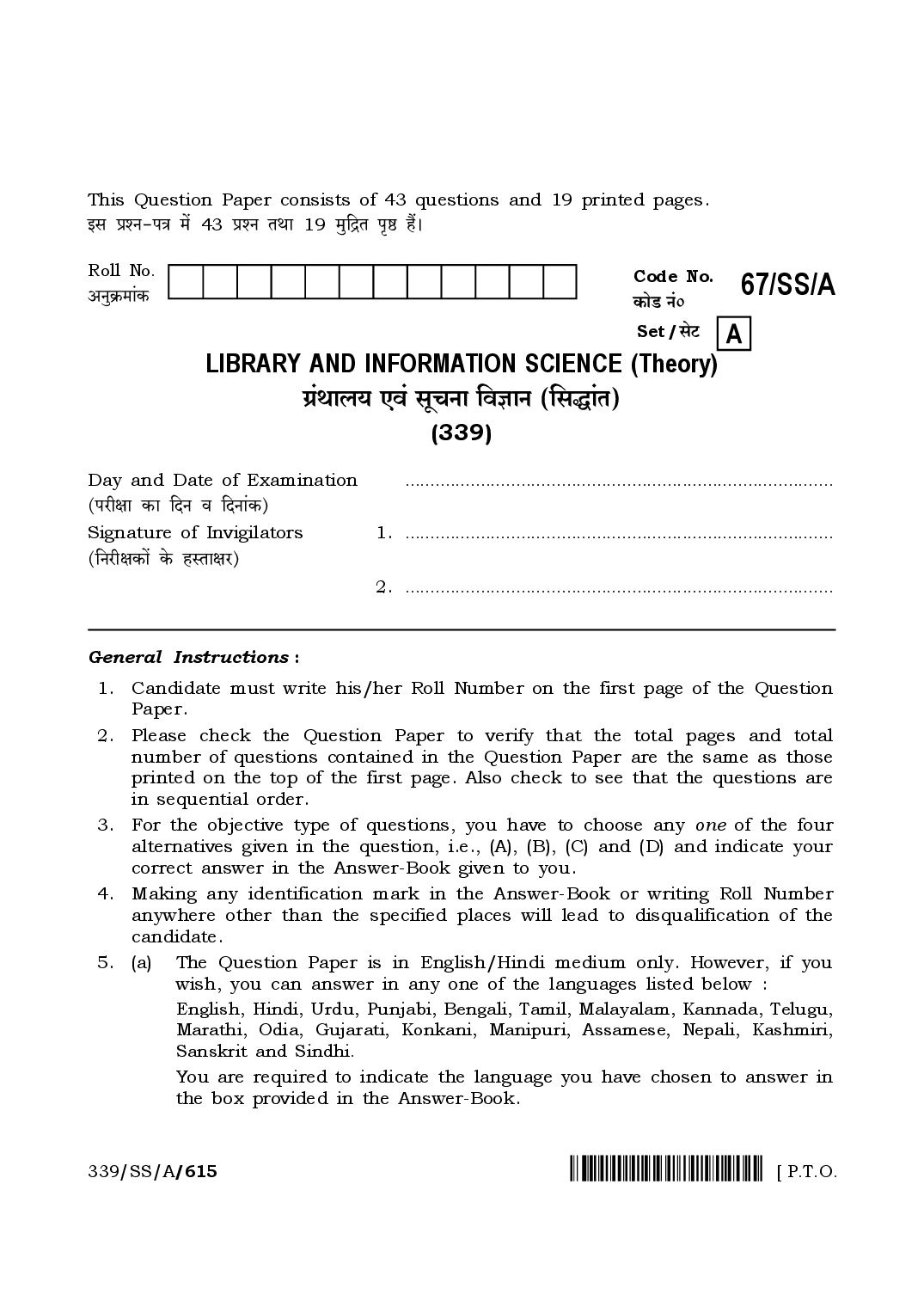
NIOS Class 12 April 2024 Question Paper Library and Information Science
Finished viewing? Save it for later —
Download NIOS Class 12 April 2024 Question Paper Library and Information Science (PDF · 19 pages)About NIOS Class 12 April 2024 Question Paper Library and Information Science
NIOS Class 12 April 2024 Question Paper Library and Information Science is available here for free download. Published by NIOS for National Institute of Open Schooling Class 12, this question paper can be viewed online or downloaded as a PDF (19 pages). Candidates preparing for National Institute of Open Schooling Class 12 can use NIOS Class 12 April 2024 Question Paper Library and Information Science to understand the exam pattern, the type of questions asked, and the overall difficulty level.
Frequently Asked Questions
How can I download NIOS Class 12 April 2024 Question Paper Library and Information Science?
Open this page and click the Download button to save NIOS Class 12 April 2024 Question Paper Library and Information Science as a PDF. It is completely free on AglaSem Docs.
Is NIOS Class 12 April 2024 Question Paper Library and Information Science free to download?
Yes. NIOS Class 12 April 2024 Question Paper Library and Information Science can be viewed online and downloaded as a PDF free of cost on AglaSem Docs.
How many pages does NIOS Class 12 April 2024 Question Paper Library and Information Science have?
NIOS Class 12 April 2024 Question Paper Library and Information Science contains 19 pages, which you can read online or download together as a single PDF.
Where can I find more National Institute of Open Schooling Class 12 study material?
You can find more National Institute of Open Schooling Class 12 question papers, sample papers, syllabus, and answer keys on AglaSem Docs.
NIOS Class 12 April 2024 Question Paper Library and Information Science – Text
Read the full text of this question paper below — useful to quickly search, copy and reference the content online without downloading the PDF.
📄 View text version (19 pages)
Page 1
Bg àíZ-nÌ ‘| 43 àíZ VWm 19 ‘w{ÐV n¥ð> h¢&
Roll No. Code No.
AZwH«$‘m§H$ 67/SS/A
u
H$moS> Z§0
Set / goQ>
LIBRARY AND INFORMATION SCIENCE (Theory)
J«§Wmb¶ Ed§ gyMZm {dkmZ ({gÕm§V)
(339)
Day and Date of Examination .....................................................................................
(narjm H$m {XZ d {XZm§H$)
Signature of Invigilators 1. .....................................................................................
({ZarjH$m| Ho$ hñVmja)
2. .....................................................................................
General Instructions :
1. Candidate must write his/her Roll Number on the first page of the Question
Paper.
2. Please check the Question Paper to verify that the total pages and total
number of questions contained in the Question Paper are the same as those
printed on the top of the first page. Also check to see that the questions are
in sequential order.
3. For the objective type of questions, you have to choose any one of the four
alternatives given in the question, i.e., (A), (B), (C) and (D) and indicate your
correct answer in the Answer-Book given to you.
4. Making any identification mark in the Answer-Book or writing Roll Number
anywhere other than the specified places will lead to disqualification of the
candidate.
5. (a) The Question Paper is in English/Hindi medium only. However, if you
wish, you can answer in any one of the languages listed below :
English, Hindi, Urdu, Punjabi, Bengali, Tamil, Malayalam, Kannada, Telugu,
Marathi, Odia, Gujarati, Konkani, Manipuri, Assamese, Nepali, Kashmiri,
Sanskrit and Sindhi.
You are required to indicate the language you have chosen to answer in
the box provided in the Answer-Book.
339/SS/A/615 [ P.T.O.
Page 2
English, the responsibility for any errors/mistakes in understanding the
question will be yours only.
6. Candidate will not be allowed to take Calculator, Mobile Phone, Bluetooth,
Earphone or any such electronic devices in the Examination Hall.
7. In case of any doubt or confusion in the Question Paper, the English version
will prevail.
8. Write your Question Paper Code No. 67/SS/A, Set u on the Answer-Book.
gm‘mݶ AZwXoe …
1. narjmWu àíZ-nÌ Ho$ nhbo n¥ð> na AnZm AZwH«$‘m§H$ Adí¶ {bI|&
2. H¥$n¶m àíZ-nÌ H$mo Om±M b| {H$ àíZ-nÌ Ho$ Hw$b n¥ð>m| VWm àíZm| H$s CVZr hr g§»¶m h¡ {OVZr àW‘ n¥ð> Ho$
g~go D$na N>nr h¡& Bg ~mV H$s Om±M ^r H$a b| {H$ àíZ H«${‘H$ ê$n ‘| h¢&
3. dñVw{Zð> àíZm| _o§ AmnH$mo Mma {dH$ënm| (A), (B), (C) VWm (D) _| go H$moB© EH$ CÎma MwZZm h¡ VWm Xr JB©
CÎma-nwpñVH$m _| Amn ghr CÎma {bI|Ÿ&
4. CÎma-nwpñVH$m ‘| nhMmZ-{M• ~ZmZo AWdm {Z{X©ï> ñWmZm| Ho$ A{V[aº$ H$ht ^r AZwH«$‘m§H$ {bIZo na narjmWu H$mo
A¶mo½¶ R>ham¶m Om¶oJm&
5. (H$) n«íZ-nÌ Ho$db A§J«oOr/{hÝXr ‘mܶ‘ ‘| h¡& {’$a ^r, ¶{X Amn Mmh| Vmo ZrMo Xr JB© {H$gr EH$ ^mfm ‘|
CÎma Xo gH$Vo h¢ …
A§J«oOr, {hÝXr, CXÿ©, n§Om~r, ~§Jbm, V{‘b, ‘b¶mb‘, H$Þ‹S>, VobwJy, ‘amR>r, C{‹S>¶m, JwOamVr, H$m|H$Ur,
‘{Unwar, Ag{‘¶m, Zonmbr, H$í‘rar, g§ñH¥$V Am¡a {gÝYr&
H¥$n¶m CÎma-nwpñVH$m ‘| {XE JE ~m°³g ‘| {bI| {H$ Amn {H$g ^mfm ‘| CÎma {bI aho h¢&
(I) ¶{X Amn {hÝXr Ed§ A§J«oOr Ho$ A{V[aº$ {H$gr Aݶ ^mfm ‘| CÎma {bIVo h¢, Vmo àíZm| H$mo g‘PZo ‘| hmoZo dmbr
Ìw{Q>¶m|/Jb{V¶m| H$s {Oå‘oXmar Ho$db AmnH$s hmoJr&
6. narjmWu H$mo narjm hm°b ‘| H¡$ëHw$boQ>a, ‘mo~mBb ’$moZ, ãbwQy>W, B¶a’$moZ O¡go {H$gr ^r Bbo³Q´>m°{ZH$ CnH$aU H$mo
bo OmZo H$s AZw‘{V Zht h¡&
7. àíZ-nÌ ‘| {H$gr ^r àH$ma Ho$ g§Xoh AWdm Xþ{dYm H$s pñW{V ‘| A§J«oOr AZwdmX hr ‘mݶ hmoJm&
8. AnZr CÎma-nwpñVH$m na àíZ-nÌ H$s H$moS> g§»¶m 67/SS/A, goQ u {bI|&
339/SS/A/615 2
Page 3
J«§Wmb¶ Ed§ gyMZm {dkmZ ({gÕm§V)
(339)
Time : 3 Hours ] [ Maximum Marks : 80
g‘¶ … 3 KÊQ>o ] [ nyUmªH$ … 80
Note : (i) This Question Paper consists of 43 questions in all.
(ii) All questions are compulsory.
(iii) Marks are given against each question.
(iv) Section—A consists of
(a) Q. Nos. 1 to 16—Multiple-choice questions (MCQs) carry 1 mark
each. Select and write the most appropriate option out of the four
options given in each of these questions. An internal choice has
been provided in some of these questions. You have to attempt only
one of the given choices in such questions.
(b) Q. Nos. 17 to 28—Objective-type questions. Q. Nos. 17 to 28 carry
2 marks each (few questions with 2 sub-parts of 1 mark each).
(v) Section—B consists of
(a) Q. Nos. 29 to 36—Very short answer-type questions carrying
2 marks each to be answered in the range of 30 to 50 words.
(b) Q. Nos. 37 to 40—Short answer-type questions carrying 3 marks
each to be answered in the range of 50 to 80 words.
(c) Q. Nos. 41 to 43—Long answer-type questions carrying 4 marks
each to be answered in the range of 80 to 120 words.
(d) Answer the questions from either Optional Module—A or Optional
Module—B.
{ZX}e … (i) Bg àíZ-nÌ ‘| Hw$b 43 àíZ h¢&
(ii) g^r àíZ A{Zdm¶© h¢&
(iii) à˶oH$ àíZ Ho$ gm‘Zo CgHo$ A§H$ {XE JE h¢&
(iv) IÊS>-H$
(a) à0 g§0 1 go 16 VH$ ~hþ-{dH$ënr¶ àíZ h¡§, à˶oH$ H$m 1 A§H$ h¡&
BZ‘o go à˶oH$ àíZ ‘| {XE JE Mma {dH$ënm| ‘o§ go g~go Cn¶yº$ {dH$ën H$mo MwZH$a {b{IE&
Hw$N> àíZm| ‘| Am§V[aH$ {dH$ën {X¶m J¶m h¡& AmnH$mo CZ‘| go {H$gr EH$ H$mo hb H$aZm h¡&
339/SS/A/615 3 [ P.T.O.
Page 4
2 Cn-^mJm| g{hV)
(v) IÊS>-I
(a) à0 g§0 29 go 36 VH$ A{V bKw-CÎmar¶ àíZ h¢& à˶oH$ Ho$ 2 A§H$ h¢, à˶oH$ H$m CÎma
30 go 50 eãXmo§ ‘o§ X|&
(b) à0 g§0 37 go 40 VH$ bKw-CÎmar¶ àíZ h¢& à˶oH$ Ho$ 3 A§H$ h¢& à˶oH$ H$m CÎma
50 go 80 eãXmo§ ‘o§ X|&
(c) à0 g§0 41 go 43 VH$ XrK©-CÎmar¶ àíZ h¢ à˶oH$ Ho$ 4 A§H$ h¢& à˶oH$ H$m CÎma
80 go 120 eãXm| ‘o§ X|&
(d) d¡H$pënH$ ‘m°S²>¶yb A AWdm d¡H$pënH$ ‘m°S²>¶yb B Ho$ àíZm| Ho$ CÎma X|&
(1) Answers of all questions are to be given in the Answer-Book given to you.
g^r àíZm| Ho$ CÎma AmnH$mo Xr JB© CÎma-nwpñVH$m ‘| hr {bI|&
(2) 15 minute time has been allotted to read this question paper. The question
paper will be distributed at 2:15 p.m. From 2:15 p.m. to 2:30 p.m., the
students will read the question paper only and will not write any answer
on the Answer-Book during this period.
Bg àíZ-nÌ H$mo n‹T>Zo Ho$ {bE 15 {‘ZQ> H$m g‘¶ {X¶m J¶m h¡& àíZ-nÌ H$m {dVaU Xmonha ‘|
2:15 ~Oo {H$¶m OmEJm& Xmonha 2:15 ~Oo go 2:30 ~Oo VH$ N>mÌ Ho$db àíZ-nÌ H$mo n‹T>|Jo Am¡a
Bg Ad{Y Ho$ Xm¡amZ do CÎma-nwpñVH$m na H$moB© CÎma Zht {bI|Jo&
SECTION—A
IÊS>–H$
1. Who is known as the father of Library Science in India? 1
(A) Prof. B. S. Kesavan (B) Dr. Velaga Venkatappaiah
(C) Dr. P. N. Kaula (D) Dr. S. R. Ranganathan
J«§Wmb¶ {dkmZ H$m OZH$ {H$go ‘mZm OmVm h¡?
(A) àmo0 ~r0 Eg0 Ho$gdZ (B) S>m°0 dobmJm d|H$Q>ßn¡¶m
(C) S>m°0 nr0 EZ0 H$m¡bm (D) S>m°0 Eg0 Ama0 a§JZmWZ
Or / AWdm
‘‘Every Book its Reader’’ is
(A) the First Law (B) the Second Law
(C) the Third Law (D) the Fourth Law
339/SS/A/615 4
Page 5
(A) àW‘ gyÌ (B) Xÿgam gyÌ
(C) Vrgam gyÌ (V¥Vr¶ gyÌ) (D) MVwW© gyÌ
2. The book, Five Laws of Library Science was published in
(A) 1929 (B) 1930
(C) 1931 (D) 1932 1
Five Laws of Library Science Zm‘H$ nwñVH$ H$~ àH$m{eV H$s JB©?
(A) 1929 (B) 1930
(C) 1931 (D) 1932
Or / AWdm
The _____ implies that the library be kept open for as long as it is possible.
(A) First Law (B) Second Law
(C) Third Law (D) Fourth Law
_____ gyÌ ‘| ¶h {Z{hVmW© h¡ {H$ Ohm± VH$ gå^d hmo gHo$ J«§Wmb¶ A{YH$ go A{YH$ g‘¶ Ho$ {bE
Imobo OmE±&
(A) àW‘ gyÌ (B) {ÛVr¶ gyÌ
(C) V¥Vr¶ gyÌ (D) MVwW© gyÌ
3. _____ verifies the collected information for its validity, reliability and
accuracy before dissemination. 1
(A) Information Analysis Centre (B) Clearing House
(C) Data Bank (D) Data Centre
_____ g§J«{hV gyMZmAm| H$s d¡YVm, {dídgZr¶Vm Am¡a ewÕVm H$m ‘yë¶m§H$Z àgma go nhbo
H$aVm h¡&
(A) gyMZm {díbofU H|$Ð (B) p³b¶[a¨J hmCg
(C) S>mQ>m ~¢H$ (D) S>mQ>m H|$Ð
4. The functions of the library are collection, processing, storage,
retrieval and _____. 1
(A) dissemination (B) socialization
(C) polarization (D) liberalization
339/SS/A/615 5 [ P.T.O.
Page 6
(A) àgma (B) g‘mOrH$aU
(C) Y«wdrH$aU (D) CXmarH$aU
5. A _____ library staff should have adequate professional knowledge and be
active to serve their reader in an efficient and effective manner. 1
(A) referral (B) reference
(C) circulation (D) periodical
_____ ‘| H$m¶©aV J«§Wmb¶ Ho$ H$m{‘©H$m| H$mo n¶m©á ì¶dgm{¶H$ kmZ Ho$ gmW-gmW nyU© g{H«$¶ hmoH$a
nmR>H$m| H$s BpÀN>V Amdí¶H$VmAm| H$mo à^mdnyU© Ed§ Hw$ebVmnyU© T>§J go nyam H$aZm Mm{hE&
(A) g§àofU (B) g§X^© (godmAm|)
(C) àgma (D) Amd{YH$
6. The secondary sources are based on _____ sources. 1
(A) internet (B) primary
(C) multi-volume (D) audio-visual
{ÛVr¶H$ òmoV _____ òmoVm| na {Z^©a hmoVo h¢&
(A) B§Q>aZoQ> (B) àmW{‘H$
(C) ~hþ-I§S>r¶ (D) Ñí¶-lì¶
Or / AWdm
A book is a written or published document of at least _____ text pages.
(A) 46 (B) 47
(C) 48 (D) 49
EH$ nwñVH$ {b{IV ¶m àH$m{eV àboI h¡ {Og‘| H$‘-go-H$‘ _____ nmR> Ho$ n¥ð> hm|&
(A) 46 (B) 47
(C) 48 (D) 49
7. The process of examining the library’s holdings to identify missing items
in the collection is referred to as _____. 1
(A) stock weeding (B) stock clearance
(C) stock verification (D) stock acquisition
Jw‘ hþB© ‘Xm| H$mo Ty>‹T>Zo Ho$ {bE J«§Wmb¶ Ho$ g§J«h H$m ì¶dpñWV T>§J go {ZarjU H$aZo H$mo _____
H$hVo h¢&
(A) g§J«h N>±Q>Zr (B) g§J«h {ZH$mgr
(C) g§J«h g˶mnZ (D) g§J«h A{YJ«hU
339/SS/A/615 6
Page 7
(A) Preservation (B) Acquisition
(C) Weeding (D) Verification
_____ à{H«$¶m H$bmH¥${V¶m| VH$ nhþ±M ~ZmE aIZo ¶m CÝh| nwZ:ñWm{nV H$aZo go g§~§{YV h¡&
(A) g§ajH$ (B) A{YJ«hU
(C) N>±Q>Zr (D) g˶mnZ
9. _____ is the act of removing library books which are no longer useful in
the library. 1
(A) Acquisition (B) Weeding
(C) Stock verification (D) Stock clearance
_____ à{H«$¶m J«§Wmb¶ ‘| AZwn¶moJr nwñVH$m| H$mo g§J«h go ~mha H$aZo H$s h¡&
(A) A{YJ«hU (B) N>±Q>Zr
(C) g§J«h g˶mnZ (D) g§J«h {ZH$mgr
10. _____ is especially beneficial for journalists and specialized writers to
contribute to current affairs in any field. 1
(A) Current Awareness Service
(B) Newspaper Clipping Service
(C) Selective Dissemination of Information
(D) Indexing and Abstracting Service
_____ nÌH$mam| Am¡a {deofk boIH$m| Ho$ {H$gr ^r joÌ ‘| g‘gm‘{¶H$ {df¶m| ‘| ¶moJXmZ Ho$ {bE {deof
ê$n go Cn¶moJr h¡&
(A) g‘gm‘{¶H$ OmJê$H$Vm godm (B) g‘mMmanÌ H$VaZ godm
(C) M¶{ZV gyMZm àgmaU godm (D) AZwH«$‘{UH$aU Ed§ gmaH$aU godm
11. _____ deals with the supply of document(s) to the users on demand, either
in original or in its copy in print or non-print form, irrespective of its
location. 1
(A) Current Awareness Service (B) Translation Service
(C) Document Delivery Service (D) Referral Service
_____ ‘m±J na, Mmho ‘yb ‘|, ¶m ‘w{ÐV ¶m J¡a-‘w{ÐV ê$n ‘| BgH$s à{V{b{n, {H$gr ^r OJh go
nmR>H$m| H$mo àboIm| H$s Amny{V© {H$E OmZo go g§~§{YV h¡&
(A) g‘gm‘{¶H$ OmJê$H$Vm godm (B) AZwdmX godm
(C) àboI àXm¶ godm (D) g§X^© (ao’$ab) godm
339/SS/A/615 7 [ P.T.O.
Page 8
d¡H$pënH$ ‘m°S>çyb—A·
12. Which of the following is not the element of trinity of the library as
envisioned by Dr. S. R. Ranganathan? 1
(A) Book (B) Reader
(C) Staff (D) Publisher
S>m°0 Eg0 Ama0 a§JZmWZ Zo {ZåZ ‘| go {H$g KQ>H$ H$mo J«§Wmb¶ Ho$ ̶r Ho$ ê$n ‘| Zht Xem©¶m h¡?
(A) nwñVH$ (B) nmR>H$
(C) H$‘©Mmar (D) àH$meH$
13. _____ involves evaluating the performance and efficiency of each employee
about their assigned duties and responsibilities. 1
(A) Performance appraisal (B) Staff training
(C) Induction (D) Selection
_____ à˶oH$ H$‘u Ho$ H$m¶©{ZînmXZ Am¡a XjVm H$mo CÝh| àXÎm H$Îm©ì¶ Am¡a Xm{¶Ëd Ho$ n[aàoú¶ ‘|
‘mnZm h¡&
(A) H$m¶©{ZînmXZ ‘yë¶m§H$Z (B) H$‘©Mmar à{ejU
(C) nXmamohU (D) M¶Z
14. The _____ method is effective for examining the utilization of a library
catalogue. 1
(A) interview (B) questionnaire
(C) observation (D) semi-structured interview
_____ {d{Y J«§Wmb¶ àgyMr Ho$ Cn¶moJ H$s Om±M Ho$ {bE à^mdr h¡&
(A) gmjmËH$ma (B) àíZmdbr
(C) AdbmoH$Z (D) AY©-g§a{MV gmjmËH$ma
15. Which of the following is not one of the qualities of a good librarian? 1
(A) Should have teamwork skills
(B) Passionate about their job
(C) Understands and applies the Five Laws of Library Science
(D) Not familiar with current and emerging technologies
339/SS/A/615 8
Page 9
(A) g‘yh ‘| H$m¶© H$aZo H$m H$m¡eb hmoZm Mm{hE
(B) AnZo H$m¶© Ho$ à{V OwZyZ hmoZm
(C) J«§Wmb¶ {dkmZ Ho$ nm±Mm| gyÌm| H$mo g‘PVm Am¡a CÝh| bmJy H$aVm h¡
(D) dV©‘mZ d ZB© C^a ahr àm¡Úmo{J{H$¶m| go n[a{MV Z hmoZm
16. The school libraries usually have a librarian belonging to _____ of
management. 1
(A) senior level (B) middle level
(C) lower level (D) semi-senior Level
{dÚmb¶ Ho$ J«§Wmb¶ ‘| Am‘Vm¡a na J«§Wmb¶r à~§YZ Ho$ _____ (ñVa) go g§~§{YV hmoVo h¢&
(A) d{að> ñVa (B) ‘ܶ‘ ñVa
(C) {ZåZ ñVa (D) AÕ©-d[að> ñVa
Or / AWdm
OPTIONAL MODULE—B
d¡H$pënH$ ‘m°S>çyb—B
12. The term ‘information retrieval’ was coined by _____. 1
(A) Calvin Mooers (B) S. R. Ranganathan
(C) Melvil Dewey (D) Minnie Earl Sears
gyMZm nwZ…àm{á nXmdbr H$m Am{dîH$ma _____ Zo {H$¶m&
(A) Ho$pëdZ ‘yg© (B) Eg0 Ama0 a§JZmWZ
C) ‘opëdb S>odr (S>çwB©) (D) {‘Þr Ab© {g¶g©
13. Which of the following is not an example of controlled indexing languages? 1
(A) Thesaurofacet (B) Thesauri
(C) Subject (D) Classaurus
{ZåZ ‘| H$m¡Z {Z¶§{ÌV AZwH«$‘{UH$m ^mfm H$m CXmhaU Zht h¡?
(A) {Wgm°amo’o$goQ> (B) Wrgm°ar
(C) {df¶ (D) ³bmgm°ag
339/SS/A/615 9 [ P.T.O.
Page 10
(A) search result (B) search string or query
(C) search evaluation (D) search edit
gM© B§OZ H$mo {X¶m J¶m BZnwQ> _____ H$hbmVm h¡&
(A) gM© n[aUm‘ (B) gM© pñQ´>¨½g ¶m àíZmdbr
(C) gM© ‘yë¶m§H$Z (D) gM© g§nm{XV
15. The _____ operator allows the searcher to specify alternatives among the
search terms. 1
(A) AND (B) NOT
(C) SELECT (D) OR
_____ Am°naoQ>a ImoOH$Vm©Am| H$mo ImoO Ho$ nXm| ‘| {dH$ën {d{Z{X©ï> H$aZo H$s AZw‘{V XoVo h¢&
(A) AND (B) NOT
(C) SELECT (D) OR
16. _____ involves searching for various manifestations of a word that share a
common root and exploring different forms of expression. 1
(A) Truncation search (B) Proximity search
(C) Range search (D) Limiting search
_____ ‘| EH$ eãX H$s {d{^Þ A{^ì¶{º$¶m| H$s ImoO H$aZm em{‘b h¡ Omo EH$ g‘mZ ‘mJ© gmPm H$aVo
h¢ Am¡a A{^ì¶{º$ Ho$ {d{^Þ ê$nm| H$s ImoO H$aVo h¢&
(A) g§jonU ImoO (B) gm{ZܶVm ImoO
(C) gr{‘{VH$aU ImoO (D) Xm¶am~Õ ImoO
OBJECTIVE—II
dñVw{Zð> àíZ—II
Some of these questions have 4 sub-parts.
BZ‘| go Hw$N> àíZmo ‘| 4 Cn-^mJ h¢&
You have to attempt any two sub-parts out of 4 sub-parts in such questions.
AmnH$mo 4 Cn-^mJm| ‘o§ go {H$Ýhr§ Xmo Cn^mJm| Ho$ CÎma XoZo h¢&
17. Fill in the blanks (any two) : 1×2=2
(a) The Second Law emphasizes _____ of library services to every kind of
reader.
(b) A library is regarded as a _____ institution.
(c) A document covering a narrow field of knowledge is called _____.
(d) The Third Law stresses the maximum use of _____.
339/SS/A/615 10
Page 11
(H$) {ÛVr¶ gyÌ à˶oH$ àH$ma Ho$ nmR>H$ H$mo J«§Wmb¶ godmAm| Ho$ _____ na µOmoa XoVm h¡&
(I) EH$ J«§Wmb¶ H$mo _____ g§ñWm ‘mZm OmVm h¡&
(J) kmZ Ho$ EH$ g§H$sU© joÌ H$mo H$da H$aZo dmbm XñVmdoO _____ H$hbmVm h¡&
(K) V¥Vr¶ gyÌ ‘o§ _____ Ho$ gdm}Îm‘ Cn¶moJ na ~b {X¶m J¶m h¡&
18. Fill in the blanks (any two) : 1×2=2
(a) Standards can be categorized into two main types—(i) _____ standards
and (ii) _____ standards.
(b) A secondary periodical with an abstract is _____ periodical and
without an abstract is _____ periodical.
(c) A pamphlet has a minimum of _____ pages and a maximum of _____
pages.
(d) E-journals are also known as _____ journals and _____ journals.
[aº$ ñWmZm| H$s ny{V© H$s{OE (H$moB© Xmo) :
(H$) ‘mZH$ ‘yb ê$n go Xmo àH$ma Ho$ hmoVo h¢—(i) _____ ‘mZH$ Am¡a (ii) _____ ‘mZH$&
(I) gmam§e g{hV {ÛVr¶H$ gm‘{¶H$s _____ gm‘{¶H$s H$hbmVr h¡ Am¡a gmam§e a{hV gm‘{¶H$s _____
gm‘{¶H$s H$hbmVr h¡&
(J) EH$ n¡å’$boQ> ¶m {ddaU-nwpñVH$m ‘| H$‘-go-H$‘ _____ n¥ð> Am¡a A{YH$-go-A{YH$ _____
n¥ð> hmoVo h¢&
(K) Bbo³Q´>m°{ZH$ n{ÌH$m _____ n{ÌH$m Am¡a _____ n{ÌH$m Ho$ Zm‘ go ^r OmZr OmVr h¢&
19. Answer any two of the following questions : 1×2=2
(a) Give an example of any two secondary sources of information.
(b) Name in how many ways documentary sources can be classified.
(c) Give one example of each of Artifacts and Realia.
(d) Give an example of any two non-documentary sources of information.
{ZåZ{b{IV ‘| go {H$Ýht Xmo àíZm| Ho$ CÎma Xr{OE :
(H$) gyMZm Ho$ {H$Ýht Xmo {ÛVr¶H$ òmoVm| H$m CXmhaU Xr{OE&
(I) àboIr¶ òmoVm| H$mo {H$VZo VarHo$ go dJuH¥$V {H$¶m Om gH$Vm h¡? CZHo$ Zm‘ {b{IE&
(J) H$bmH¥${V Am¡a dmñV{dH$ Z‘yZo H$m EH$-EH$ CXmhaU Xr{OE&
(K) gyMZm Ho$ AàboIr¶ òmoV Ho$ H$moB© Xmo CXmhaU Xr{OE&
339/SS/A/615 11 [ P.T.O.
Page 12
1×2=2
Column—I Column—II
(a) Treasure Island (i) Periodical
(b) Annals of Library and (ii) Removing library books that no longer
Information Studies serve a purpose in the library
(c) ISO 2709 (iii) Robert Louis Stevenson
(d) Weeding (iv) Standard for Bibliographic Record Formats
H$m°b‘—I H$s ‘Xm| H$m H$m°b‘—II Ho$ ghr {dH$ënm| Ho$ gmW {‘bmZ H$s{OE (H$moB© Xmo) :
H$m°b‘—I H$m°b‘—II
(a) Q´>oµOa AmB©b¢S> (i) n{ÌH$m
(b) EoZëg Am°’$ bmB~«oar EÊS> (ii) AZwn¶moJr gm‘J«r H$mo J«§Wmb¶ g§J«h go ~mha
BÝ’$m°‘}eZ ñQ>S>rµO H$aZo H$s à{H«$¶m
(c) AmB©0 Eg0 Amo0 2709 (iii) am°~Q>© bwB©g ñQ>rd|gZ
(d) N>±Q>Zr (iv) J«§WnaH$ à{d{ï>¶m| H$s g§aMZm H$m ‘mZH$
21. Differentiate between the following (any two) : 1×2=2
(a) Journal and Electronic Journal
(b) Newspaper and Electronic Newspaper
(c) Book and Reference Book
(d) Dissertation and Microforms
{ZåZ{b{IV Ho$ ~rM A§Va ñnï> H$s{OE (H$moB© Xmo) :
(H$) OZ©b Am¡a BboH$Q´>m°{ZH$ OZ©b
(I) g‘mMma-nÌ Am¡a Bbo³Q´>m°{ZH$ g‘mMma-nÌ
(J) nwñVH$ Am¡a g§X^© J«§W
(K) bKw emoY-à~§Y Am¡a ‘mBH«$mo’$m°‘©
22. List various types of periodical display racks available for libraries. 2
J«§Wmb¶ ‘| CnbãY n{ÌH$m àXe©Z a¡H$ Ho$ {d{^Þ àH$mam| H$s gyMr ~ZmBE&
Or / AWdm
Which is the best way of arranging periodicals on display rack in a library?
J«§Wmb¶ ‘| {S>ñßbo a¡H$ na n{ÌH$mAm| H$m àXe©Z H$aZo H$m g~go A{YH$ gw{dYmOZH$ VarH$m
H$m¡Z-gm h¡?
339/SS/A/615 12
Page 13
(a) The steps in organizing library material are necessary to access,
acquire, process and to maintain the _____.
(b) _____ provides information about words : their meanings, derivations,
spellings, pronunciations, syllabification and usage.
(c) The main purpose of _____ documents in the library is to conserve
documents for future use.
(d) _____ is the systematic checking of the library’s holdings for finding
out missing items.
[aº$ ñWmZm| H$s ny{V© H$s{OE (H$moB© Xmo) :
(H$) J«§Wmb¶ gm‘J«r Ho$ ì¶dñWmnZ Ho$ {bE A{YJ‘, A{YJ«hU à{H«$¶mH$aU Am¡a _____ Ho$ aI-
aImd Ho$ g^r MaU A˶mdí¶H$ h¢&
(I) _____ nX H$m AW©, ì¶wËn{Îm, dV©Zr, CƒmaU, {gb¡~r{’$Ho$eZ Am¡a à¶moJ ~VmVm h¡&
(J) J«§Wmb¶ ‘o§ XñVmdoOm| H$s _____ H$m ‘w»¶ CÔoí¶ XñVmdoOm| H$mo ^{dî¶ ‘| Cn¶moJ Ho$ {bE gwa{jV
aIm OmE&
(K) _____ g§J«h ‘| go Jw‘ hmo MwH$s gm‘J«r H$mo {d{YdV AmH$bZ H$aHo$ {M{•V H$aZm h¡&
24. List the basic or essential services provided by libraries. 2
J«§Wmb¶m| Ûmam àXmZ H$s OmZo dmbr AmYma^yV ¶m Amdí¶H$ godmAm| H$mo gyMr~Õ H$s{OE&
Or / AWdm
Distinguish between ready reference service and long-range reference
service.
VËH$mb g§X^© godm Am¡a XrK©H$mbrZ g§X^© godm ‘| A§Va ñnï> H$s{OE&
25. Fill in the blanks (any two) : 1×2=2
(a) _____ library staff waits for the user to approach them and make a
demand.
(b) Responsive information services are also known as _____ services.
(c) A _____ is a list of documents on a particular subject.
(d) _____ deals with reproduction of various types of documents.
[aº$ ñWmZm| H$s ny{V© H$s{OE (H$moB© Xmo) :
(H$) _____ J«§Wmb¶ ñQ>m’$ Ho$ Ûmam nmR>H$m§o Ho$ àñVmd Am¡a ‘m±J H$m B§VOma {H$¶m OmVm h¡&
(I) à˶wÎmamË‘H$ gyMZm godmE± _____ godmAm| Ho$ Zm‘ go ^r OmZr OmVr h¢&
(J) EH$ _____ {d{eï> {df¶ na àboIm| H$s EH$ gyMr h¡&
(K) _____ {d{^Þ àH$mam| Ho$ àboIm| Ho$ nwZéËnmXZ go g§~§{YV h¡&
339/SS/A/615 13 [ P.T.O.
Page 14
1×2=2
(a) Library Services are generally known as Reference and Information
Services.
(b) Services provided in anticipation of users’ demands are called long-
range reference services.
(c) Subject bibliographies are compiled by libraries on requests from the
users.
(d) Indexing services provide a concise summary of the entire content of
the document.
ghr H$WZ Ho$ gm‘Zo ghr Am¡a JbV H$WZ Ho$ gm‘Zo JbV {b{IE (H$moB© Xmo) :
(H$) J«§Wmb¶ godmE± Am‘Vm¡a na g§X^© Am¡a gyMZm godmAm| Ho$ ê$n ‘| OmZr OmVr h¢&
(I) Cn¶moJ H$Vm©Am| H$s à˶mem ‘| àXmZ H$s JB© godmAm| H$mo XrK©H$mbrZ g§X^© godm H$hVo h¢&
(J) nmR>H$m| Ho$ AZwamoY na J«§Wmb¶ {df¶ J«§WgyMr H$m g§H$bZ H$aVm h¡&
(K) AZwH«$‘{UH$aU godmE± àboI H$s ‘yb gm‘J«r H$m EH$ g§{jágma àXmZ H$aVr h¡&
OPTIONAL MODULE—A
d¡H$pënH$ ‘m°S>çyb—A
27. Answer any two of the following questions : 1×2=2
(a) What is ‘POSDCORB’?
(b) Define a system.
(c) Name the three levels of management.
(d) List the direct methods of library user studies.
{ZåZ{b{IV ‘| go {H$Ýht Xmo àíZm| Ho$ CÎma Xr{OE :
(H$) ‘POSDCORB (nmoñQ>H$m°~©)’ ³¶m h¡?
(I) EH$ àUmbr H$mo n[a^m{fV H$s{OE&
(J) à~§YZ Ho$ VrZ ñVam| Ho$ Zm‘ {b{IE&
(K) J«§Wmb¶ Cn¶moº$m Aܶ¶Z H$s à˶j {d{Y¶m| H$s gyMr ~ZmBE&
339/SS/A/615 14
Page 15
(a) _____ is a people’s profession.
(b) _____ programmes are designed to introduce and acclimate newly
hired employees into the organization.
(c) Repairing a slightly damaged printed document is called _____.
(d) _____ is acquainting the new user to the library and its facilities.
[aº$ ñWmZm| H$s ny{V© H$s{OE (H$moB© Xmo) :
(H$) _____ EH$ OZ ì¶dgm¶ h¡&
(I) _____ H$m¶©H«$‘ g§JR>Z ‘| AmE Z¶o H$‘©Mmar H$mo n[a{MV H$admZo Am¡a ghO ~ZmZo Ho$ {bE ~ZmE
OmVo h¢&
(J) Aën ê$n go j{VJ«ñV ‘w{ÐV g§gmYZm| H$s ‘aå‘V H$mo _____ H$hm OmVm h¡&
(K) _____ Z¶o Cn¶moº$m H$mo J«§Wmb¶ d CgH$s gw{dYmAm| go n[a{MV H$amVm h¡&
Or / AWdm
OPTIONAL MODULE—B
d¡H$pënH$ ‘m°S>çyb—B
27. Answer any two of the following questions : 1×2=2
(a) Define a search engine.
(b) Distinguish between Natural indexing language and Free indexing
language.
(c) Define a search strategy.
(d) Explain the terms ‘subject heading’ and ‘list of subject headings’.
{ZåZ{b{IV ‘| go {H$Ýht Xmo àíZm| Ho$ CÎma Xr{OE :
(H$) gM© B§OZ H$mo n[a^m{fV H$s{OE&
(I) àmH¥${VH$ AZwH«$‘UrH$aU ^mfm Am¡a ‘wº$ AZwH«$‘UrH$aU ^mfm ‘| A§Va ñnï> H$s{OE&
(J) ImoO aUZr{V H$mo n[a^m{fV H$s{OE&
(K) "{df¶ erf©' Am¡a "{df¶ erf© àgyMr' XmoZm| nXm| H$m C„oI H$s{OE&
339/SS/A/615 15 [ P.T.O.
Page 16
1×2=2
Column—I Column—II
(a) Melvil Dewey (i) Database
(b) PMEST (ii) Appropriate subject heading
(c) PubMed (iii) S. R. Ranganathan
(d) LCSH (iv) The first librarian to consider the
detailed arrangement by subject
H$m°b‘—I H$s ‘Xm| H$mo H$m°b‘—II H$m ghr {dH$ënm| Ho$ gmW {‘bmZ H$s{OE (H$moB© Xmo) :
H$m°b‘—I H$m°b‘—II
(a) ‘opëdb S>odr (i) S>mQ>m~og
(b) nr0 E‘0 B©0 Eg0 Q>r0 (ii) Cn¶wº$ {df¶ erf©
(c) n~‘oS> (iii) Eg0 Ama0 a§JZmWZ
(d) Eb0 gr0 Eg0 EM0 (iv) {df¶ Ho$ AZwê$n {dñV¥V ì¶dñWmnZ Ho$ g§~§Y ‘|
{dMma H$aZo dmbm nhbm J«§Wmb¶r
SECTION—B
IÊS>—B
29. Differentiate between Data Centre and Data Bank. 2
S>mQ>m H|$Ð VWm S>mQ>m ~¢H$ ‘| A§Va ñnï> H$s{OE&
30. How can you classify secondary sources? 2
{ÛVr¶H$ òmoVm| H$mo Amn H¡$go dJuH¥$V H$a|Jo?
31. What is the basic purpose of trade literature? 2
ì¶mnm[aH$ gm{h˶ H$m ‘yb CÔoí¶ ³¶m h¡?
32. Differentiate between print and non-print materials. 2
‘w{ÐV Am¡a A‘w{ÐV gm‘J«r ‘| A§Va ñnï> H$s{OE&
339/SS/A/615 16
Page 17
g‘gm‘{¶H$ OmJê$H$Vm godmAm| Ho$ A§VJ©V H$m¡Z-gr godmE± AmVr h¢?
Or / AWdm
What services fall under the IT-related service?
gyMZm àmoÚmo{JH$s (AmB©0 Q>r0) g§~§Yr godmAm| Ho$ A§VJ©V H$m¡Z-gr godmE± AmVr h¢?
34. Name any four types of information needs of the users. 2
nmR>H$m| H$s {H$Ýht Mma àH$ma H$s gyMZm Amdí¶H$VmAm| Ho$ Zm‘ {b{IE&
OPTIONAL MODULE—A
d¡H$pënH$ ‘m°S>çyb—A
35. Enumerate the different categories of library staff. 2
J«§Wmb¶ H${‘©¶m| Ho$ {d{^Þ dJm] H$s gyMr ~ZmBE&
36. What is information literacy? 2
gyMZm gmjaVm ³¶m h¡?
Or / AWdm
OPTIONAL MODULE—B
d¡H$pënH$ ‘m°S>çyb—B
35. What is the primary objective of a transactional search? 2
nañna boZXoZ g§~§Yr ImoO H$m àmW{‘H$ CÔoí¶ ³¶m h¡?
36. What are the four types of term relationships in Library of Congress Subject
Headings? 2
bmB~«oar Am°’$ H$m§J«og gãOo³Q> hoqS>½g ‘| eãX g‘yhm| Ho$ Mma àH$ma Ho$ nañna g§~§Y
³¶m h¢?
339/SS/A/615 17 [ P.T.O.
Page 18
J«§Wmb¶ Ho$ VrZ ‘yb H$m¶m] H$m C„oI H$s{OE&
Or / AWdm
Enumerate any three time-saving devices according to the Fourth Law of
Library Science.
J«§Wmb¶ {dkmZ Ho$ MVwW© gyÌ Ho$ AZwgma {H$Ýht VrZ g‘¶ ~MmZo dmbo CnH$aUm| H$s JUZm H$s{OE&
38. What is meant by non-documentary sources? List the categories of mass
media with examples. 3
AàboIr¶ òmoV go ³¶m A{^àm¶ h¡? OZg§Mma ‘mܶ‘ H$s lo{U¶m| H$mo CXmhaUg{hV gyMr~Õ H$s{OE&
39. Distinguish between preservation and conservation of library material. 3
J«§Wmb¶ gm‘J«r Ho$ g§ajU Am¡a n[aajU ‘| A§Va ñnï> H$s{OE&
OPTIONAL MODULE—A
d¡H$pënH$ ‘m°S>çyb—A
40. ‘‘Libraries offer timeless opportunities for ongoing self-education.’’ Explain. 3
""nwñVH$mb¶ gVV ñd{ejm Ho$ {bE emídV Adga àXmZ H$aVo h¢&'' ì¶m»¶m H$s{OE&
Or / AWdm
OPTIONAL MODULE—B
d¡H$pënH$ ‘m°S>çyb—B
40. Explain the importance of catalogues and bibliographic tools in libraries. 3
J«§Wmb¶ ‘| àgy{M¶m| Am¡a J«§W-àgy{M¶m| Ho$ ‘hËd H$m C„oI H$s{OE&
41. ‘‘Library is a Social Institution.’’ Explain. 4
""J«§Wmb¶ EH$ gm‘m{OH$ g§ñWm h¡&'' ì¶m»¶m H$s{OE&
339/SS/A/615 18
Page 19
Explain the implications of the Fourth Law of Library Science.
J«§Wmb¶ {dkmZ Ho$ MVwW© gyÌ Ho$ {Z{hVmWm] H$m dU©Z H$s{OE&
42. What are documentary sources? List the basic categories of documentary
sources. 4
àboIr¶ òmoV ³¶m h¢? àboIr¶ òmoV Ho$ ~w{Z¶mXr dJm] H$s gyMr ~ZmBE&
Or / AWdm
State the difference between a book and a manuscript.
nwñVH$ Am¡a nmÊSw>{b{n ‘| A§Va ~VmBE&
43. Discuss the services provided by a special library. 4
{d{eï> J«§Wmb¶ Ûmam Xr OmZo dmbr godmAm| H$s ì¶m»¶m H$s{OE&
Or / AWdm
What is ‘literature search’? Enumerate the basic steps involved in the
compilation of a bibliography manually.
"gm{h˶ ImoO' go ³¶m A{^àm¶ h¡? {df¶ J«§WgyMr Ho$ hñV g§H$bZ Ho$ {bE CR>mE JE ~w{Z¶mXr H$X‘m| H$s
JUZm H$s{OE&
339/SS/A/615 [24V—900] 19
Document Details
| Board / Org | NIOS |
| Exam | National Institute of Open Schooling Class 12 |
| Type | Question Paper |
| Pages | 19 |
| Language | english |
| Updated | 24 Sep 2026 |