HBSE Class 9 Sample Paper 2026 Answers Science
Finished viewing? Save it for later —
Download HBSE Class 9 Sample Paper 2026 Answers Science (PDF · 16 pages)About HBSE Class 9 Sample Paper 2026 Answers Science
HBSE Class 9 Sample Paper 2026 Answers Science is available here for free download. Published by Haryana Board for Class 9, this answer key can be viewed online or downloaded as a PDF (16 pages). Candidates preparing for Class 9 can use HBSE Class 9 Sample Paper 2026 Answers Science to understand the exam pattern, the type of questions asked, and the overall difficulty level.
Frequently Asked Questions
How can I download HBSE Class 9 Sample Paper 2026 Answers Science?
Open this page and click the Download button to save HBSE Class 9 Sample Paper 2026 Answers Science as a PDF. It is completely free on AglaSem Docs.
Is HBSE Class 9 Sample Paper 2026 Answers Science free to download?
Yes. HBSE Class 9 Sample Paper 2026 Answers Science can be viewed online and downloaded as a PDF free of cost on AglaSem Docs.
How many pages does HBSE Class 9 Sample Paper 2026 Answers Science have?
HBSE Class 9 Sample Paper 2026 Answers Science contains 16 pages, which you can read online or download together as a single PDF.
Where can I find more Class 9 study material?
You can find more Class 9 question papers, sample papers, syllabus, and answer keys on AglaSem Docs.
HBSE Class 9 Sample Paper 2026 Answers Science – Text
Read the full text of this answer key below — useful to quickly search, copy and reference the content online without downloading the PDF.
📄 View text version (16 pages)
Page 1
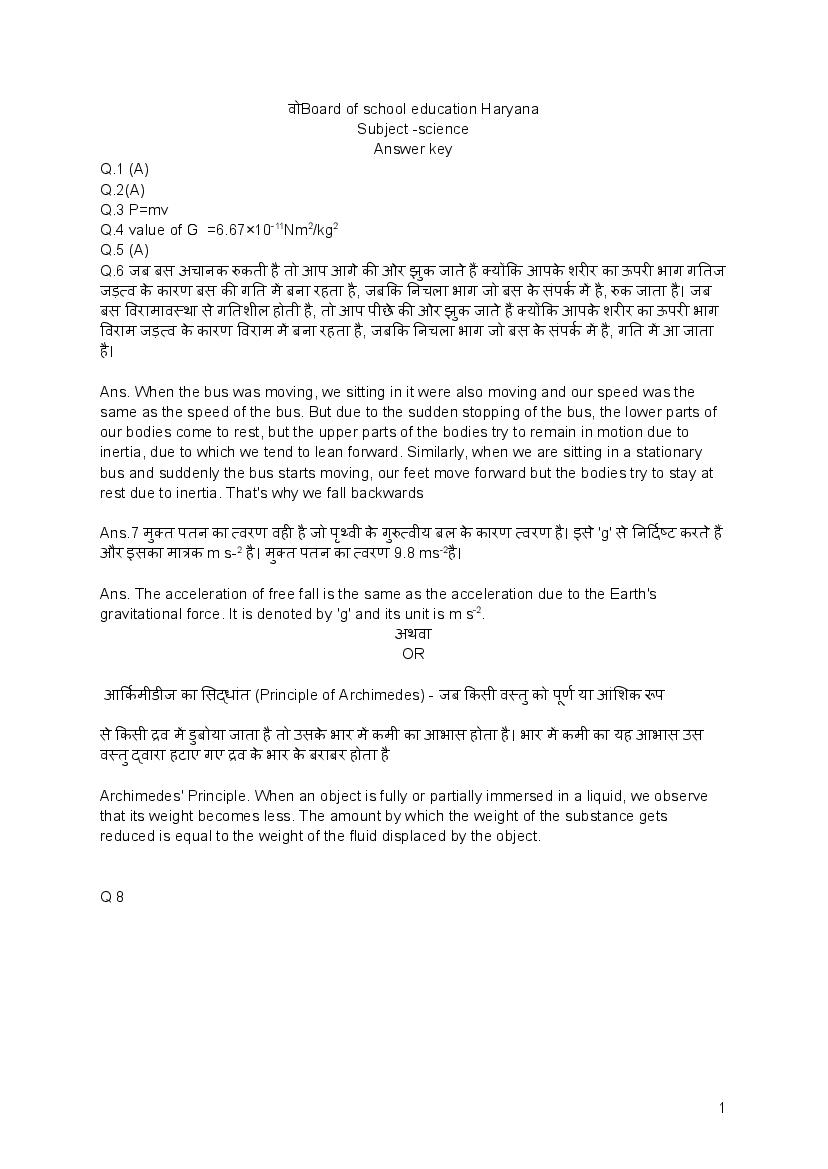
Subject -science
Answer key
Q.1 (A)
Q.2(A)
Q.3 P=mv
Q.4 value of G =6.67×10⁻¹¹Nm2/kg2
Q.5 (A)
Q.6 जब बस अचानक रुकती है तो आप आगे की ओर झक ु जाते हैं क्योंकि आपके शरीर का ऊपरी भाग गतिज
जड़त्व के कारण बस की गति में बना रहता है , जबकि निचला भाग जो बस के संपर्क में है , रुक जाता है । जब
बस विरामावस्था से गतिशील होती है , तो आप पीछे की ओर झक ु जाते हैं क्योंकि आपके शरीर का ऊपरी भाग
विराम जड़त्व के कारण विराम में बना रहता है , जबकि निचला भाग जो बस के संपर्क में है , गति में आ जाता
है ।
Ans. When the bus was moving, we sitting in it were also moving and our speed was the
same as the speed of the bus. But due to the sudden stopping of the bus, the lower parts of
our bodies come to rest, but the upper parts of the bodies try to remain in motion due to
inertia, due to which we tend to lean forward. Similarly, when we are sitting in a stationary
bus and suddenly the bus starts moving, our feet move forward but the bodies try to stay at
rest due to inertia. That's why we fall backwards
Ans.7 मक्
ु त पतन का त्वरण वही है जो पथ्
ृ वी के गरु
ु त्वीय बल के कारण त्वरण है । इसे 'g' से निर्दिष्ट करते हैं
और इसका मात्रक m s- है । मक्
2
ु त पतन का त्वरण 9.8 ms-2है ।
Ans. The acceleration of free fall is the same as the acceleration due to the Earth's
gravitational force. It is denoted by 'g' and its unit is m s-2.
अथवा
OR
आर्कि मीडीज का सिद्धांत (Principle of Archimedes) - जब किसी वस्तु को पर्ण
ू या आंशिक रूप
से किसी द्रव में डुबोया जाता है तो उसके भार में कमी का आभास होता है । भार में कमी का यह आभास उस
वस्तु द्वारा हटाए गए द्रव के भार के बराबर होता है
Archimedes' Principle. When an object is fully or partially immersed in a liquid, we observe
that its weight becomes less. The amount by which the weight of the substance gets
reduced is equal to the weight of the fluid displaced by the object.
Q8
1
Page 2
Page 3
अथवा
3
Page 4
ध्वनि की प्रबलता तथा तीव्रता में अंतर बताइए।
उत्तर- यद्यपि हम 'प्रबलता' तथा 'तीव्रता' शब्दों को पर्याय के रूप में प्रयोग कर लेते हैं पर इन का एक ही अर्थ
नहीं है । प्रबलता ध्वनि के लिए कानों की संवेदनशीलता है लेकिन तीव्रता किसी एकांक क्षेत्रफल से एक सेकंड में
गज़
ु रने वाली ध्वनि ऊर्जा होती है । इनमें निम्नलिखित अंतर होते हैं-
ध्वनि प्रबलता
(1) ध्वनि के लिए प्रबलता कानों की संवेदनशीलता की माप है ।
(2) ध्वनि की प्रबलता को नापा नहीं जा सकता।
(3) भिन्न-भिन्न प्रेक्षकों के लिए ध्वनि की प्रबलता अलग-अलग हो सकती है ।
(4) पराश्रव्य और अवश्रव्य ध्वनि तरं गों की प्रबलता सन
ु ाई न दे ने के कारण शन्
ू य होती है ।
ध्वनि तीव्रता
4
Page 5
ु रने वाली ध्वनि ऊर्जा है ।
(2) ध्वनि की तीव्रता को नापा जा सकता है ।
(3) सभी के लिए ध्वनि की तीव्रता एक समान होती है ।
(4) पराश्रव्य और अवश्रव्य ध्वनि तरं गों में तीव्रता का होना संभव है ।
Ans. Although we use the words 'loudness' and 'intensity' as synonyms, they do not mean
the same thing. Loudness is the sensitivity of the ear to sound but intensity is the sound
energy passing through a unit area in one second. They have the following differences-
Loudness
1. Loudness is a measure of the sensitivity of the ears to sound.
2. The loudness of sound cannot be measured
3. The loudness of the sound may be different for different observers.
4. The loudness of the ultrasonic and infrasonic waves is zero as these are not audible.
Intensity of Sound
1. Intensity is the amount of sound energy passing through a unit area in one second.
. 2. The intensity of sound can be measured.
3. The intensity of sound is the same for all.
4. Ultrasonic and infrasonic sound waves may have intensity
Q.10 (a)
गरु
ु त्व त्वरण(g) गरु
ु त्वाकर्षण स्थिरांक (G)
(1) यह गरु
ु त्वीय त्वरण को प्रदर्शित करता है । (1) यह गरु
ु त्वाकर्षण स्थिरांक को प्रदर्शित करता है ।
(2) इसका मान भिन्न-भिन्न स्थानों पर (2) इसका मान सभी स्थानों पर समान है । इसलिए
भिन्न-भिन्न होता है । इसे सार्वत्रिक स्थिरांक भी कहते हैं।
(3) इसका पथ्
ृ वी पर मान 9-8 m/s² है । (3) इसका मान 6.67 x 10⁻¹¹ N m-2 kg-2 है ।
(4) यह ऋणात्मक तथा धनात्मक होता है । (4) यह सदा धनात्मक होता है ।
5
Page 6
(1) It represents the acceleration due to (1) It represents the gravitational constant.
gravity.
(2) Its value is same at all places.
(2) Its value is different at different places. Therefore, it is also called universal
gravitational constant.
tant.
(3) Its value is 6.67 x 10⁻¹¹ N m² kg-2,
(3) Its value on earth is 9.8 m/s².
(4) It is always positive.
(4) It can be positive or negative.
(b)
उत्तर - चंद्रमा का द्रव्यमान पथ्
ृ वी की अपेक्षा छः गण
ु ा कम है जिस कारण चंद्रमा वस्तओ
ु ं पर छः गण ु ा कम
आकर्षण बल लगाता है इसलिए किसी वस्तु का चंद्रमा पर भार पथ् ृ वी पर इसके भार का गण ु ा होता है ।
The mass of the moon is six times less than that of the earth, due to which the moon exerts
six times less force of attraction on the objects, so the weight of an object on the moon is
multiplied by 1/6th of its weight on the earth.
Section -B
Chemistry
रसायन विज्ञान
Q.11 (C )
Q.12 (A)
Q.13 ऊर्ध्वपान
Sublimation
Q.14गतिज ऊर्जा
Kinetic energy
Q.15 (C )
Q.16 एसीटोन/पेट्रोल या इत्र हथेली पर डालने से इनके कण हथेली और उसके आस-पास से ऊर्जा प्राप्त कर
लेते हैं और वाष्पीकृत हो जाते हैं, जिस से हथेली ठं डी हो जाती है ।
By pouring acetone/petrol or perfume on the palm, the particles of the poured liquid takes
energy from the palm and its surroundings for changing into vapours. As energy from the
palm is lost due to which the palm becomes cold.
हीलियम परमाणु का परमाणु द्रव्यमान 4u है और उसके नाभिक में दो प्रोटॉन होते हैं। इसमें कितने न्यट्र
ू ान
होंगे ?
Q 17- परमाणु द्रव्यमान= (p + n)
नाभिक में प्रोटॉन (p) = 2
न्यट्र
ू ॉन = 4-2=2
. Atomic Mass (P+ n) = 4 Protons in the nucleus (P) = 2 Neutrons = 4-2=3
OR
अथवा
6
Page 7
L कोश भरा होने की अवस्था में परमाणु में इलेक्ट्रॉन = 8
अतः इलेक्ट्रॉनों की संख्या 8+2=10 होगी।
Electrons in the fully filled K shell = 2
Electrons in the fully filled L shell = 8
Number of electrons will be 2 + 8 = 10.
Q.18
समांगी मिश्रण विषमांगी मिश्रण
(1) इसके अवयव एक समान बंटे होते हैं। (1) इसके अवयव एक समान रूप में बंटे नहीं होते।
(2) इसमें अंशों के गण
ु तथा संरचना हर अवस्था में 2) इसमें अंशों के गण
ु एक-दस
ू रे से भिन्न होते हैं।
समरूप होती है ।
उदाहरण - रे त कण और लोह चर्ण ू , रे त + अमोनियम
उदाहरण-पीतल, कांसा, पानी में चीनी, एल्कोहल में क्लोराइड, पानी में चॉक, पानी में तेल आदि।
पानी, वायु आदि।
Homogeneous mixture Heterogeneous mixture
1. Its components are equally distributed. 1. Its components are not evenly
distributed.
2. In this, the properties and composition of 2. In this, the properties of the fractions are
the fractions are the same. different from each other.
Example-brass, bronz Example- sand particles and iron powder,
sand + ammonium chloride, chalk in water,
oil in water etc.
ठोस द्रव गैस
7
Page 8
निश्चित आकार होता है नहीं होता। इन्हें जिस होता और ये जिस बर्तन
और इनकी स्पष्ट बर्तन में रखा जाता है ये में रखी जाती हैं उसी का
सीमाएं होती हैं। उसी का आकार ले लेते आकार ले लेती हैं।
हैं।
2. संपीड्यता इन में नगण्य संपीड्यता गैसों में संपीड्यता काफ़ी
होती है इसलिए बाहरी इनमें निश्चित आयतन अधिक होती है ।
बल लगाने पर भी अपना होता है और संपीड्यता
आकार बनाए रखते हैं। के कारण आकार
बदलता है ।
3. दृढ़ता ये दृढ़ होते हैं। ये गैसीय होते हैं।
ये दृढ़ नहीं बल्कि तरल
ठोस पदार्थों में दस
ू रे होते हैं। गैसों में अन्य गैसों का
4.विसरण ठोस पदार्थ में विसरित विसरण बहुत तीव्रता से
होने के गण
ु नहीं होते। द्रवों में ठोस और द्रवों होता है ।
और गैसों का विसरण
होता है ।
ठोस पदार्थों में कण गैसों में कणों की स्थिति
5. कणों की स्थिति एक-दसू रे के बहुत बहुत ढीली होती है और
निकट होते हैं। उनके बीचे रिक्त स्थान
द्रवों में कण एक-दसू रे से बहुत अधिक होता हैं।
दरू होते हैं और कणों के
बीच पर्याप्त रिक्त
ठोस के कणों के बीच स्थान होता है । गैसों के कणों में
6. कणों में आकर्षण बल आकर्षण बल बहुत आकर्षण बल न के
अधिक होता है , वे केवल बराबर होता है । वे तीव्र
घर्ण
ू न करते हैं। द्रवों में आकर्षण बल गति से इधर-उधर गति
अपेक्षा-कृत कमज़ोर कर सकते हैं।
होता है पर इतना
ये बहते नहीं है कमज़ोर नहीं कि कण
7. बहाव एक-दस ू रे से अलग हो सभी दिशाओं में बहते
जाएं। हैं।
उच्च से निम्न तल की
ओर बहते हैं।
Solid Liquid Gas
8
Page 9
substances have does not have does not have
definite shape and definite shape but definite shape as
fixed boundaries. they take shape in liquid they also take
which they poured. shape where they
poured.
2. Compression They have
negligible They have definite Gases have
compressibility volume. So due maximum
there-fore cannot com-pression they compressibility.
change their shape change their shape. Gases have
by applying maximum
external force. compressibity.
3. Rigidity They are very They are not rigid These are gaseous.
rigid. but are liquid.
In gases, the
4. Diffusion Solids do not have Liquid have the diffusion of other
the property of property to diffused gases is very rapid.
being diffused into into others.
other solids.
In gases the position
In solids, the In liquid the particles of particles is very
5. State of the particle particles are very are far away from loose and spaces
closely packed. each other and they between them are
have vacant spaces very large.
6. Attractive forces In solids, the force in bet-ween them.
between the parti-cles of attraction
between the The force of The gases the force
particles are very attraction in liquids is of attraction is
strong so they can relatively weak but neglige-able
only vibrate. not so weak that therefore their
they separate from particle can drift
each other. anywhere.
7. Flow They does not They flow from They can flow in an
flow. higher level to lower direction.
level.
Q.19
परमाणु संख्या (Atomic Number) -
किसी परमाणु के नाभिक में स्थित प्रोटॉनों की संख्या को परमाणु संख्या या परमाणु क्रमांक कहते हैं। इसी से
किसी तत्व की रासायनिक प्रकृति निर्धारित की जाती है । इसे 'Z' से प्रकट किया जाता है ।
द्रव्यमान संख्या (Mass Number) -
9
Page 10
ू ॉन की कुल संख्या को उसकी द्रव्यमान संख्या कहते हैं।
समस्थानिक (Isotopes) —
किसी तत्व में ऐसे परमाणु जिनमें परमाणु द्रव्यमान भिन्न हों परं तु परमाणु संख्या समान हो, उसे
समस्थानिक कहते है
Atomic Number. The number of protons in the nucleus of an atom is called atomic number.
This determines the chemical nature of an element. It is represented by Z.
Mass Number. The total number of protons and neutrons present in an atom of an element is
called its mass number.
Isotopes. Atoms of an element having different atomic masses but the same atomic number
are called isotopes.
Q.20
कैल्शियम ऑक्साइड :- CaO
अल्यमिु नियम क्लोराइड :-AlCl3
सोडियम क्लोराइड:- NaCl
मैग्नीशियम ऑक्साइड:- MgO
कैल्शियम सल्फेट:- CaSO4
Calcium oxide:- CaO
Aluminium chloride: -AlCl3
Sodium chloride:- NaCl
Magnesium oxide: - MgO
Calcium sulphate: - CaSO4
OR
अथवा
Al₂(SO₄)₃: Aluminium Sulphate
एल्यमि
ु नियम सल्फेट
K₂SO₄.:PotassiumSulphate
पोटे शियम सल्फेट
Mg(OH)₂:Magnesium Hydroxide
मैग्निशियम हाइड्रोक्साइड
Na₂CO₃:Sodium Carbonate
सोडियम कार्बोनेट
Ca(OH)₂:Calcium Hydroxide
कैल्शियम हाइड्रोक्साइड
Section -C
जीव विज्ञान
Biology
Q.21 (D )
Q.22 (B )
Q.23 दृढ़ ऊतक (स्क्लेरेनकाइमा)
Sclerenchyma.
Q.24 करनाल
10
Page 11
Q.25 (D )
Q.26 ऊतक (Tissue) - समान उत्पत्ति, संरचना तथा कार्यों वाली कोशिकाओं के समह
ू को ऊतक कहते हैं।
A group of cells having the same origin, structure and function is called a tissue.
Q.27 रे खित तथा अरे खित पेशी में अंतर स्पष्ट कीजिए। उत्तर-रे खित तथा अरे खित पेशियों में अंतर -
रे खित पेशियां
अरे खित पेशियां
(1) यह दीर्घ, बेलनाकार तथा अशाखित होती हैं।
(1) यह छोटी, तर्का
ु कार तथा नक
ु ीले सिरे वाली होती हैं।
(2) इसमें गहरे तथा हल्के रं ग की पट्टिकाएं होती हैं
(2) इसमें पट्टिकाएं नहीं होतीं।
(3) इसमें ऐच्छिक संकुचन तेजी से तथा थोड़े समय के लिए होता है ।
(3) इसमें संकुचन धीरे -धीरे होता है , परं तु काफी समय तक होता है ।
(4) ये जल्दी ही थकान महसस
ू करती है ।
(4) इसमें पेशी को थकान का अनभ
ु व नहीं होता।
(5) यह बहुकेंद्रकीय है तथा केंद्रक परिधि में होता है ।
(5) यह एक केंद्रकीय है तथा केंद्रक मध्य में होता है ।
(6) ये कंकाल से जड़
ु ी होती हैं।
(6) ये शरीर में अंगों की दीवारों में पाई जाती हैं।
(7) इनमें सारकोलैमा पतला तथा मजबत
ू होता है ।
(7) इनमें साइकोलैमा नहीं होता
Difference between striated and unstriated muscles :
Striated muscles
(1) It is long, cylindrical and unbranched.
(2) It has dark and light coloured bands.
3) In this, the voluntary contraction is rapid and for a short time.
11
Page 12
5) It is multinucleated and the nucleus is in the periphery.
6) They are attached to the skeleton.
7) In it, the sarcolemma is thin and strong.
Unstriated muscles
(1)It is small, spindle-shaped and have a pointed end.
(2) It does not have dark and light coloured bands.
(3) In this the contraction is gradual, but it lasts for a long time.
(4)This type of muscle does not feel tired.
(5)It is mononucleated and the nucleus is at the centre.
(6)It is found in organs' wall in the body.
(7) They do not have sarcolemma.
OR
अथव
जल के अणओ ु ं की गति जब वर्णात्मक पारगम्य झिल्ली के द्वारा हो तो उसे परासरण कहते हैं। प्ला झिल्ली
से जल की गति जल में घल ु े पदार्थों की मात्रा के कारण प्रभावित होती है । जल के अणु वर्णात्मक पारगम्य झिन
से उच्च जल की सांद्रता से निम्न जल की सांद्रता की ओर जाते हैं। वर्णात्मक पारगम्य झिल्ली अपने
छोटे -छोटे छिद्र जल अणओु ं को पार गज़ ु रने दे ती है पर घलु नशील पदार्थ के बड़े अणु इससे नहीं गज
ु र पातें हैं।
Movement of water through a semipermeable membrane is cal of water across plasma
membrane is affected by the amount of sub Water move from its higher concentration to its
lower concentration membrane which allows water, but prevents large molecules in the small
pores.
Q.28
पैरेंकाइमा कॉलेंकाइमा स्क्लेरेंकाइमा
(1) इनमें कोशिका भित्ति पेक्टिन (1) इनमें कोशिका भित्ति पेक्टिन (1) इनमें कोशिका भित्ति लिग्निन
तथा सेल्यल ू ोज़ की बनी होती है । तथा सेल्यल ू ोज़ की बनी होती है । की बनी होती है ।
(2) यह गोल, महीन कोशिका (2) यह बहुभज ु ी कोशिकाओं का (2)यह मोटी भित्ति वाली
भित्ति वाली कोशिकाओं का बना बना होता है । कोशिकाओं का बना होता है ।
होता है । (3) ये सजीव होती हैं। (3)ये मत
ृ कोशिकाएं होती हैं।
(3) ये सजीव होती हैं। (4) ये तने तथा पत्ती की मध्य
(4) ये जड़, तना तथा पत्ती में पाई शिरा में पाई जाती हैं। 4) ये तने तथा फलों के गद ु े और
जाती हैं। (5) ये यांत्रिक सहारा दे ने का कार्य फलों की पाषाण कोशिकाओं में
(5) ये खाद्य भंडारण तथा यांत्रिक करती हैं। पाई जाती हैं।
सहारा दे ने का कार्य करती हैं। 5)ये सहारा दे ने का कार्य करती हैं।
12
Page 13
(1) In these, the cell wall is (1) In these, the cell wall is (1) In these, the cell wall is
made up of pectin and made up of pectin and made of lignin.
cellulose. cellulose. (2) It is made up of thick
(2) It is made up of rounded (2) It is made up of walled cells.
cells with a thin cell wall. polygonal cells. (3) These are dead cells.
(3) They are alive. (3) They are alive. (4) They are found in stem,
(4) They are found in the (4) It is found in the stem fleshy part of fruits and
root, stem and leaf. and midrib of the leaf. stone cells of fruits,
(5) It stores food. (5) Their role is to provide (5) Their role is to provide
mechanical support. support.
Q.29
खाद उर्वरक
( (1) ये कृत्रिम पदार्थ हैं जो
कारखानों में तैयार किए जाते हैं।
1) ये गोबर तथा गले-सड़े पौधों
जैसे प्राकृतिक पदार्थों से बनती हैं। (2) ये मख्
ु यतः अकार्बनिक पदार्थ
हैं।
(2)ये मख्
ु यतः कार्बनिक पदार्थ हैं।
(3) ये कम स्थान घेरते हैं।
(3)ये अधिक स्थान घेरते हैं। इसलिए इनका स्थानांतरण तथा
इसलिए इनका स्थानांतरण भंडारण सवि ु धाजनक है ।
तथा भंडारण असवि ु धाजनक है । (4) ये नमी का अवशोषण करके
खराब हो जाते हैं।
(4)ये नमी के अवशोषण से खराब (5) इनमें पौधों की वद् ृ धि के लिए
नहीं होते। आवश्यक नाइट्रोजन, फॉस्फोरस
तथा पोटाशियम जैसे पोषक तत्व
(5) इनमें पौधों की वद् ृ धि के लिए बहुत अधिक मात्रा में होते हैं।
आवश्यक नाइट्रोजन, फॉस्फोरस
तथा पोटाशियम जैसे पोषक तत्व (6) उर्वरक पोषक विशेष होते हैं।
अधिक मात्रा में नहीं होते। नाइट्रोजन यक् ु त, फॉस्फोरस तथा
(6) खादें पोषक विशेष नहीं होतीं। पोटाशियम यक् ु त उर्वरक मिट्टी
ये केवल मिट्टी के सामान्य में मिला दे ने से कोई भी वांछित
प्रभाव को परू ा कर सकती हैं। पोषक तत्व प्राप्त किया जा
सकता है ।
(7)खादें मिट्टी को ह्यम ू स प्रदान
करती हैं। (7)उर्वरक मिट्टी को ह्यम ू स
प्रदान नहीं करते हैं।
(8) खादें मिट्टी के गठन को
प्रभावित करती हैं जिससे मिट्टी (8) उर्वरक मिट्टी के गठन
में पौधों को थामे रखने की क्षमता (Texture) को प्रभावित नहीं
प्रदान करा दे ती हैं। करते।
(9) खादें जल में अघल
ु नशील (9) उर्वरक जल में घल
ु नशील होने
होती हैं जिससे फसली पौधों के कारण फसली पौधों द्वारा
द्वारा इनका अवशोषण धीरे -धीरे आसानी से अवशोषित कर लिए
होता है । जाते हैं।
13
Page 14
की प्राप्ति में अधिक समय लगता (10) इनके अनावश्यक प्रयोग से
है पर यह सस्ता मिलता है । फसल की प्राप्ति में कमी हो
सकती है और इनका उपयोग
महं गा पड़ता है ।
Manure Fertilizer
Manure (1) These are chemicals
prepared artificially in
d factories.
(1) They are made from (2) These are mainly
decomposition of cow dung inorganic substances.
and rotten plants.
(3) Their transfer and
(2) These are mainly storage is convenient as
organic matter. they occupy less space.
(3) Their transport and (4) Moisture spoils them.
storage are inconvenient as
they occupy more space. (5) These mainly consists of
nutrients like Nitrogen,
(4) They are not affected Phosphorus and Potassium
due to the presence of in high amounts.
moisture.
(6) Fertilizers are nutrient
(5) The amount of nutrients specific. Any desired
like nitrogen, phosphorus nutrient can be obtained by
and potassium is low in adding nitrogen-rich,
these. phosphorus and
potassium-rich fertilizers to
(6) Manure is not too the soil.
nutritious but can affect
productivity of the soil. (7) Fertilizers do not provide
humus to the soil.
(7) Manures provide humus
to the soil. (8) Fertilizers do not affect
soil texture.
(8) Manure improves the soil
texture and increases the (9) Fertilizers are easily
plant holding strength of absorbed by crop plants as
soil. they are water soluble.
(9) Manure is water
insoluble so its absorption (10) Unnecessary use of
by crop plants is slow. them can reduce the yield of
the crop and their use
(10) Manure is cheap but becomes costly.
आपtakes more time to
increase production.
14
Page 15
रं ध्र वायम
ु ड
ं ल से गैसों का आदान-प्रदान करते हैं। वाष्पोत्सर्जन की क्रिया भी इन्हीं के द्वारा होती हैं।
The stomata exchange gases with the atmosphere. The process of transpiration also takes
place through them.
(b)
हृदयक पेशी का विशेष कार्य परू े जीवन भर लयबद्ध होकर प्रसार और संकुचन करना है । इसी के परिणाम
स्वरूप रक्त सारे शरीर में गति करता है ।
The muscles of the heart show rhythmic contraction and relaxation throughout life. It is
responsible for heartbeat and plays a role in circulation (pumping) of blood in the body.
(c )
पौधों की कोशिकाओं की सबसे बाहरी परत एपीडर्मिस है । शष्ु क स्थानों पर मिलने वाले पौधों में यह मोटी हो
जाती है और पानी की हानि को कम कर उनकी रक्षा करती है । पौधों की परू ी सतह एपीडर्मिस से ढकी रहती हैं।
इसलिए यह पौधों के सभी भागों की रक्षा करती है । इसके बाहर मोम जैसी जल प्रतिरोधी परत बनती है जो जल
हानि के विरुद्ध यांत्रिक आघात तथा परजीवी कवक के प्रवेश से पौधों की रक्षा करती है । पत्तियों की एपीडर्मिस
में छोटे -छोटे रं ध्रों से वायम
ु ड
ं ल से गैसों का आदान-प्रदान होता है , इन्हीं से वाष्पोत्सर्जन क्रिया होता है । जड़ों की
एपीडर्मल कोशिकाएं पानी सोखने का कार्य करती हैं। मरुस्थलीय पौधों के बाहरी सतह वाले एपीडर्मिस में
रासायनिक पदार्थ क्यटि ू न होता है जिस कारण पानी का वाष्पन नहीं होता।
The outermost layer of plant cells is the epidermis. It thickens in plants found in dry places
and protects them by reducing loss of water. The entire surface of the plant is covered with
epidermis. Hence, it protects all parts of the plants.
A wax-like water resistant layer is formed on the outside which
protects the plants against water loss, from mechanical shock and entry of parasitic fungi.
The exchange of gases with the atmosphere takes place through small stomata in the
epidermis of the leaves, through which transpiration takes place. The epidermal cells of the
roots perform the function of absorbing water. The epidermis of the outer surface of desert
plants contains the chemical substance cutin, due to which water vapour does not
evaporate.
OR
अथवा
(a )डीऑक्सी राइबो- न्यक्लि
ू क अम्ल
Deoxyribo nucleic acid
(b )
कोशिका के मख्
ु य कार्य निम्नलिखित हैं-
(i) यह पाचन में सहायता करती है ।
(ii) यह ऊर्जा उत्पन्न करने में सहायक है ।
15
Page 16
(iv) यह आवश्यक पदार्थों के संश्लेषण में सहायता करती है ।
The main functions of the cell are
(i) It helps in digestion.
(ii) It helps in generating energy.
(iii) It helps in the secretion of substances.
(iv) It helps in the synthesis of essential substances.
(c )
16
Document Details
| Board / Org | Haryana Board |
| Exam | Class 9 |
| Type | Sample Paper |
| Pages | 16 |
| Updated | 24 Sep 2026 |