APTET Question Paper with Answers 18 Jun 2018 Paper 2 Kannada (Shift 1)
Finished viewing? Save it for later —
Download APTET Question Paper with Answers 18 Jun 2018 Paper 2 Kannada (Shift 1) (PDF · 53 pages)About APTET Question Paper with Answers 18 Jun 2018 Paper 2 Kannada (Shift 1)
APTET Question Paper with Answers 18 Jun 2018 Paper 2 Kannada (Shift 1) is available here for free download. Published by Andhra Pradesh Exams for Andhra Pradesh Teacher Eligibility Test, this question paper can be viewed online or downloaded as a PDF (53 pages). Candidates preparing for Andhra Pradesh Teacher Eligibility Test can use APTET Question Paper with Answers 18 Jun 2018 Paper 2 Kannada (Shift 1) to understand the exam pattern, the type of questions asked, and the overall difficulty level.
Frequently Asked Questions
How can I download APTET Question Paper with Answers 18 Jun 2018 Paper 2 Kannada (Shift 1)?
Open this page and click the Download button to save APTET Question Paper with Answers 18 Jun 2018 Paper 2 Kannada (Shift 1) as a PDF. It is completely free on AglaSem Docs.
Is APTET Question Paper with Answers 18 Jun 2018 Paper 2 Kannada (Shift 1) free to download?
Yes. APTET Question Paper with Answers 18 Jun 2018 Paper 2 Kannada (Shift 1) can be viewed online and downloaded as a PDF free of cost on AglaSem Docs.
How many pages does APTET Question Paper with Answers 18 Jun 2018 Paper 2 Kannada (Shift 1) have?
APTET Question Paper with Answers 18 Jun 2018 Paper 2 Kannada (Shift 1) contains 53 pages, which you can read online or download together as a single PDF.
Where can I find more Andhra Pradesh Teacher Eligibility Test study material?
You can find more Andhra Pradesh Teacher Eligibility Test question papers, sample papers, syllabus, and answer keys on AglaSem Docs.
APTET Question Paper with Answers 18 Jun 2018 Paper 2 Kannada (Shift 1) – Text
Read the full text of this question paper below — useful to quickly search, copy and reference the content online without downloading the PDF.
📄 View text version (28 pages)
Page 1
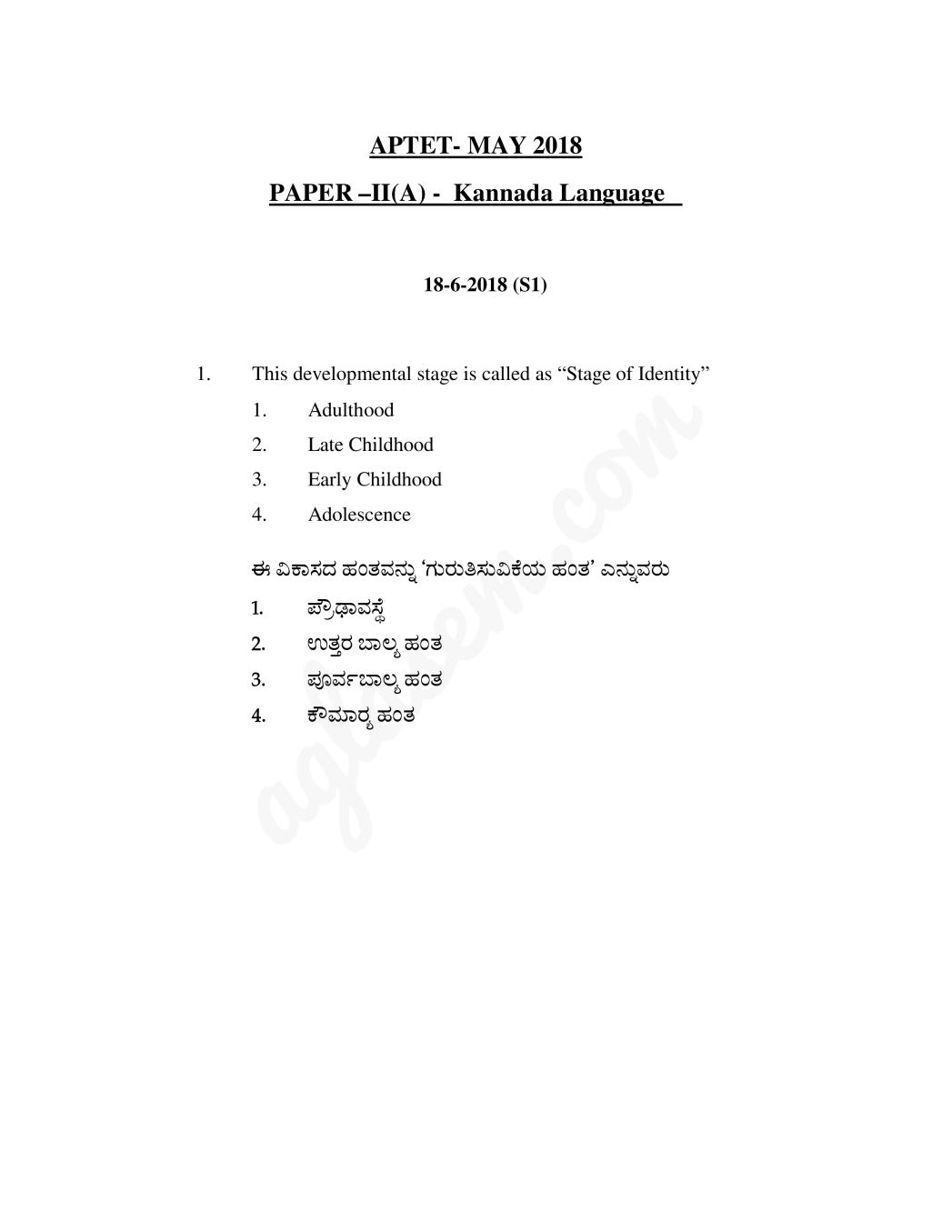
PAPER –II(A) - Kannada Language
18-6-2018 (S1)
1. This developmental stage is called as “Stage of Identity”
1. Adulthood
2. Late Childhood
3. Early Childhood
4. Adolescence
Page 2
able to play with left hand also. – The type of transfer of
learning here is
1. Positive Transfer
2. Bilateral Transfer
3. Negative Transfer
4. Zero Transfer
3. According to this psychologist intelligent people may have
intelligent ancestors
1. Galton
2. Watson
3. Boring
4. Woodworth
Page 3
examination threw away his books
1. Rationalization
2. Reaction formation
3. Displacement
4. Regression
5. Beep sound that comes from a car when the driver doesn’t
wear a seat belt is called
1. Negative Reinforcement
2. Positive Reinforcement
3. Neutral Reinforcement
4. Unconditioned Reinforcement
Page 4
1. Goal behind learning
2. Gender
3. Interesting learning material
4. Taking some rest after learning
7. Construction of knowledge is done through experiences –
This was stated by
1. Pavlov
2. Bandura
3. Piaget
4. Skinner
Page 5
for Psychology. While taking Sociology examination she got
confused due to recollection of psychological theories – This
is due to
1. Pro active inhibition
2. Retro active inhibition
3. Decay of memory traces
4. Lack of interest in Sociology
9. Shaping is an important mechanism in this learning theory.
1. Classical Conditioning
2. Operant Conditioning
3. Insightful Learning
4. Trial and Error Learning
Page 6
1. Reinforcement Attention Retention Performance
2. Attention Retention Performance Reinforcement
3. Performance Reinforcement Attention Retention
4. Retention Reinforcement Attention Performance
11. Process of transformation of a person who born as a living
organism into human being is
1. Mental Development
2. Moral Development
3. Social Development
4. Emotional Development
Page 7
1. To evaluate every aspect of the student
2. To evaluate scholastic abilities of students
3. To evaluate the progress of a student in curricular
areas
4. To evaluate the progress of the students in co-
curricular areas
13. Lowest level and foremost objective in Psychomotor Domain
is
1. Imitation
2. Precision
3. Naturalization
4. Manipulation
Page 8
in his social development also – The development principle here is
1. Development is the process of interaction
2. Developments proceed with interrelation
3. Development proceeds from general to specific
4. Development is cumulative
15. According to RTE Act – 2009, in Primary schools if the
strength of the students is above 200, the teacher pupil ratio
excluding Headmaster shall not exceed
1. 1 : 30
2. 1 : 35
3. 1 : 50
4. 1 : 40
Page 9
relations and personality is
1. Subject centered approach
2. Nature centered approach
3. Person centered approach
4. Relation centered approach
17. All children have done their project work because, the teacher
announced a reward for those who have done their project
work – The type of motivation here is
1. Achievement Motivation
2. Extrinsic Motivation
3. Intrinsic Motivation
4. Individual Motivation
Page 10
helps differently abled students by going from one school to
another.
1. Alternative school model
2. Resource model
3. Dual teaching model
4. Itinerant teaching model
19. Meier – Seashore Art judgment test is used to measure
1. Aesthetic Aptitudes
2. Scholastic Aptitudes
3. Vocational Aptitudes
4. General Aptitudes
Page 11
possessed by him is called
1. Self Skill
2. Self Respect
3. Self Concept
4. Self Attitude
21. Physical factor that affects learners learning is
1. Interest
2. Attitude
3. Intelligence
4. Maturity
Page 12
1. Mastery style learners
2. Understanding learners
3. Self expressive learners
4. Interpersonal learners
23. Unexpected reappearance of an extinguished conditional
response after a rest period is called
1. Discrimination
2. Extinction
3. Insight
4. Spontaneous Recovery
Page 13
the employment opportunities for them after the completion
of the course is called
1. Educational Guidance
2. Personal Guidance
3. Vocational Guidance
4. Group Guidance
25. These play a vital role in ‘learning to learn’ skills
1. Intelligence, Aptitude
2. Interest, Attitude
3. Motivation, Self confidence
4. Creativity, Learning
Page 14
this psychosocial critical situation
1. Trust Vs Mistrust
2. Autonomy Vs Shame and Doubt
3. Initiative Vs Guilt
4. Intimacy Vs Isolation
Vs
Vs
Vs
Vs
27. One of the following is the limitation of observation method
1. Study of the behaviour of students directly
2. Recording of previously decided behavioural aspects
3. Assessing the behaviour, based on external behaviour
only
4. Study of the behaviour of animals and mental patients
Page 15
person to assist himself is
1. Guidance
2. Counselling
3. Social Scaffolding
4. Instructional Scaffolding
29. The learning in which learners depend on one another and
also accountable to each other is
1. Inquiry based learning
2. Co-operative learning
3. Differentiated learning
4. Collaborative learning
Page 16
1. Prominence to acquire knowledge
2. Classroom is silent
3. Students express their ideas freely
4. Evaluation is done by the teacher only
Page 26
Choose the meaning of the word ‘disaster’.
1. A creation resulting from study
2. An event resulting great loss
3. An essential drug
4. A serious thought
62. Choose the word that refers to ‘a number of directors of a
company’.
1. Board
2. Play
3. Mob
4. Pretension
Page 27
1. India
2. Independent
3. Interest
4. Inter
64. Choose the word with correct spelling.
1. Futile
2. Tatered
3. Iritation
4. Pashion
65. Choose the homophone of ‘see’.
1. Seen
2. Ice
3. Sea
4. She
Page 28
Choose the antonym of ‘stretch’.
1. Open
2. Huddle
3. Length
4. Sweep
67. I will call on you this evening.
Choose the meaning of ‘call on’ in the context.
1. Talk
2. Visit
3. Help
4. Tell
68. He can speak French.
This sentence expresses;
1. an ability
2. an order
3. a habit
4. an interest
Page 29
Choose the article that fits the context.
1. a
2. an
3. the
4. No article is needed.
70. Kumar was afraid ……….. his enemies.
Choose the correct preposition to complete the sentence.
1. by
2. for
3. with
4. of
71. Suresh, who is my elder brother, passed the exam.
This sentence has;
1. A defining relative clause
2. A non-defining relative clause
3. A noun clause
4. An adverbial clause
Page 30
This sentence indicates;
1. a moral obligation
2. a wish
3. an offer
4. a request
73. Choose the sentence with correct question tag.
1. She did not watch the film last night, did she ?
2. She sings melodiously, does she ?
3. He will go to university, will he ?
4. He comes every Friday, does he ?
74. Is it far from here
This sentence ends with;
1. a full stop
2. a question mark
3. a comma
4. an exclamatory mark
Page 31
The correct reported speech of this sentence is;
1. Gopi’s sister said to Gopi that she was often like this
these days.
2. Gopi’s sister asked Gopi if she was often like that
those days.
3. Gopi’s sister explained that she was often like that
those days.
4. Gopi’s sister said that she had been often like this
those days.
76. The mother of these children …………. in a factory.
Choose the correct form of the verb that fits the subject.
1. are working
2. have worked
3. work
4. works
77. It generally ………….. in August.
Choose the correct tense form that fits the blank.
1. rain
2. rains
3. raining
4. rained
Page 32
The part of speech of the word ‘pensive is;
1. an adjective
2. an adverb
3. a noun
4. a verb
79. Choose the linker that indicates addition.
1. Firstly
2. Besides
3. Later
4. As a result
80. Dr. Kotnis was a doctor and Guo, a nurse.
This sentence has;
1. one main clause only
2. one subordinate clause
3. two subordinate clauses
4. two main clauses
Page 33
1. Indu is hating films.
2. Indu has been hating films.
3. Indu was hating films.
4. Indu hates films.
82. Identify the word that cannot begin with a capital letter.
1. June
2. Monday
3. East
4. India
83. Choose the sentence in passive voice.
1. The boys were fed.
2. They had performed this operation.
3. There was a general start.
4. He has asked for more.
Page 34
Choose the grammatically correct expression that fits the
context.
1. the greater
2. greater than
3. as great as
4. the greatest
85. In a personal letter, the main point is written in;
1. the body
2. the post script
3. the closing
4. the heading
86. Choose the list of words in correct alphabetical order.
1. faith, faithfully, faithful, faithless
2. sing, sings, singing, sang
3. with, without, white, whiter
4. dream, dreamed, dreamer, dreaming
Page 35
Choose the synonym of ‘dexterous’.
1. Famous
2. Skilful
3. Involved
4. Passed
88. Victoria was dressed ………. colours.
Choose the correct preposition that fits the blank.
1. by
2. with
3. in
4. for
89. Read the following passage and choose the correct
answer to the question.
People moan about poverty as great evil and it seems to be an
accepted belief that if people had plenty of money, they
would be happy, and get more out of life.
People believe that;
1. happiness depends upon the amount of money.
2. poverty gives happiness.
3. poverty gives money.
4. poverty is fortune.
Page 36
answer to the question.
People moan about poverty as great evil and it seems to be an
accepted belief that if people had plenty of money, they
would be happy, and get more out of life.
The popular notion about poverty is;
1. It is a great amount of money.
2. It is a great happiness.
3. It is a great evil.
4. It gives more out of life.
Page 53
Paper-II(A) - Kannada Language - Set-N 18.06.2018 Morning Session
Q.Nos CDP Q.Nos Kannada Q.Nos English Q.Nos Kannada Q.Nos Kannada
1 4 31 1 61 2 91 1 121 3
2 2 32 2 62 1 92 3 122 2
3 1 33 2 63 2 93 4 123 4
4 3 34 4 64 1 94 2 124 1
5 1 35 1 65 3 95 1 125 3
6 2 36 3 66 2 96 3 126 2
7 3 37 1 67 2 97 1 127 4
8 2 38 3 68 1 98 3 128 1
9 2 39 2 69 3 99 2 129 3
10 2 40 4 70 4 100 3 130 2
11 3 41 4 71 2 101 4 131 4
12 1 42 2 72 1 102 1 132 3
13 1 43 1 73 1 103 2 133 1
14 2 44 4 74 2 104 1 134 4
15 4 45 3 75 3 105 3 135 2
16 3 46 1 76 4 106 4 136 1 or 3
17 2 47 4 77 2 107 2 137 1
18 4 48 3 78 1 108 1 138 4
19 1 49 2 79 2 109 3 139 2
20 3 50 1 80 4 110 4 140 1
21 4 51 3 81 4 111 1 141 4
22 2 52 2 82 3 112 4 142 4
23 4 53 4 83 1 113 1 143 2
24 3 54 3 84 3 114 2 144 1
25 3 55 1 85 1 115 4 145 3
26 1 56 4 86 4 116 1 146 Add Score
27 3 57 1 87 2 117 3 147 1
28 1 58 3 88 3 118 2 148 1
29 4 59 2 89 1 119 4 149 3
30 3 60 3 90 3 120 1 150 4
Document Details
| Board / Org | Andhra Pradesh Exams |
| Exam | Andhra Pradesh Teacher Eligibility Test |
| Type | Question Paper |
| Pages | 53 |
| Updated | 30 Apr 2026 |