NIOS Class 12 April 2024 Question Paper Mathematics
Finished viewing? Save it for later —
Download NIOS Class 12 April 2024 Question Paper Mathematics (PDF · 28 pages)About NIOS Class 12 April 2024 Question Paper Mathematics
NIOS Class 12 April 2024 Question Paper Mathematics is available here for free download. Published by NIOS for National Institute of Open Schooling Class 12, this question paper can be viewed online or downloaded as a PDF (28 pages). Candidates preparing for National Institute of Open Schooling Class 12 can use NIOS Class 12 April 2024 Question Paper Mathematics to understand the exam pattern, the type of questions asked, and the overall difficulty level.
Frequently Asked Questions
How can I download NIOS Class 12 April 2024 Question Paper Mathematics?
Open this page and click the Download button to save NIOS Class 12 April 2024 Question Paper Mathematics as a PDF. It is completely free on AglaSem Docs.
Is NIOS Class 12 April 2024 Question Paper Mathematics free to download?
Yes. NIOS Class 12 April 2024 Question Paper Mathematics can be viewed online and downloaded as a PDF free of cost on AglaSem Docs.
How many pages does NIOS Class 12 April 2024 Question Paper Mathematics have?
NIOS Class 12 April 2024 Question Paper Mathematics contains 28 pages, which you can read online or download together as a single PDF.
Where can I find more National Institute of Open Schooling Class 12 study material?
You can find more National Institute of Open Schooling Class 12 question papers, sample papers, syllabus, and answer keys on AglaSem Docs.
NIOS Class 12 April 2024 Question Paper Mathematics – Text
Read the full text of this question paper below — useful to quickly search, copy and reference the content online without downloading the PDF.
📄 View text version (27 pages)
Page 1
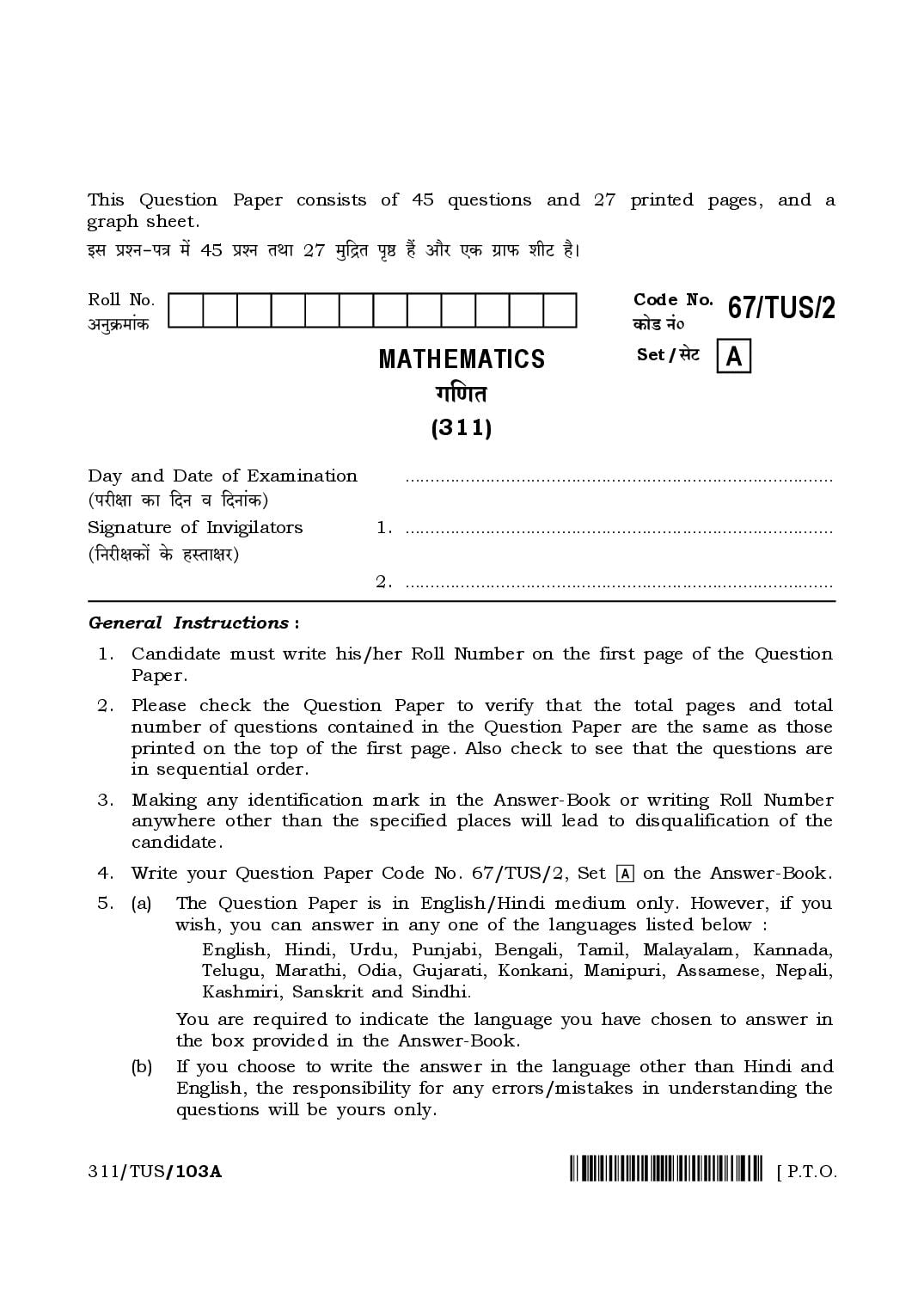
graph sheet.
Bg àíZ-nÌ ‘| 45 àíZ VWm 27 ‘w{ÐV n¥ð> h¢ Am¡a EH$ J«m’$ erQ> h¡&
Roll No. Code No.
67/TUS/2
u
AZwH«$‘m§H$ H$moS> Z§0
MATHEMATICS Set / goQ>
J{UV
(311)
Day and Date of Examination .....................................................................................
(narjm H$m {XZ d {XZm§H$)
Signature of Invigilators 1. .....................................................................................
({ZarjH$m| Ho$ hñVmja)
2. .....................................................................................
General Instructions :
1. Candidate must write his/her Roll Number on the first page of the Question
Paper.
2. Please check the Question Paper to verify that the total pages and total
number of questions contained in the Question Paper are the same as those
printed on the top of the first page. Also check to see that the questions are
in sequential order.
3. Making any identification mark in the Answer-Book or writing Roll Number
anywhere other than the specified places will lead to disqualification of the
candidate.
4. Write your Question Paper Code No. 67/TUS/2, Set u on the Answer-Book.
5. (a) The Question Paper is in English/Hindi medium only. However, if you
wish, you can answer in any one of the languages listed below :
English, Hindi, Urdu, Punjabi, Bengali, Tamil, Malayalam, Kannada,
Telugu, Marathi, Odia, Gujarati, Konkani, Manipuri, Assamese, Nepali,
Kashmiri, Sanskrit and Sindhi.
You are required to indicate the language you have chosen to answer in
the box provided in the Answer-Book.
(b) If you choose to write the answer in the language other than Hindi and
English, the responsibility for any errors/mistakes in understanding the
questions will be yours only.
311/TUS/103A [ P.T.O.
Page 2
1. narjmWu àíZ-nÌ Ho$ nhbo n¥ð> na AnZm AZwH«$‘m§H$ Adí¶ {bI|&
2. H¥$n¶m àíZ-nÌ H$mo Om±M b| {H$ àíZ-nÌ Ho$ Hw$b n¥ð>m| VWm àíZm| H$s CVZr hr g§»¶m h¡ {OVZr àW‘ n¥ð> Ho$ g~go
D$na N>nr h¡& Bg ~mV H$s Om±M ^r H$a b| {H$ àíZ H«${‘H$ ê$n ‘| h¢&
3. CÎma-nwpñVH$m ‘| nhMmZ-{M• ~ZmZo AWdm {Z{X©ï> ñWmZm| Ho$ A{V[aº$ H$ht ^r AZwH«$‘m§H$ {bIZo na narjmWu H$mo
A¶mo½¶ R>ham¶m OmEJm&
4. AnZr CÎma-nwpñVH$m na àíZ-nÌ H$m H$moS> Z§0 67/TUS/2, goQ u {bI|&
5. (H$) n«íZ-nÌ Ho$db {hÝXr/A§J«oOr ‘| h¡& {’$a ^r, ¶{X Amn Mmh| Vmo ZrMo Xr JB© {H$gr EH$ ^mfm ‘| CÎma Xo
gH$Vo h¢ …
A§J«oOr, {hÝXr, CXÿ©, n§Om~r, ~§Jbm, V{‘b, ‘b¶mb‘, H$Þ‹S>, VobwJy, ‘amR>r, C{‹S>¶m, JwOamVr, H$m|H$Ur,
‘{Unwar, Ag{‘¶m, Zonmbr, H$í‘rar, g§ñH¥$V Am¡a {gÝYr&
H¥$n¶m CÎma-nwpñVH$m ‘| {XE JE ~m°³g ‘| {bI| {H$ Amn {H$g ^mfm ‘| CÎma {bI aho h¢&
(I) ¶{X Amn {hÝXr Ed§ A§J«oOr Ho$ A{V[aº$ {H$gr Aݶ ^mfm ‘| CÎma {bIVo h¢, Vmo àíZm| H$mo g‘PZo ‘| hmoZo dmbr
Ìw{Q>¶m|/Jb{V¶m| H$s {Oå‘oXmar Ho$db AmnH$s hmoJr&
311/TUS/103A 2
Page 3
J{UV
(311)
Time : 3 Hours ] [ Maximum Marks : 100
g‘¶ … 3 KÊQ>o ] [ nyUmªH$ … 100
Note : (i) This Question Paper consists of 45 questions in all.
(ii) All questions are compulsory.
(iii) Marks are given against each question.
(iv) Section–A consists of
(a) Question Nos. 1 to 20 (multiple choice type questions (MCQs)
carrying 1 mark each). Select and write the most appropriate option
out of the four options given in each of these questions. An internal
choice has been provided in some of these questions. You have to
attempt only one of the given choices in such questions.
(b) Question Nos. 21 to 29 (objective type questions). Question Nos. 21 to
24 carry 2 marks each (with 2 sub-parts of 1 mark each), Question
Nos. 25 to 28 carry 4 marks each (with 4 sub-parts of 1 mark each)
and Question No. 29 carries 6 marks (with 6 sub-parts of 1 mark
each). Attempt these questions as per the instructions given for each.
(v) Section–B consists of
(a) Question Nos. 30 to 38 (very short answer type questions carrying
2 marks each)
(b) Question Nos. 39 to 43 (short answer type questions carrying
4 marks each)
(c) Question Nos. 44 and 45 (long answer type questions carrying
6 marks each)
{ZX}e … (i) Bg àíZ-nÌ ‘| Hw$b 45 àíZ h¢&
(ii) g^r àíZ A{Zdm¶© h¢&
(iii) à˶oH$ àíZ Ho$ A§H$ CgHo$ gm‘Zo {XE JE h¢&
(iv) IÊS>–A ‘| gpå‘{bV h¡
(a) àíZ g§»¶m 1 go 20 (~hþ{dH$ënr àH$ma Ho$ àíZ (MCQs), à˶oH$ 1 A§H$ H$m)& à˶oH$ àíZ ‘|
{XE JE Mma {dH$ënm| ‘| go g~go Cn¶wº$ {dH$ën H$mo MwZH$a {bIZm h¡& Hw$N> àíZm| ‘| Am§V[aH$
{dH$ën {X¶m J¶m h¡& Eogo àíZm| ‘| {XE JE {dH$ënm| ‘| go {H$gr EH$ H$mo MwZZm h¡&
(b) àíZ g§»¶m 21 go 29 (dñVw{Zð> àH$ma Ho$ àíZ)& àíZ g§»¶m 21 go 24 VH$ à˶oH$ 2 A§H$ H$m
h¡ ({Og‘| 2 Cn^mJ h¢, à˶oH$ 1 A§H$ H$m), àíZ g§»¶m 25 go 28 VH$ à˶oH$ 4 A§H$ H$m h¡
({Og‘| 4 Cn^mJ h¢, à˶oH$ 1 A§H$ H$m) VWm àíZ g§»¶m 29 Ho$ {bE 6 A§H$ {XE JE h¢ ({Og‘|
6 Cn^mJ h¢, à˶oH$ 1 A§H$ H$m)& à˶oH$ Ho$ {bE {XE JE {ZX}e Ho$ AZwgma BZ àíZm| H$mo hb
H$s{OE&
311/TUS/103A 3 [ P.T.O.
Page 4
(a) àíZ g§»¶m 30 go 38 (A{V bKyÎmar¶ àH$ma Ho$ àíZ, à˶oH$ 2 A§H$ H$m)
(b) àíZ g§»¶m 39 go 43 (bKyÎmar¶ àH$ma Ho$ àíZ, à˶oH$ 4 A§H$ H$m)
(c) àíZ g§»¶m 44 Am¡a 45 (XrK©-CÎmar¶ àH$ma Ho$ àíZ, à˶oH$ 6 A§H$ H$m)
(1) Answers of all questions are to be given in the Answer-Book given to you.
g^r àíZm| Ho$ CÎma AmnH$mo Xr JB© CÎma-nwpñVH$m ‘| hr {bI|&
(2) 15 minutes time has been allotted to read this Question Paper. The Question
Paper will be distributed at 2:15 p.m. From 2:15 p.m. to 2:30 p.m., the
students will read the Question Paper only and will not write any answer on
the Answer-Book during this period.
Bg àíZ-nÌ H$mo n‹T>Zo Ho$ {bE 15 {‘ZQ> H$m g‘¶ {X¶m J¶m h¡& àíZ-nÌ H$m {dVaU Xmonha ‘|
2:15 ~Oo {H$¶m OmEJm& 2:15 ~Oo go 2:30 ~Oo VH$ N>mÌ Ho$db àíZ-nÌ H$mo n‹T>|Jo Am¡a Bg Ad{Y
Ho$ Xm¡amZ do CÎma-nwpñVH$m na H$moB© CÎma Zht {bI|Jo&
SECTION–A
IÊS>–A
1. The x-intercept and the y-intercept of the line 4x 3y 6 0 are respectively
aoIm 4x 3y 6 0 Ho$ x-AÝV…IÊS> VWm y-AÝV…IÊS> h¢, H«$‘e…
3 2 1
(A) , 2 (B) ,
2 3 2
3 2 1
(C) , 2 (D) , 1
2 3 2
2. (a) Which one of the following mappings represents an onto function? 1
{ZåZ ‘| go H$m¡Z-gm EH$ à{V{MÌU, AmÀN>mXH$ ’$bZ H$mo {Zê${nV H$aVm h¡?
(A) (B)
(C) (D)
311/TUS/103A 4
Page 5
1 1
(b) The principal value of cos is
2
1
cos 1 H$m ‘w»¶ ‘mZ h¡
2
(A) (B)
3 3
2 4
(C) (D)
3 3
3. (a) If
x 2 9 2
18 x 18 4
and x 0 , then the value of x is
¶{X
x 2 9 2
18 x 18 4
VWm x 0 , Vmo x H$m ‘mZ h¡
(A) 4 (B) 9
(C) 6 (D) 36 1
Or / AWdm
(b) If
x y 1 1 9 15
2 3
2 0 0 2 4 6
then the values of x and y are
¶{X
x y 1 1 9 15
2 3
2 0 0 2 4 6
Vmo x VWm y Ho$ ‘mZ h¢
(A) x 3, y 9 (B) x 9, y 3
(C) x 0, y 0 (D) x 4, y 8
311/TUS/103A 5 [ P.T.O.
Page 6
aoIm y 3 0 H$s àdUVm h¡
(A) 0 (B) 1
(C) –3 (D) –1 1
Or / AWdm
3
(b) The equation of the line having slope and passing through the
2
point (1, 2) is
àdUVm 3 VWm {~ÝXþ (1, 2) go hmoH$a OmZo dmbr aoIm H$m g‘rH$aU h¡
2
(A) 3x 2y 1 0
(B) 3x 2y 1 0
(C) 3x 2y 1 0
(D) 3x 2y 1 0
1 1
5. The slope of the tangent to the curve x y 1 at , is
4 4
1 1
dH«$ x y 1 H$s , na ñne© aoIm H$s àdUVm h¡
4 4
(A) 1 (B) –1
1
(C) 2 (D) 1
2
6. (a) The direction cosines of y-axis are
y-Aj H$s {XH²$ H$moÁ¶mE± h¢
(A) 1, 1, 0 (B) 1, 0, 1
(C) 0, 1, 0 (D) 0, 1, 1 1
311/TUS/103A 6
Page 7
(b) A unit vector parallel to the resultant of vectors a 3iˆ ˆj 4kˆ and
b iˆ ˆj kˆ is
g{Xem| a 3iˆ ˆj 4kˆ VWm iˆ ˆj kˆ
b Ho$ n[aUm‘r g{Xe Ho$ g‘mÝVa EH$ ‘mÌH$
g{Xe h¡
4 ˆ 2 ˆ 5 ˆ
(A) i j k
45 45 45
4 ˆ 2 ˆ 5 ˆ
(B) i j k
45 45 45
4 ˆ 5 ˆ
(C) i k
41 41
2 ˆ 2 ˆ 3 ˆ
(D) i j k
17 17 17
7. If
1 0 0 x 5
A 0 1 0 y 4
0 0 1 z 1
then the value of x y z is
¶{X
1 0 0 x 5
A 0 1 0 y 4
0 0 1 z 1
Vmo x y z H$m ‘mZ h¡
(A) 0 (B) –2
(C) 1 (D) 2 1
311/TUS/103A 7 [ P.T.O.
Page 8
decreasing, is
dh AÝVamb, {Og‘| ’$bZ f (x ) sin x , x (0, 2) õmg‘mZ h¡, h¡
(A) (B) (0, )
0,
2
3
(C) , (D) (, 2) 1
2 2
Or / AWdm
(b) The value of x at which the function f (x ) 2 cos x x has a maximum
or minimum, is
x H$m dh ‘mZ, {Og na ’$bZ f (x ) 2 cos x x C{ƒð> AWdm {ZpåZð> h¡, h¡
(A) (B)
6 3
(C) (D)
2
9. (a) The feasible region (shaded) for an LPP is shown in the figure below.
Maximum of Z 3x 8y occurs at which of the following points? 1
EH$ a¡{IH$ àmoJ«m‘Z g‘ñ¶m H$m g§^mì¶ joÌ (N>m¶m§{H$V) AmH¥${V ‘| Xem©¶m J¶m h¡& {ZåZ ‘| go
{H$g {~ÝXþ/{H$Z {~ÝXþAm| na Z 3x 8y A{YH$V‘ hmoJm?
(A) (0, 5)
(B) (4, 4)
(C) (6, 0) and (0, 5)
(6, 0) VWm (0, 5)
(D) At every point of the line segment joining the points (4, 4) and
(6, 0)
{~ÝXþAm| (4, 4) VWm (6, 0) H$mo Omo‹S>Zo dmbr aoIm Ho$ à˶oH$ {~ÝXþ na
311/TUS/103A 8
Page 9
(b) What is the converse of the given statement?
‘‘If n is a positive number, then n3 is a positive number.’’
(A) If n is not a positive number, then n3 is not a positive number.
(B) If n3 is not a positive number, then n is not a positive number.
(C) If n3 is a positive number, then n is a positive number.
(D) If n is a positive number, then n3 is not a positive number.
{XE JE H$WZ H$m {dbmo‘ ³¶m h¡?
""¶{X n EH$ YZmË‘H$ g§»¶m h¡, Vmo n3 EH$ YZmË‘H$ g§»¶m h¡&''
(A) ¶{X n EH$ YZmË‘H$ g§»¶m Zht h¡, Vmo n3 EH$ YZmË‘H$ g§»¶m Zht h¡&
(B) ¶{X n3 EH$ YZmË‘H$ g§»¶m Zht h¡, Vmo n EH$ YZmË‘H$ g§»¶m Zht h¡&
(C) ¶{X n3 EH$ YZmË‘H$ g§»¶m h¡, Vmo n EH$ YZmË‘H$ g§»¶m h¡&
(D) ¶{X n EH$ YZmË‘H$ g§»¶m h¡, Vmo n3 EH$ YZmË‘H$ g§»¶m Zht h¡&
10. The centre and radius of the circle x 2 y 2 3x y 4 are respectively
d¥Îm x 2 y 2 3x y 4 Ho$ Ho$ÝÐ VWm {ÌÁ¶m h¢, H«$‘e…
3 1 6 3 1 13
(A) , , (B) , ,
2 2 2 2 2 2
3 1 26
(C) (3, 1), 14 (D) , , 1
2 2 2
311/TUS/103A 9 [ P.T.O.
Page 10
{ZåZ AdH$b g‘rH$aU H$m KmV h¡
3 4
d 2y d 2y dy
4 2 3 2 5 1 0
dx dx dx
(A) 1 (B) 3
(C) 4 (D) 2 1
cos x sin x
12. (a) If A and A A I , then the value of x is
sin x cos x
cos x sin x
¶{X A VWm A A I , Vmo x H$m ‘mZ h¡
sin x cos x
(A) (B)
2 3
(C) (D) 1
4 6
Or / AWdm
(b) If A is a square matrix of order 3 and | A | 5 , then the value of
|2A | is
¶{X A H$mo{Q> 3 H$m EH$ dJ© Amì¶yh h¡ VWm | A | 5 , Vmo |2A | H$m ‘mZ h¡
(A) – 40 (B) 10
(C) –10 (D) 40
13. The position vectors of the points P, Q and R are a 2b , 3a 4b and
— —
7a 8b respectively. If QR PQ , then the value of is
{~ÝXþ P, Q VWm R Ho$ pñW{V g{Xe H«$‘e… a 2b , 3a 4b VWm 7a 8b h¢& ¶{X
— —
QR PQ , Vmo H$m ‘mZ h¡
(A) 2 (B) 4
1
(C) (D) –2 1
2
311/TUS/103A 10
Page 11
function? 1
{ZåZ ‘| go H$m¡Z-gm EH$ J«m’$, ’$bZ Ho$ J«m’$ H$mo {Zê${nV Zht H$aVm?
(A) (B)
(C) (D)
15. (a) The derivative of sin x with respect to log x is
log x Ho$ gmnoj sin x H$m AdH$bO h¡
cos x
(A) (B) x cos x
x
1 x
(C) (D) 1
x cos x cos x
Or / AWdm
dy
(b) If y sin1(cos x ) , then
dx
dy
¶{X y sin1(cos x ) , Vmo
dx
1
(A) (B) cosec x
sin x
(C) 1 (D) –1
311/TUS/103A 11 [ P.T.O.
Page 12
16. If A [aij ] is a matrix of order 2×3 and aij , then the matrix A is
2
i 2j
¶{X A [aij ] H$mo{Q> 2×3 H$m EH$ Amì¶yh h¡ VWm aij , Vmo Amì¶yh A h¡
2
3 3
2 3 2 2
(A) 2 3 (B) 5 3
2
5 7 7 4
2 2 2
3 5 7 3 5
2 2 2
(C) 2 2 2 (D)
3 3 7
2 3 4 2 1
2 3 6
17. (a) The distance of the plane r iˆ ˆj kˆ 4 from the origin is
7 7 7
2 ˆ 3 ˆ 6 ˆ
‘yb {~ÝXþ go g‘Vb r i j k 4 H$s Xÿar h¡
7 7 7
(A) 4 (B) 28
1
(C) (D) 7 1
7
Or / AWdm
2 2
(b) If a and b are unit vectors, then the value of (a b ) |a b | is
2 2
¶{X a VWm b ‘mÌH$ g{Xe h¢, Vmo (a b ) |a b | H$m ‘mZ h¡
(A) 0 (B) 1
(C) 2 (D) sin cos
311/TUS/103A 12
Page 13
{ZåZ AdH$b g‘rH$aU H$m g‘mH$bZ JwUH$ h¡
dy y 1
4
dx x x
(A) 4x (B) x2
4
(C) x4 (D) 1
x
cos 2 x
19. (a) 1 sin x dx
(A) x cos x c (B) x cos x c
(C) x sin x c (D) x sin x c 1
Or / AWdm
(log x )2
(b) x dx
3
log x log x 3
(A) c (B) c
3 3
3
log x 3 c x
(C) (D) log c
3 3
20. Which one of the following statements is true? 1
(A) Every scalar matrix is an identity matrix.
(B) Every identity matrix is a scalar matrix.
(C) Every diagonal matrix is an identity matrix.
(D) A square matrix whose each element is 1 is an identity matrix.
311/TUS/103A 13 [ P.T.O.
Page 14
(A) à˶oH$ A{Xe Amì¶yh EH$ BH$mB© Amì¶yh h¡&
(B) à˶oH$ BH$mB© Amì¶yh EH$ A{Xe Amì¶yh h¡&
(C) à˶oH$ {dH$U© Amì¶yh EH$ BH$mB© Amì¶yh h¡&
(D) EH$ dJ© Amì¶yh, {OgH$m à˶oH$ Ad¶d 1 h¡, EH$ BH$mB© Amì¶yh h¡&
21. Fill in the blanks : 1×2=2
[aº$ ñWmZ ^[aE …
(a) Let be a binary operation defined by a b b 2a , then the value
of (1 2) 3 is _____.
‘mZm EH$ {Û-AmYmar g§{H«$¶m a b b 2a Ûmam n[a^m{fV h¡, Vmo (1 2) 3 H$m ‘mZ
_____ h¡&
(b) A relation R on any set A is said to be _____, if (a , b ) R ,
(b, c ) R (a , c ) R for all a, b, c A .
g‘wƒ¶ A na EH$ gå~ÝY R _____ H$hbmVm h¡, ¶{X (a , b ) R ,
(b, c ) R (a , c ) R , g^r a, b, c A Ho$ {bE&
22. Match the integral in Column–I with its correct solution given in
Column–II : 1×2=2
ñV§^–I ‘| {XE JE g‘mH$bZ H$m ñV§^–II ‘| {XE JE BgHo$ ghr hb go {‘bmZ H$s{OE :
Column (ñV§^ )–I Column (ñV§^ )–II
(a) sin x dx P. cos x c
2
(b) sec x dx Q. log(sin x ) c
R. tan x c
S. cos x c
311/TUS/103A 14
Page 15
[aº$ ñWmZ ^[aE ((a) go (d) ‘| go H$moB© Xmo Cn^mJ H$s{OE) :
(a) Let f : R R be defined by f (x ) 2x , then ( f f )(0) is equal to _____.
‘mZm f : R R , f (x ) 2x Ûmam n[a^m{fV h¡, Vmo ( f f )(0) ~am~a h¡ _____ Ho$&
1 1
(b) The value of cos 1 2sin1 is _____.
2 2
1 1
cos 1 2sin1 H$m ‘mZ _____ h¡&
2 2
3
(c) If cot 1 x , then the value of cos x is _____.
4
3
¶{X cot 1 x , Vmo cos x H$m ‘mZ _____ h¡&
4
(d) A binary operation on a set A is a function from _____ to A.
g‘wƒ¶ A na EH$ {Û-AmYmar g§{H«$¶m EH$ ’$bZ h¡, Omo _____ go A VH$ h¡&
24. Answer any two sub-parts from (a) to (d) : 1×2=2
(a) go (d) ‘| go {H$Ýht Xmo Cn^mJm| Ho$ CÎma Xr{OE :
(a) Write the negation of the statement, ‘‘ 5 is not a rational number’’.
H$WZ, "" 5 EH$ n[a‘o¶ g§»¶m Zht h¡'' H$m {ZfoYZ {b{IE&
(b) Write the converse of the statement, ‘‘If x is a prime number, then x
is an even number’’.
H$WZ, ""¶{X x EH$ A^mÁ¶ g§»¶m h¡, Vmo x EH$ g‘ g§»¶m h¡'' H$m {dbmo‘ {b{IE&
311/TUS/103A 15 [ P.T.O.
Page 16
its square is not negative’’.
H$WZ, ""¶{X H$moB© g§»¶m {df‘ h¡, Vmo BgH$m dJ© G UmË‘H$ Zht h¡'' H$m à{VgH$mamË‘H$ ê$n
{b{IE&
(d) Combine the statements P and Q using ‘if and only if’ :
P : If two angles of a triangle are equal, then it is an isosceles
triangle.
Q : If a triangle is an isosceles triangle, then its two angles are
equal.
"¶{X Am¡a Ho$db ¶{X' H$s ghm¶Vm go H$WZ P VWm Q H$mo Omo{‹S>E :
P : ¶{X {H$gr {Ì^wO Ho$ Xmo H$moU ~am~a h¢, Vmo ¶h EH$ g‘{Û~mhþ {Ì^wO h¡&
Q : ¶{X H$moB© {Ì^wO g‘{Û~mhþ {Ì^wO h¡, Vmo BgHo$ Xmo H$moU ~am~a h¢&
25. Fill in the blanks (attempt any four sub-parts from the (a) to (f) ) : 1×4=4
[aº$ ñWmZ ^[aE ((a) go (f) ‘| go H$moB© Mma Cn^mJ H$s{OE) :
(a) The unit vector in the direction of the vector a 2iˆ ˆj 2kˆ is _____.
g{Xe a 2iˆ ˆj 2kˆ H$s {Xem ‘| ‘mÌH$ g{Xe _____ h¡&
(b) The three coordinate planes divide the whole space into eight parts
called _____.
VrZ {ZX}em§H$ g‘Vb nyao AmH$me H$mo AmR> ^mJm| ‘| {d^m{OV H$aVo h¡|, {OÝh| _____ H$hVo h¢&
(c) (a b ) (a b ) _____.
(d) The vector equation of a plane passing through the point (2, –3, 4) and
perpendicular to the line with direction ratios 1, 3, –2 is _____.
aoIm, {OgHo$ {XH²$ AZwnmV 1, 3, –2 h¢, na bå~ VWm {~ÝXþ (2, –3, 4) go hmoH$a JwOaZo
dmbo g‘Vb H$m g{Xe g‘rH$aU _____ h¡&
311/TUS/103A 16
Page 17
z-Aj na g‘Vb 2x 3y 5z 30 0 H$m AÝV…IÊS> _____ h¡&
(f) The Cartesian form of the equation of the line
r (3iˆ 4 ˆj 2kˆ ) (iˆ ˆj 3kˆ ) is _____.
aoIm r (3iˆ 4 ˆj 2kˆ ) (iˆ ˆj 3kˆ ) Ho$ g‘rH$aU H$m H$mVu¶ ê$n _____ h¡&
26. For the ellipse 16x 2 y 2 16 , find the following (attempt any four
sub-parts from (a) to (f)) : 1×4=4
(a) Length of the major axis
(b) Length of the minor axis
(c) Eccentricity
(d) Foci
(e) Equation of directrices
(f) Length of the latus rectum
XrK©d¥Îm 16x 2 y 2 16 Ho$ {bE {ZåZ kmV H$s{OE ((a) go (f) ‘| go H$moB© Mma Cn^mJ
H$s{OE) :
(a) XrK© Aj H$s bå~mB©
(b) bKw Aj H$s bå~mB©
(c) CËHo$ÝÐVm
(d) Zm{^
(e) {Z¶VmAm| Ho$ g‘rH$aU
(f) Zm{^bå~ H$s bå~mB©
311/TUS/103A 17 [ P.T.O.
Page 18
[aº$ ñWmZ ^[aE ((a) go (f) ‘| go H$moB© Mma Cn^mJ H$s{OE) :
2 1 5
(a) If A , then A _____.
3 8 7
2 1 5
¶{X A , Vmo A _____.
3 8 7
(b) If A is a skew-symmetric matrix, then all its diagonal elements
are _____.
¶{X A EH$ {df‘ g‘{‘V Amì¶yh h¡, Vmo BgHo$ {dH$U© Ho$ g^r Ad¶d _____ h¡|&
(c) If
1
A 2
3
and B 3 1 2 , then AB = _____.
¶{X
1
A 2
3
VWm B 3 1 2 , Vmo AB = _____.
(d) If
2x 1
5
2x 1 2x 1
and x 0 , then x = _____.
¶{X
2x 1
5
2x 1 2x 1
VWm x 0 , Vmo x = _____.
311/TUS/103A 18
Page 19
x1 x 2 x 3
y1 y2 y3 _____.
1 1 1
x1 x 2 x 3
{~ÝXþ (x1, y1 ), (x2 , y2 ), (x3 , y3 ) g§ aoIr h¢, ¶{X y1 y2 y3 _____.
1 1 1
(f) Let AX B be a system of linear equations having unique solution,
then the solution is given by X = _____.
‘mZm a¡{IH$ g‘rH$aU {ZH$m¶ AX B H$m A{ÛVr¶ hb h¡, Vmo BgH$m hb X = _____ Ûmam
{X¶m OmVm h¡&
28. Evaluate the following integrals (attempt any four sub-parts from (i) to (vi) ) :
1×4=4
{ZåZ g‘mH$bZmo| Ho$ ‘mZ {ZH$m{bE ((i) go (vi) ‘| go H$moB© Mma Cn^mJ H$s{OE) :
cos x
(i) dx
x
3 log x
(ii) e x 4dx
sec2 x
(iii) dx
1 tan2 x
2 cos3 x
(iv) dx
0 sin3 x cos 3 x
(v) cosec x (cosec x cot x ) dx
(vi) 4 sin 2x dx
0
311/TUS/103A 19 [ P.T.O.
Page 20
[aº$ ñWmZ ^[aE ((a) go (i) ‘| go H$moB© N>… Cn^mJ H$s{OE) :
x4 1
(a) lim _____.
x x 1
e 2x 1
(b) lim _____.
x 0 x
ax 1, x 3
(c) If f (x ) is continuous at x 3 , then the value of
5 , x 3
a is _____.
ax 1, x 3
¶{X x 3 na f (x ) gVV h¡, Vmo a H$m ‘mZ _____ h¡&
5 , x 3
2 2 , then d 2y
(d) If y (x 1) _____.
dx 2
2
¶{X y (x 2 1)2 , Vmo d y2 _____.
dx
dy
(e) If y tan x , then = _____.
dx
¶{X y tan x , Vmo dy = _____.
dx
x (x 2 1)
(f) If f (x ) , then f (1) = _____.
x 4
x (x 2 1)
¶{X f (x ) , Vmo f (1) = _____.
x 4
311/TUS/103A 20
Page 21
r 4 cm, is _____.
d¥Îm Ho$ joÌ’$b ‘| {ÌÁ¶m r Ho$ gmnoj n[adV©Z H$s Xa, O~ r 4 cm h¡, _____ hmoJr&
(h) f (x ) cos x , x (0, 2) is increasing in the interval _____.
f (x ) cos x , x (0, 2) AÝVamb _____ ‘| dY©‘mZ h¡&
(i) The slope of the tangent to the curve y x 3 x at x 2 is _____.
dH«$ y x 3 x Ho$ {bE x 2 na ñne© aoIm H$s àdUVm _____ h¡&
SECTION–B
IÊS>–~
30. Using determinants, determine whether the points (a , b c ) , (b, c a ) and
(c , a b ) form a triangle or not. 2
gma{UH$mo§ H$m à¶moJ H$aVo hþE nVm bJmBE {H$ {~ÝXþ (a , b c ) , (b, c a ) VWm (c , a b ) EH$
{Ì^wO ~ZmVo h¢ ¶m Zht&
Or / AWdm
Prove that
{gÕ H$spOE {H$
x 4 2x 2x
2x x 4 2x (5x 4)(4 x )2
2x 2x x 4
31. Solve for x : 2
x Ho$ {bE hb H$s{OE …
2 tan1(cos x ) tan 1(2 cosec x )
311/TUS/103A 21 [ P.T.O.
Page 22
If f : {3, 4, 5, 6} {4, 5, 6, 10} and g : {4, 5, 6, 10} {8, 12, 16} are two
functions defined by f (3) 4 , f (4) 5 , f (5) f (6) 6 and g (4) g (5) 8 ,
g (6) g (10) 12 , then find g f .
¶{X f : {3, 4, 5, 6} {4, 5, 6, 10} VWm g : {4, 5, 6, 10} {8, 12, 16} Xmo ’$bZ
f (3) 4 , f (4) 5 , f (5) f (6) 6 VWm g (4) g (5) 8 , g (6) g (10) 12 Ûmam
n[a^m{fV h¢, Vmo g f kmV H$s{OE&
32. Find the angle between the x-axis and the line joining the points (5, 4) and
(6, 3). 2
x-Aj VWm {~ÝXþAm| (5, 4) VWm (6, 3) H$mo {‘bmZo dmbr aoIm Ho$ ~rM ~Zm H$moU kmV H$s{OE&
33. Solve the following differential equation : 2
{ZåZ AdH$b g‘rH$aU hb H$s{OE :
dy
x 2y x 2
dx
— —
34. A vector makes angles and with OX and OY respectively. Find the
3 2
—
angle made by it with OZ . 2
— — —
EH$ g{Xe OX VWm OY Ho$ gmW H«$‘e… Am¡a ‘mn H$m H$moU ~ZmVm h¡& BgH$m OZ
3 2
Ho$ gmW ~Zm H$moU kmV H$s{OE&
1 2
35. Find A 1 for A . 2
2 5
1 2 1
A
2 5 Ho$ {bE A kmV H$s{OE&
311/TUS/103A 22
Page 23
by y-axis. 2
{~ÝXþAm| (2, –3) VWm (5, 6) H$mo {‘bmZo dmbo aoImIÊS> H$mo y-Aj {H$g AZwnmV ‘| {d^m{OV H$aVm
h¡?
37. Using differentials, find the approximate value of 06. 2
AdH$bZ H$m à¶moJ H$aVo hþE 06 H$m g{ÞH$Q> ‘mZ kmV H$s{OE&
Or / AWdm
dy
Find for y x x cos x .
dx
dy
y x x cos x Ho$ {bE kmV H$s{OE&
dx
38. Find the vector equation of a line passing through the point (4, 3, 0) and
parallel to the line joining the points (2, 5, –1) and (–1, 4, 3). 2
{~ÝXþAm| (2, 5, –1) VWm (–1, 4, 3) H$mo {‘bmZo dmbr aoIm Ho$ g‘mÝVa VWm {~ÝXþ (4, 3, 0) go
hmoH$a OmZo dmbr aoIm H$m g{Xe g‘rH$aU kmV H$s{OE&
Or / AWdm
Find a vector of magnitude 6 which is perpendicular to both the vectors
a 4iˆ ˆj 3kˆ and b 2iˆ ˆj 2kˆ .
dh g{Xe kmV H$s{OE {OgH$m n[a‘mU 6 h¡ VWm Omo g{Xem| a 4iˆ ˆj 3kˆ VWm
b 2iˆ ˆj 2kˆ XmoZm| na bå~ h¡&
39. Find : 4
kmV H$s{OE :
x2
x 2 6x 12 dx
311/TUS/103A 23 [ P.T.O.
Page 24
Evaluate :
‘mZ kmV H$s{OE :
3
1
1 tan x dx
6
40. If
1 0 2 2 0 1
A 0 2 1 and B 2 1 3
2 0 3 1 1 0
then find A2 B 2 2AB . 4
¶{X
1 0 2 2 0 1
A 0 2 1 Am¡a B 2 1 3
2 0 3 1 1 0
Vmo A2 B 2 2AB kmV H$s{OE&
41. The vertices of a ABC are A(3, 3) , B (5, 2) and C (1, 4) . If M and N
are the midpoints of AB and AC respectively, then show that
1
MN BC 4
2
ABC Ho$ erf© A(3, 3) , B (5, 2) VWm C (1, 4) h¢& ¶{X M VWm N H«$‘e… AB VWm
AC Ho$ ‘ܶ-{~ÝXþ h¢, Vmo Xem©BE {H$
1
MN BC
2
311/TUS/103A 24
Page 25
Find the equation of the circle which passes through the points (2, 3) and
(–1, 1), and whose centre lies on the line x 3y 11 0 .
Cg d¥Îm H$m, Omo {~ÝXþAm| (2, 3) VWm (–1, 1) go hmoH$a JwOaVm h¡ VWm {OgH$m Ho$ÝÐ, aoIm
x 3y 11 0 na pñWV h¡, g‘rH$aU kmV H$s{OE&
d 2y
42. If x a ( cos log tan ) and y a sin , then find . 4
2 dx 2
d 2y
¶{X x a ( cos log tan 2 ) Am¡a y a sin , Vmo kmV H$s{OE&
dx 2
43. Let f : R 4 be a function defined as f (x ) x 2 4 , then show that
f is invertible and find the inverse. 4
‘mZm f : R 4 EH$ ’$bZ h¡, Omo f (x ) x 2 4 Ûmam n[a^m{fV h¡, Vmo Xem©BE {H$
f ì¶wËH«$‘Ur¶ h¡ VWm BgH$m à{Vbmo‘ kmV H$s{OE&
x 1 y 3 z 5 x 2 y 4 z 6
44. Show that the lines
and
3 5 7 1 4 7
are coplanar. Also, find the equation of the plane containing these
lines. 6
x 1 y 3 z 5 x 2 y 4 z 6
Xem©BE {H$ aoImE± VWm g‘Vbr¶ h¢& Cg
3 5 7 1 4 7
g‘Vb H$m g‘rH$aU ^r kmV H$s{OE, {Og‘| ¶o aoImE± pñWV h¢&
Or / AWdm
Find the vector and Cartesian equation of the plane passing through
A(2, 3, 1) , B (3, 7, 4) and C (1, 0, 1) . Also, find its intercepts on the
three coordinate axes and its distance from the origin.
311/TUS/103A 25 [ P.T.O.
Page 26
B (3, 7, 4) VWm C (1, 0, 1) go hmoH$a JwOaVm h¡& gmW hr VrZ {ZX}em§H$ Ajm| na BgHo$
AÝV…IÊS> kmV H$s{OE VWm ‘yb-{~ÝXþ go BgH$s Xÿar kmV H$s{OE&
45. A cooperative society of farmers has 50 hectares of land to grow two crops
A and B. The profits from crops A and B per hectare are estimated as
R 10,500 and R 9,000 respectively. To control weeds, a liquid herbicide has
to be used for crops A and B at the rate of 20 litres and 10 litres per
hectare respectively. Further, not more than 800 litres of herbicide should
be used in order to protect fish and wildlife in the pond which collects
drainage from this land. How much land should be allocated to each crop
so as to maximize the profit? Form an LPP and solve it graphically. 6
{H$gmZmo| H$s EH$ ghH$mar g{‘{V Ho$ nmg Xmo àH$ma H$s ’$gbm| A VWm B H$mo CJmZo Ho$ {bE 50 ho³Q>o¶a
^y{‘ h¡& ’$gbm| A VWm B go H«$‘e… à{V ho³Q>o¶a AZw‘m{ZV bm^ R 10,500 VWm R 9,000 h¡&
IanVdma Ho$ {Z¶ÝÌU Ho$ {bE g{‘{V EH$ Vab emH$Zmer Xdm à¶moJ H$aVr h¡ {OgH$s ‘mÌm ’$gbm|
A VWm B Ho$ {bE H«$‘e… 20 brQ>a VWm 10 brQ>a à{V ho³Q>o¶a h¡& Cg Vmbm~, Omo ^y{‘ go Ob-
{ZH$mgr H$aVm h¡, ‘| ahZo dmbr ‘N>{b¶m| VWm Aݶ dݶ OrdZ H$mo ~MmE aIZo Ho$ {bE emH$Zmer
H$m à¶moJ 800 brQ>a go A{YH$ Zht {H$¶m OmZm Mm{hE& à˶oH$ ’$gb Ho$ {bE {H$VZr-{H$VZr ^y{‘
{Z¶V H$s OmE {H$ bm^ A{YH$V‘ hmo? Bgo EH$ a¡{IH$ àmoJ«m‘Z g‘ñ¶m ~ZmH$a AmboI Ûmam hb
H$s{OE&
Or / AWdm
Solve the following LPP by graphical method :
Minimize Z 20x 10y
subject to
x 2y 40
3x y 30
4x 3y 60
x, y 0
311/TUS/103A 26
Page 27
Z 20x 10y H$m ݶyZV‘ ‘mZ kmV H$s{OE
{ZåZ à{V~ÝYm| Ho$ A§VJ©V
x 2y 40
3x y 30
4x 3y 60
x, y 0
311/TUS/103A [24V—800×3] 27
Document Details
| Board / Org | NIOS |
| Exam | National Institute of Open Schooling Class 12 |
| Type | Question Paper |
| Pages | 28 |
| Language | english |
| Updated | 24 Sep 2026 |