CBSE Class 12 Printed Textile Question Paper 2019
Finished viewing? Save it for later —
Download CBSE Class 12 Printed Textile Question Paper 2019 (PDF · 7 pages)About CBSE Class 12 Printed Textile Question Paper 2019
CBSE Class 12 Printed Textile Question Paper 2019 is available here for free download. Published by CBSE for Class 12, this question paper can be viewed online or downloaded as a PDF (7 pages). Candidates preparing for Class 12 can use CBSE Class 12 Printed Textile Question Paper 2019 to understand the exam pattern, the type of questions asked, and the overall difficulty level.
Frequently Asked Questions
How can I download CBSE Class 12 Printed Textile Question Paper 2019?
Open this page and click the Download button to save CBSE Class 12 Printed Textile Question Paper 2019 as a PDF. It is completely free on AglaSem Docs.
Is CBSE Class 12 Printed Textile Question Paper 2019 free to download?
Yes. CBSE Class 12 Printed Textile Question Paper 2019 can be viewed online and downloaded as a PDF free of cost on AglaSem Docs.
How many pages does CBSE Class 12 Printed Textile Question Paper 2019 have?
CBSE Class 12 Printed Textile Question Paper 2019 contains 7 pages, which you can read online or download together as a single PDF.
Where can I find more Class 12 study material?
You can find more Class 12 question papers, sample papers, syllabus, and answer keys on AglaSem Docs.
CBSE Class 12 Printed Textile Question Paper 2019 – Text
Read the full text of this question paper below — useful to quickly search, copy and reference the content online without downloading the PDF.
📄 View text version (7 pages)
Page 1
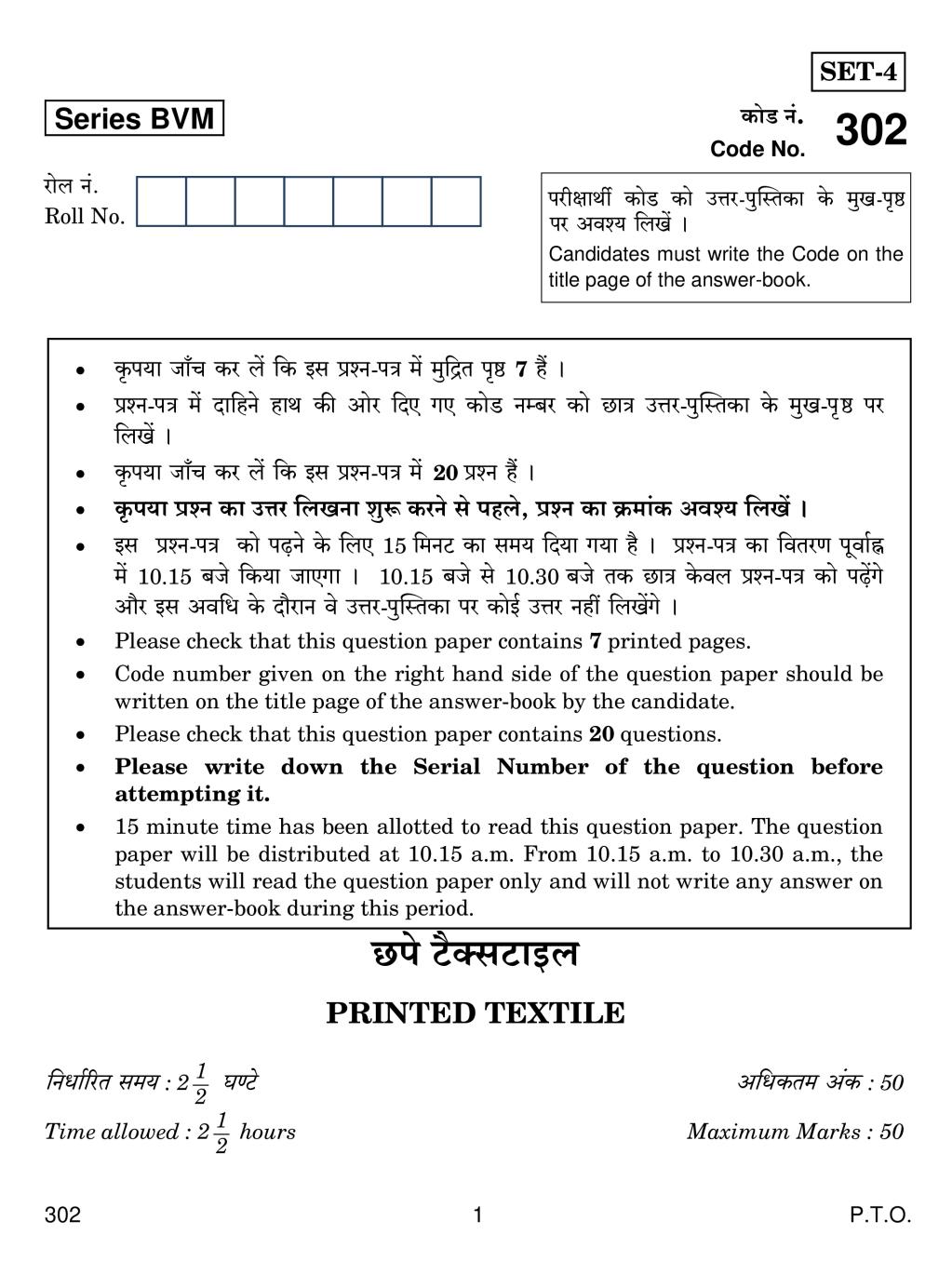
Series BVM H$moS> Z§.
Code No.
302
amob Z§. narjmWu H$moS >H$mo CÎma-nwpñVH$m Ho$ _wI-n¥ð
Roll No. >na Adí` {bIo§ &
Candidates must write the Code on the
title page of the answer-book.
H¥$n`m Om±M H$a b| {H$ Bg àíZ-nÌ _o§ _w{ÐV n¥ð> 7 h¢ &
àíZ-nÌ _| Xm{hZo hmW H$s Amoa {XE JE H$moS >Zå~a H$mo N>mÌ CÎma-nwpñVH$m Ho$ _wI-n¥>ð> na
{bI| &
H¥$n`m Om±M H$a b| {H$ Bg àíZ-nÌ _| >20 àíZ h¢ &
H¥$n`m àíZ H$m CÎma {bIZm ewê$ H$aZo go nhbo, àíZ H$m H«$_m§H$ Adí` {bI| &
Bg àíZ-nÌ H$mo n‹T>Zo Ho$ {bE 15 {_ZQ >H$m g_` {X`m J`m h¡ & àíZ-nÌ H$m {dVaU nydm©•
_| 10.15 ~Oo {H$`m OmEJm & 10.15 ~Oo go 10.30 ~Oo VH$ N>mÌ Ho$db àíZ-nÌ H$mo n‹T>|Jo
Am¡a Bg Ad{Y Ho$ Xm¡amZ do CÎma-nwpñVH$m na H$moB© CÎma Zht {bI|Jo &
Please check that this question paper contains 7 printed pages.
Code number given on the right hand side of the question paper should be
written on the title page of the answer-book by the candidate.
Please check that this question paper contains 20 questions.
Please write down the Serial Number of the question before
attempting it.
15 minute time has been allotted to read this question paper. The question
paper will be distributed at 10.15 a.m. From 10.15 a.m. to 10.30 a.m., the
students will read the question paper only and will not write any answer on
the answer-book during this period.
N>no Q>¡ŠgQ>mBb
PRINTED TEXTILE
{ZYm©[aV g_` : 2 12 KÊQ>o A{YH$V_ A§H$ : 50
1
Time allowed : 2 hours Maximum Marks : 50
2
302 1 P.T.O.
Page 2
(i) Bg àíZ-nÌ _| 20 àíZ em{_b h¢ &
(ii) àíZ-nÌ Xmo IÊS>m| _| {d^m{OV h¡ &
IÊS> A
~hþ{dH$ënr` àíZ /[aº ñWmZ ^[aE /grYo àíZ : Hw$b 12 àíZ em{_b h¢ Omo
1 – 1 A§H$ Ho$ h¢ & BZ_| go {H$Ýht 10 àíZm| Ho$ CÎma Xr{OE &
A{V bKw CÎmar` àíZ : BZ_| Hw$b 7 àíZ em{_b h¢, àË`oH$ 2 A§H$ Ho$ h¢ & BZ_| go
{H$Ýht 5 àíZm| Ho$ CÎma Xr{OE &
bKw CÎmar` àíZ : BZ_| Hw$b 7 àíZ em{_b h¢, àË`oH$ 3 A§H$ Ho$ h¢ & BZ_| go
{H$Ýht 5 àíZm| Ho$ CÎma Xr{OE &
IÊS> ~
XrK© CÎmar` /{Z~ÝYmË_H$ àíZ : BZ_| Hw$b 5 àíZ em{_b h¢, àË`oH$ 5 A§H$ Ho$ h¢ & BZ_|
go {H$Ýht 3 àíZm| Ho$ CÎma Xr{OE &
(iii) Ohm± gå^d hmo, AnZo CÎmam| H$mo {M{ÌV H$s{OE &
General Instructions :
(i) This question paper contains 20 questions.
(ii) Question paper is divided into two sections.
SECTION A
Multiple choice questions / Fill in the blanks/Direct questions :
contains total 12 questions of 1 mark each. Answer any 10 questions.
Very short answer type questions : contains total 7 questions of
2 marks each. Answer any 5 questions.
Short answer type questions : contains total 7 questions of 3 marks
each. Answer any 5 questions.
SECTION B
Long answer / Essay type questions : contains total 5 questions of 5 marks
each. Answer any 3 questions.
(iii) Illustrate your answers wherever possible.
302 2
Page 3
SECTION A
1. [aº$ ñWmZ ^[aE ({H$Ýht Xg ) : 1 10=10
Fill in the blanks (any ten) :
(a) S>m`aoŠQ> qàqQ>J e¡br _| n¥îR>^y{_ Á`mXmVa __________ H$s hmoVr h¡ & 1
The background is mostly __________ in case of the direct style of
printing.
(b) ___________ H$s IoVr Am¡a ~wZmB© nhbr ~ma MrZ _| hþB© Wr & 1
____________ was first cultivated and woven in China.
(c) Xmo g~go Am_ àH$ma Ho$ new qàQ> ___________ Am¡a ____________ h¢ & 1
The two most common kinds of animal prints are __________ and
___________.
(d) ____________ VH$ZrH$ Zo qàQ> {S>µOmBZ Ho$ {dH$mg Ho$ {bE amo_m§MH$ ZB© g§^mdZmE±
àXmZ H$s¨ & 1
____________ technique provided exciting new possibilities for
development of print design.
(e) {b~Q>u {S>µOmBZ AnZm Zm_ ____________,EH$ A§J«oOr H$n‹S>m H§$nZr go boVo h¢ & 1
Liberty designs take their name from _____________, an English
textile company.
(f) _______________ Am¡a bm¡am Eebo O¡go {S>µOmBZa AnZo g§J«h _| ~hþV gmao nwîn
g§~§Yr {S>µOmBZ H$m Cn`moJ H$aVo h¢ & 1
Designers like ____________ and Laura Ashley use a lot of floral
designs in their collections.
(g) EH$ aMZmË_H$ g_yh Omo {H$gr {XE JE joÌ _| ZB© AdYmaUmAm| Am¡a VH$ZrH$m| Ho$
ZdmMma Am¡a AZwà`moJ _| g{H«$` hmoVm h¡ dh ____________ Ho$ ê$n _| OmZm OmVm
h¡ & 1
A creative group active in the innovation and application of new
concepts and techniques in a given field is known as _____________.
302 3 P.T.O.
Page 4
`m OmZda h¢ {OZ_| H$hmZr H$m g§Ho$V h¡ & 1
The beauty of __________ prints lies in the fact that they have
human figures or animals with a hint of story in it.
(i) _______________, 1910 Ho$ Amg-nmg BQ>br _| EH$ H$bmË_H$ Am§XmobZ Wm
{OgZo _erZ `wJ H$s D$Om© Am¡a _yë`m| H$mo ì`º$ H$aZo H$s H$mo{ee H$s Wr & 1
_____________, is an artistic movement in Italy around 1910 that
tried to express the energy and values of the machine age.
(j) ~m{Q>H$ Am¡a Q>mB©-S>mB© qàqQ>J ______________ e¡br Ho$ CXmhaU h¢ & 1
Batik and tie and dye are examples of the ____________ style of
printing.
(k) _w{ÐV dñÌ {S>µOmBZ H$m B{Vhmg ____________ ~r.gr. Ho$ Ama§^ go {XZm§{H$V h¡ & 1
The history of printed textile design is dated as early as
_____________ B.C.
(l) _w{ÐV n¡MdH©$ H$mo _______________ ^r H$hm OmVm h¡ & 1
Printed patchwork is also called a ______________.
{H$Ýht nm±M àíZm| (à. 2 8) Ho$ ~hþV g§{jßV CÎma {b{IE : 2 5=10
Write very short answers of any five questions (Q. 2 8) :
2. {H$Ýht Xmo à{gÕ H$bmH$mam| Ho$ Zm_ Xr{OE {OÝhm|Zo _w{ÐV dñÌ V¡`ma {H$E Wo & 2
Name any two well-known fine artists who have designed printed
textiles.
3. ñQ>|{gb qàqQ>J Ho$ {H$Ýht Xmo ZwH$gmZm| H$mo gyMr~Õ H$s{OE & 2
List any two disadvantages of stencil printing.
4. H$n‹S>m CÚmoJ _| ‘H$b[añQ>’ H$s Š`m ^y{_H$m h¡ ? 2
What is the role of ‘Colorist’ in textile industry ?
302 4
Page 5
List the motifs used in nautical prints.
6. ‘dñÌ _wÐU>’ Š`m h¡ ? _wÐU H$s Xmo g~go nwamZr e¡{b`m| Ho$ Zm_ Xr{OE & 2
What is ‘Textile printing’ ? Name the two oldest styles of printing.
7. H$m¡Z-H$m¡Z gr {d{^Þ àH$ma H$s g§X^© gm_{J«`m± CnbãY h¢ Omo {S>µOmBZa BñVo_mb H$a gH$Vo
h¢ ? 2
What are the different types of reference materials available that a
designer can refer to ?
8. {S>{µOQ>b qàqQ>J {S>µOmBZam| _| bmoH${à` Š`m| h¡ ? 2
Why is digital printing popular with designers ?
{H$Ýht nm±M àíZm| (à. 9 15) Ho$ àË`oH$ 50 – 70 eãXm| _| g§{jßV CÎma {b{IE & 3 5=15
Write short answers of any five questions (Q. 915) in 50 – 70 words each.
9. bmoH${à` [anrQ> H$m Zm_ Xr{OE {OZH$mo {XbMñn n¡Q>{ZªJ àmßV H$aZo Ho$ {bE EH$ gmW
{db` {H$`m Om gH$Vm h¡ & 3
Name the popular repeats that can be merged together to achieve
interesting patterning.
10. ‘n¡MdH©$>’ Š`m h¡ ? {H$Ýht VrZ Am_ n¡MdH©$ ãbm°H$ Zm_m| Ho$ Zm_ Xr{OE & 3
What is ‘Patchwork’ ? Name any three common patchwork block names.
11. ñH«$sZ qàqQ>J Ho$ \$m`Xo Am¡a ZwH$gmZ Š`m h¢ ? 3
What are the advantages and disadvantages of screen printing ?
12. new qàQ> Ho$ {d{^Þ Cn`moJm| H$s gyMr ~ZmBE & new qàQ> H$s {H$Ýht Xmo A{ÛVr` {deofVmAm|
H$m CëboI H$s{OE & 3
List the various end uses of animal prints. Mention any two unique
characteristics of animal prints.
302 5 P.T.O.
Page 6
Explain the process of roller printing.
14. {S>µOmBZa Š`m H$aVm h¡ ? {S>µOmBZa Ho$ {bE Amdí`H$ VrZ H$m¡eb Š`m h¢ ? 3
What does a designer do ? What are the three skills required by the
designer ?
15. \$m°Bb qàqQ>J _| \$m°Bb nona H$m Cn`moJ H¡$go {H$`m OmVm h¡ ? 3
How is foil paper used in foil printing ?
IÊS> ~
SECTION B
{H$Ýht VrZ àíZm| (à. 16 20) Ho$ àË`oH$ 100 – 150 eãXm| _| {dñV¥V CÎma {b{IE : 5 3=15
Write descriptive answers of any three questions (Q. 16 20) in 100 – 150
words each :
16. qàqQ>J H$s ao{gñQ> Am¡a {S>ñMmO© e¡br Ho$ ~rM A§Va ñnîQ> H$s{OE & 5
Distinguish between the resist and discharge style of printing.
17. {ZåZ{b{IV _| go {H$Ýht Xmo na CZH$s _w»` {deofVmAm|, à`wº$ àmê$nm| (_mo{Q>\$) Am¡a
{d{^Þ Cn`moJm| H$mo COmJa H$aVo hþE EH$ g§{jßV ZmoQ> {b{IE : 5
(a) pñH«$ßQ> qàQ²>g
(b) ~moQ>¡{ZH$b qàQ²>g
(c) Amo[aE§Q>b qàQ²>g
Write a short note on any two of the following highlighting their key
characteristics, motifs used and the various end uses :
(a) Script prints
(b) Botanical prints
(c) Oriental prints
302 6
Page 7
Explain the transfer printing process in detail.
19. Á`m{_Vr` qàQ>m| H$s {dñVma go ì`m»`m H$s{OE & 5
Explain the geometric prints in detail.
20. qàqQ>J _| {deof à^md {H$Z {d{^Þ VarH$m| go àmßV {H$E Om gH$Vo h¢ ? {H$Ýht Xmo VarH$m| H$s
ì`m»`m H$s{OE & 5
What are the different ways in which special effects in printing can be
achieved ? Explain any two methods.
302 7 P.T.O.
Document Details
| Board / Org | CBSE |
| Exam | Class 12 |
| Type | Question Paper |
| Pages | 7 |
| Updated | 30 Apr 2026 |