Manipur Board Class 11 Syllabus 2027 Chemistry
Finished viewing? Save it for later —
Download Manipur Board Class 11 Syllabus 2027 Chemistry (PDF · 8 pages)About Manipur Board Class 11 Syllabus 2027 Chemistry
Manipur Board Class 11 Syllabus 2027 Chemistry is available here for free download. Published by Manipur Board for Class 11, this syllabus can be viewed online or downloaded as a PDF (8 pages). Candidates preparing for Class 11 can use Manipur Board Class 11 Syllabus 2027 Chemistry to understand the exam pattern, the type of questions asked, and the overall difficulty level.
Frequently Asked Questions
How can I download Manipur Board Class 11 Syllabus 2027 Chemistry?
Open this page and click the Download button to save Manipur Board Class 11 Syllabus 2027 Chemistry as a PDF. It is completely free on AglaSem Docs.
Is Manipur Board Class 11 Syllabus 2027 Chemistry free to download?
Yes. Manipur Board Class 11 Syllabus 2027 Chemistry can be viewed online and downloaded as a PDF free of cost on AglaSem Docs.
How many pages does Manipur Board Class 11 Syllabus 2027 Chemistry have?
Manipur Board Class 11 Syllabus 2027 Chemistry contains 8 pages, which you can read online or download together as a single PDF.
Where can I find more Class 11 study material?
You can find more Class 11 question papers, sample papers, syllabus, and answer keys on AglaSem Docs.
Manipur Board Class 11 Syllabus 2027 Chemistry – Text
Read the full text of this syllabus below — useful to quickly search, copy and reference the content online without downloading the PDF.
📄 View text version (9 pages)
Page 1
Manipur Board Class
11 Syllabus 2027
Chemistry
EXAM YEAR TYPE SUBJECT
Manipur Class 11 2027 Syllabus Chemistry
Notes · Sample Papers · Previous Year Papers · Mock Tests
Page 2
m .co
m .co s e m
se g l a
a
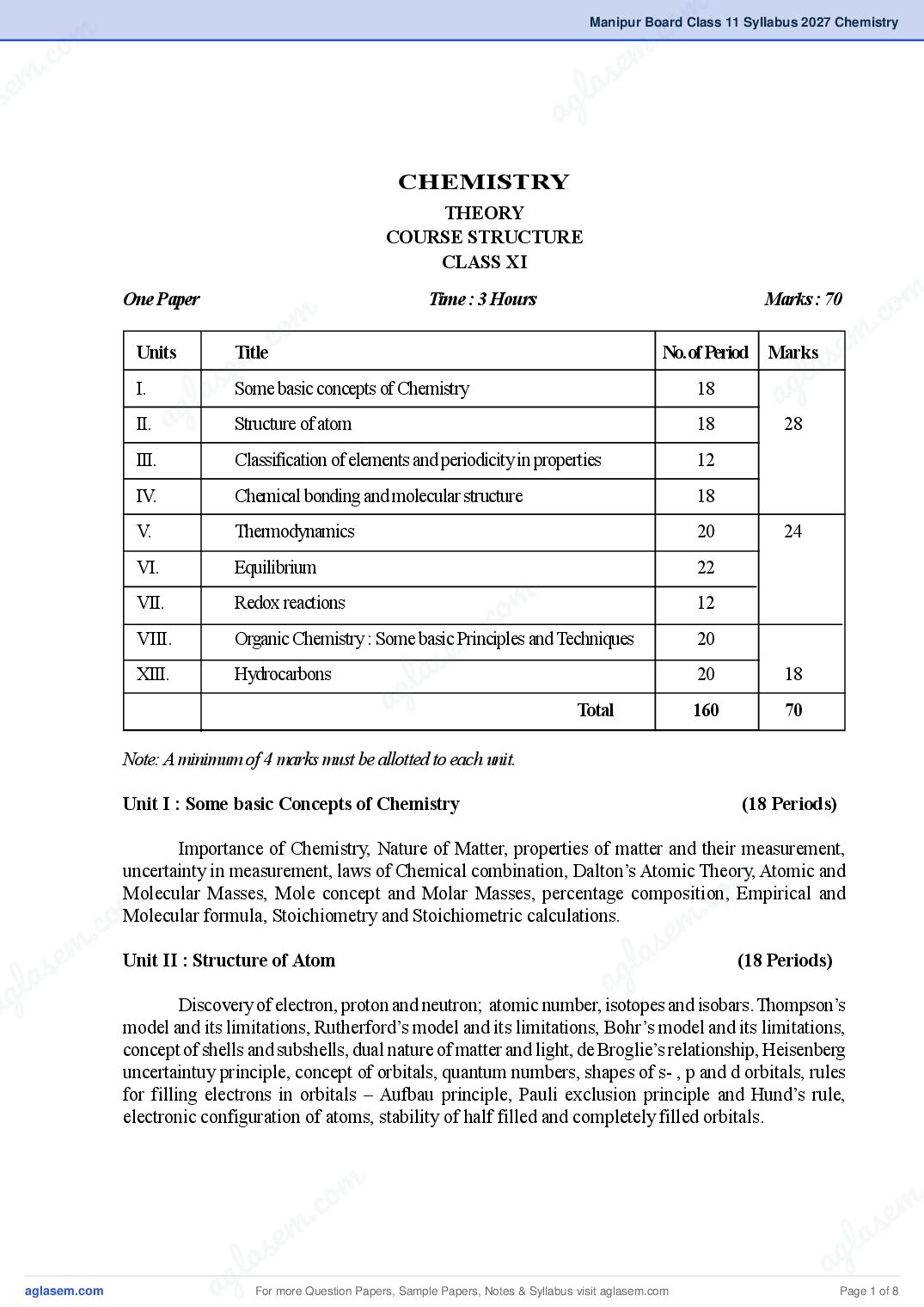
CHEMISTRY
THEORY
COURSE STRUCTURE
CLASS XI
m
.co
One Paper Time : 3 Hours Marks : 70
o m m
Title.
c s e
Units
e m No. of Period Marks
l a
I.
l as Some basic concepts of Chemistry 18
ag
II. a
g Structure of atom 18 28
III. Classification of elements and periodicity in properties 12
IV. Chemical bonding and molecular structure 18
V. Thermodynamics 20 24
VI. Equilibrium 22
VII. Redox reactions
o m 12
c
. and Techniques
VIII. m
Organic Chemistry : Some basic Principles
e 20
XIII. Hydrocarbons
la s 20 18
ag Total 160 70
Note: A minimum of 4 marks must be allotted to each unit.
Unit I : Some basic Concepts of Chemistry (18 Periods)
Importance of Chemistry, Nature of Matter, properties of matter and their measurement,
uncertainty in measurement, laws of Chemical combination, Dalton’s Atomic Theory, Atomic and
m
Molecular Masses, Mole concept and Molar Masses, percentage composition, Empirical and
m .co
.co m
Molecular formula, Stoichiometry and Stoichiometric calculations.
s e
s em Unit II : Structure of Atom g l a (18 Periods)
g la a
a Discovery of electron, proton and neutron; atomic number, isotopes and isobars. Thompson’s
model and its limitations, Rutherford’s model and its limitations, Bohr’s model and its limitations,
concept of shells and subshells, dual nature of matter and light, de Broglie’s relationship, Heisenberg
uncertaintuy principle, concept of orbitals, quantum numbers, shapes of s- , p and d orbitals, rules
for filling electrons in orbitals – Aufbau principle, Pauli exclusion principle and Hund’s rule,
electronic configuration of atoms, stability of half filled and completely filled orbitals.
m .
.co s e m
s em l a
g la ag
a For more Question Papers, Sample Papers, Notes & Syllabus visit Page 1 of 8
Page 3
Why do we need to classify elements ? Genesis of periodic classification, Modern Periodic
Law and the present form of the perioidic Table, nomenclature of elements with Atomic Number>100,
Electronic configurations of elements and the periodic table, Electronic configuration and types of
elements , s-, p-d-f- Blocks, Periodic Trends in Properties of Elements – atomic radii , ionic radii,
A ionization enthalpy electron gain enthalpy, electronetivity, periodic trends in chemical properties.
Unit IV : Chemical Bonding and Molecular Structure. (18 periods)
Kossel – Lewis Approach to Chemical Bonding, Ionic or Electrovalent Bond, Covalent
bond, Bond parameters, Polarity of bonds, The Valence shell Electron Pair Repulsion (VSEPR)
Theory, Valence Bond Theory, Hybridisation, Molecular Orbital Theory, Bonding in some
Homonuclear Diatomic molecules, hydrogen Bonding.
Unit V : Thermodynamics (20 periods)
Thermodynamic Terms, Applications, First law of thermodynamics, Heat capacity,
Relationship between Cp and Cv, Measurement of U and H, Calorimetry, Enthalpy change, rH
of a Reaction-Reaction Enthalpy, Enthalpies for different types of reactions, Entropy, Spontaneity,
Gibbs energy change and equilibrium, Third law of thermodynamics (brief introduction).
Unit –VI : Equilibrium (22 periods)
Equilibrium in physical processes, equilibrium in chemical processes – Dynamic
Equilibrium, Law of Chemical Equilibrium and Equilibrium constant, Homogenous Equilibria,
Heterogeneous Equilibria, Application of Equilibrium constants, Relationship between Equilibrium
constant K, Reaction Quotient Q and Gibbs Energy G, Factors Affecting Equilibria Ionic Equilibrium
in solution, Acids, Bases and salts, Ionization of Acids and Bases, Hydrolysis of salts and pH of
their solutions, buffer solutioins, Handerson - Hasselbalch equation, solubility Equilibria of sparingly
soluble salts common ion effect.
Unit – VII : Redox Reactions (12 periods)
Classical idea of Redox reactions – Oxidation and Reduction Reactions, Redox Reactions
in terms of Electron Transfer, Oxidation Number, Balancing redox reactions, Redox Reactions and
Electrode Processes.
For more Question Papers, Sample Papers, Notes & Syllabus visit Page 2 of 8
Page 4
m .co
m .co s e m
se g l a
a
Unit – VIII : Organic Chemistry – some basic principles and Techniques. ( 20 periods)
General Introduction, Tetra valance of carbon : shapes of organic compounds, structural
representations of organic compounds, classification of organic compounds, Nomenclature of organic
compounds, Isomerism, Fundamental concepts in organic Reaction Mechanism, Methods of m
m
purification of organic compounds, Qualitative Analysis of organic compounds, Quantitative .co
Analysis.
.co s e m
s em l a
g
Unit –IX l:aHydrocarbons ag
( 20 periods)
a
General introduction, classification of Hydrocarbons.
Alkanes- Nomenclature, isomerism, conformations (ethane only), Preparations, Physical
properties, chemical reactions including free radical mechanism of halogenations, combustion and
pyrolysis.
Alkenes Nomenclature, structure of double bond (ethene) geometrical isomerism, physical
properties, methods of preparation; chemical reactions : addition of hydrogen, halogen, water,
m
.co
hydrogen halides (Markovnikov’s addition and peroxide effect), ozonolysis, oxidation, mechanism
of electrophilic addition.
e m
s
Alkynes – Nomenclature, structure of triple bond (ethyne), physical properties, methods of
la
halogens, hydrogen halides and water. ag
preparation, chemical reactions : acidic character of alkynes, addition reaction of – hydrogen,
Aromatic hydrocarbons – Introduction, IUPAC nomenclature; Benzne,: resonance,
aromaticity; chemical properties: mechanism of electrophilic substitution – nitration sulphonation,
halogenations, Friedel Craft’s alkylation and acylation; directive influence of functional group in
mono-substituted benzene; carcinogenicity and toxicity.
m
m .co
m .co s e m
s e g l a
g la a
a
m .
.co s e m
s em l a
g la ag
a For more Question Papers, Sample Papers, Notes & Syllabus visit Page 3 of 8
Page 5
PRACTICALS
CLASS- XI
Evaluation scheme for Examination Marks
A Volumetric Analysis 8
B Salt Analysis 8
C Content Based Experiment 5
D Project Report 5
E Class Record 2
F Viva Voce 2
Total = 30
A . Quantitative estimation (18 Periods)
Using a chemical balance
Preparation of Standard solution of oxalic acid.
Determination of strength of a given solution of sodium hydroxide by titrating it against
standard solution of oxalic acid.
Preparation of Standard solution of sodium carbonate.
Determination of strength of a given solution of hydrochloric acid by titrating it against
standard solution of sodium carbonate.
B. Qualitative analysis (18 Periods)
Determination of one cation and one anion in a given salt
Cations : Pb+2, Cu+2, As3+, Fe3+, Mn2+, Ni2+, Zn2+, Co2+, Ca2+, Sr2+, Ba2+, Mg2+, NH4+
Anions : CO32-, S2-, SO32- , SO42-, NO2- , NO3-, Cl-, Br-, I-, PO43-, C2O42-, CH3COO-
(Note : Insoluble salts Excluded)
C. Content based experiment
(i) Basic Laboratory Technique : (3 Periods)
1. Cutting glass tube and glass rod
2. Bending a glass tube
3. Drawing out a glass jet
4. Boring a cork
(ii) Characterization and Purification of Chemical Substances: (7 Periods)
1. Determination of melting point of an organic compound.
2. Determination of boiling point of an organic compound.
For more Question Papers, Sample Papers, Notes & Syllabus visit Page 4 of 8
Page 6
m .co
m .co s e m
se g l a
a
3. Crystallization of impure sample of any one of the following:
Alum, Copper sulphate, Benzoic acid
(iii) Experiments related to pH change (7 Periods)
(a) Any one of the following experiments:
m
.co
Determination of pH of some solutions obtained from fruit juices, varied
m
.co
concentrations of acids, bases and salts using pH paper or universal indicator.
e m
Comparing the pH of solutions of strong and weak acids of same concentration.
em Study of the pH change in titration of a strong base using universal indicator.
l as
l as a gbases.
ag (b) Study of pH change by common ion effect in case of weak acids and weak
(iv) Chemical equilibrium (5 Periods)
One of the experiments:
(a) Study of the shift in equilibrium between ferric ions and thiocyanate ions by
increasing/decreasing the concentration of either of the ions.
(b) Study in the shift in equilibrium between [Co(H2O)6]2+ and chloride ion by
changing the concentration of either of the ions.
m
.co
(v) Detection of nitrogen, sulphur, chlorine (12 Periods)
D. PROJECTS s em
g la testing and collecting information from other sources.
A few suggested Projects
a
Scientific investigations involving laboratory
• Checking the bacterial contamination in drinking water by testing sulphide ion
• Study of the methods of purification of water
• Testing the hardness, presence of Iron, Fluoride, Chloride, etc., depending upon the regional
variation in drinking water and study of causes of presence of these ions above permissible
limit (if any).
m
.co
• Investigation of the foaming capacity of different washing soaps and the effect of addition
m
.co m
of Sodium carbonate on it • Study the acidity of different samples of tea leaves.
m s e
s e •
a
Determination of the rate of evaporation of different liquids Study the effect of acids and
g l
g la bases on the tensile strength of fibers.
a
a • Study of acidity of fruit and vegetable juices.
Note: Any other investigatory project, which involves about 10 periods of work, can be
chosen with the approval of the teacher.
E. Class record
F. Viva voce.
m .
.co s e m
s em l a
g la ag
a For more Question Papers, Sample Papers, Notes & Syllabus visit Page 5 of 8
Page 7
1. Chemistry Part - I
Textbook for Class-XI.
Published by : NCERT, New Delhi.
2. Chemistry Part - II
Textbook for Class-XI.
Published by : NCERT, New Delhi.
REFERENCE BOOK :
1. Pradeep’s New Course Chemistry (Vol- I & II) for Class XI
By : S.C. Kheterpal, S.N. Dhawan & P.N. Kapil
Published by : Pradeep Publications, Jalandhar.
2. Dinesh Companion Chemistry for Class XI (Vol- I & II)
By : S.K. Malhotra
Published by : S. Dinesh & Co., Jalandhar City.\
3. Saraswati Lab Manual Chemistry for Class XI (NCF 2023 Aligned)
By : R.P. Manchanda.
Published by : New Saraswati House (India) Pvt. Ltd., New Delhi - 110002
4. Comprehensive Practical Chemistry for Class XI (New Edition)
By : Dr. N.K. Verma, Dr B.K. Vermani and Dr. Neera Verma
Published by : Laxmi Publications (P) Ltd., New Delhi - 110 002.
5. A Textbook of Practical Chemistry for Class XI
By : Dr. N. Nila Singh and Dr. K. Nabachandra Singh
Published by : Writer’s Book Store, Paona Bazar, Imphal
*****
For more Question Papers, Sample Papers, Notes & Syllabus visit Page 6 of 8
Page 8
m .co
m .co s e m
se g l a
a
DESIGN OF
QUESTION PAPER
Subject : CHEMISTRY
Paper : Theory
Class : XI
Time : 3 hours m
c o m
WEIGHTAGE TO OBJECTIVES:
Full Marks : 70
m .co
Objectives . s e
em
Marks Percentage
s l a
ag
Knowledge(K) 10 15
I
g la
Understanding(U) 35 50
a
Application(A)
Including Analysis, Synthesis and Evaluation
21 30
Skill(S) 4 5
Total: 70 100
WEIGHTAGE TO FORMS OF QUESTIONS:
Forms of Questions No. of Question Time (in minute) Marks Percentage
Essay/Long Answer(E/LA) 3 60 15 21
II Short Answer (SA-I) 6 37 18 26
Short Answer (SA-II) 10 40 20 29
Very Short Answer (VSA) 7 21 m 07 10
MCQ
Total:
10
36 m .co
22
180
10
70
14
100
WEIGHTAGE TO CONTENT: s e
g la
UNITS/CONTENTS: Marks
1 Some basic concepts of chemistry
2 Structure of atom
a
III 3 Classification of Elements and Periodicity in properties 28
4 Chemical bonding and Molecular structure
5 Thermodynamics
6 Equilibrium
24
7 Redox reactions
8 Organic Chemistry: Some basic Principles and Techniques
9 Hydrocarbons 18
m
.co
Total: 70
m
.co
Note: A minimum of 4 marks must be allotted to each unit
IV SCHEME OF SECTIONS: Nil
e m
e m V SCHEME OF OPTIONS:
l as
las 1. Internal option will be given in Essay Type Question.
ag
ag 2. Internal option will be given in three questions of SA-I including one case-study based question.
VI DIFFICULTY LEVEL :
Difficult : 35% of the total marks
Average : 50% of the total marks
Easy :15% of the total marks
Abbreviation: K(Knowledge), U(Understanding), A(Application), C(Comprehension), Exp.(Expression),
S(Skill), E(Essay Type), SA(Short Answer Type), VSA(Very Short Answer Type), MCQ
(Multiple Choice Question)
NOTE- (i) Two questions out of 10 (ten) questions of MCQ will be assertion & reason type question.
m
(ii) Only one question of SA-I will be Case Study based question.
.
.co s e m
s em l a
g la ag
a For more Question Papers, Sample Papers, Notes & Syllabus visit Page 7 of 8
Page 9
QUESTION PAPER
Subject: CHEMISTRY
Paper: Practical (One Paper)
Class: XI
Time: 3 hours
Full Marks: 30
Skill to be tested
Sl. Form of Related Estimated
Nature of Exercise Manipulative Observational Drawing Reporting Total
No. Exercise Under- Time
Skill Skill Skill Skill Marks
standing (Mins.)
1 Category A Quantitative Estimation 1 3 0 2 2 8 45
2 Category B Qualitative Analysis 1 1 0 4 2 8 90
Any one of the
Experiments in the
category C of the syllabus
may be given
Eg.
Basic Laboratory
techniques:
Cutting and Rounding,
Bending, Drawing out of
jet of glass tubes, Boring
of cokes; 1 1 0 2 1
Or,
Characterization and
purification of Chemical
3 Category C Substances; 1 1 0 2 1
Or, 5 30
Determination of melting
point, boiling point,
1 1 0 2 1
Crystallization etc.;
Or,
Experiments related to pH
determination of 1 1 0 2 1
solutions;
Or,
Experiments on
equilibrium ionic
reactions; 1 1 0 2 1
A report on scientific
investigations involving
laboratory testing and 1 1 0 2 1
collecting information
4 Project Work from other sources in one 5
of the areas suggested in
syllabus or any other 15
innovative topic should be
submitted.
5 Class record 2
6 Viva Voce 2
TOTAL 30 180
For more Question Papers, Sample Papers, Notes & Syllabus visit Page 8 of 8
Document Details
| Board / Org | Manipur Board |
| Exam | Class 11 |
| Type | Syllabus |
| Pages | 8 |
| Updated | 04 Nov 2026 |